Presentor : Dr. Siddharth Singh,
Junior Resident,
Department of Community Medicine,
Institute of Medical Sciences, Banaras Hindu University
Climate Change : The New Reality
Presentor : Dr. Siddharth Singh,
Junior Resident,
Department of Community Medicine,
Institute of Medical Sciences, Banaras Hindu University
Climate Change : The New Reality
Global warming!
Climate Crisis!
Greenhouse effect!
Pollution!
Extreme weather!
Glacier melting!
Heat wave!
Green House
What is Climate Change?
“Climate change refers to long-term shifts in temperatures
and weather patterns.”
- UN Climate Change
“Climate change describes the ongoing increase in global
average temperature and its impacts on Earth's climate system.”
- Intergovernmental Panel on Climate Change (IPCC)
The definition seems incomplete….
Are we hiding something?🤔
“Climate change refers to long-term shifts in
temperatures and weather patterns.”
These shifts may be natural, such as through variations
in the solar cycle. But since the 1800s, human activities
have been the main driver of climate change, primarily
due to burning fossil fuels like coal, oil and gas.
- UN Climate Change
Climate Change is natural ?
•Remember this guy??? •Sorry…
•Only the former exists because of “natural” climate change.
History of Climate Change
Theophrastus, Ancient Greek philosopher in the 4th century BC
The draining of marshes had
made a particular locality more
susceptible to freezing, and
speculated that lands became
warmer when the clearing of
forests exposed them to
sunlight.
History of Climate Change
Renaissance period European thinkers (1400s)
“Deforestation, Irrigation,
and Grazing had altered the lands
around the Mediterranean since
ancient times; they thought it plausible
that these human interventions had
affected the local weather.”
History of Climate Change
Eunice Newton Foote in 1856
•“Warming effect of the sun is
greater for air with water vapour
than for dry air, and the effect is
even greater with carbon dioxide.”
•Demonstrated the “Green House
Effect”.
History of Climate Change
Paul R. Ehrlich in 1960
By the 1960s, aerosol pollution
("smog") had become a serious local
problem in many cities, and some
scientists began to consider whether
the cooling effect
of particulate pollution could affect
global temperatures.
History of Climate Change
J. Murray Mitchell in 1963
•He presented one of the first up-to-date
temperature reconstructionsIn his
presentation, Murray showed that,
beginning in 1880, global temperatures
increased steadily until 1940.
•After that, a multi-decade cooling trend
emerged. Murray's work contributed to the
overall acceptance of a possible global
cooling trend.
History of Climate Change
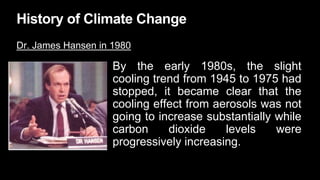
Dr. James Hansen in 1980
By the early 1980s, the slight
cooling trend from 1945 to 1975 had
stopped, it became clear that the
cooling effect from aerosols was not
going to increase substantially while
carbon dioxide levels were
progressively increasing.
History of Climate Change
1980 to Present
The 1980s saw important
breakthroughs with regard to global
environmental challenges.
Ozone depletion was mitigated by
the Vienna Convention (1985) and
the Montreal Protocol (1987).
History of Climate Change
•In 1988, the WMO established
the Intergovernmental Panel on
Climate Change with the support of
the UNEP.
•The IPCC continues its work
through the present day, and
issues a series of Assessment
Reports and supplemental reports.
What basically causes Climate Change?
•Burning fossil fuels, cutting down forests and farming
livestock are increasingly influencing the climate and
the earth’s temperature.
•This adds enormous amounts of greenhouse gases to
those naturally occurring in the atmosphere,
increasing the greenhouse effect and global warming.
Greenhouse Effect
•The main driver of climate change is the greenhouse
effect.
•Some gases in the Earth's atmosphere act a bit like
the glass in a greenhouse, trapping the sun's heat and
stopping it from leaking back into space and causing
global warming.
Greenhouse Effect
Many of these greenhouse gases occur naturally, but
human activities are increasing the concentrations of
some of them in the atmosphere, in particular:
• carbon dioxide (CO2)
• methane
• nitrous oxide
• fluorinated gases
Greenhouse Effect
•CO2 produced by human activities is the largest
contributor to global warming.
•By 2020, its concentration in the atmosphere had risen
to 48% above its pre-industrial level (before 1750).
Annual CO2 Emission Worldwide
Greenhouse Effect
•Natural causes, such as changes in solar radiation or
volcanic activity are estimated to have contributed less
than plus or minus 0.1°C to total warming between
1890 and 2010.
Global Warming
•2011-2020 was the warmest decade recorded, with
global average temperature reaching 1.1°C above pre-
industrial levels in 2019. Human-induced global
warming is presently increasing at a rate of 0.2°C per
decade.
Global Warming
•An increase of 2°C compared to the temperature in
pre-industrial times is associated with serious negative
impacts on to the natural environment and human
health and wellbeing, including a much higher risk that
dangerous and possibly catastrophic changes in the
global environment will occur.
Global Warming
•For this reason, the international community has
recognised the need to keep warming well below 2°C
and pursue efforts to limit it to 1.5°C.
Global Average Surface Temperature
Is it climate change or global warming?
• The two terms are sometimes used interchangeably.
• Scientifically, global warming refers only to increased
surface warming, and climate change describes the full
effect of greenhouse gases on Earth's climate system.
• Since the 2000s, climate change has increased in
usage. Climate change can also refer more broadly to
both human-caused changes or natural
changes throughout Earth's history.
Why should we worry about Climate
Change?
Why should we worry about Climate
Change?
•The impacts of climate change on different
sectors of society are interrelated.
•Climate change impacts are uneven across
the country and the world — even within a
single community, climate change impacts
can differ between neighbourhoods or
individuals.
Why should we worry about Climate
Change?
•Long-standing socioeconomic inequities can
make underserved groups, who often have the
highest exposure to hazards and the fewest
resources to respond, more vulnerable.
•The Intergovernmental Panel on Climate Change
(IPCC) has concluded that to avert catastrophic health
impacts and prevent millions of climate change-related
deaths, the world must limit temperature rise to 1.5°C.
•Global heating of even 1.5°C is not considered safe,
however; every additional tenth of a degree of warming
will take a serious toll on people’s lives and health.
Why should we worry about Climate
Change?
Why should we worry about Climate
Change?
Water
Environment
Health
Infrastructure
Food
Water
•Flooding is an increasing issue as our climate is
changing. Compared to the beginning of the 20th
century, there are both stronger and more frequent
abnormally heavy precipitation events across most of
the India.
Water
•Conversely, drought is also becoming more common,
particularly in the Western part of the country.
•Humans are using more water, especially for
agriculture. Much like we sweat more when it is hot
out, higher air temperatures cause plants to lose,
or transpire, more water, meaning farmers must give
them more water.
Why should we worry about Climate
Change?
Water
Environment
Health
Infrastructure
Food
Food
•Our food supply depends on climate and weather
conditions. Although farmers and researchers may be
able to adapt some agricultural techniques and
technologies or develop new ones, some changes will
be difficult to manage.
Food
•Increased temperatures, drought and water stress,
diseases, and weather extremes create challenges for
the farmers who put food on our tables.
•Human farm workers can suffer from heat-related
health issues, like exhaustion, heatstroke, and heart
attacks. Rising temperatures and heat stress can also
harm livestock.
Why should we worry about Climate
Change?
Water
Environment
Health
Infrastructure
Food
Infrastructure
•Extreme weather events that bring heavy rains, floods,
wind, snow, or temperature changes can stress
existing structures and facilities.
•Increased temperatures require more indoor cooling,
which can put stress on an energy grid.
Infrastructure
•A large population lives in coastal counties, meaning
millions of people will be impacted by sea level
rise. Coastal infrastructure, such as roads, bridges,
water supplies, and much more, is at risk. Sea level
rise can also lead to coastal erosion and high-tide
flooding.
•Some communities are projected to possibly end up at
or below sea level by 2100.
Energy-related carbon dioxide emissions worldwide from 1975 to 2021
Weather catastrophe economic losses globally from 2007 to 2021
(in billion U.S. dollars)
Why should we worry about Climate
Change?
Water
Environment
Health
Infrastructure
Food
Environment
•Some living things are able to respond to climate
change; some plants are blooming earlier and some
species may expand their geographic range.
•Changes are also occurring in the ocean. The ocean
absorbs about 30% of the carbon dioxide that is
released into the atmosphere from the burning of
fossil fuels. As a result, the water is becoming more
acidic, affecting marine life.
Environment
•Sea levels are rising due to thermal expansion, in
addition to melting ice sheets and glaciers, putting
coastal areas at greater risk of erosion and storm
surge.
Why should we worry about Climate
Change?
Water
Environment
Health
Infrastructure
Food
Health
•Climate change is already impacting human health. Changes
in weather and climate patterns can put lives at risk.
•Heat is one of the most deadly weather phenomena.
•As ocean temperatures rise, hurricanes are getting stronger
and wetter, which can cause direct and indirect deaths.
Health
•Dry conditions lead to more wildfires, which bring
many health risks.
•Higher incidences of flooding can lead to the spread of
waterborne diseases, injuries, and chemical hazards.
•As geographic ranges of mosquitoes and ticks expand,
they can carry diseases to new locations.
Health
•The most vulnerable groups, including children, the
elderly, people with preexisting health conditions, outdoor
workers and people with low income, are at an even
higher risk because of the compounding factors from
climate change.
Health
•Between 2030 and 2050, climate change is
expected to cause approximately 2,50,000
additional deaths per year, from malnutrition,
malaria, diarrhoea and heat stress.
•The direct damage costs to health (i.e. excluding
costs in health-determining sectors such as
agriculture and water and sanitation), is estimated
to be between USD 2-4 billion/yr by 2030.
Health
•Areas with weak health infrastructure – mostly in
developing countries – will be the least able to
cope without assistance to prepare and respond.
•Reducing emissions of greenhouse gases through
better transport, food and energy-use choices can
result in improved health, particularly through
reduced air pollution.
How does climate change affect
health?
Climate Change Vulnerability
•UNGA’s comprehensive definition includes “the
conditions determined by physical, social,
economic and environmental factors or
processes, which increase the susceptibility of
an individual, a community, assets or systems
to the impacts of hazards”.
Climate Change Vulnerability
•Climate change stress and shocks may increase
vulnerability over time, by also impacting on
other social, environmental and economic
factors.
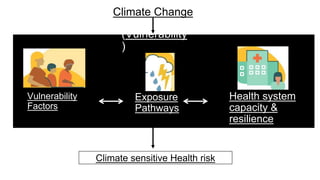
Vulnerability
Factors
Exposure
Pathways
Health system
capacity &
resilience
Climate sensitive Health risk
Climate Change
(Vulnerability
)
Exposure Pathways:-
Extreme weather events
Heat stress
Air Quality
Water quality and
quantity
Food security and safety
Vector distribution and
ecology
Vulnerability
Factors
Exposure
Pathways
Health system
capacity &
resilience
Climate sensitive Health risk
Climate Change
(Vulnerability
)
Vulnerability Factors:-
Demographic factors
Geographic factors
Biological factors &
health status
Sociopolitical conditions
Socioeconomic factors
Vulnerability
Factors
Exposure
Pathways
Health system
capacity &
resilience
Climate sensitive Health risk
Climate Change
(Vulnerability
)
Health system capacity &
resilience:-
Leadership & governance
Health workforce
Health information systems
Essential medical products &
technologies
Service delivery
Financing
Vulnerability
Factors
Exposure
Pathways
Health system
capacity &
resilience
Climate Change
(Vulnerability
)
Climate sensitive
Health risk
Climate sensitive
Health risk
Few New Terms:
•Climate Hazard : The event causing the damage.
•Climate Sensitive Disease : Infectious Disease
•Climate Sensitive Health outcome :
Noncommunicable Diseases and Unintentional
Outcomes
•Possible exposure pathways : The route of
causation of harm.
CLIMATE-SENSITIVE DISEASES:-
Waterborne diseases
Vector borne diseases
Zoonotic diseases
Food borne diseases
Airborne diseases
CLIMATE-SENSITIVE HEALTH
OUTCOMES:-
Cardiovascular diseases
chronic respiratory diseases
protein-energy malnutrition
(adverse nutritional effects causing
childhood stunting)
POSSIBLE EXPOSURE PATHWAYS :-
Changed weather patterns;
accelerated survival, growth, virulence
and transmission of certain pathogens;
heat exposure;
increased biological hazards;
changes in vector habitat
increased food insecurity
CLIMATE-SENSITIVE
DISEASES:-
Water and food-borne diseases;
vector borne diseases;
zoonotic diseases;
acute respiratory infections
eye and skin infections;
CLIMATE-SENSITIVE HEALTH
OUTCOMES:-
Deaths;
drowning;
physical traumas;
hypothermia;
animal bites;
heart attack); chronic respiratory diseases (asthma, COPD, respiratory allergies); venomous animal bites (snakes, scorpions);
eye, nose and skin irritation; protein-energy malnutrition; renal failure (due to lack of access to health care, dialysis)
CLIMATE-SENSITIVE HEALTH
OUTCOMES:-
chemical poisoning and intoxication;
electrical shock;
mental health effects (acute traumatic
stress, anxiety and depression,
insomnia);
cardiovascular diseases
heart attack); chronic respiratory diseases (asthma, COPD, respiratory allergies); venomous animal bites (snakes, scorpions);
eye, nose and skin irritation; protein-energy malnutrition; renal failure (due to lack of access to health care, dialysis)
POSSIBLE EXPOSURE PATHWAYS :-
Damaged or flooded health care
facilities;
building collapse;
water and food contamination;
changes in vector habitat;
flooded sewage and waste systems;
POSSIBLE EXPOSURE PATHWAYS :-
lack of power;
overcrowding increasing infectious
diseases;
release of and exposure to hazardous
chemicals;
food insecurity
CLIMATE-SENSITIVE
DISEASES
Respiratory infections;
water- and food-borne
diseases
harmful algal bloom
toxins
CLIMATE-SENSITIVE HEALTH
OUTCOMES:-
Death;
cardiovascular diseases (stroke,
heart diseases, diabetes,
thrombogenesis);
heat stress;
heat exhaustion;
heat syncope;
heat oedema;
heat rash;
dehydration-induced heat
cramps;
chronic respiratory diseases
protein-energy malnutrition;
kidney disorder;
aggravated chronic pulmonary
conditions;
eyes and skin irritation;
POSSIBLE EXPOSURE PATHWAYS :-
Heat exposure;
air pollution (particulate matter and
ozone);
surface water algal blooms due to
increased level of nutrients;
water and food contamination;
food insecurity;
power outages;
Details
Where do we stand now?
How are we dealing with climate
change?
How are we dealing with climate change?
Taking urgent action to combat climate change and
its devastating impacts is therefore an imperative to
save lives and livelihood, and key to making the 2030
Agenda for Sustainable Development and its 17
Goals – the blueprint for a better future – a reality.
•13.1 Strengthen resilience and adaptive
capacity to climate-related hazards and
natural disasters in all countries
•13.2 Integrate climate change measures
into national policies, strategies and
planning
•13.3 Improve education, awareness-
raising and human and institutional
capacity on climate change mitigation,
adaptation, impact reduction and early
warning
How are we dealing with climate change?
•WHO supports countries in building climate-resilient
health systems and tracking national progress in
protecting health from climate change.
•Assessing the health gains that would result from the
implementation of the existing Nationally Determined
Contributions to the Paris Agreement, and the
potential for larger gains from more ambitious climate
action.
How are we dealing with climate change?
•Advocacy and partnerships
•Monitoring science and evidence
•Supporting countries to protect human health from
climate change
•Building capacity on climate change and human health
Advocacy and partnerships
•coordinating with partner agencies within the UN
system,
•ensuring that health is properly represented in the
climate change agenda,
•providing and disseminating information on the threats
that climate change presents to human health and
opportunities to promote health while cutting carbon
emissions
Monitoring science and evidence
•coordinating reviews of the scientific evidence on the
links between climate change and health;
•assessing country's preparedness and needs when
facing climate change;
•developing a global research agenda
Supporting countries to protect human health from climate change
•strengthening national capacities
•improving the resilience and adaptive
capacity of health systems to deal with the
adverse health effects of climate change
Building capacity on climate change and human health
•assisting countries to build capacity to reduce health
vulnerability to climate change
•promoting health while reducing carbon emissions.
Thank you….

Climate Change.pptx

  • 1.
    Presentor : Dr.Siddharth Singh, Junior Resident, Department of Community Medicine, Institute of Medical Sciences, Banaras Hindu University Climate Change : The New Reality
  • 2.
    Presentor : Dr.Siddharth Singh, Junior Resident, Department of Community Medicine, Institute of Medical Sciences, Banaras Hindu University Climate Change : The New Reality Global warming! Climate Crisis! Greenhouse effect! Pollution! Extreme weather! Glacier melting! Heat wave! Green House
  • 3.
    What is ClimateChange? “Climate change refers to long-term shifts in temperatures and weather patterns.” - UN Climate Change “Climate change describes the ongoing increase in global average temperature and its impacts on Earth's climate system.” - Intergovernmental Panel on Climate Change (IPCC)
  • 4.
    The definition seemsincomplete…. Are we hiding something?🤔 “Climate change refers to long-term shifts in temperatures and weather patterns.” These shifts may be natural, such as through variations in the solar cycle. But since the 1800s, human activities have been the main driver of climate change, primarily due to burning fossil fuels like coal, oil and gas. - UN Climate Change
  • 5.
    Climate Change isnatural ? •Remember this guy??? •Sorry… •Only the former exists because of “natural” climate change.
  • 6.
  • 7.
    History of ClimateChange Theophrastus, Ancient Greek philosopher in the 4th century BC The draining of marshes had made a particular locality more susceptible to freezing, and speculated that lands became warmer when the clearing of forests exposed them to sunlight.
  • 8.
    History of ClimateChange Renaissance period European thinkers (1400s) “Deforestation, Irrigation, and Grazing had altered the lands around the Mediterranean since ancient times; they thought it plausible that these human interventions had affected the local weather.”
  • 9.
    History of ClimateChange Eunice Newton Foote in 1856 •“Warming effect of the sun is greater for air with water vapour than for dry air, and the effect is even greater with carbon dioxide.” •Demonstrated the “Green House Effect”.
  • 10.
    History of ClimateChange Paul R. Ehrlich in 1960 By the 1960s, aerosol pollution ("smog") had become a serious local problem in many cities, and some scientists began to consider whether the cooling effect of particulate pollution could affect global temperatures.
  • 11.
    History of ClimateChange J. Murray Mitchell in 1963 •He presented one of the first up-to-date temperature reconstructionsIn his presentation, Murray showed that, beginning in 1880, global temperatures increased steadily until 1940. •After that, a multi-decade cooling trend emerged. Murray's work contributed to the overall acceptance of a possible global cooling trend.
  • 12.
    History of ClimateChange Dr. James Hansen in 1980 By the early 1980s, the slight cooling trend from 1945 to 1975 had stopped, it became clear that the cooling effect from aerosols was not going to increase substantially while carbon dioxide levels were progressively increasing.
  • 13.
    History of ClimateChange 1980 to Present The 1980s saw important breakthroughs with regard to global environmental challenges. Ozone depletion was mitigated by the Vienna Convention (1985) and the Montreal Protocol (1987).
  • 14.
    History of ClimateChange •In 1988, the WMO established the Intergovernmental Panel on Climate Change with the support of the UNEP. •The IPCC continues its work through the present day, and issues a series of Assessment Reports and supplemental reports.
  • 15.
    What basically causesClimate Change?
  • 16.
    What basically causesClimate Change? •Burning fossil fuels, cutting down forests and farming livestock are increasingly influencing the climate and the earth’s temperature. •This adds enormous amounts of greenhouse gases to those naturally occurring in the atmosphere, increasing the greenhouse effect and global warming.
  • 17.
    Greenhouse Effect •The maindriver of climate change is the greenhouse effect. •Some gases in the Earth's atmosphere act a bit like the glass in a greenhouse, trapping the sun's heat and stopping it from leaking back into space and causing global warming.
  • 18.
    Greenhouse Effect Many ofthese greenhouse gases occur naturally, but human activities are increasing the concentrations of some of them in the atmosphere, in particular: • carbon dioxide (CO2) • methane • nitrous oxide • fluorinated gases
  • 19.
    Greenhouse Effect •CO2 producedby human activities is the largest contributor to global warming. •By 2020, its concentration in the atmosphere had risen to 48% above its pre-industrial level (before 1750).
  • 20.
  • 21.
    Greenhouse Effect •Natural causes,such as changes in solar radiation or volcanic activity are estimated to have contributed less than plus or minus 0.1°C to total warming between 1890 and 2010.
  • 24.
    Global Warming •2011-2020 wasthe warmest decade recorded, with global average temperature reaching 1.1°C above pre- industrial levels in 2019. Human-induced global warming is presently increasing at a rate of 0.2°C per decade.
  • 25.
    Global Warming •An increaseof 2°C compared to the temperature in pre-industrial times is associated with serious negative impacts on to the natural environment and human health and wellbeing, including a much higher risk that dangerous and possibly catastrophic changes in the global environment will occur.
  • 26.
    Global Warming •For thisreason, the international community has recognised the need to keep warming well below 2°C and pursue efforts to limit it to 1.5°C.
  • 27.
  • 28.
    Is it climatechange or global warming? • The two terms are sometimes used interchangeably. • Scientifically, global warming refers only to increased surface warming, and climate change describes the full effect of greenhouse gases on Earth's climate system. • Since the 2000s, climate change has increased in usage. Climate change can also refer more broadly to both human-caused changes or natural changes throughout Earth's history.
  • 29.
    Why should weworry about Climate Change?
  • 30.
    Why should weworry about Climate Change? •The impacts of climate change on different sectors of society are interrelated. •Climate change impacts are uneven across the country and the world — even within a single community, climate change impacts can differ between neighbourhoods or individuals.
  • 31.
    Why should weworry about Climate Change? •Long-standing socioeconomic inequities can make underserved groups, who often have the highest exposure to hazards and the fewest resources to respond, more vulnerable.
  • 32.
    •The Intergovernmental Panelon Climate Change (IPCC) has concluded that to avert catastrophic health impacts and prevent millions of climate change-related deaths, the world must limit temperature rise to 1.5°C. •Global heating of even 1.5°C is not considered safe, however; every additional tenth of a degree of warming will take a serious toll on people’s lives and health. Why should we worry about Climate Change?
  • 33.
    Why should weworry about Climate Change? Water Environment Health Infrastructure Food
  • 34.
    Water •Flooding is anincreasing issue as our climate is changing. Compared to the beginning of the 20th century, there are both stronger and more frequent abnormally heavy precipitation events across most of the India.
  • 36.
    Water •Conversely, drought isalso becoming more common, particularly in the Western part of the country. •Humans are using more water, especially for agriculture. Much like we sweat more when it is hot out, higher air temperatures cause plants to lose, or transpire, more water, meaning farmers must give them more water.
  • 38.
    Why should weworry about Climate Change? Water Environment Health Infrastructure Food
  • 39.
    Food •Our food supplydepends on climate and weather conditions. Although farmers and researchers may be able to adapt some agricultural techniques and technologies or develop new ones, some changes will be difficult to manage.
  • 40.
    Food •Increased temperatures, droughtand water stress, diseases, and weather extremes create challenges for the farmers who put food on our tables. •Human farm workers can suffer from heat-related health issues, like exhaustion, heatstroke, and heart attacks. Rising temperatures and heat stress can also harm livestock.
  • 42.
    Why should weworry about Climate Change? Water Environment Health Infrastructure Food
  • 43.
    Infrastructure •Extreme weather eventsthat bring heavy rains, floods, wind, snow, or temperature changes can stress existing structures and facilities. •Increased temperatures require more indoor cooling, which can put stress on an energy grid.
  • 44.
    Infrastructure •A large populationlives in coastal counties, meaning millions of people will be impacted by sea level rise. Coastal infrastructure, such as roads, bridges, water supplies, and much more, is at risk. Sea level rise can also lead to coastal erosion and high-tide flooding. •Some communities are projected to possibly end up at or below sea level by 2100.
  • 46.
    Energy-related carbon dioxideemissions worldwide from 1975 to 2021
  • 47.
    Weather catastrophe economiclosses globally from 2007 to 2021 (in billion U.S. dollars)
  • 48.
    Why should weworry about Climate Change? Water Environment Health Infrastructure Food
  • 49.
    Environment •Some living thingsare able to respond to climate change; some plants are blooming earlier and some species may expand their geographic range. •Changes are also occurring in the ocean. The ocean absorbs about 30% of the carbon dioxide that is released into the atmosphere from the burning of fossil fuels. As a result, the water is becoming more acidic, affecting marine life.
  • 50.
    Environment •Sea levels arerising due to thermal expansion, in addition to melting ice sheets and glaciers, putting coastal areas at greater risk of erosion and storm surge.
  • 53.
    Why should weworry about Climate Change? Water Environment Health Infrastructure Food
  • 54.
    Health •Climate change isalready impacting human health. Changes in weather and climate patterns can put lives at risk. •Heat is one of the most deadly weather phenomena. •As ocean temperatures rise, hurricanes are getting stronger and wetter, which can cause direct and indirect deaths.
  • 55.
    Health •Dry conditions leadto more wildfires, which bring many health risks. •Higher incidences of flooding can lead to the spread of waterborne diseases, injuries, and chemical hazards. •As geographic ranges of mosquitoes and ticks expand, they can carry diseases to new locations.
  • 56.
    Health •The most vulnerablegroups, including children, the elderly, people with preexisting health conditions, outdoor workers and people with low income, are at an even higher risk because of the compounding factors from climate change.
  • 57.
    Health •Between 2030 and2050, climate change is expected to cause approximately 2,50,000 additional deaths per year, from malnutrition, malaria, diarrhoea and heat stress. •The direct damage costs to health (i.e. excluding costs in health-determining sectors such as agriculture and water and sanitation), is estimated to be between USD 2-4 billion/yr by 2030.
  • 58.
    Health •Areas with weakhealth infrastructure – mostly in developing countries – will be the least able to cope without assistance to prepare and respond. •Reducing emissions of greenhouse gases through better transport, food and energy-use choices can result in improved health, particularly through reduced air pollution.
  • 59.
    How does climatechange affect health?
  • 60.
    Climate Change Vulnerability •UNGA’scomprehensive definition includes “the conditions determined by physical, social, economic and environmental factors or processes, which increase the susceptibility of an individual, a community, assets or systems to the impacts of hazards”.
  • 61.
    Climate Change Vulnerability •Climatechange stress and shocks may increase vulnerability over time, by also impacting on other social, environmental and economic factors.
  • 62.
  • 63.
    Exposure Pathways:- Extreme weatherevents Heat stress Air Quality Water quality and quantity Food security and safety Vector distribution and ecology
  • 64.
  • 65.
    Vulnerability Factors:- Demographic factors Geographicfactors Biological factors & health status Sociopolitical conditions Socioeconomic factors
  • 66.
  • 67.
    Health system capacity& resilience:- Leadership & governance Health workforce Health information systems Essential medical products & technologies Service delivery Financing
  • 68.
  • 69.
  • 73.
    Few New Terms: •ClimateHazard : The event causing the damage. •Climate Sensitive Disease : Infectious Disease •Climate Sensitive Health outcome : Noncommunicable Diseases and Unintentional Outcomes •Possible exposure pathways : The route of causation of harm.
  • 74.
    CLIMATE-SENSITIVE DISEASES:- Waterborne diseases Vectorborne diseases Zoonotic diseases Food borne diseases Airborne diseases
  • 75.
    CLIMATE-SENSITIVE HEALTH OUTCOMES:- Cardiovascular diseases chronicrespiratory diseases protein-energy malnutrition (adverse nutritional effects causing childhood stunting)
  • 76.
    POSSIBLE EXPOSURE PATHWAYS:- Changed weather patterns; accelerated survival, growth, virulence and transmission of certain pathogens; heat exposure; increased biological hazards; changes in vector habitat increased food insecurity
  • 77.
    CLIMATE-SENSITIVE DISEASES:- Water and food-bornediseases; vector borne diseases; zoonotic diseases; acute respiratory infections eye and skin infections;
  • 78.
    CLIMATE-SENSITIVE HEALTH OUTCOMES:- Deaths; drowning; physical traumas; hypothermia; animalbites; heart attack); chronic respiratory diseases (asthma, COPD, respiratory allergies); venomous animal bites (snakes, scorpions); eye, nose and skin irritation; protein-energy malnutrition; renal failure (due to lack of access to health care, dialysis)
  • 79.
    CLIMATE-SENSITIVE HEALTH OUTCOMES:- chemical poisoningand intoxication; electrical shock; mental health effects (acute traumatic stress, anxiety and depression, insomnia); cardiovascular diseases heart attack); chronic respiratory diseases (asthma, COPD, respiratory allergies); venomous animal bites (snakes, scorpions); eye, nose and skin irritation; protein-energy malnutrition; renal failure (due to lack of access to health care, dialysis)
  • 80.
    POSSIBLE EXPOSURE PATHWAYS:- Damaged or flooded health care facilities; building collapse; water and food contamination; changes in vector habitat; flooded sewage and waste systems;
  • 81.
    POSSIBLE EXPOSURE PATHWAYS:- lack of power; overcrowding increasing infectious diseases; release of and exposure to hazardous chemicals; food insecurity
  • 82.
    CLIMATE-SENSITIVE DISEASES Respiratory infections; water- andfood-borne diseases harmful algal bloom toxins
  • 83.
    CLIMATE-SENSITIVE HEALTH OUTCOMES:- Death; cardiovascular diseases(stroke, heart diseases, diabetes, thrombogenesis); heat stress; heat exhaustion; heat syncope; heat oedema;
  • 84.
    heat rash; dehydration-induced heat cramps; chronicrespiratory diseases protein-energy malnutrition; kidney disorder; aggravated chronic pulmonary conditions; eyes and skin irritation;
  • 85.
    POSSIBLE EXPOSURE PATHWAYS:- Heat exposure; air pollution (particulate matter and ozone); surface water algal blooms due to increased level of nutrients; water and food contamination; food insecurity; power outages;
  • 89.
  • 90.
    Where do westand now?
  • 92.
    How are wedealing with climate change?
  • 93.
    How are wedealing with climate change? Taking urgent action to combat climate change and its devastating impacts is therefore an imperative to save lives and livelihood, and key to making the 2030 Agenda for Sustainable Development and its 17 Goals – the blueprint for a better future – a reality.
  • 94.
    •13.1 Strengthen resilienceand adaptive capacity to climate-related hazards and natural disasters in all countries •13.2 Integrate climate change measures into national policies, strategies and planning •13.3 Improve education, awareness- raising and human and institutional capacity on climate change mitigation, adaptation, impact reduction and early warning
  • 95.
    How are wedealing with climate change? •WHO supports countries in building climate-resilient health systems and tracking national progress in protecting health from climate change. •Assessing the health gains that would result from the implementation of the existing Nationally Determined Contributions to the Paris Agreement, and the potential for larger gains from more ambitious climate action.
  • 96.
    How are wedealing with climate change? •Advocacy and partnerships •Monitoring science and evidence •Supporting countries to protect human health from climate change •Building capacity on climate change and human health
  • 97.
    Advocacy and partnerships •coordinatingwith partner agencies within the UN system, •ensuring that health is properly represented in the climate change agenda, •providing and disseminating information on the threats that climate change presents to human health and opportunities to promote health while cutting carbon emissions
  • 98.
    Monitoring science andevidence •coordinating reviews of the scientific evidence on the links between climate change and health; •assessing country's preparedness and needs when facing climate change; •developing a global research agenda
  • 100.
    Supporting countries toprotect human health from climate change •strengthening national capacities •improving the resilience and adaptive capacity of health systems to deal with the adverse health effects of climate change
  • 102.
    Building capacity onclimate change and human health •assisting countries to build capacity to reduce health vulnerability to climate change •promoting health while reducing carbon emissions.
  • 105.