Classification of sediments
Lecture 2
Jyoti Khatiwada
Roll no 10
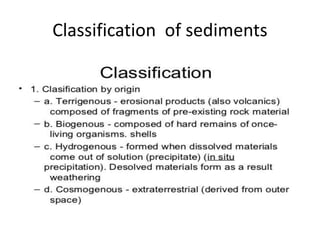
Classification of sediments
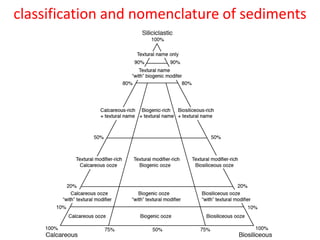
classification and nomenclature of sediments
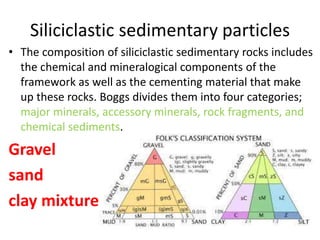
Siliciclastic sedimentary particles
• The composition of siliciclastic sedimentary rocks includes
the chemical and mineralogical components of the
framework as well as the cementing material that make
up these rocks. Boggs divides them into four categories;
major minerals, accessory minerals, rock fragments, and
chemical sediments.
Gravel
sand
clay mixture
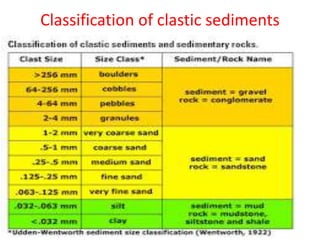
Classification of clastic sediments
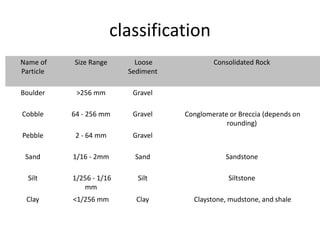
classification
Name of
Particle
Size Range Loose
Sediment
Consolidated Rock
Boulder >256 mm Gravel
Conglomerate or Breccia (depends on
rounding)
Cobble 64 - 256 mm Gravel
Pebble 2 - 64 mm Gravel
Sand 1/16 - 2mm Sand Sandstone
Silt 1/256 - 1/16
mm
Silt Siltstone
Clay <1/256 mm Clay Claystone, mudstone, and shale
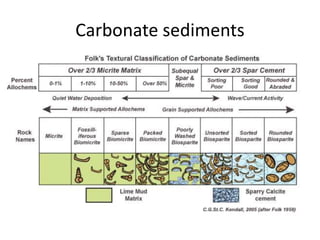
Carbonate sediments
Carbonate sediments
• Modern carbonate sediments are comprised of three
principal minerals: aragonite, calcite (CaCO3) and
dolomite (CaMg (CO3)2). The mineral type is
determined by the organism from which the grains are
derived. Once lithified, these will generally form
limestone, although chemical diagenesis or
lithification in specialized conditions that concentrate
magnesium (i.e, evaporation) can form dolomite.
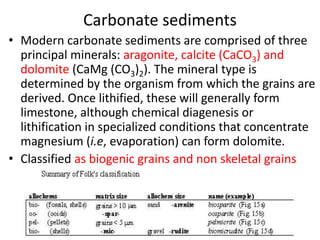
• Classified as biogenic grains and non skeletal grains
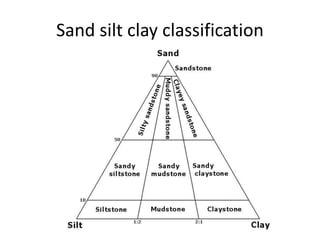
Sand silt clay classification
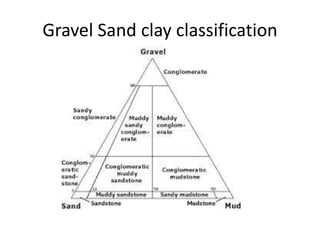
Gravel Sand clay classification
Classaification of sediments

Classaification of sediments

  • 1.
    Classification of sediments Lecture2 Jyoti Khatiwada Roll no 10
  • 2.
  • 3.
  • 4.
    Siliciclastic sedimentary particles •The composition of siliciclastic sedimentary rocks includes the chemical and mineralogical components of the framework as well as the cementing material that make up these rocks. Boggs divides them into four categories; major minerals, accessory minerals, rock fragments, and chemical sediments. Gravel sand clay mixture
  • 5.
  • 6.
    classification Name of Particle Size RangeLoose Sediment Consolidated Rock Boulder >256 mm Gravel Conglomerate or Breccia (depends on rounding) Cobble 64 - 256 mm Gravel Pebble 2 - 64 mm Gravel Sand 1/16 - 2mm Sand Sandstone Silt 1/256 - 1/16 mm Silt Siltstone Clay <1/256 mm Clay Claystone, mudstone, and shale
  • 7.
  • 8.
    Carbonate sediments • Moderncarbonate sediments are comprised of three principal minerals: aragonite, calcite (CaCO3) and dolomite (CaMg (CO3)2). The mineral type is determined by the organism from which the grains are derived. Once lithified, these will generally form limestone, although chemical diagenesis or lithification in specialized conditions that concentrate magnesium (i.e, evaporation) can form dolomite. • Classified as biogenic grains and non skeletal grains
  • 9.
    Sand silt clayclassification
  • 10.
    Gravel Sand clayclassification