CEN 341: GEOTEHCNICALENGINEERING-I
DEPARTMENT OF CIVIL ENGINEERING
PORT CITY INTERNATIONAL UNIVERSITY
CHITTAGONG, BANGLADESH
LECTURE 2
Introduction to Geotechnical Engineering: Clay Mineralogy, Soil
Structure & Fabric
2.
INTRODUCTION
A ‘mineral’ isan inorganic chemical compound formed in nature. As a solid, it may occur in an amorphous state or
in a crystalline state. A ‘crystal’ is a homogenous body bounded by smooth plane surfaces. Soil particles are largely
composed of mineral crystals. Molecules of minerals are composed of atoms of chemical elements. The atoms in a
crystal are arranged in a definite orderly manner to form a three dimensional net-work, called a “lattice.” An atom
consists of a small nucleus having a positive electromagnetic charge around which a definite number of negatively
charged electrons rotate. The electrons rotate in orbits of different radii forming the so-called electron shells.
Many compounds lose their identity, in solution, by separating into “ions.” The ions consist of only one element of
the compound or of two or more elements which are not electrically balanced. Atoms get transformed into ions by
the gain or loss of electrons. The positively charged ions are called “cations” and the negatively charged ions are
called “anions”. On removal from solution the cations and anions write to form the original solid compound. Many
elements do not form ions, yet they unite to form compounds. Solutions of non-ion forming elements or
compounds in water are poor conductors of electric current.
ATOMIC AND MOLECULAR BONDS
Forces which bind atoms and molecules to build up the structure of substances are primarily of electrical nature.
They may be broadly classified into “primary bonds” and “secondary bonds.’ Primary bonds combine the atoms
into molecules. Secondary bonds link atoms in one molecular to atoms in another. They are much weaker than the
primary bonds. Primary bonds are the ionic bond and the covalent bond. Secondary bonds are the hydrogen bond
and the Van der Waals bond.
CLAY MINERALOGY
3.
Ionic Bond
The ionicbond is the simplest and strongest of the bonds which hold atoms together. This bond is formed
between oppositely charged ions by the exchange of electrons. Atoms held together by ionic bonds form
“ionic compounds”’, e.g. common salt (sodium chloride), and a majority of clay mineral crystals fall into this
group.
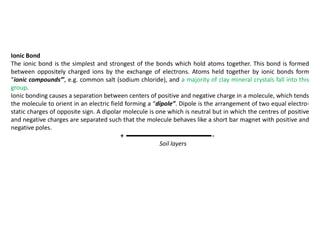
Ionic bonding causes a separation between centers of positive and negative charge in a molecule, which tends
the molecule to orient in an electric field forming a “dipole”. Dipole is the arrangement of two equal electro-
static charges of opposite sign. A dipolar molecule is one which is neutral but in which the centres of positive
and negative charges are separated such that the molecule behaves like a short bar magnet with positive and
negative poles.
+ -
Soil layers
4.
Covalent bond
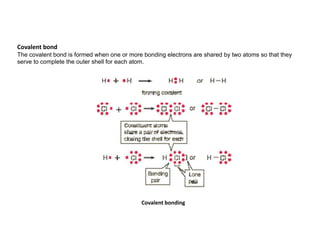
The covalentbond is formed when one or more bonding electrons are shared by two atoms so that they
serve to complete the outer shell for each atom.
Covalent bonding
5.
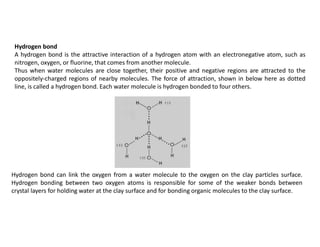
Hydrogen bond
A hydrogenbond is the attractive interaction of a hydrogen atom with an electronegative atom, such as
nitrogen, oxygen, or fluorine, that comes from another molecule.
Thus when water molecules are close together, their positive and negative regions are attracted to the
oppositely-charged regions of nearby molecules. The force of attraction, shown in below here as dotted
line, is called a hydrogen bond. Each water molecule is hydrogen bonded to four others.
Hydrogen bond can link the oxygen from a water molecule to the oxygen on the clay particles surface.
Hydrogen bonding between two oxygen atoms is responsible for some of the weaker bonds between
crystal layers for holding water at the clay surface and for bonding organic molecules to the clay surface.
6.
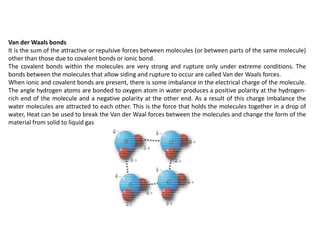
Van der Waalsbonds
It is the sum of the attractive or repulsive forces between molecules (or between parts of the same molecule)
other than those due to covalent bonds or ionic bond.
The covalent bonds within the molecules are very strong and rupture only under extreme conditions. The
bonds between the molecules that allow siding and rupture to occur are called Van der Waals forces.
When ionic and covalent bonds are present, there is some imbalance in the electrical charge of the molecule.
The angle hydrogen atoms are bonded to oxygen atom in water produces a positive polarity at the hydrogen-
rich end of the molecule and a negative polarity at the other end. As a result of this charge imbalance the
water molecules are attracted to each other. This is the force that holds the molecules together in a drop of
water, Heat can be used to break the Van der Waal forces between the molecules and change the form of the
material from solid to liquid gas
7.
Basic Structural Unitsof Clay Minerals
The clay minerals are a group of complex alumino-silicates, i.e., oxides of aluminium and silicon with smaller amounts of metal
ions substituted within the crystal. The atomic structures of clay minerals are built up of two basic units;
a) Silica tetrahedral units, and
b) Aluminium (or magnesium) octahedral unit.
These units are held together by ionic bonds.
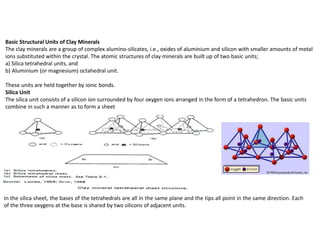
Silica Unit
The silica unit consists of a silicon ion surrounded by four oxygen ions arranged in the form of a tetrahedron. The basic units
combine in such a manner as to form a sheet
In the silica sheet, the bases of the tetrahedrals are all in the same plane and the tips all point in the same direction. Each
of the three oxygens at the base is shared by two silicons of adjacent units.
8.
Aluminium (or Magnesium)Octahedral Unit
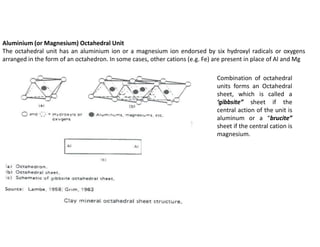
The octahedral unit has an aluminium ion or a magnesium ion endorsed by six hydroxyl radicals or oxygens
arranged in the form of an octahedron. In some cases, other cations (e.g. Fe) are present in place of Al and Mg
Combination of octahedral
units forms an Octahedral
sheet, which is called a
‘gibbsite” sheet if the
central action of the unit is
aluminum or a “brucite”
sheet if the central cation is
magnesium.
9.
TYPES OF CLAYMINERALS
The variation in the stacking of the two basic sheet structures and nature of bonding has given rise to over dozen clay
minerals which have been identified. From an engineering point of view, three clay minerals of interest are kaolinite,
montmorillonite and illite.
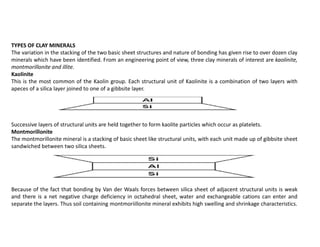
Kaolinite
This is the most common of the Kaolin group. Each structural unit of Kaolinite is a combination of two layers with
apeces of a silica layer joined to one of a gibbsite layer.
Successive layers of structural units are held together to form kaolite particles which occur as platelets.
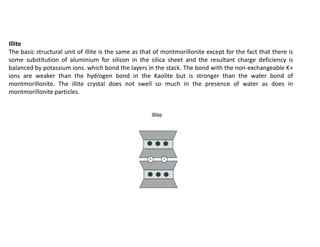
Montmorillonite
The montmorillonite mineral is a stacking of basic sheet like structural units, with each unit made up of gibbsite sheet
sandwiched between two silica sheets.
Because of the fact that bonding by Van der Waals forces between silica sheet of adjacent structural units is weak
and there is a net negative charge deficiency in octahedral sheet, water and exchangeable cations can enter and
separate the layers. Thus soil containing montmoriillonite mineral exhibits high swelling and shrinkage characteristics.
10.
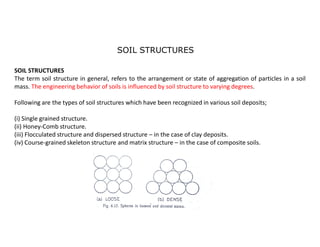
Illite
The basic structuralunit of illite is the same as that of montmorillonite except for the fact that there is
some substitution of aluminium for silicon in the silica sheet and the resultant charge deficiency is
balanced by potassium ions. which bond the layers in the stack. The bond with the non-exchangeable K+
ions are weaker than the hydrogen bond in the Kaolite but is stronger than the water bond of
montmorillonite. The illite crystal does not swell so much in the presence of water as does in
montmorillonite particles.
11.
SOIL STRUCTURES
SOIL STRUCTURES
Theterm soil structure in general, refers to the arrangement or state of aggregation of particles in a soil
mass. The engineering behavior of soils is influenced by soil structure to varying degrees.
Following are the types of soil structures which have been recognized in various soil deposits;
(i) Single grained structure.
(ii) Honey-Comb structure.
(iii) Flocculated structure and dispersed structure – in the case of clay deposits.
(iv) Course-grained skeleton structure and matrix structure – in the case of composite soils.
12.
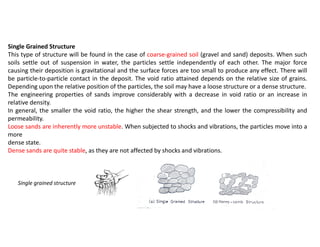
Single grained structure
SingleGrained Structure
This type of structure will be found in the case of coarse-grained soil (gravel and sand) deposits. When such
soils settle out of suspension in water, the particles settle independently of each other. The major force
causing their deposition is gravitational and the surface forces are too small to produce any effect. There will
be particle-to-particle contact in the deposit. The void ratio attained depends on the relative size of grains.
Depending upon the relative position of the particles, the soil may have a loose structure or a dense structure.
The engineering properties of sands improve considerably with a decrease in void ratio or an increase in
relative density.
In general, the smaller the void ratio, the higher the shear strength, and the lower the compressibility and
permeability.
Loose sands are inherently more unstable. When subjected to shocks and vibrations, the particles move into a
more
dense state.
Dense sands are quite stable, as they are not affected by shocks and vibrations.
13.
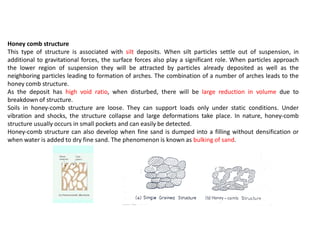
Honey comb structure
Thistype of structure is associated with silt deposits. When silt particles settle out of suspension, in
additional to gravitational forces, the surface forces also play a significant role. When particles approach
the lower region of suspension they will be attracted by particles already deposited as well as the
neighboring particles leading to formation of arches. The combination of a number of arches leads to the
honey comb structure.
As the deposit has high void ratio, when disturbed, there will be large reduction in volume due to
breakdown of structure.
Soils in honey-comb structure are loose. They can support loads only under static conditions. Under
vibration and shocks, the structure collapse and large deformations take place. In nature, honey-comb
structure usually occurs in small pockets and can easily be detected.
Honey-comb structure can also develop when fine sand is dumped into a filling without densification or
when water is added to dry fine sand. The phenomenon is known as bulking of sand.
14.
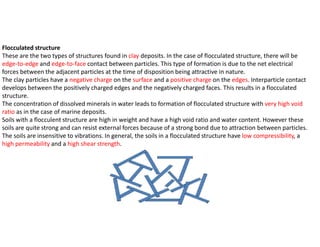
Flocculated structure
These arethe two types of structures found in clay deposits. In the case of flocculated structure, there will be
edge-to-edge and edge-to-face contact between particles. This type of formation is due to the net electrical
forces between the adjacent particles at the time of disposition being attractive in nature.
The clay particles have a negative charge on the surface and a positive charge on the edges. Interparticle contact
develops between the positively charged edges and the negatively charged faces. This results in a flocculated
structure.
The concentration of dissolved minerals in water leads to formation of flocculated structure with very high void
ratio as in the case of marine deposits.
Soils with a flocculent structure are high in weight and have a high void ratio and water content. However these
soils are quite strong and can resist external forces because of a strong bond due to attraction between particles.
The soils are insensitive to vibrations. In general, the soils in a flocculated structure have low compressibility, a
high permeability and a high shear strength.
15.
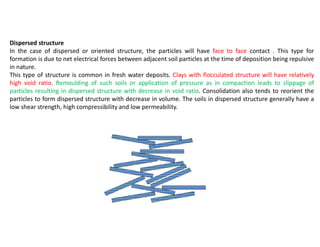
Dispersed structure
In thecase of dispersed or oriented structure, the particles will have face to face contact . This type for
formation is due to net electrical forces between adjacent soil particles at the time of deposition being repulsive
in nature.
This type of structure is common in fresh water deposits. Clays with flocculated structure will have relatively
high void ratio. Remoulding of such soils or application of pressure as in compaction leads to slippage of
particles resulting in dispersed structure with decrease in void ratio. Consolidation also tends to reorient the
particles to form dispersed structure with decrease in volume. The soils in dispersed structure generally have a
low shear strength, high compressibility and low permeability.
16.
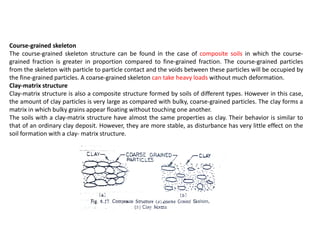
Course-grained skeleton
The course-grainedskeleton structure can be found in the case of composite soils in which the course-
grained fraction is greater in proportion compared to fine-grained fraction. The course-grained particles
from the skeleton with particle to particle contact and the voids between these particles will be occupied by
the fine-grained particles. A coarse-grained skeleton can take heavy loads without much deformation.
Clay-matrix structure
Clay-matrix structure is also a composite structure formed by soils of different types. However in this case,
the amount of clay particles is very large as compared with bulky, coarse-grained particles. The clay forms a
matrix in which bulky grains appear floating without touching one another.
The soils with a clay-matrix structure have almost the same properties as clay. Their behavior is similar to
that of an ordinary clay deposit. However, they are more stable, as disturbance has very little effect on the
soil formation with a clay- matrix structure.