Clay
Material Description - Clay
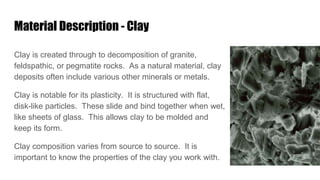
Clay is created through to decomposition of granite,
feldspathic, or pegmatite rocks. As a natural material, clay
deposits often include various other minerals or metals.
Clay is notable for its plasticity. It is structured with flat,
disk-like particles. These slide and bind together when wet,
like sheets of glass. This allows clay to be molded and
keep its form.
Clay composition varies from source to source. It is
important to know the properties of the clay you work with.
Material Description - Types of Clay
● Kaolin - a very pure type of clay that is white in color. It is fired at high temperatures and is often
used in porcelain. It can be found in North Carolina, South Carolina, and Georgia.
● Ball Clay - a dark grey color clay found in swampy areas. Decaying vegetation breaks clay particles
into finer sizes. It is very plastic as a result and is often added to other clays to increase plasticity. It
is fired at high temperatures. Found in Tennessee and Kentucky.
● Stoneware - a buff or grey color that fires at mid-range temperatures. Very common base clay to
which other clays are added. Found from New York to Missouri and along the Pacific Coast.
● Fireclay - refractory clay used for insulating or fire brick. They can range in granular size but often
contain iron, flint, or alumina. Found through most of the US.
● Earthenware - low fire, porous clay with a wide variety of clay composition. It was formed in
prehistoric lake beds that turned into shale.
● Bentonite - formed from prehistoric volcanic eruptions. It has the finest particular size and is largely
made of silica. It is used in glazes or to add plasticity to clay mixtures. Found in western mountain
and the Gulf Coast states.
Tools - Wet Clay
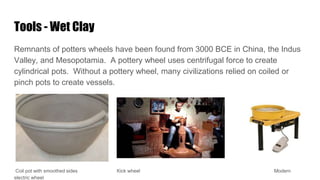
Remnants of potters wheels have been found from 3000 BCE in China, the Indus
Valley, and Mesopotamia. A pottery wheel uses centrifugal force to create
cylindrical pots. Without a pottery wheel, many civilizations relied on coiled or
pinch pots to create vessels.
Coil pot with smoothed sides Kick wheel Modern
electric wheel
Tools - Wet Clay
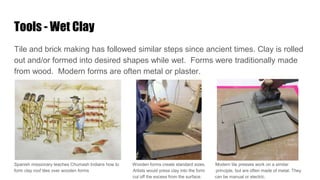
Tile and brick making has followed similar steps since ancient times. Clay is rolled
out and/or formed into desired shapes while wet. Forms were traditionally made
from wood. Modern forms are often metal or plaster.
Spanish missionary teaches Chumash Indians how to Wooden forms create standard sizes. Modern tile presses work on a similar
form clay roof tiles over wooden forms Artists would press clay into the form principle, but are often made of metal. They
cut off the excess from the surface. can be manual or electric.
Tools - Leather Hard
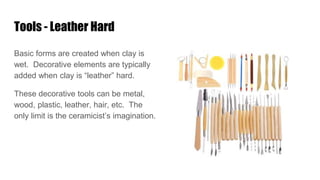
Basic forms are created when clay is
wet. Decorative elements are typically
added when clay is “leather” hard.
These decorative tools can be metal,
wood, plastic, leather, hair, etc. The
only limit is the ceramicist’s imagination.
Tools - Firing
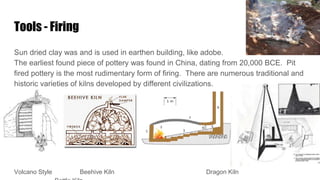
Sun dried clay was and is used in earthen building, like adobe.
The earliest found piece of pottery was found in China, dating from 20,000 BCE. Pit
fired pottery is the most rudimentary form of firing. There are numerous traditional and
historic varieties of kilns developed by different civilizations.
Volcano Style Beehive Kiln Dragon Kiln
Tools - Firing
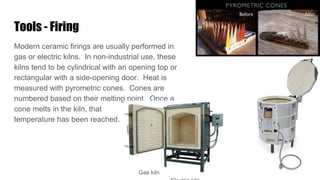
Modern ceramic firings are usually performed in
gas or electric kilns. In non-industrial use, these
kilns tend to be cylindrical with an opening top or
rectangular with a side-opening door. Heat is
measured with pyrometric cones. Cones are
numbered based on their melting point. Once a
cone melts in the kiln, that
temperature has been reached.
Gas kiln
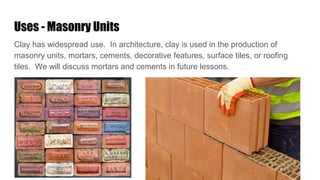
Uses - Masonry Units
Clay has widespread use. In architecture, clay is used in the production of
masonry units, mortars, cements, decorative features, surface tiles, or roofing
tiles. We will discuss mortars and cements in future lessons.
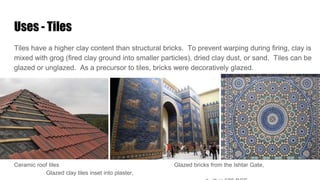
Uses - Tiles
Tiles have a higher clay content than structural bricks. To prevent warping during firing, clay is
mixed with grog (fired clay ground into smaller particles), dried clay dust, or sand. Tiles can be
glazed or unglazed. As a precursor to tiles, bricks were decoratively glazed.
Ceramic roof tiles Glazed bricks from the Ishtar Gate,
Glazed clay tiles inset into plaster,
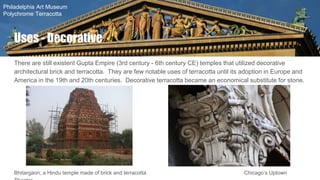
There are still existent Gupta Empire (3rd century - 6th century CE) temples that utilized decorative
architectural brick and terracotta. They are few notable uses of terracotta until its adoption in Europe and
America in the 19th and 20th centuries. Decorative terracotta became an economical substitute for stone.
Bhitargaon, a Hindu temple made of brick and terracotta Chicago’s Uptown
Uses - Decorative
Philadelphia Art Museum
Polychrome Terracotta
Safety
Clay contains silica. Inhalation of silica dust causes silicosis. Symptoms include:
shortness of breath, dry cough, emphysema, and high susceptibility to lung
infections such as tuberculosis. The disease may take years to develop. Silica
dust exposure is not hazardous by skin contact or ingestion.
Clay can also contain other hazardous materials such as lead and asbestos.
Workers should not sweep dry clay dust and “work wet.”
Most glazes contain metals as a colorant or a flux. Workers should avoid skin
contact with glazes and work in ventilated spaces.
Firings can vaporize these toxic chemicals and oxide other chemicals into
hazardous ones like carbon monoxide. Work in areas with lots of ventilation.
Preservation - Deterioration
Moisture - Clay is naturally porous. Lower fired clay is more porous than higher fired clay. In architectural
ceramics, freeze-thaw cycles can significantly damage ceramics. Entrapped water can freeze and cause cracks,
spalling, or delamination. In glazed terracotta, this can happen between the glaze and terracotta.
Reactions - Decorative terracotta was usually fastened with iron or steel wires and fasteners. These corrode
with water and can contribute to spalling and crazing. Ceramic roof tiles should only utilize copper or stainless
steel fasteners. TILES
Movement - Thermal expansion and seismic movement can cause cracking in terracotta. Terracotta blocks have
poor tensile strength but good compressive strength.
Constitution - Excessive grog or sand added to clay can create large and multiple weak points and pores in the
fired clay. This allows later water infiltration. Glazing materials vary in rates and causes of deterioration.
Poor repairs - Improper repair material, like cement-based materials, can exacerbate cracking. Caulking cracks
does not address the reason for cracking, and reduces area for water to evaporate. Sealants used to waterproof
entrap water and also exacerbate the problem.
1. Cleaning - regular cleaning is integral to preservation. A diluted detergent and nylon brush are
appropriate for regular cleaning. Depending on the cause and severity of surface soiling, more
aggressive cleaning should be deliberately planned and tested. Start with the least invasive
treatments in low visibility areas.
2. Cause - no repair treatment should begin until the cause of the issue is determined. Ameliorate
these issues prior to repair work.
3. Stability - ensure that the terracotta feature is fastened correctly. Remove failed fasteners and/or
mortars/grouts. Replace damaged pins or wires on decorative terracotta. Ensure roof tiles are
fastened, clipped, and/or gooped according to manufacturer instructions. Ensure floor tiles are
appropriately bedded in substrate and grouted with appropriate materials.
4. Shoring - Sometimes budget or material availability can limit a preservation or restoration plan.
This is particularly true in large scale restorations, where failing decorative terracotta features can
pose safety hazards. Ensure shoring plans include reversible actions. First eliminate causes of
deterioration if possible. Then, create a deliberate stabilization plan. Remove and catalogue
elements that need replacing. Stabilize repair items with pinning, wiring, or caulking. It is best to
avoid cementing during a shoring phase.
Preservation - Methods
5. Repairs - Superficial damage to terracotta can be patched. Patches on glazed terracotta or tiles are difficult
to blend with surrounding features. Lime-based patching compounds (not cement based) can be used to fill
in voids or sculpt areas. Glazings can be matched with epoxies. Crazed glazing should be recoated with a
sealant. Non-glazed terracotta can be patched with lime-based patching compounds. Many suppliers offer
a variety of colors or color matching services. Paint does not adhere well to terracotta.
6. Replacement - Ceramic roofing tiles can be easy to replace depending on the style and origin. Modern
manufacturers have standard designs and these can easily be reintegrated into roofs. Older tiles, like those
at Spanish missions, are more difficult to replace. These were often made on site with local kilns and clay.
Flat tile replacement varies. It is easy to find replacements for modern tiles. However, these are usually
bedded in portland cement-based mortars and can be labor intensive to remove. Older tiles are more
difficult to reproduce. Some historic glazings are no longer used due to safety hazards. Historic kiln firings
created large variations in final color and size. There are firms and independent ceramicists that specialize
in tile reproductions. Decorative terracotta can be expensive and time consuming to replace. Only a few
firms specialize in historic architectural terracotta. One alternative is to replace terracotta with cast stone.
Different aggregates can create a lightweight alternative to terracotta. Concrete can be dyed or stained to
match the surrounding historic fabric.

Clay

  • 1.
  • 2.
    Material Description -Clay Clay is created through to decomposition of granite, feldspathic, or pegmatite rocks. As a natural material, clay deposits often include various other minerals or metals. Clay is notable for its plasticity. It is structured with flat, disk-like particles. These slide and bind together when wet, like sheets of glass. This allows clay to be molded and keep its form. Clay composition varies from source to source. It is important to know the properties of the clay you work with.
  • 3.
    Material Description -Types of Clay ● Kaolin - a very pure type of clay that is white in color. It is fired at high temperatures and is often used in porcelain. It can be found in North Carolina, South Carolina, and Georgia. ● Ball Clay - a dark grey color clay found in swampy areas. Decaying vegetation breaks clay particles into finer sizes. It is very plastic as a result and is often added to other clays to increase plasticity. It is fired at high temperatures. Found in Tennessee and Kentucky. ● Stoneware - a buff or grey color that fires at mid-range temperatures. Very common base clay to which other clays are added. Found from New York to Missouri and along the Pacific Coast. ● Fireclay - refractory clay used for insulating or fire brick. They can range in granular size but often contain iron, flint, or alumina. Found through most of the US. ● Earthenware - low fire, porous clay with a wide variety of clay composition. It was formed in prehistoric lake beds that turned into shale. ● Bentonite - formed from prehistoric volcanic eruptions. It has the finest particular size and is largely made of silica. It is used in glazes or to add plasticity to clay mixtures. Found in western mountain and the Gulf Coast states.
  • 4.
    Tools - WetClay Remnants of potters wheels have been found from 3000 BCE in China, the Indus Valley, and Mesopotamia. A pottery wheel uses centrifugal force to create cylindrical pots. Without a pottery wheel, many civilizations relied on coiled or pinch pots to create vessels. Coil pot with smoothed sides Kick wheel Modern electric wheel
  • 5.
    Tools - WetClay Tile and brick making has followed similar steps since ancient times. Clay is rolled out and/or formed into desired shapes while wet. Forms were traditionally made from wood. Modern forms are often metal or plaster. Spanish missionary teaches Chumash Indians how to Wooden forms create standard sizes. Modern tile presses work on a similar form clay roof tiles over wooden forms Artists would press clay into the form principle, but are often made of metal. They cut off the excess from the surface. can be manual or electric.
  • 6.
    Tools - LeatherHard Basic forms are created when clay is wet. Decorative elements are typically added when clay is “leather” hard. These decorative tools can be metal, wood, plastic, leather, hair, etc. The only limit is the ceramicist’s imagination.
  • 7.
    Tools - Firing Sundried clay was and is used in earthen building, like adobe. The earliest found piece of pottery was found in China, dating from 20,000 BCE. Pit fired pottery is the most rudimentary form of firing. There are numerous traditional and historic varieties of kilns developed by different civilizations. Volcano Style Beehive Kiln Dragon Kiln
  • 8.
    Tools - Firing Modernceramic firings are usually performed in gas or electric kilns. In non-industrial use, these kilns tend to be cylindrical with an opening top or rectangular with a side-opening door. Heat is measured with pyrometric cones. Cones are numbered based on their melting point. Once a cone melts in the kiln, that temperature has been reached. Gas kiln
  • 9.
    Uses - MasonryUnits Clay has widespread use. In architecture, clay is used in the production of masonry units, mortars, cements, decorative features, surface tiles, or roofing tiles. We will discuss mortars and cements in future lessons.
  • 10.
    Uses - Tiles Tileshave a higher clay content than structural bricks. To prevent warping during firing, clay is mixed with grog (fired clay ground into smaller particles), dried clay dust, or sand. Tiles can be glazed or unglazed. As a precursor to tiles, bricks were decoratively glazed. Ceramic roof tiles Glazed bricks from the Ishtar Gate, Glazed clay tiles inset into plaster,
  • 11.
    There are stillexistent Gupta Empire (3rd century - 6th century CE) temples that utilized decorative architectural brick and terracotta. They are few notable uses of terracotta until its adoption in Europe and America in the 19th and 20th centuries. Decorative terracotta became an economical substitute for stone. Bhitargaon, a Hindu temple made of brick and terracotta Chicago’s Uptown Uses - Decorative Philadelphia Art Museum Polychrome Terracotta
  • 12.
    Safety Clay contains silica.Inhalation of silica dust causes silicosis. Symptoms include: shortness of breath, dry cough, emphysema, and high susceptibility to lung infections such as tuberculosis. The disease may take years to develop. Silica dust exposure is not hazardous by skin contact or ingestion. Clay can also contain other hazardous materials such as lead and asbestos. Workers should not sweep dry clay dust and “work wet.” Most glazes contain metals as a colorant or a flux. Workers should avoid skin contact with glazes and work in ventilated spaces. Firings can vaporize these toxic chemicals and oxide other chemicals into hazardous ones like carbon monoxide. Work in areas with lots of ventilation.
  • 13.
    Preservation - Deterioration Moisture- Clay is naturally porous. Lower fired clay is more porous than higher fired clay. In architectural ceramics, freeze-thaw cycles can significantly damage ceramics. Entrapped water can freeze and cause cracks, spalling, or delamination. In glazed terracotta, this can happen between the glaze and terracotta. Reactions - Decorative terracotta was usually fastened with iron or steel wires and fasteners. These corrode with water and can contribute to spalling and crazing. Ceramic roof tiles should only utilize copper or stainless steel fasteners. TILES Movement - Thermal expansion and seismic movement can cause cracking in terracotta. Terracotta blocks have poor tensile strength but good compressive strength. Constitution - Excessive grog or sand added to clay can create large and multiple weak points and pores in the fired clay. This allows later water infiltration. Glazing materials vary in rates and causes of deterioration. Poor repairs - Improper repair material, like cement-based materials, can exacerbate cracking. Caulking cracks does not address the reason for cracking, and reduces area for water to evaporate. Sealants used to waterproof entrap water and also exacerbate the problem.
  • 14.
    1. Cleaning -regular cleaning is integral to preservation. A diluted detergent and nylon brush are appropriate for regular cleaning. Depending on the cause and severity of surface soiling, more aggressive cleaning should be deliberately planned and tested. Start with the least invasive treatments in low visibility areas. 2. Cause - no repair treatment should begin until the cause of the issue is determined. Ameliorate these issues prior to repair work. 3. Stability - ensure that the terracotta feature is fastened correctly. Remove failed fasteners and/or mortars/grouts. Replace damaged pins or wires on decorative terracotta. Ensure roof tiles are fastened, clipped, and/or gooped according to manufacturer instructions. Ensure floor tiles are appropriately bedded in substrate and grouted with appropriate materials. 4. Shoring - Sometimes budget or material availability can limit a preservation or restoration plan. This is particularly true in large scale restorations, where failing decorative terracotta features can pose safety hazards. Ensure shoring plans include reversible actions. First eliminate causes of deterioration if possible. Then, create a deliberate stabilization plan. Remove and catalogue elements that need replacing. Stabilize repair items with pinning, wiring, or caulking. It is best to avoid cementing during a shoring phase. Preservation - Methods
  • 15.
    Preservation - Methods 5.Repairs - Superficial damage to terracotta can be patched. Patches on glazed terracotta or tiles are difficult to blend with surrounding features. Lime-based patching compounds (not cement based) can be used to fill in voids or sculpt areas. Glazings can be matched with epoxies. Crazed glazing should be recoated with a sealant. Non-glazed terracotta can be patched with lime-based patching compounds. Many suppliers offer a variety of colors or color matching services. Paint does not adhere well to terracotta. 6. Replacement - Ceramic roofing tiles can be easy to replace depending on the style and origin. Modern manufacturers have standard designs and these can easily be reintegrated into roofs. Older tiles, like those at Spanish missions, are more difficult to replace. These were often made on site with local kilns and clay. Flat tile replacement varies. It is easy to find replacements for modern tiles. However, these are usually bedded in portland cement-based mortars and can be labor intensive to remove. Older tiles are more difficult to reproduce. Some historic glazings are no longer used due to safety hazards. Historic kiln firings created large variations in final color and size. There are firms and independent ceramicists that specialize in tile reproductions. Decorative terracotta can be expensive and time consuming to replace. Only a few firms specialize in historic architectural terracotta. One alternative is to replace terracotta with cast stone. Different aggregates can create a lightweight alternative to terracotta. Concrete can be dyed or stained to match the surrounding historic fabric.