1
WASTE MANAGEMENT
GLASS
2
WORK PROCESS
• Glass as a waste material and its waste management procedure
• Create awareness about glass waste
• Basic introduction
– What is glass
– How is it manufactured
– Use of glass in our daily life
• Sources of generation of glass waste
• Glass products as waste
• Recycling of glass
• How waste glass can be used to make usable products
– Type of usable waste glass
– Live examples
– Use of waste glass in architecture
3
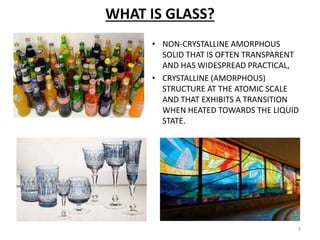
• NON-CRYSTALLINE AMORPHOUS
SOLID THAT IS OFTEN TRANSPARENT
AND HAS WIDESPREAD PRACTICAL,
• CRYSTALLINE (AMORPHOUS)
STRUCTURE AT THE ATOMIC SCALE
AND THAT EXHIBITS A TRANSITION
WHEN HEATED TOWARDS THE LIQUID
STATE.
WHAT IS GLASS?
4
MANUFACTURING PROCESS
GLASS IS 100% RECYCLABLE AND CAN BE
RECYCLED ENDLESSLY WITHOUT LOSS IN
QUALITY OR PURITY
GLASS CONTAINER RECYCLING LOOP
RECYCLED
GLASS
REDUCES
EMISSIONS
REDUCES CONSUMPTION
OF RAW MATERIALS
EXTENDS LIFE OF PLANT
EQUIPMENT
ONE TON OF CARBON DIOXIDE IS
REDUCED FOR EVERY SIX TONS OF
RECYCLED CONTAINER GLASS USED IN
THE MANUFACTURING PROCESS
RECYCLING 15 GLASS
BOTTLESSAVES
ENOUGH ENERGY
TO POWER A
LAPTOP FOR 31.3
HOURS
RUN THE AC FOR 1 HOUR
ENERGY COSTS DROP ABOUT 2-3% FOR
EVERY 10% CULLET USED IN THE
MANUFACTURING PROCESS
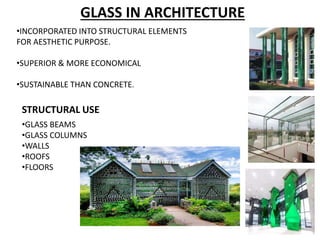
GLASS IN ARCHITECTURE
•INCORPORATED INTO STRUCTURAL ELEMENTS
FOR AESTHETIC PURPOSE.
•SUPERIOR & MORE ECONOMICAL
•SUSTAINABLE THAN CONCRETE.
STRUCTURAL USE
•GLASS BEAMS
•GLASS COLUMNS
•WALLS
•ROOFS
•FLOORS
USE OF GLASS WASTE-ARCHITECTURAL USES
• Use of glass wastes as fine aggregate in Concrete:
– While using waste glass as fine aggregate replacement, 28 d strength is found to
marginally increase up to 20% replacement level
– Marginal decrease in strength is observed at 30 to 40% replacement level of waste glass
with fine aggregate.
– Waste glass can effectively be used as fine aggregate replacement.
– The optimum replacement level of waste glass as fine aggregate is 10%.
• Use of recycled glass in self-compacting concrete
– was first developed in Japan
– ability to consolidate by its own weight
• Recycled glass cullet with two particle size ranges (<5 mm and 5–10 mm) were
used to replace river sand and 5–10 mm granite. The fresh properties results showed
that the slump flow and blocking ratio of concrete mixes increased with the increase
of recycled glass cullet contents.
9
SOURCES-
http://jairjp.com/NOVEMBER%202012/10%20GOWTHAM.pdf
http://sampaproject.iq.unesp.br/archives/tools/Fernando/Glass%20Recycling/1-s2.0-S0921344912001917-main.pdf

Glass

  • 1.
  • 2.
    2 WORK PROCESS • Glassas a waste material and its waste management procedure • Create awareness about glass waste • Basic introduction – What is glass – How is it manufactured – Use of glass in our daily life • Sources of generation of glass waste • Glass products as waste • Recycling of glass • How waste glass can be used to make usable products – Type of usable waste glass – Live examples – Use of waste glass in architecture
  • 3.
    3 • NON-CRYSTALLINE AMORPHOUS SOLIDTHAT IS OFTEN TRANSPARENT AND HAS WIDESPREAD PRACTICAL, • CRYSTALLINE (AMORPHOUS) STRUCTURE AT THE ATOMIC SCALE AND THAT EXHIBITS A TRANSITION WHEN HEATED TOWARDS THE LIQUID STATE. WHAT IS GLASS?
  • 4.
  • 5.
    GLASS IS 100%RECYCLABLE AND CAN BE RECYCLED ENDLESSLY WITHOUT LOSS IN QUALITY OR PURITY
  • 6.
  • 7.
    RECYCLED GLASS REDUCES EMISSIONS REDUCES CONSUMPTION OF RAWMATERIALS EXTENDS LIFE OF PLANT EQUIPMENT ONE TON OF CARBON DIOXIDE IS REDUCED FOR EVERY SIX TONS OF RECYCLED CONTAINER GLASS USED IN THE MANUFACTURING PROCESS RECYCLING 15 GLASS BOTTLESSAVES ENOUGH ENERGY TO POWER A LAPTOP FOR 31.3 HOURS RUN THE AC FOR 1 HOUR ENERGY COSTS DROP ABOUT 2-3% FOR EVERY 10% CULLET USED IN THE MANUFACTURING PROCESS
  • 8.
    GLASS IN ARCHITECTURE •INCORPORATEDINTO STRUCTURAL ELEMENTS FOR AESTHETIC PURPOSE. •SUPERIOR & MORE ECONOMICAL •SUSTAINABLE THAN CONCRETE. STRUCTURAL USE •GLASS BEAMS •GLASS COLUMNS •WALLS •ROOFS •FLOORS
  • 9.
    USE OF GLASSWASTE-ARCHITECTURAL USES • Use of glass wastes as fine aggregate in Concrete: – While using waste glass as fine aggregate replacement, 28 d strength is found to marginally increase up to 20% replacement level – Marginal decrease in strength is observed at 30 to 40% replacement level of waste glass with fine aggregate. – Waste glass can effectively be used as fine aggregate replacement. – The optimum replacement level of waste glass as fine aggregate is 10%. • Use of recycled glass in self-compacting concrete – was first developed in Japan – ability to consolidate by its own weight • Recycled glass cullet with two particle size ranges (<5 mm and 5–10 mm) were used to replace river sand and 5–10 mm granite. The fresh properties results showed that the slump flow and blocking ratio of concrete mixes increased with the increase of recycled glass cullet contents. 9 SOURCES- http://jairjp.com/NOVEMBER%202012/10%20GOWTHAM.pdf http://sampaproject.iq.unesp.br/archives/tools/Fernando/Glass%20Recycling/1-s2.0-S0921344912001917-main.pdf