Unit - 2Introduction to ArchitectureAR0120Theoryof Architecture Handled by - g.yogapriya
Unit - 2Introduction to Architecture
Principles of Design
1. Proportion
2. Balance
3. Scale
4. Axis
5. Rhythm
6. Hierarchy
7. Symmetry
Unit - 2Introduction to Architecture
Proportion
1. The relationship between different things or
parts with respect to comparative size, number,
or degree
2. a part considered with respect to the whole
3. The interrelationship of all parts of an
arrangement.
Unit - 2Introduction to Architecture
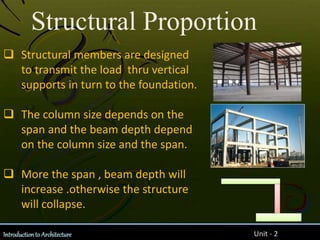
Structural Proportion
 Structural members are designed
to transmit the load thru vertical
supports in turn to the foundation.
 The column size depends on the
span and the beam depth depend
on the column size and the span.
 More the span , beam depth will
increase .otherwise the structure
will collapse.
Unit - 2Introduction to Architecture
Manufactured Proportion
 Many architectural
elements not only depends
on structural proportion or
function. It depends on the
manufacturing process. As
they are produced as a bulk
product.
Casement
window
Modular kitchen
Clay brick
Unit - 2Introduction to Architecture
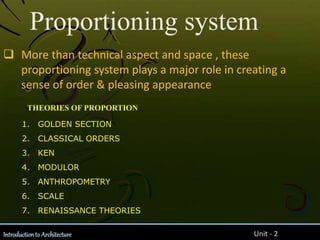
Proportioning system
 More than technical aspect and space , these
proportioning system plays a major role in creating a
sense of order & pleasing appearance
THEORIES OF PROPORTION
1. GOLDEN SECTION
2. CLASSICAL ORDERS
3. KEN
4. MODULOR
5. ANTHROPOMETRY
6. SCALE
7. RENAISSANCE THEORIES
Unit - 2Introduction to Architecture
Golden section
Rectangle one: Ratio 1:1
Rectangle two: Ratio 2:1
Rectangle Three: Ratio 1.618:1
The third rectangle is the most appealing. Because the ratio of its length to its width is the
Golden Ratio! For centuries, designers of art and architecture have recognized the
significance of the Golden Ratio in their work.
Unit - 2Introduction to Architecture
Proportioning system
Unit - 2Introduction to Architecture
The Golden Section in
Architecture
Golden section appears in many of the proportions of the Parthenon in
Greece
Front elevation is built on the golden section (0.618 times as wide as it
is tall)
Unit - 2Introduction to Architecture
The Human Body
The human body is based on Phi and 5
The human body illustrates the Golden Section. We'll use the same building blocks again:
The Proportions in the Body
The white line is the body's height.
The blue line, a golden section of the white line, defines the
distance from the head to the finger tips
The yellow line, a golden section of the blue line, defines the
distance from the head to the navel and the elbows.
The green line, a golden section of the yellow line, defines the
distance from the head to the pectorals and inside top of the
arms, the width of the shoulders, the length of the forearm
and the shin bone.
The magenta line, a golden section of the green line, defines
the distance from the head to the base of the skull and the
width of the abdomen. The sectioned portions of the magenta
line determine the position of the nose and the hairline.
Although not shown, the golden section of the magenta line
(also the short section of the green line) defines the width of
the head and half the width of the chest and the hips.
Unit - 2Introduction to Architecture
The Fibonacci Numbers
and
The Golden Section
Unit - 2Introduction to Architecture
The Fibonacci Numbers
1. He introduced in The Book of Calculating
2. Series begins with 0 and 1
3. Next number is found by adding the last
two numbers together
4. Number obtained is the next number in
the series
5. Pattern is repeated over and over
0, 1, 1, 2, 3, 5, 8, 13, 21, 34, 55, 89, 144, 233, 377, 610, 987, …
Unit - 2Introduction to Architecture
1
1
2
3 1.5000000000000000
5 1.6666666666666700
8 1.6000000000000000
13 1.6250000000000000
21 1.6153846153846200
34 1.6190476190476200
55 1.6176470588235300
89 1.6181818181818200
144 1.6179775280898900
233 1.6180555555555600
377 1.6180257510729600
610 1.6180371352785100
987 1.6180327868852500
1,597 1.6180344478216800
2,584 1.6180338134001300
4,181 1.6180340557275500
6,765 1.6180339631667100
10,946 1.6180339985218000
17,711 1.6180339850173600
28,657 1.6180339901756000
46,368 1.6180339882053200
75,025 1.6180339889579000
The ratio in golden ratio
Unit - 2Introduction to Architecture
Drawing golden rectangle
Unit - 2Introduction to Architecture
Golden Spiral manipulative
Unit - 2Introduction to Architecture
The Fibonacci Numbers in
Nature
~ Fibonacci spiral found in both snail and sea shells
Unit - 2Introduction to Architecture
The Fibonacci Numbers in
Nature Continued
~ Pinecones clearly show the Fibonacci spiral
Unit - 2Introduction to Architecture
The Fibonacci Numbers in
Nature Continued
Lilies and irises = 3 petals
Black-eyed Susan’s = 21 petals
Corn marigolds = 13 petals
Buttercups and wild roses = 5 petals
Unit - 2Introduction to Architecture
The Fibonacci Numbers in
Nature Continued
~ Fibonacci spirals can be made through the use of visual computer
programs
~ Each sequence of layers is a certain linear combination of previous
ones
Unit - 2Introduction to Architecture
The Fibonacci Numbers in
Nature Continued
~ Fibonacci spiral can be found in cauliflower
Unit - 2Introduction to Architecture
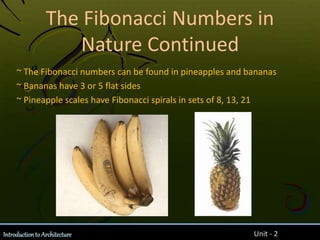
The Fibonacci Numbers in
Nature Continued
~ The Fibonacci numbers can be found in pineapples and bananas
~ Bananas have 3 or 5 flat sides
~ Pineapple scales have Fibonacci spirals in sets of 8, 13, 21
Unit - 2Introduction to Architecture
The Fibonacci Numbers in
Nature Continued
~ The Fibonacci numbers can be found in the human hand and fingers
- 5 fingers
Unit - 2Introduction to Architecture
The ratio of your forearm to hand is Phi
Unit - 2Introduction to Architecture
The Golden Section in
Architecture Continued
~ Golden section can be found in the design of Notre Dame in Paris
~ Golden section continues to be used today in modern architecture
United Nations Headquarters
Secretariat building
Unit - 2Introduction to Architecture
MODULAR SYSTEM OF PROPORTIONING SYSTEM
Charles-Edouard Jeanneret-Gris (1887-
1965) was a Swiss-born architect. He
adopted the name Le Corbusier in the
early 1920s. He introduced a new system
of proportioning called the Modulor
which was based on human
measurements, Fibonacci numbers, and
the golden ratio.
The navel divides the height into the
golden section. Figure 1 is supposed to
be based on model male proportions. Le
Corbusier used this relationship
between human measurements and the
golden ratio to develop two series of
measurements based on a six-foot
(1.83m) man,
Unit - 2Introduction to Architecture
The red series (4-6-10-16-27-43-70-113-183-296…)
based on the height of the navel (1.13m),
The blue series (13-20-33-53-86-140-226-366-592…)
based on the height of the tip of the upraised fingers
(2.26m).
Unit - 2Introduction to Architecture
 The architecture of Andrea Palladio has influenced countless
generations of architects, beginning most notably with Inigo
Jones in England .
 Expounding on the theories of Pythagoras, Plato claimed that
the harmony of the world was contained in seven numbers,
{1,2,3,4,8,9,27}, which were derived from musical consonances
and could be broken down into two sets, {1,2,4,8} and
{1,3,9,27}
 These numbers and their ratios became the basis for the
proportions used by Palladio.
 In all the villa capra , villa rotunda Palladio used these
proportion in room size or in building dimension which is more
harmonious as musical note.
 The overall ratios of the lengths and widths of the rooms,
 16:24:36, then becomes 4:6:9, with 6 as the geometric mean
between 4 and 9 and further connecting the rooms .
RENAISSANCE THEORIES
Unit - 2Introduction to Architecture
Ideal shape for room
Unit - 2Introduction to Architecture
CLASSICAL ORDER PROPORTION
•Greek and roman
columns represents the
perfect proportion to
express beauty and
harmony.
•The basic unit of
dimension was the
diameter of the column.
the other parts
dimension are derived
from this.
Unit - 2Introduction to Architecture
The measurement of the human individual
for the purposes of understanding human
physical variation.
Anthropometry plays an important role in
industrial design, clothing design,
ergonomics and architecture where
statistical data about the distribution of
body dimensions in the population are used
to optimize products.
Changes in life styles, nutrition and ethnic
composition of populations lead to changes
in the distribution of body dimensions and
require regular updating of anthropometric
data collections.
ANTHROPOMETRY
Unit - 2Introduction to Architecture
Ken
• Japanese unit of measurement is shaku
and ken , like feet and inches.
Unit - 2Introduction to Architecture
Ken – 1.8m
• Modular grid
Inaka ma method – 3 x 6 shaku (1/2 x 1 ken )
Kyoma method - 3.15 x 6.30 shaku
• Tatami mats are a traditional type of Japanese
flooring. Traditionally made of rice straw to
form the core.
Unit - 2Introduction to Architecture
•Size of the floor mat depends on the proportion of two persons
sitting or one person sleeping.
Eg 6 mats = 9 ft x 12 ft
Unit - 2Introduction to Architecture
Balance
• Stability of an arrangement
– Arrangement appears secure and stable
– Balance must be both visual and actual
– visual balance refers to the way an arrangement appears to
the eye.
Unit - 2Introduction to Architecture
Balance
• Symmetrical and Asymmetrical balance
are two types commonly used.
Unit - 2Introduction to Architecture
Roman Catholic CathedralSantiago Calatrava
Lyon-Satolas TGV Station
Lyon, France
Symmetrical Asymmetrical
Symmetry evokes stability & balance evokes dynamism

Unit 2

  • 1.
    Unit - 2Introductionto ArchitectureAR0120Theoryof Architecture Handled by - g.yogapriya
  • 2.
    Unit - 2Introductionto Architecture Principles of Design 1. Proportion 2. Balance 3. Scale 4. Axis 5. Rhythm 6. Hierarchy 7. Symmetry
  • 3.
    Unit - 2Introductionto Architecture Proportion 1. The relationship between different things or parts with respect to comparative size, number, or degree 2. a part considered with respect to the whole 3. The interrelationship of all parts of an arrangement.
  • 4.
    Unit - 2Introductionto Architecture Structural Proportion  Structural members are designed to transmit the load thru vertical supports in turn to the foundation.  The column size depends on the span and the beam depth depend on the column size and the span.  More the span , beam depth will increase .otherwise the structure will collapse.
  • 5.
    Unit - 2Introductionto Architecture Manufactured Proportion  Many architectural elements not only depends on structural proportion or function. It depends on the manufacturing process. As they are produced as a bulk product. Casement window Modular kitchen Clay brick
  • 6.
    Unit - 2Introductionto Architecture Proportioning system  More than technical aspect and space , these proportioning system plays a major role in creating a sense of order & pleasing appearance THEORIES OF PROPORTION 1. GOLDEN SECTION 2. CLASSICAL ORDERS 3. KEN 4. MODULOR 5. ANTHROPOMETRY 6. SCALE 7. RENAISSANCE THEORIES
  • 7.
    Unit - 2Introductionto Architecture Golden section Rectangle one: Ratio 1:1 Rectangle two: Ratio 2:1 Rectangle Three: Ratio 1.618:1 The third rectangle is the most appealing. Because the ratio of its length to its width is the Golden Ratio! For centuries, designers of art and architecture have recognized the significance of the Golden Ratio in their work.
  • 8.
    Unit - 2Introductionto Architecture Proportioning system
  • 9.
    Unit - 2Introductionto Architecture The Golden Section in Architecture Golden section appears in many of the proportions of the Parthenon in Greece Front elevation is built on the golden section (0.618 times as wide as it is tall)
  • 10.
    Unit - 2Introductionto Architecture The Human Body The human body is based on Phi and 5 The human body illustrates the Golden Section. We'll use the same building blocks again: The Proportions in the Body The white line is the body's height. The blue line, a golden section of the white line, defines the distance from the head to the finger tips The yellow line, a golden section of the blue line, defines the distance from the head to the navel and the elbows. The green line, a golden section of the yellow line, defines the distance from the head to the pectorals and inside top of the arms, the width of the shoulders, the length of the forearm and the shin bone. The magenta line, a golden section of the green line, defines the distance from the head to the base of the skull and the width of the abdomen. The sectioned portions of the magenta line determine the position of the nose and the hairline. Although not shown, the golden section of the magenta line (also the short section of the green line) defines the width of the head and half the width of the chest and the hips.
  • 11.
    Unit - 2Introductionto Architecture The Fibonacci Numbers and The Golden Section
  • 12.
    Unit - 2Introductionto Architecture The Fibonacci Numbers 1. He introduced in The Book of Calculating 2. Series begins with 0 and 1 3. Next number is found by adding the last two numbers together 4. Number obtained is the next number in the series 5. Pattern is repeated over and over 0, 1, 1, 2, 3, 5, 8, 13, 21, 34, 55, 89, 144, 233, 377, 610, 987, …
  • 13.
    Unit - 2Introductionto Architecture 1 1 2 3 1.5000000000000000 5 1.6666666666666700 8 1.6000000000000000 13 1.6250000000000000 21 1.6153846153846200 34 1.6190476190476200 55 1.6176470588235300 89 1.6181818181818200 144 1.6179775280898900 233 1.6180555555555600 377 1.6180257510729600 610 1.6180371352785100 987 1.6180327868852500 1,597 1.6180344478216800 2,584 1.6180338134001300 4,181 1.6180340557275500 6,765 1.6180339631667100 10,946 1.6180339985218000 17,711 1.6180339850173600 28,657 1.6180339901756000 46,368 1.6180339882053200 75,025 1.6180339889579000 The ratio in golden ratio
  • 14.
    Unit - 2Introductionto Architecture Drawing golden rectangle
  • 15.
    Unit - 2Introductionto Architecture
  • 16.
    Unit - 2Introductionto Architecture Golden Spiral manipulative
  • 17.
    Unit - 2Introductionto Architecture The Fibonacci Numbers in Nature ~ Fibonacci spiral found in both snail and sea shells
  • 18.
    Unit - 2Introductionto Architecture The Fibonacci Numbers in Nature Continued ~ Pinecones clearly show the Fibonacci spiral
  • 19.
    Unit - 2Introductionto Architecture The Fibonacci Numbers in Nature Continued Lilies and irises = 3 petals Black-eyed Susan’s = 21 petals Corn marigolds = 13 petals Buttercups and wild roses = 5 petals
  • 20.
    Unit - 2Introductionto Architecture The Fibonacci Numbers in Nature Continued ~ Fibonacci spirals can be made through the use of visual computer programs ~ Each sequence of layers is a certain linear combination of previous ones
  • 21.
    Unit - 2Introductionto Architecture The Fibonacci Numbers in Nature Continued ~ Fibonacci spiral can be found in cauliflower
  • 22.
    Unit - 2Introductionto Architecture The Fibonacci Numbers in Nature Continued ~ The Fibonacci numbers can be found in pineapples and bananas ~ Bananas have 3 or 5 flat sides ~ Pineapple scales have Fibonacci spirals in sets of 8, 13, 21
  • 23.
    Unit - 2Introductionto Architecture The Fibonacci Numbers in Nature Continued ~ The Fibonacci numbers can be found in the human hand and fingers - 5 fingers
  • 24.
    Unit - 2Introductionto Architecture The ratio of your forearm to hand is Phi
  • 25.
    Unit - 2Introductionto Architecture The Golden Section in Architecture Continued ~ Golden section can be found in the design of Notre Dame in Paris ~ Golden section continues to be used today in modern architecture United Nations Headquarters Secretariat building
  • 26.
    Unit - 2Introductionto Architecture MODULAR SYSTEM OF PROPORTIONING SYSTEM Charles-Edouard Jeanneret-Gris (1887- 1965) was a Swiss-born architect. He adopted the name Le Corbusier in the early 1920s. He introduced a new system of proportioning called the Modulor which was based on human measurements, Fibonacci numbers, and the golden ratio. The navel divides the height into the golden section. Figure 1 is supposed to be based on model male proportions. Le Corbusier used this relationship between human measurements and the golden ratio to develop two series of measurements based on a six-foot (1.83m) man,
  • 27.
    Unit - 2Introductionto Architecture The red series (4-6-10-16-27-43-70-113-183-296…) based on the height of the navel (1.13m), The blue series (13-20-33-53-86-140-226-366-592…) based on the height of the tip of the upraised fingers (2.26m).
  • 28.
    Unit - 2Introductionto Architecture
  • 29.
    Unit - 2Introductionto Architecture  The architecture of Andrea Palladio has influenced countless generations of architects, beginning most notably with Inigo Jones in England .  Expounding on the theories of Pythagoras, Plato claimed that the harmony of the world was contained in seven numbers, {1,2,3,4,8,9,27}, which were derived from musical consonances and could be broken down into two sets, {1,2,4,8} and {1,3,9,27}  These numbers and their ratios became the basis for the proportions used by Palladio.  In all the villa capra , villa rotunda Palladio used these proportion in room size or in building dimension which is more harmonious as musical note.  The overall ratios of the lengths and widths of the rooms,  16:24:36, then becomes 4:6:9, with 6 as the geometric mean between 4 and 9 and further connecting the rooms . RENAISSANCE THEORIES
  • 30.
    Unit - 2Introductionto Architecture Ideal shape for room
  • 31.
    Unit - 2Introductionto Architecture CLASSICAL ORDER PROPORTION •Greek and roman columns represents the perfect proportion to express beauty and harmony. •The basic unit of dimension was the diameter of the column. the other parts dimension are derived from this.
  • 32.
    Unit - 2Introductionto Architecture The measurement of the human individual for the purposes of understanding human physical variation. Anthropometry plays an important role in industrial design, clothing design, ergonomics and architecture where statistical data about the distribution of body dimensions in the population are used to optimize products. Changes in life styles, nutrition and ethnic composition of populations lead to changes in the distribution of body dimensions and require regular updating of anthropometric data collections. ANTHROPOMETRY
  • 33.
    Unit - 2Introductionto Architecture Ken • Japanese unit of measurement is shaku and ken , like feet and inches.
  • 34.
    Unit - 2Introductionto Architecture Ken – 1.8m • Modular grid Inaka ma method – 3 x 6 shaku (1/2 x 1 ken ) Kyoma method - 3.15 x 6.30 shaku • Tatami mats are a traditional type of Japanese flooring. Traditionally made of rice straw to form the core.
  • 35.
    Unit - 2Introductionto Architecture •Size of the floor mat depends on the proportion of two persons sitting or one person sleeping. Eg 6 mats = 9 ft x 12 ft
  • 36.
    Unit - 2Introductionto Architecture Balance • Stability of an arrangement – Arrangement appears secure and stable – Balance must be both visual and actual – visual balance refers to the way an arrangement appears to the eye.
  • 37.
    Unit - 2Introductionto Architecture Balance • Symmetrical and Asymmetrical balance are two types commonly used.
  • 38.
    Unit - 2Introductionto Architecture Roman Catholic CathedralSantiago Calatrava Lyon-Satolas TGV Station Lyon, France Symmetrical Asymmetrical Symmetry evokes stability & balance evokes dynamism