WARM UP TECHNIQUES AND
ACTIVITIES
BY JAGOBAHASA
GOALS:
• TESOL Classroom Warm ups Activities
• Philosophy of Teaching (read at home)
• Teaching children, Teaching Adults
• Students learning levels. (read at home)
• Retaining language – The association method
• Classroom management
REVISION
How would you demonstrate these words to
your students?
1. credit card (n)
2. rich (adj)
3. swim (v)
4. similar (adj)
5. itinerary (n)
6. sister in law (n)
7. sour (adj)
8. next to (prep)
9. hungry (adj)
10. anxious (adj)
•
•
•
•
•
•
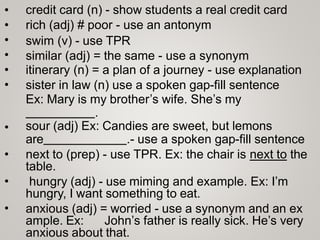
credit card (n) - show students a real credit card
rich (adj) # poor - use an antonym
swim (v) - use TPR
similar (adj) = the same - use a synonym
itinerary (n) = a plan of a journey - use explanation
sister in law (n) use a spoken gap-fill sentence
Ex: Mary is my brother’s wife. She’s my
.
sour (adj) Ex: Candies are sweet, but lemons
are .- use a spoken gap-fill sentence
next to (prep) - use TPR. Ex: the chair is next to the
table.
hungry (adj) - use miming and example. Ex: I’m
hungry, I want something to eat.
anxious (adj) = worried - use a synonym and an ex
ample. Ex: John’s father is really sick. He’s very
anxious about that.
•
•
•
•
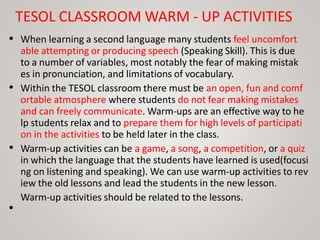
TESOL CLASSROOM WARM - UP ACTIVITIES
• When learning a second language many students feel uncomfort
able attempting or producing speech (Speaking Skill). This is due
to a number of variables, most notably the fear of making mistak
es in pronunciation, and limitations of vocabulary.
Within the TESOL classroom there must be an open, fun and comf
ortable atmosphere where students do not fear making mistakes
and can freely communicate. Warm-ups are an effective way to he
lp students relax and to prepare them for high levels of participati
on in the activities to be held later in the class.
Warm-up activities can be a game, a song, a competition, or a quiz
in which the language that the students have learned is used(focusi
ng on listening and speaking). We can use warm-up activities to rev
iew the old lessons and lead the students in the new lesson.
Warm-up activities should be related to the lessons.
•
•
•
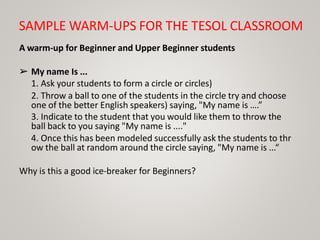
SAMPLE WARM-UPS FOR THE TESOL CLASSROOM
A warm-up for Beginner and Upper Beginner students
➢ My name Is ...
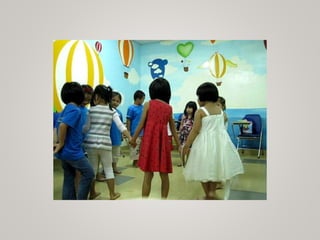
1. Ask your students to form a circle or circles)
2. Throw a ball to one of the students in the circle try and choose
one of the better English speakers) saying, "My name is ….”
3. Indicate to the student that you would like them to throw the
ball back to you saying "My name is ...."
4. Once this has been modeled successfully ask the students to thr
ow the ball at random around the circle saying, "My name is ...“
Why is this a good ice-breaker for Beginners?
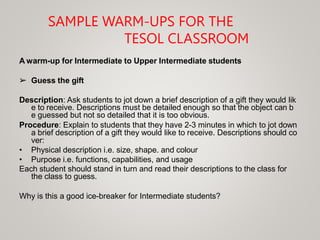
SAMPLE WARM-UPS FOR THE
TESOL CLASSROOM
A warm-up for Intermediate to Upper Intermediate students
➢ Guess the gift
Description: Ask students to jot down a brief description of a gift they would lik
e to receive. Descriptions must be detailed enough so that the object can b
e guessed but not so detailed that it is too obvious.
Procedure: Explain to students that they have 2-3 minutes in which to jot down
a brief description of a gift they would like to receive. Descriptions should co
ver:
• Physical description i.e. size, shape. and colour
• Purpose i.e. functions, capabilities, and usage
Each student should stand in turn and read their descriptions to the class for
the class to guess.
Why is this a good ice-breaker for Intermediate students?
SAMPLE WARM-UPS FOR THE
TESOL CLASSROOM
A warm-up for Advanced students
➢ Tell me about yourself
1. Ask your students to form pairs and give them a list of questions to ask
each other.
2. Alternatively you could ask your students to write their own questions.
3. Tell your students that once they have interviewed each other one pair
will be selected at random to report their findings to the whole class.
Tell me about yourself questionnaire
1. What is your name?
2. Where do you live?
3. What do you do?
4. What are your interests?
5. Why are you here?
6. Do you ever hope to live overseas? If so, where?
Now make up two questions of your own.
7. ………………………………………………………………….
8. ………………………………………………………………….
WORK IN GROUPS
- Take a look at the 2 pages of
American File 1.
- Discuss and design a warm-up activity
about 5-7 minutes. Your students are y
oung adults, elementary students.
- One representative presents in front of
the class.
Sample Warm-up activity by the teacher. –
Guessing game.
PHILOSOPHY OF TEACHING
• I feel that my responsibility as a teacher is to educate students and deve
lop their intelligence. A society cannot survive without educated citizens
and responsible, highly-trained leaders. Good citizens must be prepared
with basic skills and enough information, which will eventually enable th
em to think independently and to learn self-discipline.
As a teacher, I should provide space for individual levels of ability. Each
student should be challenged to reach the highest level of his/her ment
al, physical, and emotional capacity. I will try to create an environment i
n the classroom where each child is equally valued and appreciated. Te
aching should never humiliate or injure a student's self- esteem.
It is essential that standards be dearly defined and that discipline be firm
, fair, and consistent. The methods of measuring achievement should be u
nderstood by students, parents, and school personnel. High expectations
from a teacher will produce maximum results from the students.
I hope that as a teacher I can encourage respect for learning and intel
lectual achievement by stimulating individual curiosity about the worl
d and of mankind. I want to help students acquire knowledge of sever
al foundations that will allow them to think logically, clearly and indep
endently in order to prepare themselves for the future.
•
•
•
INSPIRATIONAL QUOTES FOR THE TESOL
TEACHER
❖ There isn't an answer to give, but one to find.
❖ There's no teacher and no student, only. learners exchanging and
sharing experiences and life itself.
❖ All people by nature desire to know.
❖ If you have knowledge, let others light their candles from it.
❖ The important thing is not so much that every child should be
taught, as that every child should be given the wish to learn.
❖ I am glad to learn, in order that I may teach.
❖ The great aim of education is not knowledge, but action.
❖ There is no royal road to learning; no short cut to the acquirement of
any'valuable art.
INSPIRATIONAL QUOTES FOR THE TESOL
TEACHER
❖ A teacher affects eternity, she can never tell where her influence
stops.
❖ A true teacher defends his pupils against his own personal
influence.
❖
❖
To know how to suggest is the great art of teaching.
What nobler employment, or more valuable to the state, than that of
the person who instructs the rising generation?
❖ The secret of teaching is to appear to have known all your life what
you learned this afternoon.
❖ A great teacher is a student, a great student is a teacher.
❖ A teacher is a guide on the side, not a sage on the stage.
❖ I am always ready to learn, but do not always like being taught.
❖ If life is a journey, then the greatest tragedy is to not have enjoyed
the ride.
WORK IN GROUPS OF THREE AND
WRITE DOWN ALL THE
WORDS/IDEAS RELATING TO:
TEACHING
CHILDREN
TEACHING CHILDREN: HELPFUL HINTS
When teaching children, keep these points in
mind.
1) Teach children only if you like children!
2) Set boundaries and keep them.
3) Be firm, but caring.
4) Be sure to vary the classroom activities.
In a 45-60 minute class, you should have 4-5
different activities for the children in your class.
Activities for children should be from 5-10 minu
tes. In the activities, have your students doing
different things: standing, watching, sitting, mo
ving, reading, drawing, acting, listening.
TEACHING CHILDREN: HELPFUL HINTS
5) Until students are about 10 years of age, teach
them language in a playful way (this is due to the
way in which the brain develops and operates and
language is acquired and transferred).
6) Behavioural problems ( items 6 – 12 in the slid
es) relating to classroom management. (later)
TIPS FOR TEACHING CHILDREN
•
•
•
•
•
•
•
•
Vary activities
Use plenty of games
Use flashcards to teach new vocabulary (sight word recognition)
Use humour
Be flexible
Pace the activities
Be patient
Understand not all children of the same age will have the same
cognitive abilities
Keep children active; running, jumping, playing and making things.
Use art and crafts
Decorate the classroom
Give rewards
Give recognition of achievement and effort
Praise regularly
Use team work
Teach by example
•
•
•
•
•
•
•
•
WHAT YOU NEED TO KNOW ABOUT
ADULT LEARNERS
• The adult learner has experience and maturity.
• The adult learner often has time to learn only what she
needs. The adult learner usually knows what he wants to
learn.
• The adult learner is usually self-
directing. Adult learners have
different learning styles.
• The adult learner often has to resume a role she left
behind many years ago.
• The adult learner wants to use what he has learned as
soon as possible.
• The adult learner is a voluntary learner.
TEACHING ADULTS
When teaching adults, keep these points in mind.
1) Give the adult learners a lot of choices and control.
2) Adult learners bring a lot of life knowledge and experience with them
to class. Let them share this knowledge and experience in the class.
3) Be careful with criticism with adults. Adults tend to take errors
personally.
4) Adults like low-risk activities at the beginning.
5) Adults want to spend their class-time wisely.
6) Adults learn best in a positive and relaxed classroom climate.
7) Adults like lots of examples to be provided.
8) Adults like to have fun as much as children do.
9) Adults need to be physically active while in the classroom, just as children
do.
10) Adults like to be praised.
11) Adults can store approximately 7 items/units in their short-term memory
at one time. This means teach smaller chunks of information at a time, then
move on to other information; rather than teach a lot of information all at one
time.
12) Adults learn from discussing with others.
13) Adults need time to reflect on new information.
14) Adults like clear instructions and explanations.
15) Adults need time to practice and correct errors.
16) Adults need to be able to ask questions.
17) Adults want to celebrate their success.
LANGUAGE RETENTION
To increase language retention in your students, it is important to
associate an action, a word, or a picture to the new information th
at you are introducing. For example, when teaching sports, mode
l an action associated with that sport (eg. baseball: swinging a ba
t) to the students and have students do the action each time they
say the sport name. By associating a physical action to the new v
ocabulary word, they will remember the new vocabulary word an
d it's meaning more effectively.
Also, repetition is very important for retention. When teaching ne
w vocabulary, always review all the words already taught during t
hat lesson before introducing the next vocabulary word. The proc
ess of returning to the first word, then each time building up the li
st with new words is effective for retention.
RETAINING LANGUAGE: THE
‘ASSOCIATION’ TECHNIQUE
One of the best methods of enabling your students to
retain language in the words of Professor John Ras
sias is to introduce “emotion, rhythm and movem
ent into the classroom”. This is usually best achie
ved by getting students out of their seats and movi
ng around.
A simple to organise activity which gives students the
chance to be active is known as the ‘Association M
ethod’ (also known as ‘Progressive Stories’). This is
useful in the TESOL classroom as a means of pract
ising the sequencing of language and also of retaini
ng language.
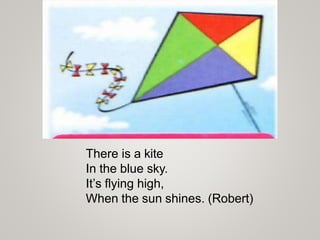
There is a kite
In the blue sky.
It’s flying high,
When the sun shines. (Robert)
STUDENT LEARNING LEVELS
BEGINNER (BASIC)
-
-
-
-
-
- May speak a little, but usually not at all. May recognize some
letters, but have trouble pronouncing them.
Understanding is very limited and may range from no apparent
comprehension to comprehending short phrases or key words.
May be unable to copy Roman script (a-z alphabet). Can usually
print own name, but cannot manage address or anything else.
May not handle pen/pencil at all, or only with awkwardness.
May not read/write in own language.
Usually has little or no sight word recognition. May have minimal
ability to phonetically decode words. If words can be decoded, th
ere may be no understanding of their meaning.
STUDENT LEARNING LEVELS
UPPER BEGINNER
-
-
-
- Minimal speaking ability, with limited vocabulary, usually
constrained to topics of personal information. Speech is f
requently interrupted by hesitations while searching for n
eeded words/structures.
Can understand only a little, usually with the help of ges
tures, and only if words are spoken at a slow pace. May
tend to repeat phrases questions just heard, rather than
respond to them.
Writing is usually quite limited (eg. name, address, and
some high- frequency words).
Can read alphabet, numbers, and basic
words/sentences.
STUDENT LEARNING LEVELS
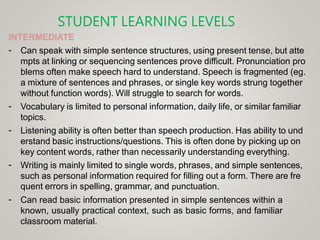
INTERMEDIATE
-
-
-
-
- Can speak with simple sentence structures, using present tense, but atte
mpts at linking or sequencing sentences prove difficult. Pronunciation pro
blems often make speech hard to understand. Speech is fragmented (eg.
a mixture of sentences and phrases, or single key words strung together
without function words). Will struggle to search for words.
Vocabulary is limited to personal information, daily life, or similar familiar
topics.
Listening ability is often better than speech production. Has ability to und
erstand basic instructions/questions. This is often done by picking up on
key content words, rather than necessarily understanding everything.
Writing is mainly limited to single words, phrases, and simple sentences,
such as personal information required for filling out a form. There are fre
quent errors in spelling, grammar, and punctuation.
Can read basic information presented in simple sentences within a
known, usually practical context, such as basic forms, and familiar
classroom material.
STUDENT LEARNING LEVELS
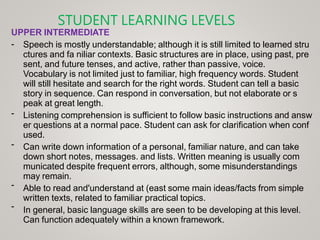
UPPER INTERMEDIATE
-
-
-
-
- Speech is mostly understandable; although it is still limited to learned stru
ctures and fa niliar contexts. Basic structures are in place, using past, pre
sent, and future tenses, and active, rather than passive, voice.
Vocabulary is not limited just to familiar, high frequency words. Student
will still hesitate and search for the right words. Student can tell a basic
story in sequence. Can respond in conversation, but not elaborate or s
peak at great length.
Listening comprehension is sufficient to follow basic instructions and answ
er questions at a normal pace. Student can ask for clarification when conf
used.
Can write down information of a personal, familiar nature, and can take
down short notes, messages. and lists. Written meaning is usually com
municated despite frequent errors, although, some misunderstandings
may remain.
Able to read and'understand at (east some main ideas/facts from simple
written texts, related to familiar practical topics.
In general, basic language skills are seen to be developing at this level.
Can function adequately within a known framework.
STUDENT LEARNING LEVELS
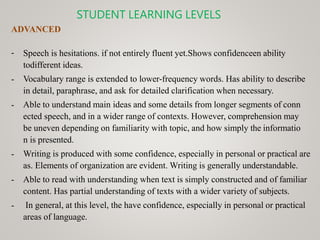
ADVANCED
-
-
-
-
-
- Speech is hesitations. if not entirely fluent yet.Shows confidenceen ability
todifferent ideas.
Vocabulary range is extended to lower-frequency words. Has ability to describe
in detail, paraphrase, and ask for detailed clarification when necessary.
Able to understand main ideas and some details from longer segments of conn
ected speech, and in a wider range of contexts. However, comprehension may
be uneven depending on familiarity with topic, and how simply the informatio
n is presented.
Writing is produced with some confidence, especially in personal or practical are
as. Elements of organization are evident. Writing is generally understandable.
Able to read with understanding when text is simply constructed and of familiar
content. Has partial understanding of texts with a wider variety of subjects.
In general, at this level, the have confidence, especially in personal or practical
areas of language.
CLASSROOM MANAGEMENT
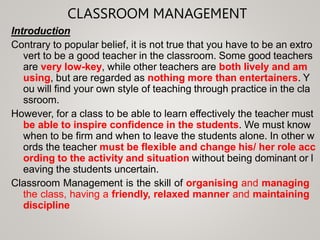
Introduction
Contrary to popular belief, it is not true that you have to be an extro
vert to be a good teacher in the classroom. Some good teachers
are very low-key, while other teachers are both lively and am
using, but are regarded as nothing more than entertainers. Y
ou will find your own style of teaching through practice in the cla
ssroom.
However, for a class to be able to learn effectively the teacher must
be able to inspire confidence in the students. We must know
when to be firm and when to leave the students alone. In other w
ords the teacher must be flexible and change his/ her role acc
ording to the activity and situation without being dominant or l
eaving the students uncertain.
Classroom Management is the skill of organising and managing
the class, having a friendly, relaxed manner and maintaining
discipline
EYE CONTACT
As we all know, it is very difficult to speak to so
meone who is always looking elsewhere or to
someone who looks us in the eye all of the ti
me. Also, we are aware that appropriate eye
contact can convey messages. Good eye con
tact in the classroom is essential to establish
a good rapport with the students. A teacher w
ho never looks students in the eye will appea
r to lack confidence and could then have prob
lems with discipline. On the other hand, starin
g at the students is not very productive either.
How can eye contact be used in the classroom?
To show students that they are all involved in the lesson.
To ensure that students understand what they are
supposed to do and what is going on.
To indicate who is to speak (often with a nod of the
head).
To encourage contributions.
To hold the attention of students who are not being
addressed.
To maintain discipline.
To signal students to start, stop or get a move on.
To indicate that something is correct or incorrect.
To check that everybody is participating.
•
•
•
•
•
•
•
•
•
GESTURE
Good use of gestures (at least commonly understood international
gestures) can be effective and useful in the following ways:
•
•
•
•
•
Convey the meaning of language
Manage the class, e.g. to reinforce instructions
To add visual interest
To increase the pace of the lesson
To reduce the need for verbal explanation
Which gestures you could use for the following situations:
-
-
-
-
-
-
-
listen: Put your hand behind your ear
repeat in chorus:
get into pairs: St
op:
Good: n
ot right:
nearly right;
VOICE
If your voice does not have the correct clarity, range, variety or pr
ojection, you will have a difficult time in making your instructio
ns and explanations understood to all members of the class. Y
our voice should change naturally according to the circumstan
ces, e.g. Individual tutoring lesson or 16 young children. Obvio
usly greater projection will be necessary in a large, noisy class
room than a small quiet room. An effective teacher will also ad
apt the complexity of his/her language to suit the level and abil
ity of the students.
As a class often follows the lead of the teacher, the lesson can b
e livened up or quietened down by an alteration in the volume
of the teacher’s voice. The greater the variation in the tone an
d range of the voice, the greater the effectiveness. A dull mon
otone will only create boredom and lead to students not payin
g attention and misbehaving.
USING STUDENTS’ NAMES
Student’s names should be used when you
want to:
•
•
•
•
•
organise an activity ackno
wledge the students
indicate who is to answer or respond
get the attention of a student
build rapport with the students
GROUPING STUDENTS
There is no real limit to the way a teacher can group st
udents, though factors such as class size and classr
oom furniture can be problematic. Activities geared to
the whole class, students working alone, in pairs and
larger groups, are all appropriate and each has its ow
n place in the classroom.
- Whole-class grouping pros and cons
- Students working on their own – pros and cons
- Pair work – pros and cons
- Group work – pros and cons
GIVING INDIVIDUAL ATTENTION
•Make sure you know all the students’ names. Don’t just pick on the
students whose names you know. Make the effort to get to know ev
eryone.
If necessary, spend longer with students who do not understand or
who cannot do the task.
Don’t teach exclusively to only the strong or weak students.
Try to be unpredictable.
Don’t allow individual students to ‘hog’ your attention. Re
member to include all students equally in any activity.
If students do not want to, or cannot contribute, it may be better to
let them remain silent. They should never feel that they are being p
icked on. To help build such a student’s confidence, ask simple qu
estions that you know the student is likely to be able to answer corr
ectly, giving praise when s/he responds.
•
•
•
•
•
•
ESTABLISHING RAPPORT
Rapport between the teacher and students (and between the
students themselves) plays an important part in determinin
g if a class is successful and enjoyable. Students are more
likely to contribute and take part in the lessons when the at
mosphere is relaxed and they get on well with the teacher.
While the students play a large part in setting the atmosphe
re in the classroom, it can be encouraged and stimulated b
y the general attitude and approach of the teacher.
REASONS FOR PROBLEM BEHAVIOUR
There are many reasons why disciplinary problems can occur in
theclassroom. These can often include:
•
•
•
•
•
•
•
•
•
•
Family problems
Low self-esteem
Boredom
Peer pressure
Lack of respect for the teacher/ other students
Class size
Lack of understanding of lesson material or requirements
Lesson too easy or too difficult
Poor pacing
Lack of motivation
Some of these problems are out of your hands but many
disciplinary issues can be prevented by the teacher.
PREVENTING PROBLEM BEHAVIOUR
You can help stop problems arising in the first place if:
•
•
•
•
you are punctual
you are well prepared
you are consistent and fair
you do not let personal feelings influence your treatment of
students
• you never make threats that you cannot or are not prepared to
carry out
•
•
•
you return homework promptly
you never lose your temper
you show the same respect for your students as you expect from
them
you make your lessons interesting and varied
you are enthusiastic about your teaching
you establish rapport(relationship) with the students
•
•
•
RESPONDING TO PROBLEM BEHAVIOUR
If you have done everything possible to prevent problem behaviour, what can
you do if it still arises?
•
•
•
•
•
•
•
• Act immediately – don’t wait for the problem to worsen. This could simply i
nvolve stopping and looking at the student. However, sometimes stronger
action may be necessary.
Focus on the behaviour and not the student.
Change the classroom dynamic – reseat the students if necessary/
appropriate.
Keep calm – losing your temper never helps.
Keep the problem student behind after class and reprimand in private.
Keep to the school’s disciplinary code and don’t make threats that you
cannot enforce.
Use the knowledge of your colleagues. They have probably been in the sam
e situation before and should be able to offer suggestions. Don’t be too
proud to ask for advice.
Bear in mind that it’s possible to go ‘over the top’ with rules.

Warm up Techniques and Activities in Classroom.pptx

  • 1.
    WARM UP TECHNIQUESAND ACTIVITIES BY JAGOBAHASA
  • 2.
    GOALS: • TESOL ClassroomWarm ups Activities • Philosophy of Teaching (read at home) • Teaching children, Teaching Adults • Students learning levels. (read at home) • Retaining language – The association method • Classroom management
  • 3.
    REVISION How would youdemonstrate these words to your students? 1. credit card (n) 2. rich (adj) 3. swim (v) 4. similar (adj) 5. itinerary (n) 6. sister in law (n) 7. sour (adj) 8. next to (prep) 9. hungry (adj) 10. anxious (adj)
  • 4.
    • • • • • • credit card (n)- show students a real credit card rich (adj) # poor - use an antonym swim (v) - use TPR similar (adj) = the same - use a synonym itinerary (n) = a plan of a journey - use explanation sister in law (n) use a spoken gap-fill sentence Ex: Mary is my brother’s wife. She’s my . sour (adj) Ex: Candies are sweet, but lemons are .- use a spoken gap-fill sentence next to (prep) - use TPR. Ex: the chair is next to the table. hungry (adj) - use miming and example. Ex: I’m hungry, I want something to eat. anxious (adj) = worried - use a synonym and an ex ample. Ex: John’s father is really sick. He’s very anxious about that. • • • •
  • 5.
    TESOL CLASSROOM WARM- UP ACTIVITIES • When learning a second language many students feel uncomfort able attempting or producing speech (Speaking Skill). This is due to a number of variables, most notably the fear of making mistak es in pronunciation, and limitations of vocabulary. Within the TESOL classroom there must be an open, fun and comf ortable atmosphere where students do not fear making mistakes and can freely communicate. Warm-ups are an effective way to he lp students relax and to prepare them for high levels of participati on in the activities to be held later in the class. Warm-up activities can be a game, a song, a competition, or a quiz in which the language that the students have learned is used(focusi ng on listening and speaking). We can use warm-up activities to rev iew the old lessons and lead the students in the new lesson. Warm-up activities should be related to the lessons. • • •
  • 6.
    SAMPLE WARM-UPS FORTHE TESOL CLASSROOM A warm-up for Beginner and Upper Beginner students ➢ My name Is ... 1. Ask your students to form a circle or circles) 2. Throw a ball to one of the students in the circle try and choose one of the better English speakers) saying, "My name is ….” 3. Indicate to the student that you would like them to throw the ball back to you saying "My name is ...." 4. Once this has been modeled successfully ask the students to thr ow the ball at random around the circle saying, "My name is ...“ Why is this a good ice-breaker for Beginners?
  • 7.
    SAMPLE WARM-UPS FORTHE TESOL CLASSROOM A warm-up for Intermediate to Upper Intermediate students ➢ Guess the gift Description: Ask students to jot down a brief description of a gift they would lik e to receive. Descriptions must be detailed enough so that the object can b e guessed but not so detailed that it is too obvious. Procedure: Explain to students that they have 2-3 minutes in which to jot down a brief description of a gift they would like to receive. Descriptions should co ver: • Physical description i.e. size, shape. and colour • Purpose i.e. functions, capabilities, and usage Each student should stand in turn and read their descriptions to the class for the class to guess. Why is this a good ice-breaker for Intermediate students?
  • 8.
    SAMPLE WARM-UPS FORTHE TESOL CLASSROOM A warm-up for Advanced students ➢ Tell me about yourself 1. Ask your students to form pairs and give them a list of questions to ask each other. 2. Alternatively you could ask your students to write their own questions. 3. Tell your students that once they have interviewed each other one pair will be selected at random to report their findings to the whole class. Tell me about yourself questionnaire 1. What is your name? 2. Where do you live? 3. What do you do? 4. What are your interests? 5. Why are you here? 6. Do you ever hope to live overseas? If so, where? Now make up two questions of your own. 7. …………………………………………………………………. 8. ………………………………………………………………….
  • 9.
    WORK IN GROUPS -Take a look at the 2 pages of American File 1. - Discuss and design a warm-up activity about 5-7 minutes. Your students are y oung adults, elementary students. - One representative presents in front of the class. Sample Warm-up activity by the teacher. – Guessing game.
  • 10.
    PHILOSOPHY OF TEACHING •I feel that my responsibility as a teacher is to educate students and deve lop their intelligence. A society cannot survive without educated citizens and responsible, highly-trained leaders. Good citizens must be prepared with basic skills and enough information, which will eventually enable th em to think independently and to learn self-discipline. As a teacher, I should provide space for individual levels of ability. Each student should be challenged to reach the highest level of his/her ment al, physical, and emotional capacity. I will try to create an environment i n the classroom where each child is equally valued and appreciated. Te aching should never humiliate or injure a student's self- esteem. It is essential that standards be dearly defined and that discipline be firm , fair, and consistent. The methods of measuring achievement should be u nderstood by students, parents, and school personnel. High expectations from a teacher will produce maximum results from the students. I hope that as a teacher I can encourage respect for learning and intel lectual achievement by stimulating individual curiosity about the worl d and of mankind. I want to help students acquire knowledge of sever al foundations that will allow them to think logically, clearly and indep endently in order to prepare themselves for the future. • • •
  • 11.
    INSPIRATIONAL QUOTES FORTHE TESOL TEACHER ❖ There isn't an answer to give, but one to find. ❖ There's no teacher and no student, only. learners exchanging and sharing experiences and life itself. ❖ All people by nature desire to know. ❖ If you have knowledge, let others light their candles from it. ❖ The important thing is not so much that every child should be taught, as that every child should be given the wish to learn. ❖ I am glad to learn, in order that I may teach. ❖ The great aim of education is not knowledge, but action. ❖ There is no royal road to learning; no short cut to the acquirement of any'valuable art.
  • 12.
    INSPIRATIONAL QUOTES FORTHE TESOL TEACHER ❖ A teacher affects eternity, she can never tell where her influence stops. ❖ A true teacher defends his pupils against his own personal influence. ❖ ❖ To know how to suggest is the great art of teaching. What nobler employment, or more valuable to the state, than that of the person who instructs the rising generation? ❖ The secret of teaching is to appear to have known all your life what you learned this afternoon. ❖ A great teacher is a student, a great student is a teacher. ❖ A teacher is a guide on the side, not a sage on the stage. ❖ I am always ready to learn, but do not always like being taught. ❖ If life is a journey, then the greatest tragedy is to not have enjoyed the ride.
  • 13.
    WORK IN GROUPSOF THREE AND WRITE DOWN ALL THE WORDS/IDEAS RELATING TO: TEACHING CHILDREN
  • 14.
    TEACHING CHILDREN: HELPFULHINTS When teaching children, keep these points in mind. 1) Teach children only if you like children! 2) Set boundaries and keep them. 3) Be firm, but caring. 4) Be sure to vary the classroom activities. In a 45-60 minute class, you should have 4-5 different activities for the children in your class. Activities for children should be from 5-10 minu tes. In the activities, have your students doing different things: standing, watching, sitting, mo ving, reading, drawing, acting, listening.
  • 15.
    TEACHING CHILDREN: HELPFULHINTS 5) Until students are about 10 years of age, teach them language in a playful way (this is due to the way in which the brain develops and operates and language is acquired and transferred). 6) Behavioural problems ( items 6 – 12 in the slid es) relating to classroom management. (later)
  • 16.
    TIPS FOR TEACHINGCHILDREN • • • • • • • • Vary activities Use plenty of games Use flashcards to teach new vocabulary (sight word recognition) Use humour Be flexible Pace the activities Be patient Understand not all children of the same age will have the same cognitive abilities Keep children active; running, jumping, playing and making things. Use art and crafts Decorate the classroom Give rewards Give recognition of achievement and effort Praise regularly Use team work Teach by example • • • • • • • •
  • 17.
    WHAT YOU NEEDTO KNOW ABOUT ADULT LEARNERS • The adult learner has experience and maturity. • The adult learner often has time to learn only what she needs. The adult learner usually knows what he wants to learn. • The adult learner is usually self- directing. Adult learners have different learning styles. • The adult learner often has to resume a role she left behind many years ago. • The adult learner wants to use what he has learned as soon as possible. • The adult learner is a voluntary learner.
  • 18.
    TEACHING ADULTS When teachingadults, keep these points in mind. 1) Give the adult learners a lot of choices and control. 2) Adult learners bring a lot of life knowledge and experience with them to class. Let them share this knowledge and experience in the class. 3) Be careful with criticism with adults. Adults tend to take errors personally. 4) Adults like low-risk activities at the beginning. 5) Adults want to spend their class-time wisely. 6) Adults learn best in a positive and relaxed classroom climate. 7) Adults like lots of examples to be provided. 8) Adults like to have fun as much as children do.
  • 19.
    9) Adults needto be physically active while in the classroom, just as children do. 10) Adults like to be praised. 11) Adults can store approximately 7 items/units in their short-term memory at one time. This means teach smaller chunks of information at a time, then move on to other information; rather than teach a lot of information all at one time. 12) Adults learn from discussing with others. 13) Adults need time to reflect on new information. 14) Adults like clear instructions and explanations. 15) Adults need time to practice and correct errors. 16) Adults need to be able to ask questions. 17) Adults want to celebrate their success.
  • 21.
    LANGUAGE RETENTION To increaselanguage retention in your students, it is important to associate an action, a word, or a picture to the new information th at you are introducing. For example, when teaching sports, mode l an action associated with that sport (eg. baseball: swinging a ba t) to the students and have students do the action each time they say the sport name. By associating a physical action to the new v ocabulary word, they will remember the new vocabulary word an d it's meaning more effectively. Also, repetition is very important for retention. When teaching ne w vocabulary, always review all the words already taught during t hat lesson before introducing the next vocabulary word. The proc ess of returning to the first word, then each time building up the li st with new words is effective for retention.
  • 22.
    RETAINING LANGUAGE: THE ‘ASSOCIATION’TECHNIQUE One of the best methods of enabling your students to retain language in the words of Professor John Ras sias is to introduce “emotion, rhythm and movem ent into the classroom”. This is usually best achie ved by getting students out of their seats and movi ng around. A simple to organise activity which gives students the chance to be active is known as the ‘Association M ethod’ (also known as ‘Progressive Stories’). This is useful in the TESOL classroom as a means of pract ising the sequencing of language and also of retaini ng language.
  • 23.
    There is akite In the blue sky. It’s flying high, When the sun shines. (Robert)
  • 24.
    STUDENT LEARNING LEVELS BEGINNER(BASIC) - - - - - - May speak a little, but usually not at all. May recognize some letters, but have trouble pronouncing them. Understanding is very limited and may range from no apparent comprehension to comprehending short phrases or key words. May be unable to copy Roman script (a-z alphabet). Can usually print own name, but cannot manage address or anything else. May not handle pen/pencil at all, or only with awkwardness. May not read/write in own language. Usually has little or no sight word recognition. May have minimal ability to phonetically decode words. If words can be decoded, th ere may be no understanding of their meaning.
  • 25.
    STUDENT LEARNING LEVELS UPPERBEGINNER - - - - Minimal speaking ability, with limited vocabulary, usually constrained to topics of personal information. Speech is f requently interrupted by hesitations while searching for n eeded words/structures. Can understand only a little, usually with the help of ges tures, and only if words are spoken at a slow pace. May tend to repeat phrases questions just heard, rather than respond to them. Writing is usually quite limited (eg. name, address, and some high- frequency words). Can read alphabet, numbers, and basic words/sentences.
  • 26.
    STUDENT LEARNING LEVELS INTERMEDIATE - - - - -Can speak with simple sentence structures, using present tense, but atte mpts at linking or sequencing sentences prove difficult. Pronunciation pro blems often make speech hard to understand. Speech is fragmented (eg. a mixture of sentences and phrases, or single key words strung together without function words). Will struggle to search for words. Vocabulary is limited to personal information, daily life, or similar familiar topics. Listening ability is often better than speech production. Has ability to und erstand basic instructions/questions. This is often done by picking up on key content words, rather than necessarily understanding everything. Writing is mainly limited to single words, phrases, and simple sentences, such as personal information required for filling out a form. There are fre quent errors in spelling, grammar, and punctuation. Can read basic information presented in simple sentences within a known, usually practical context, such as basic forms, and familiar classroom material.
  • 27.
    STUDENT LEARNING LEVELS UPPERINTERMEDIATE - - - - - Speech is mostly understandable; although it is still limited to learned stru ctures and fa niliar contexts. Basic structures are in place, using past, pre sent, and future tenses, and active, rather than passive, voice. Vocabulary is not limited just to familiar, high frequency words. Student will still hesitate and search for the right words. Student can tell a basic story in sequence. Can respond in conversation, but not elaborate or s peak at great length. Listening comprehension is sufficient to follow basic instructions and answ er questions at a normal pace. Student can ask for clarification when conf used. Can write down information of a personal, familiar nature, and can take down short notes, messages. and lists. Written meaning is usually com municated despite frequent errors, although, some misunderstandings may remain. Able to read and'understand at (east some main ideas/facts from simple written texts, related to familiar practical topics. In general, basic language skills are seen to be developing at this level. Can function adequately within a known framework.
  • 28.
    STUDENT LEARNING LEVELS ADVANCED - - - - - -Speech is hesitations. if not entirely fluent yet.Shows confidenceen ability todifferent ideas. Vocabulary range is extended to lower-frequency words. Has ability to describe in detail, paraphrase, and ask for detailed clarification when necessary. Able to understand main ideas and some details from longer segments of conn ected speech, and in a wider range of contexts. However, comprehension may be uneven depending on familiarity with topic, and how simply the informatio n is presented. Writing is produced with some confidence, especially in personal or practical are as. Elements of organization are evident. Writing is generally understandable. Able to read with understanding when text is simply constructed and of familiar content. Has partial understanding of texts with a wider variety of subjects. In general, at this level, the have confidence, especially in personal or practical areas of language.
  • 29.
    CLASSROOM MANAGEMENT Introduction Contrary topopular belief, it is not true that you have to be an extro vert to be a good teacher in the classroom. Some good teachers are very low-key, while other teachers are both lively and am using, but are regarded as nothing more than entertainers. Y ou will find your own style of teaching through practice in the cla ssroom. However, for a class to be able to learn effectively the teacher must be able to inspire confidence in the students. We must know when to be firm and when to leave the students alone. In other w ords the teacher must be flexible and change his/ her role acc ording to the activity and situation without being dominant or l eaving the students uncertain. Classroom Management is the skill of organising and managing the class, having a friendly, relaxed manner and maintaining discipline
  • 30.
    EYE CONTACT As weall know, it is very difficult to speak to so meone who is always looking elsewhere or to someone who looks us in the eye all of the ti me. Also, we are aware that appropriate eye contact can convey messages. Good eye con tact in the classroom is essential to establish a good rapport with the students. A teacher w ho never looks students in the eye will appea r to lack confidence and could then have prob lems with discipline. On the other hand, starin g at the students is not very productive either.
  • 31.
    How can eyecontact be used in the classroom? To show students that they are all involved in the lesson. To ensure that students understand what they are supposed to do and what is going on. To indicate who is to speak (often with a nod of the head). To encourage contributions. To hold the attention of students who are not being addressed. To maintain discipline. To signal students to start, stop or get a move on. To indicate that something is correct or incorrect. To check that everybody is participating. • • • • • • • • •
  • 32.
    GESTURE Good use ofgestures (at least commonly understood international gestures) can be effective and useful in the following ways: • • • • • Convey the meaning of language Manage the class, e.g. to reinforce instructions To add visual interest To increase the pace of the lesson To reduce the need for verbal explanation Which gestures you could use for the following situations: - - - - - - - listen: Put your hand behind your ear repeat in chorus: get into pairs: St op: Good: n ot right: nearly right;
  • 33.
    VOICE If your voicedoes not have the correct clarity, range, variety or pr ojection, you will have a difficult time in making your instructio ns and explanations understood to all members of the class. Y our voice should change naturally according to the circumstan ces, e.g. Individual tutoring lesson or 16 young children. Obvio usly greater projection will be necessary in a large, noisy class room than a small quiet room. An effective teacher will also ad apt the complexity of his/her language to suit the level and abil ity of the students. As a class often follows the lead of the teacher, the lesson can b e livened up or quietened down by an alteration in the volume of the teacher’s voice. The greater the variation in the tone an d range of the voice, the greater the effectiveness. A dull mon otone will only create boredom and lead to students not payin g attention and misbehaving.
  • 34.
    USING STUDENTS’ NAMES Student’snames should be used when you want to: • • • • • organise an activity ackno wledge the students indicate who is to answer or respond get the attention of a student build rapport with the students
  • 35.
    GROUPING STUDENTS There isno real limit to the way a teacher can group st udents, though factors such as class size and classr oom furniture can be problematic. Activities geared to the whole class, students working alone, in pairs and larger groups, are all appropriate and each has its ow n place in the classroom. - Whole-class grouping pros and cons - Students working on their own – pros and cons - Pair work – pros and cons - Group work – pros and cons
  • 36.
    GIVING INDIVIDUAL ATTENTION •Makesure you know all the students’ names. Don’t just pick on the students whose names you know. Make the effort to get to know ev eryone. If necessary, spend longer with students who do not understand or who cannot do the task. Don’t teach exclusively to only the strong or weak students. Try to be unpredictable. Don’t allow individual students to ‘hog’ your attention. Re member to include all students equally in any activity. If students do not want to, or cannot contribute, it may be better to let them remain silent. They should never feel that they are being p icked on. To help build such a student’s confidence, ask simple qu estions that you know the student is likely to be able to answer corr ectly, giving praise when s/he responds. • • • • • •
  • 37.
    ESTABLISHING RAPPORT Rapport betweenthe teacher and students (and between the students themselves) plays an important part in determinin g if a class is successful and enjoyable. Students are more likely to contribute and take part in the lessons when the at mosphere is relaxed and they get on well with the teacher. While the students play a large part in setting the atmosphe re in the classroom, it can be encouraged and stimulated b y the general attitude and approach of the teacher.
  • 38.
    REASONS FOR PROBLEMBEHAVIOUR There are many reasons why disciplinary problems can occur in theclassroom. These can often include: • • • • • • • • • • Family problems Low self-esteem Boredom Peer pressure Lack of respect for the teacher/ other students Class size Lack of understanding of lesson material or requirements Lesson too easy or too difficult Poor pacing Lack of motivation Some of these problems are out of your hands but many disciplinary issues can be prevented by the teacher.
  • 39.
    PREVENTING PROBLEM BEHAVIOUR Youcan help stop problems arising in the first place if: • • • • you are punctual you are well prepared you are consistent and fair you do not let personal feelings influence your treatment of students • you never make threats that you cannot or are not prepared to carry out • • • you return homework promptly you never lose your temper you show the same respect for your students as you expect from them you make your lessons interesting and varied you are enthusiastic about your teaching you establish rapport(relationship) with the students • • •
  • 40.
    RESPONDING TO PROBLEMBEHAVIOUR If you have done everything possible to prevent problem behaviour, what can you do if it still arises? • • • • • • • • Act immediately – don’t wait for the problem to worsen. This could simply i nvolve stopping and looking at the student. However, sometimes stronger action may be necessary. Focus on the behaviour and not the student. Change the classroom dynamic – reseat the students if necessary/ appropriate. Keep calm – losing your temper never helps. Keep the problem student behind after class and reprimand in private. Keep to the school’s disciplinary code and don’t make threats that you cannot enforce. Use the knowledge of your colleagues. They have probably been in the sam e situation before and should be able to offer suggestions. Don’t be too proud to ask for advice. Bear in mind that it’s possible to go ‘over the top’ with rules.