P R E S E N T E D B Y K R I S D E L A P L A I N
A P R I L 1 2 , 2 0 1 6
Teamwork in the Classroom
Agenda
 Introductions
 Define the team and specify roles and
responsibilities of team members.
 The importance of communication between team
members.
 Teaming to support students based upon classroom
scenarios.
SECTION 1:
DEFINING “THE TEAM”
Defining the “TEAM”
 A Team consists of members who join in the
common purpose of serving students by:
Identifying student needs.
Establishing priorities.
Deciding who does what with whom for
how long using what resources.
Communication
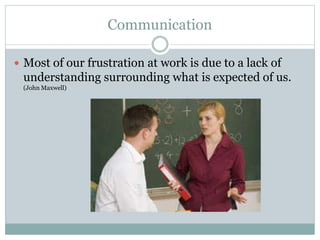
 Most of our frustration at work is due to a lack of
understanding surrounding what is expected of us.
(John Maxwell)
What Does it Take to Make a Good Team
a Great Team?
 Communication
 Valued membership
 Respect
 Common goal
 Open-mindedness
 Cooperation
 Sense of humor
Activity: Defining your Team
Handout
 Who are the members of your team?
 List the role each member plays.
 List the responsibilities of each member within the
school and the team.
Make Sure You Stay in Your Lane
Consider:
 What would happen if the dentist and
the dental hygienist didn’t “stay in their
lane?”
 What about the ER Doctor and nursing
staff?
Defining roles
 What’s my job?
 What’s not my job?
 Whose job is it?
Whether you are new or experienced, it is
important…to clearly understand the difference
between teachers’ roles and …[the
paraprofessional’s] roles as members of instructional
teams (Pickett, et. al, 2007, p 15)
The Teacher’s Role
Teachers…
 Identify learning needs
 Plan lessons
 Modify curriculum or instructional methods
 Evaluate the effectiveness of the instruction
 Involve parents in their child’s education
 Manage behavior
 Create a positive learning environment
Paraprofessional’s role
 Paraprofessionals assist teachers in achieving the learning goals for students by
carrying out tasks developed by and assigned to them by teachers.
 Paraprofessionals…
 Accept and complete assigned tasks
 Respect and work collaboratively with others
 Maintain a positive and caring environment
 Communicate often with team members
 Follow policies concerning confidentiality, security, and safety
 Paraprofessionals responsibilities to the teacher
 Adjust to changing needs, demands, and tasks
 Engage learners in activities developed by the teacher
 Follow behavior plans created by the teacher
 Assist in collecting data in order for the teacher to make instructional decisions
 Communicate challenges, opportunities, and experiences at periodic meetings
 Perform tasks only for which they are trained
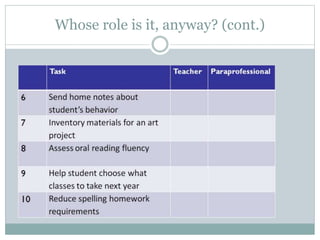
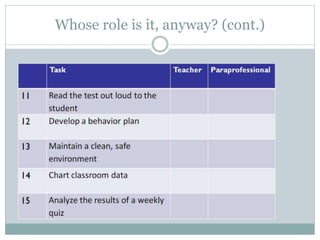
Activity: Whose Role is it?
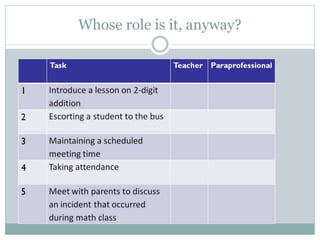
 Work in partners to determine if the teacher, the
paraprofessional or both are responsible for the task.
 Place a checkmark in the correct column of the most
appropriate person(s) to be responsible.
 Discuss your choices.
Whose role is it, anyway?
Whose role is it, anyway? (cont.)
Section I Summary
 There are many factors that make a ‘good’ team a
‘great’ team.
 Team members each have a role and a responsibility
to the team.
 Each members role and responsibility must be
defined in order to create a positive learning
environment.
SECTION 2:
GOOD COMMUNICATION BUILDS
EFFECTIVE TEAMS
17
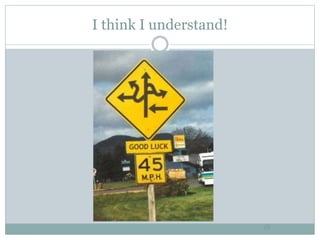
I think I understand!
18
Use Effective Communication Skills
19
 Demonstrate professionalism
 Use correct grammar, speak and write clearly
 Avoid slang and profanity
 Be a positive role model by the way you speak and act
 Avoid negative talk about anyone!
 Listen with the intent of understanding the message
(e.g. “So, what I hear you saying is…”)
Use Effective Communication Skills
20
 Ask questions
 Paraphrase to check that you understand
 Seek clarification and additional information
 Encourage others to talk and share
 Maintain a positive and upbeat attitude
 Be able to explain a problem or give information in a
concise, factual manner
 Stay calm and cool
Use Effective Communication Skills
21
 Share information in a timely manner
 Focus on the positive aspects of a difficult
situation. Good things can come out of tough
situations. But, it takes work to discover and
capitalize on them.
 Acknowledge the contributions, knowledge, and
expertise of others.
Write a goal for improvement in one of these areas?
How can I make it a good habit?
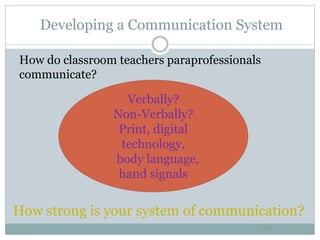
Developing a Communication System
22
How do classroom teachers paraprofessionals
communicate?
Verbally?
Non-Verbally?
Print, digital
technology,
body language,
hand signals
How strong is your system of communication?
Developing a Communication System
23
 What do we need to communicate about?
 Classroom routines and scheduling
 Individual student progress
 Clarification questions
 Clarifying roles and responsibilities
 Curriculum planning
 Request assistance
 Emergencies
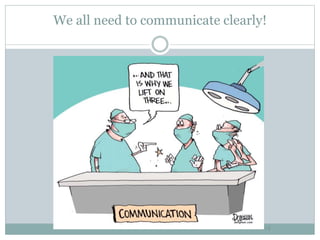
We all need to communicate clearly!
24
Three Components of Positive Communication
25
When communicating with others (i.e. teachers,
students) we need to be aware of:
the words we choose
how we say the words
our body language
The Words We Choose
26
Teacher in Learning Support Classroom:
“Alex, when you are typing your report, why do you
type two spaces after every word?”
Student in Learning Support Classroom:
“Well Ms. B., Mrs. Smith told me this must be doubled
spaced.”
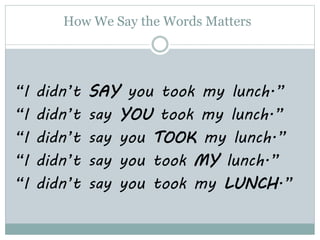
How We Say the Words Matters
“I didn’t SAY you took my lunch.”
“I didn’t say YOU took my lunch.”
“I didn’t say you TOOK my lunch.”
“I didn’t say you took MY lunch.”
“I didn’t say you took my LUNCH.”
Activity: Our Body Language
28
What are some ways your body language
could send mixed-messages to your team
members and/or students?
Fill in the bubbles for the next 3 slides.
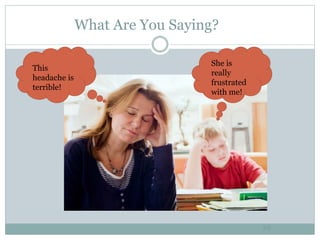
What Are You Saying?
29
This
headache is
terrible!
She is
really
frustrated
with me!
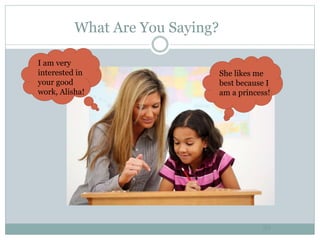
What Are You Saying?
30
I am very
interested in
your good
work, Alisha!
She likes me
best because I
am a princess!
What Are You Saying?
31
I can’t believe
you just did
that!
It is freezing in
here!
Avoid Communication Breakdown
32
 Consider how your attitudes, bias, or feelings may
influence your communication.
 Be aware of similarities and differences, (i.e. points
of view, education levels, experiences).
 Develop a shared vocabulary and system of
nonverbal cues
Adapted from Pickett, A.L. (1986)
Effective Communication Strategies
33
Team Members
 specify task directions and expectations proactively;
 are willing to ask for clarification, when needed;
 utilize each other’s special talents and interests;
 create an atmosphere of trust, cooperation, and
respect.
Adapted from Pickett, A.L. (1986)
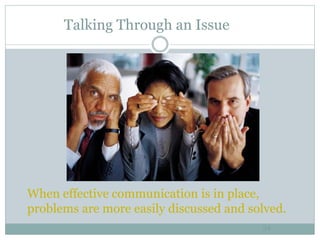
Talking Through an Issue
34
When effective communication is in place,
problems are more easily discussed and solved.
The Solution-Finding Process
35
Even in the most effective teams,
problems can arise. It is important to
take the necessary steps to address the
conflict within a respectful process.
We often may not be aware of all of the
factors that go into making a decision.
The Process of Finding the Solution!
1. Identify and describe the problem
• What is the problem?
• What is not working?
• What factors are contributing to the situation?
• Who is involved in the situation?
• Who is affected and how?
2. Define and determine the cause of the problem
3. Decide on a goal and identify alternative solutions
The Process of Finding the Solution!
4. Select a course of action
• Which solution is under the team’s control?
• Which one will meet the needs and achieve the goal?
• Which is least disruptive and easiest to implement?
5. Implement and evaluate the solution
• What resources are needed?
• Who will do what?
• What is the timeline?
• Evaluate the solution and the process used to get
there
• Did we achieve the goal?
• Was the process effective?
Characteristics of Effective Teams
38
Using the handout, circle the number showing to what degree you believe
these effective team characteristics are implemented in your team.
1 2 3 4 5
____________________________________________________
Absent Working on it We’ve got it!
Characteristics of Effective Teams
39
 Compare notes!
 What are the areas of disagreement about degree of
implementation?
 What are the areas of agreement?
 Set a goal for improving one or two of the
characteristics
 Create a plan on how to do so
 Follow up and follow through!
Section 2: Summary
40
 Communication is a key characteristic of effective
teams.
 Teams need to have a communication system
defined to ensure that all members are informed and
comfortable.
 Build a solution-finding process as part of the team
communication system.
SECTION 3:
TEAMING TO SUPPORT
STUDENTS IN THE CLASSROOM
41
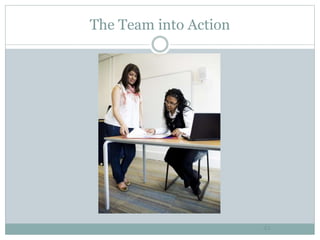
The Team into Action
42
A Positive Environment
43
 Promote a positive learning environment for all!
 Special education paraprofessionals support
teachers’ efforts in maintaining a positive, proactive
environment. This is one of the most important
things you can do for students.
 A positive, supportive learning environment
encourages learning. Students must feel safe to
inquire, participate, collaborate, and study.
A Positive Environment:
The Team
44
 The team interacts often to ensure that all on
the team are “kept in the loop.”
 Adults confer and plan with the common goal of
advancing learning of students.
 Adults speak to students, and each other, in
kind and respectful ways, never yelling or being
unkind.
 Paraprofessionals follow the guidance of
teachers.
 Disagreements are not displayed in front of
students.
A Positive Environment:
The Students
45
 Model appropriate academic and social behavior
 Address the needs of ALL children and adults
 Offer encouragement
 Answer questions
 Praise on-task behavior; redirect off-task behavior
 Thank a student for follow directions promptly
 Assist students in problem solving
The Team: The Four Knows…
46
 Know yourself
 Know your partner
 Know your students
 Know your stuff
Article: Keefe, E.B., Moore, V., Duff, F. The Four “Knows” of Collaborative
Teaching
Council For Exceptional Children, May/June 2004
Teaming Scenario One
The teacher asks the paraprofessional to develop and
teach a social studies lesson to a student. The
paraprofessional asks the teacher for some
information and guidance.
The teacher responds, “Oh, it doesn’t make a
difference how you do it, but I know you’ll do a
great job.”
Identify the ineffective teaming practices in this
scenario and describe possible solutions.
Teaming Scenario Two
A parent of a student in your program asks the
paraprofessional’s opinion about the teaching skills
of the classroom teacher. She isn’t happy with her
child’s progress and thinks the teacher is
incompetent.
How might the paraprofessional respond to this
situation to ensure confidentiality and to honor the
team relationship?
Teaming Scenario Three
A paraprofessional has been assigned to work as a 1:1
paraprofessional for a student with complex needs in
the third grade class.
List information the team should share on the first day
to effective serve the student.
Teaming Scenario Four
50
The teacher is showing the students double-digit
addition on the board. The paraprofessional notices
that a student is talking with a classmate, distracting
them from listening to the teacher.
 Discuss with your team, how both the teacher
and the paraprofessional should respond in this
situation.
 How could the team be proactive in keeping this
problem from occurring in the first place? What
class rules need to be established?
Solutions: Engage in Dialogue
 Paraprofessionals or teachers who are having
difficulty initiating conversation with partners
should consider the following suggestions:
 Try to set a prearranged time
 Be aware of partner’s mood when initiating conversation.
 Have something concrete, such as the survey, to refer to during
conversation.
 If all attempts to enter into a dialogue have failed, enlist the
aid of a third party.
Solutions: Defined Expectations
 The teacher and paraprofessional should work
together to develop a list of expectations for both the
teacher and the paraprofessional. These expectations
can be based on the survey form.
 Expectations must be clear to both people.
 The paraprofessional must make sure that he or she
understands clearly what is to be expected of them in the
classroom—both what is to be done and when and how it is to
be done.
 The teacher must make sure that her/his expectations are
based on realistic skills which the paraprofessional possesses.
Solutions: Shared Planning Time
 If possible, both the paraprofessional and the teacher
should plan together at times – whether it’s during
an entire prep period once a week or a few minutes
at the beginning or end of each day.
 It is helpful if the paraprofessional as well as the
teacher, have a written plan. If a plan book is not
available for the paraprofessional, other documents
like classroom rules, schedules, etc. can be used.
Section 3: Summary
54
 Effective teaming practices including building
and maintaining positive relationships
benefits all.
 Resources and materials are available to
support teams.
 Members need to tend to the growth of the
team as a whole to ensure it works effectively
and efficiently.
Quotes
 “My teacher never explains how she wants anything
done. Then she’s all over my back because its not done
the way she wants.”
 My teacher gives me only the boring work to do. I never
get to work with the kids. I just run off papers and run
errands. I have some skills that I sure would like to use if
I just had the chance.”
 “I know my job is to support the teacher, but five
playground duties every week, no matter what the
weather is like, a little too much. When I try to talk about
it to the teacher, she just shrugs and says, “That’s your
job.”
Resources
56
 Doyle, M. (2008), The paraprofessional’s guide to the inclusive
classroom: Working as a team (3rd ed.). Baltimore: Paul H. Brookes
Publishing Co.
 Keefe, E.B., Moore, V., Duff, F. The Four “Knows” of Collaborative
Teaching Council For Exceptional Children, May/June 2004
 Morgan, J. & Ashbaker, B. (2001). A teacher’s guide to working with
paraprofessionals and other classroom aides. Alexandria, VA:
Association for Supervision and Curriculum Development.
 PaTTAN Publications, Teachers Desk Reference: the shared
responsibility of educational team members.
 Pickett, A. & Gerlach, K. (2003). Supervising paraprofessionals in
educational settings: A team approach (2nd ed.). Austin, TX: Pro-ed.
 Pickett, ., Gerlach, K., Morgan, R., Likins, M., & Wallace, T., 2007).
paraprofessionals in schools: Strengthening the educational team.
Austin, TX: Pro-Ed.

Teamwork in the Classroom 4.12.2016.pptx

  • 1.
    P R ES E N T E D B Y K R I S D E L A P L A I N A P R I L 1 2 , 2 0 1 6 Teamwork in the Classroom
  • 2.
    Agenda  Introductions  Definethe team and specify roles and responsibilities of team members.  The importance of communication between team members.  Teaming to support students based upon classroom scenarios.
  • 3.
  • 4.
    Defining the “TEAM” A Team consists of members who join in the common purpose of serving students by: Identifying student needs. Establishing priorities. Deciding who does what with whom for how long using what resources.
  • 5.
    Communication  Most ofour frustration at work is due to a lack of understanding surrounding what is expected of us. (John Maxwell)
  • 6.
    What Does itTake to Make a Good Team a Great Team?  Communication  Valued membership  Respect  Common goal  Open-mindedness  Cooperation  Sense of humor
  • 7.
    Activity: Defining yourTeam Handout  Who are the members of your team?  List the role each member plays.  List the responsibilities of each member within the school and the team.
  • 8.
    Make Sure YouStay in Your Lane Consider:  What would happen if the dentist and the dental hygienist didn’t “stay in their lane?”  What about the ER Doctor and nursing staff?
  • 9.
    Defining roles  What’smy job?  What’s not my job?  Whose job is it? Whether you are new or experienced, it is important…to clearly understand the difference between teachers’ roles and …[the paraprofessional’s] roles as members of instructional teams (Pickett, et. al, 2007, p 15)
  • 10.
    The Teacher’s Role Teachers… Identify learning needs  Plan lessons  Modify curriculum or instructional methods  Evaluate the effectiveness of the instruction  Involve parents in their child’s education  Manage behavior  Create a positive learning environment
  • 11.
    Paraprofessional’s role  Paraprofessionalsassist teachers in achieving the learning goals for students by carrying out tasks developed by and assigned to them by teachers.  Paraprofessionals…  Accept and complete assigned tasks  Respect and work collaboratively with others  Maintain a positive and caring environment  Communicate often with team members  Follow policies concerning confidentiality, security, and safety  Paraprofessionals responsibilities to the teacher  Adjust to changing needs, demands, and tasks  Engage learners in activities developed by the teacher  Follow behavior plans created by the teacher  Assist in collecting data in order for the teacher to make instructional decisions  Communicate challenges, opportunities, and experiences at periodic meetings  Perform tasks only for which they are trained
  • 12.
    Activity: Whose Roleis it?  Work in partners to determine if the teacher, the paraprofessional or both are responsible for the task.  Place a checkmark in the correct column of the most appropriate person(s) to be responsible.  Discuss your choices.
  • 13.
    Whose role isit, anyway?
  • 14.
    Whose role isit, anyway? (cont.)
  • 15.
    Whose role isit, anyway? (cont.)
  • 16.
    Section I Summary There are many factors that make a ‘good’ team a ‘great’ team.  Team members each have a role and a responsibility to the team.  Each members role and responsibility must be defined in order to create a positive learning environment.
  • 17.
    SECTION 2: GOOD COMMUNICATIONBUILDS EFFECTIVE TEAMS 17
  • 18.
    I think Iunderstand! 18
  • 19.
    Use Effective CommunicationSkills 19  Demonstrate professionalism  Use correct grammar, speak and write clearly  Avoid slang and profanity  Be a positive role model by the way you speak and act  Avoid negative talk about anyone!  Listen with the intent of understanding the message (e.g. “So, what I hear you saying is…”)
  • 20.
    Use Effective CommunicationSkills 20  Ask questions  Paraphrase to check that you understand  Seek clarification and additional information  Encourage others to talk and share  Maintain a positive and upbeat attitude  Be able to explain a problem or give information in a concise, factual manner  Stay calm and cool
  • 21.
    Use Effective CommunicationSkills 21  Share information in a timely manner  Focus on the positive aspects of a difficult situation. Good things can come out of tough situations. But, it takes work to discover and capitalize on them.  Acknowledge the contributions, knowledge, and expertise of others. Write a goal for improvement in one of these areas? How can I make it a good habit?
  • 22.
    Developing a CommunicationSystem 22 How do classroom teachers paraprofessionals communicate? Verbally? Non-Verbally? Print, digital technology, body language, hand signals How strong is your system of communication?
  • 23.
    Developing a CommunicationSystem 23  What do we need to communicate about?  Classroom routines and scheduling  Individual student progress  Clarification questions  Clarifying roles and responsibilities  Curriculum planning  Request assistance  Emergencies
  • 24.
    We all needto communicate clearly! 24
  • 25.
    Three Components ofPositive Communication 25 When communicating with others (i.e. teachers, students) we need to be aware of: the words we choose how we say the words our body language
  • 26.
    The Words WeChoose 26 Teacher in Learning Support Classroom: “Alex, when you are typing your report, why do you type two spaces after every word?” Student in Learning Support Classroom: “Well Ms. B., Mrs. Smith told me this must be doubled spaced.”
  • 27.
    How We Saythe Words Matters “I didn’t SAY you took my lunch.” “I didn’t say YOU took my lunch.” “I didn’t say you TOOK my lunch.” “I didn’t say you took MY lunch.” “I didn’t say you took my LUNCH.”
  • 28.
    Activity: Our BodyLanguage 28 What are some ways your body language could send mixed-messages to your team members and/or students? Fill in the bubbles for the next 3 slides.
  • 29.
    What Are YouSaying? 29 This headache is terrible! She is really frustrated with me!
  • 30.
    What Are YouSaying? 30 I am very interested in your good work, Alisha! She likes me best because I am a princess!
  • 31.
    What Are YouSaying? 31 I can’t believe you just did that! It is freezing in here!
  • 32.
    Avoid Communication Breakdown 32 Consider how your attitudes, bias, or feelings may influence your communication.  Be aware of similarities and differences, (i.e. points of view, education levels, experiences).  Develop a shared vocabulary and system of nonverbal cues Adapted from Pickett, A.L. (1986)
  • 33.
    Effective Communication Strategies 33 TeamMembers  specify task directions and expectations proactively;  are willing to ask for clarification, when needed;  utilize each other’s special talents and interests;  create an atmosphere of trust, cooperation, and respect. Adapted from Pickett, A.L. (1986)
  • 34.
    Talking Through anIssue 34 When effective communication is in place, problems are more easily discussed and solved.
  • 35.
    The Solution-Finding Process 35 Evenin the most effective teams, problems can arise. It is important to take the necessary steps to address the conflict within a respectful process. We often may not be aware of all of the factors that go into making a decision.
  • 36.
    The Process ofFinding the Solution! 1. Identify and describe the problem • What is the problem? • What is not working? • What factors are contributing to the situation? • Who is involved in the situation? • Who is affected and how? 2. Define and determine the cause of the problem 3. Decide on a goal and identify alternative solutions
  • 37.
    The Process ofFinding the Solution! 4. Select a course of action • Which solution is under the team’s control? • Which one will meet the needs and achieve the goal? • Which is least disruptive and easiest to implement? 5. Implement and evaluate the solution • What resources are needed? • Who will do what? • What is the timeline? • Evaluate the solution and the process used to get there • Did we achieve the goal? • Was the process effective?
  • 38.
    Characteristics of EffectiveTeams 38 Using the handout, circle the number showing to what degree you believe these effective team characteristics are implemented in your team. 1 2 3 4 5 ____________________________________________________ Absent Working on it We’ve got it!
  • 39.
    Characteristics of EffectiveTeams 39  Compare notes!  What are the areas of disagreement about degree of implementation?  What are the areas of agreement?  Set a goal for improving one or two of the characteristics  Create a plan on how to do so  Follow up and follow through!
  • 40.
    Section 2: Summary 40 Communication is a key characteristic of effective teams.  Teams need to have a communication system defined to ensure that all members are informed and comfortable.  Build a solution-finding process as part of the team communication system.
  • 41.
    SECTION 3: TEAMING TOSUPPORT STUDENTS IN THE CLASSROOM 41
  • 42.
    The Team intoAction 42
  • 43.
    A Positive Environment 43 Promote a positive learning environment for all!  Special education paraprofessionals support teachers’ efforts in maintaining a positive, proactive environment. This is one of the most important things you can do for students.  A positive, supportive learning environment encourages learning. Students must feel safe to inquire, participate, collaborate, and study.
  • 44.
    A Positive Environment: TheTeam 44  The team interacts often to ensure that all on the team are “kept in the loop.”  Adults confer and plan with the common goal of advancing learning of students.  Adults speak to students, and each other, in kind and respectful ways, never yelling or being unkind.  Paraprofessionals follow the guidance of teachers.  Disagreements are not displayed in front of students.
  • 45.
    A Positive Environment: TheStudents 45  Model appropriate academic and social behavior  Address the needs of ALL children and adults  Offer encouragement  Answer questions  Praise on-task behavior; redirect off-task behavior  Thank a student for follow directions promptly  Assist students in problem solving
  • 46.
    The Team: TheFour Knows… 46  Know yourself  Know your partner  Know your students  Know your stuff Article: Keefe, E.B., Moore, V., Duff, F. The Four “Knows” of Collaborative Teaching Council For Exceptional Children, May/June 2004
  • 47.
    Teaming Scenario One Theteacher asks the paraprofessional to develop and teach a social studies lesson to a student. The paraprofessional asks the teacher for some information and guidance. The teacher responds, “Oh, it doesn’t make a difference how you do it, but I know you’ll do a great job.” Identify the ineffective teaming practices in this scenario and describe possible solutions.
  • 48.
    Teaming Scenario Two Aparent of a student in your program asks the paraprofessional’s opinion about the teaching skills of the classroom teacher. She isn’t happy with her child’s progress and thinks the teacher is incompetent. How might the paraprofessional respond to this situation to ensure confidentiality and to honor the team relationship?
  • 49.
    Teaming Scenario Three Aparaprofessional has been assigned to work as a 1:1 paraprofessional for a student with complex needs in the third grade class. List information the team should share on the first day to effective serve the student.
  • 50.
    Teaming Scenario Four 50 Theteacher is showing the students double-digit addition on the board. The paraprofessional notices that a student is talking with a classmate, distracting them from listening to the teacher.  Discuss with your team, how both the teacher and the paraprofessional should respond in this situation.  How could the team be proactive in keeping this problem from occurring in the first place? What class rules need to be established?
  • 51.
    Solutions: Engage inDialogue  Paraprofessionals or teachers who are having difficulty initiating conversation with partners should consider the following suggestions:  Try to set a prearranged time  Be aware of partner’s mood when initiating conversation.  Have something concrete, such as the survey, to refer to during conversation.  If all attempts to enter into a dialogue have failed, enlist the aid of a third party.
  • 52.
    Solutions: Defined Expectations The teacher and paraprofessional should work together to develop a list of expectations for both the teacher and the paraprofessional. These expectations can be based on the survey form.  Expectations must be clear to both people.  The paraprofessional must make sure that he or she understands clearly what is to be expected of them in the classroom—both what is to be done and when and how it is to be done.  The teacher must make sure that her/his expectations are based on realistic skills which the paraprofessional possesses.
  • 53.
    Solutions: Shared PlanningTime  If possible, both the paraprofessional and the teacher should plan together at times – whether it’s during an entire prep period once a week or a few minutes at the beginning or end of each day.  It is helpful if the paraprofessional as well as the teacher, have a written plan. If a plan book is not available for the paraprofessional, other documents like classroom rules, schedules, etc. can be used.
  • 54.
    Section 3: Summary 54 Effective teaming practices including building and maintaining positive relationships benefits all.  Resources and materials are available to support teams.  Members need to tend to the growth of the team as a whole to ensure it works effectively and efficiently.
  • 55.
    Quotes  “My teachernever explains how she wants anything done. Then she’s all over my back because its not done the way she wants.”  My teacher gives me only the boring work to do. I never get to work with the kids. I just run off papers and run errands. I have some skills that I sure would like to use if I just had the chance.”  “I know my job is to support the teacher, but five playground duties every week, no matter what the weather is like, a little too much. When I try to talk about it to the teacher, she just shrugs and says, “That’s your job.”
  • 56.
    Resources 56  Doyle, M.(2008), The paraprofessional’s guide to the inclusive classroom: Working as a team (3rd ed.). Baltimore: Paul H. Brookes Publishing Co.  Keefe, E.B., Moore, V., Duff, F. The Four “Knows” of Collaborative Teaching Council For Exceptional Children, May/June 2004  Morgan, J. & Ashbaker, B. (2001). A teacher’s guide to working with paraprofessionals and other classroom aides. Alexandria, VA: Association for Supervision and Curriculum Development.  PaTTAN Publications, Teachers Desk Reference: the shared responsibility of educational team members.  Pickett, A. & Gerlach, K. (2003). Supervising paraprofessionals in educational settings: A team approach (2nd ed.). Austin, TX: Pro-ed.  Pickett, ., Gerlach, K., Morgan, R., Likins, M., & Wallace, T., 2007). paraprofessionals in schools: Strengthening the educational team. Austin, TX: Pro-Ed.