CLASSROOM MANAGEMENT
101
By Mr. Frilot
BEST IN SHOW
Identify the best teacher you ever had (K-College
name isn’t important) and why they were the best.
What is one strategy that teacher used for
classroom management?
Now identify a teacher that you would consider one
of the worst teachers you ever had (K-College) and
Definitely do not give any names on this one!!
Identify specific actions that you feel have earned
them this title.
WHAT IS CLASSROOM
MANAGEMENT?
• It’s effective discipline
• It’s being prepared for class
• It’s motivating your students
• It’s providing a safe, comfortable
learning environment
• It’s building your students’ self esteem
• It’s being creative and imaginative in
daily lessons
• And . . .
. . . IT’S DIFFERENT FOR
EVERYONE!!
WHY?
• Teaching Styles
• Personality/Attitudes
• Student population
• Not all management strategies are effective for every
teacher
• Try different strategies to see if
they work for you
QUIZ TIME!!
What is your classroom management
profile?
WHY IS CLASSROOM
MANAGEMENT IMPORTANT?
• Satisfaction and enjoyment in teaching
are dependent upon leading students to
cooperate
• Classroom management issues are of
highest concern for beginning teachers
• Classroom management and effective
instruction are key in ensuring student
success and learning
YOU SET THE TONE
• Set the tone for everything…behavior,
procedures, grades, work ethic, attitude…
everything!!
• Teach students to manage their own behavior
• Students LEARN to be on-task and engaged in
the learning activities you have planned for
them…REMEMBER THIS…
“It is more natural to be off-task than on!”
• Teach, teach, and re-teach routine classroom
procedures
• Model/provide exemplars for excellence in
student work and attitudes
FFC
• Be fair, firm and consistent…remember
that students are, by nature, the
morality police.
• They can spot inconsistencies a mile
away and take joy in calling you out on
it!!
• Students may not enjoy consequences
of inappropriate behavior but they will
respect your decisions if they know
that you are fair and apply
discipline/consequences fairly
POSITIVE IS A PLUS
• Build a positive, PROFESSIONAL
rapport with students
• Establish a positive classroom
environment…greet students at
the door everyday with a smile
• Model the positive behaviors and
attitude you desire in your
students
PLAN, PLAN, PLAN
• Planning engaging, purposeful
lessons is one of the best recipes
for a smooth, orderly classroom
• Over plan your lessons to minimize
down time…down time is every
teacher’s worst enemy
• Plan lessons that address multiple
learning styles and allow all
students to experience success
BE PREPARED!!
• Be organized
• Be on time
• Be prepared for changes to your even the
“best laid plans”
• Have a plan B
• Have a plan C
• Anticipate possible hiccups in your lessons
and activities
• In other words…winging it is not an option!!
REFLECTIVE PLANNING
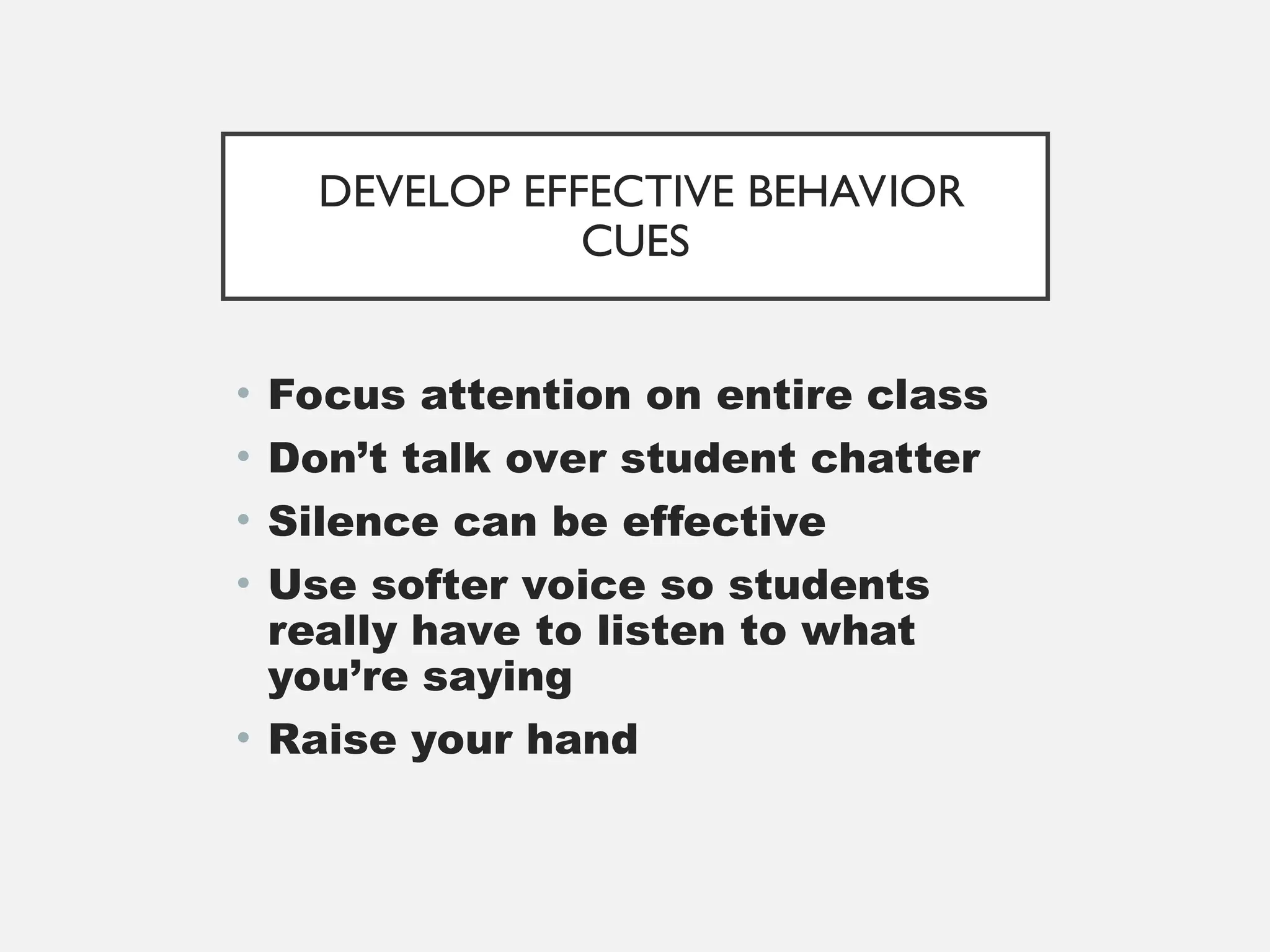
DEVELOP EFFECTIVE BEHAVIOR
CUES
• Focus attention on entire class
• Don’t talk over student chatter
• Silence can be effective
• Use softer voice so students
really have to listen to what
you’re saying
• Raise your hand
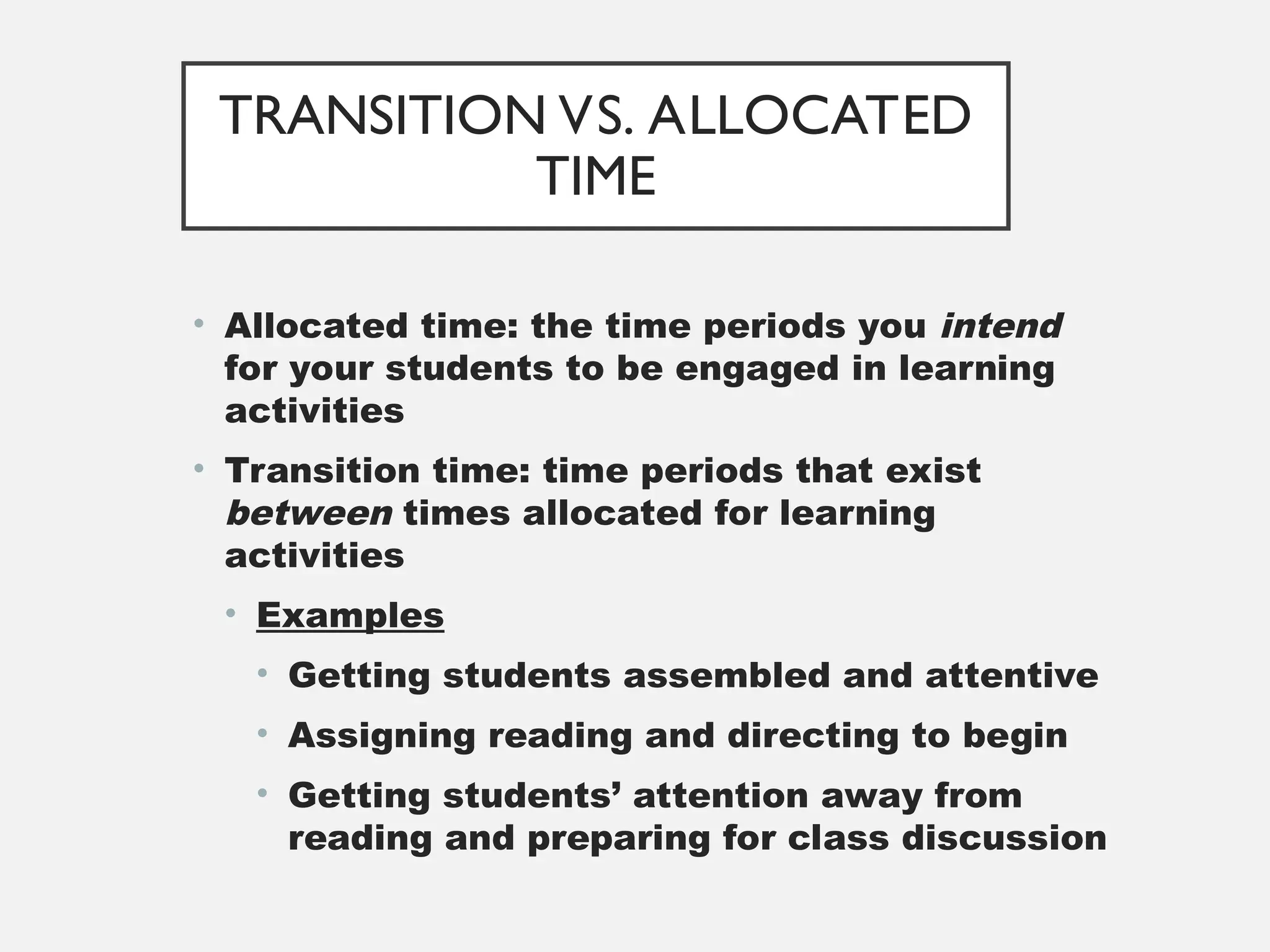
TRANSITION VS. ALLOCATED
TIME
• Allocated time: the time periods you intend
for your students to be engaged in learning
activities
• Transition time: time periods that exist
between times allocated for learning
activities
• Examples
• Getting students assembled and attentive
• Assigning reading and directing to begin
• Getting students’ attention away from
reading and preparing for class discussion
TRANSITION VS. ALLOCATED
TIME
• The Goal:
• Increase the variety of learning activities but decrease transition time.
• Student engagement and on-task behaviors
are dependent on how smoothly and
efficiently teachers move from one learning
activity to another
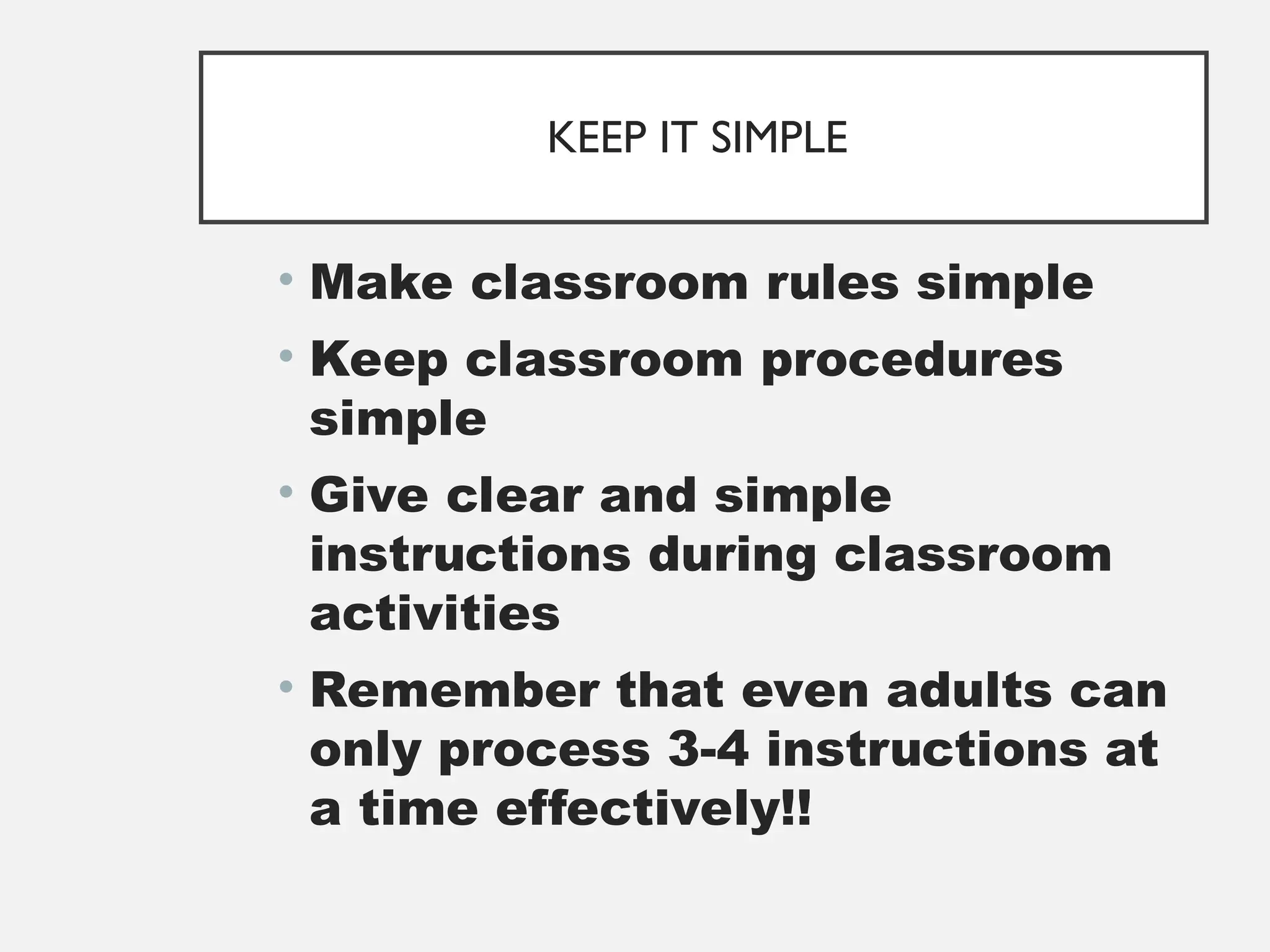
KEEP IT SIMPLE
• Make classroom rules simple
• Keep classroom procedures
simple
• Give clear and simple
instructions during classroom
activities
• Remember that even adults can
only process 3-4 instructions at
a time effectively!!
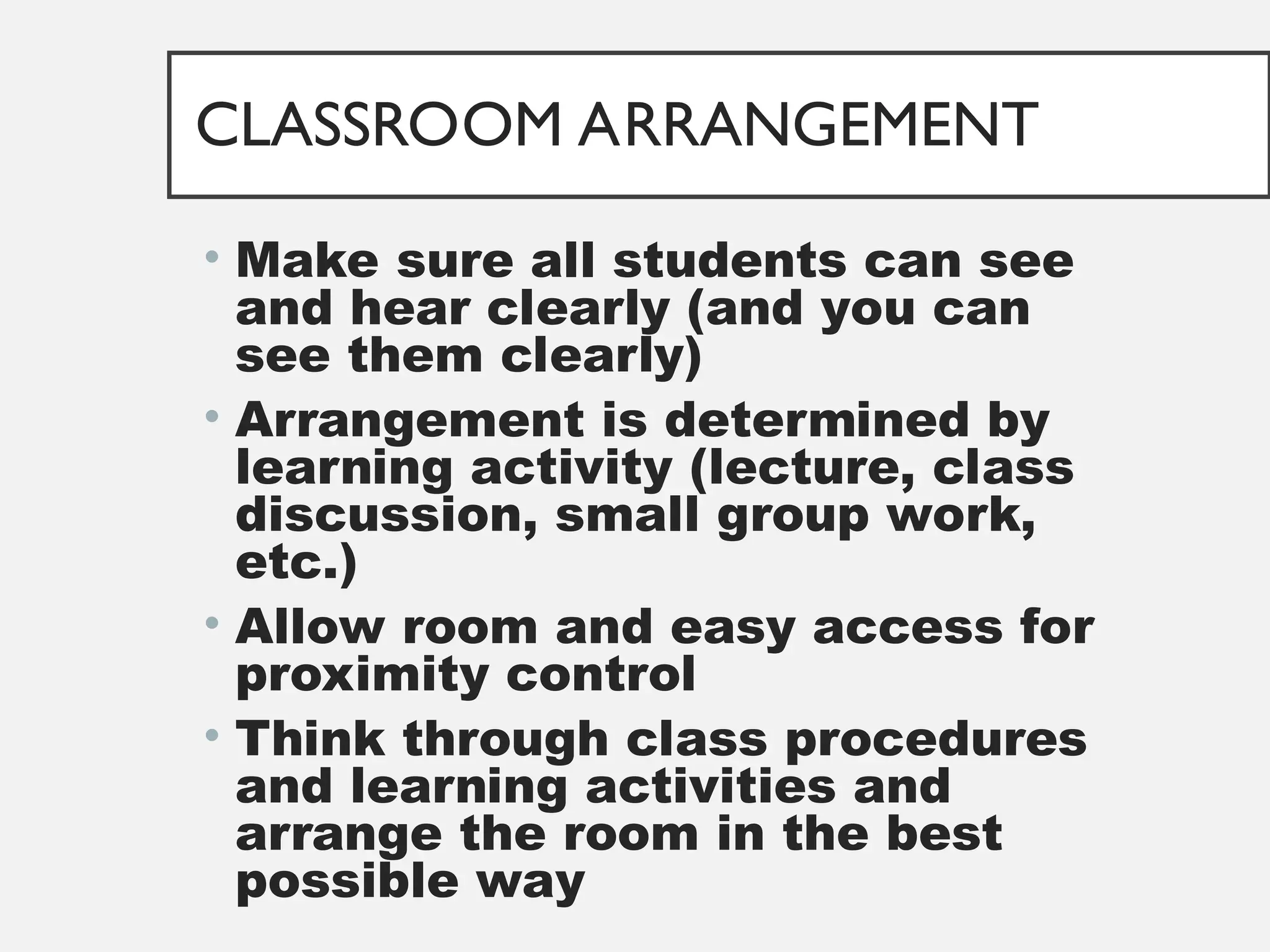
CLASSROOM ARRANGEMENT
• Make sure all students can see
and hear clearly (and you can
see them clearly)
• Arrangement is determined by
learning activity (lecture, class
discussion, small group work,
etc.)
• Allow room and easy access for
proximity control
• Think through class procedures
and learning activities and
arrange the room in the best
possible way
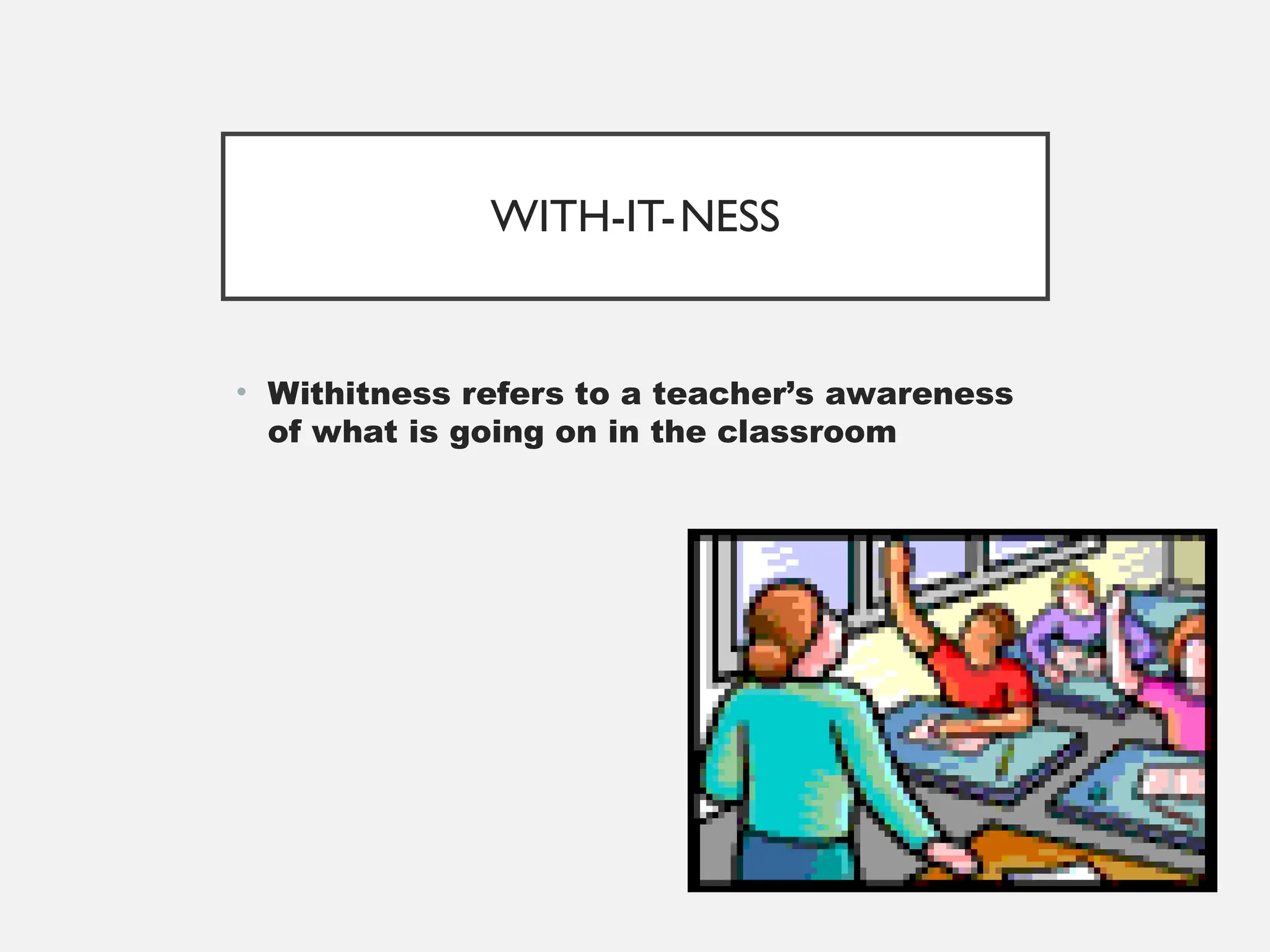
WITH-IT-NESS
• Withitness refers to a teacher’s awareness
of what is going on in the classroom
A TEACHER HAS “WITH-IT-NESS” IF:
• When discipline problems occur, the teacher
consistently takes action to suppress the
misbehavior of exactly those students who
instigated the problem
• When two discipline problems arise
concurrently, the teacher deals with the
most serious first
• The teacher decisively handles instances of
off-task behavior before the behaviors either
get out of hand or are modeled by others
WITH-IT-NESS (CONTINUED)
• When handling misbehavior –
make sure all students learn
what is unacceptable about that
behavior
• Getting angry or stressed does
not reduce future misbehavior
• Deal with misbehavior without
disrupting the learning activity
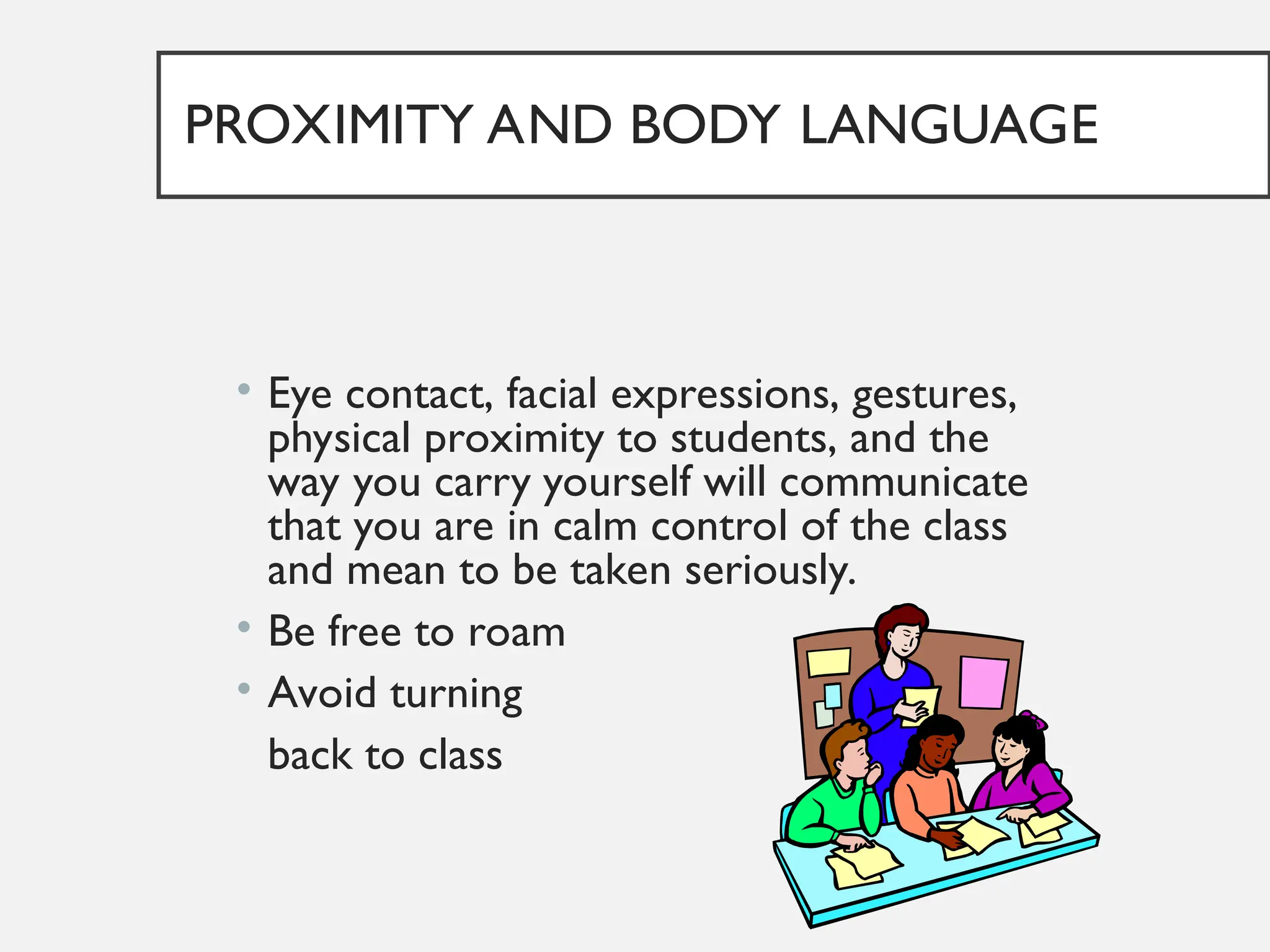
PROXIMITY AND BODY LANGUAGE
• Eye contact, facial expressions, gestures,
physical proximity to students, and the
way you carry yourself will communicate
that you are in calm control of the class
and mean to be taken seriously.
• Be free to roam
• Avoid turning
back to class
DEVELOP EFFECTIVE BEHAVIOR CUES
• Focus attention on entire class
• Don’t talk over student chatter
• Silence can be effective
• Use softer voice so students
really have to listen to what
you’re saying
• Raise your hand
PROACTIVE VS. REACTIVE
• The best teachers use these
strategies already mentioned and
more to ensure that their classroom
runs like a well-oiled machine.
• By using proactive teaching and
classroom management strategies,
more time is spent on teaching and
learning and less on reacting and
putting out fires.
• Being proactive means paying it
forward before class starts but
receives huge dividends in the end!!
EVERY PERFORMER
NEEDS A STAGE
• Confrontation gives students a
“stage” to perform
• Avoid power struggles…no one wins
• Give students a dignified way to get
out of a bad situation
• Pick your battles
• Address behavior issues in private
whenever possible
IT IS NOT PERSONAL
• Kids make poor choices…that is
what they do!
• Kids misbehave…that is their job!
• Kids test boundaries and limits…it
is a natural part of growing up!
• Kids don’t always do what we want
them to…no matter how much they
like us!
• DON’T TAKE IT PERSONNALY!!
FUNCTIONS OF
BEHAVIOR:
DEALING WITH
MISBEHAVIOR
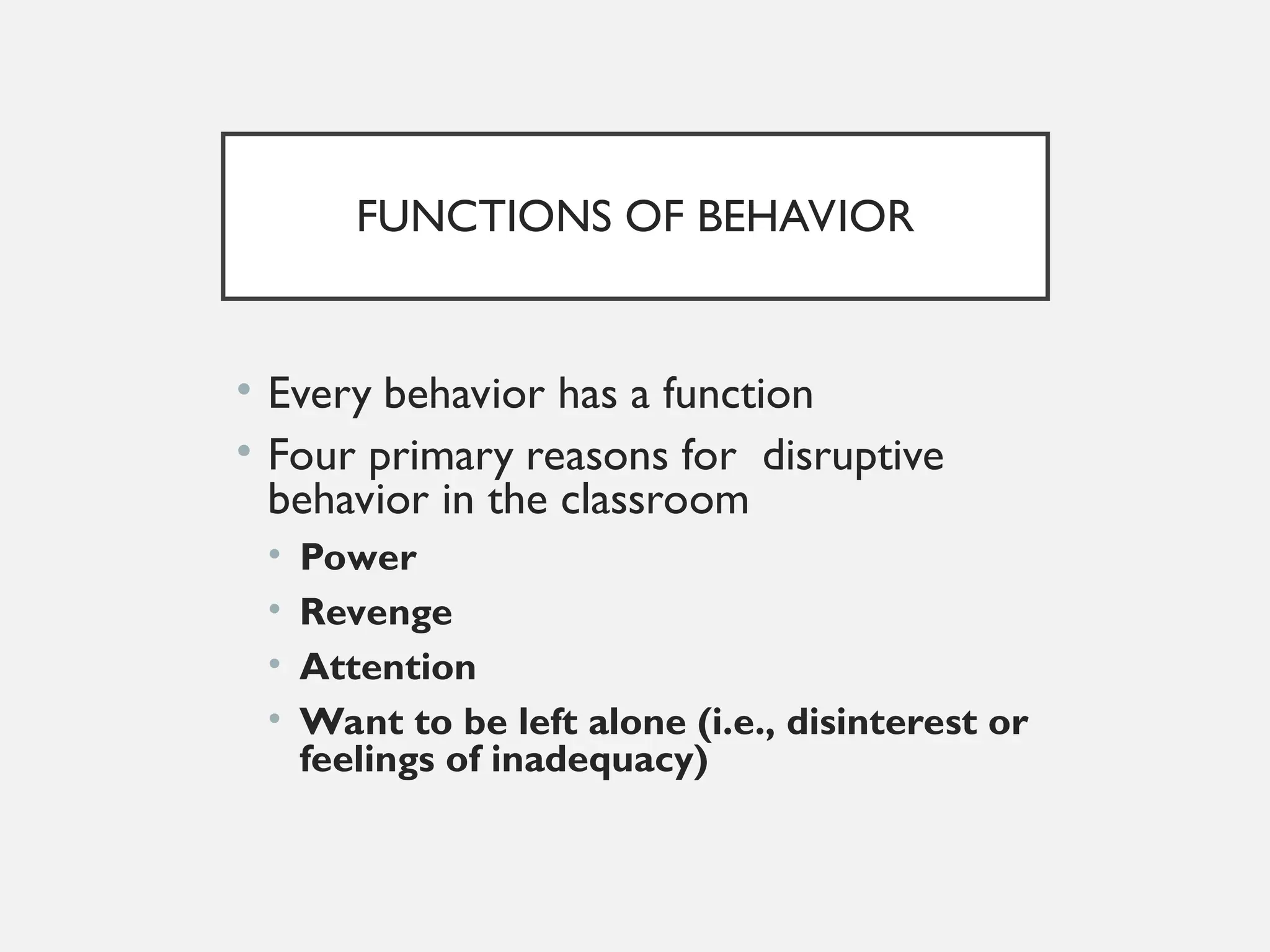
FUNCTIONS OF BEHAVIOR
• Every behavior has a function
• Four primary reasons for disruptive
behavior in the classroom
• Power
• Revenge
• Attention
• Want to be left alone (i.e., disinterest or
feelings of inadequacy)
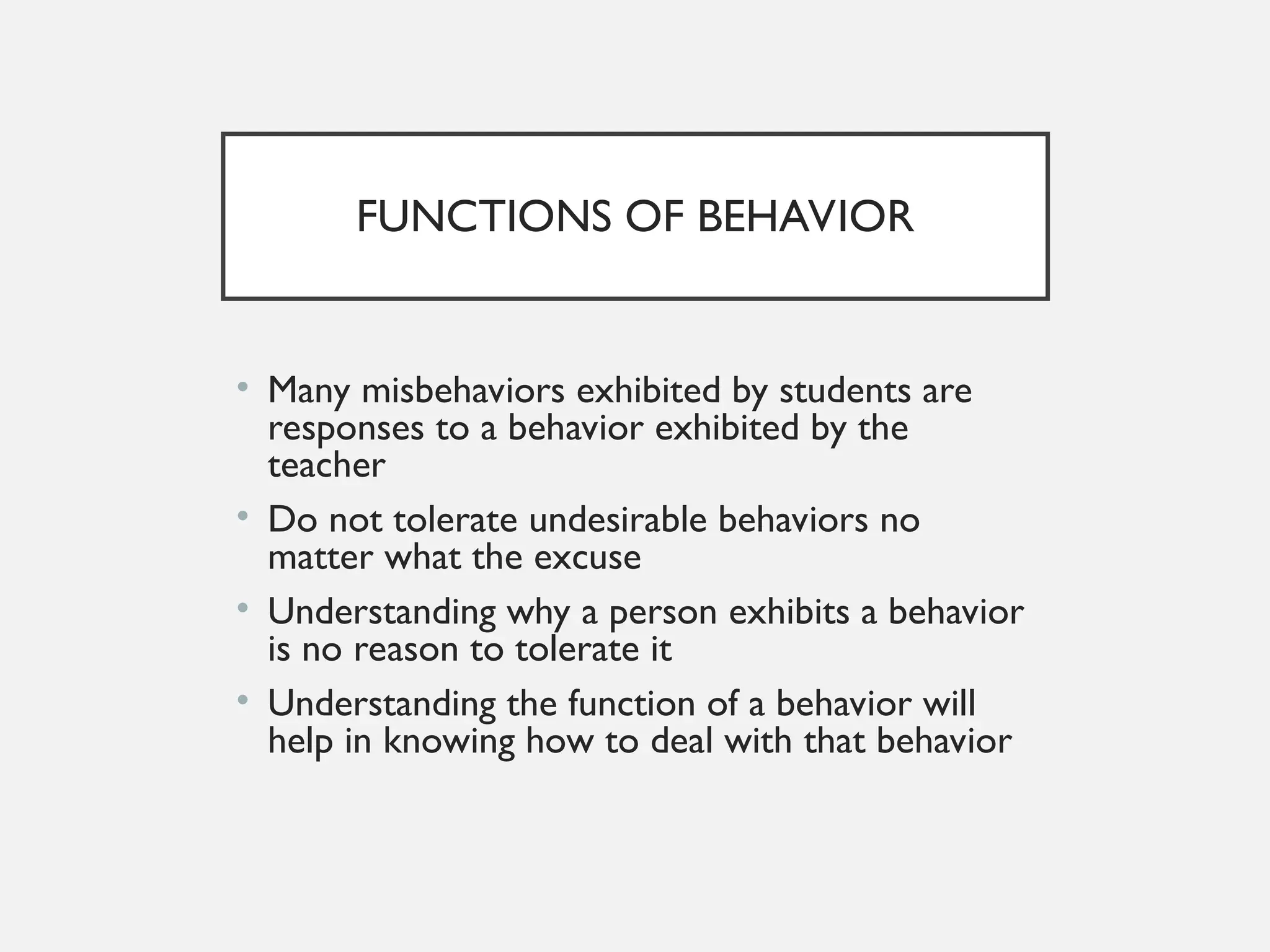
FUNCTIONS OF BEHAVIOR
• Many misbehaviors exhibited by students are
responses to a behavior exhibited by the
teacher
• Do not tolerate undesirable behaviors no
matter what the excuse
• Understanding why a person exhibits a behavior
is no reason to tolerate it
• Understanding the function of a behavior will
help in knowing how to deal with that behavior
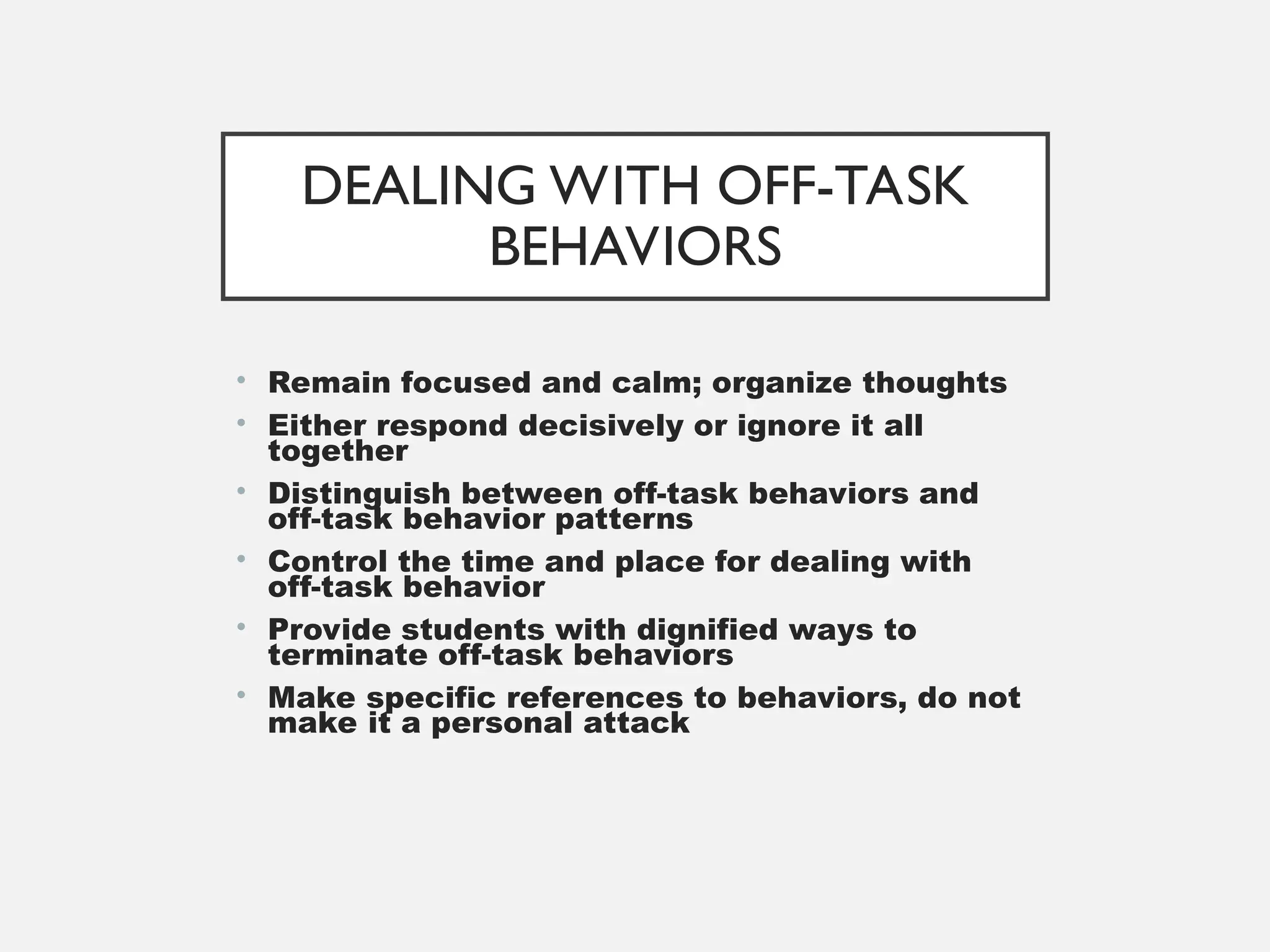
DEALING WITH OFF-TASK
BEHAVIORS
• Remain focused and calm; organize thoughts
• Either respond decisively or ignore it all
together
• Distinguish between off-task behaviors and
off-task behavior patterns
• Control the time and place for dealing with
off-task behavior
• Provide students with dignified ways to
terminate off-task behaviors
• Make specific references to behaviors, do not
make it a personal attack
DEALING WITH OFF-TASK
BEHAVIORS
• Remember that continuing with
classroom instruction is always
the main priority!!
• Avoid playing detective
• Utilize alternative lesson plans
• Utilize the help of colleagues
• Communicate and enlist the
help of parents/guardians
POWER SEEKING BEHAVIOR
• Power-seeking students attempt to provoke
teachers into a struggle of wills
• In most cases, the teacher should direct
attention to other members of the class
ATTENTION SEEKING
BEHAVIOR
• Attention-seeking students
prefer being punished,
admonished, or criticized to
being ignored
• Give attention to this student
when he or she is on-task and
cooperating
• “Catch them being good!” – and
let them know you caught them
BEHAVIOR: RAMBLING -- WANDERING
AROUND AND OFFTHE SUBJECT. USING FAR-
FETCHED EXAMPLES OR ANALOGIES.
POSSIBLE RESPONSES:
 Refocus attention by restating relevant point.
 Direct questions to group that is back on the
subject
 Use visual aids, begin to write on board, turn
on overhead projector.
 Say: "Would you summarize your main point
please?" or "Are you asking...?"
BEHAVIOR: TALKATIVENESS -- KNOWING
EVERYTHING, MANIPULATION, CHRONICWHINING.
POSSIBLE RESPONSES:
Acknowledge comments made.
Give limited time to express viewpoint or feelings, and
then move on.
Make eye contact with another participant and move
toward that person.
Give the person individual attention during breaks.
Say: "That's an interesting point. Now let's see what
other other people think."
BEHAVIOR: SHARPSHOOTING --TRYINGTO
SHOOTYOU DOWN ORTRIPYOU UP.
POSSIBLE RESPONSES:
Admit that you do not know the
answer and redirect the question the
group or the individual who asked it.
Acknowledge that this is a joint
learning experience.
Ignore the behavior.
Speak to the student in private…take
the stage away
KNOW YOUR CONTENT!!
BEHAVIOR: GRANDSTANDING -- GETTING
CAUGHT UP IN ONE'S OWN AGENDA OR
THOUGHTSTOTHE DETRIMENT OF OTHER
LEARNERS.
POSSIBLE RESPONSES:
Say: "You are entitled to your opinion, belief or
feelings, but now it's time we moved on to the next
subject," or
"Can you restate that as a question?" or
"We'd like to hear more about that if there is time
after the presentation."
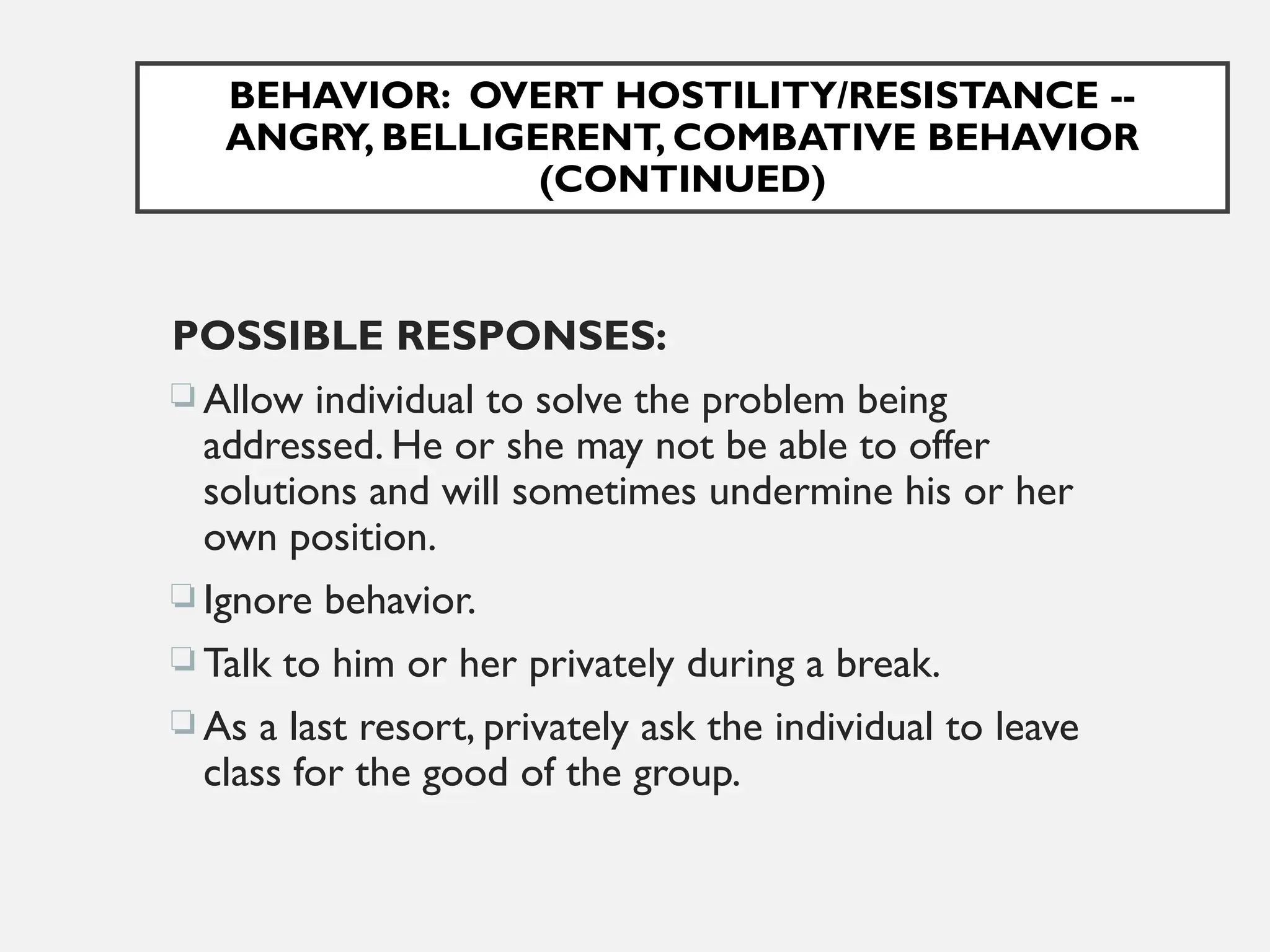
BEHAVIOR: OVERT HOSTILITY/RESISTANCE --
ANGRY, BELLIGERENT, COMBATIVE
BEHAVIOR.
POSSIBLE RESPONSES:
Hostility can be a mask for fear. Reframe hostility as fear to
depersonalize it.
Respond to fear, not hostility.
Remain calm and polite. Keep your temper in check.
Don't disagree, but build on or around what has been said.
Move closer to the hostile person, maintain eye contact.
Always allow him or her a way to gracefully retreat from the
confrontation.
BEHAVIOR: OVERT HOSTILITY/RESISTANCE --
ANGRY, BELLIGERENT, COMBATIVE BEHAVIOR
(CONTINUED)
POSSIBLE RESPONSES:
 Allow individual to solve the problem being
addressed. He or she may not be able to offer
solutions and will sometimes undermine his or her
own position.
 Ignore behavior.
 Talk to him or her privately during a break.
 As a last resort, privately ask the individual to leave
class for the good of the group.
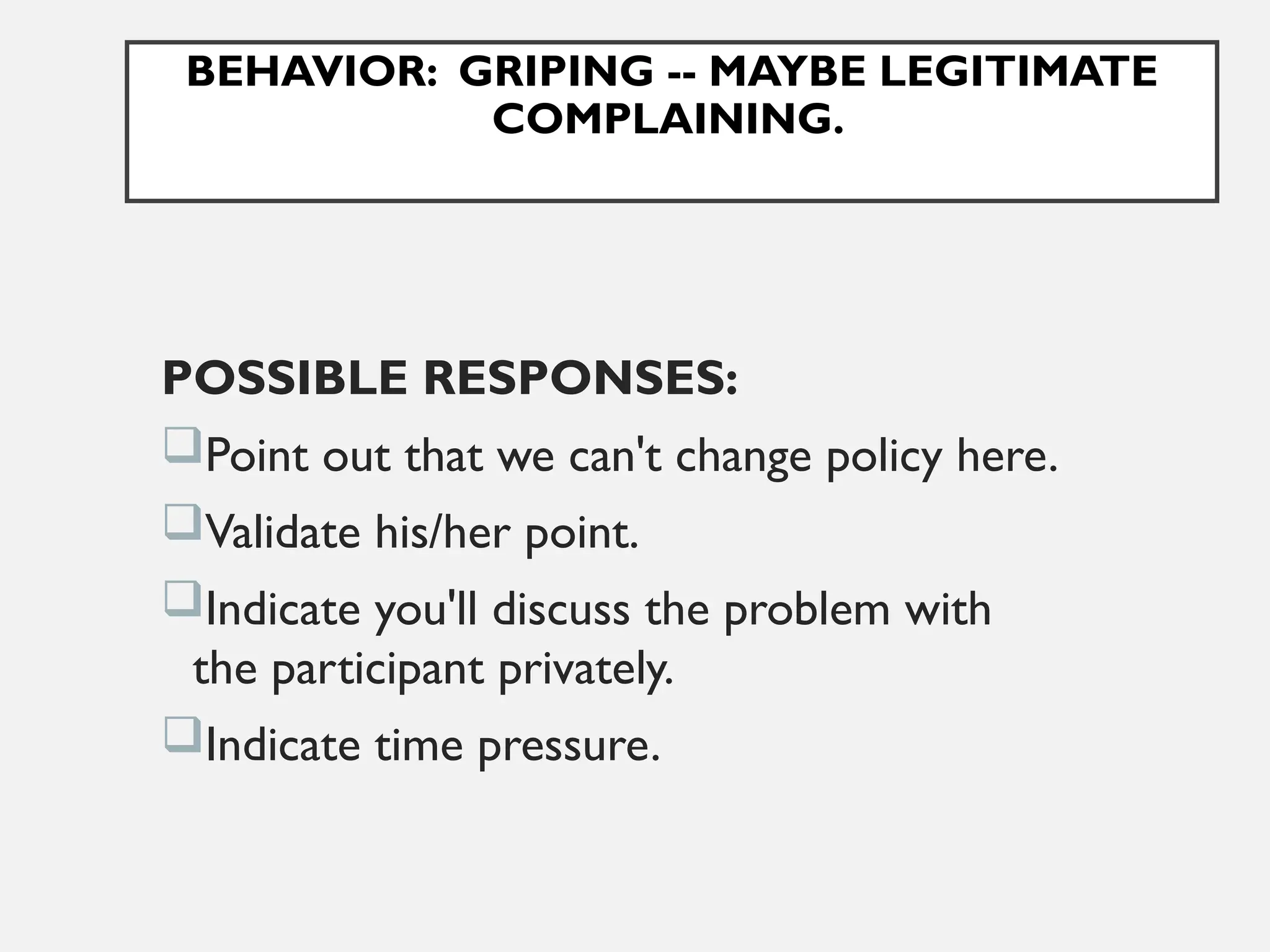
BEHAVIOR: GRIPING -- MAYBE LEGITIMATE
COMPLAINING.
POSSIBLE RESPONSES:
Point out that we can't change policy here.
Validate his/her point.
Indicate you'll discuss the problem with
the participant privately.
Indicate time pressure.
BEHAVIOR: SIDE CONVERSATIONS -- MAY BE
RELATEDTO SUBJECT OR PERSONAL. DISTRACTS
GROUP MEMBERS ANDYOU.
POSSIBLE RESPONSES:
 Don't embarrass talkers.
 Ask their opinion on topic being
discussed.
 Ask talkers if they would like to share
their ideas.
 Casually move toward those talking.
 Make eye contact with them.
 Standing near the talkers, ask a near-by
participant a question so that the new
discussion is near the talkers.
 As a last resort, stop and wait.

Classroom Management in the Classroom 101

  • 1.
  • 2.
    BEST IN SHOW Identifythe best teacher you ever had (K-College name isn’t important) and why they were the best. What is one strategy that teacher used for classroom management? Now identify a teacher that you would consider one of the worst teachers you ever had (K-College) and Definitely do not give any names on this one!! Identify specific actions that you feel have earned them this title.
  • 3.
    WHAT IS CLASSROOM MANAGEMENT? •It’s effective discipline • It’s being prepared for class • It’s motivating your students • It’s providing a safe, comfortable learning environment • It’s building your students’ self esteem • It’s being creative and imaginative in daily lessons • And . . .
  • 4.
    . . .IT’S DIFFERENT FOR EVERYONE!! WHY? • Teaching Styles • Personality/Attitudes • Student population • Not all management strategies are effective for every teacher • Try different strategies to see if they work for you
  • 5.
    QUIZ TIME!! What isyour classroom management profile?
  • 6.
    WHY IS CLASSROOM MANAGEMENTIMPORTANT? • Satisfaction and enjoyment in teaching are dependent upon leading students to cooperate • Classroom management issues are of highest concern for beginning teachers • Classroom management and effective instruction are key in ensuring student success and learning
  • 7.
    YOU SET THETONE • Set the tone for everything…behavior, procedures, grades, work ethic, attitude… everything!! • Teach students to manage their own behavior • Students LEARN to be on-task and engaged in the learning activities you have planned for them…REMEMBER THIS… “It is more natural to be off-task than on!” • Teach, teach, and re-teach routine classroom procedures • Model/provide exemplars for excellence in student work and attitudes
  • 8.
    FFC • Be fair,firm and consistent…remember that students are, by nature, the morality police. • They can spot inconsistencies a mile away and take joy in calling you out on it!! • Students may not enjoy consequences of inappropriate behavior but they will respect your decisions if they know that you are fair and apply discipline/consequences fairly
  • 9.
    POSITIVE IS APLUS • Build a positive, PROFESSIONAL rapport with students • Establish a positive classroom environment…greet students at the door everyday with a smile • Model the positive behaviors and attitude you desire in your students
  • 10.
    PLAN, PLAN, PLAN •Planning engaging, purposeful lessons is one of the best recipes for a smooth, orderly classroom • Over plan your lessons to minimize down time…down time is every teacher’s worst enemy • Plan lessons that address multiple learning styles and allow all students to experience success
  • 11.
    BE PREPARED!! • Beorganized • Be on time • Be prepared for changes to your even the “best laid plans” • Have a plan B • Have a plan C • Anticipate possible hiccups in your lessons and activities • In other words…winging it is not an option!!
  • 12.
  • 13.
    DEVELOP EFFECTIVE BEHAVIOR CUES •Focus attention on entire class • Don’t talk over student chatter • Silence can be effective • Use softer voice so students really have to listen to what you’re saying • Raise your hand
  • 14.
    TRANSITION VS. ALLOCATED TIME •Allocated time: the time periods you intend for your students to be engaged in learning activities • Transition time: time periods that exist between times allocated for learning activities • Examples • Getting students assembled and attentive • Assigning reading and directing to begin • Getting students’ attention away from reading and preparing for class discussion
  • 15.
    TRANSITION VS. ALLOCATED TIME •The Goal: • Increase the variety of learning activities but decrease transition time. • Student engagement and on-task behaviors are dependent on how smoothly and efficiently teachers move from one learning activity to another
  • 16.
    KEEP IT SIMPLE •Make classroom rules simple • Keep classroom procedures simple • Give clear and simple instructions during classroom activities • Remember that even adults can only process 3-4 instructions at a time effectively!!
  • 17.
    CLASSROOM ARRANGEMENT • Makesure all students can see and hear clearly (and you can see them clearly) • Arrangement is determined by learning activity (lecture, class discussion, small group work, etc.) • Allow room and easy access for proximity control • Think through class procedures and learning activities and arrange the room in the best possible way
  • 18.
    WITH-IT-NESS • Withitness refersto a teacher’s awareness of what is going on in the classroom
  • 19.
    A TEACHER HAS“WITH-IT-NESS” IF: • When discipline problems occur, the teacher consistently takes action to suppress the misbehavior of exactly those students who instigated the problem • When two discipline problems arise concurrently, the teacher deals with the most serious first • The teacher decisively handles instances of off-task behavior before the behaviors either get out of hand or are modeled by others
  • 20.
    WITH-IT-NESS (CONTINUED) • Whenhandling misbehavior – make sure all students learn what is unacceptable about that behavior • Getting angry or stressed does not reduce future misbehavior • Deal with misbehavior without disrupting the learning activity
  • 21.
    PROXIMITY AND BODYLANGUAGE • Eye contact, facial expressions, gestures, physical proximity to students, and the way you carry yourself will communicate that you are in calm control of the class and mean to be taken seriously. • Be free to roam • Avoid turning back to class
  • 22.
    DEVELOP EFFECTIVE BEHAVIORCUES • Focus attention on entire class • Don’t talk over student chatter • Silence can be effective • Use softer voice so students really have to listen to what you’re saying • Raise your hand
  • 23.
    PROACTIVE VS. REACTIVE •The best teachers use these strategies already mentioned and more to ensure that their classroom runs like a well-oiled machine. • By using proactive teaching and classroom management strategies, more time is spent on teaching and learning and less on reacting and putting out fires. • Being proactive means paying it forward before class starts but receives huge dividends in the end!!
  • 24.
    EVERY PERFORMER NEEDS ASTAGE • Confrontation gives students a “stage” to perform • Avoid power struggles…no one wins • Give students a dignified way to get out of a bad situation • Pick your battles • Address behavior issues in private whenever possible
  • 25.
    IT IS NOTPERSONAL • Kids make poor choices…that is what they do! • Kids misbehave…that is their job! • Kids test boundaries and limits…it is a natural part of growing up! • Kids don’t always do what we want them to…no matter how much they like us! • DON’T TAKE IT PERSONNALY!!
  • 26.
  • 27.
    FUNCTIONS OF BEHAVIOR •Every behavior has a function • Four primary reasons for disruptive behavior in the classroom • Power • Revenge • Attention • Want to be left alone (i.e., disinterest or feelings of inadequacy)
  • 28.
    FUNCTIONS OF BEHAVIOR •Many misbehaviors exhibited by students are responses to a behavior exhibited by the teacher • Do not tolerate undesirable behaviors no matter what the excuse • Understanding why a person exhibits a behavior is no reason to tolerate it • Understanding the function of a behavior will help in knowing how to deal with that behavior
  • 29.
    DEALING WITH OFF-TASK BEHAVIORS •Remain focused and calm; organize thoughts • Either respond decisively or ignore it all together • Distinguish between off-task behaviors and off-task behavior patterns • Control the time and place for dealing with off-task behavior • Provide students with dignified ways to terminate off-task behaviors • Make specific references to behaviors, do not make it a personal attack
  • 30.
    DEALING WITH OFF-TASK BEHAVIORS •Remember that continuing with classroom instruction is always the main priority!! • Avoid playing detective • Utilize alternative lesson plans • Utilize the help of colleagues • Communicate and enlist the help of parents/guardians
  • 31.
    POWER SEEKING BEHAVIOR •Power-seeking students attempt to provoke teachers into a struggle of wills • In most cases, the teacher should direct attention to other members of the class
  • 32.
    ATTENTION SEEKING BEHAVIOR • Attention-seekingstudents prefer being punished, admonished, or criticized to being ignored • Give attention to this student when he or she is on-task and cooperating • “Catch them being good!” – and let them know you caught them
  • 33.
    BEHAVIOR: RAMBLING --WANDERING AROUND AND OFFTHE SUBJECT. USING FAR- FETCHED EXAMPLES OR ANALOGIES. POSSIBLE RESPONSES:  Refocus attention by restating relevant point.  Direct questions to group that is back on the subject  Use visual aids, begin to write on board, turn on overhead projector.  Say: "Would you summarize your main point please?" or "Are you asking...?"
  • 34.
    BEHAVIOR: TALKATIVENESS --KNOWING EVERYTHING, MANIPULATION, CHRONICWHINING. POSSIBLE RESPONSES: Acknowledge comments made. Give limited time to express viewpoint or feelings, and then move on. Make eye contact with another participant and move toward that person. Give the person individual attention during breaks. Say: "That's an interesting point. Now let's see what other other people think."
  • 35.
    BEHAVIOR: SHARPSHOOTING --TRYINGTO SHOOTYOUDOWN ORTRIPYOU UP. POSSIBLE RESPONSES: Admit that you do not know the answer and redirect the question the group or the individual who asked it. Acknowledge that this is a joint learning experience. Ignore the behavior. Speak to the student in private…take the stage away KNOW YOUR CONTENT!!
  • 36.
    BEHAVIOR: GRANDSTANDING --GETTING CAUGHT UP IN ONE'S OWN AGENDA OR THOUGHTSTOTHE DETRIMENT OF OTHER LEARNERS. POSSIBLE RESPONSES: Say: "You are entitled to your opinion, belief or feelings, but now it's time we moved on to the next subject," or "Can you restate that as a question?" or "We'd like to hear more about that if there is time after the presentation."
  • 37.
    BEHAVIOR: OVERT HOSTILITY/RESISTANCE-- ANGRY, BELLIGERENT, COMBATIVE BEHAVIOR. POSSIBLE RESPONSES: Hostility can be a mask for fear. Reframe hostility as fear to depersonalize it. Respond to fear, not hostility. Remain calm and polite. Keep your temper in check. Don't disagree, but build on or around what has been said. Move closer to the hostile person, maintain eye contact. Always allow him or her a way to gracefully retreat from the confrontation.
  • 38.
    BEHAVIOR: OVERT HOSTILITY/RESISTANCE-- ANGRY, BELLIGERENT, COMBATIVE BEHAVIOR (CONTINUED) POSSIBLE RESPONSES:  Allow individual to solve the problem being addressed. He or she may not be able to offer solutions and will sometimes undermine his or her own position.  Ignore behavior.  Talk to him or her privately during a break.  As a last resort, privately ask the individual to leave class for the good of the group.
  • 39.
    BEHAVIOR: GRIPING --MAYBE LEGITIMATE COMPLAINING. POSSIBLE RESPONSES: Point out that we can't change policy here. Validate his/her point. Indicate you'll discuss the problem with the participant privately. Indicate time pressure.
  • 40.
    BEHAVIOR: SIDE CONVERSATIONS-- MAY BE RELATEDTO SUBJECT OR PERSONAL. DISTRACTS GROUP MEMBERS ANDYOU. POSSIBLE RESPONSES:  Don't embarrass talkers.  Ask their opinion on topic being discussed.  Ask talkers if they would like to share their ideas.  Casually move toward those talking.  Make eye contact with them.  Standing near the talkers, ask a near-by participant a question so that the new discussion is near the talkers.  As a last resort, stop and wait.