ACLEDA Institute of Business
Mr Chhorthong Keo & Mr Matta Kong
Classroom
Management
Teaching and Learning Forum: Experience Sharing
“All of us can be teachers but not all of us
are school teachers and fewer are
effective teachers.” Myint Swe Khine
“Effective teachers MANAGE their
classrooms; Ineffective teachers DISCIPLINE
their classrooms.” Harry Wong & Rosemary Wong
Mr. Keo Chhorthong
BA in TEFL and MEd. in Educational Leadership
Mr. Kong Matta
MA in TESOL and PhD Candidate in IR
Discussion Outline
1. Establishing Conductive Learning Environment
2. Enhancing Positive Behavior in the Classroom
3. Reaching Out to Students
4. Repertoire of Knowledge and Skills for Effective Teaching
Learning Outcome
• Appreciate the complex nature of classroom management.
• Appreciate the importance of rules and routines to manage
behaviors in the classroom.
• Examine what teacher would have to manage in a classroom to
create a positive learning environment.
• Use the strategies for building rapport.
• Break down a repertoire of knowledge and skills for effective
teaching.
Learning
Objects
Students
Teacher
Looking at the Classroom
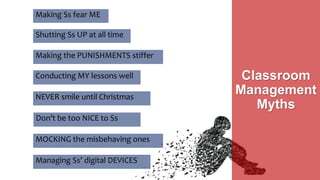
Making Ss fear ME
Shutting Ss UP at all time
Making the PUNISHMENTS stiffer
NEVER smile until Christmas
Don’t be too NICE to Ss
Managing Ss’ digital DEVICES
Classroom
Management
Myths
MOCKING the misbehaving ones
Conducting MY lessons well
Classroom
Management
Teaching & Learning
Environment
Student
Behavior
Conceptual
framework
of classroom
management
Classroom
Environment
The Physical
Environment
The Psycho-Social
Environment
• lighting,
• sound,
• space,
• furniture
• good feeling,
• secure feeling,
• comfortable feeling
1. Establishing Conductive Learning Environment
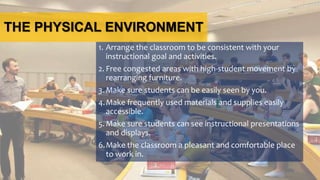
THE PHYSICAL ENVIRONMENT
1. Arrange the classroom to be consistent with your
instructional goal and activities.
2. Free congested areas with high-student movement by
rearranging furniture.
3. Make sure students can be easily seen by you.
4.Make frequently used materials and supplies easily
accessible.
5.Make sure students can see instructional presentations
and displays.
6.Make the classroom a pleasant and comfortable place
to work in.
THE PSYCHO-SOCIAL ENVIRONMENT
1. It is secure from threat and physical harm.
2. It has a friendly interactive atmosphere.
3. Students are happy to be members of the class.
4.Views are freely expressed.
5.It is stimulating learning environment.
6.It has an atmosphere of cooperative learning.
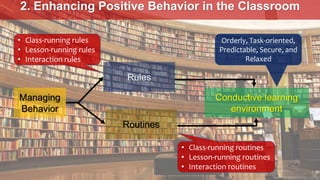
Managing
Behavior
Rules
Routines
Conductive learning
environment
2. Enhancing Positive Behavior in the Classroom
• Class-running rules
• Lesson-running rules
• Interaction rules
• Class-running routines
• Lesson-running routines
• Interaction routines
Orderly, Task-oriented,
Predictable, Secure, and
Relaxed
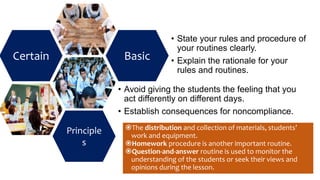
Certain
Principle
s
Basic
• State your rules and procedure of
your routines clearly.
• Explain the rationale for your
rules and routines.
• Avoid giving the students the feeling that you
act differently on different days.
• Establish consequences for noncompliance.
The distribution and collection of materials, students’
work and equipment.
Homework procedure is another important routine.
Question-and-answer routine is used to monitor the
understanding of the students or seek their views and
opinions during the lesson.
Orientation
•Introduction of lecturer’s background
•Introduction of course Syllabus
•Introduction of class rules
•Introduction of class routines
Teaching at AIB
3. Reaching
Out to
Students
RAPPORT refers to a good and
positive relationship with
students.
Positive learning environment
Effective
Management
Teacher-Student
Rapport
Effective
Teaching
•Teacher’s appearance and body language
•Teacher’s attitudes
Using positive words
Modelling good behaviors
Setting an examples
•Building personal rapport
Knowing your student’s name
Remembering clever or outstanding ones
•Building classroom synergy
Strategies for Building
Rapport
Knowledge
of Content
Knowledge
of Self
Knowledge
of School
practices
Knowledge
of
Processes
Knowledge
of SS
Learning
Styles
4. Repertoire of Knowledge
& Skills
Knowledge
of teaching
pedagogy
• Professional
Development
• Self-
assessment
• Mentoring
• Decision making
• Problem-solving
• Research
• Learning outcomes
• Entry competencies
• Instructional strategies
• Interaction
• Self-Analysis & Evaluation
• Teaching for better learning
• Teaching for thinking
“Don’t send your ducks to eagle school.” John C. Maxwell
“In an effective classroom, students should not only
know WHAT they are doing; they should know WHY
and HOW.” Harry Wong
Thanks for your paying attention

Classroom Management

  • 1.
    ACLEDA Institute ofBusiness Mr Chhorthong Keo & Mr Matta Kong Classroom Management Teaching and Learning Forum: Experience Sharing
  • 2.
    “All of uscan be teachers but not all of us are school teachers and fewer are effective teachers.” Myint Swe Khine “Effective teachers MANAGE their classrooms; Ineffective teachers DISCIPLINE their classrooms.” Harry Wong & Rosemary Wong Mr. Keo Chhorthong BA in TEFL and MEd. in Educational Leadership Mr. Kong Matta MA in TESOL and PhD Candidate in IR
  • 3.
    Discussion Outline 1. EstablishingConductive Learning Environment 2. Enhancing Positive Behavior in the Classroom 3. Reaching Out to Students 4. Repertoire of Knowledge and Skills for Effective Teaching
  • 4.
    Learning Outcome • Appreciatethe complex nature of classroom management. • Appreciate the importance of rules and routines to manage behaviors in the classroom. • Examine what teacher would have to manage in a classroom to create a positive learning environment. • Use the strategies for building rapport. • Break down a repertoire of knowledge and skills for effective teaching.
  • 5.
  • 6.
    Making Ss fearME Shutting Ss UP at all time Making the PUNISHMENTS stiffer NEVER smile until Christmas Don’t be too NICE to Ss Managing Ss’ digital DEVICES Classroom Management Myths MOCKING the misbehaving ones Conducting MY lessons well
  • 7.
  • 8.
    Classroom Environment The Physical Environment The Psycho-Social Environment •lighting, • sound, • space, • furniture • good feeling, • secure feeling, • comfortable feeling 1. Establishing Conductive Learning Environment
  • 9.
    THE PHYSICAL ENVIRONMENT 1.Arrange the classroom to be consistent with your instructional goal and activities. 2. Free congested areas with high-student movement by rearranging furniture. 3. Make sure students can be easily seen by you. 4.Make frequently used materials and supplies easily accessible. 5.Make sure students can see instructional presentations and displays. 6.Make the classroom a pleasant and comfortable place to work in.
  • 10.
    THE PSYCHO-SOCIAL ENVIRONMENT 1.It is secure from threat and physical harm. 2. It has a friendly interactive atmosphere. 3. Students are happy to be members of the class. 4.Views are freely expressed. 5.It is stimulating learning environment. 6.It has an atmosphere of cooperative learning.
  • 11.
    Managing Behavior Rules Routines Conductive learning environment 2. EnhancingPositive Behavior in the Classroom • Class-running rules • Lesson-running rules • Interaction rules • Class-running routines • Lesson-running routines • Interaction routines Orderly, Task-oriented, Predictable, Secure, and Relaxed
  • 12.
    Certain Principle s Basic • State yourrules and procedure of your routines clearly. • Explain the rationale for your rules and routines. • Avoid giving the students the feeling that you act differently on different days. • Establish consequences for noncompliance. The distribution and collection of materials, students’ work and equipment. Homework procedure is another important routine. Question-and-answer routine is used to monitor the understanding of the students or seek their views and opinions during the lesson.
  • 13.
    Orientation •Introduction of lecturer’sbackground •Introduction of course Syllabus •Introduction of class rules •Introduction of class routines Teaching at AIB
  • 14.
    3. Reaching Out to Students RAPPORTrefers to a good and positive relationship with students. Positive learning environment Effective Management Teacher-Student Rapport Effective Teaching
  • 15.
    •Teacher’s appearance andbody language •Teacher’s attitudes Using positive words Modelling good behaviors Setting an examples •Building personal rapport Knowing your student’s name Remembering clever or outstanding ones •Building classroom synergy Strategies for Building Rapport
  • 16.
    Knowledge of Content Knowledge of Self Knowledge ofSchool practices Knowledge of Processes Knowledge of SS Learning Styles 4. Repertoire of Knowledge & Skills Knowledge of teaching pedagogy • Professional Development • Self- assessment • Mentoring • Decision making • Problem-solving • Research • Learning outcomes • Entry competencies • Instructional strategies • Interaction • Self-Analysis & Evaluation • Teaching for better learning • Teaching for thinking
  • 17.
    “Don’t send yourducks to eagle school.” John C. Maxwell “In an effective classroom, students should not only know WHAT they are doing; they should know WHY and HOW.” Harry Wong Thanks for your paying attention

Editor's Notes

  • #12 Rules describe the behavior that students are able to learn effective. Routines are procedure to be followed at specific situations by your student so that there is order in the classroom.