Classification/Grading Method of Job Evaluation
Compensation Management
Prepared By
Kindly restrict the use of slides for personal purpose.
Please seek permission to reproduce the same in public forms and presentations.
Manu Melwin Joy
Assistant Professor
Ilahia School of Management Studies
Kerala, India.
Phone – 9744551114
Mail – manu_melwinjoy@yahoo.com
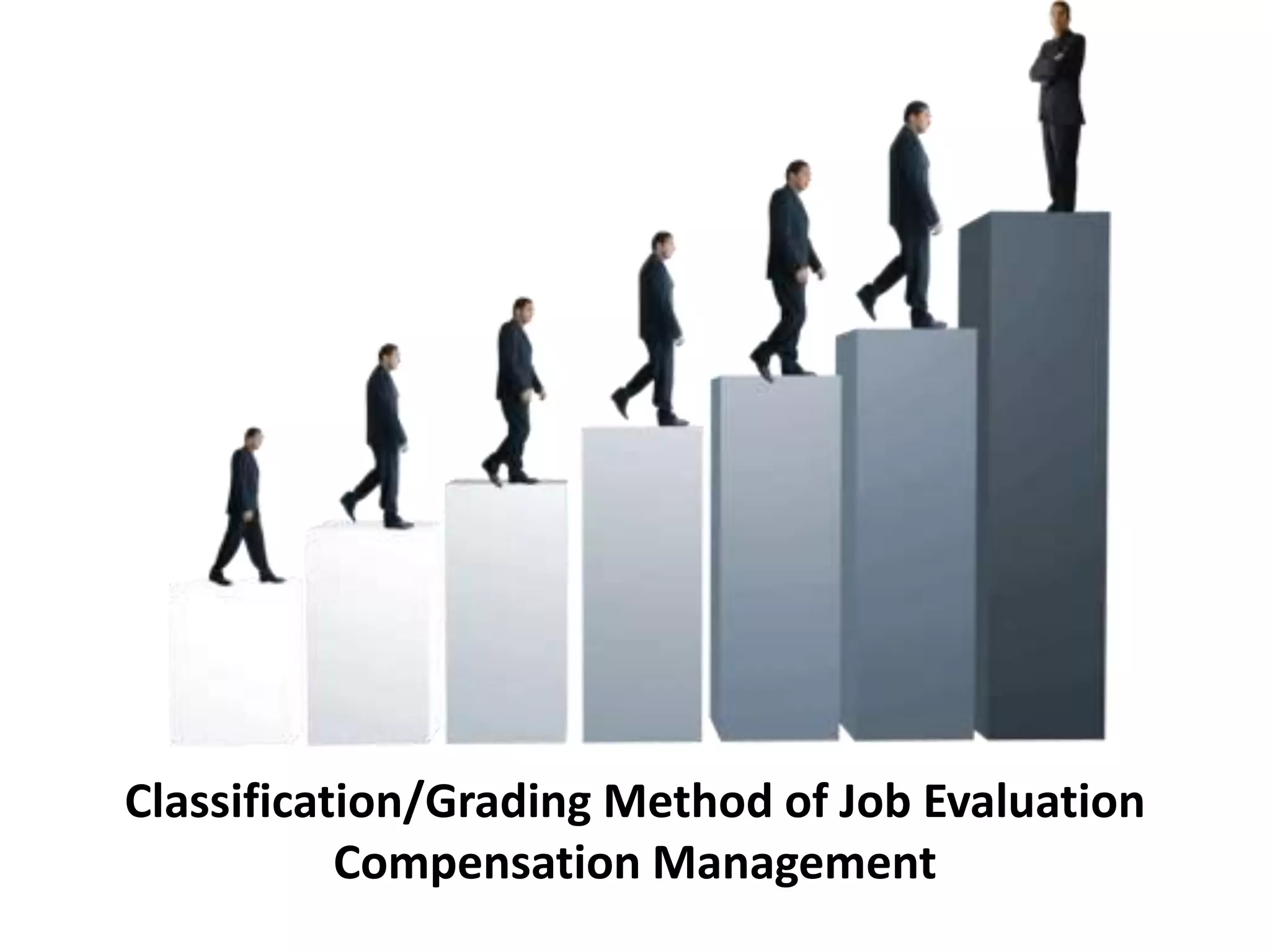
Classification/Grading Method of Job Evaluation
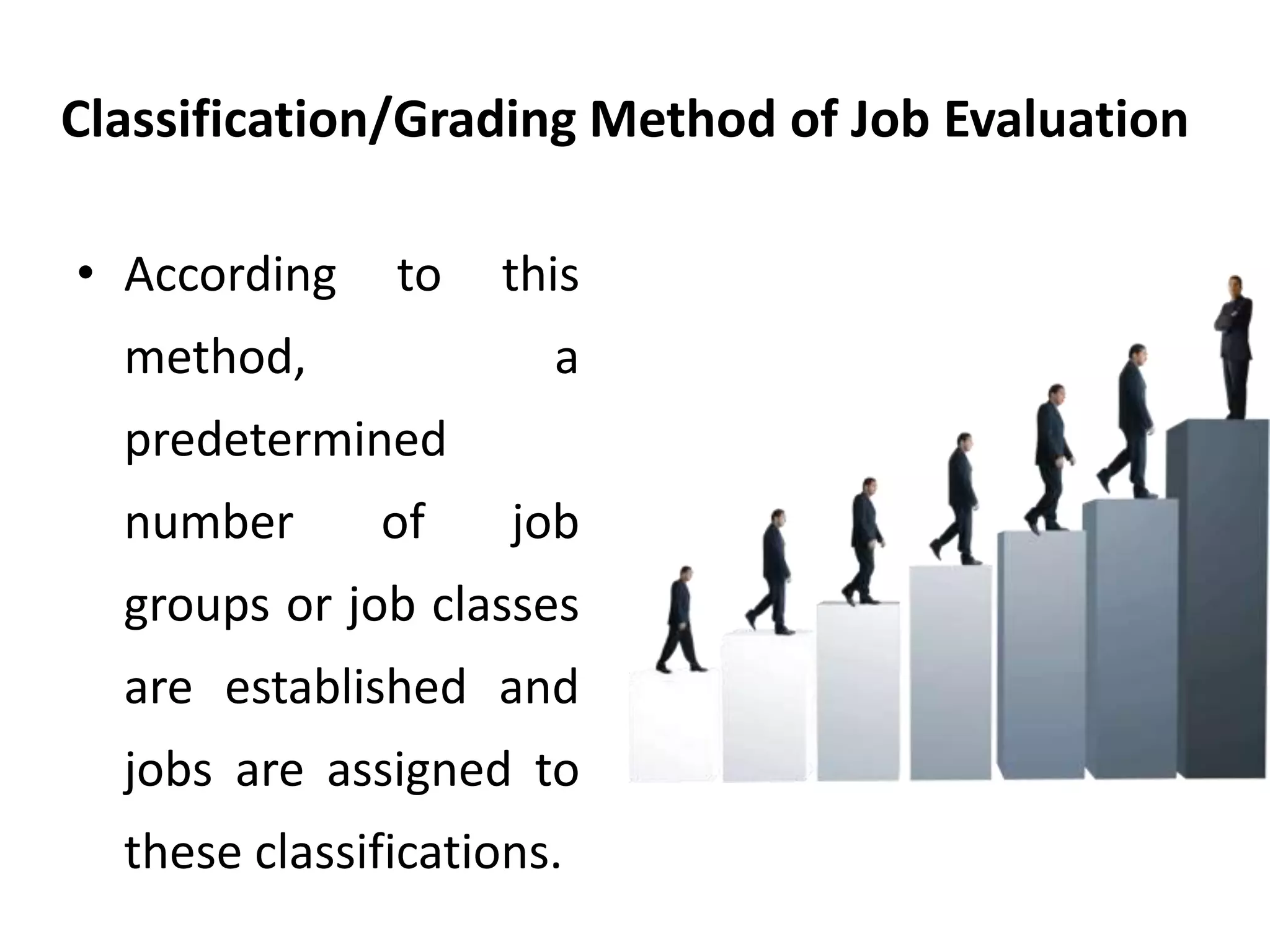
• According to this
method, a
predetermined
number of job
groups or job classes
are established and
jobs are assigned to
these classifications.
Classification/Grading Method of Job Evaluation
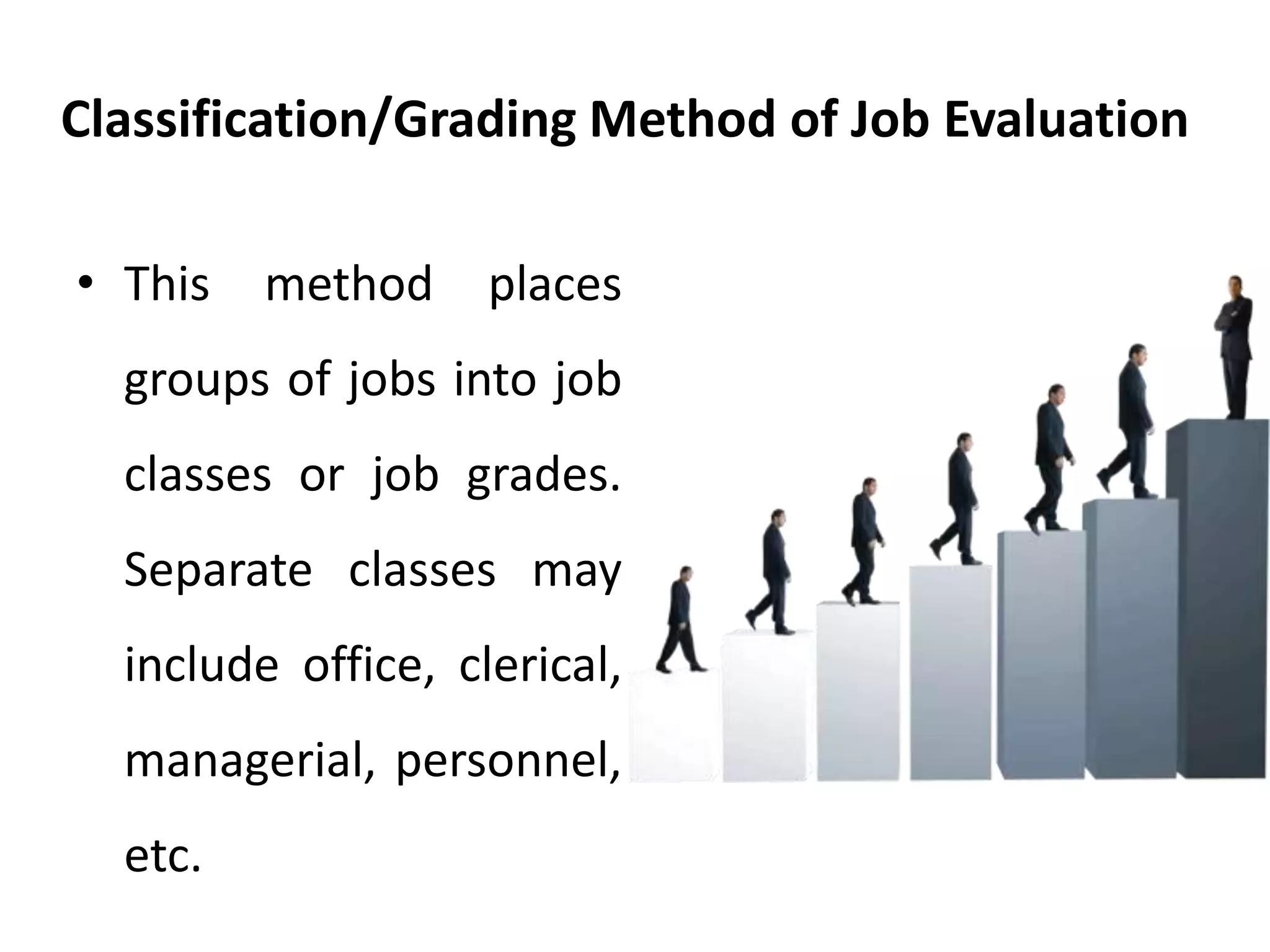
• This method places
groups of jobs into job
classes or job grades.
Separate classes may
include office, clerical,
managerial, personnel,
etc.
Classification/Grading Method of Job Evaluation
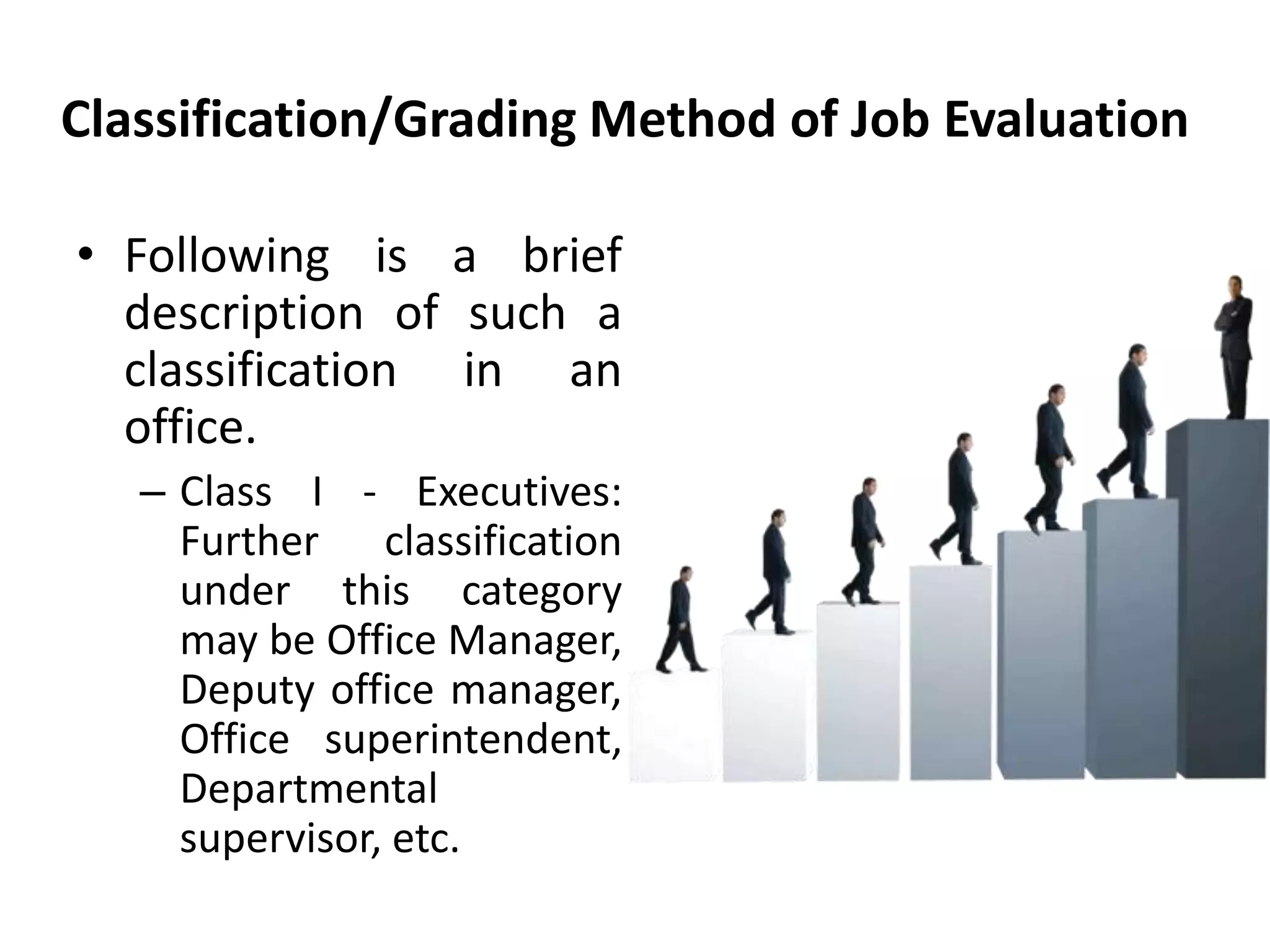
• Following is a brief
description of such a
classification in an
office.
– Class I - Executives:
Further classification
under this category
may be Office Manager,
Deputy office manager,
Office superintendent,
Departmental
supervisor, etc.
Classification/Grading Method of Job Evaluation
• Following is a brief
description of such a
classification in an
office.
– Class II - Skilled
workers: Under this
category may come
the Purchasing
assistant, Cashier,
Receipts clerk, etc.
Classification/Grading Method of Job Evaluation
• Following is a brief
description of such a
classification in an
office.
– Class III - Semiskilled
workers: Under this
category may come
Stenotypists, Machine-
operators, Switchboard
operator etc.
Classification/Grading Method of Job Evaluation
• Following is a brief
description of such a
classification in an
office.
– Class IV - Unskilled
workers: This category
may comprise peons,
messengers, house
keeping staff, File clerks,
Office boys, etc.
Classification/Grading Method of Job Evaluation
• The job grading method
is less subjective when
compared to the earlier
ranking method. The
system is very easy to
understand and
acceptable to almost all
employees without
hesitation.
Classification/Grading Method of Job Evaluation
• One strong point in
favour of the method is
that it takes into account
all the factors that a job
comprises. This system
can be effectively used
for a variety of jobs.
Classification/Grading Method of Job Evaluation
• The weaknesses of the
Grading method are:
– Even when the
requirements of different
jobs differ, they may be
combined into a single
category, depending on
the status a job carries.
– It is difficult to write all-
inclusive descriptions of a
grade.
Classification/Grading Method of Job Evaluation
• The weaknesses of the
Grading method are:
– The method oversimplifies
sharp differences between
different jobs and different
grades.
– When individual job
descriptions and grade
descriptions do not match
well, the evaluators have
the tendency to classify the
job using their subjective
judgements.
Classification/Grading method of job evaluation   - compensation management - Manu Melwin Joy

Classification/Grading method of job evaluation - compensation management - Manu Melwin Joy

  • 1.
    Classification/Grading Method ofJob Evaluation Compensation Management
  • 2.
    Prepared By Kindly restrictthe use of slides for personal purpose. Please seek permission to reproduce the same in public forms and presentations. Manu Melwin Joy Assistant Professor Ilahia School of Management Studies Kerala, India. Phone – 9744551114 Mail – manu_melwinjoy@yahoo.com
  • 3.
    Classification/Grading Method ofJob Evaluation • According to this method, a predetermined number of job groups or job classes are established and jobs are assigned to these classifications.
  • 4.
    Classification/Grading Method ofJob Evaluation • This method places groups of jobs into job classes or job grades. Separate classes may include office, clerical, managerial, personnel, etc.
  • 5.
    Classification/Grading Method ofJob Evaluation • Following is a brief description of such a classification in an office. – Class I - Executives: Further classification under this category may be Office Manager, Deputy office manager, Office superintendent, Departmental supervisor, etc.
  • 6.
    Classification/Grading Method ofJob Evaluation • Following is a brief description of such a classification in an office. – Class II - Skilled workers: Under this category may come the Purchasing assistant, Cashier, Receipts clerk, etc.
  • 7.
    Classification/Grading Method ofJob Evaluation • Following is a brief description of such a classification in an office. – Class III - Semiskilled workers: Under this category may come Stenotypists, Machine- operators, Switchboard operator etc.
  • 8.
    Classification/Grading Method ofJob Evaluation • Following is a brief description of such a classification in an office. – Class IV - Unskilled workers: This category may comprise peons, messengers, house keeping staff, File clerks, Office boys, etc.
  • 9.
    Classification/Grading Method ofJob Evaluation • The job grading method is less subjective when compared to the earlier ranking method. The system is very easy to understand and acceptable to almost all employees without hesitation.
  • 10.
    Classification/Grading Method ofJob Evaluation • One strong point in favour of the method is that it takes into account all the factors that a job comprises. This system can be effectively used for a variety of jobs.
  • 11.
    Classification/Grading Method ofJob Evaluation • The weaknesses of the Grading method are: – Even when the requirements of different jobs differ, they may be combined into a single category, depending on the status a job carries. – It is difficult to write all- inclusive descriptions of a grade.
  • 12.
    Classification/Grading Method ofJob Evaluation • The weaknesses of the Grading method are: – The method oversimplifies sharp differences between different jobs and different grades. – When individual job descriptions and grade descriptions do not match well, the evaluators have the tendency to classify the job using their subjective judgements.