Module -3
Job Evaluation
Job Evaluation
Job evaluation is a systematic way of
determining the value/worth of a job
in an organisation.
Process of systematically determining the relative worth
of jobs to create a job structure for the organization.
Evaluation is based on a combination of job content,
skills required, value to the organization, organizational
culture and the external market.
Job Evaluation consists of the
following
1. Job Analysis.
2. Job Description.
3. Job specification
4. Job Grading.
5. Job Classification.
6. Job Assessment/Job Pricing.
Major Decisions in Job Evaluation
1. Establish purpose of evaluation.
2. Decide whether to use single or multiple plans.
3. Choose among alternative approaches.
4. Obtain involvement of relevant stakeholders.
5. Evaluate plan’s usefulness.
Job Evaluation Process
1. Gaining Acceptance
2. Creating job evaluation committee
3. Finding the jobs to be evaluated
4. Analysing and preparing job description
5. Selecting the method of evaluation
6. Classifying jobs
7. Installing the programme
8. Reviewing periodically
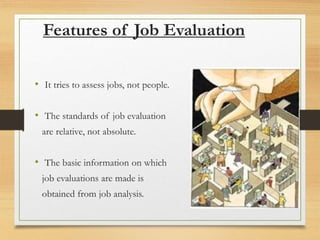
Features of Job Evaluation
• It tries to assess jobs, not people.
• The standards of job evaluation
are relative, not absolute.
• The basic information on which
job evaluations are made is
obtained from job analysis.
Features of Job Evaluation
• Job evaluations are carried out by groups, not by individuals.
• Some degree of subjectivity is always present in job evaluation.
• Job evaluation does not fix pay scales, but merely provides a
basis for evaluating a rational wage structure.
Benefits of job evaluation
• It tries to link pay with the requirements of the job.
• It offers a systematic procedure for determining the relative worth of
jobs.
• An equitable wage structure is a natural outcome of job evaluation
• An unbiased job evaluation tends to eliminate salary inequalities by
placing jobs having similar requirements in the same salary range.
Benefits of job evaluation
• Employees as well as unions participate as members of job
evaluation committee.
• Job evaluation, when conducted properly and with care, helps
in the evaluation of new jobs.
• It points out possibilities of more appropriate use of the
plant’s labour force by indicating jobs that need more or less
skilled workers than those who are manning these jobs
currently.
Job Evaluation Methods
Job Evaluation methods are divided into mainly 2 categories:-
1. Conventional
2. Innovative/Non-Conventional.
1.Conventional Methods:-
a) Non Quantitative methods:-
i) Ranking Method
ii) Classification Method.
b) Quantative methods:-
i) Points Ranking method.
ii) Factor Comparison method.
Innovative/Non-conventional:-
1. Time Span of Discretion Method
2. Decision Band Method.
3. Direct consensus method.
4. Guide Chart Profile Method.
5. Urwick Orr Profile Method.
RANKING METHOD
• It is the simplest method of job evaluation.
• In this method, jobs are arranged from highest to lowest, in order
of their value or merit to the organisation.
• Jobs can also be arranged according to the relative difficulty in
performing them.
• Jobs are usually ranked in each department and then the department
rankings are combined to develop an organisational ranking.
JOB CLASSIFICATION
• According to this method, a predetermined number of job groups or job
classes are established and jobs are assigned to these classifications.
• This method places groups of jobs into job classes or job grades.
• Separate classes may include office, clerical, managerial, personnel, etc.
JOB CLASSIFICATION
Following is a brief description of classification in an office:
 Class 1- Executives: Office manager, deputy office manager, department
supervisor, etc.
 Class 2- Skilled workers: Purchasing assistant, cashier, receipts clerk, etc.
 Class 3- Semiskilled workers: Stenotypists, machine operators,
switchboard operator, etc.
 Class 4- Semiskilled workers: file clerks, office boys, etc.
POINT METHOD or POINTS
RANKING METHOD
• This method is widely used currently.
• In this method jobs are expressed in terms of key factors.
• Points are assigned to each factor after prioritizing each factor in
order of importance.
• The points are summed up to determine the wage rate for the job.
• Jobs with similar point totals are placed in similar pay grades
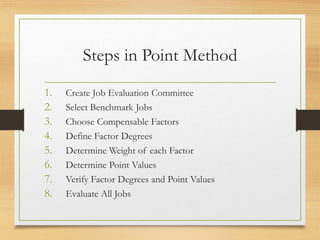
Steps in Point Method
1. Create Job Evaluation Committee
2. Select Benchmark Jobs
3. Choose Compensable Factors
4. Define Factor Degrees
5. Determine Weight of each Factor
6. Determine Point Values
7. Verify Factor Degrees and Point Values
8. Evaluate All Jobs
Steps in Point Method
• Create Job Evaluation Committee
• Advantages of JE Committees
• Broader job knowledge from different perspectives
• Increased participation leads to increased understanding and
commitment to the Job Evaluations.
• Selecting members to be on the JE committee
• Job incumbents, managers, HR expert, union reps
• Employees who have knowledge of jobs
• Manageable size
Steps in Point Method
• Select Benchmark Jobs
• “Generic” jobs with similar and agreed upon characteristics
• Relatively stable
• Represent entire range of jobs in company
• Generally accepted in the labor market for purposes of
setting pay levels
Steps in Point Method
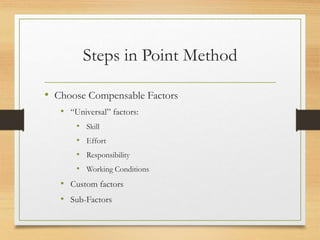
• Choose Compensable Factors
• “Universal” factors:
• Skill
• Effort
• Responsibility
• Working Conditions
• Custom factors
• Sub-Factors
Steps in Point Method
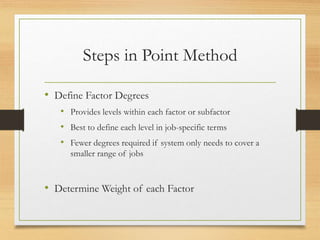
• Define Factor Degrees
• Provides levels within each factor or subfactor
• Best to define each level in job-specific terms
• Fewer degrees required if system only needs to cover a
smaller range of jobs
• Determine Weight of each Factor
Steps in Point Method
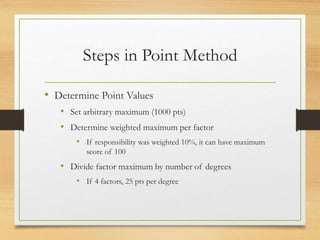
• Determine Point Values
• Set arbitrary maximum (1000 pts)
• Determine weighted maximum per factor
• If responsibility was weighted 10%, it can have maximum
score of 100
• Divide factor maximum by number of degrees
• If 4 factors, 25 pts per degree
Steps in Point Method
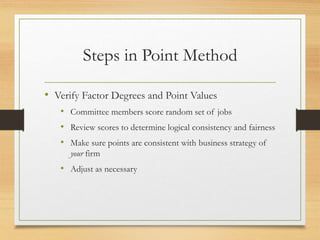
• Verify Factor Degrees and Point Values
• Committee members score random set of jobs
• Review scores to determine logical consistency and fairness
• Make sure points are consistent with business strategy of
your firm
• Adjust as necessary
Factor Comparison Method
• It is more systematic and scientific method of job evaluation.
• Though it is the most complex method of all, it is consistent
and appreciable.
• Under this method, instead of ranking complete jobs, each job
is ranked according to a series of factors.
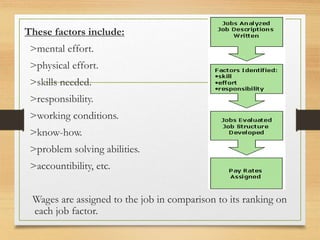
These factors include:
>mental effort.
>physical effort.
>skills needed.
>responsibility.
>working conditions.
>know-how.
>problem solving abilities.
>accountibility, etc.
Wages are assigned to the job in comparison to its ranking on
each job factor.
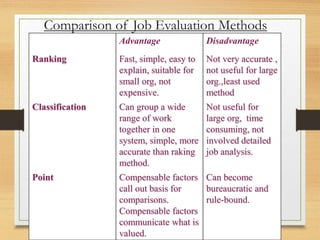
Comparison of Job Evaluation Methods
Advantage Disadvantage
Ranking Fast, simple, easy to
explain, suitable for
small org, not
expensive.
Not very accurate ,
not useful for large
org.,least used
method
Classification Can group a wide
range of work
together in one
system, simple, more
accurate than raking
method.
Not useful for
large org, time
consuming, not
involved detailed
job analysis.
Point Compensable factors
call out basis for
comparisons.
Compensable factors
communicate what is
valued.
Can become
bureaucratic and
rule-bound.
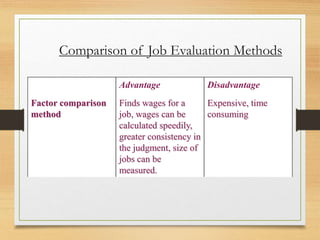
Comparison of Job Evaluation Methods
Advantage Disadvantage
Factor comparison
method
Finds wages for a
job, wages can be
calculated speedily,
greater consistency in
the judgment, size of
jobs can be
measured.
Expensive, time
consuming
The Urwick Orr Profile Method
• This method was originated by the British firm of
management consultants, Urwick Orr and partners.
• It combines the feature of point rating and ranking
methods.
The Direct Consensus Method
It relies on the Paired Comparison techniques.
An important feature of this method is members of
the valuation panel record their individual
assessments of whole job rankings and these
assessments are fed into a computer.
Direct Consensus Method
Here the workman and evaluator reach the value by
mutual consensus.
Time span of Discretion Method
This system uses the concept that all make
decisions in their work and the effect of such a
decision on their work/organisation is felt after a
certain period for taking a follow up action.
For example:-
i) Unskilled worker – few hours.
ii) Marketing Manager – 2-3 years.
iii) Board of Directors – 10 years.
Decision Band Method
Here the type of decision to be made by the job is considered
and placed in the applicable band.
For ex:-
i) Band E – Policy making decision – Top Management.
ii) Band D – Programming decision – By senior managers.
iii) Band C – Interpretive decisions – By middle managers.
iv) Band B – Routine decisions – By skilled operators.
v) Band A – Automatic decisions regarding when, how and
where – By semi skilled workers.
Guide Chart profile method
Hay plan or Hay Guide chart Profile method is for
managerial pay. It emphasizes on three critical
factors:-
1) Know-how.
2) Problem – solving.
3) Accountability.
1) Know-how:-
Practical experience, specialized expertise and technological depth.
Width of managerial knowledge.
Human Relations.
2)Problem – solving:-
Thinking environment
Challenging environment
3) Accountability:-
Freedom to act.
Impact on results.
Magnitude of success annually etc.
Obtain Job KSAOs
Knowledge
Skills
Abilities
Other Characteristics
Hay Group—Pioneer in Job
Evaluation
The Korn Ferry Hay Group Guide Charts
are proprietary instruments that yield consistent and
legally defensible evaluations of the content of jobs. Korn
Ferry Hay Group's job evaluation approach is the world's
most widely utilized, accepted, and tested over time as a
fair and unbiased way to determine job worth.
Hay Job Evaluation is a method used by corporates and
organizations to map out their job roles in the context of
the organizational structure.
• The general purpose for carrying out job evaluations using this
or similar job evaluation methods is to enable organizations to
map and align their roles/jobs. This can deliver the following
key benefits:
• Clarity in result areas and accountabilities in the processes of
the organization
• Enabling salary and benefit grading or benchmarking due to
standardization of job levels
• Improved succession planning or mobility within the
organization
• Creation of more useful and focused job descriptions
Steps in Hay Job Evaluation
• Training for representatives from major operational departments
and HR functions in the use of the method. This will include practical
exercises where a mix of people will act as a "job evaluation board“
• Revision of all job descriptions across the enterprise under HR
guidance. Typically a single standard (format) will be required if it is
not already in existence.
• Creation of job evaluation boards – mix of line management, HR and
experts to decide on plotting of jobs.
• Organization map and banding proposal – Typically the
HR function will work with senior management to put
together a proposal for banding (scales expressed in Hay
points) or grading staff and describing the benefits that
will be attracted by each band.
• Board review – once the jobs are all rated and the
organization map is completed, the company board or
equivalent will review the summary, the banding
proposals, cost if any, to the company and recommended
activities to go live. Assuming these are approved, the
overall project manager will then move to
implementation.
1) Know-how:-
Practical experience, specialized expertise and technological depth.
Width of managerial knowledge.
Human Relations.
2)Problem – solving:-
Thinking environment
Challenging environment
3) Accountability:-
Freedom to act.
Impact on results.
Magnitude of success annually etc.
Online Salary Survey
A salary survey is a tool specifically for
remuneration specialists and managers to define a fair
and competitive salary for the employees of a
company. The survey output is data on
the average or median salary for a specific position,
taking into consideration the region, industry,
company size, etc
Pay Policy Alternatives
Companies can choose from three pay level policies
1. Market lead : The market lead policy distinguishes a
company from the competition by compensating
employees more highly than most competitors.
2. Market lag : It distinguishes a company from the
competition, but by compensating employees less than
most competitors.
3. Market match : This policy most closely follows the
typical market pay rates because companies pay
according to the market pay line.
Salary Survey
A salary survey is a systematic process of
collecting & making judgments about the
compensation paid by other employers. They
provide the data for setting the pay policy relative
to competition
Reasons for conducting salary
survey
1. To make adjustments to employees pay on the
overall movement of pay rates caused by the
competition foe people in the market.
2. To set the mix of pay forms relative to that paid by
competitors.
3. To analyze pay related problems.
4. To estimate the labour costs of product/services market
competitors-to select relevant market competitors, based
on the following areas
The same occupations or skills.
Employees within the same geographic area.
Thee same products and service.
Design the Survey
Consulting firms offer a wide choice of ongoing surveys
covering almost every job family and industry group.
Designing a survey requires answering he following
questions:- 1) Who should be involved in the survey design?
2) How many employers should be included?
3) Which jobs should be included?
4) What information should be collected?
Interpreting survey results
1. The policy on competitive position is translated
into practice by pay policy lines.
2. The use of grades & ranges recognizes both
internal & external pressures on pay decisions.
3. Pay ranges permit the employers to value &
recognize these differences with pay.
Pay-Policy Line
• A mathematical expression that describes
the relationship between a job’s pay & its
evaluation points.
• Now you can define a pay-policy line by
plotting points reflecting the jobs in your
organizations based on two dimensions:
compensation value and a job ranking
(or job evaluation result).
The line that illustrates the relationship between the
external value of a job (from salary survey information) and
the internal value of jobs (from job evaluation) represents the
market line. A pay policy line portrays an organization's pay
policy with respect to the market line

Module 3 - Recruiment and selectionJob Evaluation. ppt

  • 1.
  • 2.
    Job Evaluation Job evaluationis a systematic way of determining the value/worth of a job in an organisation.
  • 3.
    Process of systematicallydetermining the relative worth of jobs to create a job structure for the organization. Evaluation is based on a combination of job content, skills required, value to the organization, organizational culture and the external market.
  • 4.
    Job Evaluation consistsof the following 1. Job Analysis. 2. Job Description. 3. Job specification 4. Job Grading. 5. Job Classification. 6. Job Assessment/Job Pricing.
  • 5.
    Major Decisions inJob Evaluation 1. Establish purpose of evaluation. 2. Decide whether to use single or multiple plans. 3. Choose among alternative approaches. 4. Obtain involvement of relevant stakeholders. 5. Evaluate plan’s usefulness.
  • 6.
    Job Evaluation Process 1.Gaining Acceptance 2. Creating job evaluation committee 3. Finding the jobs to be evaluated 4. Analysing and preparing job description 5. Selecting the method of evaluation 6. Classifying jobs 7. Installing the programme 8. Reviewing periodically
  • 7.
    Features of JobEvaluation • It tries to assess jobs, not people. • The standards of job evaluation are relative, not absolute. • The basic information on which job evaluations are made is obtained from job analysis.
  • 8.
    Features of JobEvaluation • Job evaluations are carried out by groups, not by individuals. • Some degree of subjectivity is always present in job evaluation. • Job evaluation does not fix pay scales, but merely provides a basis for evaluating a rational wage structure.
  • 9.
    Benefits of jobevaluation • It tries to link pay with the requirements of the job. • It offers a systematic procedure for determining the relative worth of jobs. • An equitable wage structure is a natural outcome of job evaluation • An unbiased job evaluation tends to eliminate salary inequalities by placing jobs having similar requirements in the same salary range.
  • 10.
    Benefits of jobevaluation • Employees as well as unions participate as members of job evaluation committee. • Job evaluation, when conducted properly and with care, helps in the evaluation of new jobs. • It points out possibilities of more appropriate use of the plant’s labour force by indicating jobs that need more or less skilled workers than those who are manning these jobs currently.
  • 11.
    Job Evaluation Methods JobEvaluation methods are divided into mainly 2 categories:- 1. Conventional 2. Innovative/Non-Conventional. 1.Conventional Methods:- a) Non Quantitative methods:- i) Ranking Method ii) Classification Method. b) Quantative methods:- i) Points Ranking method. ii) Factor Comparison method.
  • 12.
    Innovative/Non-conventional:- 1. Time Spanof Discretion Method 2. Decision Band Method. 3. Direct consensus method. 4. Guide Chart Profile Method. 5. Urwick Orr Profile Method.
  • 13.
    RANKING METHOD • Itis the simplest method of job evaluation. • In this method, jobs are arranged from highest to lowest, in order of their value or merit to the organisation. • Jobs can also be arranged according to the relative difficulty in performing them. • Jobs are usually ranked in each department and then the department rankings are combined to develop an organisational ranking.
  • 14.
    JOB CLASSIFICATION • Accordingto this method, a predetermined number of job groups or job classes are established and jobs are assigned to these classifications. • This method places groups of jobs into job classes or job grades. • Separate classes may include office, clerical, managerial, personnel, etc.
  • 15.
    JOB CLASSIFICATION Following isa brief description of classification in an office:  Class 1- Executives: Office manager, deputy office manager, department supervisor, etc.  Class 2- Skilled workers: Purchasing assistant, cashier, receipts clerk, etc.  Class 3- Semiskilled workers: Stenotypists, machine operators, switchboard operator, etc.  Class 4- Semiskilled workers: file clerks, office boys, etc.
  • 16.
    POINT METHOD orPOINTS RANKING METHOD • This method is widely used currently. • In this method jobs are expressed in terms of key factors. • Points are assigned to each factor after prioritizing each factor in order of importance. • The points are summed up to determine the wage rate for the job. • Jobs with similar point totals are placed in similar pay grades
  • 17.
    Steps in PointMethod 1. Create Job Evaluation Committee 2. Select Benchmark Jobs 3. Choose Compensable Factors 4. Define Factor Degrees 5. Determine Weight of each Factor 6. Determine Point Values 7. Verify Factor Degrees and Point Values 8. Evaluate All Jobs
  • 18.
    Steps in PointMethod • Create Job Evaluation Committee • Advantages of JE Committees • Broader job knowledge from different perspectives • Increased participation leads to increased understanding and commitment to the Job Evaluations. • Selecting members to be on the JE committee • Job incumbents, managers, HR expert, union reps • Employees who have knowledge of jobs • Manageable size
  • 19.
    Steps in PointMethod • Select Benchmark Jobs • “Generic” jobs with similar and agreed upon characteristics • Relatively stable • Represent entire range of jobs in company • Generally accepted in the labor market for purposes of setting pay levels
  • 20.
    Steps in PointMethod • Choose Compensable Factors • “Universal” factors: • Skill • Effort • Responsibility • Working Conditions • Custom factors • Sub-Factors
  • 21.
    Steps in PointMethod • Define Factor Degrees • Provides levels within each factor or subfactor • Best to define each level in job-specific terms • Fewer degrees required if system only needs to cover a smaller range of jobs • Determine Weight of each Factor
  • 22.
    Steps in PointMethod • Determine Point Values • Set arbitrary maximum (1000 pts) • Determine weighted maximum per factor • If responsibility was weighted 10%, it can have maximum score of 100 • Divide factor maximum by number of degrees • If 4 factors, 25 pts per degree
  • 23.
    Steps in PointMethod • Verify Factor Degrees and Point Values • Committee members score random set of jobs • Review scores to determine logical consistency and fairness • Make sure points are consistent with business strategy of your firm • Adjust as necessary
  • 24.
    Factor Comparison Method •It is more systematic and scientific method of job evaluation. • Though it is the most complex method of all, it is consistent and appreciable. • Under this method, instead of ranking complete jobs, each job is ranked according to a series of factors.
  • 25.
    These factors include: >mentaleffort. >physical effort. >skills needed. >responsibility. >working conditions. >know-how. >problem solving abilities. >accountibility, etc. Wages are assigned to the job in comparison to its ranking on each job factor.
  • 26.
    Comparison of JobEvaluation Methods Advantage Disadvantage Ranking Fast, simple, easy to explain, suitable for small org, not expensive. Not very accurate , not useful for large org.,least used method Classification Can group a wide range of work together in one system, simple, more accurate than raking method. Not useful for large org, time consuming, not involved detailed job analysis. Point Compensable factors call out basis for comparisons. Compensable factors communicate what is valued. Can become bureaucratic and rule-bound.
  • 27.
    Comparison of JobEvaluation Methods Advantage Disadvantage Factor comparison method Finds wages for a job, wages can be calculated speedily, greater consistency in the judgment, size of jobs can be measured. Expensive, time consuming
  • 28.
    The Urwick OrrProfile Method • This method was originated by the British firm of management consultants, Urwick Orr and partners. • It combines the feature of point rating and ranking methods.
  • 29.
    The Direct ConsensusMethod It relies on the Paired Comparison techniques. An important feature of this method is members of the valuation panel record their individual assessments of whole job rankings and these assessments are fed into a computer.
  • 30.
    Direct Consensus Method Herethe workman and evaluator reach the value by mutual consensus.
  • 31.
    Time span ofDiscretion Method This system uses the concept that all make decisions in their work and the effect of such a decision on their work/organisation is felt after a certain period for taking a follow up action. For example:- i) Unskilled worker – few hours. ii) Marketing Manager – 2-3 years. iii) Board of Directors – 10 years.
  • 32.
    Decision Band Method Herethe type of decision to be made by the job is considered and placed in the applicable band. For ex:- i) Band E – Policy making decision – Top Management. ii) Band D – Programming decision – By senior managers. iii) Band C – Interpretive decisions – By middle managers. iv) Band B – Routine decisions – By skilled operators. v) Band A – Automatic decisions regarding when, how and where – By semi skilled workers.
  • 33.
    Guide Chart profilemethod Hay plan or Hay Guide chart Profile method is for managerial pay. It emphasizes on three critical factors:- 1) Know-how. 2) Problem – solving. 3) Accountability.
  • 34.
    1) Know-how:- Practical experience,specialized expertise and technological depth. Width of managerial knowledge. Human Relations. 2)Problem – solving:- Thinking environment Challenging environment 3) Accountability:- Freedom to act. Impact on results. Magnitude of success annually etc.
  • 35.
  • 36.
    Hay Group—Pioneer inJob Evaluation The Korn Ferry Hay Group Guide Charts are proprietary instruments that yield consistent and legally defensible evaluations of the content of jobs. Korn Ferry Hay Group's job evaluation approach is the world's most widely utilized, accepted, and tested over time as a fair and unbiased way to determine job worth. Hay Job Evaluation is a method used by corporates and organizations to map out their job roles in the context of the organizational structure.
  • 37.
    • The generalpurpose for carrying out job evaluations using this or similar job evaluation methods is to enable organizations to map and align their roles/jobs. This can deliver the following key benefits: • Clarity in result areas and accountabilities in the processes of the organization • Enabling salary and benefit grading or benchmarking due to standardization of job levels • Improved succession planning or mobility within the organization • Creation of more useful and focused job descriptions
  • 38.
    Steps in HayJob Evaluation • Training for representatives from major operational departments and HR functions in the use of the method. This will include practical exercises where a mix of people will act as a "job evaluation board“ • Revision of all job descriptions across the enterprise under HR guidance. Typically a single standard (format) will be required if it is not already in existence. • Creation of job evaluation boards – mix of line management, HR and experts to decide on plotting of jobs.
  • 39.
    • Organization mapand banding proposal – Typically the HR function will work with senior management to put together a proposal for banding (scales expressed in Hay points) or grading staff and describing the benefits that will be attracted by each band. • Board review – once the jobs are all rated and the organization map is completed, the company board or equivalent will review the summary, the banding proposals, cost if any, to the company and recommended activities to go live. Assuming these are approved, the overall project manager will then move to implementation.
  • 40.
    1) Know-how:- Practical experience,specialized expertise and technological depth. Width of managerial knowledge. Human Relations. 2)Problem – solving:- Thinking environment Challenging environment 3) Accountability:- Freedom to act. Impact on results. Magnitude of success annually etc.
  • 41.
    Online Salary Survey Asalary survey is a tool specifically for remuneration specialists and managers to define a fair and competitive salary for the employees of a company. The survey output is data on the average or median salary for a specific position, taking into consideration the region, industry, company size, etc
  • 42.
    Pay Policy Alternatives Companiescan choose from three pay level policies 1. Market lead : The market lead policy distinguishes a company from the competition by compensating employees more highly than most competitors. 2. Market lag : It distinguishes a company from the competition, but by compensating employees less than most competitors. 3. Market match : This policy most closely follows the typical market pay rates because companies pay according to the market pay line.
  • 43.
    Salary Survey A salarysurvey is a systematic process of collecting & making judgments about the compensation paid by other employers. They provide the data for setting the pay policy relative to competition
  • 44.
    Reasons for conductingsalary survey 1. To make adjustments to employees pay on the overall movement of pay rates caused by the competition foe people in the market. 2. To set the mix of pay forms relative to that paid by competitors. 3. To analyze pay related problems.
  • 45.
    4. To estimatethe labour costs of product/services market competitors-to select relevant market competitors, based on the following areas The same occupations or skills. Employees within the same geographic area. Thee same products and service.
  • 46.
    Design the Survey Consultingfirms offer a wide choice of ongoing surveys covering almost every job family and industry group. Designing a survey requires answering he following questions:- 1) Who should be involved in the survey design? 2) How many employers should be included? 3) Which jobs should be included? 4) What information should be collected?
  • 47.
    Interpreting survey results 1.The policy on competitive position is translated into practice by pay policy lines. 2. The use of grades & ranges recognizes both internal & external pressures on pay decisions. 3. Pay ranges permit the employers to value & recognize these differences with pay.
  • 48.
    Pay-Policy Line • Amathematical expression that describes the relationship between a job’s pay & its evaluation points. • Now you can define a pay-policy line by plotting points reflecting the jobs in your organizations based on two dimensions: compensation value and a job ranking (or job evaluation result).
  • 49.
    The line thatillustrates the relationship between the external value of a job (from salary survey information) and the internal value of jobs (from job evaluation) represents the market line. A pay policy line portrays an organization's pay policy with respect to the market line