By – Manash Pratim Deka
Roll no. - 1273920014
Points to be discussed
Introduction
Need for Blu Ray disc
Key Characteristics
Blue Laser
Some features of Blue Laser
Accessing the disc
Applications
Difference between Blu Ray disc and DVD
Introduction
 Blu Ray Disc (BD) is a new optical disc standard or a digital optical
disc data storage format designed to supersede the Digital Versatile
Disc (DVD) format.
 The name Blu-ray Disc refers to the blue laser used to read the disc.
 It is capable of storing high-definition video resolution (1080p).
 The plastic disc is 120 mm in diameter and 1.2 mm thick, the same
size as DVDs and Compact Discs (CDs).
 Conventional Blu-ray Discs contain 25 GB per layer, with dual layer
discs (50 GB).
 Triple layer discs (100 GB) and quadruple layers (128 GB) are available
for BD-XL re-writer drives.
contd...
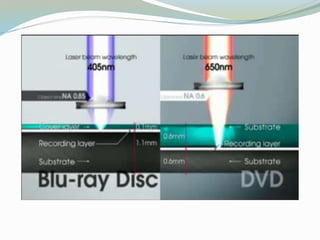
The blue laser has a 405 nm wavelength that can focus
more tightly than the red lasers used for writable DVD
and as a consequence, write much more data in the
same space.
Blu-ray uses phase change technology to enable
repeated writing to the disc.
Need for Blu Ray Disc
With the advent of High Definition videos, it is
evident that larger capacity discs are needed.
Data archiving requirements are also driving demand
for increase in capacity.
For High recording speed as well as reading speed.
Blu Ray Disc Key Characteristics
Large recording capacity up to 25GB - 27GB.
By adopting a 405nm blue-violet semiconductor laser,
with a 0.85NA field lens and a 0.1 mm. optical
transmittance protection disc layer structure, it can record
up to 27GB video data on a single sided 12cm phase
change disc. It can record over 2 hours of digital high
definition video and more than 13 hours of standard TV
broadcasting (VHS/standard definition picture quality,
3.8Mbps).
Contd…
High-speed data transfer rate 36Mbps.
It is possible for the Blu-ray Disc to record digital
high definition broadcasts or high definition images
from a digital video camera while maintaining the
original picture quality.
Easy to use disc cartridge.
An easy to use optical disc cartridge protects the
optical disc’s recording and playback phase from dust
and fingerprints.
Blue Laser
A laser is a coherent and focused beam of photons or
particles of light.
The photons are produced as the result of a chemical
reaction between special materials and this special
material in the blue laser technology is Gallium nitride.
A blue laser is a laser with a shorter wavelength than the
red laser used in today’s compact disc and laser printer
technologies and the ability to store and read two to four
times the amount of data.
Even a small shortening of wavelength of light can have a
dramatic effect in the ability to store and access data.
contd…
Red lasers used in today’s technologies have wavelengths of
over 630 nanometers. The blue laser has a wavelength of
405 nanometers.
SANYO (Electronics company in Japan)has developed the
world’s first blue laser diode with a new low-noise (stable)
beam structure produced using ion implantation.
contd…
The stable beam structure boasts lower noise, and lower
current consumption achieving higher performance
compared to the blue laser diodes used before that.
This structure makes SANYO’s blue laser diode an
optimum light source for large-capacity optical disc
systems like Blu ray discs.
The laser diode is easily mass produced because the stable
beam structure reduces the number of fabrication steps
while the top and bottom electrodes structure reduces chip
size.
Blue Laser Diodes
Contd…
In recent years, the field of optical disc systems has seen
the development of next- generation large-capacity optical
disc systems like advanced BDs that can record more than
two hours of digital high definition images.
The blue laser diode made of InGaN (indium gallium-
nitride) that is used as a light source for reading signals
recorded on the optical discs was the key to developing
these systems.
Some other features of Blue Laser
Fundamental traverse mode
The fundamental traverse mode generates a single
stable beam which means the beam can be focused
into a tiny spot using a simple optical system.
Built-in photodiode for monitoring optical output
A photodiode is installed to monitor optical output
Applications
The new laser diode is suitable for the next-
generation large-capacity optical disc systems like and
many types of measuring instruments.
Accessing the Disc
The technology behind writing in the disc and reading
from the disc is “Phase Change Technology”.
Phase change technology do not rely on magnetic
influence as do hard disks and magneto-optic (MO) discs.
In rewritable phase change media, the heat from a short,
high-intensity laser pulse turns a bit in the recording layer
into an unstructured "amorphous" state, and a medium-
intensity pulse sets it to a highly structured "crystalline"
state.
contd…
Writing a bit is accomplished by pulsing different
intensities of a laser into the phase change layer, which
changes the bit between crystalline and amorphous states.
The bit is read by sensing the reflected light from a low-
intensity laser pulse.
The crystalline bit reflects the laser beam, while the
amorphous bit absorbs the light.
Applications
Ultra Density Optical (UDO)
It utilizes violet laser and phase change media
recording technology to provide a huge leap in data
storage densities.
First generation UDO products were of 30GB capacity
and were launched in August, 2003.
The Future generations increased the capacity to 60GB
and 120GB and provides full backward read compatibility.
contd…
Digital Video Recording
The Blu-ray Disc using blue laser achieves over
2-hour digital high definition video recording on a
12cm diameter CD/DVD size phase change optical
disc.
The Blu-ray Disc enables the recording, rewriting and
play back of up to 27 gigabytes (GB) of data on a single
sided single layer disc using a 405nm blue laser.
References
World Wide Web
www.whatis.com
www.bluraytalk.com
www.computerworld.com
www.dvdeurope2002.com
www.bluray.org
Thank You

Blu ray Disc and its technology

  • 1.
    By – ManashPratim Deka Roll no. - 1273920014
  • 2.
    Points to bediscussed Introduction Need for Blu Ray disc Key Characteristics Blue Laser Some features of Blue Laser Accessing the disc Applications Difference between Blu Ray disc and DVD
  • 3.
    Introduction  Blu RayDisc (BD) is a new optical disc standard or a digital optical disc data storage format designed to supersede the Digital Versatile Disc (DVD) format.  The name Blu-ray Disc refers to the blue laser used to read the disc.  It is capable of storing high-definition video resolution (1080p).  The plastic disc is 120 mm in diameter and 1.2 mm thick, the same size as DVDs and Compact Discs (CDs).  Conventional Blu-ray Discs contain 25 GB per layer, with dual layer discs (50 GB).  Triple layer discs (100 GB) and quadruple layers (128 GB) are available for BD-XL re-writer drives.
  • 4.
    contd... The blue laserhas a 405 nm wavelength that can focus more tightly than the red lasers used for writable DVD and as a consequence, write much more data in the same space. Blu-ray uses phase change technology to enable repeated writing to the disc.
  • 5.
    Need for BluRay Disc With the advent of High Definition videos, it is evident that larger capacity discs are needed. Data archiving requirements are also driving demand for increase in capacity. For High recording speed as well as reading speed.
  • 6.
    Blu Ray DiscKey Characteristics Large recording capacity up to 25GB - 27GB. By adopting a 405nm blue-violet semiconductor laser, with a 0.85NA field lens and a 0.1 mm. optical transmittance protection disc layer structure, it can record up to 27GB video data on a single sided 12cm phase change disc. It can record over 2 hours of digital high definition video and more than 13 hours of standard TV broadcasting (VHS/standard definition picture quality, 3.8Mbps).
  • 7.
    Contd… High-speed data transferrate 36Mbps. It is possible for the Blu-ray Disc to record digital high definition broadcasts or high definition images from a digital video camera while maintaining the original picture quality. Easy to use disc cartridge. An easy to use optical disc cartridge protects the optical disc’s recording and playback phase from dust and fingerprints.
  • 8.
    Blue Laser A laseris a coherent and focused beam of photons or particles of light. The photons are produced as the result of a chemical reaction between special materials and this special material in the blue laser technology is Gallium nitride. A blue laser is a laser with a shorter wavelength than the red laser used in today’s compact disc and laser printer technologies and the ability to store and read two to four times the amount of data. Even a small shortening of wavelength of light can have a dramatic effect in the ability to store and access data.
  • 9.
    contd… Red lasers usedin today’s technologies have wavelengths of over 630 nanometers. The blue laser has a wavelength of 405 nanometers. SANYO (Electronics company in Japan)has developed the world’s first blue laser diode with a new low-noise (stable) beam structure produced using ion implantation.
  • 10.
    contd… The stable beamstructure boasts lower noise, and lower current consumption achieving higher performance compared to the blue laser diodes used before that. This structure makes SANYO’s blue laser diode an optimum light source for large-capacity optical disc systems like Blu ray discs. The laser diode is easily mass produced because the stable beam structure reduces the number of fabrication steps while the top and bottom electrodes structure reduces chip size.
  • 11.
  • 12.
    Contd… In recent years,the field of optical disc systems has seen the development of next- generation large-capacity optical disc systems like advanced BDs that can record more than two hours of digital high definition images. The blue laser diode made of InGaN (indium gallium- nitride) that is used as a light source for reading signals recorded on the optical discs was the key to developing these systems.
  • 13.
    Some other featuresof Blue Laser Fundamental traverse mode The fundamental traverse mode generates a single stable beam which means the beam can be focused into a tiny spot using a simple optical system. Built-in photodiode for monitoring optical output A photodiode is installed to monitor optical output Applications The new laser diode is suitable for the next- generation large-capacity optical disc systems like and many types of measuring instruments.
  • 14.
    Accessing the Disc Thetechnology behind writing in the disc and reading from the disc is “Phase Change Technology”. Phase change technology do not rely on magnetic influence as do hard disks and magneto-optic (MO) discs. In rewritable phase change media, the heat from a short, high-intensity laser pulse turns a bit in the recording layer into an unstructured "amorphous" state, and a medium- intensity pulse sets it to a highly structured "crystalline" state.
  • 17.
    contd… Writing a bitis accomplished by pulsing different intensities of a laser into the phase change layer, which changes the bit between crystalline and amorphous states. The bit is read by sensing the reflected light from a low- intensity laser pulse. The crystalline bit reflects the laser beam, while the amorphous bit absorbs the light.
  • 18.
    Applications Ultra Density Optical(UDO) It utilizes violet laser and phase change media recording technology to provide a huge leap in data storage densities. First generation UDO products were of 30GB capacity and were launched in August, 2003. The Future generations increased the capacity to 60GB and 120GB and provides full backward read compatibility.
  • 19.
    contd… Digital Video Recording TheBlu-ray Disc using blue laser achieves over 2-hour digital high definition video recording on a 12cm diameter CD/DVD size phase change optical disc. The Blu-ray Disc enables the recording, rewriting and play back of up to 27 gigabytes (GB) of data on a single sided single layer disc using a 405nm blue laser.
  • 25.
  • 26.