More Related Content

PPT
Series and Parallel Circuits 
DOCX

PDF
7th Introduction to Waves waves waves .pdf 
PPTX

DOCX
current and voltage in series and parallel- worksheet 
PPT
WORK ENERGY AND POWER.ppt class 10th 
PPTX

PPTX
Polyatomic Ions - What is the difference between the two different compounds?... What's hot

PPTX

PDF
What are groups and periods? 
PPT

PPT

PPT
Grade 9, U1-L8-Periodic table 
PPTX

PPTX

PPTX
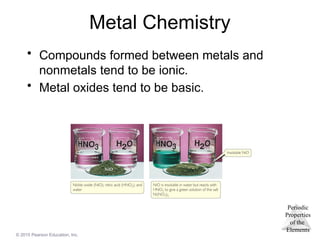
Chapter 3 Chemical Bonding 
PPT
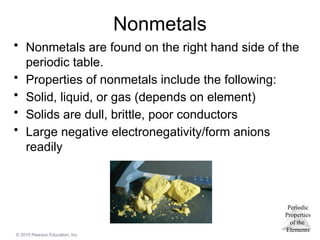
Structure of Solid Materials 
PPT
Lecture 10 temperature. thermometers. thermal expansion. 
PPT
Unit 4 Periodic Trends.ppt 
PPTX
current, voltage and resistance 
PPTX
Ch 27.2 crystalline materials & detects in crystalline materials 
PPT

PPTX

PDF
3M cable and electrical products catalogue and 3M Cable Price List - Shopelect 
PPT

PPT

PPTX
Cells in Series and in Parallel | Physics 
PDF
Unit 7 - Elements and Compounds | TEST #2 Similar to Chapter 7 Periodic Properties of the Elements.ppt

PPT
Ch. 7 Chemical Periodicity 
PPTX

PPTX
Garde nine-Chemistry-Unit two(2)-ppt.pptx 
PPT
Ch07_Outline.ppt periodic table periodic table periodic table 
PDF
Ch07 outline 000 Periodic trends 
PPTX
3. periodic Classification.pptx class 11 cbse chemistry 
PPT
Periodic Trends Complete.ppt 
PPT

PPT
AP Chemistry Chapter 7 Outline 
PPTX

PPT
GRADE 08-SCIECE CHEMISTRY Periodic Trends Complete.ppt 
PPT
Periodic Trends Complete Review cc Central Bucks School 
PPT
Periodic Trends Complete discussion in science 8.ppt 
PPTX
The periodic table class 10 
PPTX
Periodic-Trends-Dacillo-Bron-Lacson.pptx 
PPTX
Periodic-Trends-Dacillo-Bron-Lacson.pptx 
PPTX
Periodic-Trends-Dacillo-Bron-Lacson.pptx 
PDF
Lakshya_compressed.pdf of sarthi of atomic chapter 
PPT
Periodic Trends.ppt for 9th grade chemistry 
PPTX
Recently uploaded

PPTX
GRADE 8 - QUARTER 4 TYPES AND PARTS OF LETTER.pptx 
PPTX
Saber tooth tiger.pptx (Smilodon presentation ) = Extinct Animals 
PDF
Nursing care plan for Vomiting /B.Sc nsg 
PPTX
EYE IRRIGATION AND INSTILLATION....pptx 
PPTX
ENGLISH-7-Quarter-4-Week-3 Matatag .pptx 
PDF
RAJAT ARORA SIR PHYSICAL EDUCATION NOTES ALL CHAPTERS .pdf 
PDF
Types of Foot & Foot Modifications in Birds 
PPTX
Modeling Simple Equation using Bar Model.pptx 
PPTX
World cancer day 2026 4febuary united by unique 
PPTX
ECP Demo ppt.pptx Visualizing and Identifying solid figures using concrete an... 
PPTX
How Physician Assistants in the USA Earn CME Credits Online.pptx 
PPTX
How to Configure Dispatch Management System in Odoo 18 Inventory 
PDF
Chapter 05 Drugs Acting on the Central Nervous System: Anticonvulsant (Antiep... 
PDF
How "Raiders of the Lost Ark" and "Ordinary People" Employ Non-Verbal Acting 
PDF
Pratishta Educational Society., Courses & Opportunities 
PDF
Judgement Regarding Land Acquisition Act not Applicable to Encroachers.pdf 
PDF
RAIN, BMP, CURRENT, ESP 32, GAS, LINE, IR, JOYSTICK, LCD, LM35, SD, MOTION, P... 
PPTX
Lesson_1 Acceleration.pptx_Science 8-4th quarter 
PPTX
Biological source, chemical constituents, and therapeutic efficacy of the fol... 
PDF
TỔNG HỢP 156 ĐỀ CHÍNH THỨC KỲ THI CHỌN HỌC SINH GIỎI TIẾNG ANH LỚP 12 CÁC TỈN... Chapter 7 Periodic Properties of the Elements.ppt
- 1.
© 2015 PearsonEducation, Inc.
James F. Kirby
Quinnipiac University
Hamden, CT
Lecture Presentation
Chapter 7
Periodic Properties
of the Elements
- 2.
Periodic
Properties
of the
Elements
© 2015Pearson Education, Inc.
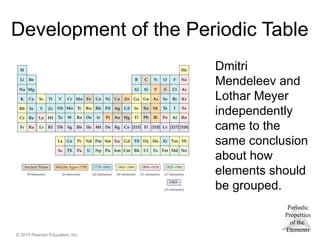
Development of the Periodic Table
Dmitri
Mendeleev and
Lothar Meyer
independently
came to the
same conclusion
about how
elements should
be grouped.
- 3.
Periodic
Properties
of the
Elements
© 2015Pearson Education, Inc.
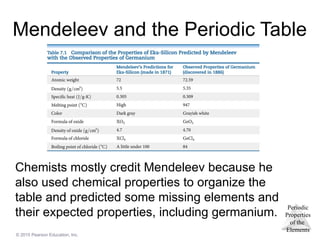
Mendeleev and the Periodic Table
Chemists mostly credit Mendeleev because he
also used chemical properties to organize the
table and predicted some missing elements and
their expected properties, including germanium.
- 4.
Periodic
Properties
of the
Elements
© 2015Pearson Education, Inc.
Atomic Number
• Mendeleev’s table was based on atomic
masses. It was the most fundamental
property of elements known at the time.
• About 35 years later, the nuclear atom was
discovered by Ernest Rutherford.
• Henry Moseley developed the concept of
atomic number experimentally. The number
of protons was considered the basis for the
periodic property of elements.
- 5.
Periodic
Properties
of the
Elements
© 2015Pearson Education, Inc.
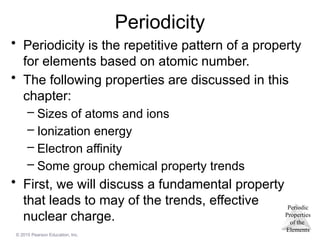
Periodicity
• Periodicity is the repetitive pattern of a property
for elements based on atomic number.
• The following properties are discussed in this
chapter:
– Sizes of atoms and ions
– Ionization energy
– Electron affinity
– Some group chemical property trends
• First, we will discuss a fundamental property
that leads to may of the trends, effective
nuclear charge.
- 6.
Periodic
Properties
of the
Elements
© 2015Pearson Education, Inc.
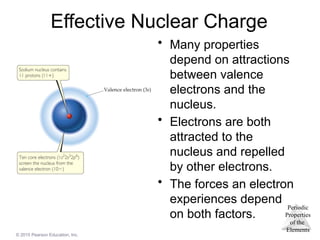
Effective Nuclear Charge
• Many properties
depend on attractions
between valence
electrons and the
nucleus.
• Electrons are both
attracted to the
nucleus and repelled
by other electrons.
• The forces an electron
experiences depend
on both factors.
- 7.
Periodic
Properties
of the
Elements
© 2015Pearson Education, Inc.
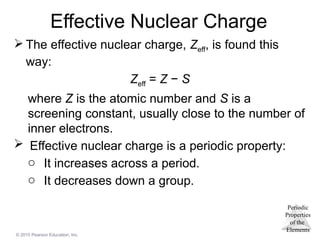
Effective Nuclear Charge
The effective nuclear charge, Zeff, is found this
way:
Zeff = Z − S
where Z is the atomic number and S is a
screening constant, usually close to the number of
inner electrons.
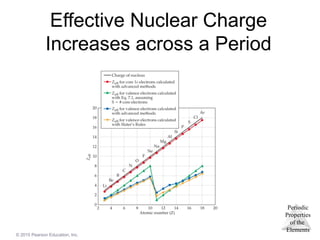
Effective nuclear charge is a periodic property:
o It increases across a period.
o It decreases down a group.
- 8.
- 9.
Periodic
Properties
of the
Elements
© 2015Pearson Education, Inc.
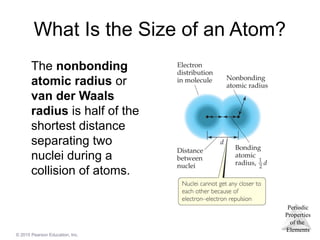
What Is the Size of an Atom?
The nonbonding
atomic radius or
van der Waals
radius is half of the
shortest distance
separating two
nuclei during a
collision of atoms.
- 10.
Periodic
Properties
of the
Elements
© 2015Pearson Education, Inc.
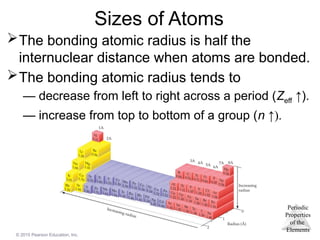
Sizes of Atoms
The bonding atomic radius is half the
internuclear distance when atoms are bonded.
The bonding atomic radius tends to
— decrease from left to right across a period (Zeff ↑).
— increase from top to bottom of a group (n ↑).
- 11.
Periodic
Properties
of the
Elements
© 2015Pearson Education, Inc.
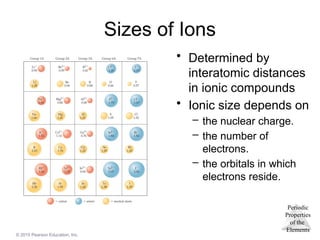
Sizes of Ions
• Determined by
interatomic distances
in ionic compounds
• Ionic size depends on
– the nuclear charge.
– the number of
electrons.
– the orbitals in which
electrons reside.
- 12.
Periodic
Properties
of the
Elements
© 2015Pearson Education, Inc.
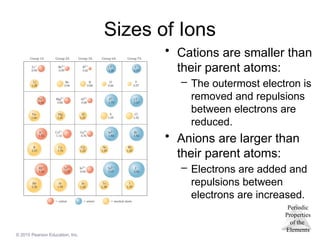
Sizes of Ions
• Cations are smaller than
their parent atoms:
– The outermost electron is
removed and repulsions
between electrons are
reduced.
• Anions are larger than
their parent atoms:
– Electrons are added and
repulsions between
electrons are increased.
- 13.
Periodic
Properties
of the
Elements
© 2015Pearson Education, Inc.
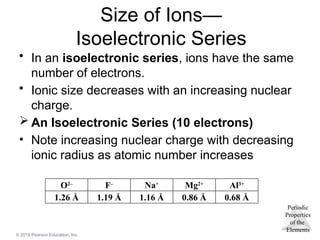
Size of Ions—
Isoelectronic Series
• In an isoelectronic series, ions have the same
number of electrons.
• Ionic size decreases with an increasing nuclear
charge.
An Isoelectronic Series (10 electrons)
• Note increasing nuclear charge with decreasing
ionic radius as atomic number increases
O2–
F–
Na+
Mg2+
Al3+
1.26 Å 1.19 Å 1.16 Å 0.86 Å 0.68 Å
- 14.
Periodic
Properties
of the
Elements
© 2015Pearson Education, Inc.
7.4 Ionization Energy (I)
• The ionization energy is the minimum
energy required to remove an electron from
the ground state of a gaseous atom or ion.
– The first ionization energy is that energy
required to remove the first electron.
– The second ionization energy is that energy
required to remove the second electron, etc.
• Note: the higher the ionization energy, the
more difficult it is to remove an electron!
- 15.
Periodic
Properties
of the
Elements
© 2015Pearson Education, Inc.
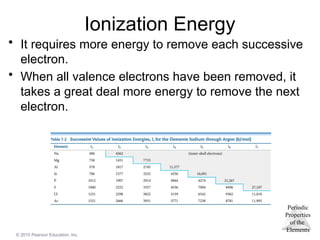
Ionization Energy
• It requires more energy to remove each successive
electron.
• When all valence electrons have been removed, it
takes a great deal more energy to remove the next
electron.
- 16.
Periodic
Properties
of the
Elements
© 2015Pearson Education, Inc.
Periodic Trends in
First Ionization Energy (I1)
1) I1 generally increases across a period.
2) I1 generally decreases down a group.
3) The s- and p-block elements show a larger
range of values for I1. (The d-block
generally increases slowly across the
period; the f-block elements show only
small variations.)
- 17.
Periodic
Properties
of the
Elements
© 2015Pearson Education, Inc.
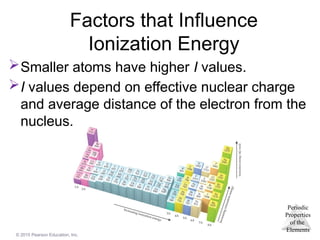
Factors that Influence
Ionization Energy
Smaller atoms have higher I values.
I values depend on effective nuclear charge
and average distance of the electron from the
nucleus.
- 18.
Periodic
Properties
of the
Elements
© 2015Pearson Education, Inc.
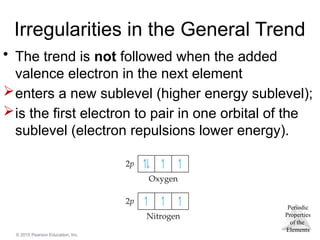
Irregularities in the General Trend
• The trend is not followed when the added
valence electron in the next element
enters a new sublevel (higher energy sublevel);
is the first electron to pair in one orbital of the
sublevel (electron repulsions lower energy).
- 19.
Periodic
Properties
of the
Elements
© 2015Pearson Education, Inc.
Electron Configurations of Ions
• Cations: The electrons are lost from the
highest energy level (n value).
Li+
is 1s2
(losing a 2s electron).
Fe2+
is 1s2
2s2
2p6
3s2
3p6
3d6
(losing two
4s electrons).
• Anions: The electron configurations are
filled to ns2
np6
; e.g., F–
is 1s2
2s2
2p6
(gaining one electron in 2p).
- 20.
Periodic
Properties
of the
Elements
© 2015Pearson Education, Inc.
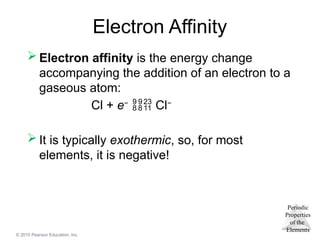
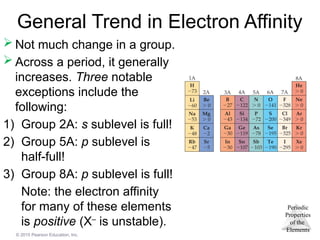
Electron Affinity
Electron affinity is the energy change
accompanying the addition of an electron to a
gaseous atom:
Cl + e−
Cl−
It is typically exothermic, so, for most
elements, it is negative!
- 21.
Periodic
Properties
of the
Elements
© 2015Pearson Education, Inc.
General Trend in Electron Affinity
Not much change in a group.
Across a period, it generally
increases. Three notable
exceptions include the
following:
1) Group 2A: s sublevel is full!
2) Group 5A: p sublevel is
half-full!
3) Group 8A: p sublevel is full!
Note: the electron affinity
for many of these elements
is positive (X–
is unstable).
- 22.
- 23.
- 24.
Periodic
Properties
of the
Elements
© 2015Pearson Education, Inc.
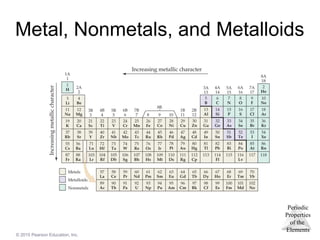
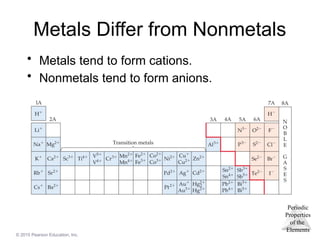
Metals
Most of the elements in nature are metals.
Properties of metals:
Shiny luster
Conduct heat and electricity
Malleable and ductile
Solids at room temperature (except mercury)
Low ionization energies/form cations easily
- 25.
- 26.
Periodic
Properties
of the
Elements
© 2015Pearson Education, Inc.
Nonmetals
• Nonmetals are found on the right hand side of the
periodic table.
• Properties of nonmetals include the following:
• Solid, liquid, or gas (depends on element)
• Solids are dull, brittle, poor conductors
• Large negative electronegativity/form anions
readily
- 27.
- 28.
- 29.
Periodic
Properties
of the
Elements
© 2015Pearson Education, Inc.
Metalloids
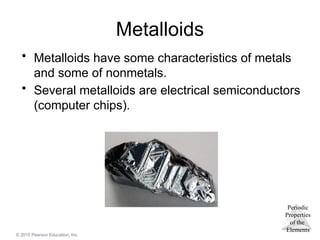
• Metalloids have some characteristics of metals
and some of nonmetals.
• Several metalloids are electrical semiconductors
(computer chips).
- 30.
Periodic
Properties
of the
Elements
© 2015Pearson Education, Inc.
Group Trends
• Elements in a group have similar properties.
• Trends also exist within groups.
• Groups Compared:
Group 1A: The Alkali Metals
Group 2A: The Alkaline Earth Metals
Group 6A: The Oxygen Group
Group 7A: The Halogens
Group 8A: The Noble Gases
- 31.
Periodic
Properties
of the
Elements
© 2015Pearson Education, Inc.
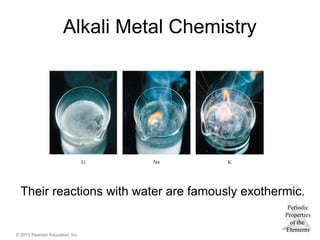
Alkali Metals
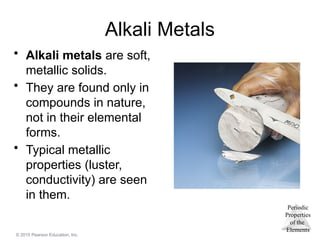
• Alkali metals are soft,
metallic solids.
• They are found only in
compounds in nature,
not in their elemental
forms.
• Typical metallic
properties (luster,
conductivity) are seen
in them.
- 32.
- 33.
- 34.
Periodic
Properties
of the
Elements
© 2015Pearson Education, Inc.
Differences in Alkali
Metal Chemistry
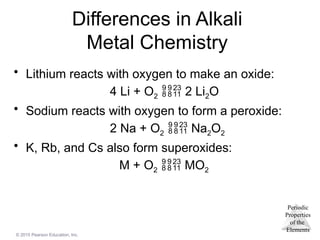
• Lithium reacts with oxygen to make an oxide:
4 Li + O2 2 Li2O
• Sodium reacts with oxygen to form a peroxide:
2 Na + O2 Na2O2
• K, Rb, and Cs also form superoxides:
M + O2 MO2
- 35.
- 36.
Periodic
Properties
of the
Elements
© 2015Pearson Education, Inc.
Alkaline Earth Metals—Compare to
Alkali Metals
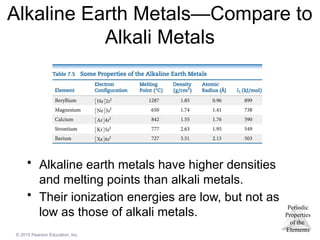
• Alkaline earth metals have higher densities
and melting points than alkali metals.
• Their ionization energies are low, but not as
low as those of alkali metals.
- 37.
Periodic
Properties
of the
Elements
© 2015Pearson Education, Inc.
Alkaline Earth Metals
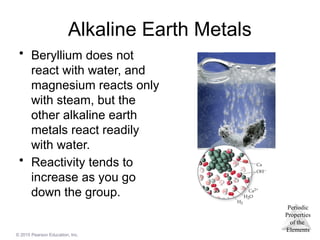
• Beryllium does not
react with water, and
magnesium reacts only
with steam, but the
other alkaline earth
metals react readily
with water.
• Reactivity tends to
increase as you go
down the group.
- 38.
Periodic
Properties
of the
Elements
© 2015Pearson Education, Inc.
Group 6A—Increasing in Metallic
Character down the Group
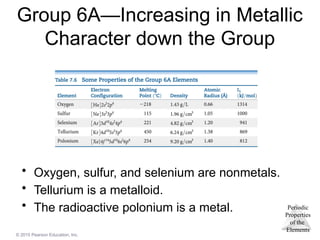
• Oxygen, sulfur, and selenium are nonmetals.
• Tellurium is a metalloid.
• The radioactive polonium is a metal.
- 39.
Periodic
Properties
of the
Elements
© 2015Pearson Education, Inc.
Group 7A—Halogens
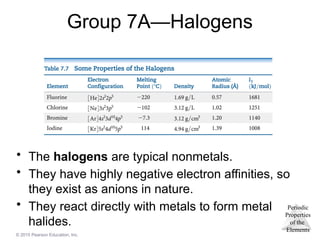
• The halogens are typical nonmetals.
• They have highly negative electron affinities, so
they exist as anions in nature.
• They react directly with metals to form metal
halides.
- 40.
Periodic
Properties
of the
Elements
© 2015Pearson Education, Inc.
Group 8A—Noble Gases
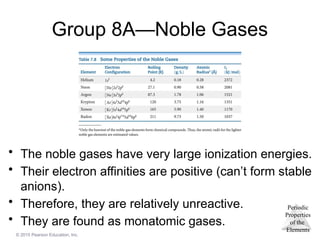
• The noble gases have very large ionization energies.
• Their electron affinities are positive (can’t form stable
anions).
• Therefore, they are relatively unreactive.
• They are found as monatomic gases.