ACC116
Introduction to Cost
Accounting
CHAPTER 1:
INTRODUCTION
Learning Outcome:
At the end of this topic, the student should be able to :
Define what is of Cost Accounting
Identify the objective of Cost Accounting
Differentiate between Financial Accounting and Cost Accounting
Differentiate between Cost unit and Cost centre
Identify the element of Costs
Classify cost according to nature, function, behaviour, controllability and
normality
Identify what is Cost statement
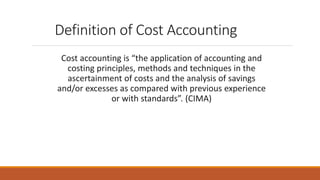
Definition of Cost Accounting
Cost accounting is “the application of accounting and
costing principles, methods and techniques in the
ascertainment of costs and the analysis of savings
and/or excesses as compared with previous experience
or with standards”. (CIMA)
What is Costing?
Defined as the ascertainment of cost
Aims at providing management with information
for purpose of planning and control.
Also helps management make policy decisions.
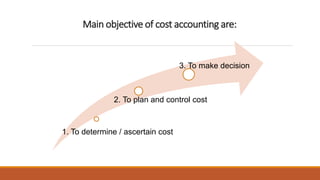
Main objective of cost accounting are:
1. To determine / ascertain cost
2. To plan and control cost
3. To make decision
Definition
Costing System – method of ascertaining costs with the ultimate aim to plan, control and
to make decisions in the operations of a business.
Management accounting – an information system that produces the information required
by managers to create value and manage resources
Financial accounting – the practice of preparing and reporting accounting information for
parties outside organisation
Costing and Financial Accounting
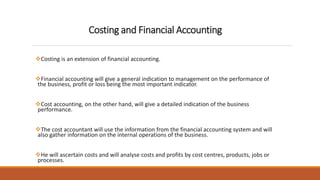
Costing is an extension of financial accounting.
Financial accounting will give a general indication to management on the performance of
the business, profit or loss being the most important indicator.
Cost accounting, on the other hand, will give a detailed indication of the business
performance.
The cost accountant will use the information from the financial accounting system and will
also gather information on the internal operations of the business.
He will ascertain costs and will analyse costs and profits by cost centres, products, jobs or
processes.
Differences between financial accounting and cost
accounting
Financial Accounting Cost Accounting
Objective It provides information about the financial
performance and financial position of the
business.
It provide information of ascertainment of
cost to control cost and for decision
making about the cost.
Reporting
requirement
Accounts are prepared to comply with the
Companies Act, to satisfy the requirements of
the Inland Revenue Board.
No legal requirement.
Users External users - shareholders, creditors,
financial analysts and government and its
agencies, etc.
Internal users -internal management at
different levels
Time focus Past oriented Future oriented
Differences between financial accounting and cost
accounting, con’t..
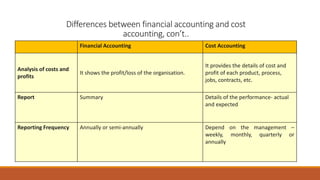
Financial Accounting Cost Accounting
Analysis of costs and
profits
It shows the profit/loss of the organisation.
It provides the details of cost and
profit of each product, process,
jobs, contracts, etc.
Report Summary Details of the performance- actual
and expected
Reporting Frequency Annually or semi-annually Depend on the management –
weekly, monthly, quarterly or
annually
Cost Concepts
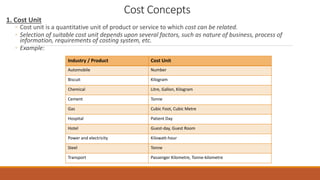
1. Cost Unit
◦ Cost unit is a quantitative unit of product or service to which cost can be related.
◦ Selection of suitable cost unit depends upon several factors, such as nature of business, process of
information, requirements of costing system, etc.
◦ Example:
Industry / Product Cost Unit
Automobile Number
Biscuit Kilogram
Chemical Litre, Gallon, Kilogram
Cement Tonne
Gas Cubic Foot, Cubic Metre
Hospital Patient Day
Hotel Guest-day, Guest Room
Power and electricity Kilowatt-hour
Steel Tonne
Transport Passenger Kilometre, Tonne-kilometre
2. Cost Centre
Defined as ‘a location, person or item of equipment (or group of them) in
respect of which costs may be ascertained and relate to the cost units’.
E.g. a person such as salesman; an item of equipment such as delivery van
Cost centre can be classified into:
Production cost centres • Where production take place.
• For furniture manufacturing business, a production cost
centres are the machine department, assembly
department and finishing department.
Process Cost Centres • Where a specific process or a continuous sequences of
operations take place
• Ex: refining process
Service Cost centre • It provide services to other cost centre
• Ex: stores, maintenance, production planning and
personnel.
Classification of Costs
Costs are classified according to the purpose for which the information is
needed.
Classification of Costs
1. Nature
Materials
Labour
Other
expenses
2. Function
Production
costs
Administration
costs
Marketing
costs
Other cost
3. Behaviour
Fixed costs
Variable costs
Semi-variable
costs
Step costs
4. Controllability
Controllable
costs
Uncontrollable
cost
5. Normality
Normal costs
Abnormal
costs
1. Nature
Direct Materials
• All materials that can be physically identified with a specific product.
• Example: for Manufacturers such as Toyota, the direct materials include
steel, tires, engines, etc.
• Example: baking a cake: flour, sugar, eggs etc
Indirect Materials
• Items of material that cannot be physically identified with a specific
product.
• Example: oil and lubricants for the machines, cleaning supplies etc.
• Example: cake: box, candles etc
Materials
*Based on the nature of costs
*classified into materials, labour and other expenses
1. Nature, con’t..
Direct Labour
• Labour costs that can be traced or identified with a particular
product.
• Example: At Toyota, direct labour includes the wages of machine
operators and technicians who assemble the parts and wire the
electronics to build the completed vehicles.
Indirect Labour
• Wages of employees who do not work on the product itself, just
assist in the manufacturing operation.
• Example: salaries, wages and benefits of plant janitors, plant
supervisors, security officer , clerk etc.
Labour
1. Nature, con’t..
Direct expenses
• Expenses which are incurred specifically to a particular
product
• Example: Cost of design and layout, royalties payable on
use of patents, copyrights, surveyors etc.
Indirect expenses
• All other costs needed to operated a factory which is not
charged directly to the product.
• Example: insurance, electricity, advertising etc.
Other Expenses
All costs associated with the manufacture of a product except direct materials
and direct labor
2. Function
Cost are classified by function to which they relate.
Costs Function
Production Costs • Incurred from the time of acquisition of materials
until the despatch of completed items to store.
• Examples: Production overhead, direct materials,
direct labour and direct expenses.
Administration
Costs
• Incurred in the general administration including
directing and controlling the operations of an
organization.
• Examples: Audit fees, office rent, salaries for admin
staff
Marketing Costs • Incurred in selling, publicizing, distributing and
product servicing.
• Examples: Selling costs, publicity cost, distribution
cost
2. Function, con’t..
Costs Function
Finance Costs • Incurred in financing the activity of the business.
• Examples: Interest, Commitment fee, insurance and
dividends.
Research
Costs
• Incurred in seeking new or improved ideas, materials,
methods and products.
• Examples: Cost of laboratory maintenance, salaries of
research staff.
Development
Costs
• Incurred in developing the new or improved ideas and
methods so that production can take place.
• Examples: Cost of test or trials runs, obsolescence and
supplies.
3. Behaviour
Costs may or may not vary with the level of activity.
◦ 1. Fixed costs
◦ Will not change (constants) over a given range of activity (volume) and within a
given period of time.
◦ Example: insurance, depreciation, director’s salary, rental
Fixed cost
The total fixed
costs do not
increase as
activity
increases.
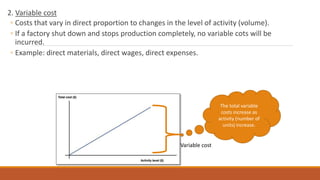
2. Variable cost
◦ Costs that vary in direct proportion to changes in the level of activity (volume).
◦ If a factory shut down and stops production completely, no variable cots will be
incurred.
◦ Example: direct materials, direct wages, direct expenses.
Variable cost
The total variable
costs increase as
activity (number of
units) increase.
3. Semi-variable or semi-fixed costs
◦ Costs that contains both fixed and variable costs.
◦ Example: telephone costs
The semi-variable
cost is made up of
a fixed and
variable cost
element.
4. Step cost
◦ Costs are fixed over a range of activity and then rises to a new level as activity
changes.
◦ Example: depreciation on machines may increase with an increase in the level
of activity as more machines are required.
Step costs
remain fixed
over a range
of activity.
4. Controllability
Controllable
Costs that are influenced
by the decisions or
actions of a manager.
Example: labour cost which can be
control by controlling factors such as
efficiency, overtime, number of
employees etc.
Uncontrollable
Costs that are not
influenced by the
decisions or actions of a
manager.
Example: increased cost
of raw materials due to
inflation.
5. Normality
• Costs that have been planned
• Part of cost production.
• Example: loss due to evaporation,
maintenance, salaries paid to employees.
Normal Costs
• Costs that have not been plannned for.
• Not charged to the cost of production;
transferred to profit or loss account
• Example: lost production due to plant /
machine breakdown, destruction due to fire
Abnormal Costs
Product Cost vs Period Cost
Product Cost
� Include all costs that are required to make a product “manufacturing costs” :
included as part of inventory and shown on the balance sheet until the product is
sold (cost of goods sold).
� Example: Direct Material, Direct Labor, Manufacturing Overhead
Period Cost
� “Non-manufacturing costs”
� Selling and Administrative costs: reported on the income statement as they are
incurred.
� Examples: Anything at corporate headquarters, anything related to selling the
product, shipping costs, administrative salaries, executive salaries, administrative
office expenses, sales commissions, advertising, research and development, etc.
� Warehouse costs and people who move inventory are period costs
Cost Statement
Cost statement is a statement showing all the costs that make up a product or
service.
RM
Direct Material Cost
Direct Labour Cost
Direct expenses
3
2
1
Prime Cost 6
Production overhead 3
Production Cost 9
Administration overhead
Selling & distribution overhead
2
1
Total Cost 12
Profit 3
Selling Price 15
ACC116- Chapter 1.pptx

ACC116- Chapter 1.pptx

  • 1.
  • 2.
    Learning Outcome: At theend of this topic, the student should be able to : Define what is of Cost Accounting Identify the objective of Cost Accounting Differentiate between Financial Accounting and Cost Accounting Differentiate between Cost unit and Cost centre Identify the element of Costs Classify cost according to nature, function, behaviour, controllability and normality Identify what is Cost statement
  • 3.
    Definition of CostAccounting Cost accounting is “the application of accounting and costing principles, methods and techniques in the ascertainment of costs and the analysis of savings and/or excesses as compared with previous experience or with standards”. (CIMA)
  • 4.
    What is Costing? Definedas the ascertainment of cost Aims at providing management with information for purpose of planning and control. Also helps management make policy decisions.
  • 5.
    Main objective ofcost accounting are: 1. To determine / ascertain cost 2. To plan and control cost 3. To make decision
  • 6.
    Definition Costing System –method of ascertaining costs with the ultimate aim to plan, control and to make decisions in the operations of a business. Management accounting – an information system that produces the information required by managers to create value and manage resources Financial accounting – the practice of preparing and reporting accounting information for parties outside organisation
  • 7.
    Costing and FinancialAccounting Costing is an extension of financial accounting. Financial accounting will give a general indication to management on the performance of the business, profit or loss being the most important indicator. Cost accounting, on the other hand, will give a detailed indication of the business performance. The cost accountant will use the information from the financial accounting system and will also gather information on the internal operations of the business. He will ascertain costs and will analyse costs and profits by cost centres, products, jobs or processes.
  • 8.
    Differences between financialaccounting and cost accounting Financial Accounting Cost Accounting Objective It provides information about the financial performance and financial position of the business. It provide information of ascertainment of cost to control cost and for decision making about the cost. Reporting requirement Accounts are prepared to comply with the Companies Act, to satisfy the requirements of the Inland Revenue Board. No legal requirement. Users External users - shareholders, creditors, financial analysts and government and its agencies, etc. Internal users -internal management at different levels Time focus Past oriented Future oriented
  • 9.
    Differences between financialaccounting and cost accounting, con’t.. Financial Accounting Cost Accounting Analysis of costs and profits It shows the profit/loss of the organisation. It provides the details of cost and profit of each product, process, jobs, contracts, etc. Report Summary Details of the performance- actual and expected Reporting Frequency Annually or semi-annually Depend on the management – weekly, monthly, quarterly or annually
  • 10.
    Cost Concepts 1. CostUnit ◦ Cost unit is a quantitative unit of product or service to which cost can be related. ◦ Selection of suitable cost unit depends upon several factors, such as nature of business, process of information, requirements of costing system, etc. ◦ Example: Industry / Product Cost Unit Automobile Number Biscuit Kilogram Chemical Litre, Gallon, Kilogram Cement Tonne Gas Cubic Foot, Cubic Metre Hospital Patient Day Hotel Guest-day, Guest Room Power and electricity Kilowatt-hour Steel Tonne Transport Passenger Kilometre, Tonne-kilometre
  • 11.
    2. Cost Centre Definedas ‘a location, person or item of equipment (or group of them) in respect of which costs may be ascertained and relate to the cost units’. E.g. a person such as salesman; an item of equipment such as delivery van Cost centre can be classified into: Production cost centres • Where production take place. • For furniture manufacturing business, a production cost centres are the machine department, assembly department and finishing department. Process Cost Centres • Where a specific process or a continuous sequences of operations take place • Ex: refining process Service Cost centre • It provide services to other cost centre • Ex: stores, maintenance, production planning and personnel.
  • 12.
    Classification of Costs Costsare classified according to the purpose for which the information is needed. Classification of Costs 1. Nature Materials Labour Other expenses 2. Function Production costs Administration costs Marketing costs Other cost 3. Behaviour Fixed costs Variable costs Semi-variable costs Step costs 4. Controllability Controllable costs Uncontrollable cost 5. Normality Normal costs Abnormal costs
  • 13.
    1. Nature Direct Materials •All materials that can be physically identified with a specific product. • Example: for Manufacturers such as Toyota, the direct materials include steel, tires, engines, etc. • Example: baking a cake: flour, sugar, eggs etc Indirect Materials • Items of material that cannot be physically identified with a specific product. • Example: oil and lubricants for the machines, cleaning supplies etc. • Example: cake: box, candles etc Materials *Based on the nature of costs *classified into materials, labour and other expenses
  • 14.
    1. Nature, con’t.. DirectLabour • Labour costs that can be traced or identified with a particular product. • Example: At Toyota, direct labour includes the wages of machine operators and technicians who assemble the parts and wire the electronics to build the completed vehicles. Indirect Labour • Wages of employees who do not work on the product itself, just assist in the manufacturing operation. • Example: salaries, wages and benefits of plant janitors, plant supervisors, security officer , clerk etc. Labour
  • 15.
    1. Nature, con’t.. Directexpenses • Expenses which are incurred specifically to a particular product • Example: Cost of design and layout, royalties payable on use of patents, copyrights, surveyors etc. Indirect expenses • All other costs needed to operated a factory which is not charged directly to the product. • Example: insurance, electricity, advertising etc. Other Expenses All costs associated with the manufacture of a product except direct materials and direct labor
  • 16.
    2. Function Cost areclassified by function to which they relate. Costs Function Production Costs • Incurred from the time of acquisition of materials until the despatch of completed items to store. • Examples: Production overhead, direct materials, direct labour and direct expenses. Administration Costs • Incurred in the general administration including directing and controlling the operations of an organization. • Examples: Audit fees, office rent, salaries for admin staff Marketing Costs • Incurred in selling, publicizing, distributing and product servicing. • Examples: Selling costs, publicity cost, distribution cost
  • 17.
    2. Function, con’t.. CostsFunction Finance Costs • Incurred in financing the activity of the business. • Examples: Interest, Commitment fee, insurance and dividends. Research Costs • Incurred in seeking new or improved ideas, materials, methods and products. • Examples: Cost of laboratory maintenance, salaries of research staff. Development Costs • Incurred in developing the new or improved ideas and methods so that production can take place. • Examples: Cost of test or trials runs, obsolescence and supplies.
  • 18.
    3. Behaviour Costs mayor may not vary with the level of activity. ◦ 1. Fixed costs ◦ Will not change (constants) over a given range of activity (volume) and within a given period of time. ◦ Example: insurance, depreciation, director’s salary, rental Fixed cost The total fixed costs do not increase as activity increases.
  • 19.
    2. Variable cost ◦Costs that vary in direct proportion to changes in the level of activity (volume). ◦ If a factory shut down and stops production completely, no variable cots will be incurred. ◦ Example: direct materials, direct wages, direct expenses. Variable cost The total variable costs increase as activity (number of units) increase.
  • 20.
    3. Semi-variable orsemi-fixed costs ◦ Costs that contains both fixed and variable costs. ◦ Example: telephone costs The semi-variable cost is made up of a fixed and variable cost element.
  • 21.
    4. Step cost ◦Costs are fixed over a range of activity and then rises to a new level as activity changes. ◦ Example: depreciation on machines may increase with an increase in the level of activity as more machines are required. Step costs remain fixed over a range of activity.
  • 22.
    4. Controllability Controllable Costs thatare influenced by the decisions or actions of a manager. Example: labour cost which can be control by controlling factors such as efficiency, overtime, number of employees etc. Uncontrollable Costs that are not influenced by the decisions or actions of a manager. Example: increased cost of raw materials due to inflation.
  • 23.
    5. Normality • Coststhat have been planned • Part of cost production. • Example: loss due to evaporation, maintenance, salaries paid to employees. Normal Costs • Costs that have not been plannned for. • Not charged to the cost of production; transferred to profit or loss account • Example: lost production due to plant / machine breakdown, destruction due to fire Abnormal Costs
  • 24.
    Product Cost vsPeriod Cost Product Cost � Include all costs that are required to make a product “manufacturing costs” : included as part of inventory and shown on the balance sheet until the product is sold (cost of goods sold). � Example: Direct Material, Direct Labor, Manufacturing Overhead Period Cost � “Non-manufacturing costs” � Selling and Administrative costs: reported on the income statement as they are incurred. � Examples: Anything at corporate headquarters, anything related to selling the product, shipping costs, administrative salaries, executive salaries, administrative office expenses, sales commissions, advertising, research and development, etc. � Warehouse costs and people who move inventory are period costs
  • 25.
    Cost Statement Cost statementis a statement showing all the costs that make up a product or service. RM Direct Material Cost Direct Labour Cost Direct expenses 3 2 1 Prime Cost 6 Production overhead 3 Production Cost 9 Administration overhead Selling & distribution overhead 2 1 Total Cost 12 Profit 3 Selling Price 15