
An Introduction to Data
Mining
NOFEL ELAHI
“
”
40 Zettabytes of data will be created
in 2019 and 90 percent of data in
existence has been created in last
two years
https://www.seagate.com/in/en/our-story/data-age-2025/
Data
Data is a set of facts,observations, measurements about objects, events or processes
of interest
• There has been enormous data growth in both commercial and scientific databases due to
advances in data generation and collection technologies
• New mantra
• Expectations
Information
When data is processed , organized or structured to present it in a certain context it is
called ‘Information’
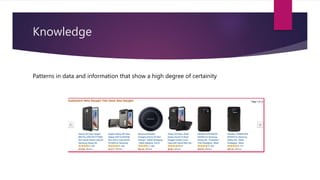
Knowledge
Patterns in data and information that show a high degree of certainity
What is Data Mining
Data mining is extracting of useful information from large databases.
It also goes by other names as KDD, pattern/data analysis, business intelligence etc.
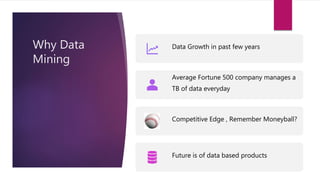
Why Data
Mining
Data Growth in past few years
Average Fortune 500 company manages a
TB of data everyday
Competitive Edge , Remember Moneyball?
Future is of data based products
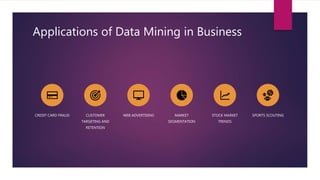
Applications of Data Mining in Business
CREDIT CARD FRAUD CUSTOMER
TARGETING AND
RETENTION
WEB ADVERTISING MARKET
SEGMENTATION
STOCK MARKET
TRENDS
SPORTS SCOUTING
Data collected and stored at enormous speeds
remote sensors on a satellite
NASA EOSDIS archives over
petabytes of earth science data / year
telescopes scanning the skies
Sky survey data
High-throughput biological data
scientific simulations
terabytes of data generated in a few hours
Data mining helps scientists
in automated analysis of massive datasets
In hypothesis formation
Data Mining - Scientific Viewpoint
Types of Data
Structured
Semi-Structured
Unstructured
Data-marts , Datawarehouse
& Data-Lakes
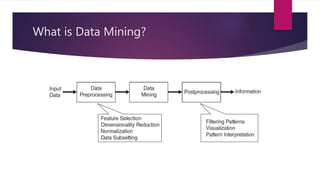
What is Data Mining?
What is (not) Data Mining?
Not Data Mining
 Look up phone number in phone directory
 Query a Web search engine for
information about “Amazon
Data Mining
 Certain names are more prevalent in
certain US locations (O’Brien, O’Rourke,
O’Reilly… in Boston area)
 Group together similar documents
returned by search engine according to
their context (e.g., Amazon rainforest,
Amazon.com)
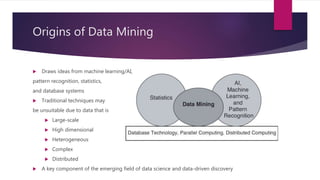
Origins of Data Mining
 Draws ideas from machine learning/AI,
pattern recognition, statistics,
and database systems
 Traditional techniques may
be unsuitable due to data that is
 Large-scale
 High dimensional
 Heterogeneous
 Complex
 Distributed
 A key component of the emerging field of data science and data-driven discovery
Data Mining Tasks
 Descriptive Methods
 Predictive Methods
 Prescriptive Methods
Tid Refund Marital
Status
Taxable
Income Cheat
1 Yes Single 125K No
2 No Married 100K No
3 No Single 70K No
4 Yes Married 120K No
5 No Divorced 95K Yes
6 No Married 60K No
7 Yes Divorced 220K No
8 No Single 85K Yes
9 No Married 75K No
10 No Single 90K Yes
11 No Married 60K No
12 Yes Divorced 220K No
13 No Single 85K Yes
14 No Married 75K No
15 No Single 90K Yes
10
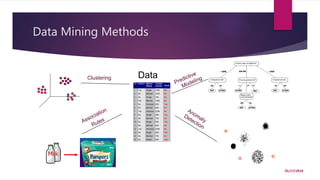
Clustering
Milk
Data
Data Mining Methods
01/17/2018
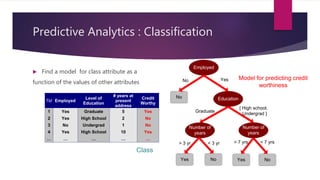
Predictive Analytics : Classification
 Find a model for class attribute as a
function of the values of other attributes
Tid Employed
Level of
Education
# years at
present
address
Credit
Worthy
1 Yes Graduate 5 Yes
2 Yes High School 2 No
3 No Undergrad 1 No
4 Yes High School 10 Yes
… … … … …10
Model for predicting credit
worthiness
Class
Employed
No Education
Number of
years
No Yes
Graduate
{ High school,
Undergrad }
Yes No
> 7 yrs < 7 yrs
Yes
Number of
years
No
> 3 yr < 3 yr
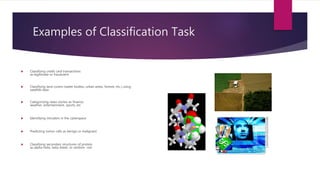
Examples of Classification Task
 Classifying credit card transactions
as legitimate or fraudulent
 Classifying land covers (water bodies, urban areas, forests, etc.) using
satellite data
 Categorizing news stories as finance,
weather, entertainment, sports, etc
 Identifying intruders in the cyberspace
 Predicting tumor cells as benign or malignant
 Classifying secondary structures of protein
as alpha-helix, beta-sheet, or random coil
Classification: Application 1
 Fraud Detection
 Goal: Predict fraudulent cases in credit card transactions.
 Approach:
 Use credit card transactions and the information on its account-holder as attributes.
 When does a customer buy, what does he buy, how often he pays on time, etc
 Label past transactions as fraud or fair transactions. This forms the class attribute.
 Learn a model for the class of the transactions.
 Use this model to detect fraud by observing credit card transactions on an account.
Classification: Application 2
 Churn prediction for telephone customers
 Goal: To predict whether a customer is likely to be lost to a competitor.
 Approach:
 Use detailed record of transactions with each of the past and present customers, to find
attributes.
 How often the customer calls, where he calls, what time-of-the day he calls most, his
financial status, marital status, etc.
 Label the customers as loyal or disloyal.
 Find a model for loyalty.
Classification: Application 3
 Sky Survey Cataloging
 Goal: To predict class (star or galaxy) of sky objects, especially visually faint ones, based
on the telescopic survey images (from Palomar Observatory).
 3000 images with 23,040 x 23,040 pixels per image.
 Approach:
 Segment the image.
 Measure image attributes (features) - 40 of them per object.
 Model the class based on these features.
 Success Story: Could find 16 new high red-shift quasars, some of the farthest objects that are
difficult to find!
Regression
 Predict a value of a given continuous valued variable based on the values of other
variables, assuming a linear or nonlinear model of dependency.
 Extensively studied in statistics, neural network fields.
 Examples:
 Predicting sales amounts of new product based on advetising expenditure.
 Predicting wind velocities as a function of temperature, humidity, air pressure, etc.
 Time series prediction of stock market indices.
01/17/2018
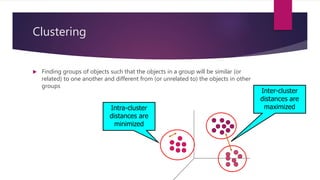
Clustering
 Finding groups of objects such that the objects in a group will be similar (or
related) to one another and different from (or unrelated to) the objects in other
groups
Inter-cluster
distances are
maximizedIntra-cluster
distances are
minimized
Applications of Cluster Analysis
 Understanding
 Custom profiling for targeted marketing
 Group related documents for browsing
 Group genes and proteins that have similar
functionality
 Group stocks with similar price fluctuations
 Summarization
 Reduce the size of large data sets
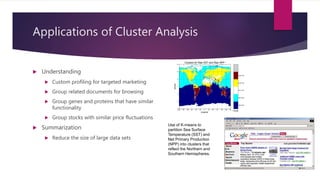
Clusters for Raw SST and Raw NPP
longitude
latitude
-180 -150 -120 -90 -60 -30 0 30 60 90 120 150 180
90
60
30
0
-30
-60
-90
Cluster
Sea Cluster 1
Sea Cluster 2
Ice or No NPP
Land Cluster 1
Land Cluster 2
Use of K-means to
partition Sea Surface
Temperature (SST) and
Net Primary Production
(NPP) into clusters that
reflect the Northern and
Southern Hemispheres.
Clustering: Application 1
 Market Segmentation:
 Goal: subdivide a market into distinct subsets of customers where any subset may conceivably be
selected as a market target to be reached with a distinct marketing mix.
 Approach:
 Collect different attributes of customers based on their geographical and lifestyle related
information.
 Find clusters of similar customers.
 Measure the clustering quality by observing buying patterns of customers in same cluster vs.
those from different clusters.
26
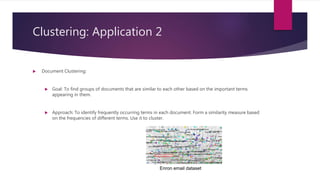
Clustering: Application 2
 Document Clustering:
 Goal: To find groups of documents that are similar to each other based on the important terms
appearing in them.
 Approach: To identify frequently occurring terms in each document. Form a similarity measure based
on the frequencies of different terms. Use it to cluster.
Enron email dataset
Association Rule Discovery
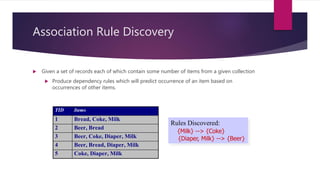
 Given a set of records each of which contain some number of items from a given collection
 Produce dependency rules which will predict occurrence of an item based on
occurrences of other items.
TID Items
1 Bread, Coke, Milk
2 Beer, Bread
3 Beer, Coke, Diaper, Milk
4 Beer, Bread, Diaper, Milk
5 Coke, Diaper, Milk
Rules Discovered:
{Milk} --> {Coke}
{Diaper, Milk} --> {Beer}
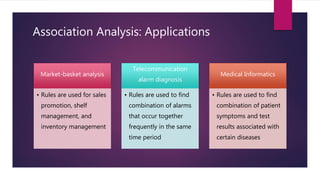
Association Analysis: Applications
Market-basket analysis
• Rules are used for sales
promotion, shelf
management, and
inventory management
Telecommunication
alarm diagnosis
• Rules are used to find
combination of alarms
that occur together
frequently in the same
time period
Medical Informatics
• Rules are used to find
combination of patient
symptoms and test
results associated with
certain diseases
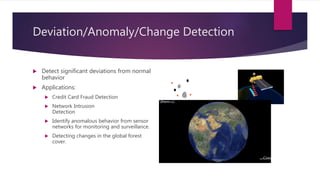
Deviation/Anomaly/Change Detection
 Detect significant deviations from normal
behavior
 Applications:
 Credit Card Fraud Detection
 Network Intrusion
Detection
 Identify anomalous behavior from sensor
networks for monitoring and surveillance.
 Detecting changes in the global forest
cover.
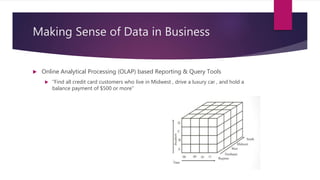
Making Sense of Data in Business
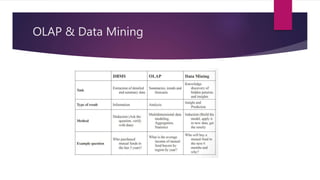
 Online Analytical Processing (OLAP) based Reporting & Query Tools
 ”Find all credit card customers who live in Midwest , drive a luxury car , and hold a
balance payment of $500 or more”
Making Sense of Data in Business
 Data Mining Tools
 To extract the ‘not so obvious’ information , for example “ find all
customers who are likely to switch their telecommunication services.
OLAP & Data Mining
Data Mining Process
 Understanding the Domain
 Getting All The Data
 Data cleaning & preprocessing
 Discovery Model?
 Interpreting Data
 Value of Mined Information
 Reporting and transforming to new actions and products
Motivating Challenges
 Scalability
 High Dimensionality
 Heterogeneous and Complex Data
 Data Ownership and Distribution
 Non-traditional Analysis
Thank You

Introduction to Data Mining

  • 1.
    An Introduction toData Mining NOFEL ELAHI
  • 3.
    “ ” 40 Zettabytes ofdata will be created in 2019 and 90 percent of data in existence has been created in last two years https://www.seagate.com/in/en/our-story/data-age-2025/
  • 4.
    Data Data is aset of facts,observations, measurements about objects, events or processes of interest • There has been enormous data growth in both commercial and scientific databases due to advances in data generation and collection technologies • New mantra • Expectations
  • 5.
    Information When data isprocessed , organized or structured to present it in a certain context it is called ‘Information’
  • 6.
    Knowledge Patterns in dataand information that show a high degree of certainity
  • 7.
    What is DataMining Data mining is extracting of useful information from large databases. It also goes by other names as KDD, pattern/data analysis, business intelligence etc.
  • 8.
    Why Data Mining Data Growthin past few years Average Fortune 500 company manages a TB of data everyday Competitive Edge , Remember Moneyball? Future is of data based products
  • 9.
    Applications of DataMining in Business CREDIT CARD FRAUD CUSTOMER TARGETING AND RETENTION WEB ADVERTISING MARKET SEGMENTATION STOCK MARKET TRENDS SPORTS SCOUTING
  • 10.
    Data collected andstored at enormous speeds remote sensors on a satellite NASA EOSDIS archives over petabytes of earth science data / year telescopes scanning the skies Sky survey data High-throughput biological data scientific simulations terabytes of data generated in a few hours Data mining helps scientists in automated analysis of massive datasets In hypothesis formation Data Mining - Scientific Viewpoint
  • 11.
  • 12.
  • 13.
    What is DataMining?
  • 14.
    What is (not)Data Mining? Not Data Mining  Look up phone number in phone directory  Query a Web search engine for information about “Amazon Data Mining  Certain names are more prevalent in certain US locations (O’Brien, O’Rourke, O’Reilly… in Boston area)  Group together similar documents returned by search engine according to their context (e.g., Amazon rainforest, Amazon.com)
  • 15.
    Origins of DataMining  Draws ideas from machine learning/AI, pattern recognition, statistics, and database systems  Traditional techniques may be unsuitable due to data that is  Large-scale  High dimensional  Heterogeneous  Complex  Distributed  A key component of the emerging field of data science and data-driven discovery
  • 16.
    Data Mining Tasks Descriptive Methods  Predictive Methods  Prescriptive Methods
  • 17.
    Tid Refund Marital Status Taxable IncomeCheat 1 Yes Single 125K No 2 No Married 100K No 3 No Single 70K No 4 Yes Married 120K No 5 No Divorced 95K Yes 6 No Married 60K No 7 Yes Divorced 220K No 8 No Single 85K Yes 9 No Married 75K No 10 No Single 90K Yes 11 No Married 60K No 12 Yes Divorced 220K No 13 No Single 85K Yes 14 No Married 75K No 15 No Single 90K Yes 10 Clustering Milk Data Data Mining Methods 01/17/2018
  • 18.
    Predictive Analytics :Classification  Find a model for class attribute as a function of the values of other attributes Tid Employed Level of Education # years at present address Credit Worthy 1 Yes Graduate 5 Yes 2 Yes High School 2 No 3 No Undergrad 1 No 4 Yes High School 10 Yes … … … … …10 Model for predicting credit worthiness Class Employed No Education Number of years No Yes Graduate { High school, Undergrad } Yes No > 7 yrs < 7 yrs Yes Number of years No > 3 yr < 3 yr
  • 19.
    Examples of ClassificationTask  Classifying credit card transactions as legitimate or fraudulent  Classifying land covers (water bodies, urban areas, forests, etc.) using satellite data  Categorizing news stories as finance, weather, entertainment, sports, etc  Identifying intruders in the cyberspace  Predicting tumor cells as benign or malignant  Classifying secondary structures of protein as alpha-helix, beta-sheet, or random coil
  • 20.
    Classification: Application 1 Fraud Detection  Goal: Predict fraudulent cases in credit card transactions.  Approach:  Use credit card transactions and the information on its account-holder as attributes.  When does a customer buy, what does he buy, how often he pays on time, etc  Label past transactions as fraud or fair transactions. This forms the class attribute.  Learn a model for the class of the transactions.  Use this model to detect fraud by observing credit card transactions on an account.
  • 21.
    Classification: Application 2 Churn prediction for telephone customers  Goal: To predict whether a customer is likely to be lost to a competitor.  Approach:  Use detailed record of transactions with each of the past and present customers, to find attributes.  How often the customer calls, where he calls, what time-of-the day he calls most, his financial status, marital status, etc.  Label the customers as loyal or disloyal.  Find a model for loyalty.
  • 22.
    Classification: Application 3 Sky Survey Cataloging  Goal: To predict class (star or galaxy) of sky objects, especially visually faint ones, based on the telescopic survey images (from Palomar Observatory).  3000 images with 23,040 x 23,040 pixels per image.  Approach:  Segment the image.  Measure image attributes (features) - 40 of them per object.  Model the class based on these features.  Success Story: Could find 16 new high red-shift quasars, some of the farthest objects that are difficult to find!
  • 23.
    Regression  Predict avalue of a given continuous valued variable based on the values of other variables, assuming a linear or nonlinear model of dependency.  Extensively studied in statistics, neural network fields.  Examples:  Predicting sales amounts of new product based on advetising expenditure.  Predicting wind velocities as a function of temperature, humidity, air pressure, etc.  Time series prediction of stock market indices. 01/17/2018
  • 24.
    Clustering  Finding groupsof objects such that the objects in a group will be similar (or related) to one another and different from (or unrelated to) the objects in other groups Inter-cluster distances are maximizedIntra-cluster distances are minimized
  • 25.
    Applications of ClusterAnalysis  Understanding  Custom profiling for targeted marketing  Group related documents for browsing  Group genes and proteins that have similar functionality  Group stocks with similar price fluctuations  Summarization  Reduce the size of large data sets Clusters for Raw SST and Raw NPP longitude latitude -180 -150 -120 -90 -60 -30 0 30 60 90 120 150 180 90 60 30 0 -30 -60 -90 Cluster Sea Cluster 1 Sea Cluster 2 Ice or No NPP Land Cluster 1 Land Cluster 2 Use of K-means to partition Sea Surface Temperature (SST) and Net Primary Production (NPP) into clusters that reflect the Northern and Southern Hemispheres.
  • 26.
    Clustering: Application 1 Market Segmentation:  Goal: subdivide a market into distinct subsets of customers where any subset may conceivably be selected as a market target to be reached with a distinct marketing mix.  Approach:  Collect different attributes of customers based on their geographical and lifestyle related information.  Find clusters of similar customers.  Measure the clustering quality by observing buying patterns of customers in same cluster vs. those from different clusters. 26
  • 27.
    Clustering: Application 2 Document Clustering:  Goal: To find groups of documents that are similar to each other based on the important terms appearing in them.  Approach: To identify frequently occurring terms in each document. Form a similarity measure based on the frequencies of different terms. Use it to cluster. Enron email dataset
  • 28.
    Association Rule Discovery Given a set of records each of which contain some number of items from a given collection  Produce dependency rules which will predict occurrence of an item based on occurrences of other items. TID Items 1 Bread, Coke, Milk 2 Beer, Bread 3 Beer, Coke, Diaper, Milk 4 Beer, Bread, Diaper, Milk 5 Coke, Diaper, Milk Rules Discovered: {Milk} --> {Coke} {Diaper, Milk} --> {Beer}
  • 29.
    Association Analysis: Applications Market-basketanalysis • Rules are used for sales promotion, shelf management, and inventory management Telecommunication alarm diagnosis • Rules are used to find combination of alarms that occur together frequently in the same time period Medical Informatics • Rules are used to find combination of patient symptoms and test results associated with certain diseases
  • 30.
    Deviation/Anomaly/Change Detection  Detectsignificant deviations from normal behavior  Applications:  Credit Card Fraud Detection  Network Intrusion Detection  Identify anomalous behavior from sensor networks for monitoring and surveillance.  Detecting changes in the global forest cover.
  • 31.
    Making Sense ofData in Business  Online Analytical Processing (OLAP) based Reporting & Query Tools  ”Find all credit card customers who live in Midwest , drive a luxury car , and hold a balance payment of $500 or more”
  • 32.
    Making Sense ofData in Business  Data Mining Tools  To extract the ‘not so obvious’ information , for example “ find all customers who are likely to switch their telecommunication services.
  • 33.
  • 34.
    Data Mining Process Understanding the Domain  Getting All The Data  Data cleaning & preprocessing  Discovery Model?  Interpreting Data  Value of Mined Information  Reporting and transforming to new actions and products
  • 35.
    Motivating Challenges  Scalability High Dimensionality  Heterogeneous and Complex Data  Data Ownership and Distribution  Non-traditional Analysis
  • 36.

Editor's Notes

  • #5 Gather whatever data you can whenever and wherever possible. Gathered data will have value either for the purpose collected or for a purpose not envisioned.
  • #17 Use some variables to predict unknown or future values of other variables. Find human-interpretable patterns that describe the data. which use optimization and simulation algorithms to advice on possible outcomes and answer: “What should we do?”
  • #18 Also Called Techninques Sequential Modelling
  • #22 From Berry & Linoff] Data Mining Techniques, 1997[
  • #23 From [Fayyad, et.al.] Advances in Knowledge Discovery and Data Mining, 1996
  • #26 Courtesy: Michael Eisen
  • #32 DOLAP ROLAP and MOLAP
  • #35 Visual & Sequential Model