An Introduction to Data Mining
Prof. S. Sudarshan
CSE Dept, IIT Bombay
Most slides courtesy:
Prof. Sunita Sarawagi
School of IT, IIT Bombay
Why Data Mining
Credit ratings/targeted marketing:
Given a database of 100,000 names, which persons are the
least likely to default on their credit cards?
Identify likely responders to sales promotions
Fraud detection
Which types of transactions are likely to be fraudulent, given the
demographics and transactional history of a particular
customer?
Customer relationship management:
Which of my customers are likely to be the most loyal, and
which are most likely to leave for a competitor? :
Data Mining helps extract
such information
Data mining
Process of semi-automatically analyzing
large databases to find patterns that are:
valid: hold on new data with some certainity
novel: non-obvious to the system
useful: should be possible to act on the item
understandable: humans should be able to
interpret the pattern
Also known as Knowledge Discovery in
Databases (KDD)
Applications
Banking: loan/credit card approval
predict good customers based on old customers
Customer relationship management:
identify those who are likely to leave for a competitor.
Targeted marketing:
identify likely responders to promotions
Fraud detection: telecommunications, financial
transactions
from an online stream of event identify fraudulent events
Manufacturing and production:
automatically adjust knobs when process parameter changes
Applications (continued)
Medicine: disease outcome, effectiveness of
treatments
analyze patient disease history: find relationship
between diseases
Molecular/Pharmaceutical: identify new drugs
Scientific data analysis:
identify new galaxies by searching for sub clusters
Web site/store design and promotion:
find affinity of visitor to pages and modify layout
The KDD process
Problem fomulation
Data collection
subset data: sampling might hurt if highly skewed data
feature selection: principal component analysis, heuristic
search
Pre-processing: cleaning
name/address cleaning, different meanings (annual, yearly),
duplicate removal, supplying missing values
Transformation:
map complex objects e.g. time series data to features e.g.
frequency
Choosing mining task and mining method:
Result evaluation and Visualization:
Knowledge discovery is an iterative process
Relationship with other
fields
Overlaps with machine learning, statistics,
artificial intelligence, databases, visualization
but more stress on
scalability of number of features and instances
stress on algorithms and architectures whereas
foundations of methods and formulations provided
by statistics and machine learning.
automation for handling large, heterogeneous data
Some basic operations
Predictive:
Regression
Classification
Collaborative Filtering
Descriptive:
Clustering / similarity matching
Association rules and variants
Deviation detection
Classification
(Supervised learning)
Classification
Given old data about customers and
payments, predict new applicant’s loan
eligibility.
Age
Salary
Profession
Location
Customer type
Previous customers Classifier Decision rules
Salary > 5 L
Prof. = Exec
New applicant’s data
Good/
bad
Classification methods
Goal: Predict class Ci = f(x1, x2, .. Xn)
Regression: (linear or any other polynomial)
a*x1 + b*x2 + c = Ci.
Nearest neighour
Decision tree classifier: divide decision
space into piecewise constant regions.
Probabilistic/generative models
Neural networks: partition by non-linear
boundaries
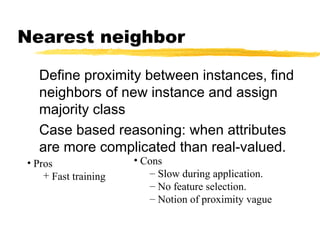
Define proximity between instances, find
neighbors of new instance and assign
majority class
Case based reasoning: when attributes
are more complicated than real-valued.
Nearest neighbor
• Cons
– Slow during application.
– No feature selection.
– Notion of proximity vague
• Pros
+ Fast training
Tree where internal nodes are simple
decision rules on one or more attributes
and leaf nodes are predicted class labels.
Decision trees
Salary < 1 M
Prof = teacher
Good
Age < 30
BadBad
Good
Decision tree classifiers
Widely used learning method
Easy to interpret: can be re-represented as if-
then-else rules
Approximates function by piece wise constant
regions
Does not require any prior knowledge of data
distribution, works well on noisy data.
Has been applied to:
classify medical patients based on the disease,
equipment malfunction by cause,
loan applicant by likelihood of payment.
Pros and Cons of decision
trees
· Cons
- Cannot handle complicated
relationship between features
- simple decision boundaries
- problems with lots of missing
data
· Pros
+ Reasonable training
time
+ Fast application
+ Easy to interpret
+ Easy to implement
+ Can handle large
number of features
More information:
http://www.stat.wisc.edu/~limt/treeprogs.html
Neural network
Set of nodes connected by directed
weighted edges
Hidden nodes
Output nodes
x1
x2
x3
x1
x2
x3
w1
w2
w3
y
n
i
ii
e
y
xwo
−
=
+
=
= ∑
1
1
)(
)(
1
σ
σ
Basic NN unit
A more typical NN
Neural networks
Useful for learning complex data like
handwriting, speech and image
recognition
Neural networkClassification tree
Decision boundaries:
Linear regression
Pros and Cons of Neural
Network
· Cons
- Slow training time
- Hard to interpret
- Hard to implement: trial
and error for choosing
number of nodes
· Pros
+ Can learn more complicated
class boundaries
+ Fast application
+ Can handle large number of
features
Conclusion: Use neural nets only if
decision-trees/NN fail.
Bayesian learning
Assume a probability model on generation of data.
Apply bayes theorem to find most likely class as:
Naïve bayes: Assume attributes conditionally
independent given class value
Easy to learn probabilities by counting,
Useful in some domains e.g. text
)(
)()|(
max)|(max:classpredicted
dp
cpcdp
dcpc jj
c
j
c jj
==
∏=
=
n
i
ji
j
c
cap
dp
cp
c
j
1
)|(
)(
)(
max
Clustering or
Unsupervised Learning
Clustering
Unsupervised learning when old data with class
labels not available e.g. when introducing a new
product.
Group/cluster existing customers based on time
series of payment history such that similar
customers in same cluster.
Key requirement: Need a good measure of
similarity between instances.
Identify micro-markets and develop policies for
each
Applications
Customer segmentation e.g. for targeted
marketing
Group/cluster existing customers based on time
series of payment history such that similar customers
in same cluster.
Identify micro-markets and develop policies for each
Collaborative filtering:
group based on common items purchased
Text clustering
Compression
Distance functions
Numeric data: euclidean, manhattan distances
Categorical data: 0/1 to indicate
presence/absence followed by
Hamming distance (# dissimilarity)
Jaccard coefficients: #similarity in 1s/(# of 1s)
data dependent measures: similarity of A and B
depends on co-occurance with C.
Combined numeric and categorical data:
weighted normalized distance:
Clustering methods
Hierarchical clustering
agglomerative Vs divisive
single link Vs complete link
Partitional clustering
distance-based: K-means
model-based: EM
density-based:
Partitional methods: K-
means
Criteria: minimize sum of square of distance
Between each point and centroid of the cluster.
Between each pair of points in the cluster
Algorithm:
Select initial partition with K clusters:
random, first K, K separated points
Repeat until stabilization:
Assign each point to closest cluster center
Generate new cluster centers
Adjust clusters by merging/splitting
Collaborative Filtering
Given database of user preferences, predict
preference of new user
Example: predict what new movies you will like
based on
your past preferences
others with similar past preferences
their preferences for the new movies
Example: predict what books/CDs a person may
want to buy
(and suggest it, or give discounts to tempt
customer)
Collaborative
recommendation
RangeelaQSQT 100 daysAnand Sholay Deewar Vertigo
Smita
Vijay
Mohan
Rajesh
Nina
Nitin ? ? ? ? ? ?
•Possible approaches:
• Average vote along columns [Same prediction for all]
• Weight vote based on similarity of likings [GroupLens]
RangeelaQSQT 100 daysAnand Sholay Deewar Vertigo
Smita
Vijay
Mohan
Rajesh
Nina
Nitin ? ? ? ? ? ?
Cluster-based approaches
External attributes of people and movies to
cluster
age, gender of people
actors and directors of movies.
[ May not be available]
Cluster people based on movie preferences
misses information about similarity of movies
Repeated clustering:
cluster movies based on people, then people based
on movies, and repeat
ad hoc, might smear out groups
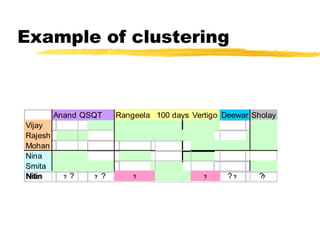
Example of clustering
RangeelaQSQT 100 daysAnand Sholay Deewar Vertigo
Smita
Vijay
Mohan
Rajesh
Nina
Nitin ? ? ? ? ? ?
Anand QSQT Rangeela 100 days Vertigo Deewar Sholay
Vijay
Rajesh
Mohan
Nina
Smita
Nitin ? ? ? ? ? ?
Model-based approach
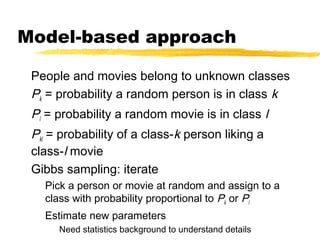
People and movies belong to unknown classes
Pk = probability a random person is in class k
Pl = probability a random movie is in class l
Pkl = probability of a class-k person liking a
class-l movie
Gibbs sampling: iterate
Pick a person or movie at random and assign to a
class with probability proportional to Pk or Pl
Estimate new parameters
Need statistics background to understand details
Association Rules
Association rules
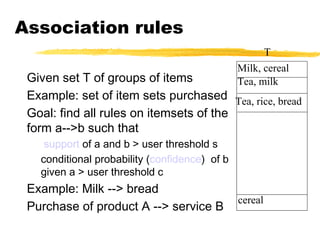
Given set T of groups of items
Example: set of item sets purchased
Goal: find all rules on itemsets of the
form a-->b such that
support of a and b > user threshold s
conditional probability (confidence) of b
given a > user threshold c
Example: Milk --> bread
Purchase of product A --> service B
Milk, cereal
Tea, milk
Tea, rice, bread
cereal
T
Variants
High confidence may not imply high
correlation
Use correlations. Find expected support
and large departures from that interesting..
see statistical literature on contingency tables.
Still too many rules, need to prune...
Prevalent ≠ Interesting
Analysts already
know about prevalent
rules
Interesting rules are
those that deviate
from prior expectation
Mining’s payoff is in
finding surprising
phenomena
1995
1998
Milk and
cereal sell
together!
Zzzz... Milk and
cereal sell
together!
What makes a rule
surprising?
Does not match prior
expectation
Correlation between
milk and cereal remains
roughly constant over
time
Cannot be trivially
derived from simpler
rules
Milk 10%, cereal 10%
Milk and cereal 10% …
surprising
Eggs 10%
Milk, cereal and eggs
0.1% … surprising!
Expected 1%
Applications of fast
itemset counting
Find correlated events:
Applications in medicine: find redundant
tests
Cross selling in retail, banking
Improve predictive capability of classifiers
that assume attribute independence
New similarity measures of categorical
attributes [Mannila et al, KDD 98]
Data Mining in Practice
Application Areas
Industry Application
Finance Credit Card Analysis
Insurance Claims, Fraud Analysis
Telecommunication Call record analysis
Transport Logistics management
Consumer goods promotion analysis
Data Service providers Value added data
Utilities Power usage analysis
Why Now?
Data is being produced
Data is being warehoused
The computing power is available
The computing power is affordable
The competitive pressures are strong
Commercial products are available
Data Mining works with
Warehouse Data
Data Warehousing provides the
Enterprise with a memory
Data Mining provides the
Enterprise with intelligence
Usage scenarios
Data warehouse mining:
assimilate data from operational sources
mine static data
Mining log data
Continuous mining: example in process control
Stages in mining:
data selection  pre-processing: cleaning 
transformation  mining  result evaluation
 visualization
Mining market
Around 20 to 30 mining tool vendors
Major tool players:
Clementine,
IBM’s Intelligent Miner,
SGI’s MineSet,
SAS’s Enterprise Miner.
All pretty much the same set of tools
Many embedded products:
fraud detection:
electronic commerce applications,
health care,
customer relationship management: Epiphany
Vertical integration:
Mining on the web
Web log analysis for site design:
what are popular pages,
what links are hard to find.
Electronic stores sales enhancements:
recommendations, advertisement:
Collaborative filtering: Net perception, Wisewire
Inventory control: what was a shopper looking
for and could not find..
OLAP Mining integration
OLAP (On Line Analytical Processing)
Fast interactive exploration of multidim.
aggregates.
Heavy reliance on manual operations for
analysis:
Tedious and error-prone on large
multidimensional data
Ideal platform for vertical integration of mining
but needs to be interactive instead of batch.
State of art in mining OLAP
integration
Decision trees [Information discovery, Cognos]
find factors influencing high profits
Clustering [Pilot software]
segment customers to define hierarchy on that dimension
Time series analysis: [Seagate’s Holos]
Query for various shapes along time: eg. spikes, outliers
Multi-level Associations [Han et al.]
find association between members of dimensions
Sarawagi [VLDB2000]
Data Mining in Use
The US Government uses Data Mining to track
fraud
A Supermarket becomes an information broker
Basketball teams use it to track game strategy
Cross Selling
Target Marketing
Holding on to Good Customers
Weeding out Bad Customers
Some success stories
Network intrusion detection using a combination of
sequential rule discovery and classification tree on 4 GB
DARPA data
Won over (manual) knowledge engineering approach
http://www.cs.columbia.edu/~sal/JAM/PROJECT/ provides good
detailed description of the entire process
Major US bank: customer attrition prediction
First segment customers based on financial behavior: found 3
segments
Build attrition models for each of the 3 segments
40-50% of attritions were predicted == factor of 18 increase
Targeted credit marketing: major US banks
find customer segments based on 13 months credit balances
build another response model based on surveys
increased response 4 times -- 2%

Datamining intro-iep

  • 1.
    An Introduction toData Mining Prof. S. Sudarshan CSE Dept, IIT Bombay Most slides courtesy: Prof. Sunita Sarawagi School of IT, IIT Bombay
  • 2.
    Why Data Mining Creditratings/targeted marketing: Given a database of 100,000 names, which persons are the least likely to default on their credit cards? Identify likely responders to sales promotions Fraud detection Which types of transactions are likely to be fraudulent, given the demographics and transactional history of a particular customer? Customer relationship management: Which of my customers are likely to be the most loyal, and which are most likely to leave for a competitor? : Data Mining helps extract such information
  • 3.
    Data mining Process ofsemi-automatically analyzing large databases to find patterns that are: valid: hold on new data with some certainity novel: non-obvious to the system useful: should be possible to act on the item understandable: humans should be able to interpret the pattern Also known as Knowledge Discovery in Databases (KDD)
  • 4.
    Applications Banking: loan/credit cardapproval predict good customers based on old customers Customer relationship management: identify those who are likely to leave for a competitor. Targeted marketing: identify likely responders to promotions Fraud detection: telecommunications, financial transactions from an online stream of event identify fraudulent events Manufacturing and production: automatically adjust knobs when process parameter changes
  • 5.
    Applications (continued) Medicine: diseaseoutcome, effectiveness of treatments analyze patient disease history: find relationship between diseases Molecular/Pharmaceutical: identify new drugs Scientific data analysis: identify new galaxies by searching for sub clusters Web site/store design and promotion: find affinity of visitor to pages and modify layout
  • 6.
    The KDD process Problemfomulation Data collection subset data: sampling might hurt if highly skewed data feature selection: principal component analysis, heuristic search Pre-processing: cleaning name/address cleaning, different meanings (annual, yearly), duplicate removal, supplying missing values Transformation: map complex objects e.g. time series data to features e.g. frequency Choosing mining task and mining method: Result evaluation and Visualization: Knowledge discovery is an iterative process
  • 7.
    Relationship with other fields Overlapswith machine learning, statistics, artificial intelligence, databases, visualization but more stress on scalability of number of features and instances stress on algorithms and architectures whereas foundations of methods and formulations provided by statistics and machine learning. automation for handling large, heterogeneous data
  • 8.
    Some basic operations Predictive: Regression Classification CollaborativeFiltering Descriptive: Clustering / similarity matching Association rules and variants Deviation detection
  • 9.
  • 10.
    Classification Given old dataabout customers and payments, predict new applicant’s loan eligibility. Age Salary Profession Location Customer type Previous customers Classifier Decision rules Salary > 5 L Prof. = Exec New applicant’s data Good/ bad
  • 11.
    Classification methods Goal: Predictclass Ci = f(x1, x2, .. Xn) Regression: (linear or any other polynomial) a*x1 + b*x2 + c = Ci. Nearest neighour Decision tree classifier: divide decision space into piecewise constant regions. Probabilistic/generative models Neural networks: partition by non-linear boundaries
  • 12.
    Define proximity betweeninstances, find neighbors of new instance and assign majority class Case based reasoning: when attributes are more complicated than real-valued. Nearest neighbor • Cons – Slow during application. – No feature selection. – Notion of proximity vague • Pros + Fast training
  • 13.
    Tree where internalnodes are simple decision rules on one or more attributes and leaf nodes are predicted class labels. Decision trees Salary < 1 M Prof = teacher Good Age < 30 BadBad Good
  • 14.
    Decision tree classifiers Widelyused learning method Easy to interpret: can be re-represented as if- then-else rules Approximates function by piece wise constant regions Does not require any prior knowledge of data distribution, works well on noisy data. Has been applied to: classify medical patients based on the disease, equipment malfunction by cause, loan applicant by likelihood of payment.
  • 15.
    Pros and Consof decision trees · Cons - Cannot handle complicated relationship between features - simple decision boundaries - problems with lots of missing data · Pros + Reasonable training time + Fast application + Easy to interpret + Easy to implement + Can handle large number of features More information: http://www.stat.wisc.edu/~limt/treeprogs.html
  • 16.
    Neural network Set ofnodes connected by directed weighted edges Hidden nodes Output nodes x1 x2 x3 x1 x2 x3 w1 w2 w3 y n i ii e y xwo − = + = = ∑ 1 1 )( )( 1 σ σ Basic NN unit A more typical NN
  • 17.
    Neural networks Useful forlearning complex data like handwriting, speech and image recognition Neural networkClassification tree Decision boundaries: Linear regression
  • 18.
    Pros and Consof Neural Network · Cons - Slow training time - Hard to interpret - Hard to implement: trial and error for choosing number of nodes · Pros + Can learn more complicated class boundaries + Fast application + Can handle large number of features Conclusion: Use neural nets only if decision-trees/NN fail.
  • 19.
    Bayesian learning Assume aprobability model on generation of data. Apply bayes theorem to find most likely class as: Naïve bayes: Assume attributes conditionally independent given class value Easy to learn probabilities by counting, Useful in some domains e.g. text )( )()|( max)|(max:classpredicted dp cpcdp dcpc jj c j c jj == ∏= = n i ji j c cap dp cp c j 1 )|( )( )( max
  • 20.
  • 21.
    Clustering Unsupervised learning whenold data with class labels not available e.g. when introducing a new product. Group/cluster existing customers based on time series of payment history such that similar customers in same cluster. Key requirement: Need a good measure of similarity between instances. Identify micro-markets and develop policies for each
  • 22.
    Applications Customer segmentation e.g.for targeted marketing Group/cluster existing customers based on time series of payment history such that similar customers in same cluster. Identify micro-markets and develop policies for each Collaborative filtering: group based on common items purchased Text clustering Compression
  • 23.
    Distance functions Numeric data:euclidean, manhattan distances Categorical data: 0/1 to indicate presence/absence followed by Hamming distance (# dissimilarity) Jaccard coefficients: #similarity in 1s/(# of 1s) data dependent measures: similarity of A and B depends on co-occurance with C. Combined numeric and categorical data: weighted normalized distance:
  • 24.
    Clustering methods Hierarchical clustering agglomerativeVs divisive single link Vs complete link Partitional clustering distance-based: K-means model-based: EM density-based:
  • 25.
    Partitional methods: K- means Criteria:minimize sum of square of distance Between each point and centroid of the cluster. Between each pair of points in the cluster Algorithm: Select initial partition with K clusters: random, first K, K separated points Repeat until stabilization: Assign each point to closest cluster center Generate new cluster centers Adjust clusters by merging/splitting
  • 26.
    Collaborative Filtering Given databaseof user preferences, predict preference of new user Example: predict what new movies you will like based on your past preferences others with similar past preferences their preferences for the new movies Example: predict what books/CDs a person may want to buy (and suggest it, or give discounts to tempt customer)
  • 27.
    Collaborative recommendation RangeelaQSQT 100 daysAnandSholay Deewar Vertigo Smita Vijay Mohan Rajesh Nina Nitin ? ? ? ? ? ? •Possible approaches: • Average vote along columns [Same prediction for all] • Weight vote based on similarity of likings [GroupLens] RangeelaQSQT 100 daysAnand Sholay Deewar Vertigo Smita Vijay Mohan Rajesh Nina Nitin ? ? ? ? ? ?
  • 28.
    Cluster-based approaches External attributesof people and movies to cluster age, gender of people actors and directors of movies. [ May not be available] Cluster people based on movie preferences misses information about similarity of movies Repeated clustering: cluster movies based on people, then people based on movies, and repeat ad hoc, might smear out groups
  • 29.
    Example of clustering RangeelaQSQT100 daysAnand Sholay Deewar Vertigo Smita Vijay Mohan Rajesh Nina Nitin ? ? ? ? ? ? Anand QSQT Rangeela 100 days Vertigo Deewar Sholay Vijay Rajesh Mohan Nina Smita Nitin ? ? ? ? ? ?
  • 30.
    Model-based approach People andmovies belong to unknown classes Pk = probability a random person is in class k Pl = probability a random movie is in class l Pkl = probability of a class-k person liking a class-l movie Gibbs sampling: iterate Pick a person or movie at random and assign to a class with probability proportional to Pk or Pl Estimate new parameters Need statistics background to understand details
  • 31.
  • 32.
    Association rules Given setT of groups of items Example: set of item sets purchased Goal: find all rules on itemsets of the form a-->b such that support of a and b > user threshold s conditional probability (confidence) of b given a > user threshold c Example: Milk --> bread Purchase of product A --> service B Milk, cereal Tea, milk Tea, rice, bread cereal T
  • 33.
    Variants High confidence maynot imply high correlation Use correlations. Find expected support and large departures from that interesting.. see statistical literature on contingency tables. Still too many rules, need to prune...
  • 34.
    Prevalent ≠ Interesting Analystsalready know about prevalent rules Interesting rules are those that deviate from prior expectation Mining’s payoff is in finding surprising phenomena 1995 1998 Milk and cereal sell together! Zzzz... Milk and cereal sell together!
  • 35.
    What makes arule surprising? Does not match prior expectation Correlation between milk and cereal remains roughly constant over time Cannot be trivially derived from simpler rules Milk 10%, cereal 10% Milk and cereal 10% … surprising Eggs 10% Milk, cereal and eggs 0.1% … surprising! Expected 1%
  • 36.
    Applications of fast itemsetcounting Find correlated events: Applications in medicine: find redundant tests Cross selling in retail, banking Improve predictive capability of classifiers that assume attribute independence New similarity measures of categorical attributes [Mannila et al, KDD 98]
  • 37.
  • 38.
    Application Areas Industry Application FinanceCredit Card Analysis Insurance Claims, Fraud Analysis Telecommunication Call record analysis Transport Logistics management Consumer goods promotion analysis Data Service providers Value added data Utilities Power usage analysis
  • 39.
    Why Now? Data isbeing produced Data is being warehoused The computing power is available The computing power is affordable The competitive pressures are strong Commercial products are available
  • 40.
    Data Mining workswith Warehouse Data Data Warehousing provides the Enterprise with a memory Data Mining provides the Enterprise with intelligence
  • 41.
    Usage scenarios Data warehousemining: assimilate data from operational sources mine static data Mining log data Continuous mining: example in process control Stages in mining: data selection  pre-processing: cleaning  transformation  mining  result evaluation  visualization
  • 42.
    Mining market Around 20to 30 mining tool vendors Major tool players: Clementine, IBM’s Intelligent Miner, SGI’s MineSet, SAS’s Enterprise Miner. All pretty much the same set of tools Many embedded products: fraud detection: electronic commerce applications, health care, customer relationship management: Epiphany
  • 43.
    Vertical integration: Mining onthe web Web log analysis for site design: what are popular pages, what links are hard to find. Electronic stores sales enhancements: recommendations, advertisement: Collaborative filtering: Net perception, Wisewire Inventory control: what was a shopper looking for and could not find..
  • 44.
    OLAP Mining integration OLAP(On Line Analytical Processing) Fast interactive exploration of multidim. aggregates. Heavy reliance on manual operations for analysis: Tedious and error-prone on large multidimensional data Ideal platform for vertical integration of mining but needs to be interactive instead of batch.
  • 45.
    State of artin mining OLAP integration Decision trees [Information discovery, Cognos] find factors influencing high profits Clustering [Pilot software] segment customers to define hierarchy on that dimension Time series analysis: [Seagate’s Holos] Query for various shapes along time: eg. spikes, outliers Multi-level Associations [Han et al.] find association between members of dimensions Sarawagi [VLDB2000]
  • 46.
    Data Mining inUse The US Government uses Data Mining to track fraud A Supermarket becomes an information broker Basketball teams use it to track game strategy Cross Selling Target Marketing Holding on to Good Customers Weeding out Bad Customers
  • 47.
    Some success stories Networkintrusion detection using a combination of sequential rule discovery and classification tree on 4 GB DARPA data Won over (manual) knowledge engineering approach http://www.cs.columbia.edu/~sal/JAM/PROJECT/ provides good detailed description of the entire process Major US bank: customer attrition prediction First segment customers based on financial behavior: found 3 segments Build attrition models for each of the 3 segments 40-50% of attritions were predicted == factor of 18 increase Targeted credit marketing: major US banks find customer segments based on 13 months credit balances build another response model based on surveys increased response 4 times -- 2%

Editor's Notes

  • #5 Any area where large amounts of historic data that if understood better can help shape future decisions.
  • #44 Absolute: 40 M$ 40M$, expected to grow 10 times by 2000 --Forrester research