Industrial Management
 Topic Name : Scientific Management by FW Taylor & its present
practice
Group Name: Password
 Nasrin Sultana (152-15-6211)
 Joyanto Chandro Barmon (152-15-6236)
 Tusher Chandra Ghosh (152-15-6237)
 Md Touhidur Rahman (152-15-6232)
 Jannatul Noori (152-15-6270)
Tusher Chandra Ghosh
Student ID: 152-15-6237
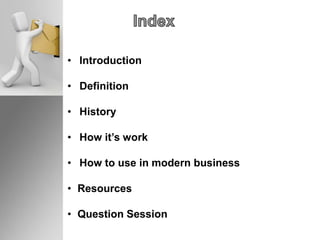
• Introduction
• Definition
• History
• How it’s work
• How to use in modern business
• Resources
• Question Session
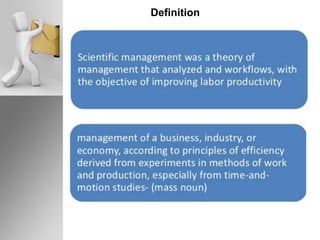
Definition
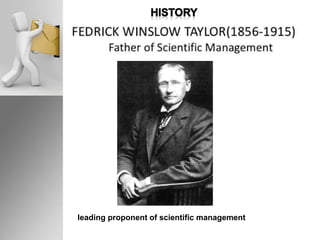
leading proponent of scientific management
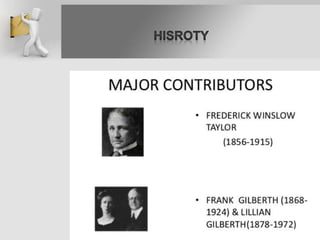
One of the earliest of these theorists was Frederick Winslow
Taylor. He started the Scientific Management movement, and he
and his associates were the first people to study the work
process scientifically.
In 1909, Taylor published "The Principles of Scientific
Management." In this, he proposed that by optimizing and
simplifying jobs, productivity would increase. He also advanced
the idea that workers and managers needed to cooperate with
one another. This was very different from the way work was
typically done in businesses beforehand. A factory manager at
that time had very little contact with the workers, and he left
them on their own to produce the necessary product. There was
no standardization, and a worker's main motivation was often
continued employment, so there was no incentive to work as
quickly or as efficiently as possible.
Joyanto Chandro Barmon
Student ID: 152-15-6236
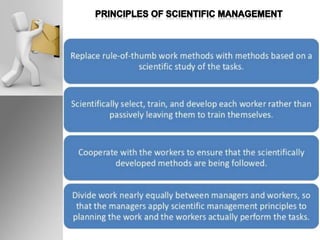
The scientific management approach propounded by F.W.
Taylor is based upon the following four principles
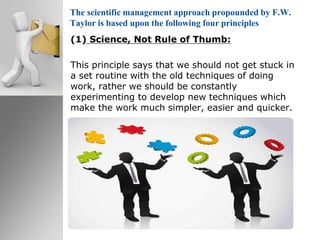
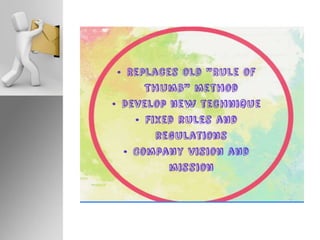
(1) Science, Not Rule of Thumb:
This principle says that we should not get stuck in
a set routine with the old techniques of doing
work, rather we should be constantly
experimenting to develop new techniques which
make the work much simpler, easier and quicker.
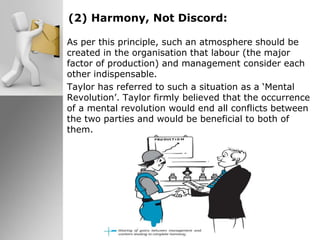
(2) Harmony, Not Discord:
As per this principle, such an atmosphere should be
created in the organisation that labour (the major
factor of production) and management consider each
other indispensable.
Taylor has referred to such a situation as a ‘Mental
Revolution’. Taylor firmly believed that the occurrence
of a mental revolution would end all conflicts between
the two parties and would be beneficial to both of
them.
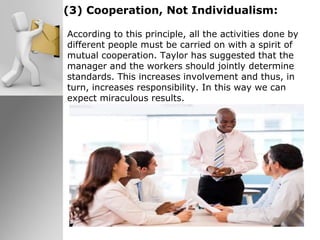
(3) Cooperation, Not Individualism:
According to this principle, all the activities done by
different people must be carried on with a spirit of
mutual cooperation. Taylor has suggested that the
manager and the workers should jointly determine
standards. This increases involvement and thus, in
turn, increases responsibility. In this way we can
expect miraculous results.
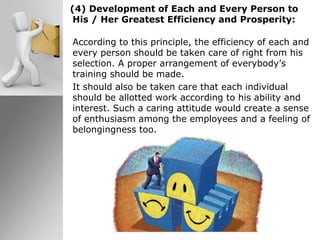
(4) Development of Each and Every Person to
His / Her Greatest Efficiency and Prosperity:
According to this principle, the efficiency of each and
every person should be taken care of right from his
selection. A proper arrangement of everybody’s
training should be made.
It should also be taken care that each individual
should be allotted work according to his ability and
interest. Such a caring attitude would create a sense
of enthusiasm among the employees and a feeling of
belongingness too.
Nasrin Sultana
Student ID: 152-15-6211
Scientific management requires a high level of managerial
control over employee work practices and entails a higher
ratio of managerial workers to laborers than previous
management methods. Such detail-oriented management
may cause friction between workers and managers.
Taylor observed that some workers were more talented than
others, and that even smart ones were often unmotivated. He
observed that most workers who are forced to perform
repetitive tasks tend to work at the slowest rate that goes
unpunished. This slow rate of work has been observed in
many industries and many countries and has been called by
various terms. Taylor used the term "soldiering” a term that
reflects the way conscripts may approach following orders,
and observed that, when paid the same amount, workers will
tend to do the amount of work that the slowest among them
does.Taylor describes soldiering as "the greatest evil with
which the working-people ... are now afflicted.”
Scientific management evolved in an era when mechanization
and automation were still in their infancy. The ideas and
methods of scientific management extended the American
system of manufacturing in the transformation from craft work
(with humans as the only possible agents) to mechanization and
automation, although proponents of scientific management did
not predict the extensive removal of humans from the
production process. Concerns over labor-displacing
technologies rose with increasing mechanization and
automation.
By factoring processes into discrete, unambiguous units,
scientific management laid the groundwork for automation and
offshoring, prefiguring industrial process control and numerical
control in the absence of any machines that could carry it out.
Taylor and his followers did not foresee this at the time; in their
world, it was humans that would execute the optimized
processes
Jannatul Noori
Student ID: 152-15-6270
The Principles of Taylor's Scientific Management Theory
became widely practiced, and the resulting cooperation
between workers and managers eventually developed into the
teamwork we enjoy today. While Taylorism in a pure sense isn't
practiced much today, scientific management did provide
many significant contributions to the advancement of
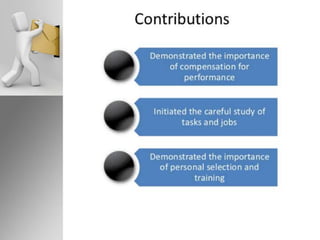
management practice. It introduced systematic selection and
training procedures, it provided a way to study workplace
efficiency, and it encouraged the idea of systematic
organizational design.
Scientific management was one of the first attempts to
systematically treat management and process improvement as
a scientific problem. It may have been the first to do so in a
"bottom-up" way and found a lineage of successors that have
many elements in common. With the advancement of statistical
methods, quality assurance and quality control began in the
1920s and 1930s. During the 1940s and 1950s, the body of
knowledge for doing scientific management evolved into
operations management, operations research, and management
cybernetics. In the 1980s total quality management became
widely popular, and in the 1990s "re-engineering" went from a
simple word to a mystique. Today's Six Sigma and lean
manufacturing could be seen as new kinds of scientific
management, although their evolutionary distance from the
original is so great that the comparison might be misleading. In
particular, Shigeo Shingo, one of the originators of the Toyota
Production System, believed that this system and Japanese
management culture in general should be seen as a kind of
scientific management.
Md. Touhidur Rahman
Student ID: 152-15-6232
How Do Today’s Managers Use
Scientific Management?
1. It was important because it could raise
countries’ standard of living by making
workers more productive and efficient.
2. Also it’s important to remember that many of
the tools and techniques developed by the
scientific.
Application in the modern workplace
1. Assembly line plants prototypical example
“prisoners of Taylorism”
2. System of Remuneration.
3. Re-Design Reengineering.
4. Benchmarking
5. Data are used to refine, improve, change,
modify and eliminate organizational
processes
6. Learn Manufacturing
Advantages of Scientific Management
1. Enhanced teamwork – cooperation between managers
and workers
2. Management based on observation and experiment for
context-specific solutions
3. Better planning and decision-making
4. Improved democracy in workplace
5. Improved physical working conditions for employees.
6. Increased opportunities for workers to acquire
scientific training
Disadvantages of Scientific Management
1. Suitable for small organizations only; unsuitable in big
firms
2. Managerial decisions may involve strictness and
stress for managers due to need for complete control
over the work place
3. Influences feelings of pressure among workers
4. May de-motivate workers
Resources
1. www.wikipedia.org
2. www.Google.com
3. www.tutorialspoint.com
4. www.slideshare.net
5. http://www.helpwithhomeworks.com/
Industrial management presentation

Industrial management presentation

  • 1.
  • 2.
     Topic Name: Scientific Management by FW Taylor & its present practice Group Name: Password  Nasrin Sultana (152-15-6211)  Joyanto Chandro Barmon (152-15-6236)  Tusher Chandra Ghosh (152-15-6237)  Md Touhidur Rahman (152-15-6232)  Jannatul Noori (152-15-6270)
  • 3.
  • 4.
    • Introduction • Definition •History • How it’s work • How to use in modern business • Resources • Question Session
  • 5.
  • 8.
    leading proponent ofscientific management
  • 9.
    One of theearliest of these theorists was Frederick Winslow Taylor. He started the Scientific Management movement, and he and his associates were the first people to study the work process scientifically. In 1909, Taylor published "The Principles of Scientific Management." In this, he proposed that by optimizing and simplifying jobs, productivity would increase. He also advanced the idea that workers and managers needed to cooperate with one another. This was very different from the way work was typically done in businesses beforehand. A factory manager at that time had very little contact with the workers, and he left them on their own to produce the necessary product. There was no standardization, and a worker's main motivation was often continued employment, so there was no incentive to work as quickly or as efficiently as possible.
  • 11.
  • 12.
    The scientific managementapproach propounded by F.W. Taylor is based upon the following four principles (1) Science, Not Rule of Thumb: This principle says that we should not get stuck in a set routine with the old techniques of doing work, rather we should be constantly experimenting to develop new techniques which make the work much simpler, easier and quicker.
  • 13.
    (2) Harmony, NotDiscord: As per this principle, such an atmosphere should be created in the organisation that labour (the major factor of production) and management consider each other indispensable. Taylor has referred to such a situation as a ‘Mental Revolution’. Taylor firmly believed that the occurrence of a mental revolution would end all conflicts between the two parties and would be beneficial to both of them.
  • 14.
    (3) Cooperation, NotIndividualism: According to this principle, all the activities done by different people must be carried on with a spirit of mutual cooperation. Taylor has suggested that the manager and the workers should jointly determine standards. This increases involvement and thus, in turn, increases responsibility. In this way we can expect miraculous results.
  • 15.
    (4) Development ofEach and Every Person to His / Her Greatest Efficiency and Prosperity: According to this principle, the efficiency of each and every person should be taken care of right from his selection. A proper arrangement of everybody’s training should be made. It should also be taken care that each individual should be allotted work according to his ability and interest. Such a caring attitude would create a sense of enthusiasm among the employees and a feeling of belongingness too.
  • 17.
  • 18.
    Scientific management requiresa high level of managerial control over employee work practices and entails a higher ratio of managerial workers to laborers than previous management methods. Such detail-oriented management may cause friction between workers and managers. Taylor observed that some workers were more talented than others, and that even smart ones were often unmotivated. He observed that most workers who are forced to perform repetitive tasks tend to work at the slowest rate that goes unpunished. This slow rate of work has been observed in many industries and many countries and has been called by various terms. Taylor used the term "soldiering” a term that reflects the way conscripts may approach following orders, and observed that, when paid the same amount, workers will tend to do the amount of work that the slowest among them does.Taylor describes soldiering as "the greatest evil with which the working-people ... are now afflicted.”
  • 19.
    Scientific management evolvedin an era when mechanization and automation were still in their infancy. The ideas and methods of scientific management extended the American system of manufacturing in the transformation from craft work (with humans as the only possible agents) to mechanization and automation, although proponents of scientific management did not predict the extensive removal of humans from the production process. Concerns over labor-displacing technologies rose with increasing mechanization and automation. By factoring processes into discrete, unambiguous units, scientific management laid the groundwork for automation and offshoring, prefiguring industrial process control and numerical control in the absence of any machines that could carry it out. Taylor and his followers did not foresee this at the time; in their world, it was humans that would execute the optimized processes
  • 22.
  • 24.
    The Principles ofTaylor's Scientific Management Theory became widely practiced, and the resulting cooperation between workers and managers eventually developed into the teamwork we enjoy today. While Taylorism in a pure sense isn't practiced much today, scientific management did provide many significant contributions to the advancement of management practice. It introduced systematic selection and training procedures, it provided a way to study workplace efficiency, and it encouraged the idea of systematic organizational design.
  • 25.
    Scientific management wasone of the first attempts to systematically treat management and process improvement as a scientific problem. It may have been the first to do so in a "bottom-up" way and found a lineage of successors that have many elements in common. With the advancement of statistical methods, quality assurance and quality control began in the 1920s and 1930s. During the 1940s and 1950s, the body of knowledge for doing scientific management evolved into operations management, operations research, and management cybernetics. In the 1980s total quality management became widely popular, and in the 1990s "re-engineering" went from a simple word to a mystique. Today's Six Sigma and lean manufacturing could be seen as new kinds of scientific management, although their evolutionary distance from the original is so great that the comparison might be misleading. In particular, Shigeo Shingo, one of the originators of the Toyota Production System, believed that this system and Japanese management culture in general should be seen as a kind of scientific management.
  • 26.
  • 27.
    How Do Today’sManagers Use Scientific Management? 1. It was important because it could raise countries’ standard of living by making workers more productive and efficient. 2. Also it’s important to remember that many of the tools and techniques developed by the scientific.
  • 28.
    Application in themodern workplace 1. Assembly line plants prototypical example “prisoners of Taylorism” 2. System of Remuneration. 3. Re-Design Reengineering. 4. Benchmarking 5. Data are used to refine, improve, change, modify and eliminate organizational processes 6. Learn Manufacturing
  • 30.
    Advantages of ScientificManagement 1. Enhanced teamwork – cooperation between managers and workers 2. Management based on observation and experiment for context-specific solutions 3. Better planning and decision-making 4. Improved democracy in workplace 5. Improved physical working conditions for employees. 6. Increased opportunities for workers to acquire scientific training
  • 31.
    Disadvantages of ScientificManagement 1. Suitable for small organizations only; unsuitable in big firms 2. Managerial decisions may involve strictness and stress for managers due to need for complete control over the work place 3. Influences feelings of pressure among workers 4. May de-motivate workers
  • 32.
    Resources 1. www.wikipedia.org 2. www.Google.com 3.www.tutorialspoint.com 4. www.slideshare.net 5. http://www.helpwithhomeworks.com/