Historical Background 
• The Classical era, also called “Age of Reasons” 
• The term "classical period" is generally used to refer to the post-baroque & pre-romantic 
era of music composed between 1750 and 1830, which covers the development 
of the classical symphony and concerto 
• Music of this period was generally of an orderly nature, with qualities of clarity & 
balance, and emphasizing formal beauty rather than emotional expression 
• The Term classical denotes conformity with the principles and characteristics of ancient 
Greece and Roman literature and art which were formal, elegant, simple , freed and 
dignified 
• Important historical events that occurred in the West were the French Revolution and 
the Napoleonic Wars, the American declaration of Independence in 1776 and the 
American Revolution
Cultural 
Background • Cultural life was dominated by the aristocracy, as patrons of musicians 
and artist who generally influenced the arts. 
• The birth of classical civilization was deeply rooted in the adventurous 
social, economic and constitutional restructuring that took place in the 
Archaic period.
Music Characteristics 
• Harmony and texture is homophonic in general 
• The dynamics of loud and soft were clearly shown through the extensive use of 
crescendo and diminuendo 
• The style of broken chord accompaniment called Alberti Bass was practiced. 
• MELODY: Short and clearly defined musical phrases with two or more 
contrasting themes. 
• RHYTHM: Very defined and regular. 
• TEXTURE: Mostly Homophonic. 
• TIMBRE: The symphony orchestra was organised into four sections - strings, 
woodwind, brass and percussion. The harpsichord was seldom used.
Types of Classical 
Music 
Whereas most popular styles lend themselves to the song form, classical music has been noted 
for its development of highly sophisticated forms of instrumental music: these include 
The Concerto, Symphony , Sonata , Suite , Etude , Symphonic Poem , Opera and others. 
•Overture - Has three sections, a fast intro, a slow middle section and a fast ending. 
•Symphony - Has 3, sometimes 4 movements. The beginning is moderately fast, next section is 
slow followed by a minuet and then a very fast conclusion. 
•Sonata allegro - Also called sonata, this is one of the most important music forms of this 
period. This type of music is written for a solo instrument, or a solo instrument with 
accompaniment; having three or four movements, each complete in itself. Also used to define 
the first movement of a symphony like that of Haydn's symphonies.
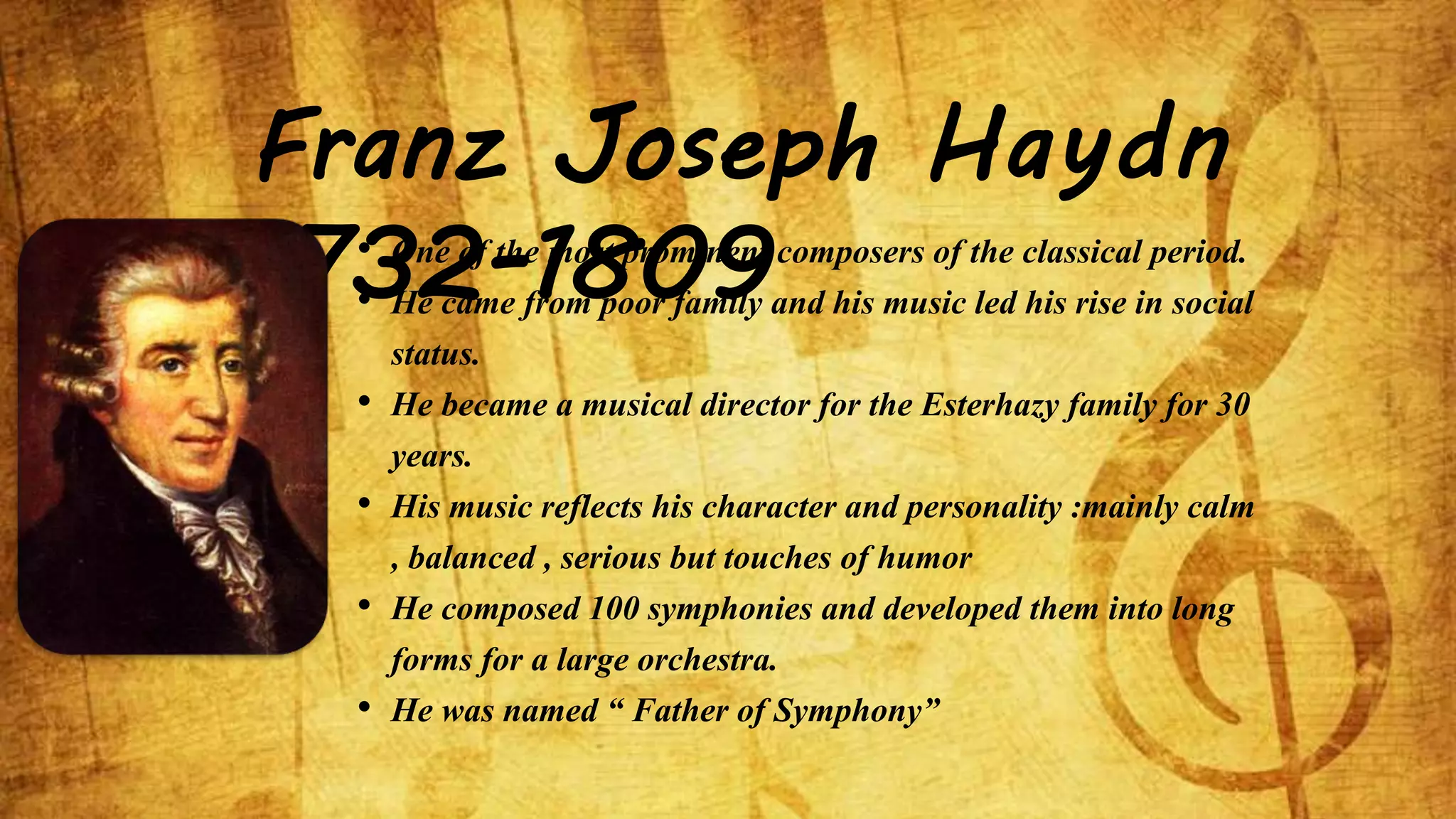
Franz Joseph Haydn 
1732-1809 • One of the most prominent composers of the classical period. 
• He came from poor family and his music led his rise in social 
status. 
• He became a musical director for the Esterhazy family for 30 
years. 
• His music reflects his character and personality :mainly calm 
, balanced , serious but touches of humor 
• He composed 100 symphonies and developed them into long 
forms for a large orchestra. 
• He was named “ Father of Symphony”
Haydn’s 
Compositions • Most of his symphonies have nicknames such as the “ 
Surprise Symphony” , “ The clock “ , “The Military “. 
• Symphony No. 94 in G major “Surprise “ 2nd movement 
• Symphony No. 101 in D major , “The Clock “ 
• Symphony No. 100 in G major, “Military”
Wolfgang Amadeus Mozart 1756 
- 179•1He is a child prodigy and the most amazing genius in 
musical history. 
• At age thirteen, he had written sonatas, concertos, 
symphonies , religious works , and operas and operettas. 
• He experimented in all kinds of music and composed over 
700 works. 
• Unfortunately , due to mismanaged finances he lived his life 
in poverty , died young and was buried in an unknown 
grave.
Mozart’s 
Compositions • He composed wonderful concertos , symphonies and operas such as “ The Marriage of 
Figaro “ (1786), “Don Giovanni “ (1789), and “The Magic Flute” which became popular. 
• Other known works: Eine Kleine Nachtmusik , Symphony No.40 in G major, and Sonata No. 
11 in A major K311. 
• Piano Sonata No. 16 in C major, K.545 (so called facile or semplice sonata) 
• Piano Sonata No.11, K331 in A major , 1st mov. (Andante Grazioso) 
• Symphony No. 40 in G minor, 1st mov. (Molto Allegro) 
• Serenade in G minor (Eine Kleine Nachtmusik)
Ludwig Van Beethoven 
1770-1827 • He was born in Bonn , Germany to a family of musicians and studied music 
at an early age. 
• He was the composer who bridged the late Classical era and the early 
Romantic era. 
• His famous compositions include 32 piano sonatas, 21 set of variation, 9 
symphonies , 5 concertos for piano, 16 string quarters and choral music 
• His works include the “Missa Solemnis “ (1818-1823) and opera “ Fidelio “ 
(1805) 
• His known symphonies are : Symphony no. 3 (Eroica), No. 5 (Pastoral), No.9 
(Choral ) , which adds voices to the orchestra. 
• He began to be deaf in 1796 but this did not became a hindrance, He 
continued composing through the help of an assistant and hearing gadget. 
Some of his famous compositions were made when he was deaf.
Characteristics of 
Beethoven’s works • His music veered toward larger orchestra 
• Sound was centered on the violas and lower registers of the 
violins and cellos to give his music a darker mood. 
• All themes in a piece are tied together by one motif. 
• He developed musical themes and motifs extensively by means 
of modulation. 
• He uses more brass instruments and dynamics
Beethoven’s 
Compositions • Piano Sonata no. 14 in C sharp minor ( Moonlight) 
1st mov. Op. 27 no. 2 
• Piano Concerto no. 1 in C major Op. 15 
• Piano Concerto no. 5 “ Emperor” in E flat major op. 
73 
• Symphony no. 5 Op.67. C minor 
• Symphony No.9, Op. 125, d minor “Choral”
Project in Music 
CREATED BY: 
Faith Esther Joy 
Ramos 
Grade 9 – Alejandro Roces 
Sta. Elena High School

Classical Period

  • 2.
    Historical Background •The Classical era, also called “Age of Reasons” • The term "classical period" is generally used to refer to the post-baroque & pre-romantic era of music composed between 1750 and 1830, which covers the development of the classical symphony and concerto • Music of this period was generally of an orderly nature, with qualities of clarity & balance, and emphasizing formal beauty rather than emotional expression • The Term classical denotes conformity with the principles and characteristics of ancient Greece and Roman literature and art which were formal, elegant, simple , freed and dignified • Important historical events that occurred in the West were the French Revolution and the Napoleonic Wars, the American declaration of Independence in 1776 and the American Revolution
  • 3.
    Cultural Background •Cultural life was dominated by the aristocracy, as patrons of musicians and artist who generally influenced the arts. • The birth of classical civilization was deeply rooted in the adventurous social, economic and constitutional restructuring that took place in the Archaic period.
  • 4.
    Music Characteristics •Harmony and texture is homophonic in general • The dynamics of loud and soft were clearly shown through the extensive use of crescendo and diminuendo • The style of broken chord accompaniment called Alberti Bass was practiced. • MELODY: Short and clearly defined musical phrases with two or more contrasting themes. • RHYTHM: Very defined and regular. • TEXTURE: Mostly Homophonic. • TIMBRE: The symphony orchestra was organised into four sections - strings, woodwind, brass and percussion. The harpsichord was seldom used.
  • 5.
    Types of Classical Music Whereas most popular styles lend themselves to the song form, classical music has been noted for its development of highly sophisticated forms of instrumental music: these include The Concerto, Symphony , Sonata , Suite , Etude , Symphonic Poem , Opera and others. •Overture - Has three sections, a fast intro, a slow middle section and a fast ending. •Symphony - Has 3, sometimes 4 movements. The beginning is moderately fast, next section is slow followed by a minuet and then a very fast conclusion. •Sonata allegro - Also called sonata, this is one of the most important music forms of this period. This type of music is written for a solo instrument, or a solo instrument with accompaniment; having three or four movements, each complete in itself. Also used to define the first movement of a symphony like that of Haydn's symphonies.
  • 7.
    Franz Joseph Haydn 1732-1809 • One of the most prominent composers of the classical period. • He came from poor family and his music led his rise in social status. • He became a musical director for the Esterhazy family for 30 years. • His music reflects his character and personality :mainly calm , balanced , serious but touches of humor • He composed 100 symphonies and developed them into long forms for a large orchestra. • He was named “ Father of Symphony”
  • 8.
    Haydn’s Compositions •Most of his symphonies have nicknames such as the “ Surprise Symphony” , “ The clock “ , “The Military “. • Symphony No. 94 in G major “Surprise “ 2nd movement • Symphony No. 101 in D major , “The Clock “ • Symphony No. 100 in G major, “Military”
  • 9.
    Wolfgang Amadeus Mozart1756 - 179•1He is a child prodigy and the most amazing genius in musical history. • At age thirteen, he had written sonatas, concertos, symphonies , religious works , and operas and operettas. • He experimented in all kinds of music and composed over 700 works. • Unfortunately , due to mismanaged finances he lived his life in poverty , died young and was buried in an unknown grave.
  • 10.
    Mozart’s Compositions •He composed wonderful concertos , symphonies and operas such as “ The Marriage of Figaro “ (1786), “Don Giovanni “ (1789), and “The Magic Flute” which became popular. • Other known works: Eine Kleine Nachtmusik , Symphony No.40 in G major, and Sonata No. 11 in A major K311. • Piano Sonata No. 16 in C major, K.545 (so called facile or semplice sonata) • Piano Sonata No.11, K331 in A major , 1st mov. (Andante Grazioso) • Symphony No. 40 in G minor, 1st mov. (Molto Allegro) • Serenade in G minor (Eine Kleine Nachtmusik)
  • 11.
    Ludwig Van Beethoven 1770-1827 • He was born in Bonn , Germany to a family of musicians and studied music at an early age. • He was the composer who bridged the late Classical era and the early Romantic era. • His famous compositions include 32 piano sonatas, 21 set of variation, 9 symphonies , 5 concertos for piano, 16 string quarters and choral music • His works include the “Missa Solemnis “ (1818-1823) and opera “ Fidelio “ (1805) • His known symphonies are : Symphony no. 3 (Eroica), No. 5 (Pastoral), No.9 (Choral ) , which adds voices to the orchestra. • He began to be deaf in 1796 but this did not became a hindrance, He continued composing through the help of an assistant and hearing gadget. Some of his famous compositions were made when he was deaf.
  • 12.
    Characteristics of Beethoven’sworks • His music veered toward larger orchestra • Sound was centered on the violas and lower registers of the violins and cellos to give his music a darker mood. • All themes in a piece are tied together by one motif. • He developed musical themes and motifs extensively by means of modulation. • He uses more brass instruments and dynamics
  • 13.
    Beethoven’s Compositions •Piano Sonata no. 14 in C sharp minor ( Moonlight) 1st mov. Op. 27 no. 2 • Piano Concerto no. 1 in C major Op. 15 • Piano Concerto no. 5 “ Emperor” in E flat major op. 73 • Symphony no. 5 Op.67. C minor • Symphony No.9, Op. 125, d minor “Choral”
  • 14.
    Project in Music CREATED BY: Faith Esther Joy Ramos Grade 9 – Alejandro Roces Sta. Elena High School