1
CLASSICAL MUSIC WORKSHEET
0. INTRODUCTION
The Classicism was the period that marked the transition from the Early Modern Period to
Contemporary Age. Musically, we delimit its chronology between the years 1730 and 1820
approximatety.
In the rest of arts, this period is known as “Neoclassicism”, because there was
a new return to the ideals of Greco-Roman culture (based on reason, at the
service of balance and beauty). Music shared with those arts the search for
formal perfection and the ideal of beauty.
The 18th century was the Age of Enlightenment. This cultural movement led to
the French Revolution that broke the power of absolute monarchies. Music abandoned
little by little church and palace circles in order to get closer to bourgeois circles
like private houses, halls and public concerts. The composer turned more
and more into a liberal artist who wanted to reach out new audiences with
humane and naturaI music, elegant and pleasant for everybody, in which formal
clarity and melodic simplicity predominated.
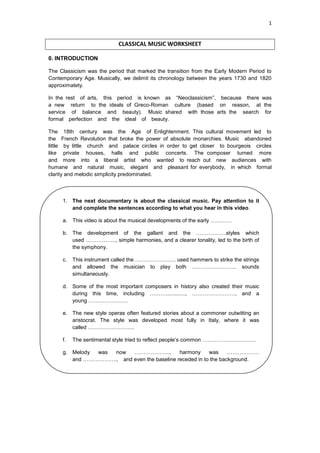
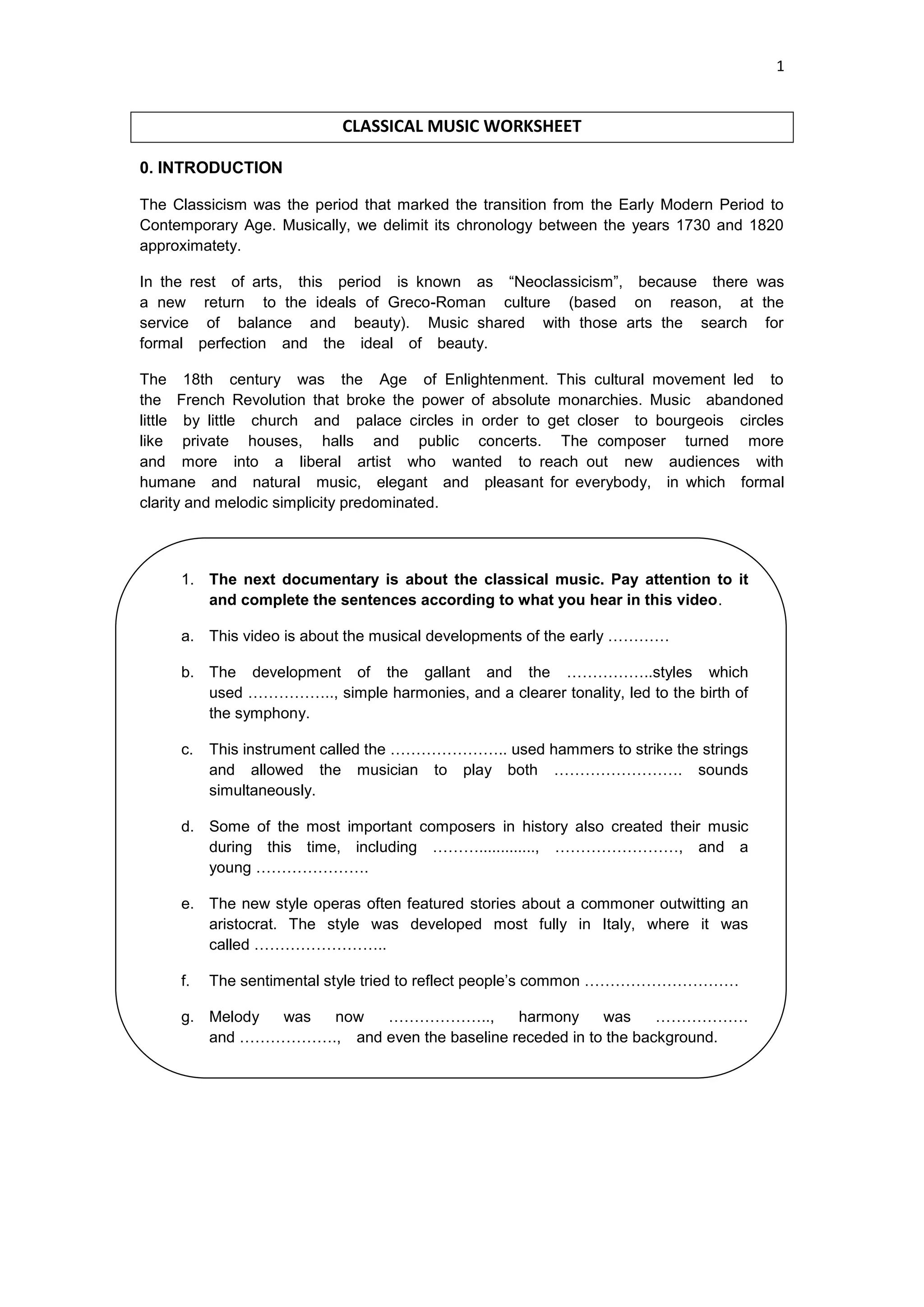
1. The next documentary is about the classical music. Pay attention to it
and complete the sentences according to what you hear in this video.
a. This video is about the musical developments of the early …………
b. The development of the gallant and the ……………..styles which
used …………….., simple harmonies, and a clearer tonality, led to the birth of
the symphony.
c. This instrument called the ………………….. used hammers to strike the strings
and allowed the musician to play both ……………………. sounds
simultaneously.
d. Some of the most important composers in history also created their music
during this time, including ………............., ……………………, and a
young ………………….
e. The new style operas often featured stories about a commoner outwitting an
aristocrat. The style was developed most fully in Italy, where it was
called ……………………..
f. The sentimental style tried to reflect people’s common …………………………
g. Melody was now ……………….., harmony was ………………
and ………………., and even the baseline receded in to the background.
2
1. MUSIC IN THE CLASSICAL PERIOD.
1.1 Classical period chronology.
1750-1800
1.2 Classical period history context.
I. The age of Enlightenment>>promoted the values of reason and science>>led
to the French Revolution that broke the power of absolute monarchies.
II. Improvements in education, agriculture and science.
III. “Neoclassicism” in arts >> new return to the ideals of Greco-Roman
culture (reason, at the service of balance and beauty). Music
looked for formal perfection and the ideal of beauty.
1.3 Function of music
I. Music is considered to be a form of entertainment
1.4 The musicians role.
II. Closer to bourgeois circles (private houses, halls and public concerts). The
composer turned more and more into a liberal artist, selling their scores and
receiveing a percentage of the sales of concert tickets
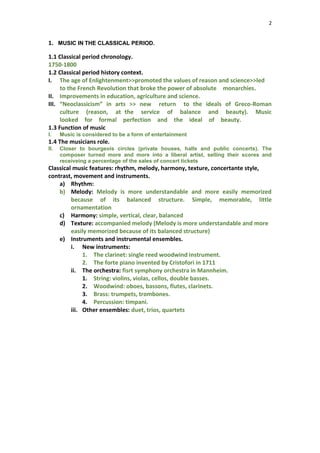
Classical music features: rhythm, melody, harmony, texture, concertante style,
contrast, movement and instruments.
a) Rhythm:
b) Melody: Melody is more understandable and more easily memorized
because of its balanced structure. Simple, memorable, little
ornamentation
c) Harmony: simple, vertical, clear, balanced
d) Texture: accompanied melody (Melody is more understandable and more
easily memorized because of its balanced structure)
e) Instruments and instrumental ensembles.
i. New instruments:
1. The clarinet: single reed woodwind instrument.
2. The forte piano invented by Cristofori in 1711
ii. The orchestra: fisrt symphony orchestra in Mannheim.
1. String: violins, violas, cellos, double basses.
2. Woodwind: oboes, bassons, flutes, clarinets.
3. Brass: trumpets, trombones.
4. Percussion: timpani.
iii. Other ensembles: duet, trios, quartets
3
3. Musical forms: the sonata, the symphony and the concerto.
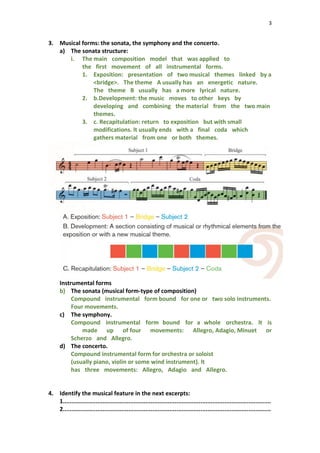
a) The sonata structure:
i. The main composition model that was applied to
the first movement of all instrumental forms.
1. Exposition: presentation of two musical themes linked by a
<bridge>. The theme A usually has an energetic nature.
The theme B usually has a more lyrical nature.
2. b.Development: the music moves to other keys by
developing and combining the material from the two main
themes.
3. c. Recapitulation: return to exposition but with small
modifications. lt usually ends with a final coda which
gathers material from one or both themes.
Instrumental forms
b) The sonata (musical form-type of composition)
Compound instrumental form bound for one or two solo instruments.
Four movements.
c) The symphony.
Compound instrumental form bound for a whole orchestra. lt is
made up of four movements: Allegro, Adagio, Minuet or
Scherzo and Allegro.
d) The concerto.
Compound instrumental form for orchestra or soloist
(usually piano, violin or some wind instrument). lt
has three movements: Allegro, Adagio and Allegro.
4. Identify the musical feature in the next excerpts:
1.........................................................................................................................
2.........................................................................................................................
4
3.........................................................................................................................
4.........................................................................................................................
5.........................................................................................................................
6.........................................................................................................................
7.........................................................................................................................
8.........................................................................................................................
BIOGRAPHIES
Antonio Vivaldi Biography
Priest, Educator, Composer(1678–1741)
Antonio Vivaldi was a 17th and 18th century composer who’s become one of the
most renowned figures in European classical music.
Synopsis
Born on March 4, 1678, in Venice, Italy, Antonio Vivaldi was ordained as a priest
though he instead chose to follow his passion for music. A prolific composer who
created hundreds of works, he became renowned for his concertos in Baroque style,
becoming a highly influential innovator in form and pattern. He was also known for
his operas, including Argippo and Bajazet. He died on July 28, 1741.
Johann Sebastian Bach Biography
Composer(1685–1750)
A magnificent baroque-era composer, Johann Sebastian Bach is revered through the
ages for his work's musical complexities and stylistic innovations.
Synopsis
Born on March 31, 1685 (N.S.), in Eisenach, Thuringia, Germany, Johann Sebastian
Bach had a prestigious musical lineage and took on various organist positions during
the early 18th century, creating famous compositions like "Toccata and Fugue in D
minor." Some of his best-known compositions are the "Mass in B Minor," the
"Brandenburg Concertos" and "The Well-Tempered Clavier." Bach died in Leipzig,
Germany, on July 28, 1750. Today, he is considered one of the greatest Western
composers of all time.
5
George Frideric Handel Biography
Composer(1685–1759)
George Frideric Handel composed operas, oratorios and instrumentals. His 1741
work, 'Messiah,' is among the most famous oratorios in history.
Synopsis
Baroque composer George Frideric Handel was born in Halle, Germany, in 1685. In
1705 he made his debut as an opera composer with Almira. He produced several
operas with the Royal Academy of Music in England before forming the New Royal
Academy of Music in 1727. When Italian operas fell out of fashion, he started
composing oratorios, including his most famous, Messiah. Handel died in London,
England, in 1759

Classical music worksheet

  • 1.
    1 CLASSICAL MUSIC WORKSHEET 0.INTRODUCTION The Classicism was the period that marked the transition from the Early Modern Period to Contemporary Age. Musically, we delimit its chronology between the years 1730 and 1820 approximatety. In the rest of arts, this period is known as “Neoclassicism”, because there was a new return to the ideals of Greco-Roman culture (based on reason, at the service of balance and beauty). Music shared with those arts the search for formal perfection and the ideal of beauty. The 18th century was the Age of Enlightenment. This cultural movement led to the French Revolution that broke the power of absolute monarchies. Music abandoned little by little church and palace circles in order to get closer to bourgeois circles like private houses, halls and public concerts. The composer turned more and more into a liberal artist who wanted to reach out new audiences with humane and naturaI music, elegant and pleasant for everybody, in which formal clarity and melodic simplicity predominated. 1. The next documentary is about the classical music. Pay attention to it and complete the sentences according to what you hear in this video. a. This video is about the musical developments of the early ………… b. The development of the gallant and the ……………..styles which used …………….., simple harmonies, and a clearer tonality, led to the birth of the symphony. c. This instrument called the ………………….. used hammers to strike the strings and allowed the musician to play both ……………………. sounds simultaneously. d. Some of the most important composers in history also created their music during this time, including ………............., ……………………, and a young …………………. e. The new style operas often featured stories about a commoner outwitting an aristocrat. The style was developed most fully in Italy, where it was called …………………….. f. The sentimental style tried to reflect people’s common ………………………… g. Melody was now ……………….., harmony was ……………… and ………………., and even the baseline receded in to the background.
  • 2.
    2 1. MUSIC INTHE CLASSICAL PERIOD. 1.1 Classical period chronology. 1750-1800 1.2 Classical period history context. I. The age of Enlightenment>>promoted the values of reason and science>>led to the French Revolution that broke the power of absolute monarchies. II. Improvements in education, agriculture and science. III. “Neoclassicism” in arts >> new return to the ideals of Greco-Roman culture (reason, at the service of balance and beauty). Music looked for formal perfection and the ideal of beauty. 1.3 Function of music I. Music is considered to be a form of entertainment 1.4 The musicians role. II. Closer to bourgeois circles (private houses, halls and public concerts). The composer turned more and more into a liberal artist, selling their scores and receiveing a percentage of the sales of concert tickets Classical music features: rhythm, melody, harmony, texture, concertante style, contrast, movement and instruments. a) Rhythm: b) Melody: Melody is more understandable and more easily memorized because of its balanced structure. Simple, memorable, little ornamentation c) Harmony: simple, vertical, clear, balanced d) Texture: accompanied melody (Melody is more understandable and more easily memorized because of its balanced structure) e) Instruments and instrumental ensembles. i. New instruments: 1. The clarinet: single reed woodwind instrument. 2. The forte piano invented by Cristofori in 1711 ii. The orchestra: fisrt symphony orchestra in Mannheim. 1. String: violins, violas, cellos, double basses. 2. Woodwind: oboes, bassons, flutes, clarinets. 3. Brass: trumpets, trombones. 4. Percussion: timpani. iii. Other ensembles: duet, trios, quartets
  • 3.
    3 3. Musical forms:the sonata, the symphony and the concerto. a) The sonata structure: i. The main composition model that was applied to the first movement of all instrumental forms. 1. Exposition: presentation of two musical themes linked by a <bridge>. The theme A usually has an energetic nature. The theme B usually has a more lyrical nature. 2. b.Development: the music moves to other keys by developing and combining the material from the two main themes. 3. c. Recapitulation: return to exposition but with small modifications. lt usually ends with a final coda which gathers material from one or both themes. Instrumental forms b) The sonata (musical form-type of composition) Compound instrumental form bound for one or two solo instruments. Four movements. c) The symphony. Compound instrumental form bound for a whole orchestra. lt is made up of four movements: Allegro, Adagio, Minuet or Scherzo and Allegro. d) The concerto. Compound instrumental form for orchestra or soloist (usually piano, violin or some wind instrument). lt has three movements: Allegro, Adagio and Allegro. 4. Identify the musical feature in the next excerpts: 1......................................................................................................................... 2.........................................................................................................................
  • 4.
    4 3......................................................................................................................... 4......................................................................................................................... 5......................................................................................................................... 6......................................................................................................................... 7......................................................................................................................... 8......................................................................................................................... BIOGRAPHIES Antonio Vivaldi Biography Priest,Educator, Composer(1678–1741) Antonio Vivaldi was a 17th and 18th century composer who’s become one of the most renowned figures in European classical music. Synopsis Born on March 4, 1678, in Venice, Italy, Antonio Vivaldi was ordained as a priest though he instead chose to follow his passion for music. A prolific composer who created hundreds of works, he became renowned for his concertos in Baroque style, becoming a highly influential innovator in form and pattern. He was also known for his operas, including Argippo and Bajazet. He died on July 28, 1741. Johann Sebastian Bach Biography Composer(1685–1750) A magnificent baroque-era composer, Johann Sebastian Bach is revered through the ages for his work's musical complexities and stylistic innovations. Synopsis Born on March 31, 1685 (N.S.), in Eisenach, Thuringia, Germany, Johann Sebastian Bach had a prestigious musical lineage and took on various organist positions during the early 18th century, creating famous compositions like "Toccata and Fugue in D minor." Some of his best-known compositions are the "Mass in B Minor," the "Brandenburg Concertos" and "The Well-Tempered Clavier." Bach died in Leipzig, Germany, on July 28, 1750. Today, he is considered one of the greatest Western composers of all time.
  • 5.
    5 George Frideric HandelBiography Composer(1685–1759) George Frideric Handel composed operas, oratorios and instrumentals. His 1741 work, 'Messiah,' is among the most famous oratorios in history. Synopsis Baroque composer George Frideric Handel was born in Halle, Germany, in 1685. In 1705 he made his debut as an opera composer with Almira. He produced several operas with the Royal Academy of Music in England before forming the New Royal Academy of Music in 1727. When Italian operas fell out of fashion, he started composing oratorios, including his most famous, Messiah. Handel died in London, England, in 1759