CLASSICAL ERA
         (1750 - c.1825)


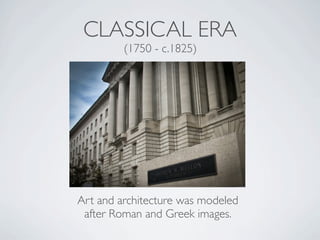
Art and architecture was modeled
 after Roman and Greek images.
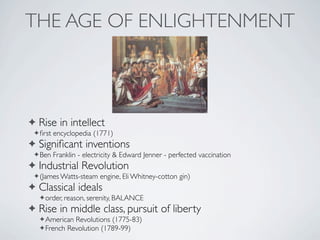
The Age of Enlightenment
•   Rise in intellect - first encyclopedia (1771)
•   Significant inventions
     Ben Franklin - electricity & Edward Jenner - perfected vaccination
•   Industrial Revolution
    James Watts-steam engine, Eli Whitney-cotton gin
•   Classical ideals
     order, reason, serenity, BALANCE
•   Rise in middle class, pursuit of liberty
      American Revolutions (1775-83)
     French Revolution (1789-99)
STYLE CHARACTERISTICS
• Great experimentation
• LARGER FORMS
• Major/minor tonalities
    exploited to full potential
• Continue many Baroque genres (opera, masses, oratorios,
   sonatas, solo concertos)
• New genres (SYMPHONIES, STRING QUARTETS, and
   other chamber groups)
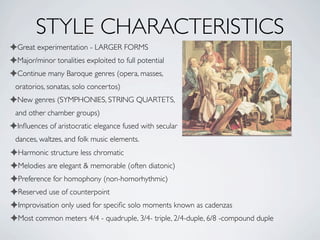
• Influences of aristocratic elegance fused with secular dances,
   waltzes, and folk music elements.
STYLE CHARACTERISTICS
•   Harmonic structure less chromatic
•   Melodies are elegant & memorable (often diatonic)
•   Preference for homophony (non-homorhythmic)
•   Reserved use of counterpoint
•   Improvisation only used for specific solo moments
    known as cadenzas
• Most common meters 4/4 - quadruple, 3/4- triple, 2/4-
    duple, 6/8 -compound duple
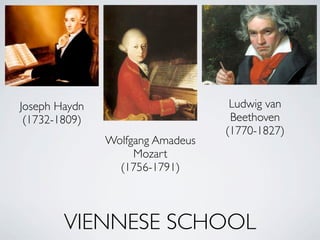
Joseph Haydn                       Ludwig van
 (1732-1809)                       Beethoven
                                  (1770-1827)
               Wolfgang Amadeus
                    Mozart
                 (1756-1791)


           Viennese School
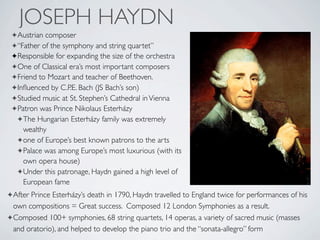
Joseph Haydn
•    Austrian composer
•    “Father of the symphony and string quartet”
•    Responsible for expanding the size of the orchestra
•    Friend to Mozart and teacher of Beethoven.
•    Influenced by C.P.E. Bach (JS Bach’s son)
•    Studied music at St. Stephen’s Cathedral in Vienna
•    Patron was Prince Nikolaus Esterházy
    • The Hungarian Esterházy family was extremely
       wealthy
    • one of Europe’s best known patrons to the arts
    • Palace was among Europe’s most luxurious (with its
       own opera house)
    • Under this patronage, Haydn gained a high level of
       European fame


    • After Prince Esterházy’s death in 1790, Haydn travelled to England twice for performances
      of his own compositions = Great success. Composed 12 London Symphonies as a result.
    • Composed 100+ symphonies, 68 string quartets, 14 operas, a variety of sacred music
      (masses and oratorio), and helped to develop the piano trio and the “sonata-allegro” form
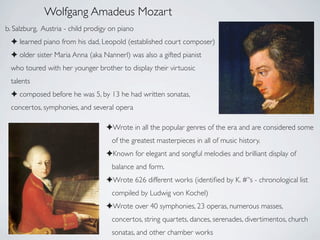
WOLFGANG AMADEUS MOZART
b. Salzburg, Austria - child prodigy on piano
   • learned piano from his dad, Leopold (established court
      composer)
   • older sister Maria Anna (aka Nannerl) was also a gifted pianist
      who toured with her younger brother to display their
      virtuosic talents
   • composed before he was 5, by 13 he had written sonatas,
      concertos, symphonies, and several opera
                              • Wrote in all the popular genres of the era and are considered some
                                 of the greatest masterpieces in all of music history.
                              • Known for elegant and songful melodies and brilliant display of
                                 balance and form.
                              • Wrote 626 different works (identified by K. #’‘s - chronological list
                                 compiled by Ludwig von Kochel)
                              • Wrote over 40 symphonies, 23 operas, numerous masses, concertos,
                                 string quartets, dances, serenades, divertimentos, church sonatas, and
                                 other chamber works
Ludwig van Beethoven
• Born in Bonn, Germany
• virtuoso performer on keyboards (mostly piano)
• Career in aristocratic patronage and concerts to the
  middle-class in concert halls.
• Wrote 1 opera, 9 symphonies, 5 piano concerti, 32
  piano sonatas, 9 concerti, and 16 string quartets -
  among others
• Began to lose his sense of hearing in his early 30’s.
 • eventually completely lost his hearing, continued to
    compose but could no longer perform

                          3 style periods
                            • 1st - first 2 symphonies (his “classical period”)
                            • 2nd - symphonies 3-8 (his “herioc period”)
                                 enlarged orchestra
                                 music had a fire and rhythmic drive that gave a
                               “heroic” sensibility.
                            • 3rd - final symphony (his “romantic period”)
Instrumental music
absolute music - there is no prescribed story or text
  • Dependent on form
  • non-dramatic, no story line, no text, no pictorial
  • Dominant instrumental music type (as opposed to “program” music)
  • Sonata, Solo, Chamber, Orchestral

 Classical Sonata
  • for solo or duet (typically piano was one of the instruments)
  • popular in homes and in performance
  Classical composers preferred multi-movement works from 1750 well into
   the Romantic period.
   •3-4 movements
   •each movement had prescribed forms and tempos
   •found in symphonies, string quartets, concertos, and sonatas
Multimovement Form
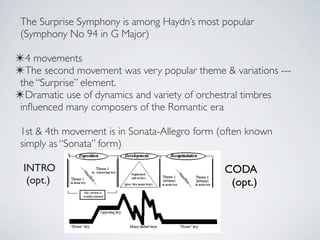
1st movement - form: sonata-allegro (aka sonata form)
   • tempo = Allegro, meter=4/4
   • most organized form in multimovement works

2nd (contrasting key) - ABA or theme & variations
  • tempo = Adagio, Andante, meter=varies
  • t&v form, intro theme may be newly invented or borrowed but is always
    simple in order to allow for melodic, harmonic, and/or rhythmic variation.

3rd (opt.) - “dance” minuet & trio or scherzo & trio (19th c.)
   • ternary form (A=minuet or scherzo, B= trio)
   • tempo = varies from “stately” to “lively”, meter = 3/4

Final movement - sonata-rondo (aka rondo form)
   • A B A C A (etc.) the rondo theme (A) is known as a “refrain”
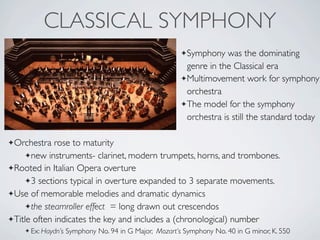
Classical Symphony
                                                        •   Symphony was the dominating
                                                            genre in the Classical era
                                                        •   Multimovement work for
                                                            symphony orchestra
                                                        •   The model for the symphony
                                                            orchestra is still the standard
                                                            today
•    Orchestra rose to maturity
       new instruments- clarinet, modern trumpets, horns, and trombones.
•    Rooted in Italian Opera overture
       3 sections typical in overture expanded to 3 separate movements.
    • Use of memorable melodies and dramatic dynamics

       the steamroller effect = long drawn out crescendos
    • Title often indicates the key and includes a (chronological) number
      Ex: Haydn’s Symphony No. 94 in G Major, Mozart’s Symphony No. 40 in G minor, K. 550
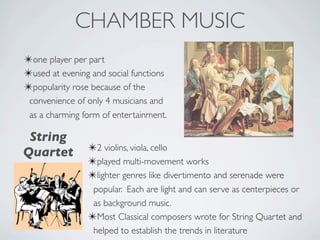
Chamber music
• one player per part
• used at evening and social functions
• popularity rose
     convenience of only 4 musicians
     charming form of entertainment.

      String         • 2 violins, viola, cello
     Quartet         • played multi-movement works
                     • lighter genres like divertimento and serenade were
                        popular. Each are light and can serve as centerpieces or
                        as background music.
                     • Most Classical composers wrote for String Quartet and
                        helped to establish the trends in literature
Listen to Mozart’s
                                  Eine Kleine Nachtmusik
Key: G major
Written for string quartet supported by a double bass
often performed by a string orchestra
•1st mvmt: Allegro, SONATA-ALLEGRO form
 opening theme is known as his rocket theme


 INTRO
   (opt.)


•3rd mvmt: Allegro, MINUET & TRIO form
Active Listening Question:
Is this recording a string quartet or a string orchestra?
Classical Concerto
• Classical concerto featured a soloist plus orchestra
  •piano and violin were the most popular solo instruments
  •other solo instruments like the trumpet and clarinet were
 used
 •3 movements (fast - slow - fast) were the standard (as
 opposed to the symphony which favored 4 movements)
 •concerti often featured the soloist alone during cadenzas.
 The orchestra would drop out completely so the soloist
 could freely present a dazzling passage of improvised/virtuoso
 melodic runs (often used one or more themes from the
 movement)
Classical Opera
Opera in classical era split into 2 types
 opera seria - “serious” subject matter, often has a tragic ending
 comic opera - comedic subject
opera seria
•Italian opera that grew out of the Baroque era
•“serious” overly dramatic depictions of figures in Mythology or history
•3 acts = static- with convoluted plots that were subordinate to music
•largely shaped by the ideas of poet/librettist Pietro Metastasio
•Favored the soloists
    • prima donna = heroin “first lady”
    • prima uomo = hero “first male” (often a tenor voice)
    • the castrati were still used
•REFORMED by Christoph Willibald Gluck (fused French opera trends with
Italian tradition) which pushed opera to be less dependent on solo virtuosity and
unrealistic situations in plot. Instead, opera should be more beautiful, natural,
and accessible with larger use of chorus for more contrast.
    • Ex: Gluck’s Orfeo and Euredice -1762
comic opera

• Realistic, relatable, and lively story lines
• Humorous and grew to use more satire when
   depicting the aristocrats.
• Written in vernacular (native language)
• Common characters (lawyers/doctors/servants)
• Large use of ensemble and low male voice
     buffa – traditional bass voice character who
     spoke to the audience with a “wink and a nod”)

Different names given to different regions - slightly different interpretations for
   each region
• opera buffa - Italy (Mozart’s The Marriage of Figaro, & Don Giovanni)
• opéra comique - France (Jean-Philippe Rameau’s Querelle des Bouffons)
• Singspiel - Germany (Mozart’s The Magic Flute)
• ballad opera (dialogue opera) - England (Johanne Pepusch/ John Gay’s The
   Beggar’s Opera)

Classical power point

  • 1.
    CLASSICAL ERA (1750 - c.1825) Art and architecture was modeled after Roman and Greek images.
  • 2.
    The Age ofEnlightenment • Rise in intellect - first encyclopedia (1771) • Significant inventions Ben Franklin - electricity & Edward Jenner - perfected vaccination • Industrial Revolution James Watts-steam engine, Eli Whitney-cotton gin • Classical ideals order, reason, serenity, BALANCE • Rise in middle class, pursuit of liberty American Revolutions (1775-83) French Revolution (1789-99)
  • 3.
    STYLE CHARACTERISTICS • Greatexperimentation • LARGER FORMS • Major/minor tonalities exploited to full potential • Continue many Baroque genres (opera, masses, oratorios, sonatas, solo concertos) • New genres (SYMPHONIES, STRING QUARTETS, and other chamber groups) • Influences of aristocratic elegance fused with secular dances, waltzes, and folk music elements.
  • 4.
    STYLE CHARACTERISTICS • Harmonic structure less chromatic • Melodies are elegant & memorable (often diatonic) • Preference for homophony (non-homorhythmic) • Reserved use of counterpoint • Improvisation only used for specific solo moments known as cadenzas • Most common meters 4/4 - quadruple, 3/4- triple, 2/4- duple, 6/8 -compound duple
  • 5.
    Joseph Haydn Ludwig van (1732-1809) Beethoven (1770-1827) Wolfgang Amadeus Mozart (1756-1791) Viennese School
  • 6.
    Joseph Haydn • Austrian composer • “Father of the symphony and string quartet” • Responsible for expanding the size of the orchestra • Friend to Mozart and teacher of Beethoven. • Influenced by C.P.E. Bach (JS Bach’s son) • Studied music at St. Stephen’s Cathedral in Vienna • Patron was Prince Nikolaus Esterházy • The Hungarian Esterházy family was extremely wealthy • one of Europe’s best known patrons to the arts • Palace was among Europe’s most luxurious (with its own opera house) • Under this patronage, Haydn gained a high level of European fame • After Prince Esterházy’s death in 1790, Haydn travelled to England twice for performances of his own compositions = Great success. Composed 12 London Symphonies as a result. • Composed 100+ symphonies, 68 string quartets, 14 operas, a variety of sacred music (masses and oratorio), and helped to develop the piano trio and the “sonata-allegro” form
  • 7.
    WOLFGANG AMADEUS MOZART b.Salzburg, Austria - child prodigy on piano • learned piano from his dad, Leopold (established court composer) • older sister Maria Anna (aka Nannerl) was also a gifted pianist who toured with her younger brother to display their virtuosic talents • composed before he was 5, by 13 he had written sonatas, concertos, symphonies, and several opera • Wrote in all the popular genres of the era and are considered some of the greatest masterpieces in all of music history. • Known for elegant and songful melodies and brilliant display of balance and form. • Wrote 626 different works (identified by K. #’‘s - chronological list compiled by Ludwig von Kochel) • Wrote over 40 symphonies, 23 operas, numerous masses, concertos, string quartets, dances, serenades, divertimentos, church sonatas, and other chamber works
  • 8.
    Ludwig van Beethoven •Born in Bonn, Germany • virtuoso performer on keyboards (mostly piano) • Career in aristocratic patronage and concerts to the middle-class in concert halls. • Wrote 1 opera, 9 symphonies, 5 piano concerti, 32 piano sonatas, 9 concerti, and 16 string quartets - among others • Began to lose his sense of hearing in his early 30’s. • eventually completely lost his hearing, continued to compose but could no longer perform 3 style periods • 1st - first 2 symphonies (his “classical period”) • 2nd - symphonies 3-8 (his “herioc period”) enlarged orchestra music had a fire and rhythmic drive that gave a “heroic” sensibility. • 3rd - final symphony (his “romantic period”)
  • 9.
    Instrumental music absolute music- there is no prescribed story or text • Dependent on form • non-dramatic, no story line, no text, no pictorial • Dominant instrumental music type (as opposed to “program” music) • Sonata, Solo, Chamber, Orchestral Classical Sonata • for solo or duet (typically piano was one of the instruments) • popular in homes and in performance Classical composers preferred multi-movement works from 1750 well into the Romantic period. •3-4 movements •each movement had prescribed forms and tempos •found in symphonies, string quartets, concertos, and sonatas
  • 10.
    Multimovement Form 1st movement- form: sonata-allegro (aka sonata form) • tempo = Allegro, meter=4/4 • most organized form in multimovement works 2nd (contrasting key) - ABA or theme & variations • tempo = Adagio, Andante, meter=varies • t&v form, intro theme may be newly invented or borrowed but is always simple in order to allow for melodic, harmonic, and/or rhythmic variation. 3rd (opt.) - “dance” minuet & trio or scherzo & trio (19th c.) • ternary form (A=minuet or scherzo, B= trio) • tempo = varies from “stately” to “lively”, meter = 3/4 Final movement - sonata-rondo (aka rondo form) • A B A C A (etc.) the rondo theme (A) is known as a “refrain”
  • 11.
    Classical Symphony • Symphony was the dominating genre in the Classical era • Multimovement work for symphony orchestra • The model for the symphony orchestra is still the standard today • Orchestra rose to maturity new instruments- clarinet, modern trumpets, horns, and trombones. • Rooted in Italian Opera overture 3 sections typical in overture expanded to 3 separate movements. • Use of memorable melodies and dramatic dynamics the steamroller effect = long drawn out crescendos • Title often indicates the key and includes a (chronological) number Ex: Haydn’s Symphony No. 94 in G Major, Mozart’s Symphony No. 40 in G minor, K. 550
  • 12.
    Chamber music • oneplayer per part • used at evening and social functions • popularity rose convenience of only 4 musicians charming form of entertainment. String • 2 violins, viola, cello Quartet • played multi-movement works • lighter genres like divertimento and serenade were popular. Each are light and can serve as centerpieces or as background music. • Most Classical composers wrote for String Quartet and helped to establish the trends in literature
  • 13.
    Listen to Mozart’s Eine Kleine Nachtmusik Key: G major Written for string quartet supported by a double bass often performed by a string orchestra •1st mvmt: Allegro, SONATA-ALLEGRO form opening theme is known as his rocket theme INTRO (opt.) •3rd mvmt: Allegro, MINUET & TRIO form Active Listening Question: Is this recording a string quartet or a string orchestra?
  • 14.
    Classical Concerto • Classicalconcerto featured a soloist plus orchestra •piano and violin were the most popular solo instruments •other solo instruments like the trumpet and clarinet were used •3 movements (fast - slow - fast) were the standard (as opposed to the symphony which favored 4 movements) •concerti often featured the soloist alone during cadenzas. The orchestra would drop out completely so the soloist could freely present a dazzling passage of improvised/virtuoso melodic runs (often used one or more themes from the movement)
  • 15.
    Classical Opera Opera inclassical era split into 2 types opera seria - “serious” subject matter, often has a tragic ending comic opera - comedic subject opera seria •Italian opera that grew out of the Baroque era •“serious” overly dramatic depictions of figures in Mythology or history •3 acts = static- with convoluted plots that were subordinate to music •largely shaped by the ideas of poet/librettist Pietro Metastasio •Favored the soloists • prima donna = heroin “first lady” • prima uomo = hero “first male” (often a tenor voice) • the castrati were still used •REFORMED by Christoph Willibald Gluck (fused French opera trends with Italian tradition) which pushed opera to be less dependent on solo virtuosity and unrealistic situations in plot. Instead, opera should be more beautiful, natural, and accessible with larger use of chorus for more contrast. • Ex: Gluck’s Orfeo and Euredice -1762
  • 16.
    comic opera • Realistic,relatable, and lively story lines • Humorous and grew to use more satire when depicting the aristocrats. • Written in vernacular (native language) • Common characters (lawyers/doctors/servants) • Large use of ensemble and low male voice buffa – traditional bass voice character who spoke to the audience with a “wink and a nod”) Different names given to different regions - slightly different interpretations for each region • opera buffa - Italy (Mozart’s The Marriage of Figaro, & Don Giovanni) • opéra comique - France (Jean-Philippe Rameau’s Querelle des Bouffons) • Singspiel - Germany (Mozart’s The Magic Flute) • ballad opera (dialogue opera) - England (Johanne Pepusch/ John Gay’s The Beggar’s Opera)