LCD 105 – Class 5 – Professor Nathacia
Languaging
System vs. Structure
The Language System is
a Structure Generator!
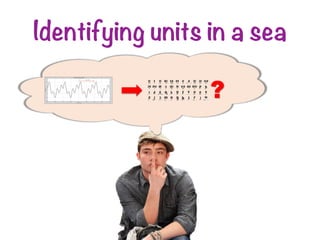
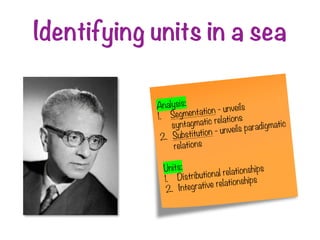
Identifying units in a sea
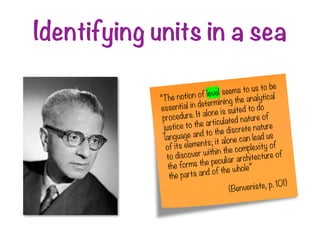
“The notion of level seems to us to be
essential in determining the analytical
procedure. It alone is suited to do
justice to the articulated nature of
language and to the discrete nature
of its elements; it alone can lead us
to discover within the complexity of
the forms the peculiar architecture of
the parts and of the whole”
(Benveniste, p. 101)
Identifying units in a sea
Analysis:
1. Segmentation - unveils
syntagmatic relations
2. Substitution - unveils paradigmatic
relations
Units:
1. Distributional relationships
2. Integrative relationships
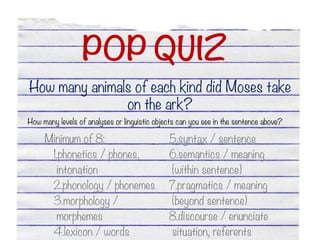
POP QUIZ
How many animals of each kind did Moses take
on the ark?
How many levels of analyses or linguistic objects can you see in the sentence above?
Minimum of 8:
1.phonetics / phones,
intonation
2.phonology / phonemes
3.morphology /
morphemes
4.lexicon / words
5.syntax / sentence
6.semantics / meaning
(within sentence)
7.pragmatics / meaning
(beyond sentence)
8.discourse / enunciate
situation, referents
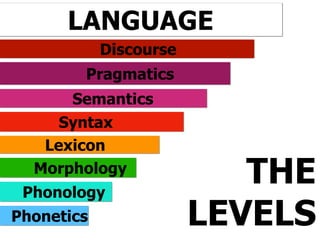
LANGUAGE
Phonetics
Phonology
Morphology
Lexicon
Syntax
Semantics
Pragmatics
Discourse
THE
LEVELS
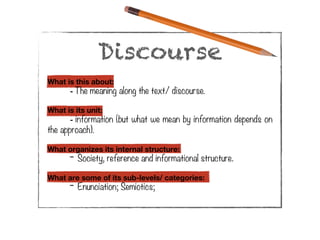
Discourse
What is this about:
- The meaning along the text/ discourse.
What is its unit:
- information (but what we mean by information depends on
the approach).
What organizes its internal structure:
- Society, reference and informational structure.
What are some of its sub-levels/ categories:
- Enunciation; Semiotics;
Some types of analysis
There are many approaches to
analyze this level.
For example:
❉ Style
❉ Enunciation
❉ Semiotics
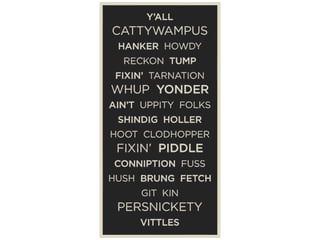
Style
Choice of preferred structures and
words based on community, identity
and prestige
https://youtu.be/KNVfFVeExik
Video: Californians guess NYC slang
Enunciation
It studies the relation between the
elements that compose the
discourse during the act of
composing it.
The Actants, Space and Time
instances.
Enunciation
Each of the instances is stablished
based on two different processes
(Shift out and Shift in) and two
different perspectives (enunciativa
and enunciva).
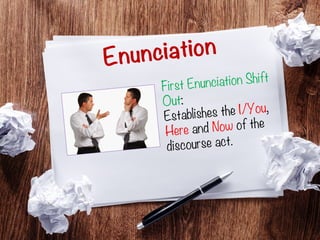
Enunciation
First Enunciation Shift
Out:
Establishes the I/You,
Here and Now of the
discourse act.
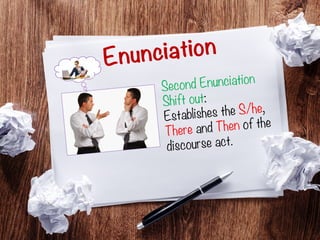
Enunciation
Second Enunciation
Shift out:
Establishes the S/he,
There and Then of the
discourse act.
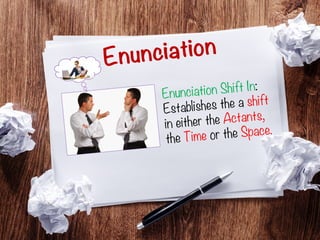
Enunciation
Enunciation Shift In:
Establishes the a shift
in either the Actants,
the Time or the Space.
Semiotics
It studies the construction of the
meaning and meaningful relations in
the discourse.
It studies the signs and symbols and
how they build the meaning chain
throughout the discourse.
Video:
I won’t give up –
Jason Mraz
https://youtu.be/O1-4u9W-bns
When I look into your eyes
It's like watching the night sky
Or a beautiful sunrise
Well, there's so much they hold
And just like them old stars
I see that you've come so far
To be right where you are
How old is your soul?
Well, I won't give up on us
Even if the skies get rough
I'm giving you all my love
I'm still looking up
And when you're needing your space
To do some navigating
I'll be here patiently waiting
To see what you find
'Cause even the stars they burn
Some even fall to the earth
We've got a lot to learn
God knows we're worth it
No, I won't give up
I don't wanna be someone who walks away so easily
I'm here to stay and make the difference that I can make
Our differences they do a lot to teach us how to use
The tools and gifts we got, yeah, we got a lot at stake
And in the end, you're still my friend at least we did
intend
For us to work we didn't break, we didn't burn
We had to learn how to bend without the world caving in
I had to learn what I've got, and what I'm not, and who I
am
I won't give up on us
Even if the skies get rough
I'm giving you all my love
I'm still looking up, I'm still looking up.
Well, I won't give up on us (no I'm not giving up)
God knows I'm tough enough (I am tough, I am loved)
We've got a lot to learn (we're alive, we are loved)
God knows we're worth it (and we're worth it)
I won't give up on us
Even if the skies get rough
I'm giving you all my love
I'm still looking up
I won’t give up – Jason Mraz
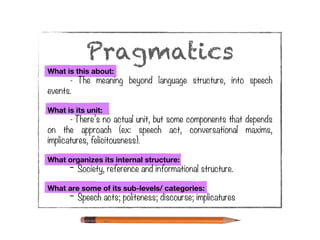
Pragmatics
What is this about:
- The meaning beyond language structure, into speech
events.
What is its unit:
- There’s no actual unit, but some components that depends
on the approach (ex: speech act, conversational maxims,
implicatures, felicitousness).
What organizes its internal structure:
- Society, reference and informational structure.
What are some of its sub-levels/ categories:
- Speech acts; politeness; discourse; implicatures
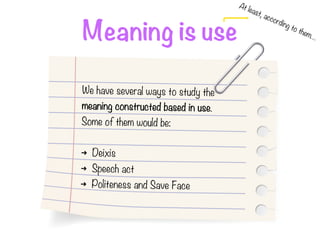
Meaning is use
At least, according to them…
We have several ways to study the
meaning constructed based in use.
Some of them would be:
➜ Deixis
➜ Speech act
➜ Politeness and Save Face
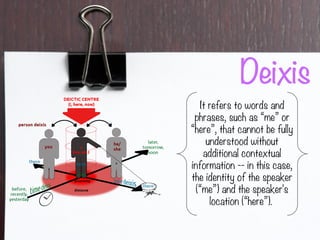
Deixis
It refers to words and
phrases, such as “me” or
“here”, that cannot be fully
understood without
additional contextual
information -- in this case,
the identity of the speaker
(“me”) and the speaker's
location (“here”).
Who are you?
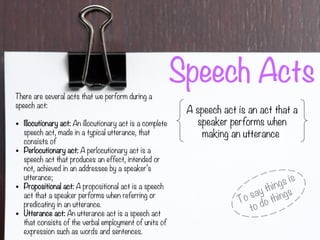
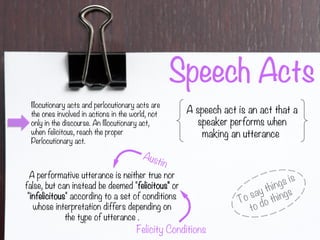
Speech Acts
A speech act is an act that a
speaker performs when
making an utterance
To say things is
to do things
There are several acts that we perform during a
speech act:
• Illocutionary act: An illocutionary act is a complete
speech act, made in a typical utterance, that
consists of
• Perlocutionary act: A perlocutionary act is a
speech act that produces an effect, intended or
not, achieved in an addressee by a speaker’s
utterance;
• Propositional act: A propositional act is a speech
act that a speaker performs when referring or
predicating in an utterance.
• Utterance act: An utterance act is a speech act
that consists of the verbal employment of units of
expression such as words and sentences.
Speech Acts
A speech act is an act that a
speaker performs when
making an utterance
To say things is
to do things
Illocutionary acts and perlocutionary acts are
the ones involved in actions in the world, not
only in the discourse. An Illocutionary act,
when felicitous, reach the proper
Perlocutionary act.
A performative utterance is neither true nor
false, but can instead be deemed "felicitous" or
"infelicitous" according to a set of conditions
whose interpretation differs depending on
the type of utterance .
Austin
Felicity Conditions
Video
Classificationof Speech Actshttps://youtu.be/f2PJoe9Umxc
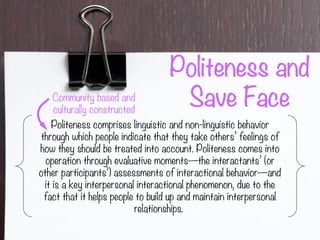
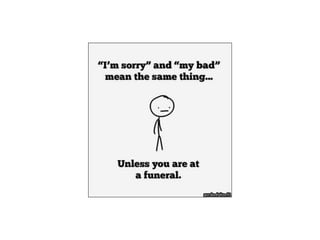
Politeness and
Save Face
Politeness comprises linguistic and non-linguistic behavior
through which people indicate that they take others’ feelings of
how they should be treated into account. Politeness comes into
operation through evaluative moments—the interactants’ (or
other participants’) assessments of interactional behavior—and
it is a key interpersonal interactional phenomenon, due to the
fact that it helps people to build up and maintain interpersonal
relationships.
Community based and
culturally constructed
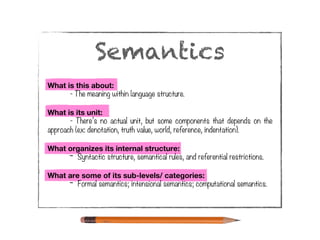
Semantics
What is this about:
- The meaning within language structure.
What is its unit:
- There’s no actual unit, but some components that depends on the
approach (ex: denotation, truth value, world, reference, indentation).
What organizes its internal structure:
- Syntactic structure, semantical rules, and referential restrictions.
What are some of its sub-levels/ categories:
- Formal semantics; intensional semantics; computational semantics.
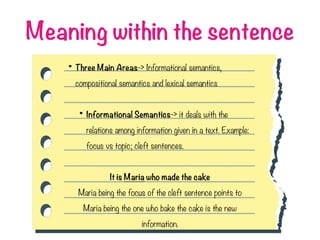
Meaning within the sentence
• Three Main Areas-> Informational semantics,
compositional semantics and lexical semantics
• Informational Semantics-> it deals with the
relations among information given in a text. Example:
focus vs topic; cleft sentences.
It is Maria who made the cake
Maria being the focus of the cleft sentence points to
Maria being the one who bake the cake is the new
information.
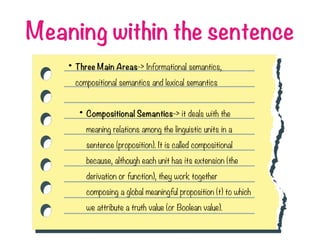
Meaning within the sentence
• Three Main Areas-> Informational semantics,
compositional semantics and lexical semantics
• Compositional Semantics-> it deals with the
meaning relations among the linguistic units in a
sentence (proposition). It is called compositional
because, although each unit has its extension (the
derivation or function), they work together
composing a global meaningful proposition (t) to which
we attribute a truth value (or Boolean value).
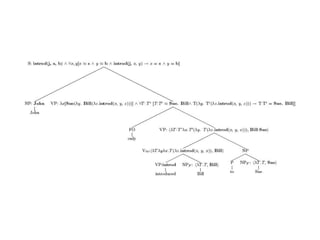
•A truth value is attributed to aproposition within a world (real world,probable world or possible world).
•Intensional Semantics, although stillcompositional, differs from extensionalsemantics because it deals withintensional verbs as ‘believe’ and ‘think’,
to which the truth value is not linked with
the truth value of the embeddedsentence.
Example: John believes that Mariabaked the cake.
Meaning within the sentence
• Three Main Areas-> Informational semantics, compositional
semantics and lexical semantics
• Lexical Semantics-> it deals with lexical units which
include not only words but also sub-words or sub-units such
as affixes and even compound words and phrases. Lexical
units make up the catalogue of words in a language, the
lexicon. Lexical semantics looks at how the meaning of the
lexical units correlates with the structure of the language or
syntax. This is referred to as syntax-semantic interface.
Meaning within the sentence
• Three Main Areas-> Informational semantics, compositional
semantics and lexical semantics
• Lexical Semantics-> it looks at:
the classification and decomposition of lexical
items
the differences and similarities in lexical semantic
structure cross-linguistically
the relationship of lexical meaning to sentence
meaning and syntax.
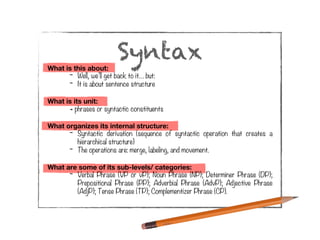
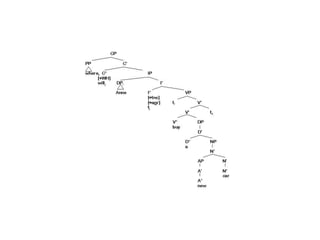
SyntaxWhat is this about:
- Well, we’ll get back to it… but:
- It is about sentence structure
What is its unit:
- phrases or syntactic constituents
What organizes its internal structure:
- Syntactic derivation (sequence of syntactic operation that creates a
hierarchical structure)
- The operations are: merge, labeling, and movement.
What are some of its sub-levels/ categories:
- Verbal Phrase (VP or vP); Noun Phrase (NP); Determiner Phrase (DP);
Prepositional Phrase (PP); Adverbial Phrase (AdvP); Adjective Phrase
(AdjP); Tense Phrase (TP); Complementizer Phrase (CP).
Class5 - Languaging
Class5 - Languaging
Class5 - Languaging
Class5 - Languaging

Class5 - Languaging

  • 1.
    LCD 105 –Class 5 – Professor Nathacia Languaging
  • 2.
    System vs. Structure TheLanguage System is a Structure Generator!
  • 3.
  • 4.
    Identifying units ina sea “The notion of level seems to us to be essential in determining the analytical procedure. It alone is suited to do justice to the articulated nature of language and to the discrete nature of its elements; it alone can lead us to discover within the complexity of the forms the peculiar architecture of the parts and of the whole” (Benveniste, p. 101)
  • 5.
    Identifying units ina sea Analysis: 1. Segmentation - unveils syntagmatic relations 2. Substitution - unveils paradigmatic relations Units: 1. Distributional relationships 2. Integrative relationships
  • 6.
    POP QUIZ How manyanimals of each kind did Moses take on the ark? How many levels of analyses or linguistic objects can you see in the sentence above? Minimum of 8: 1.phonetics / phones, intonation 2.phonology / phonemes 3.morphology / morphemes 4.lexicon / words 5.syntax / sentence 6.semantics / meaning (within sentence) 7.pragmatics / meaning (beyond sentence) 8.discourse / enunciate situation, referents
  • 7.
  • 8.
    Discourse What is thisabout: - The meaning along the text/ discourse. What is its unit: - information (but what we mean by information depends on the approach). What organizes its internal structure: - Society, reference and informational structure. What are some of its sub-levels/ categories: - Enunciation; Semiotics;
  • 9.
    Some types ofanalysis There are many approaches to analyze this level. For example: ❉ Style ❉ Enunciation ❉ Semiotics
  • 10.
    Style Choice of preferredstructures and words based on community, identity and prestige
  • 12.
  • 14.
    Enunciation It studies therelation between the elements that compose the discourse during the act of composing it. The Actants, Space and Time instances.
  • 15.
    Enunciation Each of theinstances is stablished based on two different processes (Shift out and Shift in) and two different perspectives (enunciativa and enunciva).
  • 16.
    Enunciation First Enunciation Shift Out: Establishesthe I/You, Here and Now of the discourse act.
  • 17.
    Enunciation Second Enunciation Shift out: Establishesthe S/he, There and Then of the discourse act.
  • 18.
    Enunciation Enunciation Shift In: Establishesthe a shift in either the Actants, the Time or the Space.
  • 19.
    Semiotics It studies theconstruction of the meaning and meaningful relations in the discourse. It studies the signs and symbols and how they build the meaning chain throughout the discourse.
  • 20.
    Video: I won’t giveup – Jason Mraz https://youtu.be/O1-4u9W-bns
  • 21.
    When I lookinto your eyes It's like watching the night sky Or a beautiful sunrise Well, there's so much they hold And just like them old stars I see that you've come so far To be right where you are How old is your soul? Well, I won't give up on us Even if the skies get rough I'm giving you all my love I'm still looking up And when you're needing your space To do some navigating I'll be here patiently waiting To see what you find 'Cause even the stars they burn Some even fall to the earth We've got a lot to learn God knows we're worth it No, I won't give up I don't wanna be someone who walks away so easily I'm here to stay and make the difference that I can make Our differences they do a lot to teach us how to use The tools and gifts we got, yeah, we got a lot at stake And in the end, you're still my friend at least we did intend For us to work we didn't break, we didn't burn We had to learn how to bend without the world caving in I had to learn what I've got, and what I'm not, and who I am I won't give up on us Even if the skies get rough I'm giving you all my love I'm still looking up, I'm still looking up. Well, I won't give up on us (no I'm not giving up) God knows I'm tough enough (I am tough, I am loved) We've got a lot to learn (we're alive, we are loved) God knows we're worth it (and we're worth it) I won't give up on us Even if the skies get rough I'm giving you all my love I'm still looking up I won’t give up – Jason Mraz
  • 22.
    Pragmatics What is thisabout: - The meaning beyond language structure, into speech events. What is its unit: - There’s no actual unit, but some components that depends on the approach (ex: speech act, conversational maxims, implicatures, felicitousness). What organizes its internal structure: - Society, reference and informational structure. What are some of its sub-levels/ categories: - Speech acts; politeness; discourse; implicatures
  • 23.
    Meaning is use Atleast, according to them… We have several ways to study the meaning constructed based in use. Some of them would be: ➜ Deixis ➜ Speech act ➜ Politeness and Save Face
  • 24.
    Deixis It refers towords and phrases, such as “me” or “here”, that cannot be fully understood without additional contextual information -- in this case, the identity of the speaker (“me”) and the speaker's location (“here”).
  • 25.
  • 26.
    Speech Acts A speechact is an act that a speaker performs when making an utterance To say things is to do things There are several acts that we perform during a speech act: • Illocutionary act: An illocutionary act is a complete speech act, made in a typical utterance, that consists of • Perlocutionary act: A perlocutionary act is a speech act that produces an effect, intended or not, achieved in an addressee by a speaker’s utterance; • Propositional act: A propositional act is a speech act that a speaker performs when referring or predicating in an utterance. • Utterance act: An utterance act is a speech act that consists of the verbal employment of units of expression such as words and sentences.
  • 27.
    Speech Acts A speechact is an act that a speaker performs when making an utterance To say things is to do things Illocutionary acts and perlocutionary acts are the ones involved in actions in the world, not only in the discourse. An Illocutionary act, when felicitous, reach the proper Perlocutionary act. A performative utterance is neither true nor false, but can instead be deemed "felicitous" or "infelicitous" according to a set of conditions whose interpretation differs depending on the type of utterance . Austin Felicity Conditions
  • 28.
  • 29.
    Politeness and Save Face Politenesscomprises linguistic and non-linguistic behavior through which people indicate that they take others’ feelings of how they should be treated into account. Politeness comes into operation through evaluative moments—the interactants’ (or other participants’) assessments of interactional behavior—and it is a key interpersonal interactional phenomenon, due to the fact that it helps people to build up and maintain interpersonal relationships. Community based and culturally constructed
  • 31.
    Semantics What is thisabout: - The meaning within language structure. What is its unit: - There’s no actual unit, but some components that depends on the approach (ex: denotation, truth value, world, reference, indentation). What organizes its internal structure: - Syntactic structure, semantical rules, and referential restrictions. What are some of its sub-levels/ categories: - Formal semantics; intensional semantics; computational semantics.
  • 33.
    Meaning within thesentence • Three Main Areas-> Informational semantics, compositional semantics and lexical semantics • Informational Semantics-> it deals with the relations among information given in a text. Example: focus vs topic; cleft sentences. It is Maria who made the cake Maria being the focus of the cleft sentence points to Maria being the one who bake the cake is the new information.
  • 34.
    Meaning within thesentence • Three Main Areas-> Informational semantics, compositional semantics and lexical semantics • Compositional Semantics-> it deals with the meaning relations among the linguistic units in a sentence (proposition). It is called compositional because, although each unit has its extension (the derivation or function), they work together composing a global meaningful proposition (t) to which we attribute a truth value (or Boolean value).
  • 36.
    •A truth valueis attributed to aproposition within a world (real world,probable world or possible world). •Intensional Semantics, although stillcompositional, differs from extensionalsemantics because it deals withintensional verbs as ‘believe’ and ‘think’, to which the truth value is not linked with the truth value of the embeddedsentence. Example: John believes that Mariabaked the cake.
  • 37.
    Meaning within thesentence • Three Main Areas-> Informational semantics, compositional semantics and lexical semantics • Lexical Semantics-> it deals with lexical units which include not only words but also sub-words or sub-units such as affixes and even compound words and phrases. Lexical units make up the catalogue of words in a language, the lexicon. Lexical semantics looks at how the meaning of the lexical units correlates with the structure of the language or syntax. This is referred to as syntax-semantic interface.
  • 38.
    Meaning within thesentence • Three Main Areas-> Informational semantics, compositional semantics and lexical semantics • Lexical Semantics-> it looks at: the classification and decomposition of lexical items the differences and similarities in lexical semantic structure cross-linguistically the relationship of lexical meaning to sentence meaning and syntax.
  • 40.
    SyntaxWhat is thisabout: - Well, we’ll get back to it… but: - It is about sentence structure What is its unit: - phrases or syntactic constituents What organizes its internal structure: - Syntactic derivation (sequence of syntactic operation that creates a hierarchical structure) - The operations are: merge, labeling, and movement. What are some of its sub-levels/ categories: - Verbal Phrase (VP or vP); Noun Phrase (NP); Determiner Phrase (DP); Prepositional Phrase (PP); Adverbial Phrase (AdvP); Adjective Phrase (AdjP); Tense Phrase (TP); Complementizer Phrase (CP).