The	
  Class	
  Review	
  Process:	
  	
  stories	
  of	
  
  implementa7on	
  and	
  follow-­‐up	
  	
  
                Portage	
  La	
  Prairie	
  
              December	
  6th,	
  2011	
  
                   Faye	
  Brownlie	
  
         Learning	
  in	
  Safe	
  Schools,	
  2nd	
  ed-­‐	
  
              Brownlie,	
  King	
  (2011)	
  
Goal:	


to	
  support	
  students	
  in	
  working	
  
  effec7vely	
  in	
  the	
  classroom	
  
  environment	
  
Goal:	


to	
  work	
  together	
  to	
  beMer	
  meet	
  
  the	
  needs	
  of	
  all	
  students	
  
Ra7onale:	


By	
  sharing	
  our	
  collec7ve	
  
 knowledge	
  about	
  our	
  classes	
  of	
  
 students	
  and	
  developing	
  a	
  plan	
  of	
  
 ac7on	
  based	
  on	
  this,	
  we	
  can	
  
 beMer	
  meet	
  the	
  needs	
  of	
  all	
  
 students.	
  
A	
  Key	
  Belief	
  

Interven7on	
  is	
  focused	
  on	
  classroom	
  support.	
  	
  
  Classroom-­‐based	
  interven7on	
  does	
  NOT	
  mean	
  
  that	
  all	
  specialists	
  have	
  to	
  be	
  in	
  the	
  classroom	
  
  all	
  the	
  7me.	
  	
  Instead,	
  the	
  RESULTS	
  of	
  their	
  
  work	
  have	
  to	
  show	
  up	
  in	
  the	
  classroom.	
  
McKinsey	
  Report,	
  2007	
  
•  The	
  top-­‐performing	
  school	
  systems	
  recognise	
  
   that	
  the	
  only	
  way	
  to	
  improve	
  outcomes	
  is	
  to	
  
   improve	
  instruc7on:	
  	
  learning	
  occurs	
  when	
  
   students	
  and	
  teachers	
  interact,	
  and	
  thus	
  to	
  
   improve	
  learning	
  implies	
  improving	
  the	
  quality	
  
   of	
  that	
  interac7on.	
  
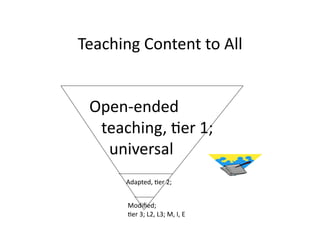
Teaching	
  Content	
  to	
  All	


  Open-­‐ended	


  teaching,	
  7er	
  1;	


  universal	
  
             	
  Adapted,	
  7er	
  2;	


              Modified;	
  	
  
              7er	
  3;	
  L2,	
  L3;	
  M,	
  I,	
  E	
  
Professional	
  Collabora7on	
  
•  Interac7ve	
  and	
  on-­‐going	
  process	
  
•  Mutually	
  agreed	
  upon	
  challenges	
  
•  Capitalizes	
  on	
  different	
  exper7se,	
  knowledge	
  and	
  
   experience	
  
•  Roles	
  are	
  blurred	
  
•  Mutual	
  trust	
  and	
  respect	
  
•  Create	
  and	
  deliver	
  targeted	
  instruc7on	
  
•  GOAL:	
  	
  beMer	
  meet	
  the	
  needs	
  of	
  diverse	
  learners	
  
Big Ideas…

As	
  a	
  school	
  community	
  we	
  want	
  to	
  work	
  together	
  to	
  meet	
  the	
  
needs	
  of	
  all	
  students.	
  

Inclusion	
  is	
  not	
  a	
  special	
  educa7on	
  model;	
  it	
  is	
  a	
  school	
  model.	
  

As	
  professionals	
  we	
  want	
  to	
  constantly	
  examine	
  and	
  refine	
  our	
  
prac7ce.	
  

Collabora7ve	
  problem-­‐solving	
  and	
  teaching	
  results	
  in	
  new	
  ideas,	
  
new	
  products	
  and	
  a	
  feeling	
  of	
  connec7on.	


Our	
  students	
  con7nue	
  to	
  change	
  and	
  learn	
  and	
  their	
  needs,	
  just	
  
like	
  the	
  school’s,	
  will	
  change	
  over	
  the	
  course	
  of	
  the	
  year.	


Brownlie	
  &	
  Schnellert	
  	
  Suppor6ng	
  Diversity:	
  	
  Working	
  Together	
  to	
  Support	
  All	
  Learners


___	
  
Where did you start this year…

What actions have you taken:

-roles
-schedules
-timetables
-instruction
-assessment
-class reviews, collaborative planning
-collaborative teaching


Share in group/share out
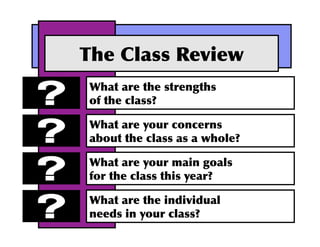
The	
  Class	
  Review	
  Process	
  
•  Meet	
  as	
  a	
  school-­‐based	
  team,	
  with	
  the	
  
   administrator	
  
•  Each	
  classroom	
  teacher	
  (CT)	
  joins	
  the	
  team	
  
   for	
  45	
  minutes	
  to	
  speak	
  of	
  her	
  class	
  
•  TOC’s	
  provide	
  coverage	
  for	
  CTs	
  
•  Follow	
  the	
  order	
  of	
  strengths,	
  needs,	
  goals,	
  
   individuals	
  
•  The	
  CT	
  does	
  not	
  do	
  the	
  recording	
  or	
  the	
  
   chairing	
  
 
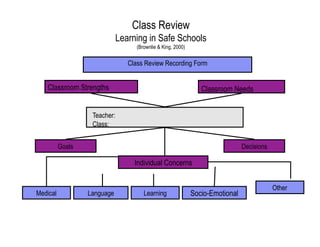
Class Review
                              Learning in Safe Schools
                                                          	
  
                                    (Brownlie & King, 2000)

                                 Class Review Recording Form


   Classroom Strengths                                              Classroom Needs


                   Teacher:
                   Class:


          Goals                                                                    Decisions

                                   Individual Concerns


                                                                                               Other
Medical           Language             Learning                  Socio-Emotional
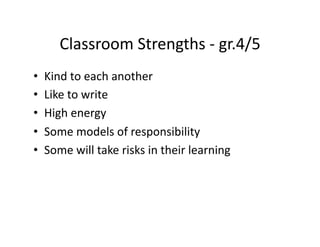
Classroom	
  Strengths	
  -­‐	
  gr.4/5	
  
•    Kind	
  to	
  each	
  another	
  
•    Like	
  to	
  write	
  
•    High	
  energy	
  
•    Some	
  models	
  of	
  responsibility	
  
•    Some	
  will	
  take	
  risks	
  in	
  their	
  learning	
  
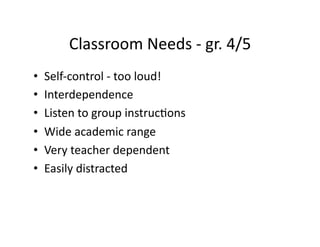
Classroom	
  Needs	
  -­‐	
  gr.	
  4/5	
  
•    Self-­‐control	
  -­‐	
  too	
  loud!	
  
•    Interdependence	
  
•    Listen	
  to	
  group	
  instruc7ons	
  
•    Wide	
  academic	
  range	
  
•    Very	
  teacher	
  dependent	
  
•    Easily	
  distracted	
  
Classroom	
  Goals	
  -­‐	
  gr.	
  4/5	
  
•  Help	
  individuals	
  within	
  class	
  to	
  	
  become	
  more	
  
   independent	
  
•  Help	
  students	
  write	
  more	
  powerfully,	
  with	
  
   criteria	
  	
  
•  Help	
  students	
  learn	
  to	
  ask	
  real	
  research	
  
   ques7ons	
  
•  Help	
  students	
  choose	
  appropriate	
  reading	
  
   materials	
  
Medical	
  
•  Challis	
  -­‐	
  ritalin,	
  see	
  file	
  
•  Karmvir	
  -­‐	
  severe	
  diabetes	
  
Language	
  
•  ESL	
  1	
  -­‐	
  Sharon	
  
•  ESL	
  2-­‐4	
  Ammen,	
  Karmjit,	
  Janel,	
  Amrit,	
  Ekam,	
  
   Tommy,	
  Iris,	
  Osama,	
  Jasdeep,	
  David	
  
•  Ini7ate	
  oral	
  language	
  -­‐	
  Jasdeep	
  
•  Pose	
  ques7ons	
  -­‐	
  Challis,	
  Dion,	
  Ekam	
  
Learning	
  
•  Focusing	
  -­‐	
  Jordan,	
  Janel,	
  Jasdeep,	
  Challis,	
  
   Kri7es,	
  Ekam,	
  Sigman	
  
•  Comprehension	
  -­‐	
  Sigmund,	
  Oscan,	
  Ekam,	
  
   Janel,	
  Challis,	
  David	
  
•  Limited	
  wriMen	
  output	
  -­‐	
  Kris7e,	
  Challis,	
  
   Tommy	
  
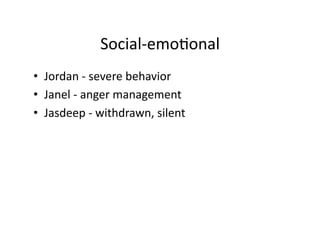
Social-­‐emo7onal	
  
•  Jordan	
  -­‐	
  severe	
  behavior	
  
•  Janel	
  -­‐	
  anger	
  management	
  
•  Jasdeep	
  -­‐	
  withdrawn,	
  silent	
  
Other	
  
•  Extensions:	
  	
  Chloe,	
  Taylor,	
  Janelle,	
  Josie,	
  Emily,	
  
   Kris7e,	
  Andrew,	
  Amanda	
  
Decisions	
  
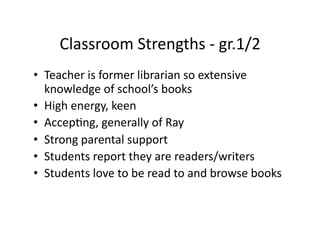
Classroom	
  Strengths	
  -­‐	
  gr.1/2	
  
•  Teacher	
  is	
  former	
  librarian	
  so	
  extensive	
  
   knowledge	
  of	
  school’s	
  books	
  
•  High	
  energy,	
  keen	
  
•  Accep7ng,	
  generally	
  of	
  Ray	
  
•  Strong	
  parental	
  support	
  
•  Students	
  report	
  they	
  are	
  readers/writers	
  
•  Students	
  love	
  to	
  be	
  read	
  to	
  and	
  browse	
  books	
  
Classroom	
  Needs	
  -­‐	
  gr.	
  1/2	
  
•  Social	
  responsibility:	
  	
  
-­‐how	
  to	
  treat	
  each	
  other	
  fairly	
  	
  
-­‐how	
  to	
  take	
  turns	
  	
  
-­‐how	
  to	
  not	
  call	
  out	
  	
  
-­‐how	
  to	
  use	
  an	
  inside	
  voice	
  
•	
  	
  Wide	
  academic	
  range	
  -­‐	
  early	
  learners	
  to	
  very	
  
       able	
  reader	
  
Classroom	
  Goals	
  -­‐	
  gr.	
  1/2	
  
•    Make	
  this	
  class	
  a	
  team	
  
•    Write	
  daily	
  
•    Guided	
  reading,	
  as	
  able	
  
•    Encourage	
  independence	
  
Medical	
  gr.	
  1/2	
  
Language-­‐gr.	
  1/2	
  
•  ESL	
  1&2	
  -­‐	
  Elvira,	
  Tom,	
  Juno,	
  Michelle,Tony,	
  Ray,	
  
   Annie,	
  Jerad	
  
•  Ray	
  -­‐	
  oken	
  incomprehensible	
  
•  ESL	
  1-­‐4	
  -­‐	
  13	
  students,	
  including	
  8	
  different	
  first	
  
   languages	
  
Learning	
  -­‐	
  gr.	
  1/2	
  
•  BriMney	
  -­‐	
  very	
  weak	
  skills	
  
•  Dominic	
  -­‐	
  knows	
  few,	
  if	
  any,	
  sounds	
  
•  Ray,	
  Elvira,	
  Annie,	
  Juno,	
  Tony,	
  Darren	
  -­‐	
  help	
  
   hearing	
  sounds	
  -­‐	
  phonemic	
  awareness	
  
•  MaMhew	
  -­‐	
  won’t	
  write	
  
•  Ray	
  -­‐	
  is	
  he	
  reading	
  for	
  meaning?	
  
Social-­‐emo7onal	
  -­‐	
  gr.	
  1/2	
  
•  BriMney	
  -­‐	
  inappropriate	
  friendship	
  skills	
  
•  Jared,	
  Trevor,	
  MaMhew	
  -­‐	
  demanding,	
  liMle	
  self	
  
   control	
  
•  Trevor	
  -­‐	
  low	
  self	
  esteem	
  
•  Michelle	
  -­‐	
  inaudible	
  speech,	
  whisper	
  
•  Ray	
  -­‐	
  wanders	
  
Other	
  -­‐	
  gr.	
  1/2	
  
•  Challenge	
  -­‐	
  Wilson,	
  Catherine	
  
Decisions	
  
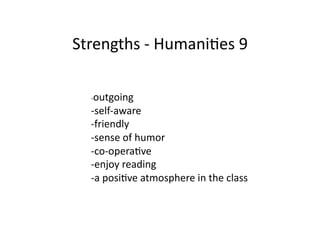
Strengths	
  -­‐	
  Humani7es	
  9	
  

   -­‐outgoing	
  
   -­‐self-­‐aware	
  
   -­‐friendly	
  
   -­‐sense	
  of	
  humor	
  
   -­‐co-­‐opera7ve	
  
   -­‐enjoy	
  reading	
  
   -­‐a	
  posi7ve	
  atmosphere	
  in	
  the	
  class	
  
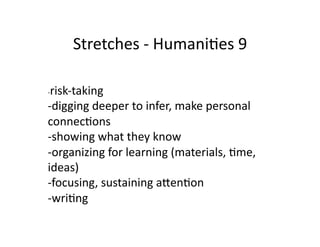
Stretches	
  -­‐	
  Humani7es	
  9	
  

  risk-­‐taking	
  
-­‐

-­‐digging	
  deeper	
  to	
  infer,	
  make	
  personal	
  	
  
connec7ons	
  
-­‐showing	
  what	
  they	
  know	
  
-­‐organizing	
  for	
  learning	
  (materials,	
  7me,	
  	
  
ideas)	
  
-­‐focusing,	
  sustaining	
  aMen7on	
  
-­‐wri7ng	
  
Interests	
  -­‐	
  Humani7es	
  9	
  

     Socializing	
  
     -­‐sports	
  
     -­‐fine	
  arts	
  
     -­‐performing	
  arts	
  
     -­‐social	
  issues/current	
  events	
  
     -­‐reading	
  
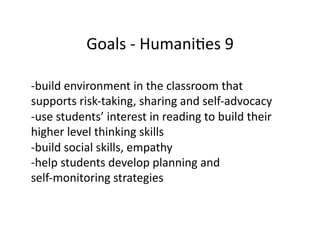
Goals	
  -­‐	
  Humani7es	
  9	
  

-­‐ build	
  environment	
  in	
  the	
  classroom	
  that	
  	
  
supports	
  risk-­‐taking,	
  sharing	
  and	
  self-­‐advocacy	


-­‐ use	
  students’	
  interest	
  in	
  reading	
  to	
  build	
  their	
  	
  
higher	
  level	
  thinking	
  skills	
  
-­‐ build	
  social	
  skills,	
  empathy	
  
-­‐ help	
  students	
  develop	
  planning	
  and	
  	
  
self-­‐monitoring	
  strategies	


  Medical	


  Learning	
  
                                                        Kelly	
  -­‐	
  adapt	
  pace,	
  key	
  ideas,	
  modified	
  outcomes	
  
          Kelly	
                                       Percilla	
  -­‐	
  highlight	
  key	
  ideas,	
  show	
  by	
  drawing,	
  
          MaM	
                                         modified	
  out.	
  
          Ryan	
                                        Aisha	
  -­‐	
  adapt	
  pace,	
  key	
  ideas	
  
                                                        Harry	
  -­‐	
  choice	
  in	
  showing	
  
                                                        Brendan	
  -­‐	
  pair	
  talk	
  with	
  visuals	


   Social-­‐emo7onal 	


  Language	
  
   Taylor 	
  -­‐	
  loud/dominant 	
  	
  
   Ryan	
  -­‐	
  shy,	
  challenging	
  homelife	
             Aisha	
  -­‐	
  recep7ve/expressive	
  
   Percilla	
  -­‐	
  opposi7onal	
                             Cici	
  -­‐	
  ESL	
  2	
  
   May	
  -­‐	
  very	
  shy,	
  reluctant	
                    Ryan	
  -­‐	
  recep7ve/expressive	
  
   Megan	
  -­‐	
  impa7ent	
  with	
  others	
                 Kirby	
  -­‐	
  ESL	
  2	
  
   Max	
  -­‐	
  confronta7onal	
  
Challenge	


    Tessa	
  
    Sarah	
  
    Marija	
  
    Chris7an	
  
Decisions	
  
Grade 10 Nest:
 Class Profile
Anderson (SS), Chiang (Sc), Fitt (En),
Padmanabhan (Ma, A), Chatha (CPP)


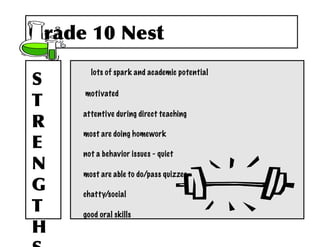
 lots of spark and academic potential


 motivated
	
 
              attentive during direct teaching
  	
 
              most are doing homework
	
            not a behavior issues - quiet
   	
         most are able to do/pass quizzes
   	
         chatty/social
	
            good oral skills


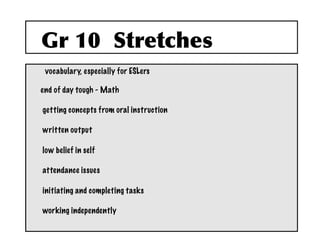
 v ocabulary, especially for ESLers

     end of day tough - Math

         getting concepts from oral instruction

         written output

         low belief in self

         attendance issues

         initiating and completing tasks

         working independently


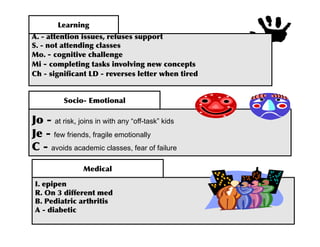
 at risk, joins in with any “off-task” kids
   	
  	
 few friends, fragile emotionally
 	
  	
 avoids academic classes, fear of failure
                                                                                     	
  
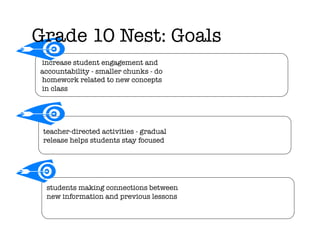
Grade 10 Nest: Goals	
  
 increase student engagement and 
 accountability - smaller chunks - do 
 homework related to new concepts 
 in class


 teacher-directed activities - gradual 
 release helps students stay focused


  students making connections between 
  new information and previous lessons
Cayoosh Creek, SD# 74
Debbie Ralston, Principal
Cayoosh	
  Elementary	


•assessment for learning
•fair, but not equal support
•collaboration
•blurred roles
•classroom support, less pull-
out
•reflection on practice
(Learning	
  in	
  Safe	
  Schools	
  -­‐	
  Brownlie,	
  King)   	
  
•  3	
  7mes	
  a	
  year	
  
•  LST,	
  Aboriginal	
  Support	
  Teacher,	
  STA,	
  principal,	
  current	
  and	
  
   last	
  year’s	
  teacher	
  (fall),	
  current	
  and	
  next	
  year’s	
  teacher	
  
   (spring)	
  
•  Become	
  90	
  minutes/teacher	
  
•  Moving	
  students	
  off	
  the	
  at-­‐risk	
  list	
  
•  PM	
  Benchmarks/DRA	
  in	
  primary	


•  Fall	
  performance-­‐based	
  assessment	
  in	
  
   intermediate	
  

•  Class	
  profile:	
  	
  strengths	
  &	
  areas	
  of	
  need	
  
•    Teams	
  of	
  CT,	
  STA,	
  Admin,	
  Ab.ST,	
  LST	
  
•    Meet	
  5	
  7mes/week	
  for	
  30	
  min.	
  with	
  each	
  class	
  
•    STA	
  doesn’t	
  do	
  running	
  record	
  
•    Weekly	
  or	
  bi-­‐weekly,	
  team	
  meets	
  in	
  CT’s	
  room	
  
     together	
  to	
  collaborate	
  
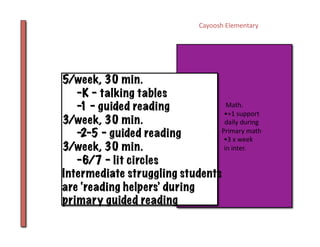
Cayoosh	
  Elementary	


5/week, 30 min.
   -K - talking tables
   - - guided reading
    1                                                Math.	
  
                                                	
  •+1	
  support	
  	
  
3/week, 30 min.                                  	
  daily	
  during	


  Primary	
  math	
  
   -2-5 - guided reading       	


  •3	
  x	
  week	
  
3/week, 30 min.                                 	
  in	
  inter.	
  
   -6/7 - lit circles
Intermediate struggling students
are ‘reading helpers’ during
primary guided reading
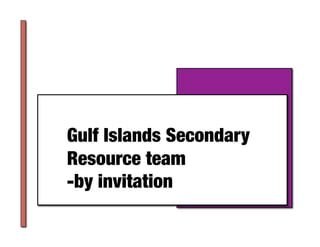
Gulf Islands Secondary
Resource team
-by invitation
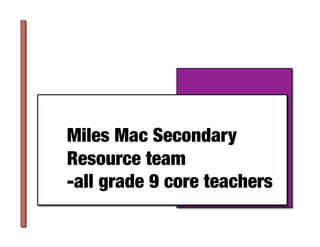
Miles Mac Secondary
Resource team
-all grade 9 core teachers
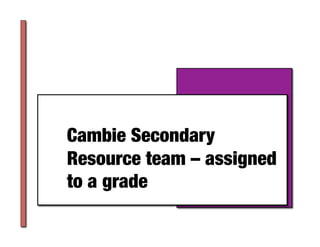
Cambie Secondary
Resource team – assigned 
to a grade
Frameworks


  It’s All about Thinking (En/Hum/SS) – Brownlie & Schnellert, 2009
It’s All about Thinking (Ma/Sc) – Brownlie, Fullerton, Schnellert, 2011
                   Collaborating to support all learners
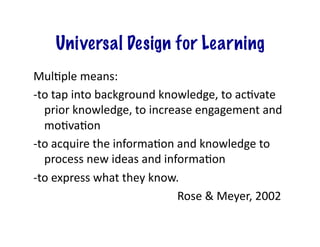
Universal Design for Learning
Mul7ple	
  means:	
  
-­‐to	
  tap	
  into	
  background	
  knowledge,	
  to	
  ac7vate	
  
        prior	
  knowledge,	
  to	
  increase	
  engagement	
  and	
  
        mo7va7on	
  
-­‐to	
  acquire	
  the	
  informa7on	
  and	
  knowledge	
  to	
  
        process	
  new	
  ideas	
  and	
  informa7on	
  
-­‐to	
  express	
  what	
  they	
  know.	


  Rose	
  &	
  Meyer,	
  2002	
  
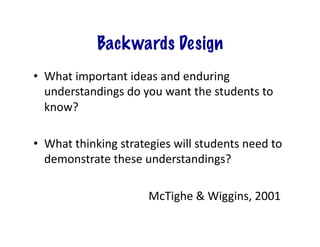
Backwards Design
•  What	
  important	
  ideas	
  and	
  enduring	
  
   understandings	
  do	
  you	
  want	
  the	
  students	
  to	
  
   know?	
  

•  What	
  thinking	
  strategies	
  will	
  students	
  need	
  to	
  
   demonstrate	
  these	
  understandings?	


  McTighe	
  &	
  Wiggins,	
  2001	
  
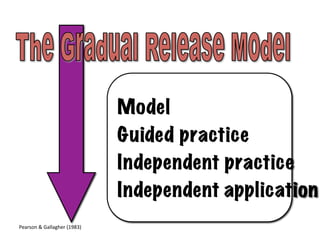
Model
                                          Guided practice
                                          Independent practice
                                          Independent application	
  
Pearson	
  &	
  Gallagher	
  (1983)	
  
Resources	
  	
  
•  Grand	
  Conversa6ons,	
  ThoughBul	
  Responses	
  –	
  a	
  unique	
  
   approach	
  to	
  literature	
  circles	
  –	
  Brownlie,	
  2005	
  
•  Student	
  Diversity,	
  2nd	
  ed.	
  –	
  Brownlie,	
  Feniak	
  &	
  Schnellert,	
  
   2006	
  
•  Reading	
  and	
  Responding,	
  gr.	
  4,5,&6	
  –	
  Brownlie	
  &	
  Jeroski,	
  
   2006	
  
•  It’s	
  All	
  about	
  Thinking	
  –	
  collabora6ng	
  to	
  support	
  all	
  learners	
  
   (in	
  English,	
  Social	
  Studies	
  and	
  Humani6es)	
  –	
  Brownlie	
  &	
  
   Schnellert,	
  2009	
  
•  It’s	
  All	
  about	
  Thinking	
  –	
  collabora6ng	
  to	
  support	
  all	
  learners	
  
   (in	
  Math	
  and	
  Science)	
  -­‐	
  Brownlie,	
  Fullerton	
  &	
  Schnellert,	
  2011	
  
•  Learning	
  in	
  Safe	
  Schools,	
  2nd	
  ed	
  –	
  Brownlie	
  &	
  King,	
  2011	
  
•  Assessment	
  &	
  Instruc6on	
  of	
  ESL	
  Learners,	
  2nd	
  ed	
  –	
  Brownlie,	
  
   Feniak,	
  &	
  McCarthy,	
  in	
  press	
  

Class reviews.portage.dec2011

  • 1.
    The  Class  Review  Process:    stories  of   implementa7on  and  follow-­‐up     Portage  La  Prairie   December  6th,  2011   Faye  Brownlie   Learning  in  Safe  Schools,  2nd  ed-­‐   Brownlie,  King  (2011)  
  • 2.
    Goal:   to  support  students  in  working   effec7vely  in  the  classroom   environment  
  • 3.
    Goal:   to  work  together  to  beMer  meet   the  needs  of  all  students  
  • 4.
    Ra7onale:   By  sharing  our  collec7ve   knowledge  about  our  classes  of   students  and  developing  a  plan  of   ac7on  based  on  this,  we  can   beMer  meet  the  needs  of  all   students.  
  • 5.
    A  Key  Belief   Interven7on  is  focused  on  classroom  support.     Classroom-­‐based  interven7on  does  NOT  mean   that  all  specialists  have  to  be  in  the  classroom   all  the  7me.    Instead,  the  RESULTS  of  their   work  have  to  show  up  in  the  classroom.  
  • 6.
    McKinsey  Report,  2007   •  The  top-­‐performing  school  systems  recognise   that  the  only  way  to  improve  outcomes  is  to   improve  instruc7on:    learning  occurs  when   students  and  teachers  interact,  and  thus  to   improve  learning  implies  improving  the  quality   of  that  interac7on.  
  • 7.
    Teaching  Content  to  All   Open-­‐ended          teaching,  7er  1;              universal    Adapted,  7er  2;   Modified;     7er  3;  L2,  L3;  M,  I,  E  
  • 8.
    Professional  Collabora7on   • Interac7ve  and  on-­‐going  process   •  Mutually  agreed  upon  challenges   •  Capitalizes  on  different  exper7se,  knowledge  and   experience   •  Roles  are  blurred   •  Mutual  trust  and  respect   •  Create  and  deliver  targeted  instruc7on   •  GOAL:    beMer  meet  the  needs  of  diverse  learners  
  • 9.
    Big Ideas… As  a  school  community  we  want  to  work  together  to  meet  the   needs  of  all  students.   Inclusion  is  not  a  special  educa7on  model;  it  is  a  school  model.   As  professionals  we  want  to  constantly  examine  and  refine  our   prac7ce.   Collabora7ve  problem-­‐solving  and  teaching  results  in  new  ideas,   new  products  and  a  feeling  of  connec7on.     Our  students  con7nue  to  change  and  learn  and  their  needs,  just   like  the  school’s,  will  change  over  the  course  of  the  year.     Brownlie  &  Schnellert    Suppor6ng  Diversity:    Working  Together  to  Support  All  Learners ___  
  • 10.
    Where did youstart this year… What actions have you taken: -roles -schedules -timetables -instruction -assessment -class reviews, collaborative planning -collaborative teaching Share in group/share out
  • 11.
  • 12.
    •  Meet  as  a  school-­‐based  team,  with  the   administrator   •  Each  classroom  teacher  (CT)  joins  the  team   for  45  minutes  to  speak  of  her  class   •  TOC’s  provide  coverage  for  CTs   •  Follow  the  order  of  strengths,  needs,  goals,   individuals   •  The  CT  does  not  do  the  recording  or  the   chairing  
  • 13.
  • 14.
    Class Review Learning in Safe Schools   (Brownlie & King, 2000) Class Review Recording Form Classroom Strengths Classroom Needs Teacher: Class: Goals Decisions Individual Concerns Other Medical Language Learning Socio-Emotional
  • 15.
    Classroom  Strengths  -­‐  gr.4/5   •  Kind  to  each  another   •  Like  to  write   •  High  energy   •  Some  models  of  responsibility   •  Some  will  take  risks  in  their  learning  
  • 16.
    Classroom  Needs  -­‐  gr.  4/5   •  Self-­‐control  -­‐  too  loud!   •  Interdependence   •  Listen  to  group  instruc7ons   •  Wide  academic  range   •  Very  teacher  dependent   •  Easily  distracted  
  • 17.
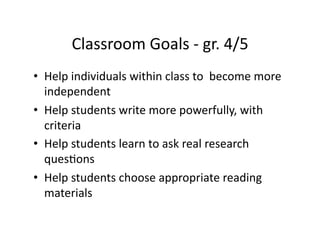
    Classroom  Goals  -­‐  gr.  4/5   •  Help  individuals  within  class  to    become  more   independent   •  Help  students  write  more  powerfully,  with   criteria     •  Help  students  learn  to  ask  real  research   ques7ons   •  Help  students  choose  appropriate  reading   materials  
  • 18.
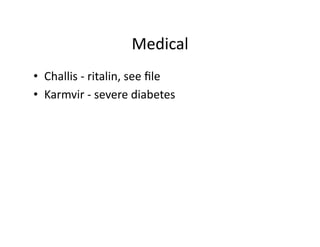
    Medical   •  Challis  -­‐  ritalin,  see  file   •  Karmvir  -­‐  severe  diabetes  
  • 19.
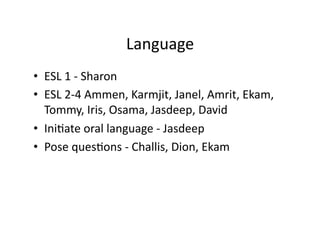
    Language   •  ESL  1  -­‐  Sharon   •  ESL  2-­‐4  Ammen,  Karmjit,  Janel,  Amrit,  Ekam,   Tommy,  Iris,  Osama,  Jasdeep,  David   •  Ini7ate  oral  language  -­‐  Jasdeep   •  Pose  ques7ons  -­‐  Challis,  Dion,  Ekam  
  • 20.
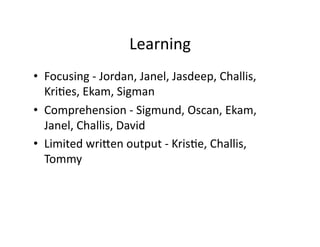
    Learning   •  Focusing  -­‐  Jordan,  Janel,  Jasdeep,  Challis,   Kri7es,  Ekam,  Sigman   •  Comprehension  -­‐  Sigmund,  Oscan,  Ekam,   Janel,  Challis,  David   •  Limited  wriMen  output  -­‐  Kris7e,  Challis,   Tommy  
  • 21.
    Social-­‐emo7onal   •  Jordan  -­‐  severe  behavior   •  Janel  -­‐  anger  management   •  Jasdeep  -­‐  withdrawn,  silent  
  • 22.
    Other   •  Extensions:    Chloe,  Taylor,  Janelle,  Josie,  Emily,   Kris7e,  Andrew,  Amanda  
  • 23.
  • 24.
    Classroom  Strengths  -­‐  gr.1/2   •  Teacher  is  former  librarian  so  extensive   knowledge  of  school’s  books   •  High  energy,  keen   •  Accep7ng,  generally  of  Ray   •  Strong  parental  support   •  Students  report  they  are  readers/writers   •  Students  love  to  be  read  to  and  browse  books  
  • 25.
    Classroom  Needs  -­‐  gr.  1/2   •  Social  responsibility:     -­‐how  to  treat  each  other  fairly     -­‐how  to  take  turns     -­‐how  to  not  call  out     -­‐how  to  use  an  inside  voice   •    Wide  academic  range  -­‐  early  learners  to  very   able  reader  
  • 26.
    Classroom  Goals  -­‐  gr.  1/2   •  Make  this  class  a  team   •  Write  daily   •  Guided  reading,  as  able   •  Encourage  independence  
  • 27.
  • 28.
    Language-­‐gr.  1/2   • ESL  1&2  -­‐  Elvira,  Tom,  Juno,  Michelle,Tony,  Ray,   Annie,  Jerad   •  Ray  -­‐  oken  incomprehensible   •  ESL  1-­‐4  -­‐  13  students,  including  8  different  first   languages  
  • 29.
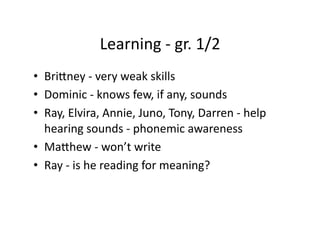
    Learning  -­‐  gr.  1/2   •  BriMney  -­‐  very  weak  skills   •  Dominic  -­‐  knows  few,  if  any,  sounds   •  Ray,  Elvira,  Annie,  Juno,  Tony,  Darren  -­‐  help   hearing  sounds  -­‐  phonemic  awareness   •  MaMhew  -­‐  won’t  write   •  Ray  -­‐  is  he  reading  for  meaning?  
  • 30.
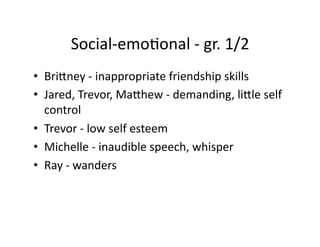
    Social-­‐emo7onal  -­‐  gr.  1/2   •  BriMney  -­‐  inappropriate  friendship  skills   •  Jared,  Trevor,  MaMhew  -­‐  demanding,  liMle  self   control   •  Trevor  -­‐  low  self  esteem   •  Michelle  -­‐  inaudible  speech,  whisper   •  Ray  -­‐  wanders  
  • 31.
    Other  -­‐  gr.  1/2   •  Challenge  -­‐  Wilson,  Catherine  
  • 32.
  • 33.
    Strengths  -­‐  Humani7es  9   -­‐outgoing   -­‐self-­‐aware   -­‐friendly   -­‐sense  of  humor   -­‐co-­‐opera7ve   -­‐enjoy  reading   -­‐a  posi7ve  atmosphere  in  the  class  
  • 34.
    Stretches  -­‐  Humani7es  9   risk-­‐taking   -­‐ -­‐digging  deeper  to  infer,  make  personal     connec7ons   -­‐showing  what  they  know   -­‐organizing  for  learning  (materials,  7me,     ideas)   -­‐focusing,  sustaining  aMen7on   -­‐wri7ng  
  • 35.
    Interests  -­‐  Humani7es  9   Socializing   -­‐sports   -­‐fine  arts   -­‐performing  arts   -­‐social  issues/current  events   -­‐reading  
  • 36.
    Goals  -­‐  Humani7es  9   -­‐ build  environment  in  the  classroom  that     supports  risk-­‐taking,  sharing  and  self-­‐advocacy       -­‐ use  students’  interest  in  reading  to  build  their     higher  level  thinking  skills   -­‐ build  social  skills,  empathy   -­‐ help  students  develop  planning  and     self-­‐monitoring  strategies  
  • 37.
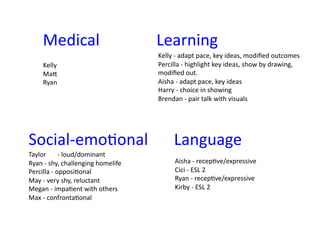
               Medical                Learning   Kelly  -­‐  adapt  pace,  key  ideas,  modified  outcomes   Kelly   Percilla  -­‐  highlight  key  ideas,  show  by  drawing,   MaM   modified  out.   Ryan   Aisha  -­‐  adapt  pace,  key  ideas   Harry  -­‐  choice  in  showing   Brendan  -­‐  pair  talk  with  visuals   Social-­‐emo7onal          Language   Taylor  -­‐  loud/dominant     Ryan  -­‐  shy,  challenging  homelife   Aisha  -­‐  recep7ve/expressive   Percilla  -­‐  opposi7onal   Cici  -­‐  ESL  2   May  -­‐  very  shy,  reluctant   Ryan  -­‐  recep7ve/expressive   Megan  -­‐  impa7ent  with  others   Kirby  -­‐  ESL  2   Max  -­‐  confronta7onal  
  • 38.
    Challenge   Tessa   Sarah   Marija   Chris7an  
  • 39.
  • 40.
    Grade 10 Nest: Class Profile Anderson (SS), Chiang (Sc), Fitt (En), Padmanabhan (Ma, A), Chatha (CPP)
  • 41.
      lots of spark and academic potential motivated attentive during direct teaching most are doing homework not a behavior issues - quiet most are able to do/pass quizzes chatty/social good oral skills
  • 42.
      v ocabulary, especially for ESLers end of day tough - Math getting concepts from oral instruction written output low belief in self attendance issues initiating and completing tasks working independently
  • 43.
          at risk, joins in with any “off-task” kids few friends, fragile emotionally avoids academic classes, fear of failure  
  • 44.
    Grade 10 Nest:Goals   increase student engagement and accountability - smaller chunks - do homework related to new concepts in class teacher-directed activities - gradual release helps students stay focused students making connections between new information and previous lessons
  • 45.
    Cayoosh Creek, SD#74 Debbie Ralston, Principal
  • 46.
    Cayoosh  Elementary   •assessmentfor learning •fair, but not equal support •collaboration •blurred roles •classroom support, less pull- out •reflection on practice
  • 47.
    (Learning  in  Safe  Schools  -­‐  Brownlie,  King)   •  3  7mes  a  year   •  LST,  Aboriginal  Support  Teacher,  STA,  principal,  current  and   last  year’s  teacher  (fall),  current  and  next  year’s  teacher   (spring)   •  Become  90  minutes/teacher   •  Moving  students  off  the  at-­‐risk  list  
  • 48.
    •  PM  Benchmarks/DRA  in  primary     •  Fall  performance-­‐based  assessment  in   intermediate   •  Class  profile:    strengths  &  areas  of  need  
  • 49.
    •  Teams  of  CT,  STA,  Admin,  Ab.ST,  LST   •  Meet  5  7mes/week  for  30  min.  with  each  class   •  STA  doesn’t  do  running  record   •  Weekly  or  bi-­‐weekly,  team  meets  in  CT’s  room   together  to  collaborate  
  • 50.
    Cayoosh  Elementary   5/week,30 min. -K - talking tables - - guided reading 1 Math.    •+1  support     3/week, 30 min.  daily  during      Primary  math   -2-5 - guided reading          •3  x  week   3/week, 30 min.  in  inter.   -6/7 - lit circles Intermediate struggling students are ‘reading helpers’ during primary guided reading
  • 51.
  • 52.
    Miles Mac Secondary Resourceteam -all grade 9 core teachers
  • 53.
    Cambie Secondary Resource team– assigned to a grade
  • 54.
    Frameworks It’sAll about Thinking (En/Hum/SS) – Brownlie & Schnellert, 2009 It’s All about Thinking (Ma/Sc) – Brownlie, Fullerton, Schnellert, 2011 Collaborating to support all learners
  • 55.
    Universal Design forLearning Mul7ple  means:   -­‐to  tap  into  background  knowledge,  to  ac7vate   prior  knowledge,  to  increase  engagement  and   mo7va7on   -­‐to  acquire  the  informa7on  and  knowledge  to   process  new  ideas  and  informa7on   -­‐to  express  what  they  know.                        Rose  &  Meyer,  2002  
  • 56.
    Backwards Design •  What  important  ideas  and  enduring   understandings  do  you  want  the  students  to   know?   •  What  thinking  strategies  will  students  need  to   demonstrate  these  understandings?                      McTighe  &  Wiggins,  2001  
  • 57.
    Model Guided practice Independent practice Independent application   Pearson  &  Gallagher  (1983)  
  • 58.
    Resources     • Grand  Conversa6ons,  ThoughBul  Responses  –  a  unique   approach  to  literature  circles  –  Brownlie,  2005   •  Student  Diversity,  2nd  ed.  –  Brownlie,  Feniak  &  Schnellert,   2006   •  Reading  and  Responding,  gr.  4,5,&6  –  Brownlie  &  Jeroski,   2006   •  It’s  All  about  Thinking  –  collabora6ng  to  support  all  learners   (in  English,  Social  Studies  and  Humani6es)  –  Brownlie  &   Schnellert,  2009   •  It’s  All  about  Thinking  –  collabora6ng  to  support  all  learners   (in  Math  and  Science)  -­‐  Brownlie,  Fullerton  &  Schnellert,  2011   •  Learning  in  Safe  Schools,  2nd  ed  –  Brownlie  &  King,  2011   •  Assessment  &  Instruc6on  of  ESL  Learners,  2nd  ed  –  Brownlie,   Feniak,  &  McCarthy,  in  press