Roll No 26251
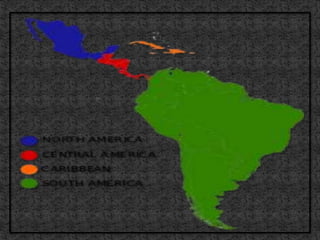
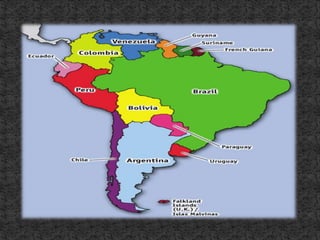
South America
Central America
Mexico
West Indies
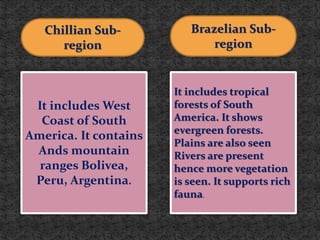
It includes West
Coast of South
America. It contains
Ands mountain
ranges Bolivea,
Peru, Argentina.
It includes tropical
forests of South
America. It shows
evergreen forests.
Plains are also seen
Rivers are present
hence more vegetation
is seen. It supports rich
fauna.
Chillian Sub-
region
Brazelian Sub-
region
Mexican Sub-region
West Indies or
Antelian Sub-region
North of isthmus of
Panama is called
Mexkon sub-region.
This region shows rocky
mountains. It is
showing sub. tropical
conditions. in this
region Tapiers are
common.
The region contains
West Indies, islands.
Trinidad and Tobago
are not included in this
region. These islands
contain mountains. In
this sub-region the
Vertebrate fauna is
poor.
7 are widely distributed
16 are unique
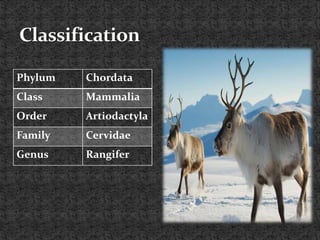
Phylum Chordata
Class Mammalia
Order Artiodactyla
Family Cervidae
Genus Rangifer
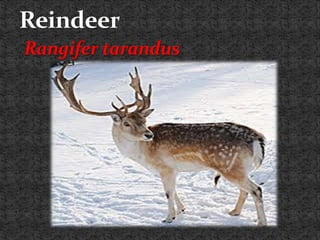
 Reindeer also called Caribou in North
America
 Life span 15 to 18 years
 Gestation: 7.5 months
 Height: 70 to 135 centimeters
 Weight: Females - 55 to 140 kilograms males -
65 to 240 kilograms
 They are social creatures. They feed, travel
and rest in groups called herds.
 Herbivores
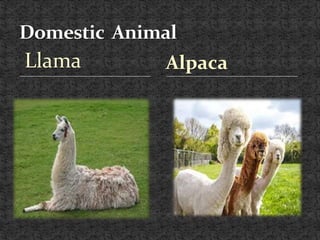
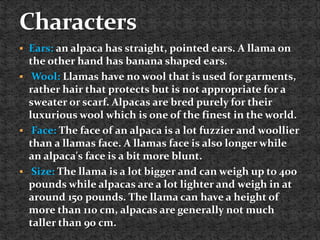
Llama
Alpaca
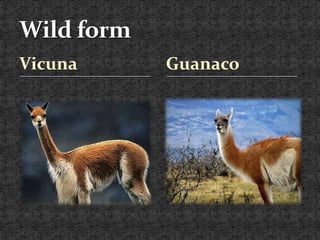
L. vicuna
L. guanaco
Phylum Chordata
Class Mammalia
Order Artiodactyla
Family Camelidae
Llama Alpaca
 Ears: an alpaca has straight, pointed ears. A llama on
the other hand has banana shaped ears.
 Wool: Llamas have no wool that is used for garments,
rather hair that protects but is not appropriate for a
sweater or scarf. Alpacas are bred purely for their
luxurious wool which is one of the finest in the world.
 Face: The face of an alpaca is a lot fuzzier and woollier
than a llamas face. A llamas face is also longer while
an alpaca's face is a bit more blunt.
 Size: The llama is a lot bigger and can weigh up to 400
pounds while alpacas are a lot lighter and weigh in at
around 150 pounds. The llama can have a height of
more than 110 cm, alpacas are generally not much
taller than 90 cm.
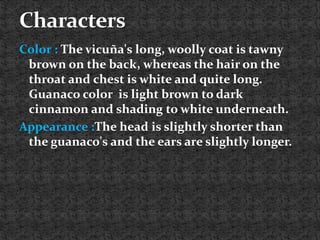
Vicuna Guanaco
Color : The vicuña's long, woolly coat is tawny
brown on the back, whereas the hair on the
throat and chest is white and quite long.
Guanaco color is light brown to dark
cinnamon and shading to white underneath.
Appearance :The head is slightly shorter than
the guanaco's and the ears are slightly longer.
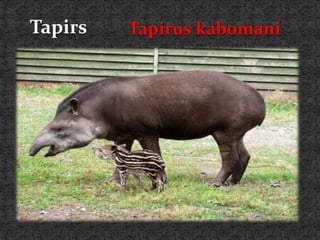
Tapirs Tapirus kabomani
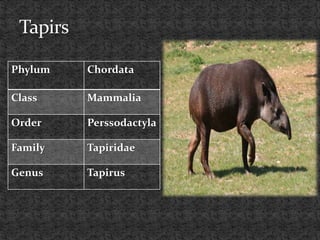
Phylum Chordata
Class Mammalia
Order Perssodactyla
Family Tapiridae
Genus Tapirus
 Similar to pig
 dark brown, paler in the face
 The round, dark ears have distinctive white
edges
 Newborn tapirs have a dark brown coat, with
small white spots and stripes along the body
 Short stubby tail
 Herbivorous
 Proboscis are highly flexible
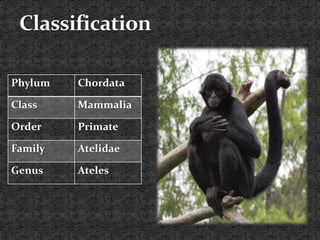
Spider monkey Atele fusciceps
Phylum Chordata
Class Mammalia
Order Primate
Family Atelidae
Genus Ateles
 Long prehensile tail
 Average weight of 11 kilograms for males and
9.66 kg for females.
 long, spindly limbs
 Heads are small with hairless faces.
 The hands are long, narrow and hook-like,
and have reduced or non-existent thumbs
 The fingers are elongated and recurved.
 Eat fruits & leaves, flower & insects
 Social Animal
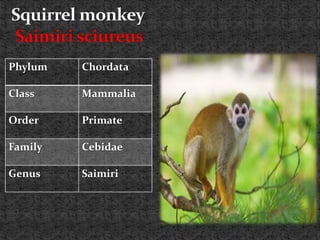
Phylum Chordata
Class Mammalia
Order Primate
Family Cebidae
Genus Saimiri
 Squirrel monkey fur is short and close,
colored black at the shoulders and yellowish
orange on its back and extremities.
 Their throats and ears are white, and their
mouths are black.
 The upper parts of their heads are hairy.
 Both males and females are equipped with
long and hairy tails, flat nails, and pointed
claws.
 squirrel monkeys are diurnal and arboreal.
 Omnivores
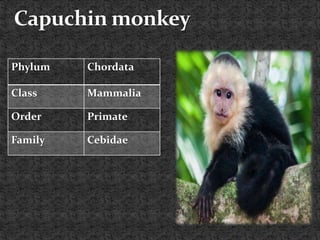
Phylum Chordata
Class Mammalia
Order Primate
Family Cebidae
 Diurnal and arboreal.
 Omnivores
 Capuchins are black, brown, buff or whitish
 length of 30 to 56 cm (12 to 22 in)
 most intelligent New World monkeys
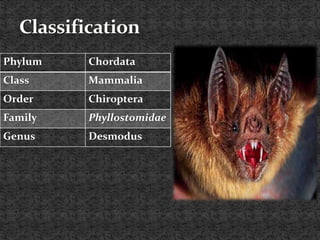
Phylum Chordata
Class Mammalia
Order Chiroptera
Family Phyllostomidae
Genus Desmodus
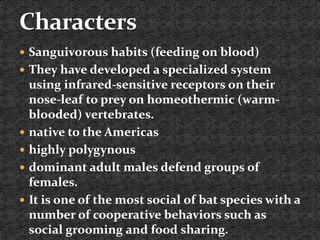
 Sanguivorous habits (feeding on blood)
 They have developed a specialized system
using infrared-sensitive receptors on their
nose-leaf to prey on homeothermic (warm-
blooded) vertebrates.
 native to the Americas
 highly polygynous
 dominant adult males defend groups of
females.
 It is one of the most social of bat species with a
number of cooperative behaviors such as
social grooming and food sharing.
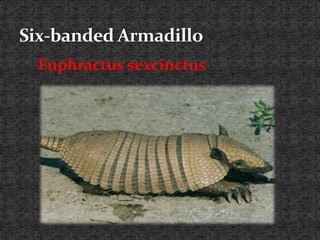
Euphractus sexcinctus
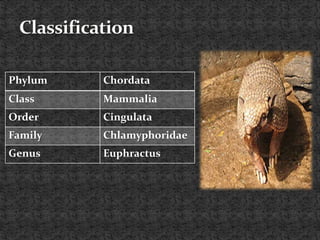
Phylum Chordata
Class Mammalia
Order Cingulata
Family Chlamyphoridae
Genus Euphractus
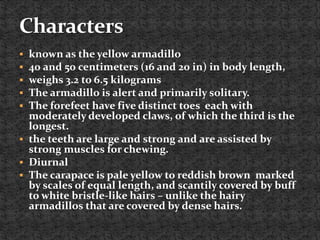
 known as the yellow armadillo
 40 and 50 centimeters (16 and 20 in) in body length,
 weighs 3.2 to 6.5 kilograms
 The armadillo is alert and primarily solitary.
 The forefeet have five distinct toes each with
moderately developed claws, of which the third is the
longest.
 the teeth are large and strong and are assisted by
strong muscles for chewing.
 Diurnal
 The carapace is pale yellow to reddish brown marked
by scales of equal length, and scantily covered by buff
to white bristle-like hairs – unlike the hairy
armadillos that are covered by dense hairs.
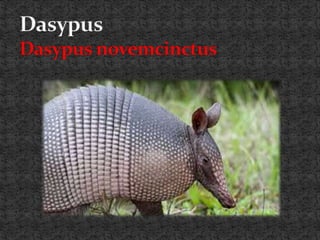
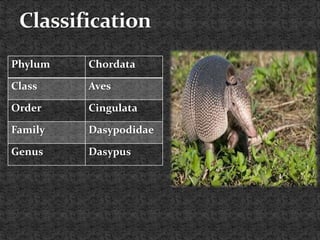
Phylum Chordata
Class Aves
Order Cingulata
Family Dasypodidae
Genus Dasypus
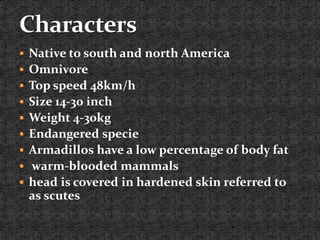
 Native to south and north America
 Omnivore
 Top speed 48km/h
 Size 14-30 inch
 Weight 4-30kg
 Endangered specie
 Armadillos have a low percentage of body fat
 warm-blooded mammals
 head is covered in hardened skin referred to
as scutes
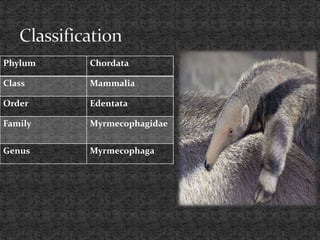
Phylum Chordata
Class Mammalia
Order Edentata
Family Myrmecophagidae
Genus Myrmecophaga
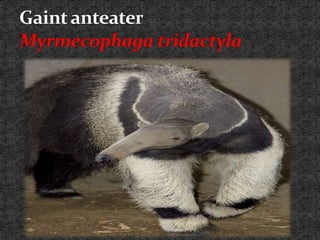
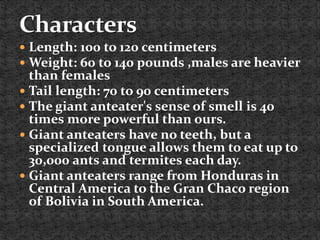
 Length: 100 to 120 centimeters
 Weight: 60 to 140 pounds ,males are heavier
than females
 Tail length: 70 to 90 centimeters
 The giant anteater's sense of smell is 40
times more powerful than ours.
 Giant anteaters have no teeth, but a
specialized tongue allows them to eat up to
30,000 ants and termites each day.
 Giant anteaters range from Honduras in
Central America to the Gran Chaco region
of Bolivia in South America.
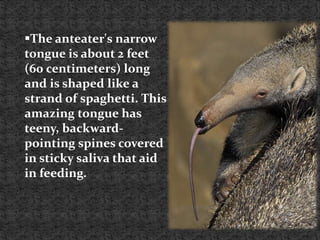
The anteater's narrow
tongue is about 2 feet
(60 centimeters) long
and is shaped like a
strand of spaghetti. This
amazing tongue has
teeny, backward-
pointing spines covered
in sticky saliva that aid
in feeding.
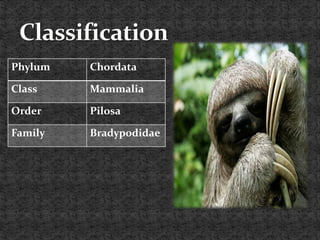
Phylum Chordata
Class Mammalia
Order Pilosa
Family Bradypodidae
 Folivores i.e bulk of their diet consists of
buds, tender shoots & leaves
 Short flat heads, big eyes, short snouts,
stout bodies, long limbs & tiny ears
 Protruding tongues for collecting leaves
 Somnolent animals sleeping for 15-18 hrz
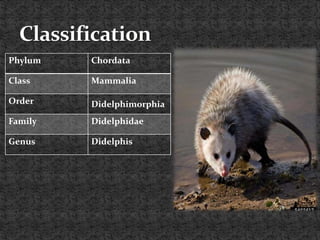
Phylum Chordata
Class Mammalia
Order Didelphimorphia
Family Didelphidae
Genus Didelphis
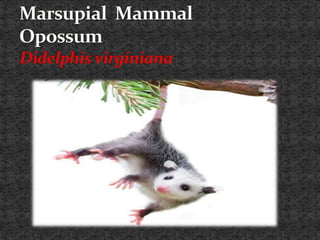
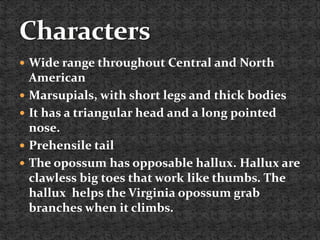
 Wide range throughout Central and North
American
 Marsupials, with short legs and thick bodies
 It has a triangular head and a long pointed
nose.
 Prehensile tail
 The opossum has opposable hallux. Hallux are
clawless big toes that work like thumbs. The
hallux helps the Virginia opossum grab
branches when it climbs.
Efrah

Efrah

  • 2.
  • 5.
  • 8.
    It includes West Coastof South America. It contains Ands mountain ranges Bolivea, Peru, Argentina. It includes tropical forests of South America. It shows evergreen forests. Plains are also seen Rivers are present hence more vegetation is seen. It supports rich fauna. Chillian Sub- region Brazelian Sub- region
  • 9.
    Mexican Sub-region West Indiesor Antelian Sub-region North of isthmus of Panama is called Mexkon sub-region. This region shows rocky mountains. It is showing sub. tropical conditions. in this region Tapiers are common. The region contains West Indies, islands. Trinidad and Tobago are not included in this region. These islands contain mountains. In this sub-region the Vertebrate fauna is poor.
  • 12.
    7 are widelydistributed 16 are unique
  • 14.
    Phylum Chordata Class Mammalia OrderArtiodactyla Family Cervidae Genus Rangifer
  • 15.
     Reindeer alsocalled Caribou in North America  Life span 15 to 18 years  Gestation: 7.5 months  Height: 70 to 135 centimeters  Weight: Females - 55 to 140 kilograms males - 65 to 240 kilograms  They are social creatures. They feed, travel and rest in groups called herds.  Herbivores
  • 16.
    Llama Alpaca L. vicuna L. guanaco PhylumChordata Class Mammalia Order Artiodactyla Family Camelidae
  • 17.
  • 18.
     Ears: analpaca has straight, pointed ears. A llama on the other hand has banana shaped ears.  Wool: Llamas have no wool that is used for garments, rather hair that protects but is not appropriate for a sweater or scarf. Alpacas are bred purely for their luxurious wool which is one of the finest in the world.  Face: The face of an alpaca is a lot fuzzier and woollier than a llamas face. A llamas face is also longer while an alpaca's face is a bit more blunt.  Size: The llama is a lot bigger and can weigh up to 400 pounds while alpacas are a lot lighter and weigh in at around 150 pounds. The llama can have a height of more than 110 cm, alpacas are generally not much taller than 90 cm.
  • 19.
  • 20.
    Color : Thevicuña's long, woolly coat is tawny brown on the back, whereas the hair on the throat and chest is white and quite long. Guanaco color is light brown to dark cinnamon and shading to white underneath. Appearance :The head is slightly shorter than the guanaco's and the ears are slightly longer.
  • 21.
  • 22.
    Phylum Chordata Class Mammalia OrderPerssodactyla Family Tapiridae Genus Tapirus
  • 23.
     Similar topig  dark brown, paler in the face  The round, dark ears have distinctive white edges  Newborn tapirs have a dark brown coat, with small white spots and stripes along the body  Short stubby tail  Herbivorous  Proboscis are highly flexible
  • 24.
  • 25.
    Phylum Chordata Class Mammalia OrderPrimate Family Atelidae Genus Ateles
  • 26.
     Long prehensiletail  Average weight of 11 kilograms for males and 9.66 kg for females.  long, spindly limbs  Heads are small with hairless faces.  The hands are long, narrow and hook-like, and have reduced or non-existent thumbs  The fingers are elongated and recurved.  Eat fruits & leaves, flower & insects  Social Animal
  • 27.
    Phylum Chordata Class Mammalia OrderPrimate Family Cebidae Genus Saimiri
  • 28.
     Squirrel monkeyfur is short and close, colored black at the shoulders and yellowish orange on its back and extremities.  Their throats and ears are white, and their mouths are black.  The upper parts of their heads are hairy.  Both males and females are equipped with long and hairy tails, flat nails, and pointed claws.  squirrel monkeys are diurnal and arboreal.  Omnivores
  • 29.
  • 30.
     Diurnal andarboreal.  Omnivores  Capuchins are black, brown, buff or whitish  length of 30 to 56 cm (12 to 22 in)  most intelligent New World monkeys
  • 32.
    Phylum Chordata Class Mammalia OrderChiroptera Family Phyllostomidae Genus Desmodus
  • 33.
     Sanguivorous habits(feeding on blood)  They have developed a specialized system using infrared-sensitive receptors on their nose-leaf to prey on homeothermic (warm- blooded) vertebrates.  native to the Americas  highly polygynous  dominant adult males defend groups of females.  It is one of the most social of bat species with a number of cooperative behaviors such as social grooming and food sharing.
  • 34.
  • 35.
    Phylum Chordata Class Mammalia OrderCingulata Family Chlamyphoridae Genus Euphractus
  • 36.
     known asthe yellow armadillo  40 and 50 centimeters (16 and 20 in) in body length,  weighs 3.2 to 6.5 kilograms  The armadillo is alert and primarily solitary.  The forefeet have five distinct toes each with moderately developed claws, of which the third is the longest.  the teeth are large and strong and are assisted by strong muscles for chewing.  Diurnal  The carapace is pale yellow to reddish brown marked by scales of equal length, and scantily covered by buff to white bristle-like hairs – unlike the hairy armadillos that are covered by dense hairs.
  • 38.
    Phylum Chordata Class Aves OrderCingulata Family Dasypodidae Genus Dasypus
  • 39.
     Native tosouth and north America  Omnivore  Top speed 48km/h  Size 14-30 inch  Weight 4-30kg  Endangered specie  Armadillos have a low percentage of body fat  warm-blooded mammals  head is covered in hardened skin referred to as scutes
  • 41.
    Phylum Chordata Class Mammalia OrderEdentata Family Myrmecophagidae Genus Myrmecophaga
  • 42.
     Length: 100to 120 centimeters  Weight: 60 to 140 pounds ,males are heavier than females  Tail length: 70 to 90 centimeters  The giant anteater's sense of smell is 40 times more powerful than ours.  Giant anteaters have no teeth, but a specialized tongue allows them to eat up to 30,000 ants and termites each day.  Giant anteaters range from Honduras in Central America to the Gran Chaco region of Bolivia in South America.
  • 43.
    The anteater's narrow tongueis about 2 feet (60 centimeters) long and is shaped like a strand of spaghetti. This amazing tongue has teeny, backward- pointing spines covered in sticky saliva that aid in feeding.
  • 45.
    Phylum Chordata Class Mammalia OrderPilosa Family Bradypodidae
  • 46.
     Folivores i.ebulk of their diet consists of buds, tender shoots & leaves  Short flat heads, big eyes, short snouts, stout bodies, long limbs & tiny ears  Protruding tongues for collecting leaves  Somnolent animals sleeping for 15-18 hrz
  • 48.
    Phylum Chordata Class Mammalia OrderDidelphimorphia Family Didelphidae Genus Didelphis
  • 49.
     Wide rangethroughout Central and North American  Marsupials, with short legs and thick bodies  It has a triangular head and a long pointed nose.  Prehensile tail  The opossum has opposable hallux. Hallux are clawless big toes that work like thumbs. The hallux helps the Virginia opossum grab branches when it climbs.