CLASS AMPHIBIA (CLASSIFICATION)
ORDER GYMNOPHIONA(APODA)
ORDER URODELA(CAUDATA)
ORDER ANURA(SALIENTIA)
B A B I D A A
A S S I S T A N T P R O F E S S O R I N Z O O L O G Y
I Q B A L C O L L E G E P E R I N G A M M A L A
Order Gymnophiona (Apoda)
They are primitive, burrowing forms.
Limbs, limb bones and girdles are absent.
Eyes are rudimentary and nonfunctional and
hence the name blind worms.
Skin is wrinkled or grooved.
Sensory tentacle is found between eye and nostril.
Tail short or absent.
Both jaws possess numerous teeth.
Two pairs of aortic arches are present. They are
connected by a blood vessel called Ductus
Botalli.
Male has protrusible copulatory organ.
Notochord is persistent.
Skull is solid and compact with bony roof.
Vertebrae are amphicoelous and pseudocentrous.
Ribs are long.
Right lung is larger than the left.
Larva has 3 pairs of external gills.
Internal Fertilization.
In some forms Parental care is seen.
Development direct or indirect.
Eg. Ichthyophis, Uraeotyphlus, Siphonops.
ICHTHYOPHIS
It is a limbless Ambhibia.
Indian species –Ichthyophis beddomei (Yellow
striped caecilian or Beddome’s caecilian)
Body is elongated ( 17 cm to 27.5 )
Head is dorsoventrally flattened and trunk is
cylindrical.
The eyes are distinct.
A sensory tentacle is found between eye and
nostril.
Tail is short.
Columella, tympanum,tympanic cavity,limbs,limb
girdles are absent.
Left lung is shorter than right.
Overall body colour is violet or brown. Yellow
stripes are found along the sides.
The skin is folded(240-304). Tail has 5-9 folds.
Cloacal aperture is present close to the tail,
hence there is almost no tail.
It lives under rocks and logs of wood in forests.
It can burrow loose soil and humus.
Male possess Copulatory organ.
Internal Fertilization.
Female is oviparous, eggs are attached by
transparent cords and cords are twisted
together. The female coils around the eggs and
guards them.
ORDER URODELA (CAUDATA)
Urodela consists of Newts and Salamanders.
Body is lizard like.
Two pairs of weak and equal limbs are present.
Exoskeleton is absent.
Both jaws carry teeth.
Vocal cords are absent.
Ribs are present.
Sternum is poorly developed.
In male copulatory organ is present.
Distinct postanal tail is present.
Vertebrae are opisthocoelous or amphicoelous.
Tympanum is absent. Eye lids are absent in terrestrial forms.
Internal fertilization, Larva is aquatic and resembles the
adult in external form.
AMBLYSTOMA (AMBYSTOMA)
They are tailed amphibians, commonly called mole
salamanders.
Tiger salamander –Amblystoma tigrinum
It is found in U S A and Mexico.
Head and trunk are flat and tail is laterally compressed. Tail
fin is absent.
Eyes are well developed.
The parotid glands are modified as poison glands.
Gill slits and external gills are absent.
Forelimb has 4 fingers and hind limbs has 5 toes.
Skin is black and wrinkled.
Yellow spots or stripes are seen in the body.
Females collect spermatophores with its cloacal lip.
Internal fertilization.
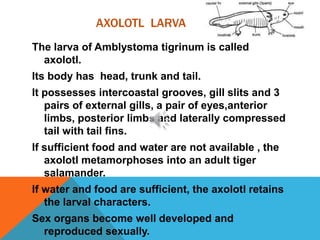
AXOLOTL LARVA
The larva of Amblystoma tigrinum is called
axolotl.
Its body has head, trunk and tail.
It possesses intercoastal grooves, gill slits and 3
pairs of external gills, a pair of eyes,anterior
limbs, posterior limbs and laterally compressed
tail with tail fins.
If sufficient food and water are not available , the
axolotl metamorphoses into an adult tiger
salamander.
If water and food are sufficient, the axolotl retains
the larval characters.
Sex organs become well developed and
reproduced sexually.
ORDER ANURA (SALIENTIA)
They are most successful of the living
ambhibians.
Anura consists of frogs and toads.
Anurans lack tail in adults.
2 pairs of pentadactyl limbs are present.
Hindlimbs are longer than forelimbs and they
are used for leaping and swimming. Toes are
connected by web.
Head and trunk are fused, neck are absent.
Sternum is present. Ribs are rudimentary or
absent.
Skin is naked, scaleless and glandular.
Skull is dicondylic. In adult gills, gill openings are
BUFO
Bufo is the common toad found all over the world except
Australia and Madagaskar.
Bufo melanostictus is the common Indian toad or common
Asian toad..
Adult is tailless.
Head is semicircular with wide mouth, wide nostrils, large
tympanum, and prominent eyes.
Limbs are short and stout.
The toes have horny tips and reduced web. There are no
teeth on the jaws.
Skin is dry ,rough and glandular. Many black tipped horny
warts ortubercles are found all over the body except at
the top and on sides of the head, snout and the region
between the eyes. The sole and toes carry small warts.
Each wart contain many poisonous glands.
Forelimb has 4 fingers and hindlimb has 5 toes.
There is a pair of large parotid gland behind the eyes. They
produce toxins that cause irritation to the enemies.
Adult male has a single vocal sac. Adult is terrestrial and
NASIKABATRACHUS
It is commonly called Purple frog due to its purple hue.
It is a medium sized frog with projecting nose, like snout of
a pig. and hence also the name Pignose frog.
This genus of frog is endemic to Western Ghats of India .
Nasikabatrachus sahyadrensis was described recently
from specimens collected in the Idukki by a team of
scientists .and from the Tropical Botanical Garden ,
Research institute Palode , India.
The specimen with which the species was originally
described was 7 cm long from the tip of the snout to the
vent.
Eyes are small, Tympanum is absent, forelimbs and
hindlimbs are short, hands are rudimentarly webbed
,snout is triangular,
The adult frog emerges at the start of the monsoon to breed,
laying its eggs in small shaded rocky pools .
RHACOPHORUS
Rhacophorus is a genus of frogs in the family Rhacophoridae
They are found in India, Japan, Africa, Madagaskar etc
Rhacophorus malabaricus is also called Malabar gliding frog or
Malabar flying frog.
It is a tree frog species found in the Western Ghats of India.
It is a bright green frog with its black skin is thinly granulated.
It has a body length of about 10 cm, Tympanum is large.
Males are smaller than females.
Snout is rounded and nostris are located nearer to the end of the
snout .
These frogs have long toes with strong webbing between them,
enabling the animals to slow their fall to a glide, parachuting. So
they are called flying frogs.
The webbing between fingers and toes is large and orange-red.In
colour, with adhesive discs at the tips.
THANK YOU

Class Amphibia

  • 1.
    CLASS AMPHIBIA (CLASSIFICATION) ORDERGYMNOPHIONA(APODA) ORDER URODELA(CAUDATA) ORDER ANURA(SALIENTIA) B A B I D A A A S S I S T A N T P R O F E S S O R I N Z O O L O G Y I Q B A L C O L L E G E P E R I N G A M M A L A
  • 2.
    Order Gymnophiona (Apoda) Theyare primitive, burrowing forms. Limbs, limb bones and girdles are absent. Eyes are rudimentary and nonfunctional and hence the name blind worms. Skin is wrinkled or grooved. Sensory tentacle is found between eye and nostril. Tail short or absent. Both jaws possess numerous teeth. Two pairs of aortic arches are present. They are connected by a blood vessel called Ductus Botalli. Male has protrusible copulatory organ.
  • 3.
    Notochord is persistent. Skullis solid and compact with bony roof. Vertebrae are amphicoelous and pseudocentrous. Ribs are long. Right lung is larger than the left. Larva has 3 pairs of external gills. Internal Fertilization. In some forms Parental care is seen. Development direct or indirect. Eg. Ichthyophis, Uraeotyphlus, Siphonops.
  • 4.
    ICHTHYOPHIS It is alimbless Ambhibia. Indian species –Ichthyophis beddomei (Yellow striped caecilian or Beddome’s caecilian) Body is elongated ( 17 cm to 27.5 ) Head is dorsoventrally flattened and trunk is cylindrical. The eyes are distinct. A sensory tentacle is found between eye and nostril. Tail is short. Columella, tympanum,tympanic cavity,limbs,limb girdles are absent. Left lung is shorter than right.
  • 5.
    Overall body colouris violet or brown. Yellow stripes are found along the sides. The skin is folded(240-304). Tail has 5-9 folds. Cloacal aperture is present close to the tail, hence there is almost no tail. It lives under rocks and logs of wood in forests. It can burrow loose soil and humus. Male possess Copulatory organ. Internal Fertilization. Female is oviparous, eggs are attached by transparent cords and cords are twisted together. The female coils around the eggs and guards them.
  • 6.
    ORDER URODELA (CAUDATA) Urodelaconsists of Newts and Salamanders. Body is lizard like. Two pairs of weak and equal limbs are present. Exoskeleton is absent. Both jaws carry teeth. Vocal cords are absent. Ribs are present. Sternum is poorly developed. In male copulatory organ is present. Distinct postanal tail is present. Vertebrae are opisthocoelous or amphicoelous. Tympanum is absent. Eye lids are absent in terrestrial forms. Internal fertilization, Larva is aquatic and resembles the adult in external form.
  • 7.
    AMBLYSTOMA (AMBYSTOMA) They aretailed amphibians, commonly called mole salamanders. Tiger salamander –Amblystoma tigrinum It is found in U S A and Mexico. Head and trunk are flat and tail is laterally compressed. Tail fin is absent. Eyes are well developed. The parotid glands are modified as poison glands. Gill slits and external gills are absent. Forelimb has 4 fingers and hind limbs has 5 toes. Skin is black and wrinkled. Yellow spots or stripes are seen in the body. Females collect spermatophores with its cloacal lip. Internal fertilization.
  • 8.
    AXOLOTL LARVA The larvaof Amblystoma tigrinum is called axolotl. Its body has head, trunk and tail. It possesses intercoastal grooves, gill slits and 3 pairs of external gills, a pair of eyes,anterior limbs, posterior limbs and laterally compressed tail with tail fins. If sufficient food and water are not available , the axolotl metamorphoses into an adult tiger salamander. If water and food are sufficient, the axolotl retains the larval characters. Sex organs become well developed and reproduced sexually.
  • 9.
    ORDER ANURA (SALIENTIA) Theyare most successful of the living ambhibians. Anura consists of frogs and toads. Anurans lack tail in adults. 2 pairs of pentadactyl limbs are present. Hindlimbs are longer than forelimbs and they are used for leaping and swimming. Toes are connected by web. Head and trunk are fused, neck are absent. Sternum is present. Ribs are rudimentary or absent. Skin is naked, scaleless and glandular. Skull is dicondylic. In adult gills, gill openings are
  • 10.
    BUFO Bufo is thecommon toad found all over the world except Australia and Madagaskar. Bufo melanostictus is the common Indian toad or common Asian toad.. Adult is tailless. Head is semicircular with wide mouth, wide nostrils, large tympanum, and prominent eyes. Limbs are short and stout. The toes have horny tips and reduced web. There are no teeth on the jaws. Skin is dry ,rough and glandular. Many black tipped horny warts ortubercles are found all over the body except at the top and on sides of the head, snout and the region between the eyes. The sole and toes carry small warts. Each wart contain many poisonous glands. Forelimb has 4 fingers and hindlimb has 5 toes. There is a pair of large parotid gland behind the eyes. They produce toxins that cause irritation to the enemies. Adult male has a single vocal sac. Adult is terrestrial and
  • 11.
    NASIKABATRACHUS It is commonlycalled Purple frog due to its purple hue. It is a medium sized frog with projecting nose, like snout of a pig. and hence also the name Pignose frog. This genus of frog is endemic to Western Ghats of India . Nasikabatrachus sahyadrensis was described recently from specimens collected in the Idukki by a team of scientists .and from the Tropical Botanical Garden , Research institute Palode , India. The specimen with which the species was originally described was 7 cm long from the tip of the snout to the vent. Eyes are small, Tympanum is absent, forelimbs and hindlimbs are short, hands are rudimentarly webbed ,snout is triangular, The adult frog emerges at the start of the monsoon to breed, laying its eggs in small shaded rocky pools .
  • 12.
    RHACOPHORUS Rhacophorus is agenus of frogs in the family Rhacophoridae They are found in India, Japan, Africa, Madagaskar etc Rhacophorus malabaricus is also called Malabar gliding frog or Malabar flying frog. It is a tree frog species found in the Western Ghats of India. It is a bright green frog with its black skin is thinly granulated. It has a body length of about 10 cm, Tympanum is large. Males are smaller than females. Snout is rounded and nostris are located nearer to the end of the snout . These frogs have long toes with strong webbing between them, enabling the animals to slow their fall to a glide, parachuting. So they are called flying frogs. The webbing between fingers and toes is large and orange-red.In colour, with adhesive discs at the tips.
  • 13.