ANIMAL ADAPTATIONS TO
ENVIRONMENTAL CHANGES
STRUCTURAL ADAPTATIONS
GARRY D. LASAGA
Reporter
ENVIRONMENTAL STRESSES
AFFECTING LIVESTOCK
MAJOR
ENVIRONMENTAL
STRESS
HEAT STRESS
NUTRITION
STRESS
Seijan et al., 2010
Heat Stress
Seijan, 2012
HEAT STRESS
Reduced milk
protein
Reduced milk fat Reduced SCC
MILK PROD’N
Reduced SNF
Lam et al., 2010
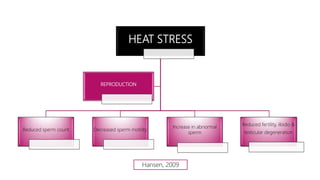
HEAT STRESS
Reduced sperm count Decreased sperm motility
Increase in abnormal
sperm
REPRODUCTION
Reduced fertility, libido &
testicular degeneration
Hansen, 2009
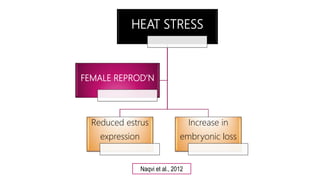
HEAT STRESS
Reduced estrus
expression
Increase in
embryonic loss
FEMALE REPROD’N
Naqvi et al., 2012
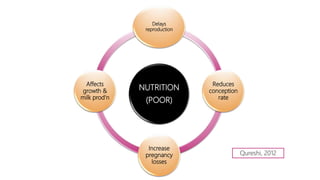
NUTRITION
(POOR)
Delays
reproduction
Reduces
conception
rate
Increase
pregnancy
losses
Affects
growth &
milk prod’n
Qureshi, 2012
MORPHOLOGICAL
ADAPTATION OF LIVESTOCK
Body sizeSkin colour
Fat storage
in hump or
tail
External
insulation
Key morphological adaptation of the animal (Khalifa, 2003)
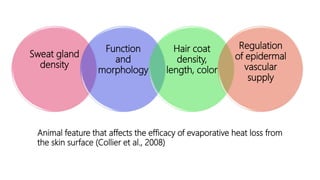
Sweat gland
density
Function
and
morphology
Hair coat
density,
length, color
Regulation
of epidermal
vascular
supply
Animal feature that affects the efficacy of evaporative heat loss from
the skin surface (Collier et al., 2008)
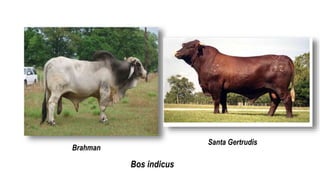
Bos indicus
Santa Gertrudis
Brahman
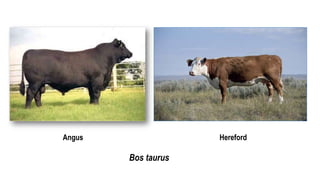
Angus Hereford
Bos taurus
Sweat gland
 Potential source through which heat is being
dissipated (Nay & Hayman, 1956).
 Increase in blood flow enables heat transfer to
the skin and sweat production (Johnson & Hales,
1983).
Adaptation (Sweat gland)
Sweating rates were found to be more in Bos
indicus (Finch, 1985).
 *Transfer of metabolic heat to the skin occurs
at a lower rate in Bos taurus than in Bos indicus.
Adaptation (Sweat gland)
Crossbred (Bos taurus × Bos indicus) cattle had
larger, more sweat glands and greater sweat
production than pure-bred Bos taurus (Nay &
Hayman, 1956).
Hair coat
Affects the heat transfer from the skin to
the adjacent environment (Hidalgo, 2009).
Breeds of cattle with short, sleek hair coats
possess higher thermo-tolerance than
those of unadapted temperate breeds
(Lucena & Olson, 2000).
Hair coat (depth)
An increase in coat depth from 3 to 10 mm
reduced the sensible heat loss in cattle by
17% at 20°C.
Turnpenny et al. (2000)
Hair coat (thickness)
da Silva, [51] reported that coat layer
thickness was found to be greater for
animals bred in temperate regions, more
than 15 mm, while the same breed adapted
to tropical climates present very thin coats,
less than 8 mm deep. )
Hair density, length, color
Bos taurus (morphological adaptations)
 Short hair & thin hair
 Pigmented skin
 Short ears with tiny hair
 Movable & slender tail
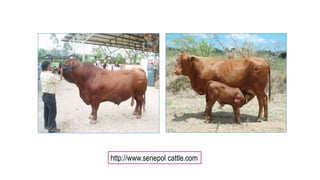
Slick hair gene
 A thermo-tolerant gene that is responsible
for the short, shiny, hair coat of the
Senepol and other breeds.
http://www.senepol cattle.com
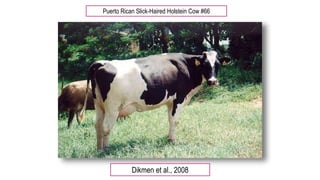
Puerto Rican Slick-Haired Holstein Cow #66
Dikmen et al., 2008
Zebu cattle
Reduced metabolic rate, decreased
resistance to flow of heat from the core to
the periphery and salient features of the
hair coat [light & sleek] (Hansen, 2004).
Buffalo
 Poor heat tolerant capacity
 Susceptible to heat stress
*Scarce and unevenly spread sweat glands,
dark skin and sparse hair on body surface.
Ganaie et al. (2013)
Buffalo
 Poor heat tolerant capacity
 Susceptible to heat stress
*Scarce and unevenly spread sweat glands,
dark skin and sparse hair on body surface.
Ganaie et al. (2013)
Reference
 Abdul Niyas, P.A., K. Chaidanya, S. Shaji,
V. Sejian, R. Bhatta, M. Bagath, G. S. Rao,
E. K. Kurien, and V. Girish. 2015.
Adaptation of livestock to environmental
challenges. J Vet Sci Med Diagn 4:3. doi:
10.4172/2325-9590.1000162
References
 Dikmen, S., E. Alava, E. Pontes, J. M. Fear, B.
Y. Dikmen, T. A. Olson, and P. J. Hansen.
Differences in thermoregulatory ability
between slick-haired and wild-type lactating
Holstein cows in response to acute heat
stress. J. Dairy Sci. 91:3395–3402
doi:10.3168/jds.2008-1072

Animal Adaptations to Environmental Changes

Editor's Notes

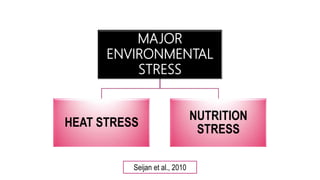
  • #4 Major environmental stresses affecting production and reproduction of livestock are heat and nutrition stress.
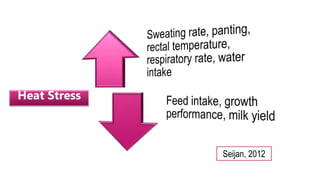
  • #5 Effects of heat stress in livestock are reduced feed intake, growth performance, milk yield, increased sweating rate, panting, rectal temperature, respiratory rate, and water intake. The effects of heat stress on growth performance are due to decrease in anabolic activity caused by decline in voluntary feed intake, and increase in tissue catabolism. Further, heat stress causes reduction in the body condition score (BCS) due to negative energy balance. Factors such as, greater maintenance requirements during hot weather, poor appetite and low quality forages during summer months contributes to the slower growth and reduced body size.
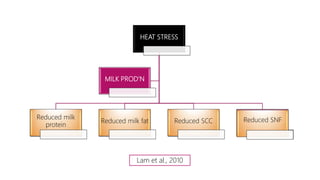
  • #6 Heat stress significantly reduce milk protein, fat, somatic cell count (SCC) and solid not fat (SNF) in dairy cattle.
  • #7 Heat stress negatively affects reproduction in livestock. Increase in testicular temperature results in reduced sperm output, decreased sperm motility and increase in proportion of morphologically abnormal spermatozoa in the ejaculate. Spermatocyte and spermatid are the cells that are most prone to damage during heat stress. Further, heat stress also results in reduced fertility, libido and testicular degeneration.
  • #8 Female reproductive system have been found to be susceptible to heat stress in female animals. These include the estrus incidences, oocyte, granulosa and theca cells within the preovulatory follicle, developing embryo during early stages of development, corpus luteum and uterine endometrium. Under heat stress, estrous expression is reduced and increase in loss of embryo. In addition, heat stress also severely reduces the blood reproductive hormones, conception and calving rates.
  • #9 Nutrition has a major role in the production performance of livestock. Environmental factors such as decline in rainfall and drought will affect pasture availability and eventually the nutrition requirements of animals. Nutritional stress affects reproduction, growth and milk production. Poor nutrition delays puberty reduces conception rate and increases pregnancy losses in cattle. Young animals are more sensitive to nutritional stress as the adaptive mechanisms will be poorly developed in the young animals.
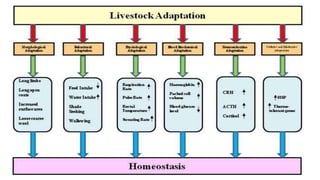
  • #10 Livestock has been proved to adapt to a variety of environmental extremities. The adaptation process can be classified into six categories such as anatomical, morphological, physiological, feeding behavior, metabolism, and performance.
  • #13 BRAHMAN. BOS INDICUS: A subspecies of cattle of south Asian origin. Often known as Zebu, they have prominent humps forward of the shoulder. The Brahman breed is one example in the U.S. In terms of heat tolerance, they are well adapted to high heat and humidity. *Indian breeds of cattle like Bos indicus perform well in hot climate compared to exotic cattle Bos Taurus, primarily due to their ability to survive in unfavorable environments.
  • #14 Adaptation: Not well adapted to hot, humid climate
  • #15 SWEAT GLAND DENSITY Importance of sweat gland: According to Nay and Hayman [43] sweat glands were described as the potential source through which the heat is being dissipated. Johnson and Hales [44] added that the increase in blood flow to the sweat glands enables heat transfer to the skin and results in sweat production.
  • #16 SWEAT GLAND DENSITY (Example of adaptation of a species of animal to environmental change, i.e. heat stress – 2 breeds of cattle- Bos indicus & Bos taurus). Finch [1985] observed that sweating rates were found to be more in tropically adapted Bos indicus compared to temperate zone. This is because the transfer of metabolic heat to the skin occurs at a lower rate in Bos taurus than in Bos indicus cattle.
  • #17 A study depicted that crossbred (Bos taurus × Bos indicus) cattle had larger and more sweat glands per unit area of the skin as well as greater sweat production than pure-bred Bos taurus (Nay & Hayman, 1956).
  • #18 HAIR COAT – it is important because the characteristics of the hair coat affects the heat transfer from the skin to the adjacent environment and thereby regulation of the body temperature. Studies conducted in Florida (Lucena & Olson, 2000) depicted that breeds of cattle with short, sleek hair coats possess higher thermo-tolerance than those of unadapted temperate breeds.
  • #19 Turnpenny et al. (2000) reported coat depth to be an important factor and suggested that an increase in coat depth from 3 to 10 mm reduced the sensible heat loss in cattle by 17% at 20°C.
  • #20 da Silva ()[51] reported that coat layer thickness was found to be greater for animals bred in temperate regions, more than 15 mm, while the same breed adapted to tropical climates present very thin coats, less than 8 mm deep. )
  • #21 Example: Bos indicus & Bos taurus Short hair and thin hair, pigmented skin, short ears with tiny hair, movable and slender tail were found to be the morphological adaptations of Bos taurus cattle which resulted in enhanced heat loss (Gaughan, 2012).
  • #22 Cattle with slick hair coats experience lower body temperatures in heat stress conditions. The superior thermoregulatory ability associated with the slick phenotype is apparently the result of increased convective and conductive heat loss and decreased absorption of solar radiation.
  • #23 Senepol is one of the breeds of cattle having a slick hair gene. Although it is a Bos Taurus breed, in terms of heat tolerance, ideal for tropical climates; and it graze throughout heat of day partly due to this type of gene.
  • #24 The slick hair gene was introduced into Holstein cattle by crossbreeding. A research study was conducted in 2008, wherein slick-haired Holsteins were compared with the wild type Holsteins in terms of its ability to regulate body temperature when exposed to an acute increase of heat stress. The study revealed that Slick Holsteins are better able to regulated body temperature during heat stress than cows with normall hair. Results indicate that slick-haired Holstein cows can regulate body temperature more effectively than wild-type cows during heat stress. One reason slick-haired animals are better able to regulate body temperature is increased sweating rate.
  • #25 Hansen (2004) reported that the reduced metabolic rate, decreased resistance to flow of heat from the core to the periphery of the body and the salient features of the hair coat ensured the thermoregulatory mechanism to be superior in case of Zebu cattle.
  • #26 Ganaie et al. [22] added that buffaloes had poor heat tolerant capacity compared to other domestic ruminants and were susceptible to heat stress due to scarce and unevenly spread sweat glands, dark skin and sparse hair on their body surface.
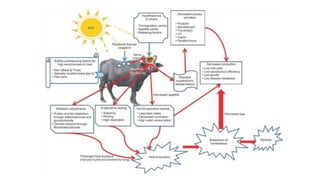
  • #27 Physiological responses in buffalo in response to heat stress.
  • #28 Ganaie et al. [22] added that buffaloes had poor heat tolerant capacity compared to other domestic ruminants and were susceptible to heat stress due to scarce and unevenly spread sweat glands, dark skin and sparse hair on their body surface.