 CHANGE IN STATE
 CHANGE IN COLOUR
 EVOLUTION OF GAS
 CHANGE IN TEMPRETURE
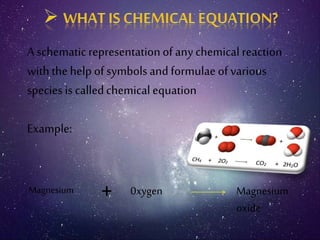
A schematicrepresentationof anychemical reaction
withthe help ofsymbolsand formulae of various
species is calledchemicalequation
Example:
Magnesium + 0xygen Magnesium
oxide
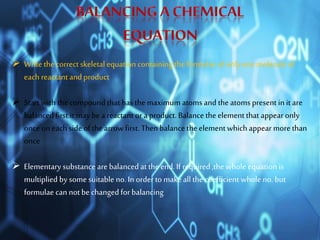
 Write the correct skeletal equation containing the formulae of only onemolecule of
each reactant and product
 Start with the compound that has the maximum atoms and the atoms present in it are
balanced first.it may bea reactant or a product. Balance the element that appear only
onceon each side of the arrow first. Then balance the element which appear more than
once
 Elementary substance are balancedat the end. If required ,the whole equation is
multiplied by some suitable no. In orderto makeall the coefficient whole no. but
formulae can not be changedfor balancing
C
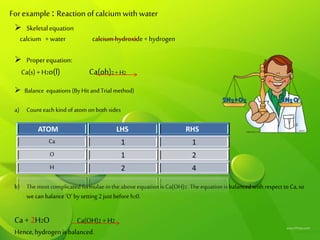
Forexample : Reaction of calcium with water
 Skeletalequation
calcium + water calcium hydroxide+ hydrogen
 Properequation:
Ca(s) +H2o(l) Ca(oh)2 + H2
 Balance equations (By Hit and Trial method)
a) Count each kindof atom on both sides
b) Themost complicated formulaein the above equation is Ca(OH)2 . Theequation is balancedwith respect to Ca,so
wecan balance ‘O’ by setting 2 just before h20.
Ca +2H2O Ca(OH)2 + H2
Hence, hydrogenis balanced.
ATOM LHS RHS
Ca 1 1
O 1 2
H 2 4
C
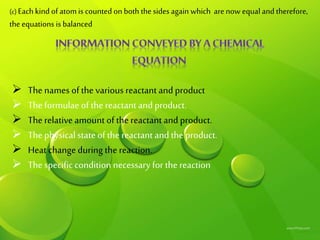
(c) Each kind of atom is counted on both the sides again which arenow equal and therefore,
the equations is balanced
 The names of the various reactant and product
 The formulae of the reactant and product.
 The relative amount of the reactant and product.
 The physical state of the reactant and the product.
 Heat change during the reaction.
 The specific condition necessary for the reaction
reactan
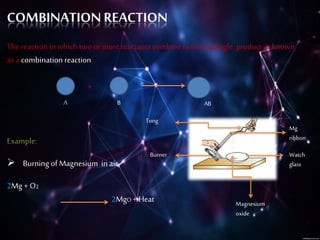
Thereaction in which two ormore reactants combine to form a single product is known
as a combination reaction.
+
A B AB
Magnesium
oxide
Watch
glass
Burner
Mg
ribbon
Tong
Example:
 Burning of Magnesium in air
2Mg + O2
2MgO + Heat
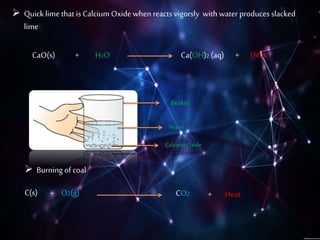
 Quick lime that is Calcium Oxide when reacts vigorsly with water produces slacked
lime
CaO(s) + H2O Ca(OH)2 (aq) + Heat
Beaker
Water
CalciumOxide
 Burning ofcoal
C(s) + O2(g) CO2 + Heat
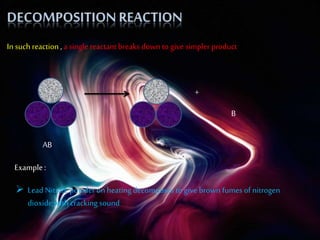
In such reaction ,a single reactant breaks down to givesimplerproduct
+
AB
B
A
Example :
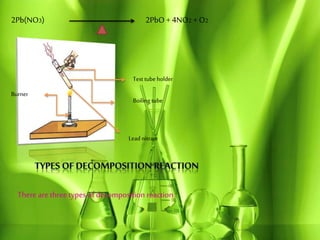
 Lead Nitrate powder onheating decomposes to givebrown fumes of nitrogen
dioxide with cracking sound
2Pb(NO3) 2PbO + 4NO2 +O2
Test tube holder
Boiling tube
Lead nitrate
Burner
There arethree types of decomposition reaction :
io
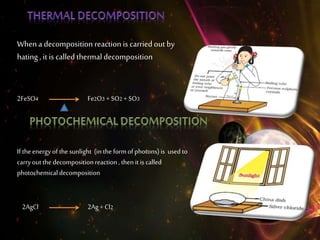
When a decomposition reaction is carriedoutby
hating , it is called thermal decomposition
2FeSO4 Fe2O3 + SO2 + SO3
If theenergy of thesunlight (in the formofphotons)is usedto
carryoutthe decompositionreaction, thenit is called
photochemicaldecomposition
2AgCl 2Ag +Cl2
io
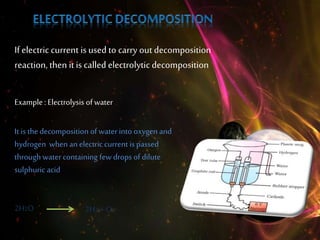
If electric current isused to carry out decomposition
reaction, then it is calledelectrolytic decomposition
Example : Electrolysis of water
It is the decomposition of water into oxygen and
hydrogen when an electric current is passed
through water containing few drops of dilute
sulphuric acid
2H2O 2H2 + O2
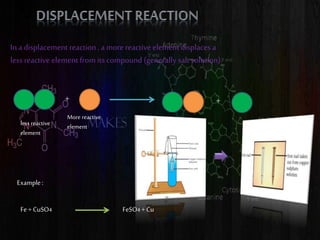
In a displacement reaction , a more reactive elementdisplaces a
less reactive element from its compound (generally salt solution)
+ +
less reactive
element
More reactive
element
Example:
Fe +CuSO4 FeSO4 + Cu
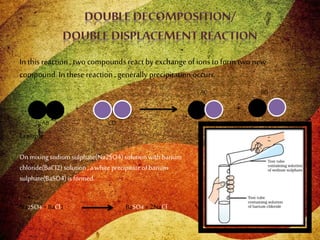
In this reaction , two compounds react by exchangeof ions to form two new
compound. In these reaction , generally precipitation occurs.
+ +
Example:
On mixing sodiumsulphate(Na2SO4)solutionwith barium
chloride(BaCl2) solution, awhite precipitateofbarium
sulphate(BaSO4)is formed.
Na2SO4 +BaCl2 BaSO4 +2NaCl
AB CD
AC BD
O
Old concept
Oxidation: Additionofoxygenor electronegativeelement toasubstanceorremoval ofhydrogenor
electropositiveelement fromthesubstanceis called oxidation
Reduction: Additionofelectropositiveelement or hydrogenin an element or removalof oxygenor
electronegativeelement fromasubstanceis called reduction.
CuO+ H2 Cu +H2O
Oxidation
Reduction
O
Modern concept:
Oxidation:Loss of electrons from an element orincrease in +veelectrovalency of an
element is called oxidation.
Reduction:Gain ofelectron by an element (like Na,K,Mg) or removal ofan
electronegative element
Redox reaction: The reaction in which oxidation and reduction takes place
simultaneously are known as redox reaction.
Corrosion:Theslow eating upofmetals bytheactionofair,moistureorachemical ontheir surfaceis
called corrosion.
(1) Ironarticlesget coatedwithareddish brownpowderwhen leftopen in moistair fora long time .This
processis commonlyknownasrusting ofiron
2Fe+ 3/2O2 + XH2O Fe2O3 .XH2O ;whereX = No.of watermolecules
Rancidity: Foodmaterialcontainingfator oil whenleft foralong time become rancidi.e.smell
andtastechanges.This isbecausetheyget oxidisedwhen theycamein contactwiththe
atmosphericoxygen. Thisis called rancidity
Some other reaction…….
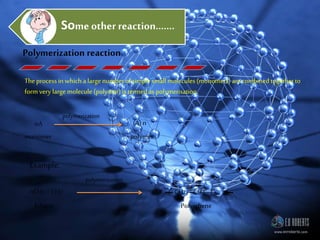
Polymerization reaction
The processin which alargenumberofsimplesmall molecules (monomers) arecombined togetherto
formvery large molecule (polymer)is termedaspolymerisation.
nA
polymerization
(A) n
monomer polymer
Example:
nCH2 = CH2
Ethene
( CH2 – CH2 )
Polyethene
polymerization
eaction
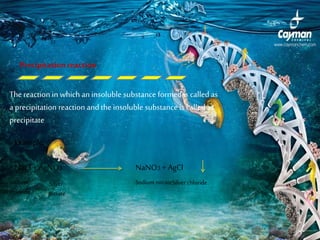
Precipitation reaction
Thereaction in which an insoluble substance formedis called as
a precipitation reaction and the insoluble substance is called as
precipitate
Example:
NaCl + AgNO3 NaNO3 + AgCl
sodium
chloride
Silver
nitrate
Sodium nitrateSilver chloride
Chemical reaction and equations(class 10th)

Chemical reaction and equations(class 10th)

  • 2.
     CHANGE INSTATE  CHANGE IN COLOUR  EVOLUTION OF GAS  CHANGE IN TEMPRETURE
  • 3.
    A schematicrepresentationof anychemicalreaction withthe help ofsymbolsand formulae of various species is calledchemicalequation Example: Magnesium + 0xygen Magnesium oxide
  • 5.
     Write thecorrect skeletal equation containing the formulae of only onemolecule of each reactant and product  Start with the compound that has the maximum atoms and the atoms present in it are balanced first.it may bea reactant or a product. Balance the element that appear only onceon each side of the arrow first. Then balance the element which appear more than once  Elementary substance are balancedat the end. If required ,the whole equation is multiplied by some suitable no. In orderto makeall the coefficient whole no. but formulae can not be changedfor balancing
  • 6.
    C Forexample : Reactionof calcium with water  Skeletalequation calcium + water calcium hydroxide+ hydrogen  Properequation: Ca(s) +H2o(l) Ca(oh)2 + H2  Balance equations (By Hit and Trial method) a) Count each kindof atom on both sides b) Themost complicated formulaein the above equation is Ca(OH)2 . Theequation is balancedwith respect to Ca,so wecan balance ‘O’ by setting 2 just before h20. Ca +2H2O Ca(OH)2 + H2 Hence, hydrogenis balanced. ATOM LHS RHS Ca 1 1 O 1 2 H 2 4
  • 7.
    C (c) Each kindof atom is counted on both the sides again which arenow equal and therefore, the equations is balanced  The names of the various reactant and product  The formulae of the reactant and product.  The relative amount of the reactant and product.  The physical state of the reactant and the product.  Heat change during the reaction.  The specific condition necessary for the reaction
  • 8.
  • 9.
    Thereaction in whichtwo ormore reactants combine to form a single product is known as a combination reaction. + A B AB Magnesium oxide Watch glass Burner Mg ribbon Tong Example:  Burning of Magnesium in air 2Mg + O2 2MgO + Heat
  • 10.
     Quick limethat is Calcium Oxide when reacts vigorsly with water produces slacked lime CaO(s) + H2O Ca(OH)2 (aq) + Heat Beaker Water CalciumOxide  Burning ofcoal C(s) + O2(g) CO2 + Heat
  • 11.
    In such reaction,a single reactant breaks down to givesimplerproduct + AB B A Example :  Lead Nitrate powder onheating decomposes to givebrown fumes of nitrogen dioxide with cracking sound
  • 12.
    2Pb(NO3) 2PbO +4NO2 +O2 Test tube holder Boiling tube Lead nitrate Burner There arethree types of decomposition reaction :
  • 13.
    io When a decompositionreaction is carriedoutby hating , it is called thermal decomposition 2FeSO4 Fe2O3 + SO2 + SO3 If theenergy of thesunlight (in the formofphotons)is usedto carryoutthe decompositionreaction, thenit is called photochemicaldecomposition 2AgCl 2Ag +Cl2
  • 14.
    io If electric currentisused to carry out decomposition reaction, then it is calledelectrolytic decomposition Example : Electrolysis of water It is the decomposition of water into oxygen and hydrogen when an electric current is passed through water containing few drops of dilute sulphuric acid 2H2O 2H2 + O2
  • 15.
    In a displacementreaction , a more reactive elementdisplaces a less reactive element from its compound (generally salt solution) + + less reactive element More reactive element Example: Fe +CuSO4 FeSO4 + Cu
  • 16.
    In this reaction, two compounds react by exchangeof ions to form two new compound. In these reaction , generally precipitation occurs. + + Example: On mixing sodiumsulphate(Na2SO4)solutionwith barium chloride(BaCl2) solution, awhite precipitateofbarium sulphate(BaSO4)is formed. Na2SO4 +BaCl2 BaSO4 +2NaCl AB CD AC BD
  • 17.
    O Old concept Oxidation: Additionofoxygenorelectronegativeelement toasubstanceorremoval ofhydrogenor electropositiveelement fromthesubstanceis called oxidation Reduction: Additionofelectropositiveelement or hydrogenin an element or removalof oxygenor electronegativeelement fromasubstanceis called reduction. CuO+ H2 Cu +H2O Oxidation Reduction
  • 18.
    O Modern concept: Oxidation:Loss ofelectrons from an element orincrease in +veelectrovalency of an element is called oxidation. Reduction:Gain ofelectron by an element (like Na,K,Mg) or removal ofan electronegative element Redox reaction: The reaction in which oxidation and reduction takes place simultaneously are known as redox reaction.
  • 19.
    Corrosion:Theslow eating upofmetalsbytheactionofair,moistureorachemical ontheir surfaceis called corrosion. (1) Ironarticlesget coatedwithareddish brownpowderwhen leftopen in moistair fora long time .This processis commonlyknownasrusting ofiron 2Fe+ 3/2O2 + XH2O Fe2O3 .XH2O ;whereX = No.of watermolecules Rancidity: Foodmaterialcontainingfator oil whenleft foralong time become rancidi.e.smell andtastechanges.This isbecausetheyget oxidisedwhen theycamein contactwiththe atmosphericoxygen. Thisis called rancidity
  • 20.
    Some other reaction……. Polymerizationreaction The processin which alargenumberofsimplesmall molecules (monomers) arecombined togetherto formvery large molecule (polymer)is termedaspolymerisation. nA polymerization (A) n monomer polymer Example: nCH2 = CH2 Ethene ( CH2 – CH2 ) Polyethene polymerization
  • 21.
    eaction Precipitation reaction Thereaction inwhich an insoluble substance formedis called as a precipitation reaction and the insoluble substance is called as precipitate Example: NaCl + AgNO3 NaNO3 + AgCl sodium chloride Silver nitrate Sodium nitrateSilver chloride