Orthographic Drawing
Grade 9 - TLE
Prepred by:
Ms. Arlyn P. Bonifacio
TLE Teacher
Objectives
• Define orthographic drawing.
• Explain the importance of the alphabet of
lines in constructing orthographic figures.
• Define pictorial drawing.
• Draw different kinds of pictorial drawing.
• Explain the basic principles of pattern
development.
Orthographic Drawing
• The term Orthographic is derived from two
Greek Works:
“Straight”
“to draw”
“…it describes a type of drawing
represented only by lines without shading
or rendering.”
What is orthographic Drawing?
Is the method of representing the exact
shape and size of a given object in one or
several views.
Others call it “multi-view drawing” because
it represents not only one but several
views which are projections of an object as
observed in one surface.
WHAT IS ALPHABET
OF LINES
• The basis of all drawings is lines.
• Many different lines are used even in
sample drawings.
• All lines should be made so clearly that
there will be no doubt of their meaning
when the drawing is read.
Alphabet of Lines
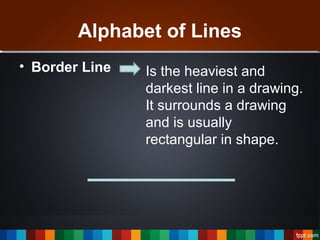
• Border Line Is the heaviest and
darkest line in a drawing.
It surrounds a drawing
and is usually
rectangular in shape.
Alphabet of Lines
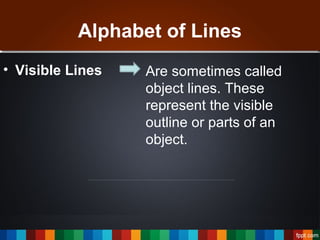
• Visible Lines Are sometimes called
object lines. These
represent the visible
outline or parts of an
object.
Alphabet of Lines
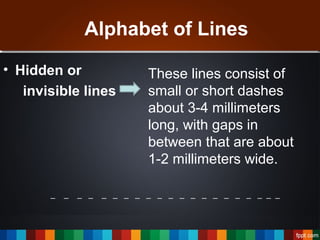
• Hidden or
invisible lines
These lines consist of
small or short dashes
about 3-4 millimeters
long, with gaps in
between that are about
1-2 millimeters wide.
_ _ _ _ _ _ _ _ _ _ _ _ _ _ _ _ _ _ _ _ _
Alphabet of Lines
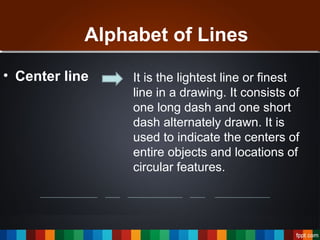
• Center line It is the lightest line or finest
line in a drawing. It consists of
one long dash and one short
dash alternately drawn. It is
used to indicate the centers of
entire objects and locations of
circular features.
Alphabet of Lines
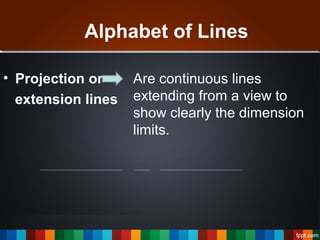
• Projection or
extension lines
Are continuous lines
extending from a view to
show clearly the dimension
limits.
Alphabet of Lines
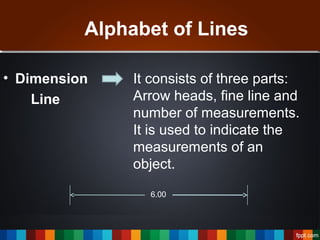
• Dimension
Line
It consists of three parts:
Arrow heads, fine line and
number of measurements.
It is used to indicate the
measurements of an
object.
6.00
Alphabet of Lines
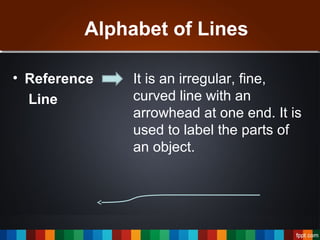
• Reference
Line
It is an irregular, fine,
curved line with an
arrowhead at one end. It is
used to label the parts of
an object.
Alphabet of Lines
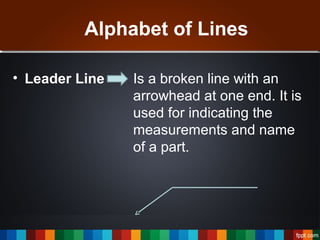
• Leader Line Is a broken line with an
arrowhead at one end. It is
used for indicating the
measurements and name
of a part.
Alphabet of Lines
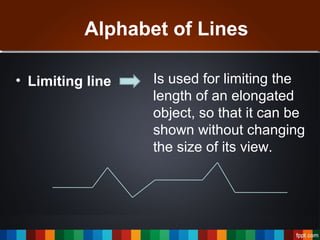
• Limiting line Is used for limiting the
length of an elongated
object, so that it can be
shown without changing
the size of its view.

Drafting no. 1

  • 1.
    Orthographic Drawing Grade 9- TLE Prepred by: Ms. Arlyn P. Bonifacio TLE Teacher
  • 2.
    Objectives • Define orthographicdrawing. • Explain the importance of the alphabet of lines in constructing orthographic figures. • Define pictorial drawing. • Draw different kinds of pictorial drawing. • Explain the basic principles of pattern development.
  • 3.
    Orthographic Drawing • Theterm Orthographic is derived from two Greek Works: “Straight” “to draw” “…it describes a type of drawing represented only by lines without shading or rendering.”
  • 4.
    What is orthographicDrawing? Is the method of representing the exact shape and size of a given object in one or several views. Others call it “multi-view drawing” because it represents not only one but several views which are projections of an object as observed in one surface.
  • 5.
    WHAT IS ALPHABET OFLINES • The basis of all drawings is lines. • Many different lines are used even in sample drawings. • All lines should be made so clearly that there will be no doubt of their meaning when the drawing is read.
  • 6.
    Alphabet of Lines •Border Line Is the heaviest and darkest line in a drawing. It surrounds a drawing and is usually rectangular in shape.
  • 7.
    Alphabet of Lines •Visible Lines Are sometimes called object lines. These represent the visible outline or parts of an object.
  • 8.
    Alphabet of Lines •Hidden or invisible lines These lines consist of small or short dashes about 3-4 millimeters long, with gaps in between that are about 1-2 millimeters wide. _ _ _ _ _ _ _ _ _ _ _ _ _ _ _ _ _ _ _ _ _
  • 9.
    Alphabet of Lines •Center line It is the lightest line or finest line in a drawing. It consists of one long dash and one short dash alternately drawn. It is used to indicate the centers of entire objects and locations of circular features.
  • 10.
    Alphabet of Lines •Projection or extension lines Are continuous lines extending from a view to show clearly the dimension limits.
  • 11.
    Alphabet of Lines •Dimension Line It consists of three parts: Arrow heads, fine line and number of measurements. It is used to indicate the measurements of an object. 6.00
  • 12.
    Alphabet of Lines •Reference Line It is an irregular, fine, curved line with an arrowhead at one end. It is used to label the parts of an object.
  • 13.
    Alphabet of Lines •Leader Line Is a broken line with an arrowhead at one end. It is used for indicating the measurements and name of a part.
  • 14.
    Alphabet of Lines •Limiting line Is used for limiting the length of an elongated object, so that it can be shown without changing the size of its view.