Made By:-
Pranav,Mahesh,Prashant,
Swapnil,Ashutosh
FE.Electronics
SOLID WASTE MANAGEMENT
PLAN OF PRESENTATION
• Introduction to waste and types
• Solid waste
• Types of solid waste
• Effects of solid waste
• Concept of 3R
• solid waste management
a) storage
b) collection
c) waste handling and transport
d) method of disposal
INTRODUCTION TO WASTE
• It is defined as
Waste (also known as rubbish, trash,
refuse, garbage, junk) is any unwanted or
useless materials.
OR
Any materials unused and rejected as
worthless or unwanted and “A useless or
profile less activity using or expanding or
consuming thoughtlessly or carefully.”
WASTE
Broadly there are 3 types of waste
which as follows
1. Household waste as municipal waste
2. Industrial waste as hazardous waste
3. Biomedical waste or hospital waste as
infectious waste
• Chemical waste
• Commercial waste/
• Business waste
• Biomedical waste
• Bulky waste
• Solid waste
• Liquid waste
• Gaseous waste
• Animal by
product(ABPs)
• Biodegradable waste
TYPES OF WASTE
SOURCE
• Agriculture
• Fisheries
• Household
• Commerce and industry
CONCEPT OF 3RS
• The 3Rs (Reduce, Reuse, Recycle) to be followed
for waste management.
SOLID WASTE
• It is defined as
• “ non liquid, non-soluble materials ranging from municipal
garbage to industrial wastes that contain complex & sometimes
hazardous substances”
• Solid waste also include
• Garbage
• Rubbish
• Demolition products
• Sewage treatment residue
• Dead animals
• Manure and other discarded material.
• -- Per capita solid waste out put 0.25-2.5 Kg/day
SOLID WASTE MANAGEMENT
Waste management is the
• storage
• collection
• transport and handling
• recycling
• disposal and monitoring of waste
materials.
STORAGE
• Storage:
- Galvanized steel dust bin
- Paper sack
- Public bins
COLLECTION
• Collection
- House-to-house collection
- Collection from the public bins
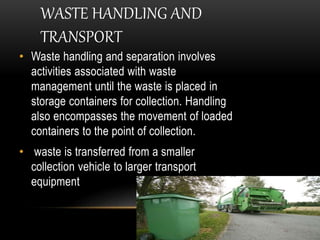
WASTE HANDLING AND
TRANSPORT
• Waste handling and separation involves
activities associated with waste
management until the waste is placed in
storage containers for collection. Handling
also encompasses the movement of loaded
containers to the point of collection.
• waste is transferred from a smaller
collection vehicle to larger transport
equipment
RECYCLING
• Recycling refers to the
collection and refuse of
waste materials such as
empty beverage container.
• The materials from which
the items are made can be
processed into new
products.
• Materials for recycling may
be collected separately from
general waste using
dedicated bins.
R
E
C
Y
C
L
E
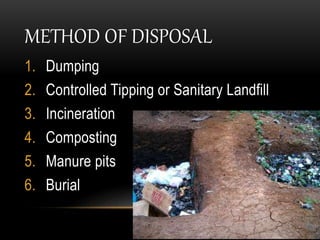
METHOD OF DISPOSAL
1. Dumping
2. Controlled Tipping or Sanitary Landfill
3. Incineration
4. Composting
5. Manure pits
6. Burial
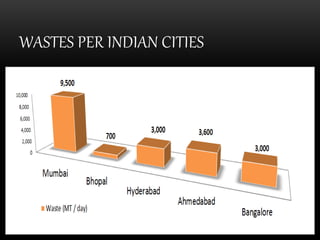
WASTES PER INDIAN CITIES
REFERENCE
• Park K. Park’s Textbook of Preventive and Social Medicine. 22nd
ed. Jabalpur: Banarsidas Bhanot Publishers; 2013. Chapter 20,
Communication for Health Education; p699-701
• Bhalwar, Rajvir et al, 2009, Textbook of Public Health and
Community Medicine, Prune, WHO/AFMC;p715-717
• BK Mahajan. (2011) Text book of preventive and social medicine.
7th Edition. Jaypee Brothers Medical Publishers (P) Ltd.,
Daryaganj, New Delhi.;p71-73
• AH Suryakantha. Community Medicine With Recent Advances.
3rd Edition. Jaypee Brothers Medical Publishers (P) Ltd.,
Daryaganj, New Delhi; 2013;p233-237
`
THANK YOU!

Civil project

  • 1.
  • 2.
    PLAN OF PRESENTATION •Introduction to waste and types • Solid waste • Types of solid waste • Effects of solid waste • Concept of 3R • solid waste management a) storage b) collection c) waste handling and transport d) method of disposal
  • 3.
    INTRODUCTION TO WASTE •It is defined as Waste (also known as rubbish, trash, refuse, garbage, junk) is any unwanted or useless materials. OR Any materials unused and rejected as worthless or unwanted and “A useless or profile less activity using or expanding or consuming thoughtlessly or carefully.”
  • 4.
    WASTE Broadly there are3 types of waste which as follows 1. Household waste as municipal waste 2. Industrial waste as hazardous waste 3. Biomedical waste or hospital waste as infectious waste
  • 5.
    • Chemical waste •Commercial waste/ • Business waste • Biomedical waste • Bulky waste • Solid waste • Liquid waste • Gaseous waste • Animal by product(ABPs) • Biodegradable waste TYPES OF WASTE
  • 6.
    SOURCE • Agriculture • Fisheries •Household • Commerce and industry
  • 7.
    CONCEPT OF 3RS •The 3Rs (Reduce, Reuse, Recycle) to be followed for waste management.
  • 8.
    SOLID WASTE • Itis defined as • “ non liquid, non-soluble materials ranging from municipal garbage to industrial wastes that contain complex & sometimes hazardous substances” • Solid waste also include • Garbage • Rubbish • Demolition products • Sewage treatment residue • Dead animals • Manure and other discarded material. • -- Per capita solid waste out put 0.25-2.5 Kg/day
  • 9.
    SOLID WASTE MANAGEMENT Wastemanagement is the • storage • collection • transport and handling • recycling • disposal and monitoring of waste materials.
  • 10.
    STORAGE • Storage: - Galvanizedsteel dust bin - Paper sack - Public bins
  • 11.
    COLLECTION • Collection - House-to-housecollection - Collection from the public bins
  • 12.
    WASTE HANDLING AND TRANSPORT •Waste handling and separation involves activities associated with waste management until the waste is placed in storage containers for collection. Handling also encompasses the movement of loaded containers to the point of collection. • waste is transferred from a smaller collection vehicle to larger transport equipment
  • 13.
    RECYCLING • Recycling refersto the collection and refuse of waste materials such as empty beverage container. • The materials from which the items are made can be processed into new products. • Materials for recycling may be collected separately from general waste using dedicated bins.
  • 14.
  • 15.
    METHOD OF DISPOSAL 1.Dumping 2. Controlled Tipping or Sanitary Landfill 3. Incineration 4. Composting 5. Manure pits 6. Burial
  • 16.
  • 17.
    REFERENCE • Park K.Park’s Textbook of Preventive and Social Medicine. 22nd ed. Jabalpur: Banarsidas Bhanot Publishers; 2013. Chapter 20, Communication for Health Education; p699-701 • Bhalwar, Rajvir et al, 2009, Textbook of Public Health and Community Medicine, Prune, WHO/AFMC;p715-717 • BK Mahajan. (2011) Text book of preventive and social medicine. 7th Edition. Jaypee Brothers Medical Publishers (P) Ltd., Daryaganj, New Delhi.;p71-73 • AH Suryakantha. Community Medicine With Recent Advances. 3rd Edition. Jaypee Brothers Medical Publishers (P) Ltd., Daryaganj, New Delhi; 2013;p233-237
  • 18.