Seguridad en los elementos
de red

Cisco


                 © Rafael Vida, 2004
Index (I)
♦ Introducción
  – General Situation
     •   Routers
     •   Security Policy
     •   Purpose of a router
     •   Basic Router Functional Architecture
  – Protecting the Network with the Router
Index (II)
♦ Protecting the Router Itself
  – Attacks on Routers
  – Managing the Router
     • SNMP
     • SSH
  – Security Policy for Cisco Routers
♦ Implementing Security: E-Policy
  – AAA
     • Remote Access
     • Logins, Privileges, Passwords, and Accounts
Index (III)
♦ Filtering
  – ACL
  – ACR
♦ RAT (Router Audit Tool)
Introduction
Introduction
♦ Purpose of a router
   – Directing packets, roting protocols
   – Filtering:ACL
   – Modifing packet´s headers: NAT, PAT.
♦ Hardware
  – CPU, Memory:
      • RAM, NVRAM, Flash, and ROM (PROM, EEPROM)
      • ROM, NVRAM.
   – Does Not have Hard disk, floppy, CDROM, etc.
Introduction
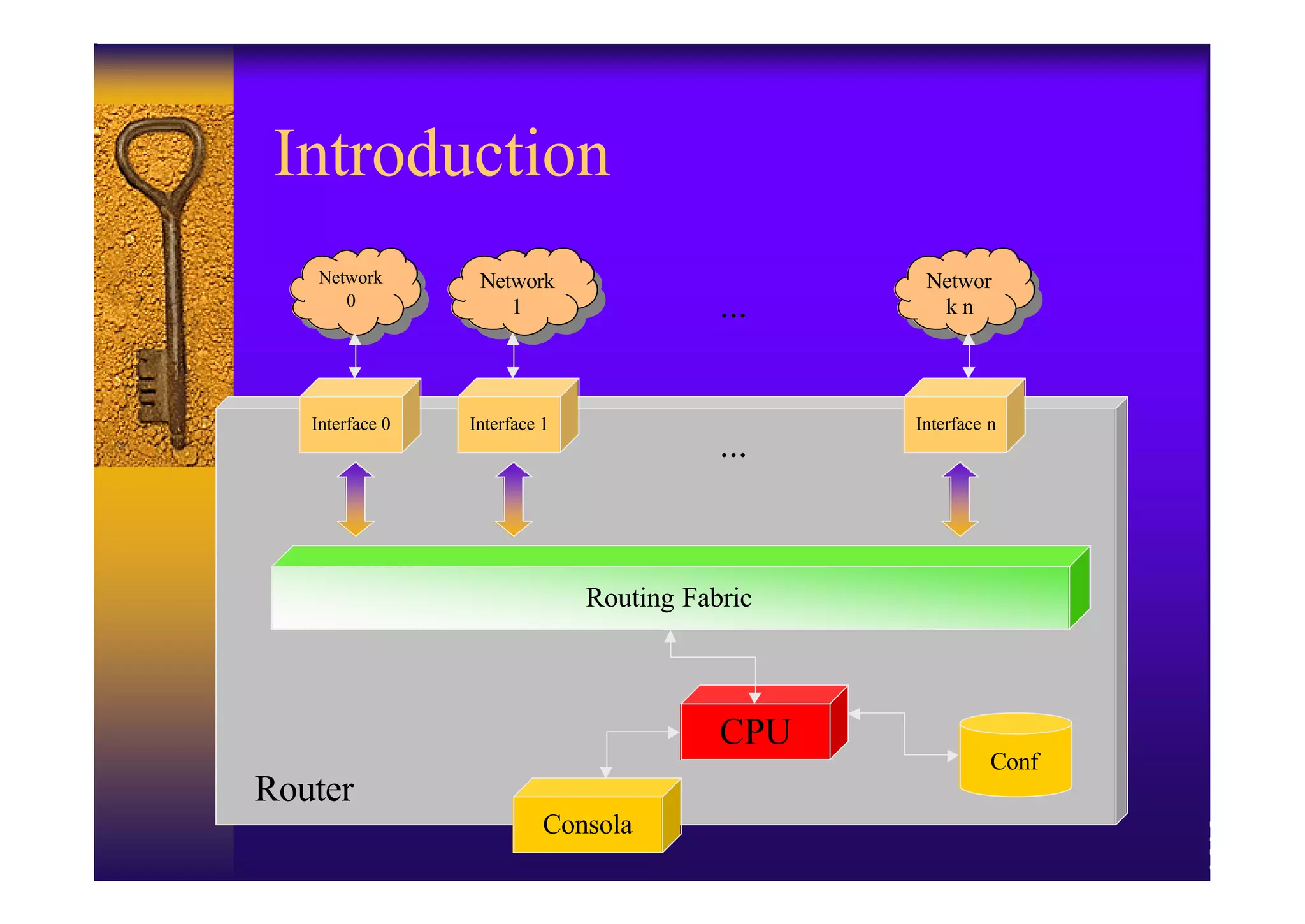
   Network        Network                        Networ
    Network        Network                        Networ
      00             11                   ...      kknn


   Interface 0   Interface 1                    Interface n
                                          ...


                               Routing Fabric


                                          CPU
                                                          Conf
Router
                           Consola
Security Policy
Security Policy
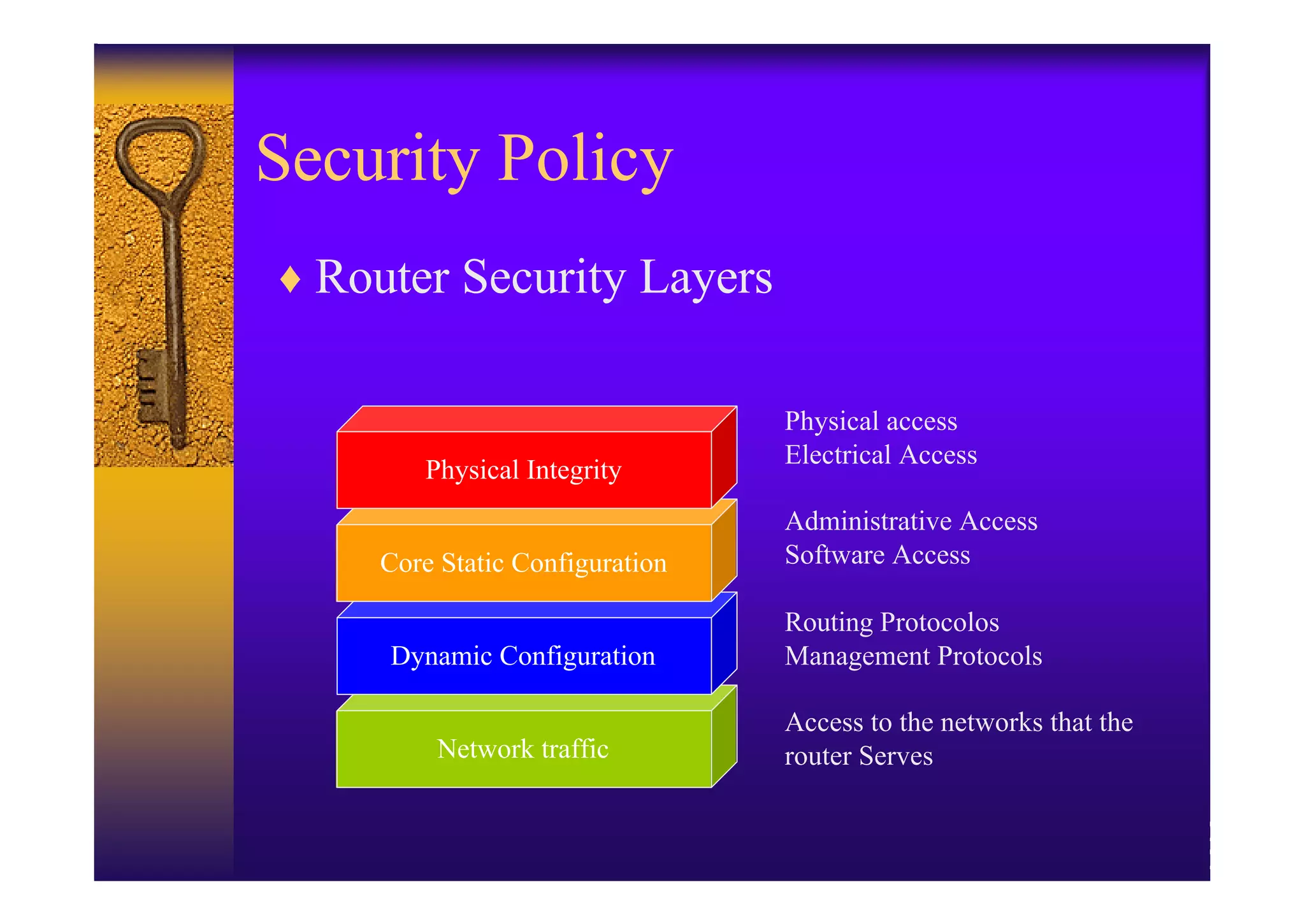
♦ Router Security Layers


                                 Physical access
                                 Electrical Access
        Physical Integrity
                                 Administrative Access
     Core Static Configuration   Software Access

                                 Routing Protocolos
     Dynamic Configuration       Management Protocols

                                 Access to the networks that the
         Network traffic         router Serves
Security Policy: Checklist
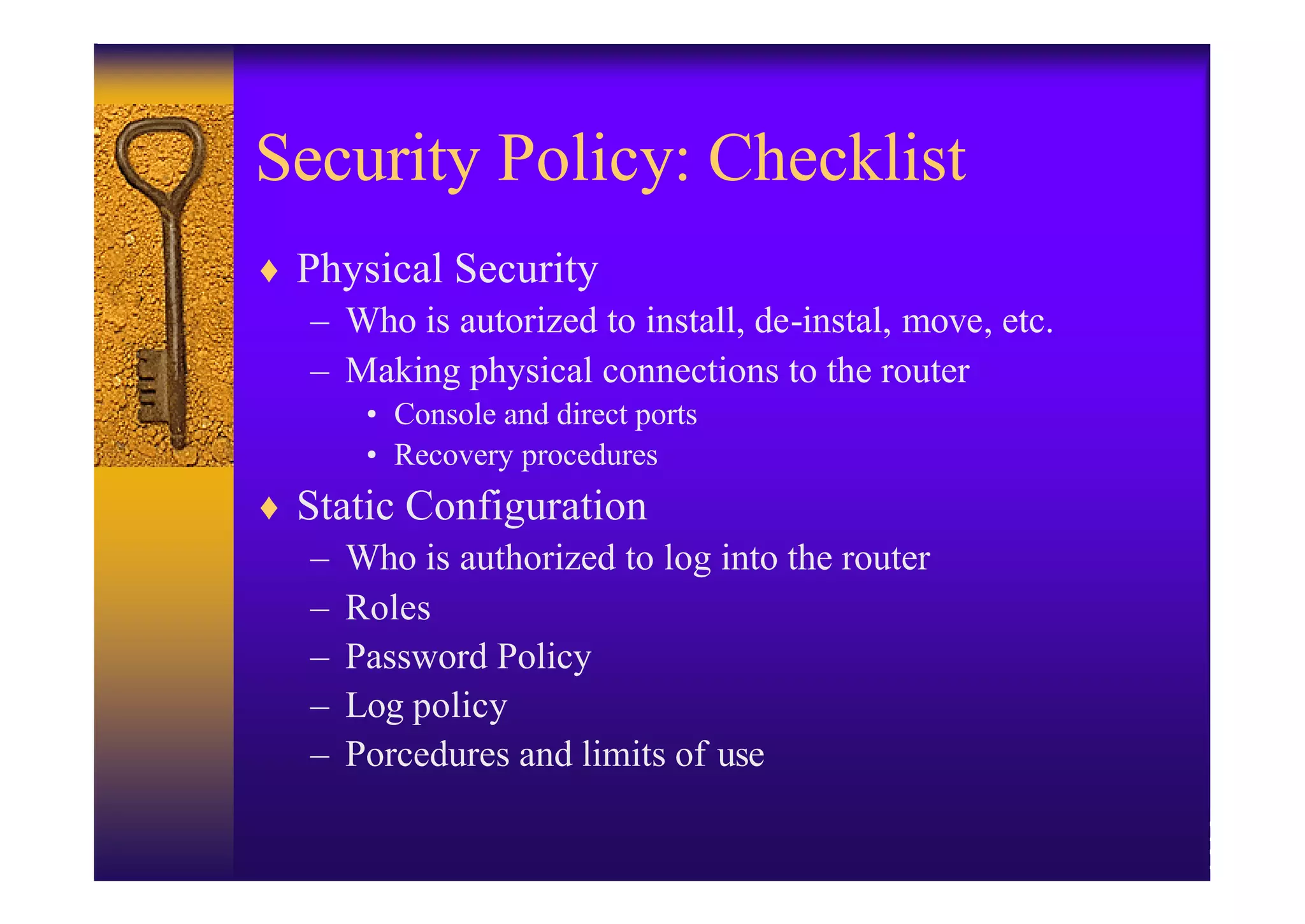
♦ Physical Security
   – Who is autorized to install, de-instal, move, etc.
   – Making physical connections to the router
       • Console and direct ports
       • Recovery procedures
♦ Static Configuration
   – Who is authorized to log into the router
   – Roles
   – Password Policy
   – Log policy
   – Porcedures and limits of use
Security Policy: Checklist
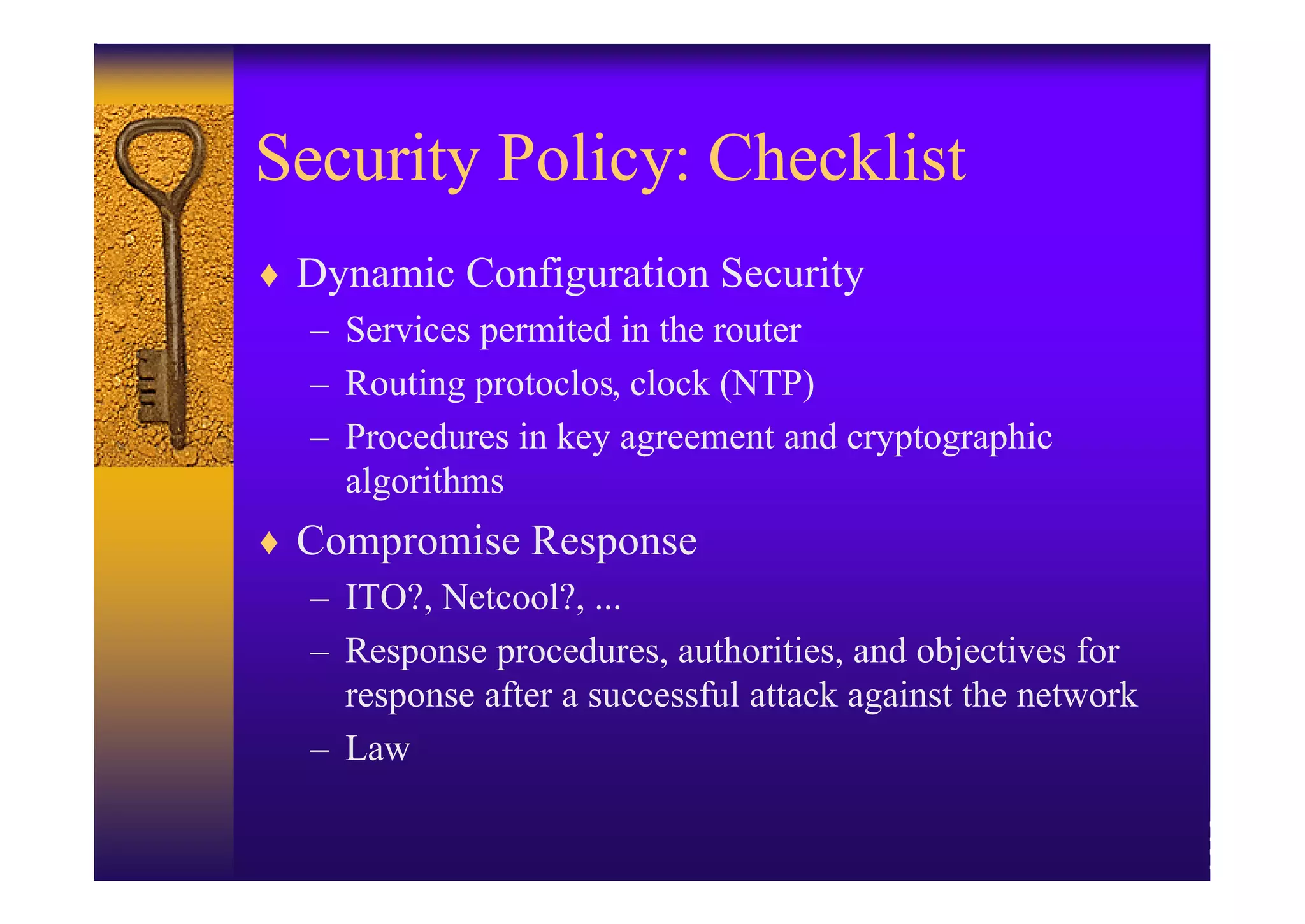
♦ Dynamic Configuration Security
  – Services permited in the router
  – Routing protoclos, clock (NTP)
  – Procedures in key agreement and cryptographic
    algorithms
♦ Compromise Response
  – ITO?, Netcool?, ...
  – Response procedures, authorities, and objectives for
    response after a successful attack against the network
  – Law
Security Policy: Checklist
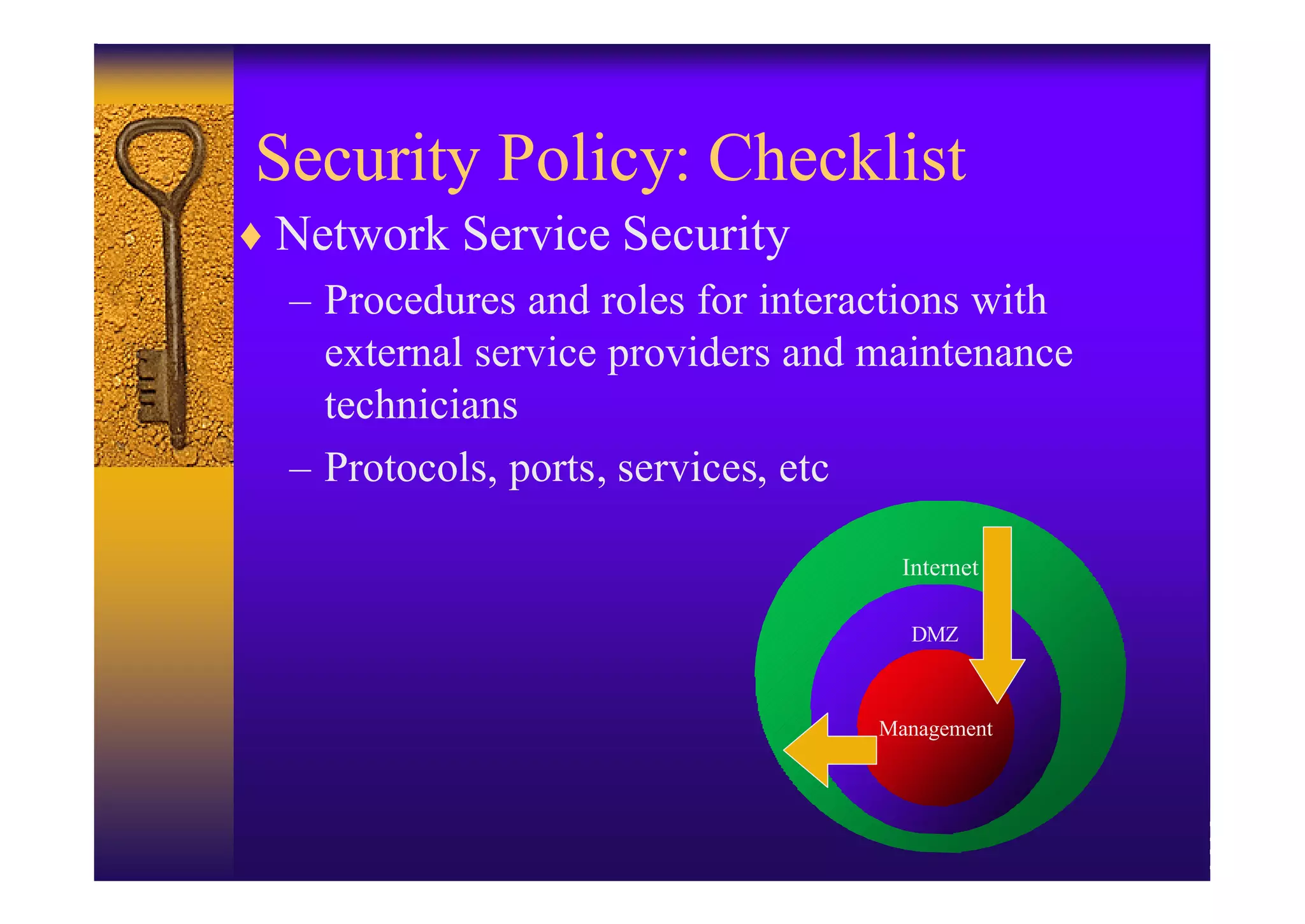
♦ Network Service Security
  – Procedures and roles for interactions with
    external service providers and maintenance
    technicians
  – Protocols, ports, services, etc

                                     Internet

                                     DMZ


                                   Management
Protecting networks and
routers
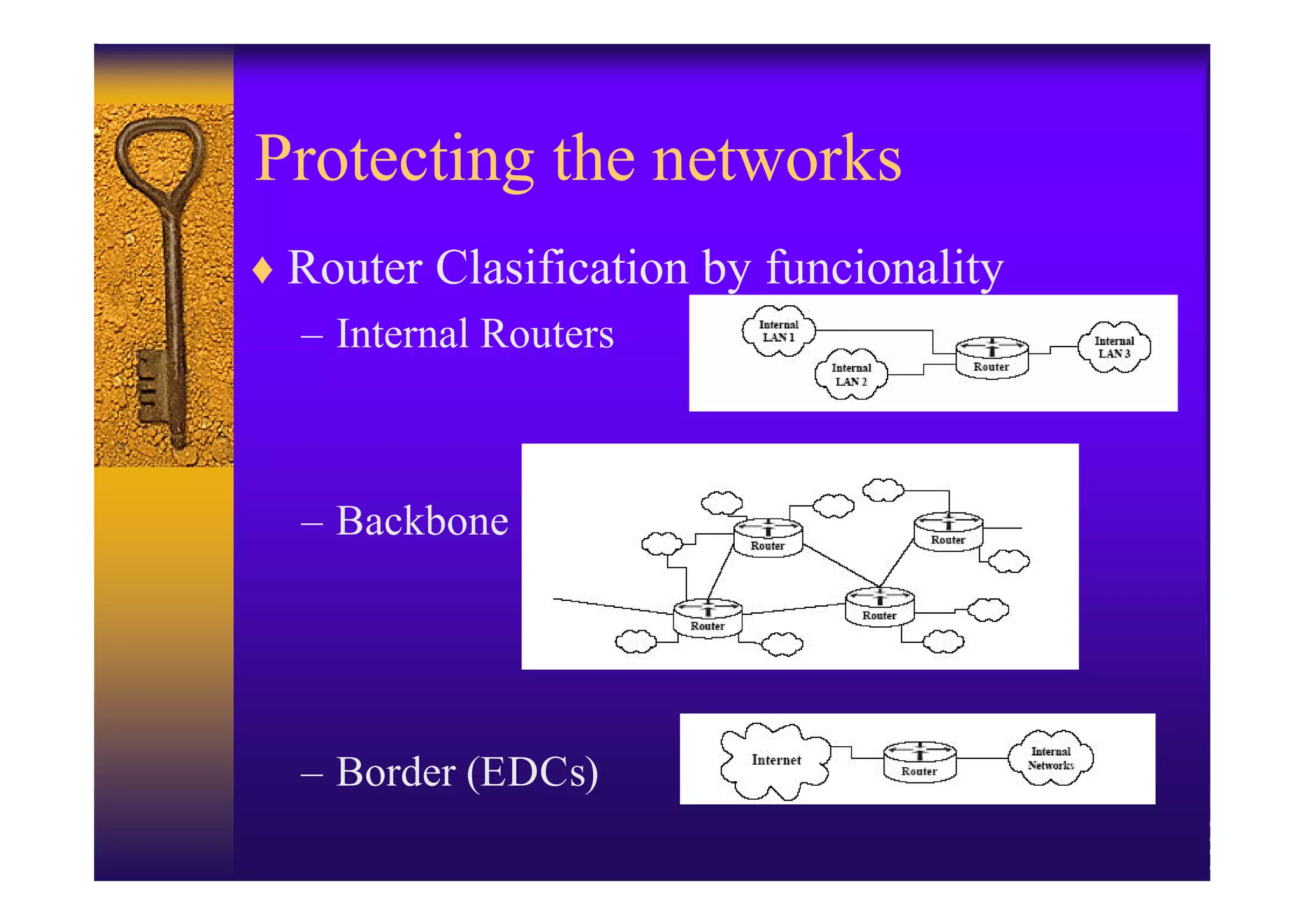
Protecting the networks
♦ Router Clasification by funcionality
  – Internal Routers


  – Backbone


  – Border (EDCs)
Protecting the router: Attacks
♦ Unauthorized access
♦ Session hijacking
♦ Rerouting
♦ Dos
♦ Ddos (!)
♦ SNMP attacks
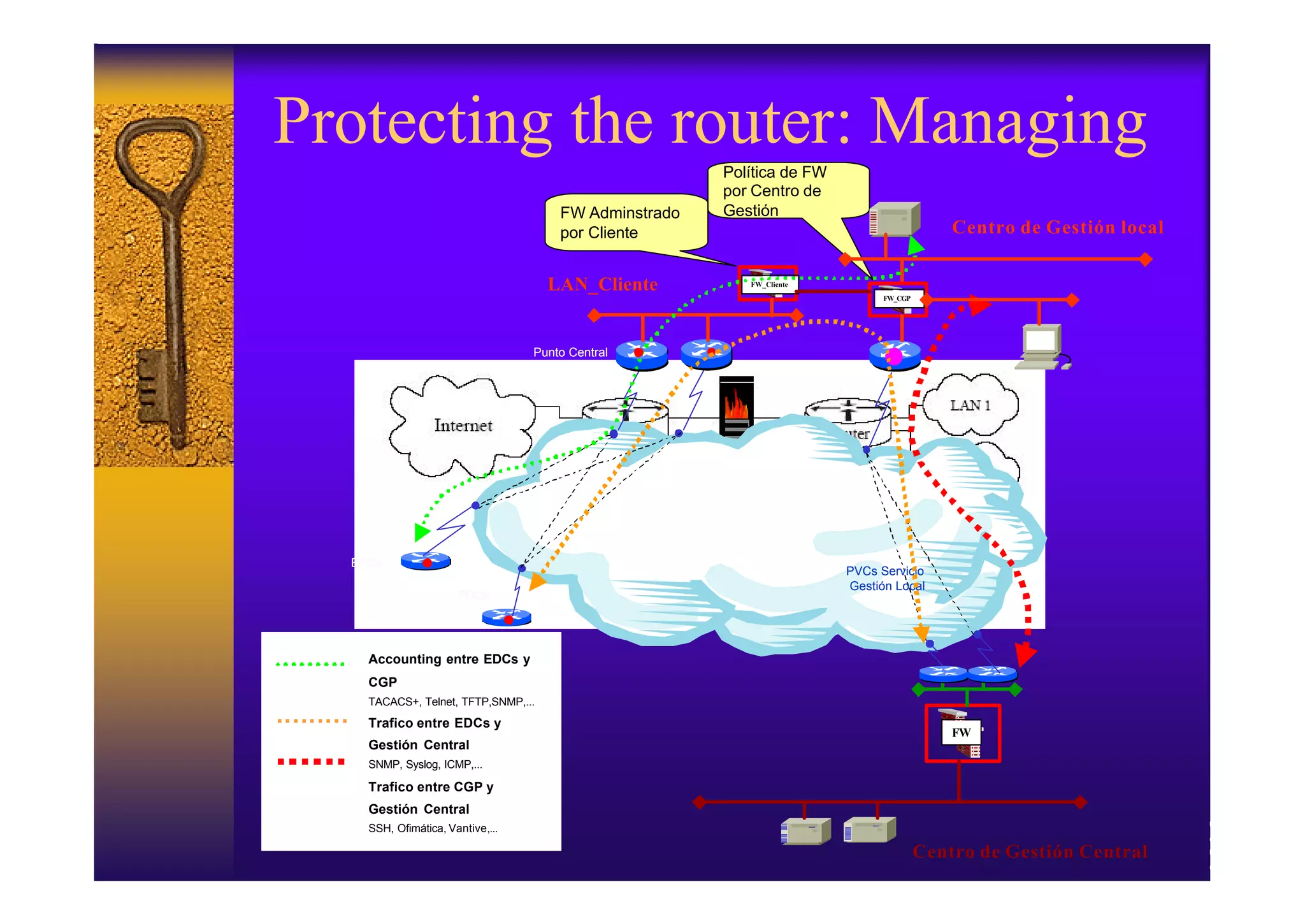
Protecting the router: Managing
                                                       Política de FW
                                                       por Centro de
                                      FW Adminstrado   Gestión
                                      por Cliente                                          Centro de Gestión local

                                     LAN_Cliente          FW_Cliente
                                                                              FW_CGP


                                  Punto Central


  EDCs
                                                                        PVCs Servicio
                                                                        Gestión Local
                      EDCs


    Accounting entre EDCs y
    CGP
    TACACS+, Telnet, TFTP,SNMP,...
    Trafico entre EDCs y
                                                                                           FW
    Gestión Central
    SNMP, Syslog, ICMP,...

    Trafico entre CGP y
    Gestión Central
    SSH, Ofimática, Vantive,...

                                                                                       Centro de Gestión Central
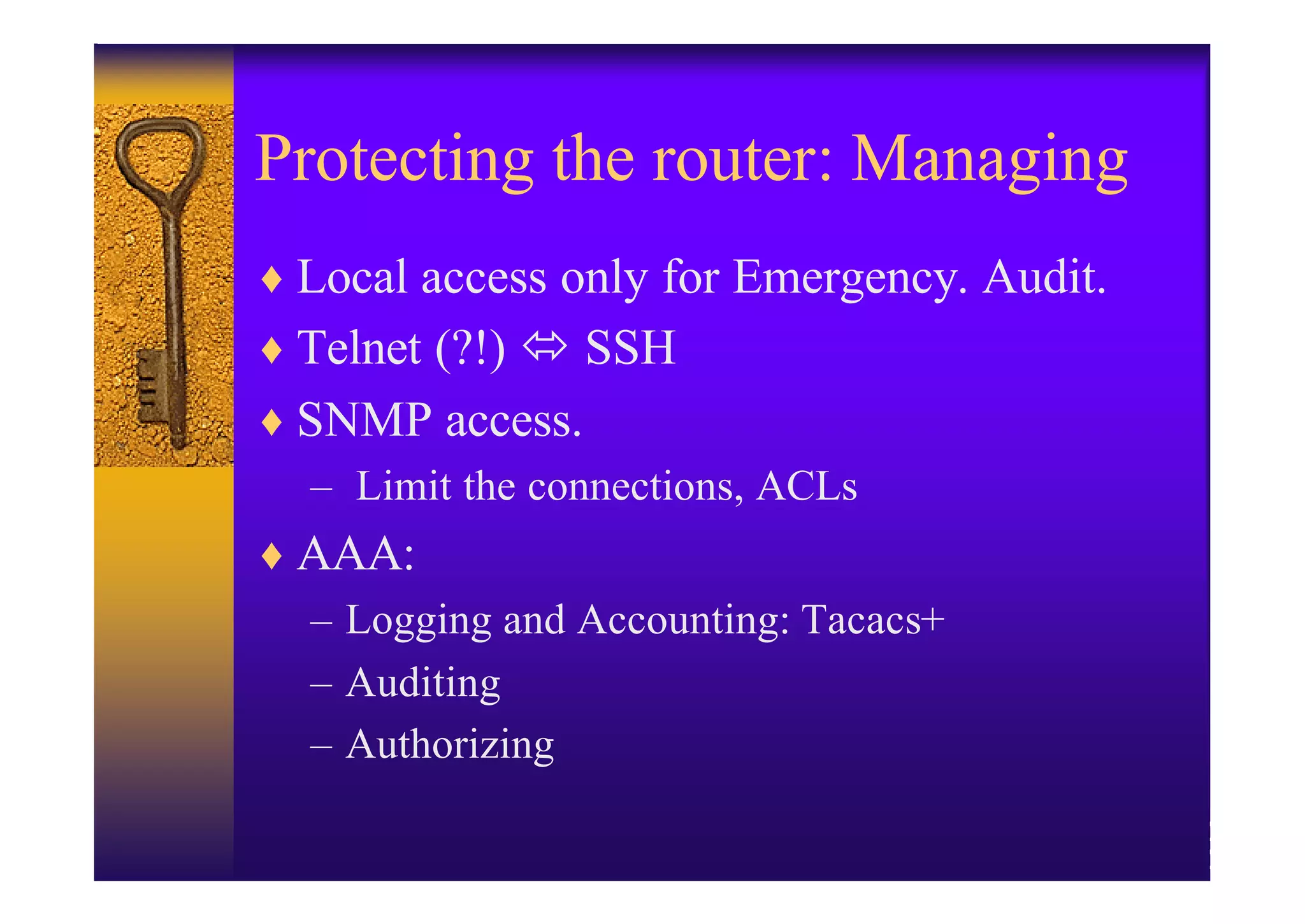
Protecting the router: Managing
♦ Local access only for Emergency. Audit.
♦ Telnet (?!) ó SSH
♦ SNMP access.
  – Limit the connections, ACLs
♦ AAA:
  – Logging and Accounting: Tacacs+
  – Auditing
  – Authorizing
Implementing: E-Policy

Cisco
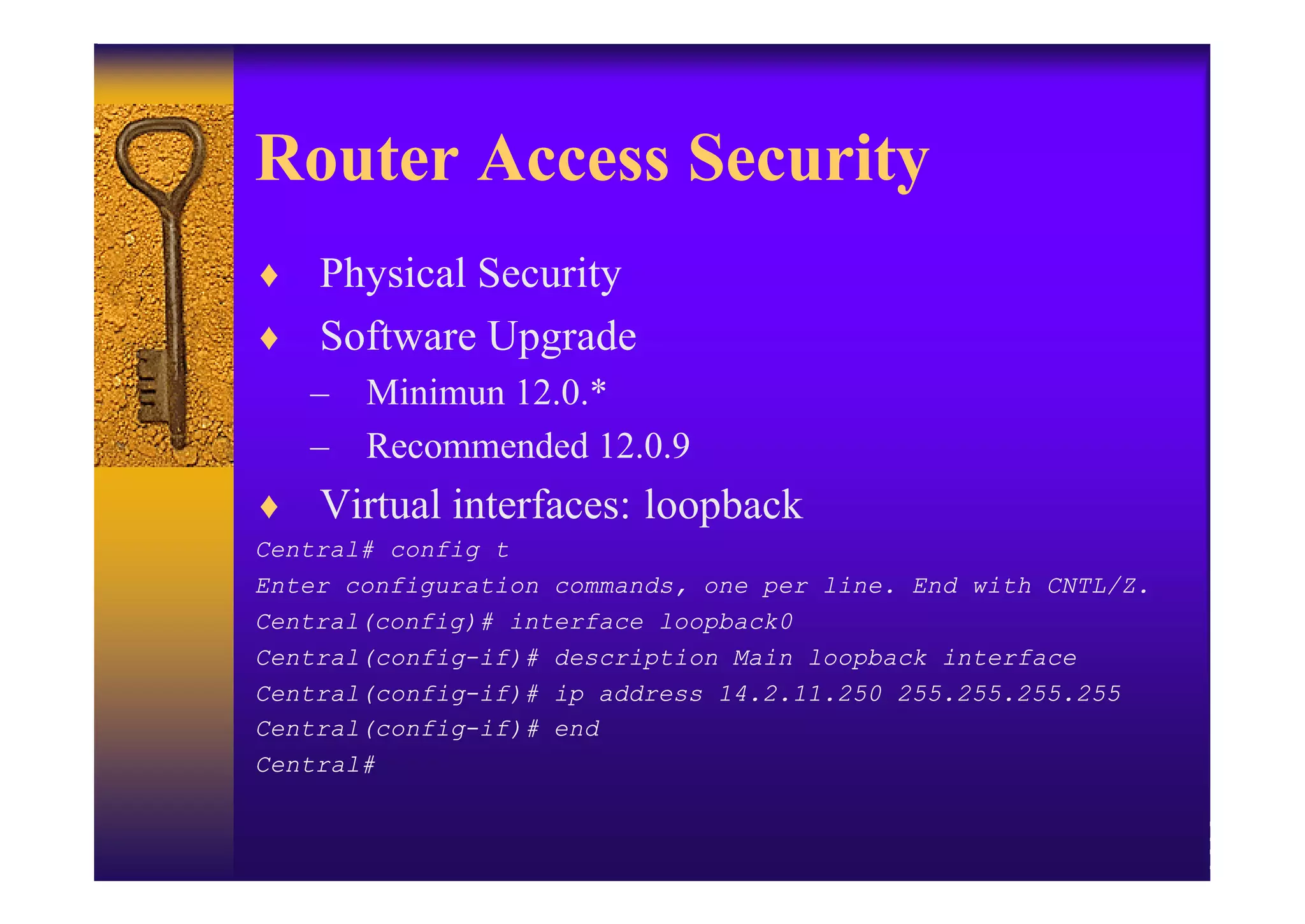
Router Access Security
♦ Physical Security
♦ Software Upgrade
  – Minimun 12.0.*
  – Recommended 12.0.9
♦ Virtual interfaces: loopback
Central# config t
Enter configuration commands, one per line. End with CNTL/Z.
Central(config)# interface loopback0
Central(config-if)# description Main loopback interface
Central(config-if)# ip address 14.2.11.250 255.255.255.255
Central(config-if)# end
Central#
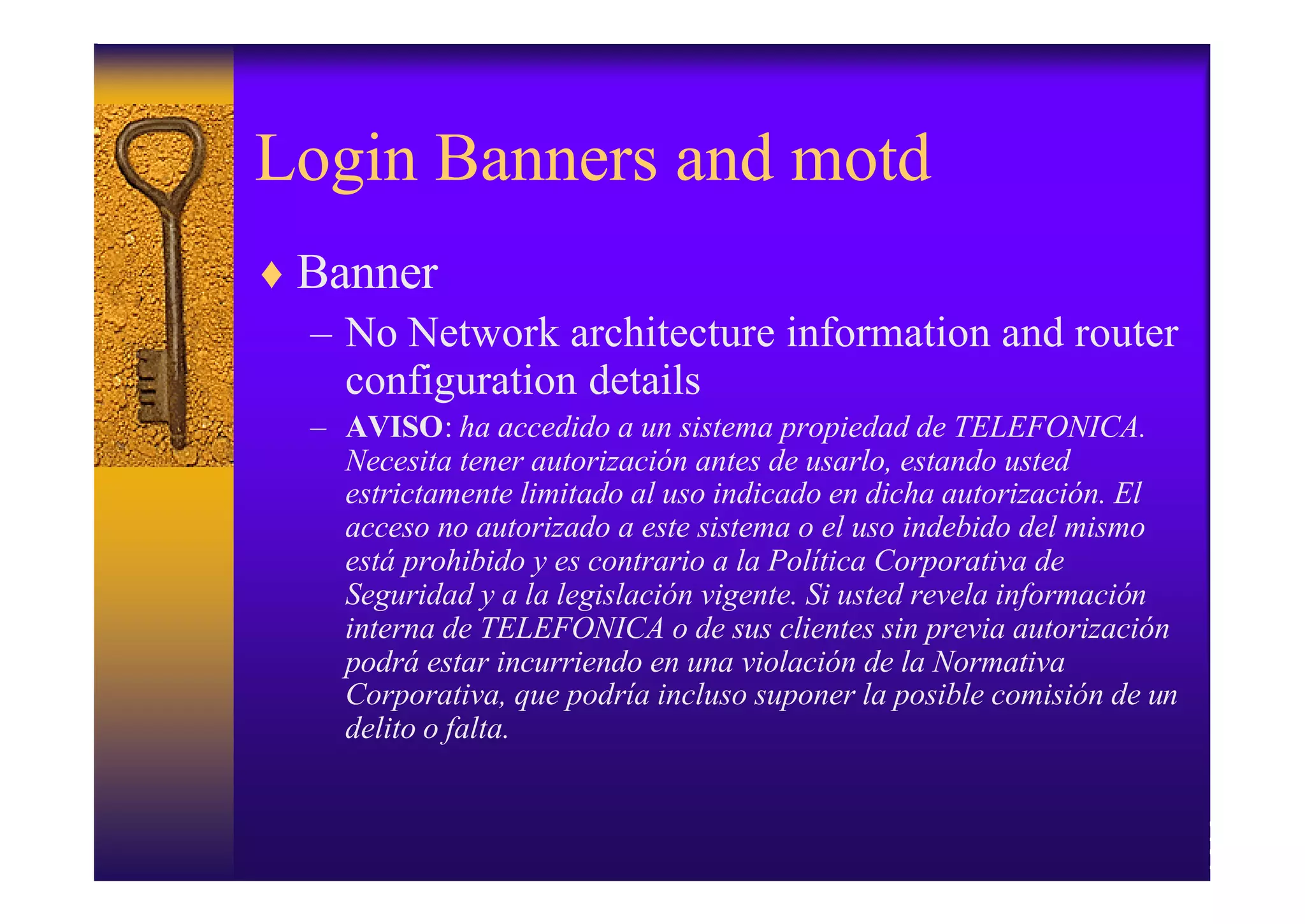
Login Banners and motd
♦ Banner
  – No Network architecture information and router
    configuration details
  – AVISO: ha accedido a un sistema propiedad de TELEFONICA.
    Necesita tener autorización antes de usarlo, estando usted
    estrictamente limitado al uso indicado en dicha autorización. El
    acceso no autorizado a este sistema o el uso indebido del mismo
    está prohibido y es contrario a la Política Corporativa de
    Seguridad y a la legislación vigente. Si usted revela información
    interna de TELEFONICA o de sus clientes sin previa autorización
    podrá estar incurriendo en una violación de la Normativa
    Corporativa, que podría incluso suponer la posible comisión de un
    delito o falta.
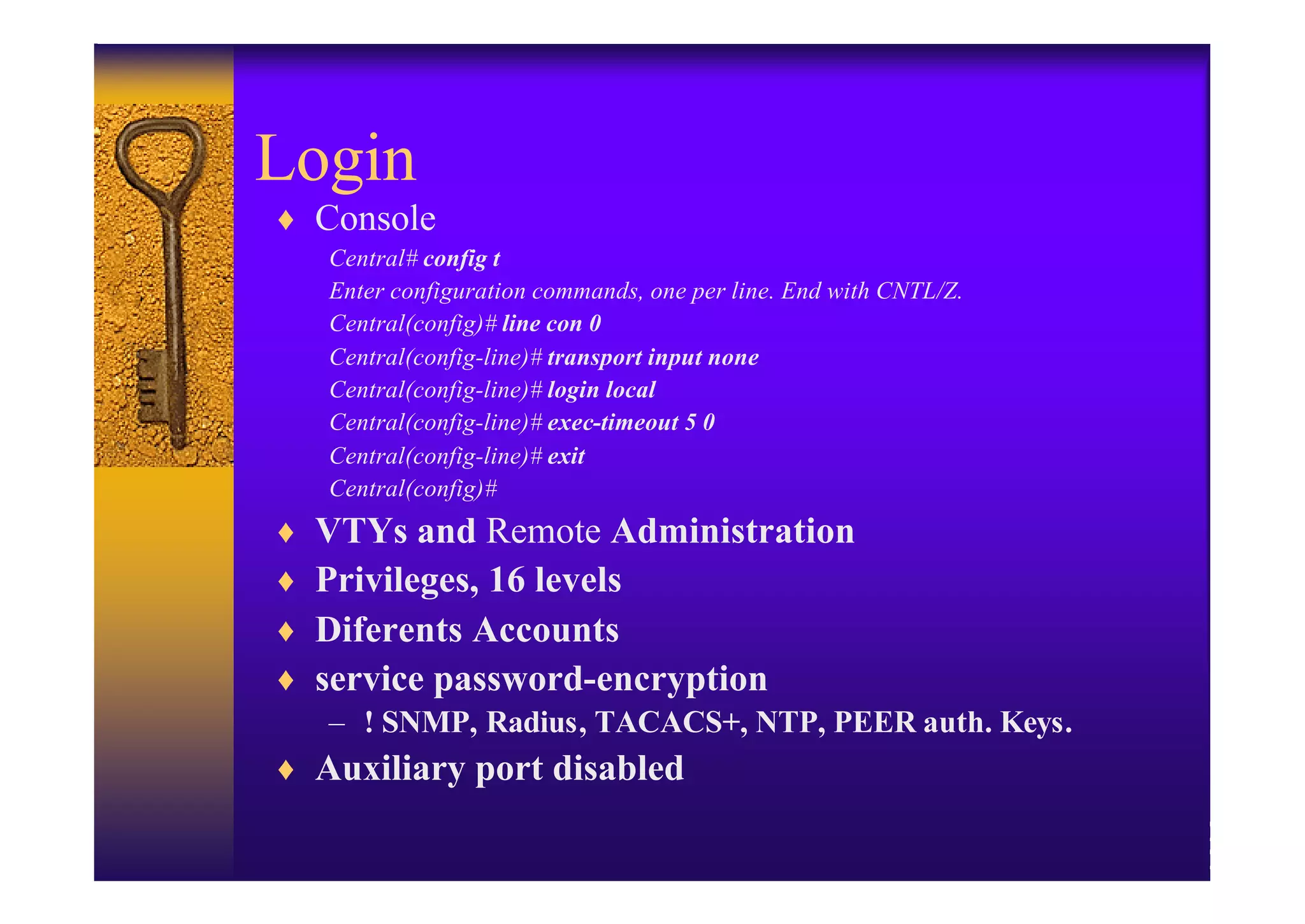
Login
♦ Console
    Central# config t
    Enter configuration commands, one per line. End with CNTL/Z.
    Central(config)# line con 0
    Central(config-line)# transport input none
    Central(config-line)# login local
    Central(config-line)# exec-timeout 5 0
    Central(config-line)# exit
    Central(config)#
♦   VTYs and Remote Administration
♦   Privileges, 16 levels
♦   Diferents Accounts
♦   service password-encryption
    – ! SNMP, Radius, TACACS+, NTP, PEER auth. Keys.
♦ Auxiliary port disabled
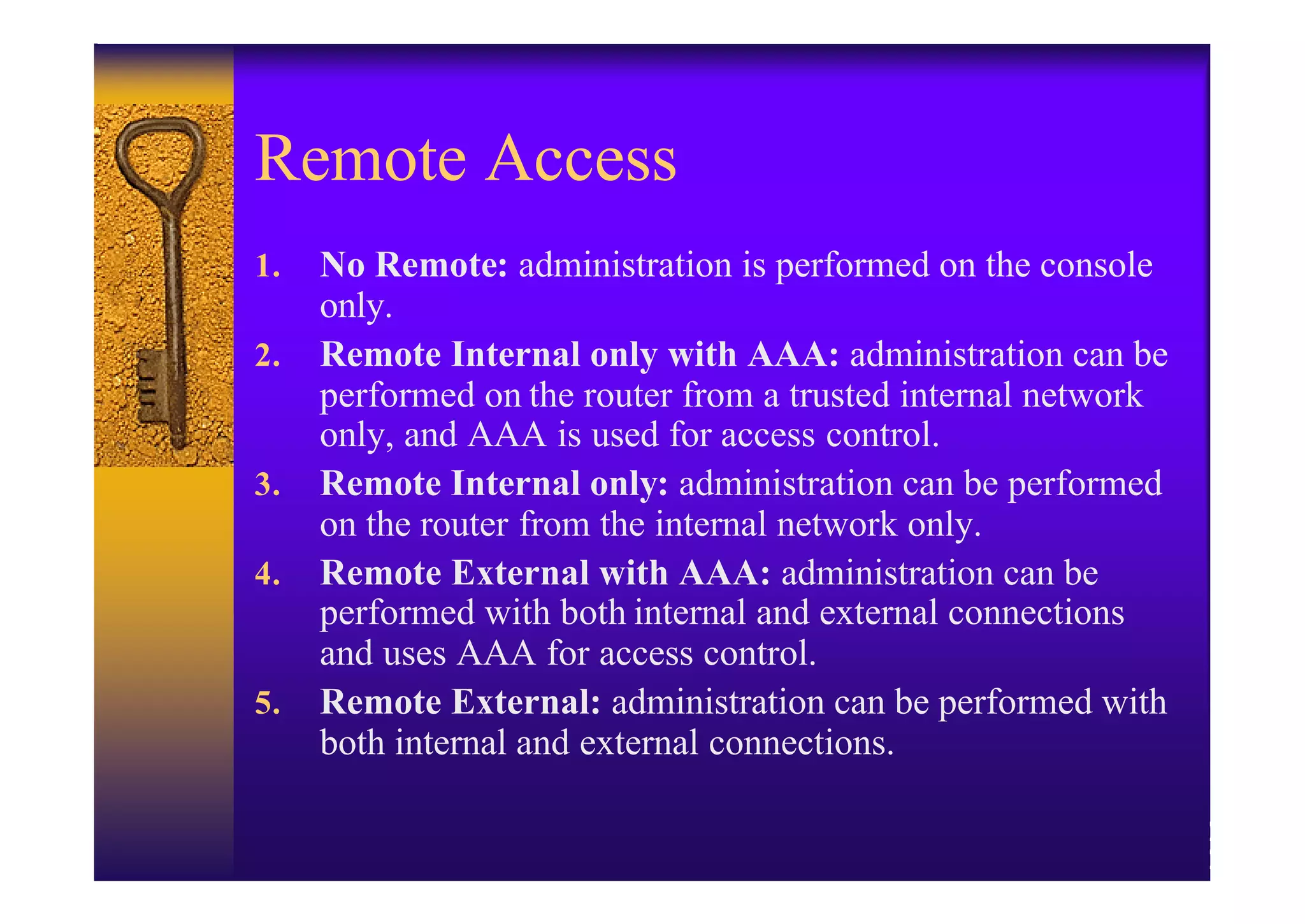
Remote Access
1.   No Remote: administration is performed on the console
     only.
2.   Remote Internal only with AAA: administration can be
     performed on the router from a trusted internal network
     only, and AAA is used for access control.
3.   Remote Internal only: administration can be performed
     on the router from the internal network only.
4.   Remote External with AAA: administration can be
     performed with both internal and external connections
     and uses AAA for access control.
5.   Remote External: administration can be performed with
     both internal and external connections.
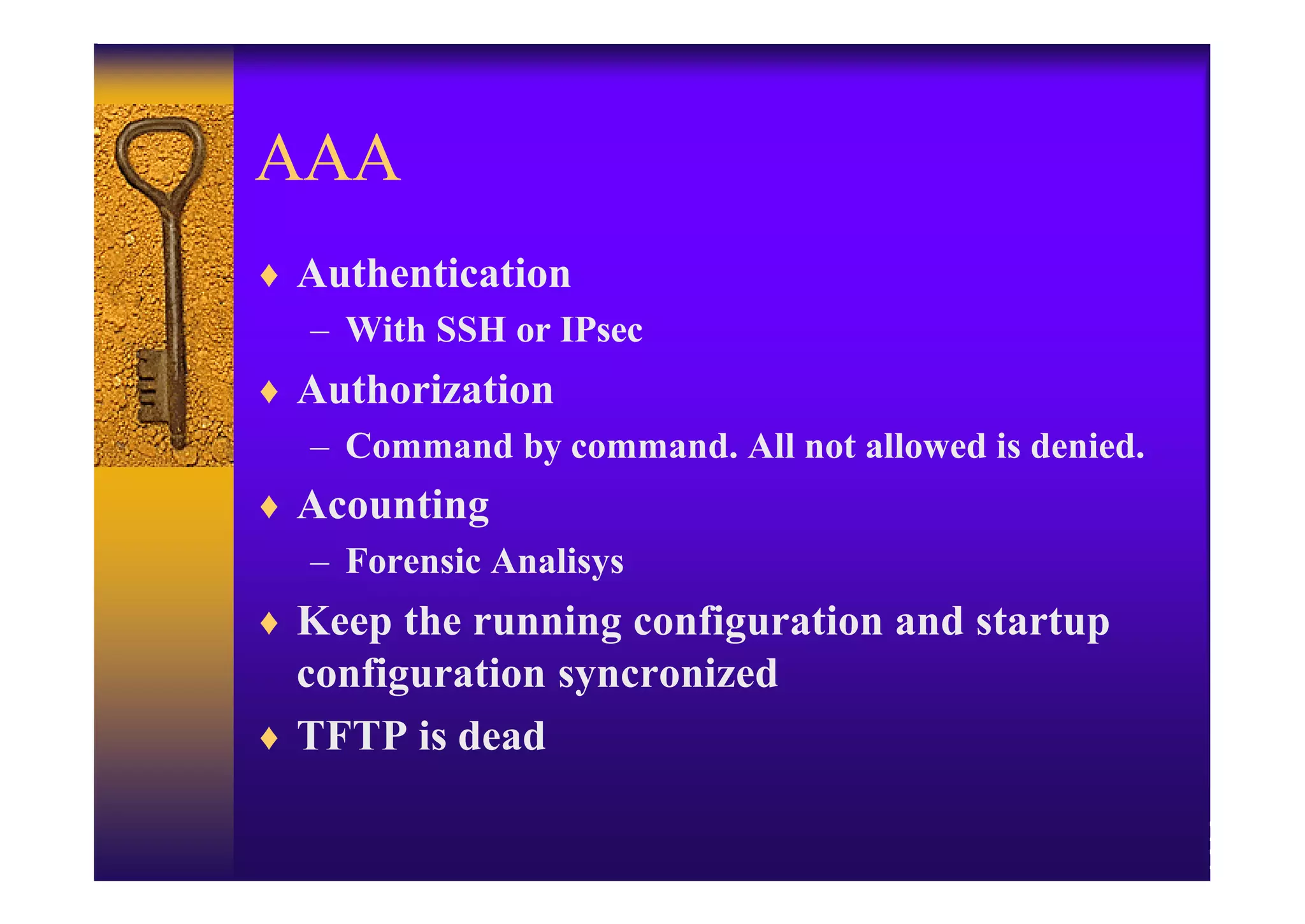
AAA
♦ Authentication
  – With SSH or IPsec
♦ Authorization
  – Command by command. All not allowed is denied.
♦ Acounting
  – Forensic Analisys
♦ Keep the running configuration and startup
  configuration syncronized
♦ TFTP is dead
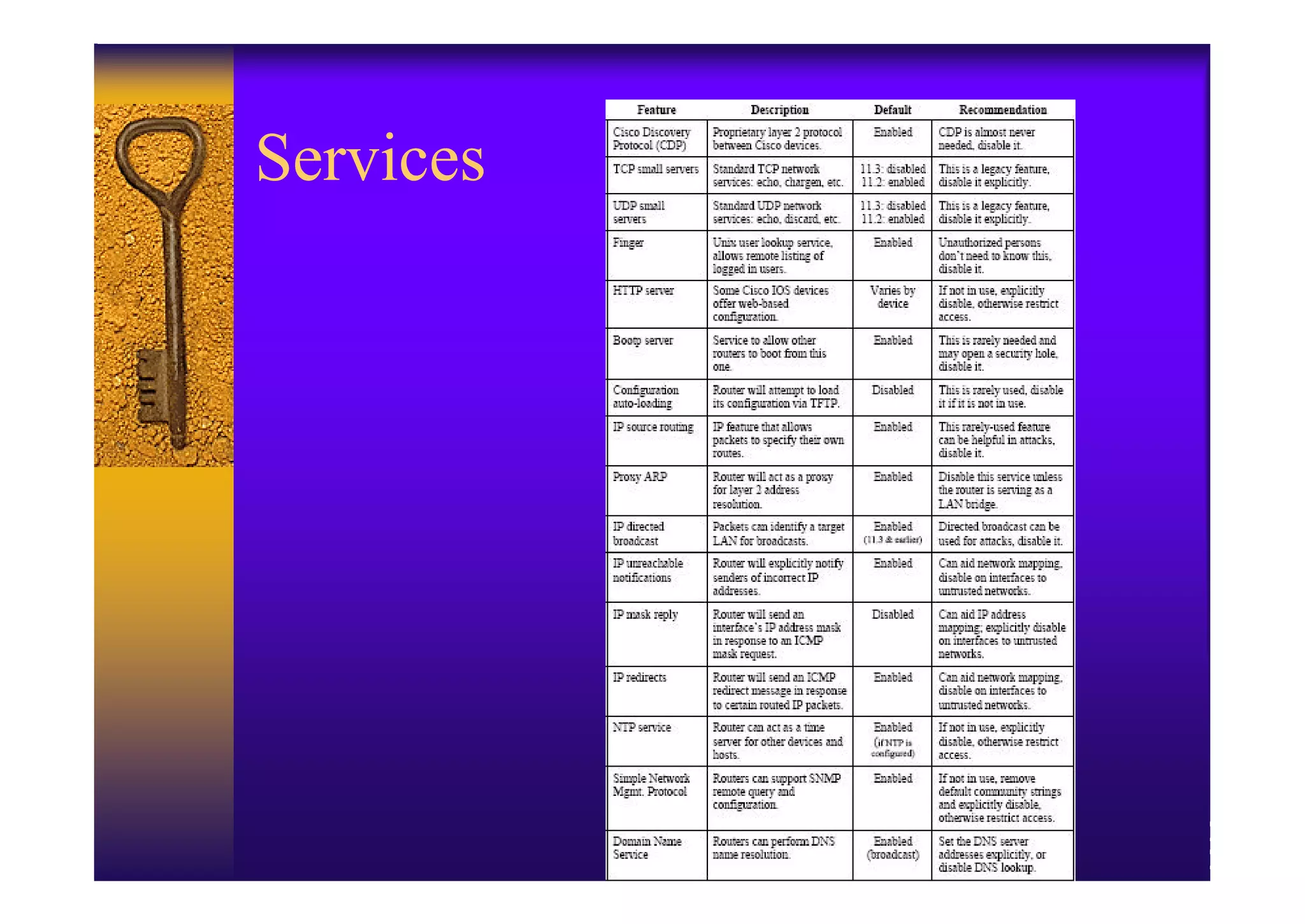
Services
Access Control List
♦ access-list list-number {deny | permit} source
  [source-wildcard] [log]

♦ access-list list-number {deny | permit} protocol
  source source-wildcard source-qualifiers
  destination destination-wildcard destination-
  qualifiers [ log | log-input]
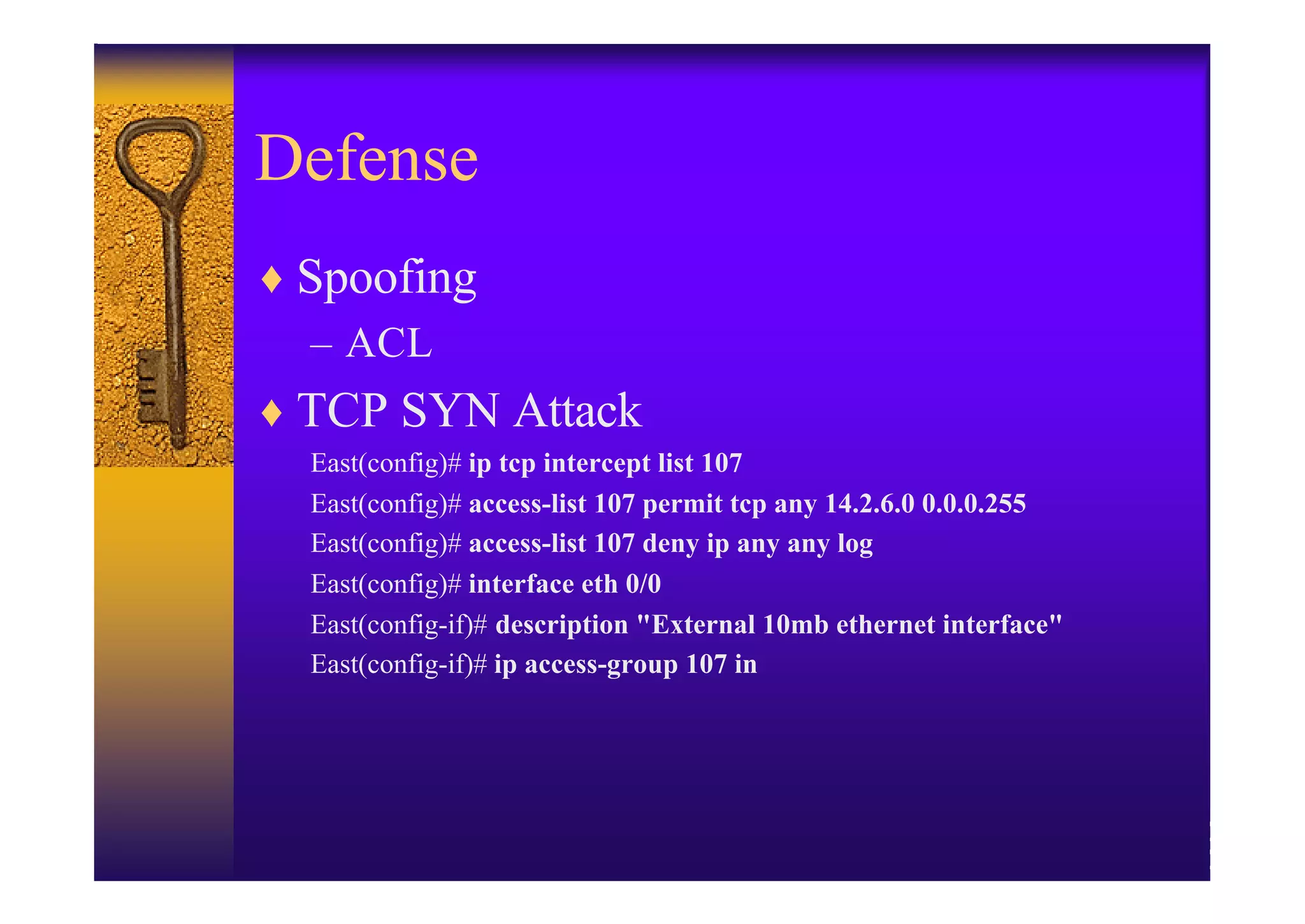
Defense
♦ Spoofing
  – ACL
♦ TCP SYN Attack
  East(config)# ip tcp intercept list 107
  East(config)# access-list 107 permit tcp any 14.2.6.0 0.0.0.255
  East(config)# access-list 107 deny ip any any log
  East(config)# interface eth 0/0
  East(config-if)# description "External 10mb ethernet interface"
  East(config-if)# ip access-group 107 in
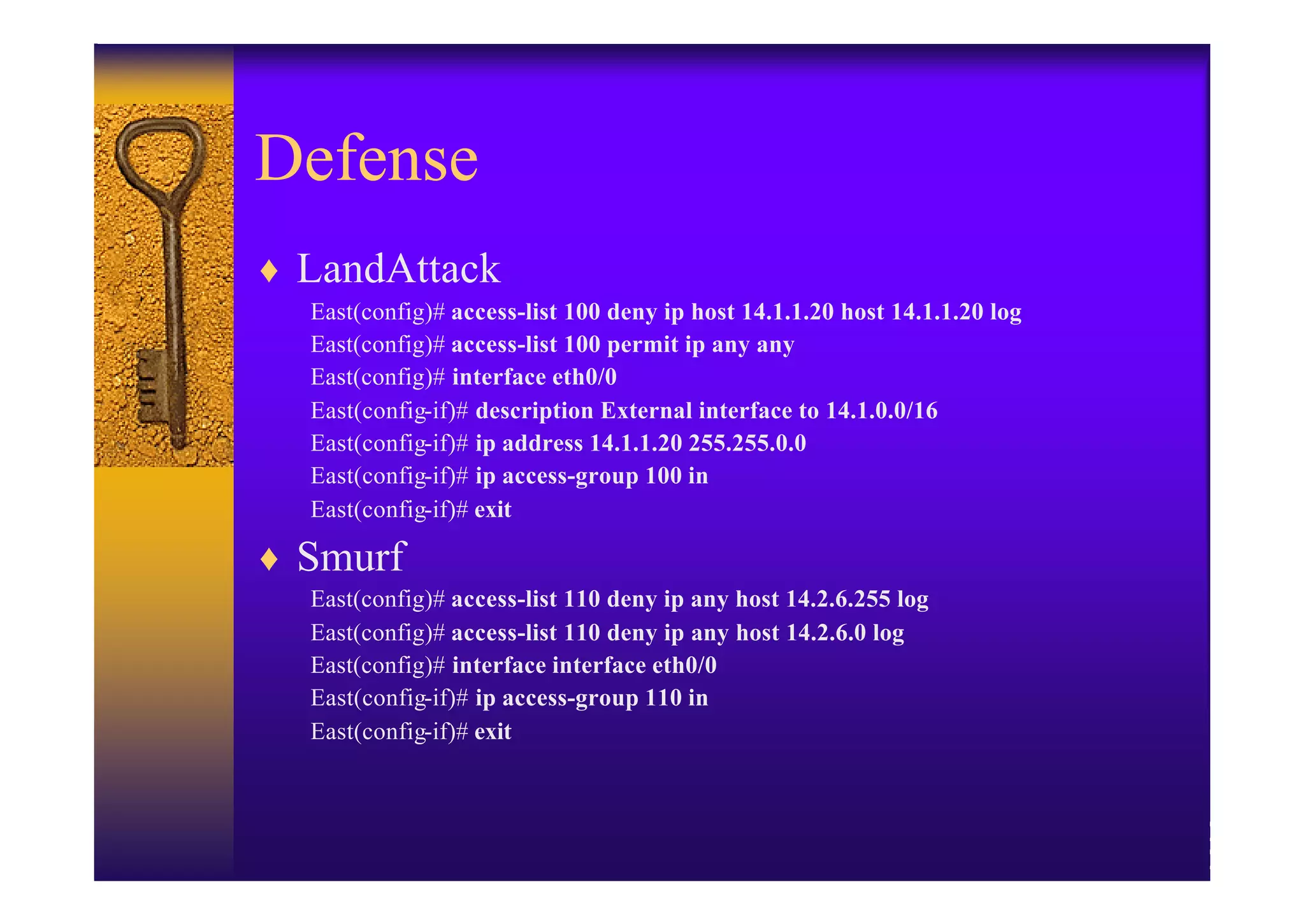
Defense
♦ LandAttack
  East(config)# access-list 100 deny ip host 14.1.1.20 host 14.1.1.20 log
  East(config)# access-list 100 permit ip any any
  East(config)# interface eth0/0
  East(config-if)# description External interface to 14.1.0.0/16
  East(config-if)# ip address 14.1.1.20 255.255.0.0
  East(config-if)# ip access-group 100 in
  East(config-if)# exit

♦ Smurf
  East(config)# access-list 110 deny ip any host 14.2.6.255 log
  East(config)# access-list 110 deny ip any host 14.2.6.0 log
  East(config)# interface interface eth0/0
  East(config-if)# ip access-group 110 in
  East(config-if)# exit
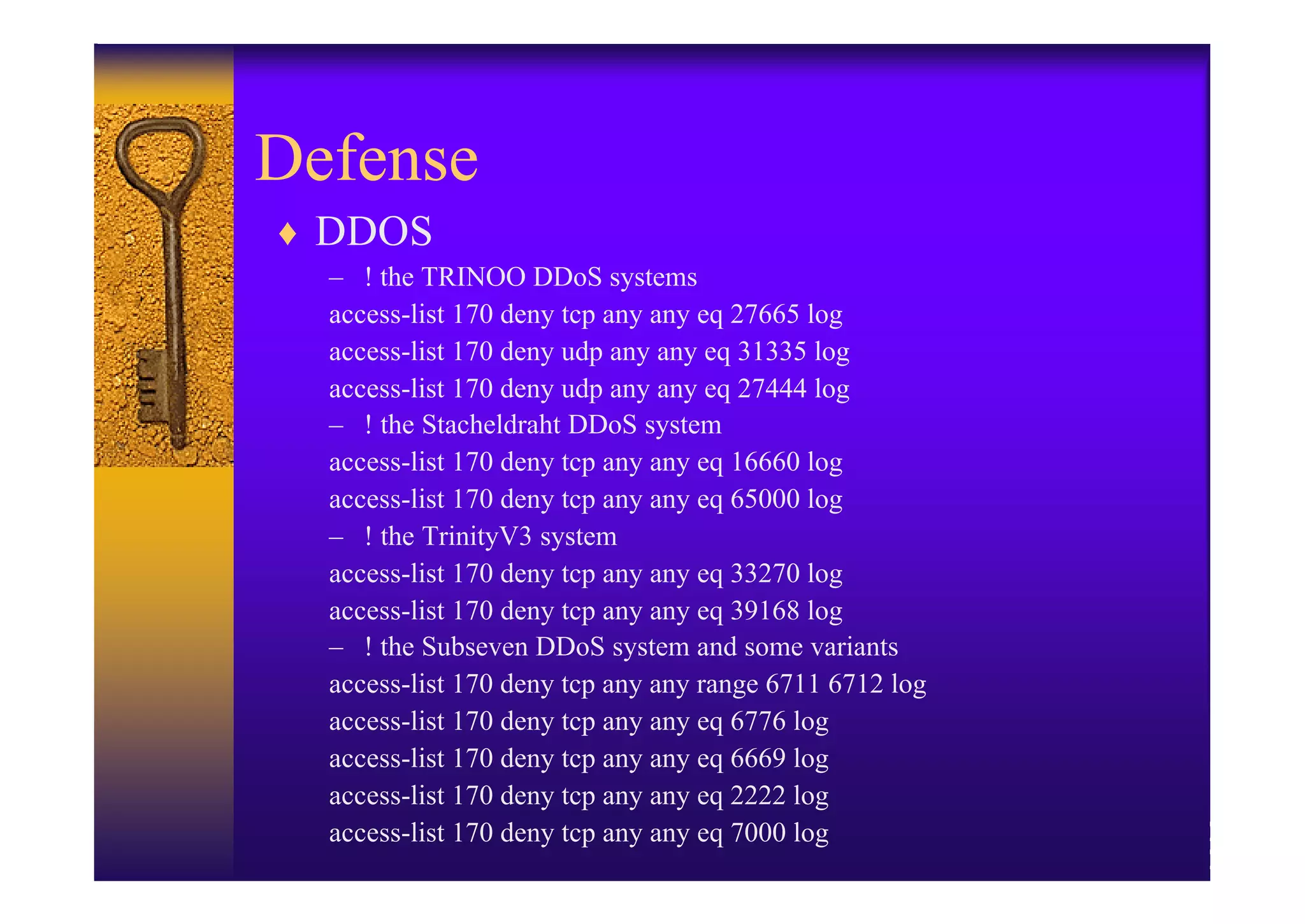
Defense
♦ DDOS
  – ! the TRINOO DDoS systems
  access-list 170 deny tcp any any eq 27665 log
  access-list 170 deny udp any any eq 31335 log
  access-list 170 deny udp any any eq 27444 log
  – ! the Stacheldraht DDoS system
  access-list 170 deny tcp any any eq 16660 log
  access-list 170 deny tcp any any eq 65000 log
  – ! the TrinityV3 system
  access-list 170 deny tcp any any eq 33270 log
  access-list 170 deny tcp any any eq 39168 log
  – ! the Subseven DDoS system and some variants
  access-list 170 deny tcp any any range 6711 6712 log
  access-list 170 deny tcp any any eq 6776 log
  access-list 170 deny tcp any any eq 6669 log
  access-list 170 deny tcp any any eq 2222 log
  access-list 170 deny tcp any any eq 7000 log
Committed Access Rate
♦ rate-limit {input | output} [access-group [rate-limit] acl]
   token-bit-rate burst-normal-size burst-excess-size
   conform-action action exceed-action action
♦ north(config)# no access-list 160
   north(config)# access-list 160 deny tcp any any established
   north(config)# access-list 160 permit tcp any any syn
   north(config)# interface eth0/0
   north(config-if)# rate-limit input access-group 160
   64000 8000 8000
   conform-action transmit exceed-action drop
   north(config-if)# end
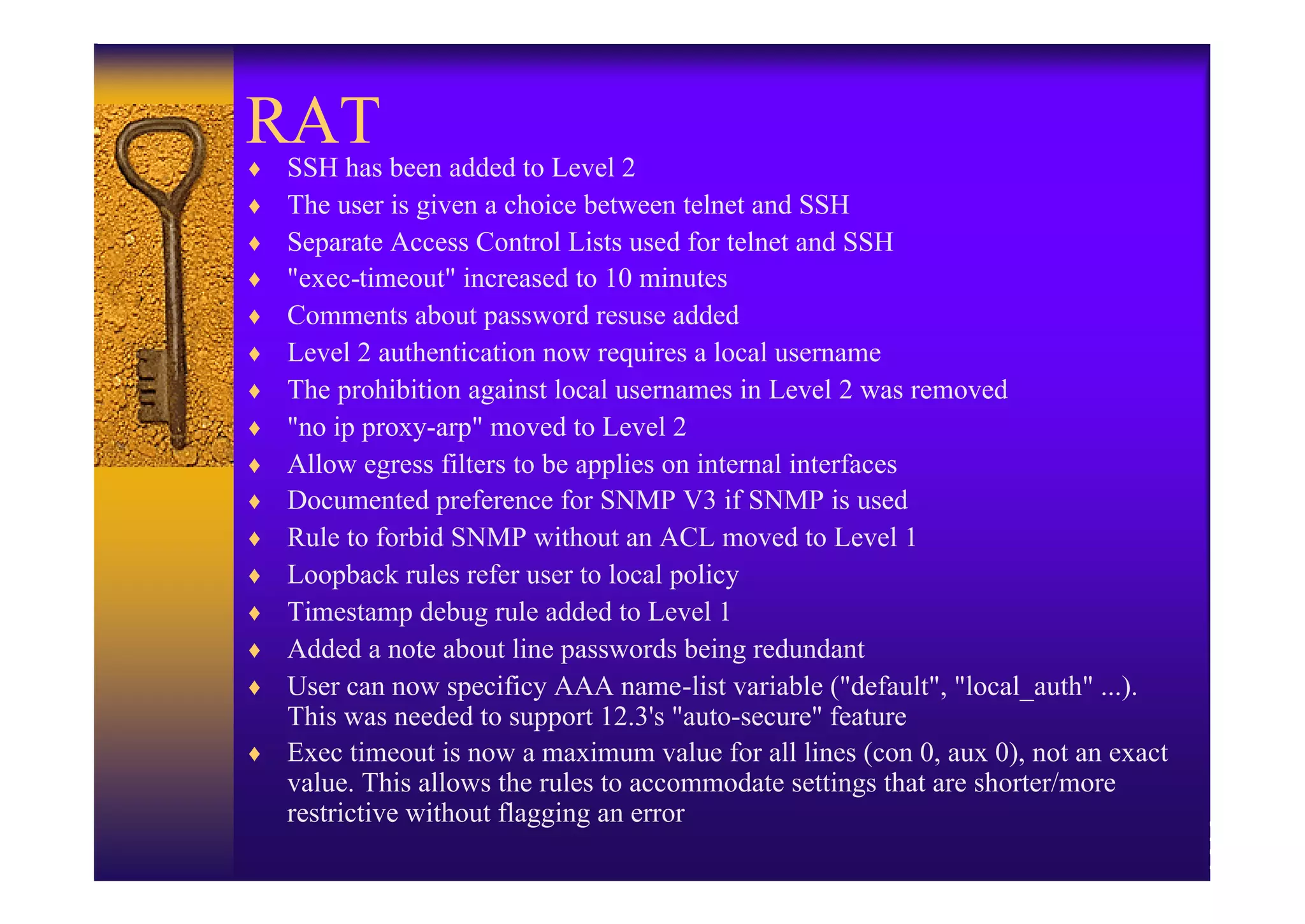
RAT been added to Level 2
♦SSH has
♦ The user is given a choice between telnet and SSH
♦ Separate Access Control Lists used for telnet and SSH
♦ "exec-timeout" increased to 10 minutes
♦ Comments about password resuse added
♦ Level 2 authentication now requires a local username
♦ The prohibition against local usernames in Level 2 was removed
♦ "no ip proxy-arp" moved to Level 2
♦ Allow egress filters to be applies on internal interfaces
♦ Documented preference for SNMP V3 if SNMP is used
♦ Rule to forbid SNMP without an ACL moved to Level 1
♦ Loopback rules refer user to local policy
♦ Timestamp debug rule added to Level 1
♦ Added a note about line passwords being redundant
♦ User can now specificy AAA name-list variable ("default", "local_auth" ...).
  This was needed to support 12.3's "auto-secure" feature
♦ Exec timeout is now a maximum value for all lines (con 0, aux 0), not an exact
  value. This allows the rules to accommodate settings that are shorter/more
  restrictive without flagging an error
References

Books, RFCs, Links
References
♦ Books                                        ♦ Papers
  –   Albritton, J. Cisco IOS Essentials,
      McGraw-Hill, 1999.                         – “Internetworking Technology
  –   Ballew, S.M., Managing IP Networks           Overview”, Cisco Systems,
      with Cisco Routers, O’Reilly                 1999.http://www.cisco.com/univer
      Associates, 1997.                            cd/cc/td/doc/cisintwk/ito_doc/
  –   Chappell, L. Introduction to Cisco
      Router Configuration, Cisco Press,         – “OSI Layer 3”, Cisco Systems
      1998.                                        Brochure, Cisco Systems,
  –   Chappell, L. (ed.) Advanced Cisco            1997.http://www.cisco.com/warp/p
      Router Configuration, Cisco Press,           ublic/535/2.html
      1999.
  –   Perlman, R., Interconnections: Bridges     – “TCP/IP”, Cisco Product
      and Routers, McGraw-Hill, 1992.              Overview, Cisco Systems,
  –   Sacket, G., Cisco Router Handbook,           1997.http://www.cisco.com/warp/p
      McGraw-Hill, 1999.                           ublic/535/4.html
  –   Held, G. and Hundley, K., Cisco
      Security Architectures, McGraw-Hill,
      1999.
  –   Tannenbaum, A., Computer Networks,
      2nd edition, Prentice-Hall, 1998.
References
♦ RFCs
  –    Postel, J., “User Datagram Protocol
                                                  –   Fuller, V., Li, T., Varadhan K., and Yu,
      (UDP)”, RFC 768, 1980.
                                                      J., “Classless Inter-Domain Routing
  –   Postel, J., “Internet Protocol (IP)”, RFC
                                                  –   (CIDR): an Address Assignment and
      791, 1981.
                                                      Aggregation Strategy”, RFC 1519,
  –   Postel, J., “Transmission Control               1993.
      Protocol (TCP)”, RFC 793, 1981.
  –   Postel, J. and Braden, R.,
      “Requirements for Internet Gateways”,
      RFC 1009, 1987.
  –   Socolofsky, T. and Kale, C., “A TCP/IP
      Tutorial”, RFC 1180, 1991.
  –   Malkin, G. and Parker T.L., “Internet
      User’s Glossary”, RFC 1392, 1993.
  –   Rekhter, Y. and Li, T., “An
      Architecture of IP Address Allocation
      with CIDR”, RFC 1518, 1993.
Fin

© Rafael Vida, 2004
Cisco-FIST@mixmail.com

Cisco Equipment Security

  • 1.
    Seguridad en loselementos de red Cisco © Rafael Vida, 2004
  • 2.
    Index (I) ♦ Introducción – General Situation • Routers • Security Policy • Purpose of a router • Basic Router Functional Architecture – Protecting the Network with the Router
  • 3.
    Index (II) ♦ Protectingthe Router Itself – Attacks on Routers – Managing the Router • SNMP • SSH – Security Policy for Cisco Routers ♦ Implementing Security: E-Policy – AAA • Remote Access • Logins, Privileges, Passwords, and Accounts
  • 4.
    Index (III) ♦ Filtering – ACL – ACR ♦ RAT (Router Audit Tool)
  • 5.
  • 6.
    Introduction ♦ Purpose ofa router – Directing packets, roting protocols – Filtering:ACL – Modifing packet´s headers: NAT, PAT. ♦ Hardware – CPU, Memory: • RAM, NVRAM, Flash, and ROM (PROM, EEPROM) • ROM, NVRAM. – Does Not have Hard disk, floppy, CDROM, etc.
  • 7.
    Introduction Network Network Networ Network Network Networ 00 11 ... kknn Interface 0 Interface 1 Interface n ... Routing Fabric CPU Conf Router Consola
  • 8.
  • 9.
    Security Policy ♦ RouterSecurity Layers Physical access Electrical Access Physical Integrity Administrative Access Core Static Configuration Software Access Routing Protocolos Dynamic Configuration Management Protocols Access to the networks that the Network traffic router Serves
  • 10.
    Security Policy: Checklist ♦Physical Security – Who is autorized to install, de-instal, move, etc. – Making physical connections to the router • Console and direct ports • Recovery procedures ♦ Static Configuration – Who is authorized to log into the router – Roles – Password Policy – Log policy – Porcedures and limits of use
  • 11.
    Security Policy: Checklist ♦Dynamic Configuration Security – Services permited in the router – Routing protoclos, clock (NTP) – Procedures in key agreement and cryptographic algorithms ♦ Compromise Response – ITO?, Netcool?, ... – Response procedures, authorities, and objectives for response after a successful attack against the network – Law
  • 12.
    Security Policy: Checklist ♦Network Service Security – Procedures and roles for interactions with external service providers and maintenance technicians – Protocols, ports, services, etc Internet DMZ Management
  • 13.
  • 14.
    Protecting the networks ♦Router Clasification by funcionality – Internal Routers – Backbone – Border (EDCs)
  • 15.
    Protecting the router:Attacks ♦ Unauthorized access ♦ Session hijacking ♦ Rerouting ♦ Dos ♦ Ddos (!) ♦ SNMP attacks
  • 16.
    Protecting the router:Managing Política de FW por Centro de FW Adminstrado Gestión por Cliente Centro de Gestión local LAN_Cliente FW_Cliente FW_CGP Punto Central EDCs PVCs Servicio Gestión Local EDCs Accounting entre EDCs y CGP TACACS+, Telnet, TFTP,SNMP,... Trafico entre EDCs y FW Gestión Central SNMP, Syslog, ICMP,... Trafico entre CGP y Gestión Central SSH, Ofimática, Vantive,... Centro de Gestión Central
  • 17.
    Protecting the router:Managing ♦ Local access only for Emergency. Audit. ♦ Telnet (?!) ó SSH ♦ SNMP access. – Limit the connections, ACLs ♦ AAA: – Logging and Accounting: Tacacs+ – Auditing – Authorizing
  • 18.
  • 19.
    Router Access Security ♦Physical Security ♦ Software Upgrade – Minimun 12.0.* – Recommended 12.0.9 ♦ Virtual interfaces: loopback Central# config t Enter configuration commands, one per line. End with CNTL/Z. Central(config)# interface loopback0 Central(config-if)# description Main loopback interface Central(config-if)# ip address 14.2.11.250 255.255.255.255 Central(config-if)# end Central#
  • 20.
    Login Banners andmotd ♦ Banner – No Network architecture information and router configuration details – AVISO: ha accedido a un sistema propiedad de TELEFONICA. Necesita tener autorización antes de usarlo, estando usted estrictamente limitado al uso indicado en dicha autorización. El acceso no autorizado a este sistema o el uso indebido del mismo está prohibido y es contrario a la Política Corporativa de Seguridad y a la legislación vigente. Si usted revela información interna de TELEFONICA o de sus clientes sin previa autorización podrá estar incurriendo en una violación de la Normativa Corporativa, que podría incluso suponer la posible comisión de un delito o falta.
  • 21.
    Login ♦ Console Central# config t Enter configuration commands, one per line. End with CNTL/Z. Central(config)# line con 0 Central(config-line)# transport input none Central(config-line)# login local Central(config-line)# exec-timeout 5 0 Central(config-line)# exit Central(config)# ♦ VTYs and Remote Administration ♦ Privileges, 16 levels ♦ Diferents Accounts ♦ service password-encryption – ! SNMP, Radius, TACACS+, NTP, PEER auth. Keys. ♦ Auxiliary port disabled
  • 22.
    Remote Access 1. No Remote: administration is performed on the console only. 2. Remote Internal only with AAA: administration can be performed on the router from a trusted internal network only, and AAA is used for access control. 3. Remote Internal only: administration can be performed on the router from the internal network only. 4. Remote External with AAA: administration can be performed with both internal and external connections and uses AAA for access control. 5. Remote External: administration can be performed with both internal and external connections.
  • 23.
    AAA ♦ Authentication – With SSH or IPsec ♦ Authorization – Command by command. All not allowed is denied. ♦ Acounting – Forensic Analisys ♦ Keep the running configuration and startup configuration syncronized ♦ TFTP is dead
  • 24.
  • 25.
    Access Control List ♦access-list list-number {deny | permit} source [source-wildcard] [log] ♦ access-list list-number {deny | permit} protocol source source-wildcard source-qualifiers destination destination-wildcard destination- qualifiers [ log | log-input]
  • 26.
    Defense ♦ Spoofing – ACL ♦ TCP SYN Attack East(config)# ip tcp intercept list 107 East(config)# access-list 107 permit tcp any 14.2.6.0 0.0.0.255 East(config)# access-list 107 deny ip any any log East(config)# interface eth 0/0 East(config-if)# description "External 10mb ethernet interface" East(config-if)# ip access-group 107 in
  • 27.
    Defense ♦ LandAttack East(config)# access-list 100 deny ip host 14.1.1.20 host 14.1.1.20 log East(config)# access-list 100 permit ip any any East(config)# interface eth0/0 East(config-if)# description External interface to 14.1.0.0/16 East(config-if)# ip address 14.1.1.20 255.255.0.0 East(config-if)# ip access-group 100 in East(config-if)# exit ♦ Smurf East(config)# access-list 110 deny ip any host 14.2.6.255 log East(config)# access-list 110 deny ip any host 14.2.6.0 log East(config)# interface interface eth0/0 East(config-if)# ip access-group 110 in East(config-if)# exit
  • 28.
    Defense ♦ DDOS – ! the TRINOO DDoS systems access-list 170 deny tcp any any eq 27665 log access-list 170 deny udp any any eq 31335 log access-list 170 deny udp any any eq 27444 log – ! the Stacheldraht DDoS system access-list 170 deny tcp any any eq 16660 log access-list 170 deny tcp any any eq 65000 log – ! the TrinityV3 system access-list 170 deny tcp any any eq 33270 log access-list 170 deny tcp any any eq 39168 log – ! the Subseven DDoS system and some variants access-list 170 deny tcp any any range 6711 6712 log access-list 170 deny tcp any any eq 6776 log access-list 170 deny tcp any any eq 6669 log access-list 170 deny tcp any any eq 2222 log access-list 170 deny tcp any any eq 7000 log
  • 29.
    Committed Access Rate ♦rate-limit {input | output} [access-group [rate-limit] acl] token-bit-rate burst-normal-size burst-excess-size conform-action action exceed-action action ♦ north(config)# no access-list 160 north(config)# access-list 160 deny tcp any any established north(config)# access-list 160 permit tcp any any syn north(config)# interface eth0/0 north(config-if)# rate-limit input access-group 160 64000 8000 8000 conform-action transmit exceed-action drop north(config-if)# end
  • 30.
    RAT been addedto Level 2 ♦SSH has ♦ The user is given a choice between telnet and SSH ♦ Separate Access Control Lists used for telnet and SSH ♦ "exec-timeout" increased to 10 minutes ♦ Comments about password resuse added ♦ Level 2 authentication now requires a local username ♦ The prohibition against local usernames in Level 2 was removed ♦ "no ip proxy-arp" moved to Level 2 ♦ Allow egress filters to be applies on internal interfaces ♦ Documented preference for SNMP V3 if SNMP is used ♦ Rule to forbid SNMP without an ACL moved to Level 1 ♦ Loopback rules refer user to local policy ♦ Timestamp debug rule added to Level 1 ♦ Added a note about line passwords being redundant ♦ User can now specificy AAA name-list variable ("default", "local_auth" ...). This was needed to support 12.3's "auto-secure" feature ♦ Exec timeout is now a maximum value for all lines (con 0, aux 0), not an exact value. This allows the rules to accommodate settings that are shorter/more restrictive without flagging an error
  • 31.
  • 32.
    References ♦ Books ♦ Papers – Albritton, J. Cisco IOS Essentials, McGraw-Hill, 1999. – “Internetworking Technology – Ballew, S.M., Managing IP Networks Overview”, Cisco Systems, with Cisco Routers, O’Reilly 1999.http://www.cisco.com/univer Associates, 1997. cd/cc/td/doc/cisintwk/ito_doc/ – Chappell, L. Introduction to Cisco Router Configuration, Cisco Press, – “OSI Layer 3”, Cisco Systems 1998. Brochure, Cisco Systems, – Chappell, L. (ed.) Advanced Cisco 1997.http://www.cisco.com/warp/p Router Configuration, Cisco Press, ublic/535/2.html 1999. – Perlman, R., Interconnections: Bridges – “TCP/IP”, Cisco Product and Routers, McGraw-Hill, 1992. Overview, Cisco Systems, – Sacket, G., Cisco Router Handbook, 1997.http://www.cisco.com/warp/p McGraw-Hill, 1999. ublic/535/4.html – Held, G. and Hundley, K., Cisco Security Architectures, McGraw-Hill, 1999. – Tannenbaum, A., Computer Networks, 2nd edition, Prentice-Hall, 1998.
  • 33.
    References ♦ RFCs – Postel, J., “User Datagram Protocol – Fuller, V., Li, T., Varadhan K., and Yu, (UDP)”, RFC 768, 1980. J., “Classless Inter-Domain Routing – Postel, J., “Internet Protocol (IP)”, RFC – (CIDR): an Address Assignment and 791, 1981. Aggregation Strategy”, RFC 1519, – Postel, J., “Transmission Control 1993. Protocol (TCP)”, RFC 793, 1981. – Postel, J. and Braden, R., “Requirements for Internet Gateways”, RFC 1009, 1987. – Socolofsky, T. and Kale, C., “A TCP/IP Tutorial”, RFC 1180, 1991. – Malkin, G. and Parker T.L., “Internet User’s Glossary”, RFC 1392, 1993. – Rekhter, Y. and Li, T., “An Architecture of IP Address Allocation with CIDR”, RFC 1518, 1993.
  • 34.
    Fin © Rafael Vida,2004 Cisco-FIST@mixmail.com