May/Madrid 2007
Con la colaboración de

y el patrocinio de


       CERT Certification

                              Vicente Aceituno
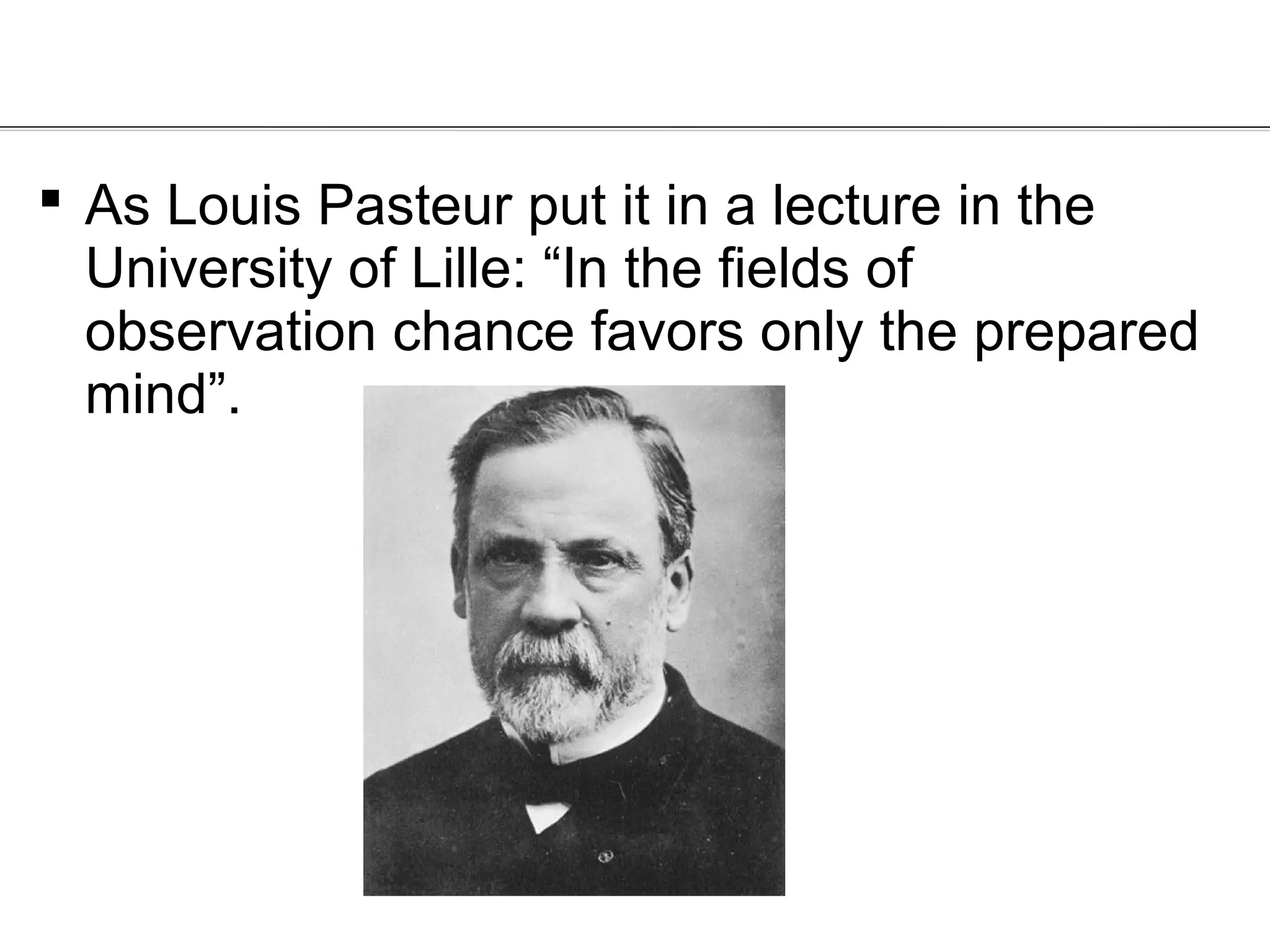
 As Louis Pasteur put it in a lecture in the
  University of Lille: “In the fields of
  observation chance favors only the prepared
  mind”.
What?


 CERT or CERT/CC (Computer Emergency
  Response Team / Coordination Center)
 CSIRT (Computer Security Incident Response
  Team)
 IRT (Incident Response Team)
 CIRT (Computer Incident Response Team)
 SERT (Security Emergency Response Team)
CERT


 A Computer Security Incident Response Team (CSIRT)
  is a service organization that is responsible for receiving,
  reviewing, and responding to computer security incident
  reports and activity.
 Their services are usually performed for a defined
  constituency that could be a parent entity such as a
  corporation, governmental, or educational organization;
  a region or country; a research network; or a paid client.
  (CERT/CC)
CERT - Benefits


 Centralized coordination for IT security issues within
  the organization.
 Specialized handling of and response to IT incidents.
 Dealing with legal issues and preserving evidence in
  the event of a lawsuit.
 Keeping track of developments in the security field.
 Stimulating cooperation within the constituency on IT
  security (awareness building).
CERT - Types

 Academic Sector CSIRT
 Commercial CSIRT
 Governmental Sector CSIRT
 Internal CSIRT
 Military Sector CSIRT
 National CSIRT
 Small & Medium Enterprises (SME) Sector
  CSIRT
 Vendor CSIRT
CERT - Services


 Reactive Services
     Alerts and Warnings
     Incident Handling
     Vulnerability Handling
     Artifact Handling
CERT - Services


 Proactive Services
   Technology Watch
   Announcements
   Security Audit or Assessments
   Configuration and Maintenance of Security
    Tools, Applications and Infrastructures
   Development of Security Tools
   Intrusion Detection Services
   Security-Related Information Dissemination
CERT - Services


 Security Quality Management Services
     Risk Analysis
     Business Continuity & Disaster Recovery Planning
     Security Consulting
     Awareness Building
     Education / Training
     Product Evaluation or Certification
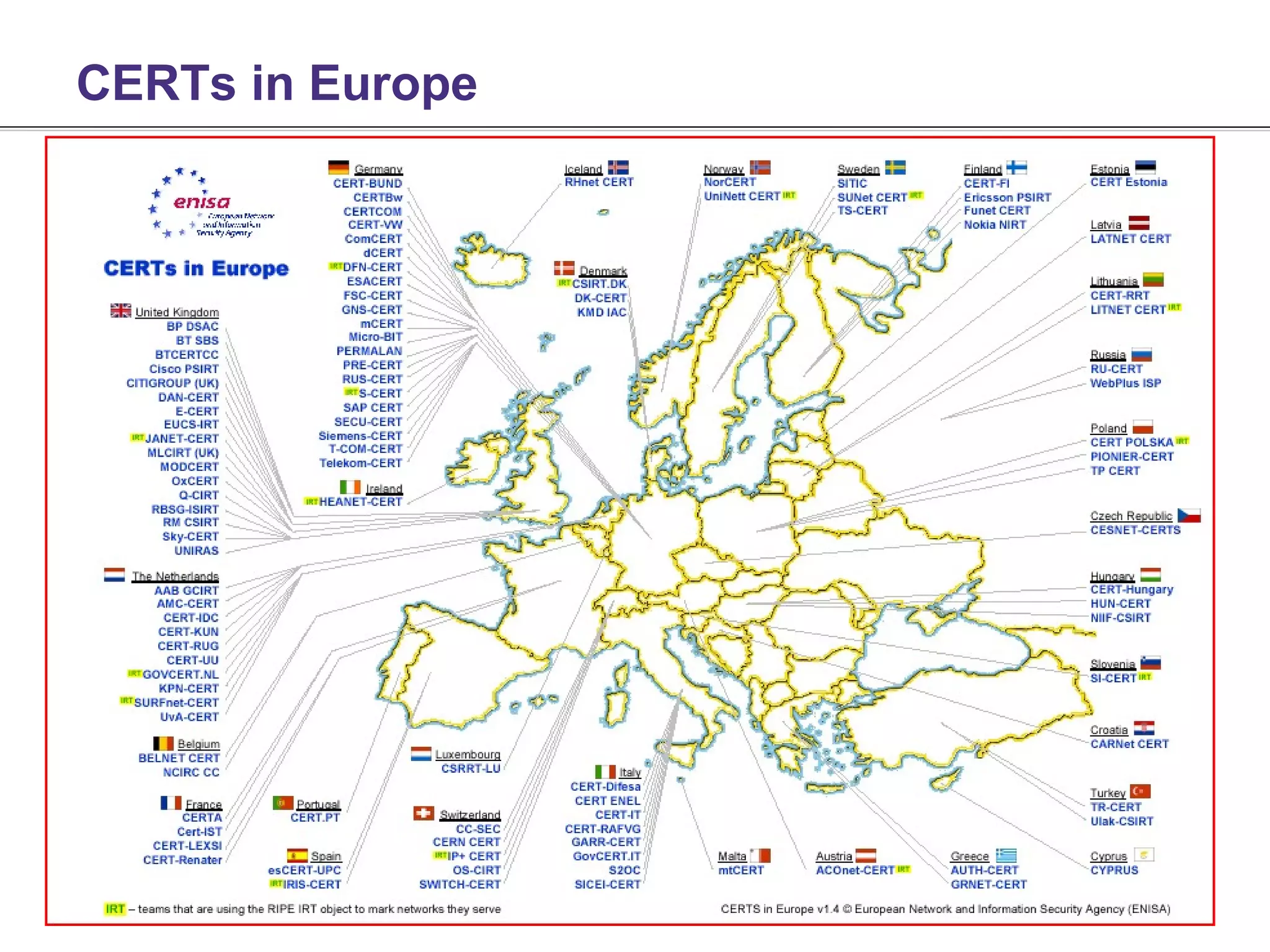
CERTs in Europe
Trust Building


   Team – Team
   Association
   Inter - Association
   Personal relationships.
   Certification - Trusted Introducer.
   Agreements:
     Code of Conduct.
     Memoranda of Understanding.
     SLAs.
 Adherence to standards.
Association - FIRST
 Mission:
    FIRST is an international confederation of trusted computer incident
     response teams who cooperatively handle computer security
     incidents and promote incident prevention programs.
    FIRST members develop and share technical information, tools,
     methodologies, processes and best practices
    FIRST encourages and promotes the development of quality
     security products, policies & services
    FIRST develops and promulgates best computer security practices
    FIRST promotes the creation and expansion of Incident Response
     teams and membership from organizations from around the world
    FIRST members use their combined knowledge, skills and
     experience to promote a safer and more secure global electronic
     environment.
Certification - Trust

 A way to evidence the organization's stance on security;
 A part of a contract to ensure commitment by one of the
  parties to security management;
 A mechanism to ensure mutual understanding of the
  services obtained from a provider.
 Trust relationships with Third Parties, like Partners,
  Customers and Suppliers.
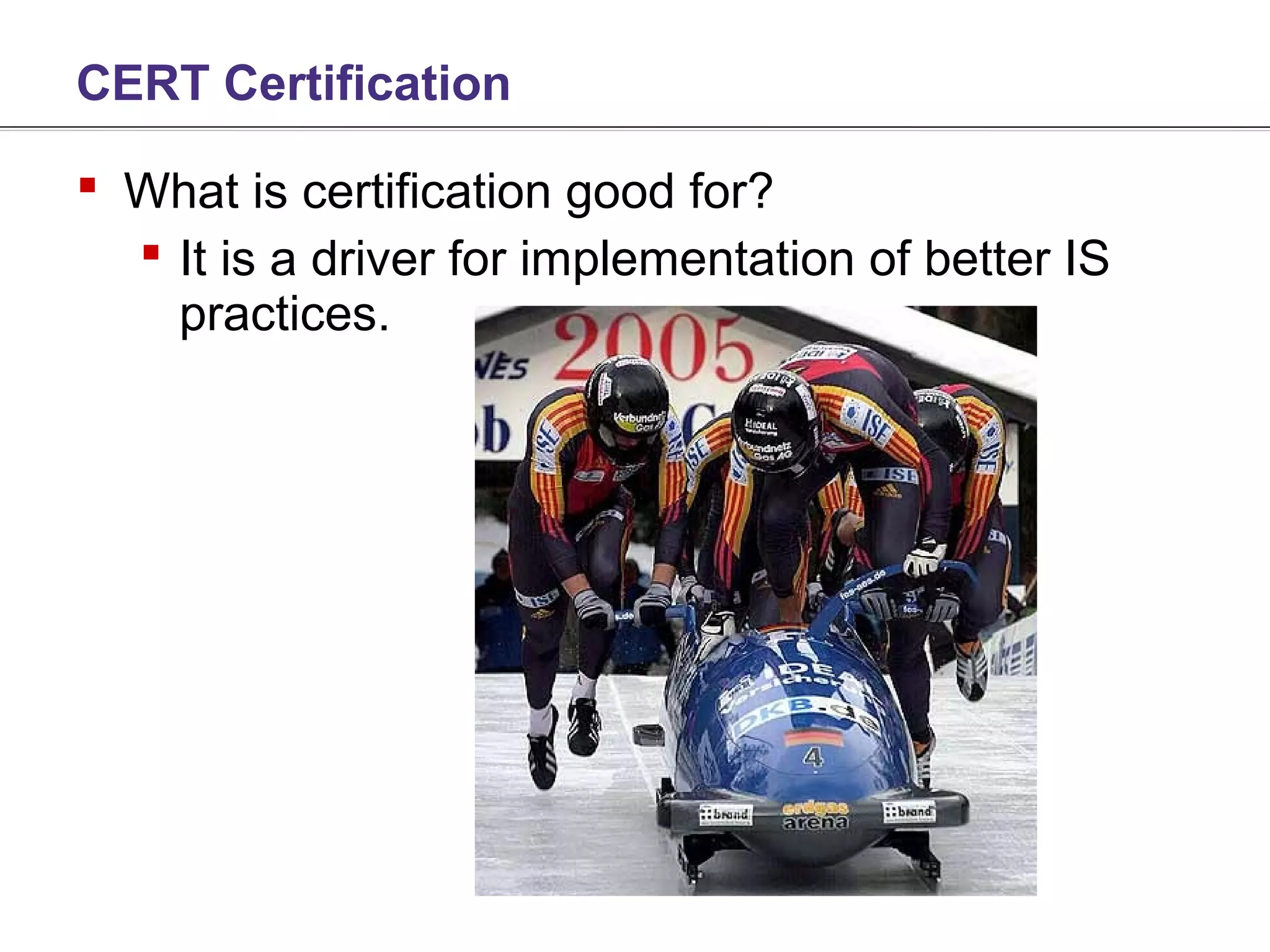
CERT Certification

 What is certification good for?
   It is a driver for implementation of better IS
    practices.
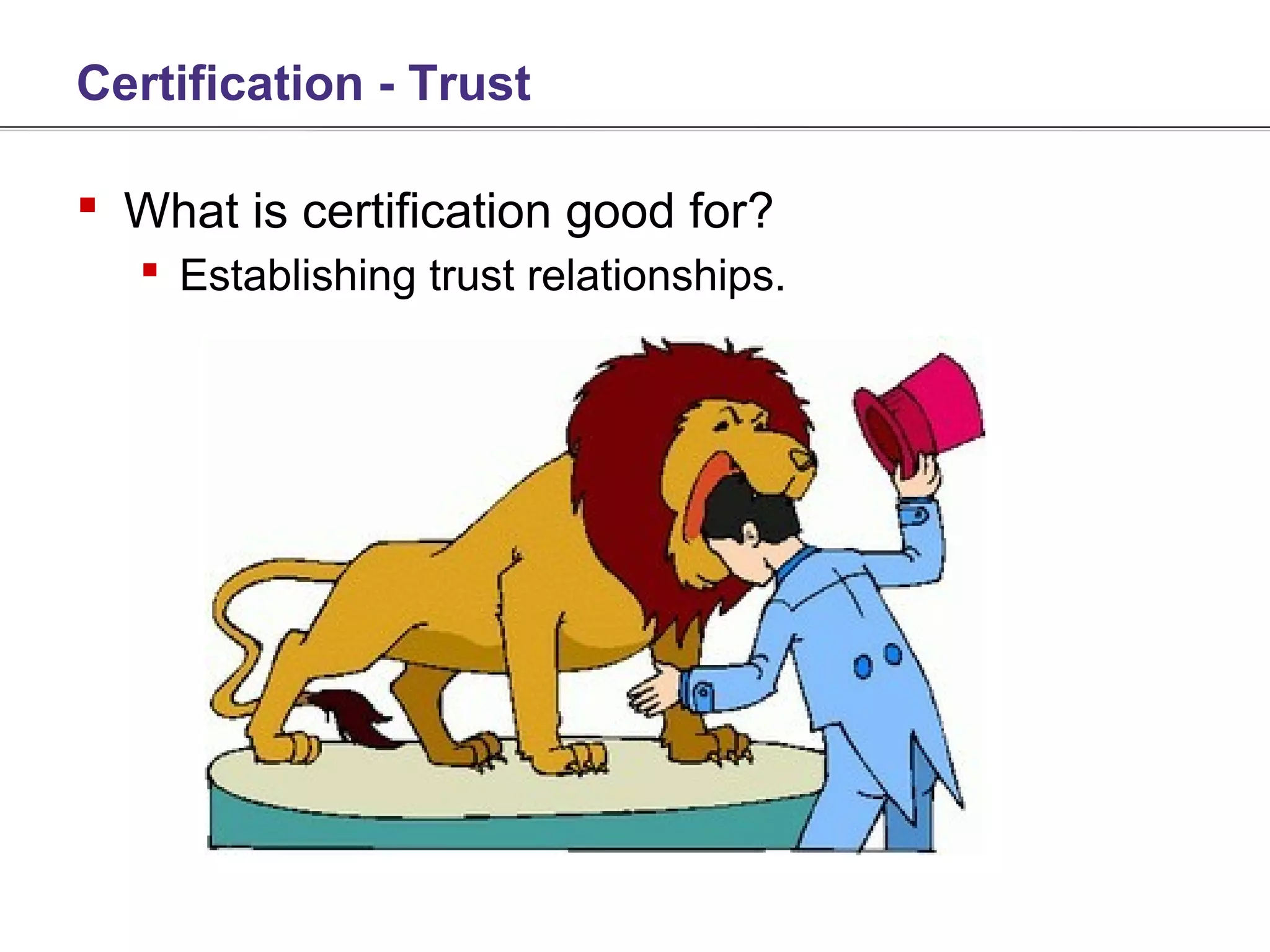
Certification - Trust

 What is certification good for?
    Establishing trust relationships.
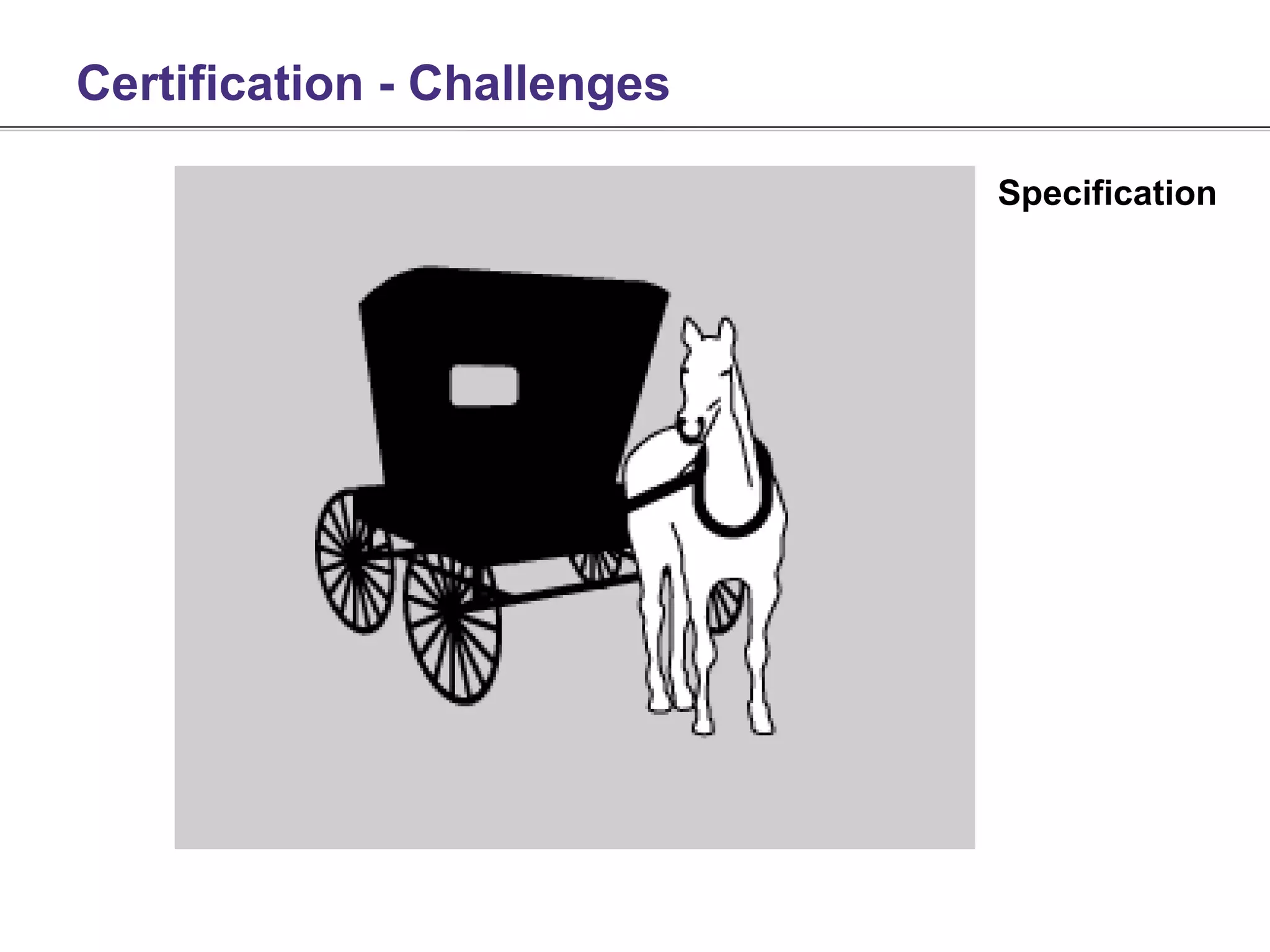
Certification - Challenges


 Challenges
    Certification doesn’t guarantee performance.
     Performance depends on the budget, the capability
     and the commitment of those involved in running it.
    Certification only guarantees that the cause of faults
     is not poor process design.
    Poor performers and bogus certifications lower the
     reputation of the certification and damage the
     reputation of all certificate holders.
Certification - Challenges

                             Specification
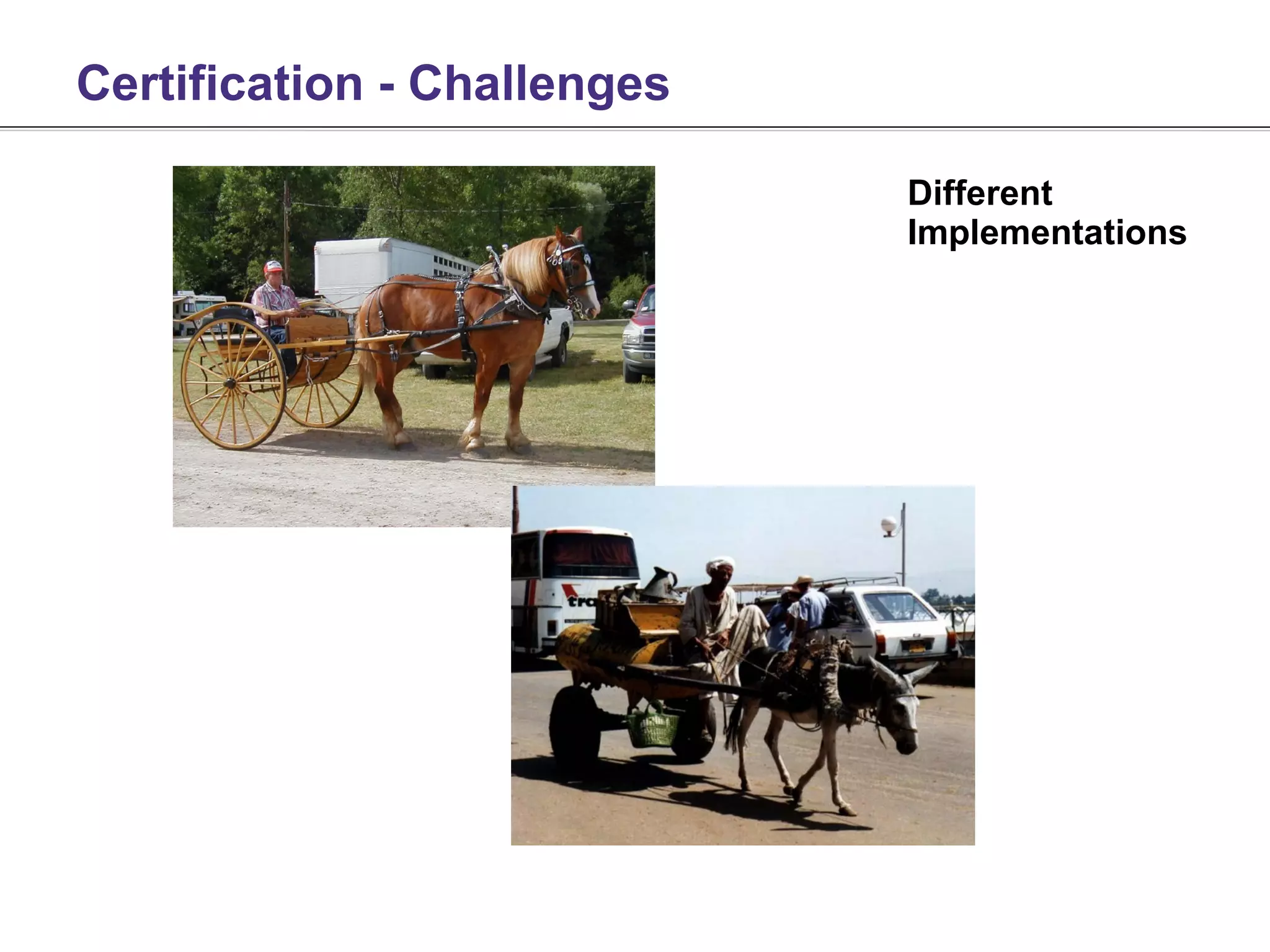
Certification - Challenges

                             Different
                             Implementations
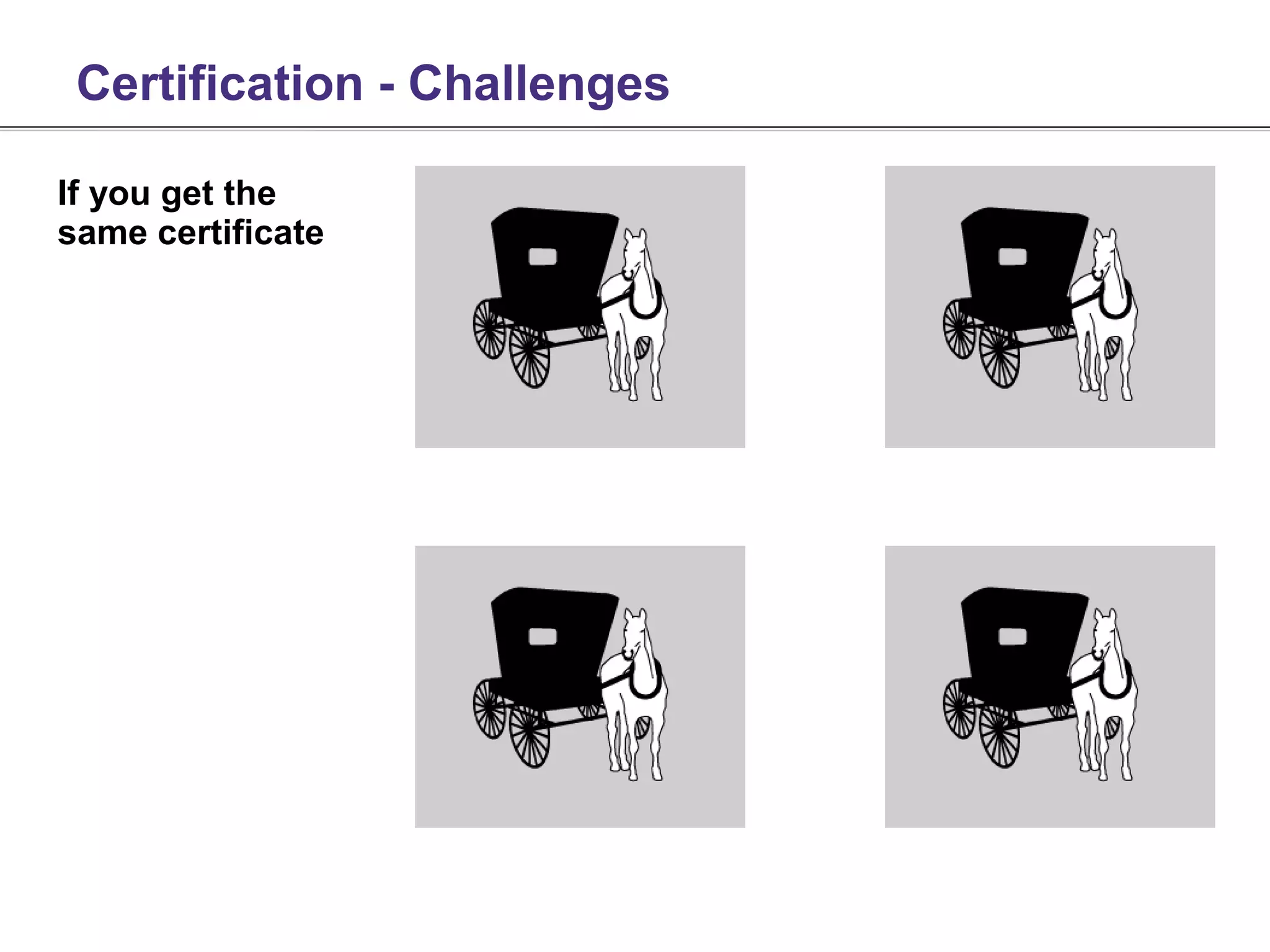
Certification - Challenges

If you get the
same certificate
Certification - Challenges

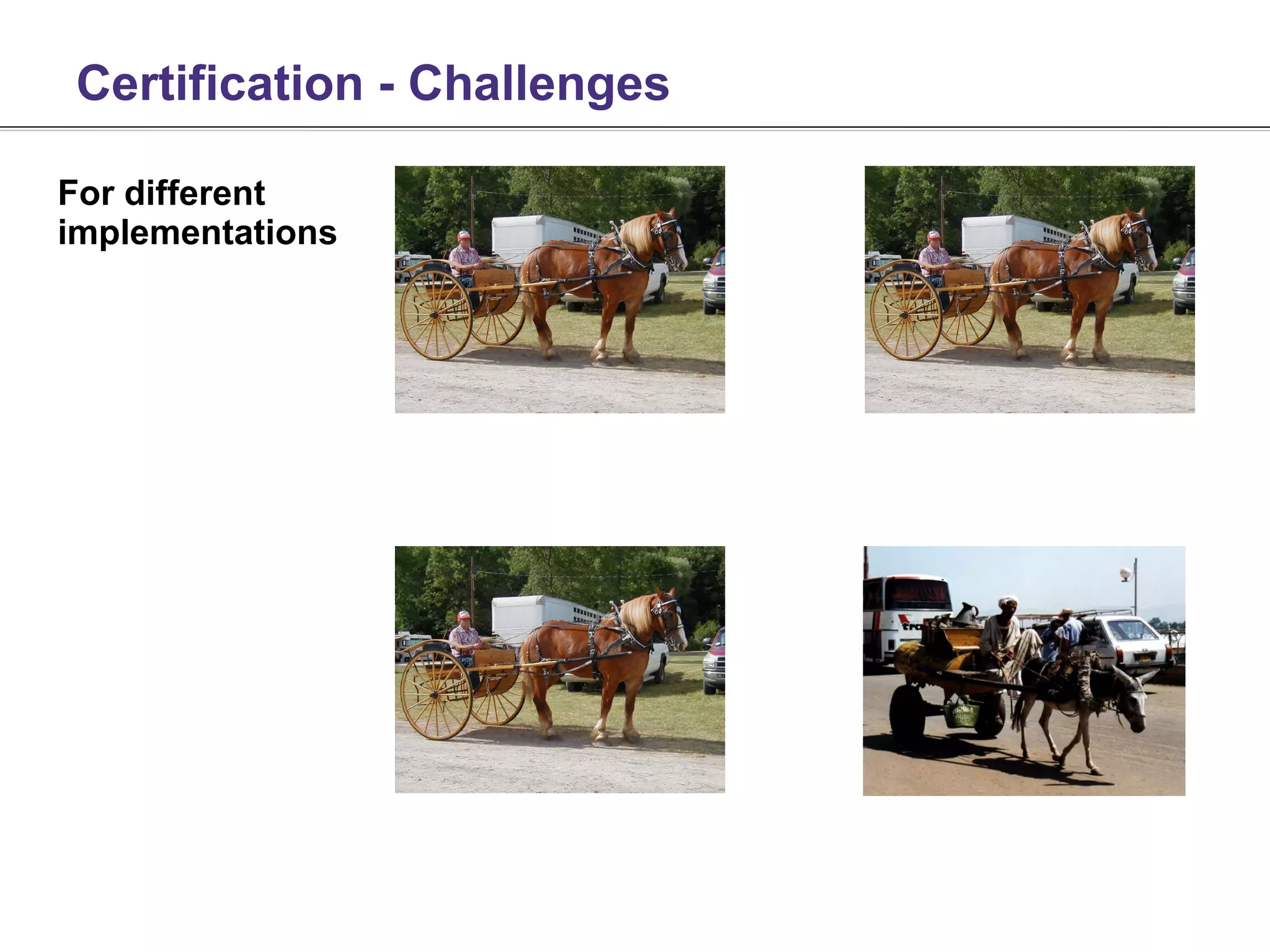
For different
implementations
Certification - Challenges

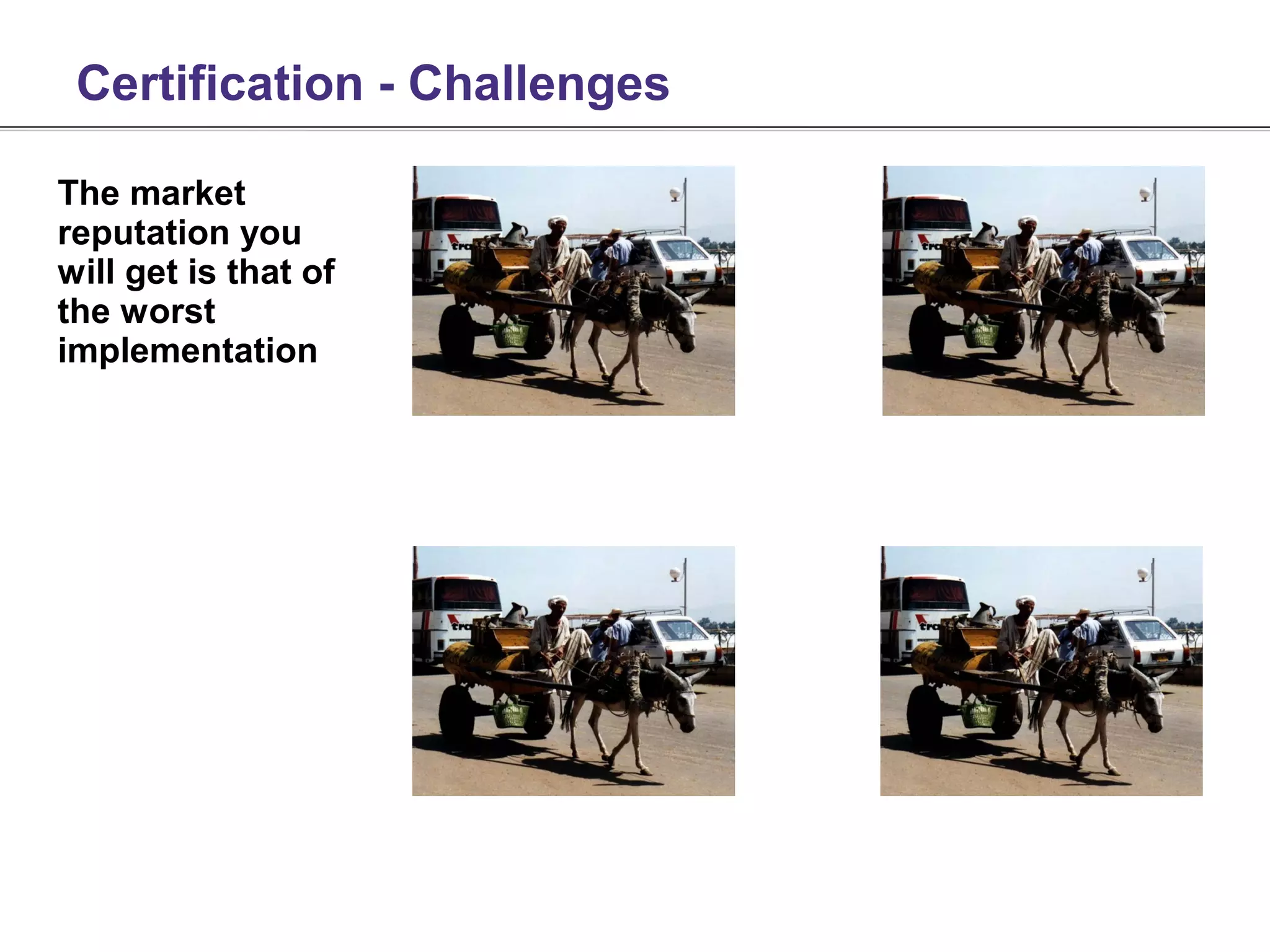
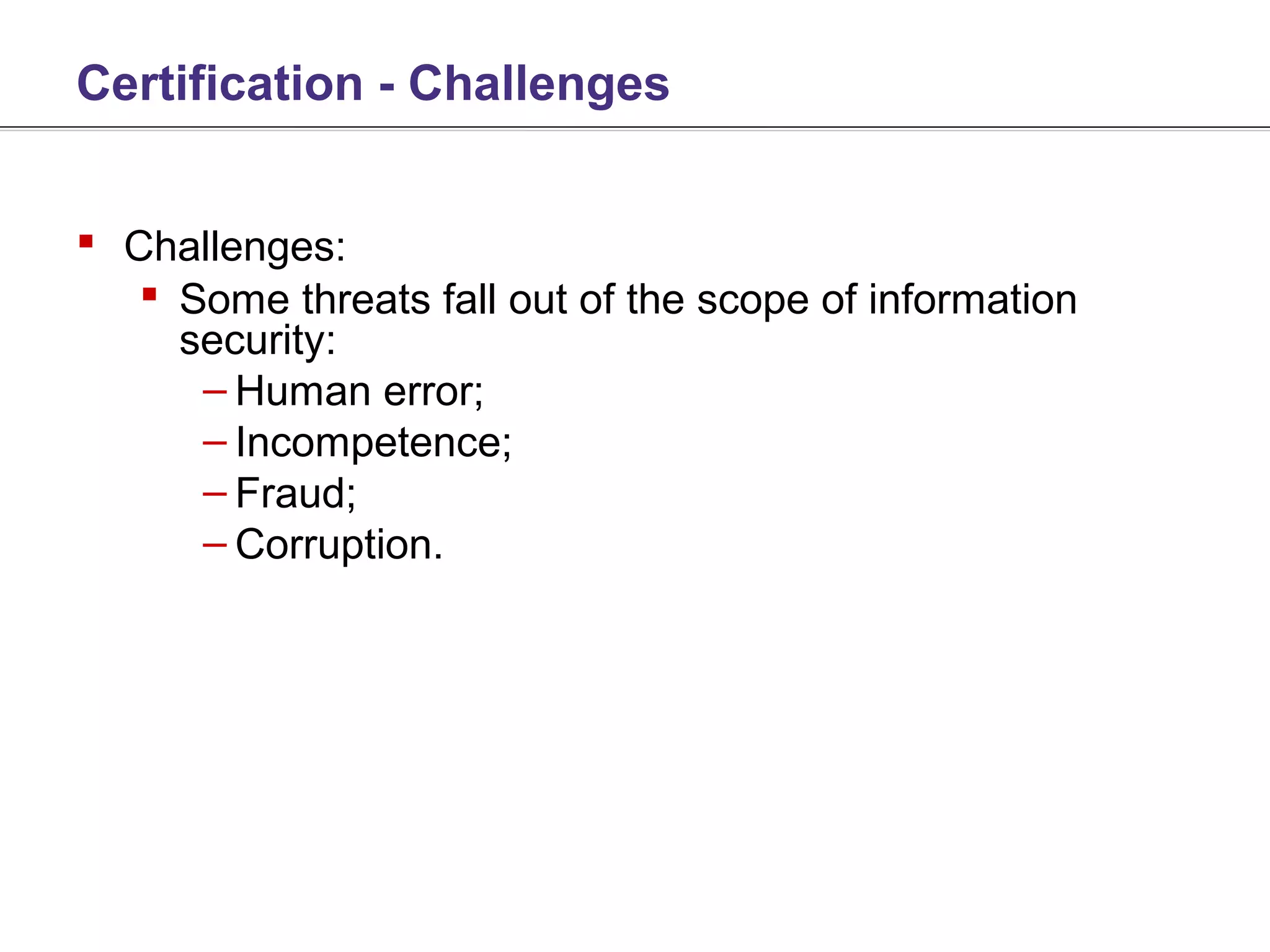
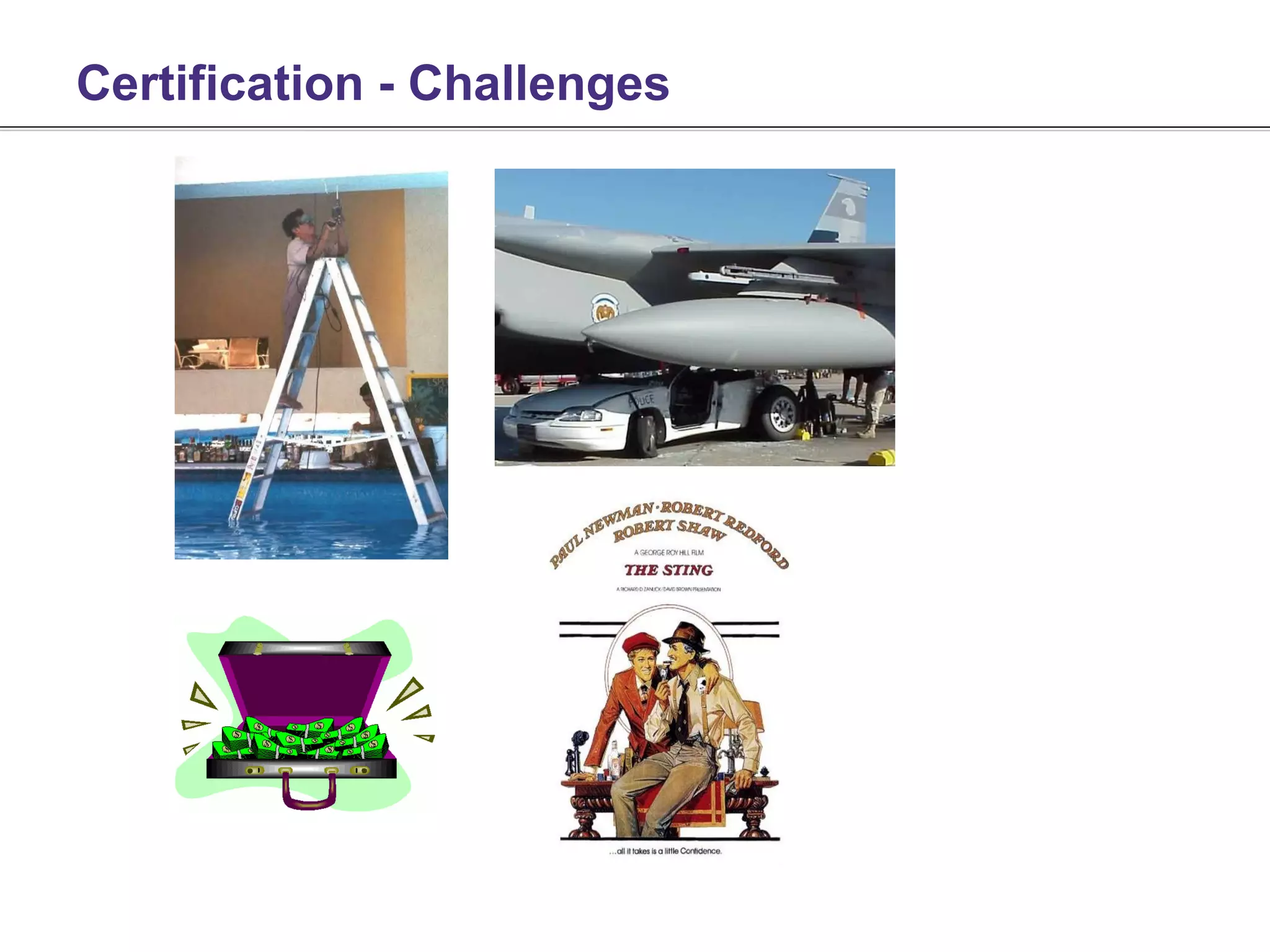
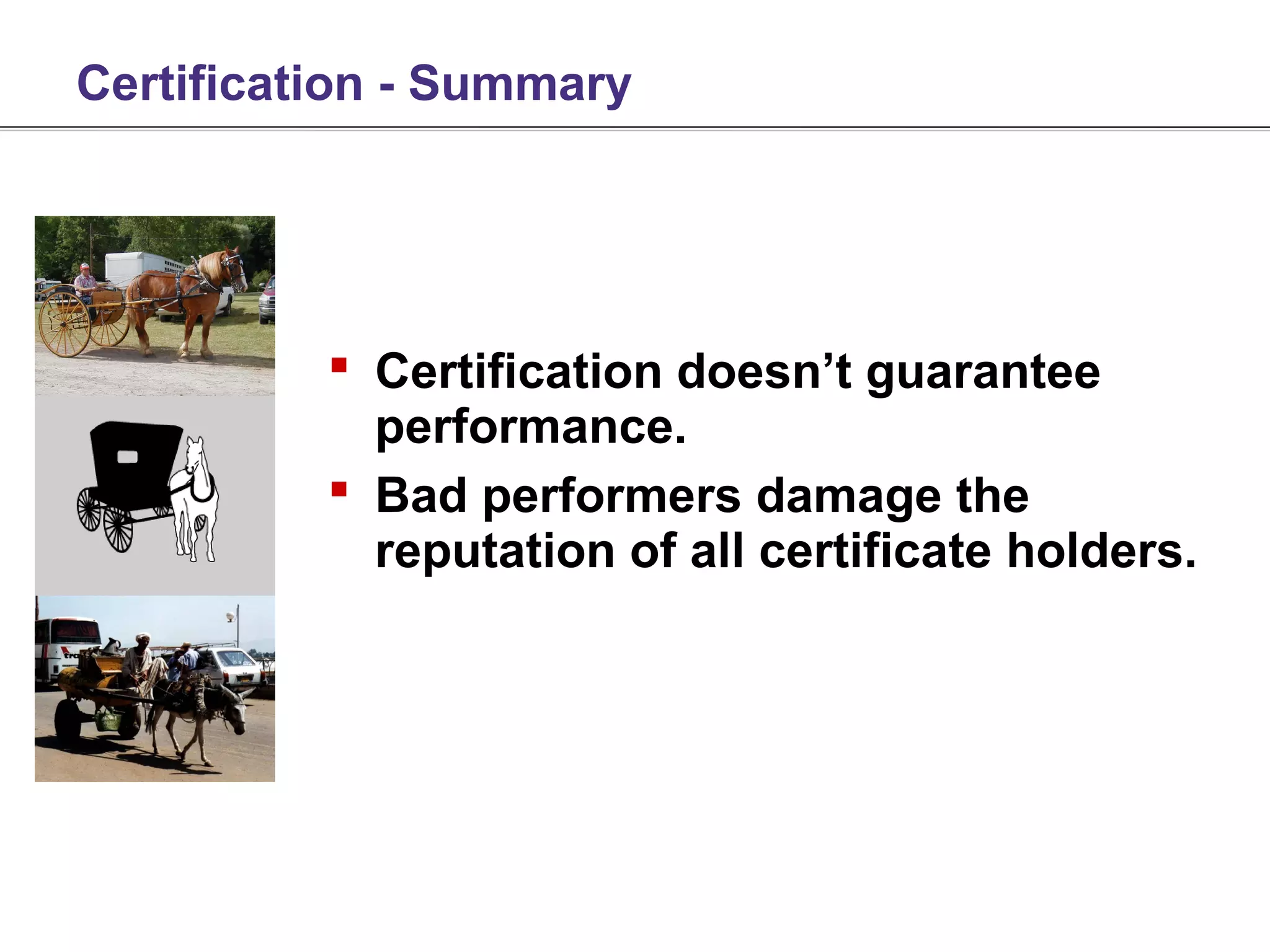
The market
reputation you
will get is that of
the worst
implementation
Certification - Challenges


 Challenges:
    Some threats fall out of the scope of information
     security:
      – Human error;
      – Incompetence;
      – Fraud;
      – Corruption.
Certification - Challenges
Certification - Summary


           Certification doesn’t guarantee
            performance.
           Bad performers damage the
            reputation of all certificate holders.
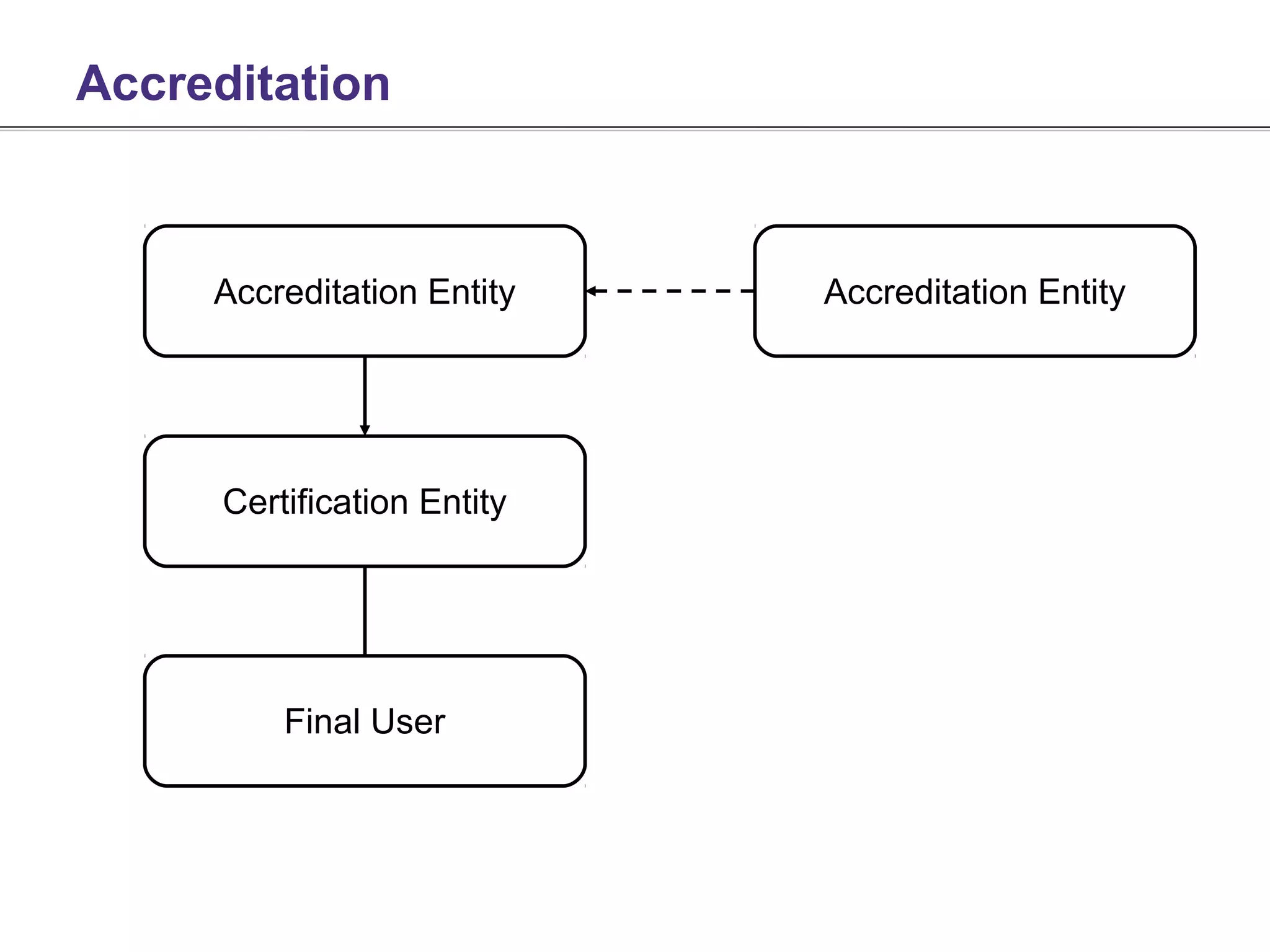
Accreditation


     Accreditation Entity    Accreditation Entity


      Certification Entity


          Final User
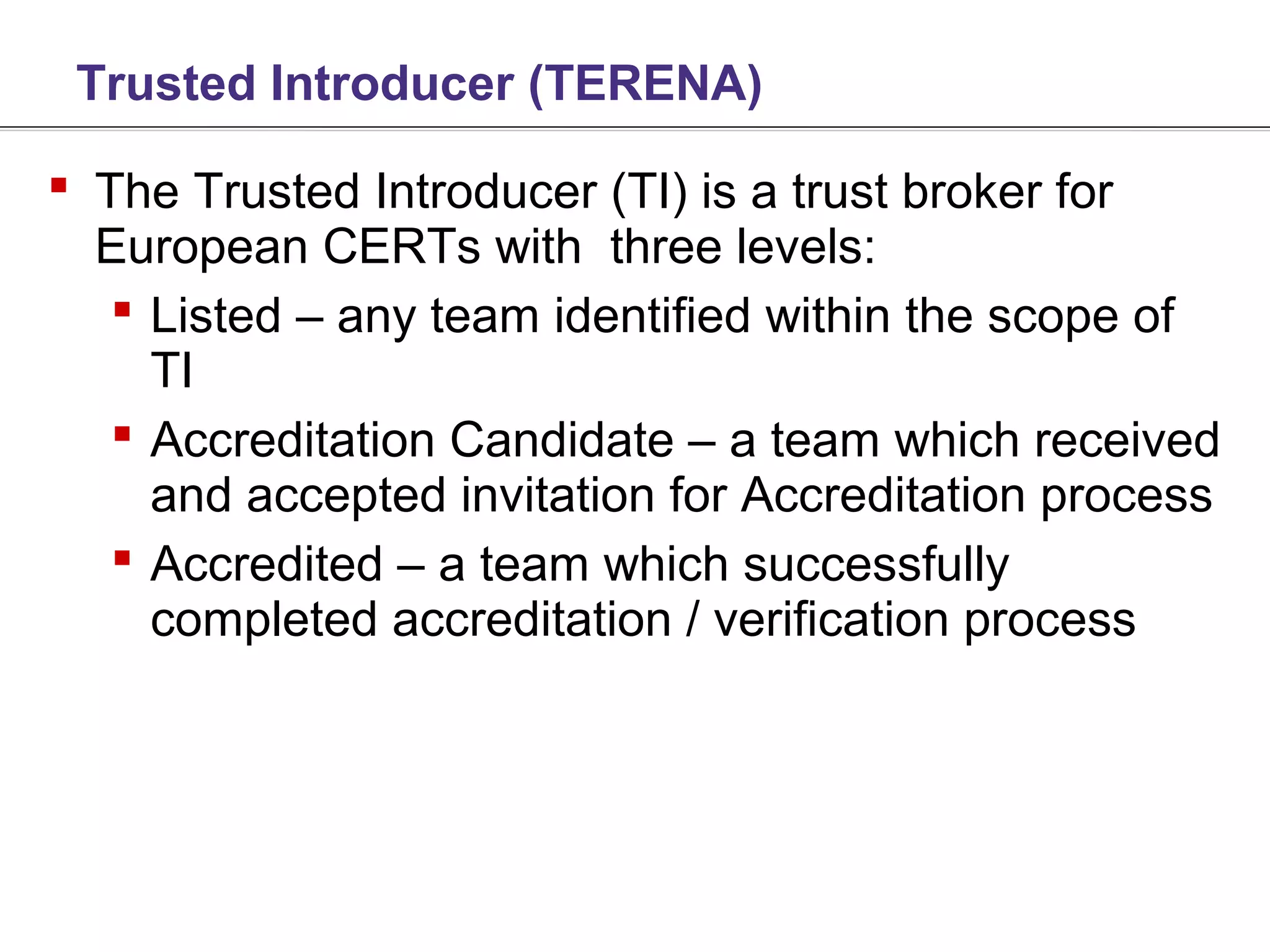
Trusted Introducer (TERENA)

 The Trusted Introducer (TI) is a trust broker for
  European CERTs with three levels:
    Listed – any team identified within the scope of
     TI
    Accreditation Candidate – a team which received
     and accepted invitation for Accreditation process
    Accredited – a team which successfully
     completed accreditation / verification process
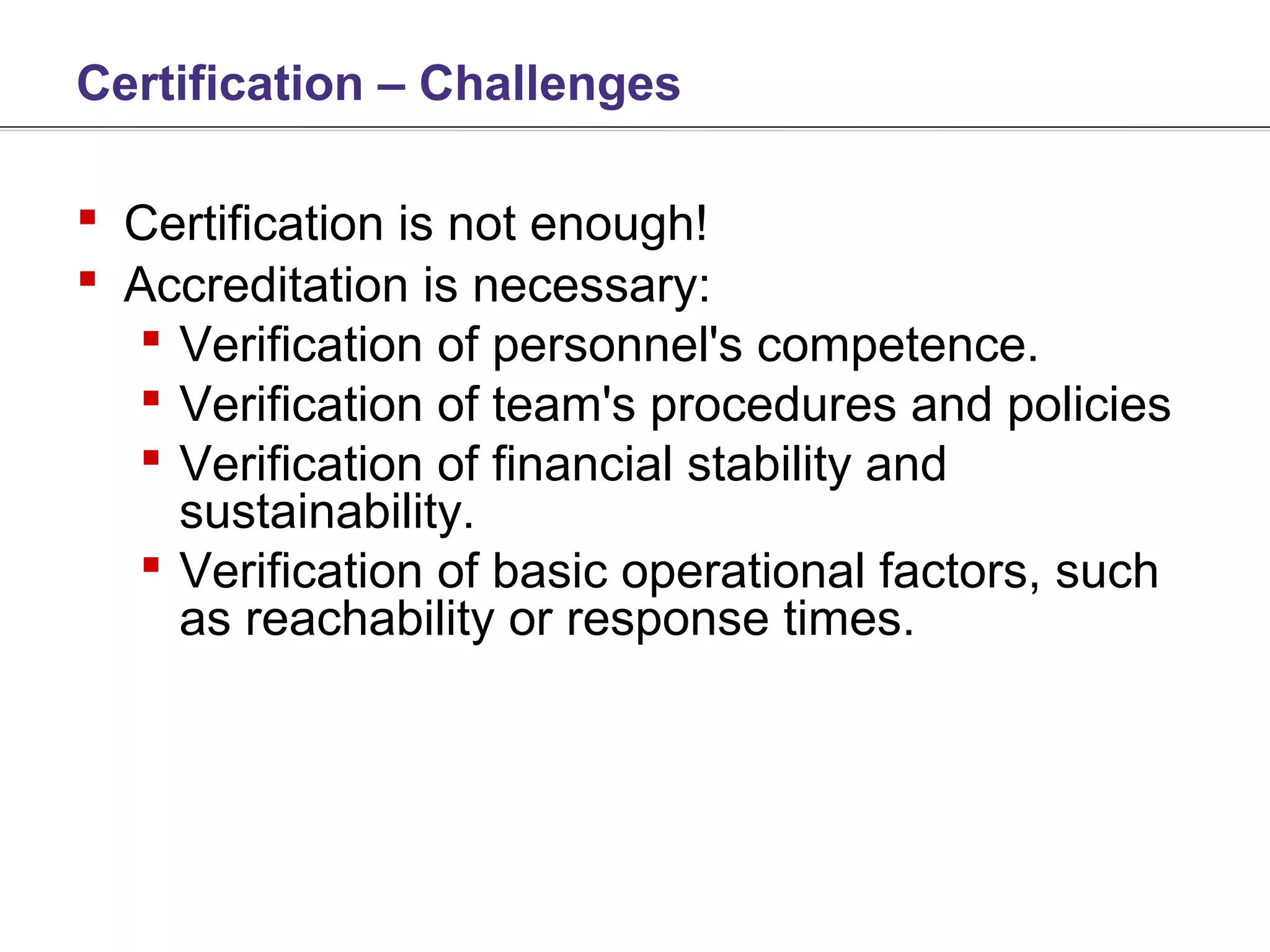
Certification – Challenges

 Certification is not enough!
 Accreditation is necessary:
   Verification of personnel's competence.
   Verification of team's procedures and policies
   Verification of financial stability and
    sustainability.
   Verification of basic operational factors, such
    as reachability or response times.
Sources
   CMU/SEI Handbook for Computer Security Incident Response Teams (CSIRTs)
   ENISA’s CERT in Europe v1.4
   ENISA’s CERT cooperation and its further facilitation by relevant stakeholders.
   ENISA’s Information Security Certification Schemes Workshop 2006 Minutes, materials
    and Report.
   ENISA’s Inventory of CERT activities in Europe.
   ENISA www.enisa.europa.eu/cert%5Finventory/index_inventory.htm
   EA 7/03 Guidelines for the Accreditation of Bodies Operating Certification/Registration of
    Information Security Management Systems.
   FIRST - www.first.com
   ISM3 v2.00
   ISO/IEC 27001:2005 Information technology — Security techniques — Information
    security management systems — Requirements
   Information Security Management Maturity Model v2.00
   ISO/IEC 19011:2002 Guidelines for quality and/or environmental management systems
    auditing
   Terena’s Trusted Introducer Service (TI)
   Terena’s TF-CSIRT.
   Terena’s A Trusted CSIRT Introducer in Europe.
May/Madrid 2007
Con la colaboración de

y el patrocinio de


 THANKS
Creative Commons Attribution-NoDerivs 2.0

You are free:
•to copy, distribute, display, and perform this work
•to make commercial use of this work
Under the following conditions:

                                 Attribution. You must give the original author credit.


                               No Derivative Works. You may not alter, transform, or build upon this
                               work.

For any reuse or distribution, you must make clear to others the license terms of this work.

Any of these conditions can be waived if you get permission from the author.

Your fair use and other rights are in no way affected by the above.

This work is licensed under the Creative Commons Attribution-NoDerivs License. To view a copy
of this license, visit http://creativecommons.org/licenses/by-nd/2.0/ or send a letter to Creative
Commons, 559 Nathan Abbott Way, Stanford, California 94305, USA.
Trusted Introducer (TERENA)
   An invitation to start the accreditation process can be sent to a "Listed" team
    upon its request or e.g. by recommendation of an already "Accredited" CERT.
    The process of accreditation requires the team to declare its support for a
    number of criteria and provide a standardized set of information about itself.
    This data is then kept and maintained by the TI to ensure it is correct and up to
    date. Gaining the "Accredited" level results in access to numerous services,
    e.g. a database of in-depth operational contacts of all accredited teams, the TI
    mailing lists open to accredited CERTs only, PGP key signing, etc. The
    services of the TI are provided by an independent contractor appointed by
    TERENA and supervised by TI Review Board consisting of 5 members: a
    TERENA representative, three members elected by accredited teams and the
    chair of TERENA TF-CSIRT ex officio.

CERT Certification

  • 1.
    May/Madrid 2007 Con lacolaboración de y el patrocinio de CERT Certification Vicente Aceituno
  • 2.
     As LouisPasteur put it in a lecture in the University of Lille: “In the fields of observation chance favors only the prepared mind”.
  • 3.
    What?  CERT orCERT/CC (Computer Emergency Response Team / Coordination Center)  CSIRT (Computer Security Incident Response Team)  IRT (Incident Response Team)  CIRT (Computer Incident Response Team)  SERT (Security Emergency Response Team)
  • 4.
    CERT  A ComputerSecurity Incident Response Team (CSIRT) is a service organization that is responsible for receiving, reviewing, and responding to computer security incident reports and activity.  Their services are usually performed for a defined constituency that could be a parent entity such as a corporation, governmental, or educational organization; a region or country; a research network; or a paid client. (CERT/CC)
  • 5.
    CERT - Benefits Centralized coordination for IT security issues within the organization.  Specialized handling of and response to IT incidents.  Dealing with legal issues and preserving evidence in the event of a lawsuit.  Keeping track of developments in the security field.  Stimulating cooperation within the constituency on IT security (awareness building).
  • 6.
    CERT - Types Academic Sector CSIRT  Commercial CSIRT  Governmental Sector CSIRT  Internal CSIRT  Military Sector CSIRT  National CSIRT  Small & Medium Enterprises (SME) Sector CSIRT  Vendor CSIRT
  • 7.
    CERT - Services Reactive Services  Alerts and Warnings  Incident Handling  Vulnerability Handling  Artifact Handling
  • 8.
    CERT - Services Proactive Services  Technology Watch  Announcements  Security Audit or Assessments  Configuration and Maintenance of Security Tools, Applications and Infrastructures  Development of Security Tools  Intrusion Detection Services  Security-Related Information Dissemination
  • 9.
    CERT - Services Security Quality Management Services  Risk Analysis  Business Continuity & Disaster Recovery Planning  Security Consulting  Awareness Building  Education / Training  Product Evaluation or Certification
  • 10.
  • 11.
    Trust Building  Team – Team  Association  Inter - Association  Personal relationships.  Certification - Trusted Introducer.  Agreements:  Code of Conduct.  Memoranda of Understanding.  SLAs.  Adherence to standards.
  • 12.
    Association - FIRST Mission:  FIRST is an international confederation of trusted computer incident response teams who cooperatively handle computer security incidents and promote incident prevention programs.  FIRST members develop and share technical information, tools, methodologies, processes and best practices  FIRST encourages and promotes the development of quality security products, policies & services  FIRST develops and promulgates best computer security practices  FIRST promotes the creation and expansion of Incident Response teams and membership from organizations from around the world  FIRST members use their combined knowledge, skills and experience to promote a safer and more secure global electronic environment.
  • 13.
    Certification - Trust A way to evidence the organization's stance on security;  A part of a contract to ensure commitment by one of the parties to security management;  A mechanism to ensure mutual understanding of the services obtained from a provider.  Trust relationships with Third Parties, like Partners, Customers and Suppliers.
  • 14.
    CERT Certification  Whatis certification good for?  It is a driver for implementation of better IS practices.
  • 15.
    Certification - Trust What is certification good for?  Establishing trust relationships.
  • 16.
    Certification - Challenges Challenges  Certification doesn’t guarantee performance. Performance depends on the budget, the capability and the commitment of those involved in running it.  Certification only guarantees that the cause of faults is not poor process design.  Poor performers and bogus certifications lower the reputation of the certification and damage the reputation of all certificate holders.
  • 17.
  • 18.
    Certification - Challenges Different Implementations
  • 19.
    Certification - Challenges Ifyou get the same certificate
  • 20.
    Certification - Challenges Fordifferent implementations
  • 21.
    Certification - Challenges Themarket reputation you will get is that of the worst implementation
  • 22.
    Certification - Challenges Challenges:  Some threats fall out of the scope of information security: – Human error; – Incompetence; – Fraud; – Corruption.
  • 23.
  • 24.
    Certification - Summary  Certification doesn’t guarantee performance.  Bad performers damage the reputation of all certificate holders.
  • 25.
    Accreditation Accreditation Entity Accreditation Entity Certification Entity Final User
  • 26.
    Trusted Introducer (TERENA) The Trusted Introducer (TI) is a trust broker for European CERTs with three levels:  Listed – any team identified within the scope of TI  Accreditation Candidate – a team which received and accepted invitation for Accreditation process  Accredited – a team which successfully completed accreditation / verification process
  • 27.
    Certification – Challenges Certification is not enough!  Accreditation is necessary:  Verification of personnel's competence.  Verification of team's procedures and policies  Verification of financial stability and sustainability.  Verification of basic operational factors, such as reachability or response times.
  • 28.
    Sources  CMU/SEI Handbook for Computer Security Incident Response Teams (CSIRTs)  ENISA’s CERT in Europe v1.4  ENISA’s CERT cooperation and its further facilitation by relevant stakeholders.  ENISA’s Information Security Certification Schemes Workshop 2006 Minutes, materials and Report.  ENISA’s Inventory of CERT activities in Europe.  ENISA www.enisa.europa.eu/cert%5Finventory/index_inventory.htm  EA 7/03 Guidelines for the Accreditation of Bodies Operating Certification/Registration of Information Security Management Systems.  FIRST - www.first.com  ISM3 v2.00  ISO/IEC 27001:2005 Information technology — Security techniques — Information security management systems — Requirements  Information Security Management Maturity Model v2.00  ISO/IEC 19011:2002 Guidelines for quality and/or environmental management systems auditing  Terena’s Trusted Introducer Service (TI)  Terena’s TF-CSIRT.  Terena’s A Trusted CSIRT Introducer in Europe.
  • 29.
    May/Madrid 2007 Con lacolaboración de y el patrocinio de THANKS
  • 30.
    Creative Commons Attribution-NoDerivs2.0 You are free: •to copy, distribute, display, and perform this work •to make commercial use of this work Under the following conditions: Attribution. You must give the original author credit. No Derivative Works. You may not alter, transform, or build upon this work. For any reuse or distribution, you must make clear to others the license terms of this work. Any of these conditions can be waived if you get permission from the author. Your fair use and other rights are in no way affected by the above. This work is licensed under the Creative Commons Attribution-NoDerivs License. To view a copy of this license, visit http://creativecommons.org/licenses/by-nd/2.0/ or send a letter to Creative Commons, 559 Nathan Abbott Way, Stanford, California 94305, USA.
  • 31.
    Trusted Introducer (TERENA)  An invitation to start the accreditation process can be sent to a "Listed" team upon its request or e.g. by recommendation of an already "Accredited" CERT. The process of accreditation requires the team to declare its support for a number of criteria and provide a standardized set of information about itself. This data is then kept and maintained by the TI to ensure it is correct and up to date. Gaining the "Accredited" level results in access to numerous services, e.g. a database of in-depth operational contacts of all accredited teams, the TI mailing lists open to accredited CERTs only, PGP key signing, etc. The services of the TI are provided by an independent contractor appointed by TERENA and supervised by TI Review Board consisting of 5 members: a TERENA representative, three members elected by accredited teams and the chair of TERENA TF-CSIRT ex officio.

Editor's Notes

  • #5 The first major outbreak of a worm in the global IT infrastructure occurred in the late 1980s. The worm was named Morris2 and it spread swiftly, effectively infecting a great number of IT systems around the world. This incident acted as a wake-up call: suddenly people got aware of a strong need for cooperation and coordination between system administrators and IT managers in order to deal with cases like this. Due to the fact that time was a critical factor, a more organised and structural approach on handling IT security incidents had to be established. And so a few days after the “Morris-incident” the Defence Advanced Research Projects Agency (DARPA) established the first CSIRT: the CERT Coordination Center (CERT/CC3), located at the Carnegie Mellon University in Pittsburgh (Pennsylvania). This model was soon adopted within Europe, and 1992 the Dutch Academic provider SURFnet launched the first CSIRT in Europe, named SURFnet-CERT4. Many teams followed and at present ENISAs Inventory of CERT activities in Europe5 lists more than 100 known teams located in Europe.
  • #11 As Louis Pasteur put it in a lecture in the University of Lille, “in the fields of observation chance favours only the prepared mind”. Likewise, governments, companies and individuals need to be prepared to observe, detect and respond to all kinds of unpredictable technical threats and incidents. This need led to the proliferation of CERTs that must share information and coordinate for reasons of efficiency, preventing duplication of efforts, and avoiding sending out incoherent or even contradictory warnings and alerts.
  • #27 The EuroCERT was funded by TERENA with money collected from voluntaries wishing to participate and contribute to the project. Since TERENA was established for research and academic networks, all participants came from this area. It was expected however that commercial ISPs would join by the end of the pilot. The pilot did not work as well as expected. One of the problems was that with different set of services delivered by each team, it was very hard to define the scope of work for EuroCERT that would satisfy the needs of all sponsors without overlapping with work that others are already doing for their own constituencies. Other problems were caused by the need of acceptance of submission to an external authority, e.g. giving up direct personal links. The fact that Europe if a multinational and multicultural structure and that work of a CERT team within national research network would be coordinated with international EuroCERT which was an international entity did not make things any easier. The EuroCERT services, and thus the project SIRCE itself ended in September 1999, two months before the scheduled date, due to lack of interest and funding.