Bench Scale And Pilot Plant Tests For 
Circulating Load 
In The Crushing And Milling Circuit 
Supervisor: Dr. Karimi 
Presenter: Hamid Faramarzi 
Imam Khomeini International University, Qazvin, Iran.
Slide 2 
Content 
 Introduction 
 Circulating load calculate 
 Most factories the purpose of control 
 Effective factors for circulating load 
 Test design 
 Conclusion 
 References
Slide 3 
circulating load ratio : 
As the ratio of the amount of solids going through the ball mill divided by 
the amount of solids going through the circuit. 
Circulating load 
circulating load ratio 
New feed 
circulating load ratio 
[8]
Circulating load calculate 
• E = Efficiency Screen % 
• R = Larger than mesh % 
• S = C.L. + new feed (t/h) 
• f = larger than mesh in feed % 
• C.L. = circulating load 
Slide 4 
[2]
For being equal F and P , quantitative of fine material must be poured onto screen to 
pass equivalent weight of F from screen throe is not all this amount in the first load. 
Slide 5 
Circulating load calculate 
• E = Efficiency Screen % 
• R = Larger than mesh % 
• S = C.L. + new feed (t/h) 
• f = larger than mesh in feed % 
• C.L. = circulating load 
[2] 
[7]
Slide 6 
performance characteristics 
Closed grinding circuit CSE, and our ability to maximize it, can be 
regarded as a function of two grinding circuit performance characteristics 
1. the circulating load ratio; 
2. the basic (or reduced) classifier separation performance [6]; 
Circulating load ratio is enormously important to grinding circuit efficiency. 
Diminishing returns dictate optimum economic operational values of 
approximately 350% to 400% for most primary ball milling circuits. [6]
There are two strategy based on the change of feed rate or added water to 
classifier. 
Slide 7 
effective factors for circulating load 
First strategy : size of product is controlled by rate of feed and Circulating 
load by the rate of added water. [8] 
Second strategy : size of product is controlled by the rate of added water 
would be controlled. 
If the reaction of ingredient be much faster , the added water would be 
controlled . 
If the reaction of mill capacity be much faster , the rate of feed would be 
set. 
[8]
Slide 8 
effective factors for circulating load 
One of the problems of mentioned strategies is interaction between 
agents. 
One for thing , rising water cause to increase the circulating load which 
itself change the size of product. [3] 
Similarly by increasing the rate of food the size of products enhance too. 
The more circulating load : 
The more long grading Uniform, 
The less Slime product and 
The less energy consumption will be. 
The less Retention time. [7]
effective factors for circulating load 
In this typical circuit arrangement, higher circulating load ratio is necessarily associated with 
loss of cyclone classifier basic sharpness of separation and increased bypass of fines. This 
leads to the diminishing returns (in terms of increased CSE and overall circuit efficiency) with 
increased circulating load ratio. [6] 
Slide 9 
quantity of new -50 micron material , percent
Slide 10 
effective factors for circulating load 
When increasing pumping energy and pump and cyclone maintenance costs are balanced 
against decreasing grinding energy and media costs, all as circulating load increases, the 
optimum economic circulating load can be identified, as it was at Kidd Creek (Table ). [4] 
The circulating load ratio was lowered from an average of approximately 450% 
to 350% through appropriate, systematic pump and cyclone adjustments. [5]
effective factors for circulating load 
Slide 11 
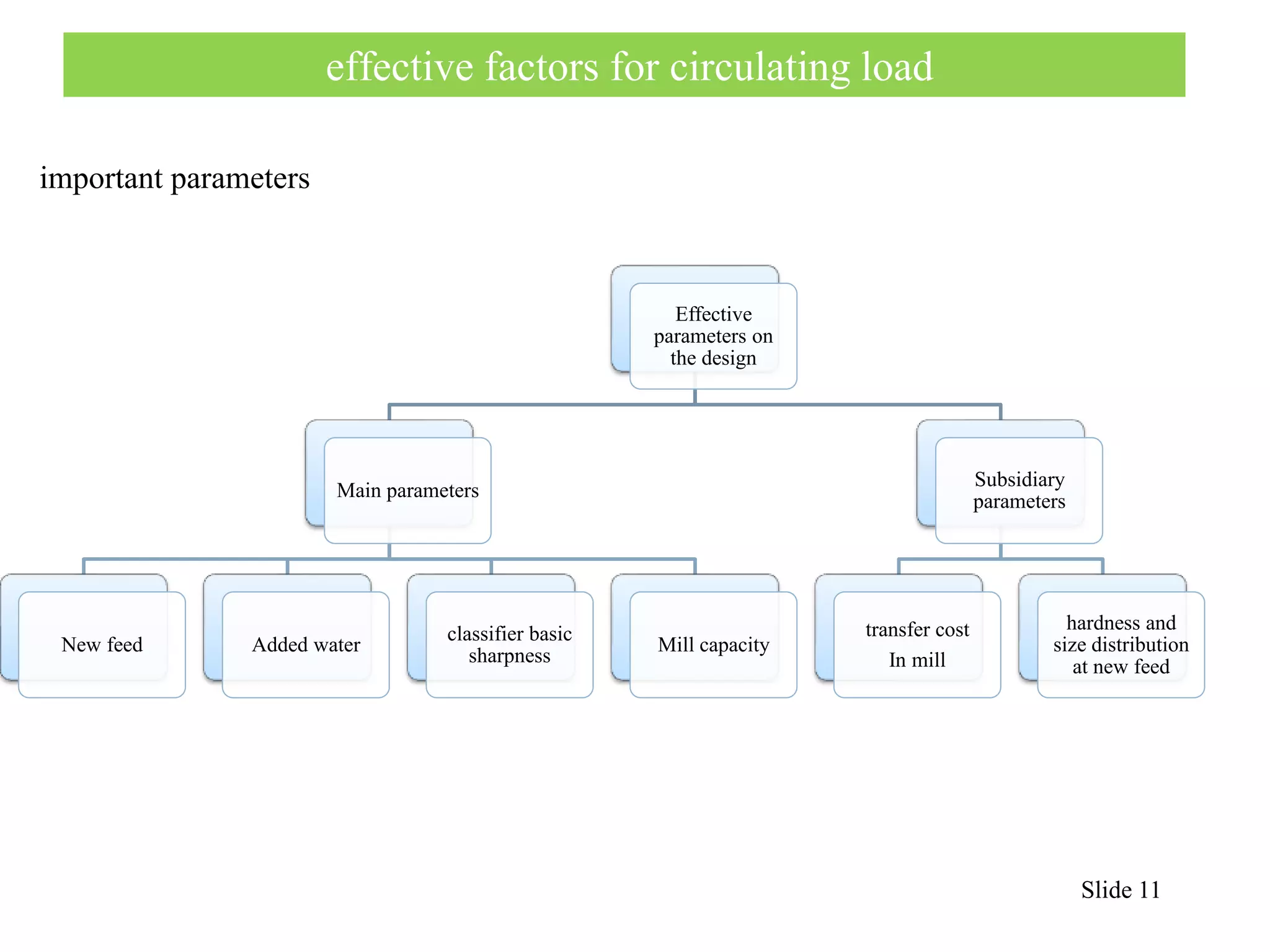
Effective 
parameters on 
the design 
Main parameters 
New feed Added water 
classifier basic 
sharpness 
Mill capacity 
Subsidiary 
parameters 
transfer cost 
In mill 
hardness and 
size distribution 
at new feed 
important parameters
Test design 
Slide 12 
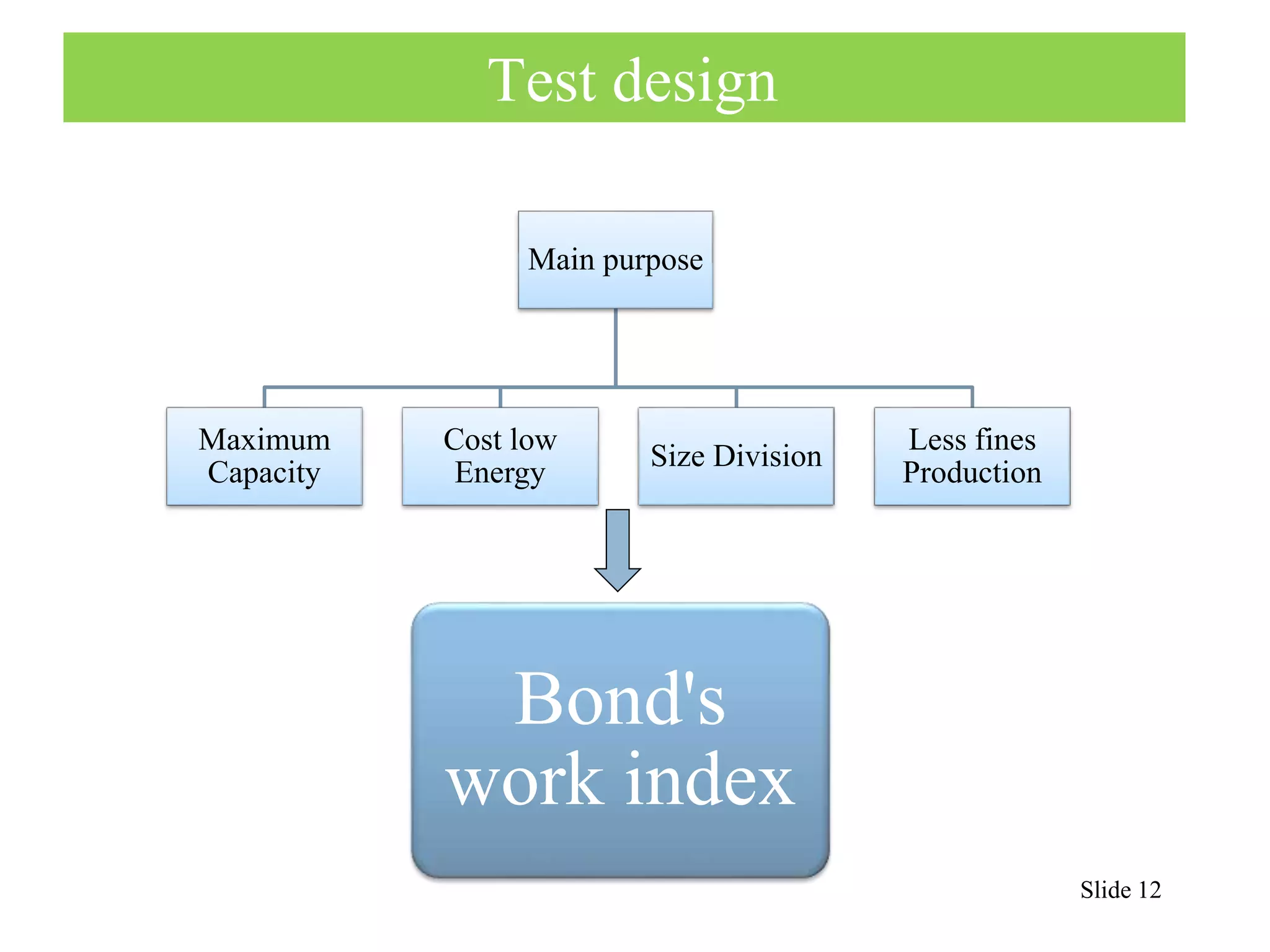
Main purpose 
Maximum 
Capacity 
Cost low 
Energy 
Size Division 
Less fines 
Production 
Bond's 
work index
Test design 
Slide 13 
Effect of circulating load on Bond's work index 
The follow figures shown variation in the Bond work index with test sieve 
size as test results[7]. 
Variation of Bond work index with 
circulating load. C.L. =100%
Test design 
Slide 14 
Variation of Bond work index with 
circulating load. C.L. = 250% [7] 
Variation of Bond work index with 
circulating load. C.L. = 400%[7]
Slide 15 
Conclusions 
 There are two strategy based on the change of feed rate or added water to classifier. 
 One of the problems of mentioned strategies is interaction between agents . 
 The more circulating load: 
The more long grading Uniform, 
The less Slime product and 
The less energy consumption will be. 
When increasing pumping energy and pump and cyclone maintenance costs are balanced 
against decreasing grinding energy and media costs. 
 The Bond's work index values increased as test sieve size decreased.
 Bond work index is changed with the change in the test sieve size and 
circulating load. This must be taken into account when energy consumption 
is calculated according to the Bond formula. 
 unit energy cost extra increased as circulating load decreased from 250%. 
However, unit energy cost decreased as circulating most suitable circulating 
load for amorphous silica used experiments is 250% because mill capacity 
is decreased. 
Slide 16
Slide 17 
Reference 
1. Introduction to Mineral Processing Design and Operation A.Gupta and D.S.Yan 
Perth,Australia,January2006 
2. Mineral Processing Technology B.A.WILLS, BSC, PHD, CENG 1997 
3. MINERAL PROCESSING By E. 1. PRYOR THIRD EDITION 2002 
4. Principles of Mineral Processing by Maurice C. Fuerstenau and Kenneth N. Han 2009 
5. Mineral processing handbook Thirteenth Edition 2011 
6. Recent advances in mineral processing plant design. 
7. The Effect of Circulating Load and Test Sieve Size on The Bond Work Index Based on 
Natural Amorphous Silica. V. Deniz. N. Sütçü & Y. Umucu , 2003 
8. جزوه مهندس ی خردایش بنیس ی صمد 1391

Circulating load

  • 1.
    Bench Scale AndPilot Plant Tests For Circulating Load In The Crushing And Milling Circuit Supervisor: Dr. Karimi Presenter: Hamid Faramarzi Imam Khomeini International University, Qazvin, Iran.
  • 2.
    Slide 2 Content  Introduction  Circulating load calculate  Most factories the purpose of control  Effective factors for circulating load  Test design  Conclusion  References
  • 3.
    Slide 3 circulatingload ratio : As the ratio of the amount of solids going through the ball mill divided by the amount of solids going through the circuit. Circulating load circulating load ratio New feed circulating load ratio [8]
  • 4.
    Circulating load calculate • E = Efficiency Screen % • R = Larger than mesh % • S = C.L. + new feed (t/h) • f = larger than mesh in feed % • C.L. = circulating load Slide 4 [2]
  • 5.
    For being equalF and P , quantitative of fine material must be poured onto screen to pass equivalent weight of F from screen throe is not all this amount in the first load. Slide 5 Circulating load calculate • E = Efficiency Screen % • R = Larger than mesh % • S = C.L. + new feed (t/h) • f = larger than mesh in feed % • C.L. = circulating load [2] [7]
  • 6.
    Slide 6 performancecharacteristics Closed grinding circuit CSE, and our ability to maximize it, can be regarded as a function of two grinding circuit performance characteristics 1. the circulating load ratio; 2. the basic (or reduced) classifier separation performance [6]; Circulating load ratio is enormously important to grinding circuit efficiency. Diminishing returns dictate optimum economic operational values of approximately 350% to 400% for most primary ball milling circuits. [6]
  • 7.
    There are twostrategy based on the change of feed rate or added water to classifier. Slide 7 effective factors for circulating load First strategy : size of product is controlled by rate of feed and Circulating load by the rate of added water. [8] Second strategy : size of product is controlled by the rate of added water would be controlled. If the reaction of ingredient be much faster , the added water would be controlled . If the reaction of mill capacity be much faster , the rate of feed would be set. [8]
  • 8.
    Slide 8 effectivefactors for circulating load One of the problems of mentioned strategies is interaction between agents. One for thing , rising water cause to increase the circulating load which itself change the size of product. [3] Similarly by increasing the rate of food the size of products enhance too. The more circulating load : The more long grading Uniform, The less Slime product and The less energy consumption will be. The less Retention time. [7]
  • 9.
    effective factors forcirculating load In this typical circuit arrangement, higher circulating load ratio is necessarily associated with loss of cyclone classifier basic sharpness of separation and increased bypass of fines. This leads to the diminishing returns (in terms of increased CSE and overall circuit efficiency) with increased circulating load ratio. [6] Slide 9 quantity of new -50 micron material , percent
  • 10.
    Slide 10 effectivefactors for circulating load When increasing pumping energy and pump and cyclone maintenance costs are balanced against decreasing grinding energy and media costs, all as circulating load increases, the optimum economic circulating load can be identified, as it was at Kidd Creek (Table ). [4] The circulating load ratio was lowered from an average of approximately 450% to 350% through appropriate, systematic pump and cyclone adjustments. [5]
  • 11.
    effective factors forcirculating load Slide 11 Effective parameters on the design Main parameters New feed Added water classifier basic sharpness Mill capacity Subsidiary parameters transfer cost In mill hardness and size distribution at new feed important parameters
  • 12.
    Test design Slide12 Main purpose Maximum Capacity Cost low Energy Size Division Less fines Production Bond's work index
  • 13.
    Test design Slide13 Effect of circulating load on Bond's work index The follow figures shown variation in the Bond work index with test sieve size as test results[7]. Variation of Bond work index with circulating load. C.L. =100%
  • 14.
    Test design Slide14 Variation of Bond work index with circulating load. C.L. = 250% [7] Variation of Bond work index with circulating load. C.L. = 400%[7]
  • 15.
    Slide 15 Conclusions  There are two strategy based on the change of feed rate or added water to classifier.  One of the problems of mentioned strategies is interaction between agents .  The more circulating load: The more long grading Uniform, The less Slime product and The less energy consumption will be. When increasing pumping energy and pump and cyclone maintenance costs are balanced against decreasing grinding energy and media costs.  The Bond's work index values increased as test sieve size decreased.
  • 16.
     Bond workindex is changed with the change in the test sieve size and circulating load. This must be taken into account when energy consumption is calculated according to the Bond formula.  unit energy cost extra increased as circulating load decreased from 250%. However, unit energy cost decreased as circulating most suitable circulating load for amorphous silica used experiments is 250% because mill capacity is decreased. Slide 16
  • 17.
    Slide 17 Reference 1. Introduction to Mineral Processing Design and Operation A.Gupta and D.S.Yan Perth,Australia,January2006 2. Mineral Processing Technology B.A.WILLS, BSC, PHD, CENG 1997 3. MINERAL PROCESSING By E. 1. PRYOR THIRD EDITION 2002 4. Principles of Mineral Processing by Maurice C. Fuerstenau and Kenneth N. Han 2009 5. Mineral processing handbook Thirteenth Edition 2011 6. Recent advances in mineral processing plant design. 7. The Effect of Circulating Load and Test Sieve Size on The Bond Work Index Based on Natural Amorphous Silica. V. Deniz. N. Sütçü & Y. Umucu , 2003 8. جزوه مهندس ی خردایش بنیس ی صمد 1391

Editor's Notes