ROLLER PRESS
(HIGH PRESSURE GRINDING
ROLLS)
V Naga Kumar
STRENGTHENING CAPABILITIES IN PYRO-PROCESSING & GRINDING
NATIONAL COUNCIL FOR CEMENT & BUILDING MATERIALS
BALLABGARH (HARYANA)
2
What is Roller Press ?
Originally a compaction tool rather than a grinder
Mainly as a pre-grinder for Capacity increase
Integral Grinding with a high recirculation rate
Applies the concept of high pressure transfer
through a bed of material
Pressure across the bed has a compacting effect
on material which is crushed and gradually reduces in
size
Stability ensured by uniform feed control
Can be utilized in various configurations
Energy saving: substitution rate w.r.t. Ball Mill: 1.5~2.5
kWh/t 3
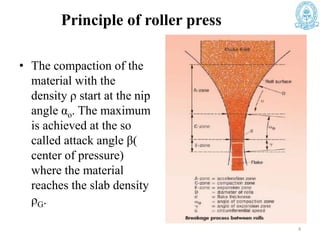
Principle of roller press
• The compaction of the
material with the
density ρ start at the nip
angle αo. The maximum
is achieved at the so
called attack angle β(
center of pressure)
where the material
reaches the slab density
ρG.
4
• High grinding pressure between 50 and 400 MPa
• Roller circumferential speed 0.5 to 1.8 m/s
• Feed grain size up to 60 mm
• Compacted cakes contain up to 40 % fines (< 90 µm)
• Compacted cakes contain also coarser particles with large
numbers of cracks and weak points
• Reduce energy during further grinding
Specifications of roller press
5
Operating principle
In high-pressure roller press comminution
The feed material is exposed to very high pressure for a short
time.
The high pressure causes formation of micro cracks in the feed
particles and generates a substantial amount of fine material.
6
Feed is nipped into the gap as a result of opposite rotation;
Material Commuted, compacted & shaped -
Into slabs / flakes /cakes
Different operations proceed simultaneously:
 Density increases from 1.6 to 2.4 t/Cu.m
 Expelling most of the air contained in the feed
 Interparticle communition
7
Feed to product
Key Parameters of Roller press
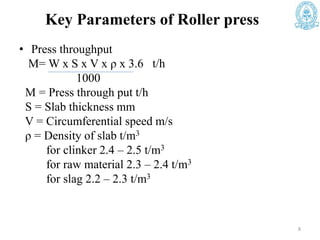
• Press throughput
M= W x S x V x ρ x 3.6 t/h
1000
M = Press through put t/h
S = Slab thickness mm
V = Circumferential speed m/s
ρ = Density of slab t/m3
for clinker 2.4 – 2.5 t/m3
for raw material 2.3 – 2.4 t/m3
for slag 2.2 – 2.3 t/m3
8
Key Parameters of Roller press
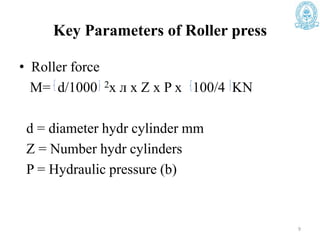
• Roller force
M= d/1000 2x л x Z x P x 100/4 KN
d = diameter hydr cylinder mm
Z = Number hydr cylinders
P = Hydraulic pressure (b)
9
Key Parameters of Roller press
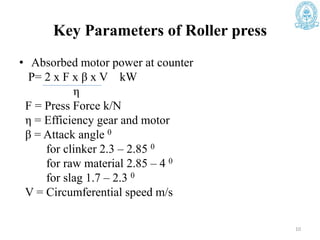
• Absorbed motor power at counter
P= 2 x F x β x V kW
η
F = Press Force k/N
η = Efficiency gear and motor
β = Attack angle 0
for clinker 2.3 – 2.85 0
for raw material 2.85 – 4 0
for slag 1.7 – 2.3 0
V = Circumferential speed m/s
10
Circulating load factor [-]
Roller speed [m/s]
Stable operation
unstable operation
 Maximize absorbed power by increasing circulating load close to
point of unstable operation
Maximizing Absorbed Power
11
Key Parameters of Roller press
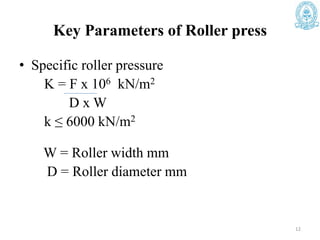
• Specific roller pressure
K = F x 106 kN/m2
D x W
k ≤ 6000 kN/m2
W = Roller width mm
D = Roller diameter mm
12
Key Parameters of Roller press
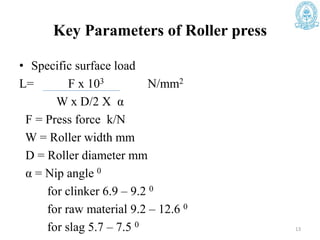
• Specific surface load
L= F x 103 N/mm2
W x D/2 X α
F = Press force k/N
W = Roller width mm
D = Roller diameter mm
α = Nip angle 0
for clinker 6.9 – 9.2 0
for raw material 9.2 – 12.6 0
for slag 5.7 – 7.5 0 13
Key Parameters of Roller press
• Specific energy consumption
E = P/M kWh/t
P = Abs motor power kW
M = Press throughput t/h
for clinker 2.5 – 3 kWh/t
for raw material 2 – 2.5 kWh/t
for slag ~ 3 kWh/t
Ec = P U /M kWh/t
Ec = Closed circuit ( with separator or/and slab
recirculation)
U = Circulation factor 14
Communition in roller press
• Increases with rising pressure , but only little
beyond an optimum level ,as after reaching
that level of compression cake behaves as non
compressible, viscous fluid
• Closely graded material requires high pressure
as more voids present
• Widely graded requires less as less void
present
15
Material layer
• Material layer above roller gap gives efficient
comminution
• Feed bin above roller gap serves as buffer to avoid
feed fluctuation
16
Material hardness
Material hardness is reduced if processed
through roller press, help in grinding hard
material
17
Feed size
For a gap width of 25 mm, material size
around 100 mm can be processed
18
Roller diameter
• Cake thickness changes proportional to roller
diameter and roller thickness
• Cake thickness can be changed by narrowing
nipping area of roller too
• Nipping area can be changed by modifying roller
surface too
19
Roller press advantages
• Long wear part life
• Low operational and maintenance costs
• Short shutdown for wear part
• Replenishment
20
Roller press cake quality
• Raw Grinding 2.2 to 2.3 MT / M3
• Finish grinding 2.6 MT/ M 3
21
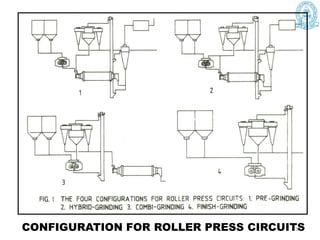
CONFIGURATION FOR ROLLER PRESS CIRCUITS
22
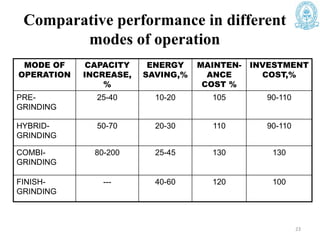
Comparative performance in different
modes of operation
MODE OF
OPERATION
CAPACITY
INCREASE,
%
ENERGY
SAVING,%
MAINTEN-
ANCE
COST %
INVESTMENT
COST,%
PRE-
GRINDING
25-40 10-20 105 90-110
HYBRID-
GRINDING
50-70 20-30 110 90-110
COMBI-
GRINDING
80-200 25-45 130 130
FINISH-
GRINDING
--- 40-60 120 100
23
24

Roller Press.pdf Srinivas nerella HPGR.pdf

  • 1.
    ROLLER PRESS (HIGH PRESSUREGRINDING ROLLS) V Naga Kumar STRENGTHENING CAPABILITIES IN PYRO-PROCESSING & GRINDING NATIONAL COUNCIL FOR CEMENT & BUILDING MATERIALS BALLABGARH (HARYANA)
  • 2.
  • 3.
    What is RollerPress ? Originally a compaction tool rather than a grinder Mainly as a pre-grinder for Capacity increase Integral Grinding with a high recirculation rate Applies the concept of high pressure transfer through a bed of material Pressure across the bed has a compacting effect on material which is crushed and gradually reduces in size Stability ensured by uniform feed control Can be utilized in various configurations Energy saving: substitution rate w.r.t. Ball Mill: 1.5~2.5 kWh/t 3
  • 4.
    Principle of rollerpress • The compaction of the material with the density ρ start at the nip angle αo. The maximum is achieved at the so called attack angle β( center of pressure) where the material reaches the slab density ρG. 4
  • 5.
    • High grindingpressure between 50 and 400 MPa • Roller circumferential speed 0.5 to 1.8 m/s • Feed grain size up to 60 mm • Compacted cakes contain up to 40 % fines (< 90 µm) • Compacted cakes contain also coarser particles with large numbers of cracks and weak points • Reduce energy during further grinding Specifications of roller press 5
  • 6.
    Operating principle In high-pressureroller press comminution The feed material is exposed to very high pressure for a short time. The high pressure causes formation of micro cracks in the feed particles and generates a substantial amount of fine material. 6
  • 7.
    Feed is nippedinto the gap as a result of opposite rotation; Material Commuted, compacted & shaped - Into slabs / flakes /cakes Different operations proceed simultaneously:  Density increases from 1.6 to 2.4 t/Cu.m  Expelling most of the air contained in the feed  Interparticle communition 7 Feed to product
  • 8.
    Key Parameters ofRoller press • Press throughput M= W x S x V x ρ x 3.6 t/h 1000 M = Press through put t/h S = Slab thickness mm V = Circumferential speed m/s ρ = Density of slab t/m3 for clinker 2.4 – 2.5 t/m3 for raw material 2.3 – 2.4 t/m3 for slag 2.2 – 2.3 t/m3 8
  • 9.
    Key Parameters ofRoller press • Roller force M= d/1000 2x л x Z x P x 100/4 KN d = diameter hydr cylinder mm Z = Number hydr cylinders P = Hydraulic pressure (b) 9
  • 10.
    Key Parameters ofRoller press • Absorbed motor power at counter P= 2 x F x β x V kW η F = Press Force k/N η = Efficiency gear and motor β = Attack angle 0 for clinker 2.3 – 2.85 0 for raw material 2.85 – 4 0 for slag 1.7 – 2.3 0 V = Circumferential speed m/s 10
  • 11.
    Circulating load factor[-] Roller speed [m/s] Stable operation unstable operation  Maximize absorbed power by increasing circulating load close to point of unstable operation Maximizing Absorbed Power 11
  • 12.
    Key Parameters ofRoller press • Specific roller pressure K = F x 106 kN/m2 D x W k ≤ 6000 kN/m2 W = Roller width mm D = Roller diameter mm 12
  • 13.
    Key Parameters ofRoller press • Specific surface load L= F x 103 N/mm2 W x D/2 X α F = Press force k/N W = Roller width mm D = Roller diameter mm α = Nip angle 0 for clinker 6.9 – 9.2 0 for raw material 9.2 – 12.6 0 for slag 5.7 – 7.5 0 13
  • 14.
    Key Parameters ofRoller press • Specific energy consumption E = P/M kWh/t P = Abs motor power kW M = Press throughput t/h for clinker 2.5 – 3 kWh/t for raw material 2 – 2.5 kWh/t for slag ~ 3 kWh/t Ec = P U /M kWh/t Ec = Closed circuit ( with separator or/and slab recirculation) U = Circulation factor 14
  • 15.
    Communition in rollerpress • Increases with rising pressure , but only little beyond an optimum level ,as after reaching that level of compression cake behaves as non compressible, viscous fluid • Closely graded material requires high pressure as more voids present • Widely graded requires less as less void present 15
  • 16.
    Material layer • Materiallayer above roller gap gives efficient comminution • Feed bin above roller gap serves as buffer to avoid feed fluctuation 16
  • 17.
    Material hardness Material hardnessis reduced if processed through roller press, help in grinding hard material 17
  • 18.
    Feed size For agap width of 25 mm, material size around 100 mm can be processed 18
  • 19.
    Roller diameter • Cakethickness changes proportional to roller diameter and roller thickness • Cake thickness can be changed by narrowing nipping area of roller too • Nipping area can be changed by modifying roller surface too 19
  • 20.
    Roller press advantages •Long wear part life • Low operational and maintenance costs • Short shutdown for wear part • Replenishment 20
  • 21.
    Roller press cakequality • Raw Grinding 2.2 to 2.3 MT / M3 • Finish grinding 2.6 MT/ M 3 21
  • 22.
    CONFIGURATION FOR ROLLERPRESS CIRCUITS 22
  • 23.
    Comparative performance indifferent modes of operation MODE OF OPERATION CAPACITY INCREASE, % ENERGY SAVING,% MAINTEN- ANCE COST % INVESTMENT COST,% PRE- GRINDING 25-40 10-20 105 90-110 HYBRID- GRINDING 50-70 20-30 110 90-110 COMBI- GRINDING 80-200 25-45 130 130 FINISH- GRINDING --- 40-60 120 100 23
  • 24.