Effect of Grinding Systems on Cement
Properties
Radu Geomolean CTL/TT
(former CMS/MPT – Grinding Technology)
2
GEO-November 08
Holcim Group Support Course for Cement Applications 2008
Content
 Background information
 Main grinding systems
 Drying in ball mills  major process aspect
 Compound / Separate grinding
 Conclusions
3
GEO-November 08
Holcim Group Support Course for Cement Applications 2008
Content
 Background information
 Main grinding systems
 Drying in ball mills  major process aspect
 Compound / Separate grinding
 Conclusions
4
GEO-November 08
Holcim Group Support Course for Cement Applications 2008
Background information
 The grinding system (including separator type) is
influencing directly the Particle Size Distribution
(PSD)
 Strength development
 Workability
 Drying = one of the main process parameters in
grinding
 Effect on the setting behaviour (e.g. because of different
gypsum dehydration)
 Insufficient drying capacity indicated by low mill exit
temperature (< 85 [oC]) or too high exit gas dew points
(> 60 [oC]) can lead to cement hydration (use of wet
additives)
5
GEO-November 08
Holcim Group Support Course for Cement Applications 2008
Content
 Background information
 Main grinding systems
 Grinding systems
 Separators (types, basic principle, influence on PSD)
 Drying in ball mills  major process aspect
 Compound / Separate grinding
 Conclusions
6
GEO-November 08
Holcim Group Support Course for Cement Applications 2008
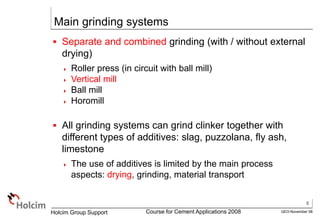
Main grinding systems
 Separate and combined grinding (with / without external
drying)
 Roller press (in circuit with ball mill)
 Vertical mill
 Ball mill
 Horomill
 All grinding systems can grind clinker together with
different types of additives: slag, puzzolana, fly ash,
limestone
 The use of additives is limited by the main process
aspects: drying, grinding, material transport
7
GEO-November 08
Holcim Group Support Course for Cement Applications 2008
Ball Mill EDM (End Discharge Mill)
Clinker Gypsum
Min.
Comp.
[l/h]
[kW]
[l/h]
[t/h]
[°C]
[mbar] [°C]
[t/h] [t/h] [t/h]
[t/h] [t/h] [t/h]
[%]
[%]
[%]
[%]
[%]
[%]
[t] [t] [t]
[°C]
[l/h]
Grinding
aid
[1/min]
[°C]
[kW]
[mbar]
[°C]
[mbar]
[kW]
[mbar]
[°C]
[1/min]
[°C]
[°C]
[°C]
[1/min]
[m3/h] [mg/m3]
Sollwerte
Prozesswerte
[t/h]
[t/h]
[1/min]
[°C]
Product
Process
parameters
8
GEO-November 08
Holcim Group Support Course for Cement Applications 2008
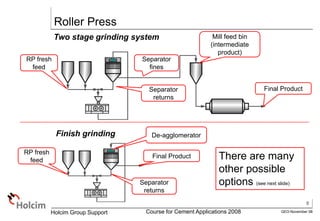
Roller Press
Two stage grinding system
Separator
fines
Mill feed bin
(intermediate
product)
Separator
returns
Final Product
RP fresh
feed
Finish grinding
Final Product
RP fresh
feed
Separator
returns
De-agglomerator
There are many
other possible
options (see next slide)
9
GEO-November 08
Holcim Group Support Course for Cement Applications 2008
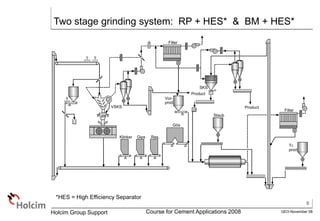
Two stage grinding system: RP + HES* & BM + HES*
20t
Filter
SKS
Filter
VSKS
Klinker Gips
Gös
Vor-
prod.
Tr.
prod.
Staub
Product
Res.
Product
*HES = High Efficiency Separator
10
GEO-November 08
Holcim Group Support Course for Cement Applications 2008
VRM (vertical roller mill) for cement grinding
grinding aid DEG
[t]
[kW]
[t/h]
[mbar]
[°C]
[%] [l/min]
[t/h] [t/h]
[%]
[cm2
/g]
sampler
[%R]
[l/h]
[mbar]
[°C]
[kW] [%]
[°C]
Hot gas
[t]
[t] [%] [%] [bar]
[mbar]
[min-1]
[min-1]
[l/h]
to cement
silo
fresh air
Clinker Gypsum
In blue = process
parameters
11
GEO-November 08
Holcim Group Support Course for Cement Applications 2008
Separators - overview
Static separators and
cyclones
No moving parts / fineness
adjustment via mechanical
modification
Dynamic separators
1st Generation
- Counter blades, distributor plate
and internal fan
- fineness control done by
mechanical adjustment or counter
blade speed change
Dynamic separators
2nd Generation
- Features as 1st Gen.
- Internal fan was replaced by
external ones
- Has cyclones
Dynamic separators
3rd Generation
(HES = High
Efficiency Separator)
- Cage rotor instead of counter
blades and distributor plate
- external fan
- fineness control by rotor speed
housing cone
tailings cone
adjusting device
rad.pos.
immersion tube
tailings
feed
fines
adjustable blades
feed
tailings
air
inlet
air+
fines
outlet
inclined plates
baffle plates
12
GEO-November 08
Holcim Group Support Course for Cement Applications 2008
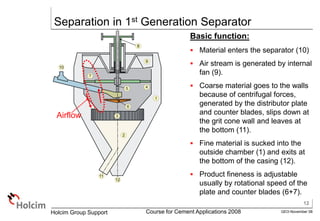
Separation in 1st Generation Separator
Basic function:
 Material enters the separator (10)
 Air stream is generated by internal
fan (9).
 Coarse material goes to the walls
because of centrifugal forces,
generated by the distributor plate
and counter blades, slips down at
the grit cone wall and leaves at
the bottom (11).
 Fine material is sucked into the
outside chamber (1) and exits at
the bottom of the casing (12).
 Product fineness is adjustable
usually by rotational speed of the
plate and counter blades (6+7).
Airflow
13
GEO-November 08
Holcim Group Support Course for Cement Applications 2008
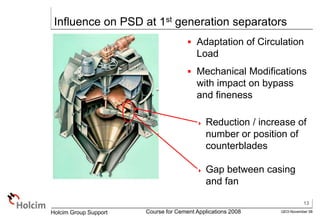
Influence on PSD at 1st generation separators
 Adaptation of Circulation
Load
 Mechanical Modifications
with impact on bypass
and fineness
 Reduction / increase of
number or position of
counterblades
 Gap between casing
and fan
14
GEO-November 08
Holcim Group Support Course for Cement Applications 2008
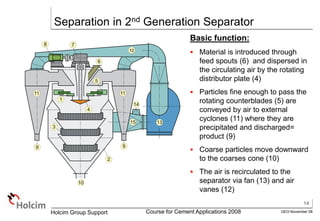
Separation in 2nd Generation Separator
Basic function:
 Material is introduced through
feed spouts (6) and dispersed in
the circulating air by the rotating
distributor plate (4)
 Particles fine enough to pass the
rotating counterblades (5) are
conveyed by air to external
cyclones (11) where they are
precipitated and discharged=
product (9)
 Coarse particles move downward
to the coarses cone (10)
 The air is recirculated to the
separator via fan (13) and air
vanes (12)
15
GEO-November 08
Holcim Group Support Course for Cement Applications 2008
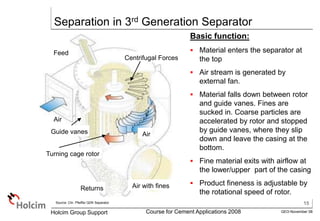
Separation in 3rd Generation Separator
Basic function:
 Material enters the separator at
the top
 Air stream is generated by
external fan.
 Material falls down between rotor
and guide vanes. Fines are
sucked in. Coarse particles are
accelerated by rotor and stopped
by guide vanes, where they slip
down and leave the casing at the
bottom.
 Fine material exits with airflow at
the lower/upper part of the casing
 Product fineness is adjustable by
the rotational speed of rotor.
Source: Chr. Pfeiffer QDK Separator
Feed
Air
Turning cage rotor
Centrifugal Forces
Returns Air with fines
Air
Guide vanes
Feed
Air
Turning cage rotor
Centrifugal Forces
Returns Air with fines
Air
Guide vanes
16
GEO-November 08
Holcim Group Support Course for Cement Applications 2008
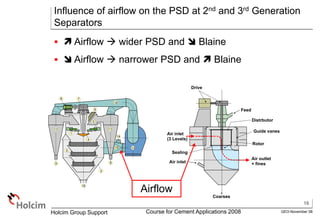
Influence of airflow on the PSD at 2nd and 3rd Generation
Separators
  Airflow  wider PSD and  Blaine
  Airflow  narrower PSD and  Blaine
separation chamber
tailings cone
air vanes
distributor plate
counterblades
feed spout
gearbox
motor
return air duct
dust collecting
fan
air duct to fan
cyclones
tailings outlet
fines outlet
pipe to filter
8 7
14
11
6
11
5
1
9
2
9
10
3
4
13
15
1
15
2
3
4
5
6
7
8
9
10
11
12
13
14
ROTOR TYPE SEPARATOR, MAKES
Feed
Air outlet
+ fines
Coarses
Distrbutor
Guide vanes
Rotor
Drive
Air inlet
(3 Levels)
Sealing
Air inlet
SEPOL
Airflow
17
GEO-November 08
Holcim Group Support Course for Cement Applications 2008
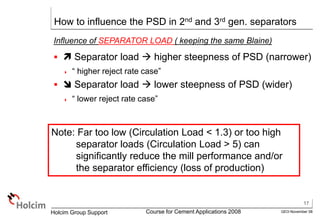
How to influence the PSD in 2nd and 3rd gen. separators
Influence of SEPARATOR LOAD ( keeping the same Blaine)
  Separator load  higher steepness of PSD (narrower)
 “ higher reject rate case”
  Separator load  lower steepness of PSD (wider)
 “ lower reject rate case”
Note: Far too low (Circulation Load < 1.3) or too high
separator loads (Circulation Load > 5) can
significantly reduce the mill performance and/or
the separator efficiency (loss of production)
18
GEO-November 08
Holcim Group Support Course for Cement Applications 2008
Content
 Background information
 Main grinding systems
 Drying in ball mills  major process aspect
 Compound / Separate grinding
 Conclusions
19
GEO-November 08
Holcim Group Support Course for Cement Applications 2008
Drying in Ball Mill - Bottlenecks
Fresh air
Fresh air
Moist additive
Hot clinker
Hot gas
H2O
Product
Air
Dust ladden air
H2O
Hot air
70
80
90
100
110
120
Product
temp. [°C]
Mill length
grinding
heat
water
evaporation
Cooling by
water injection
Finish
Product
Mill
exhaust
air
< 300 °C
> 100 °C
Recirculating air
Drying
Compartment?
Ball Mills as limited in drying capacity. An EDM can
dry max. 4% feed moisture even having a HGG!
20
GEO-November 08
Holcim Group Support Course for Cement Applications 2008
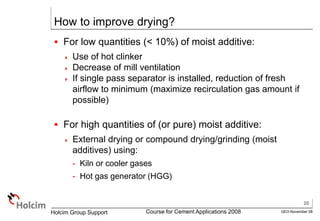
How to improve drying?
 For low quantities (< 10%) of moist additive:
 Use of hot clinker
 Decrease of mill ventilation
 If single pass separator is installed, reduction of fresh
airflow to minimum (maximize recirculation gas amount if
possible)
 For high quantities of (or pure) moist additive:
 External drying or compound drying/grinding (moist
additives) using:
- Kiln or cooler gases
- Hot gas generator (HGG)
21
GEO-November 08
Holcim Group Support Course for Cement Applications 2008
Content
 Background information
 Main grinding systems
 Drying in ball mills  major process aspect
 Compound / Separate grinding
 PSD in both cases
 Common set-ups
 Quality impacts of compound grinding systems
 Advantages / Disadvantages
 Conclusions
22
GEO-November 08
Holcim Group Support Course for Cement Applications 2008
PSD in Compound Grinding
 Compound grinding of
materials with different
grindabilities  is affecting
the product PSD
CC01-005.dsf Kma 06.06.00
[%R]
acc.
[cm2/g]
Blaine
mill length [m]
longitudinal sieving graph
GA
[g/t]
°C
[m3/h]
[%]
[kW]
[t/h]
[%R,cm2/g]
[°C]
[°C]
[mbar]
[m3/h]
separator tailings
[t/h]
[°C]
[%R]
Fresh feed
[t/h]
[%H2O]
[°C]
[% comp.]
acc.
[mm]
[m]
particle size
1 10 25 50
Blaine: Some of the
components achieve the
necessary fineness
faster inside the mill
(could be pozzolana,
limestone, fly ash) 
 Waste of energy
 Low flexibility in terms
of influencing the PSD
Cumulated
residues
23
GEO-November 08
Holcim Group Support Course for Cement Applications 2008
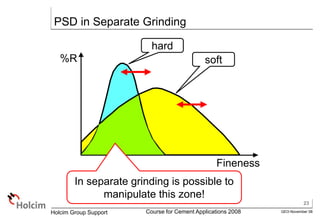
PSD in Separate Grinding
%R
Fineness
hard
soft
In separate grinding is possible to
manipulate this zone!
24
GEO-November 08
Holcim Group Support Course for Cement Applications 2008
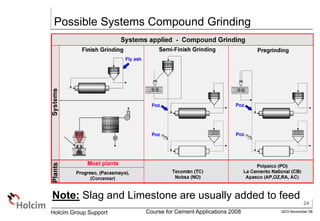
Possible Systems Compound Grinding
Note: Slag and Limestone are usually added to feed
25
GEO-November 08
Holcim Group Support Course for Cement Applications 2008
Common Systems for Separate Grinding
Clinker Gypsum
Min.
Comp.
[l/h]
[kW]
[l/h]
[t/h]
[°C]
[mbar] [°C]
[t/h] [t/h] [t/h]
[t/h] [t/h] [t/h]
[%]
[%]
[%]
[%]
[%]
[%]
[t] [t] [t]
[°C]
[l/h]
Grinding
aid
[1/min]
[°C]
[kW]
[mbar]
[°C]
[mbar]
[kW]
[mbar]
[°C]
[1/min]
[°C]
[°C]
[°C]
[1/min]
[m3/h] [mg/m3]
Sollwerte
Prozesswerte
[t/h]
[t/h]
[1/min]
[°C]
Product
grinding aid DEG
[t]
[kW]
[t/h]
[mbar]
[°C]
[%] [l/min]
[t/h] [t/h]
[%]
[cm2
/g]
sampler
[%R]
[l/h]
[mbar]
[°C]
[kW] [%]
[°C]
Hot gas
[t]
[t] [%] [%] [bar]
[mbar]
[min-1]
[min-1]
[l/h]
to cement
silo
fresh air
Clinker Gypsum
VRM for
cement & slag
grinding
BM for cement
grinding
26
GEO-November 08
Holcim Group Support Course for Cement Applications 2008
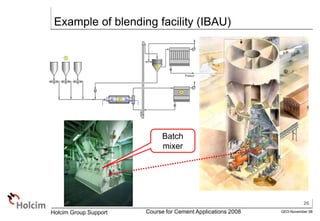
Example of blending facility (IBAU)
3
4
1
2
Product
Batch
mixer
27
GEO-November 08
Holcim Group Support Course for Cement Applications 2008
Quality Impacts of Compound Grinding BM
Problem Solution
 Partly hydration of additive (slag);
loss of strength
 Influence on sulphate due to humid
atmosphere in mill
 Separate drying
 Installation of hot gas generator and
drying chamber
 Avoid dew point > 60 [°C]
 PSD not optimum
 ‘Steepness’ (n) of PSD too high/low
 Change of circulation load*
 Too low n’: increase circ. load
 Too high n’: decrease circ. load
 New Separator?
 Strength development insufficient
 Workability not acceptable
 Setting behaviour does not meet
requirements
 Adapt mill exit temperature if related
to gypsum
*Only in certain range possible
28
GEO-November 08
Holcim Group Support Course for Cement Applications 2008
Quality Impacts of Compound Grinding VRM
Problem Solution
 Partly hydration of additive (slag);
loss of strength
 Influence on Sulfate due to humid
atmosphere in mill
 Increase fresh air (if possible)
 Avoid dew point > 60 [oC]
 Install Hot gas Generator
 Particle Size Distribution (PSD) not
optimum
 ‘Steepness’ of PSD too high/low
Change of
 Air Flow
 Roller Pressure
 Bed depth
 Separator
 Strength development insufficient
 Workability not acceptable
 Setting behaviour does not meet
requirements
 Adapt mill exit temperature if related
to gypsum
29
GEO-November 08
Holcim Group Support Course for Cement Applications 2008
Summary and Comparison of grinding processes
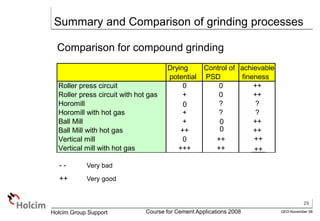
- - Very bad
++ Very good
Comparison for compound grinding
Drying Control of achievable
potential PSD fineness
Roller press circuit 0 0 ++
Roller press circuit with hot gas + 0 ++
Horomill - ? ?
Horomill with hot gas + ? ?
Ball Mill + - ++
Ball Mill with hot gas ++ - ++
Vertical mill 0 ++ +
Vertical mill with hot gas +++ ++ +
0
0
0
++
++
30
GEO-November 08
Holcim Group Support Course for Cement Applications 2008
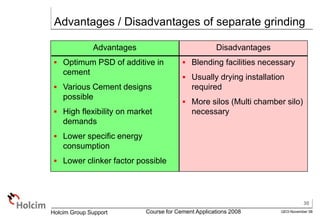
Advantages / Disadvantages of separate grinding
Advantages
 Optimum PSD of additive in
cement
 Various Cement designs
possible
 High flexibility on market
demands
 Lower specific energy
consumption
 Lower clinker factor possible
Disadvantages
 Blending facilities necessary
 Usually drying installation
required
 More silos (Multi chamber silo)
necessary
31
GEO-November 08
Holcim Group Support Course for Cement Applications 2008
Content
 Background information
 Main grinding systems
 Drying in ball mills  major process aspect
 Compound / Separate grinding
 Conclusions
32
GEO-November 08
Holcim Group Support Course for Cement Applications 2008
Conclusions
 In BM circuits the possibilities of influencing the PSD are
limited and very much depending on the separator type
 The Vertical Roller mill is well suited for compound or
separate grinding
 high flexibility for modifying cement properties
 high drying capacity
 Too low mill exit temperatures (< 85 [oC]) or dew point >
60 [oC] during compound grinding (e.g. caused by wet
slag) can lead to process and quality problems
 Separate grinding gives more flexibility in product
design, product optimisation and reaction on quality
variations of clinker or additive

CEMENT 021500geomolean.ppt

  • 1.
    Effect of GrindingSystems on Cement Properties Radu Geomolean CTL/TT (former CMS/MPT – Grinding Technology)
  • 2.
    2 GEO-November 08 Holcim GroupSupport Course for Cement Applications 2008 Content  Background information  Main grinding systems  Drying in ball mills  major process aspect  Compound / Separate grinding  Conclusions
  • 3.
    3 GEO-November 08 Holcim GroupSupport Course for Cement Applications 2008 Content  Background information  Main grinding systems  Drying in ball mills  major process aspect  Compound / Separate grinding  Conclusions
  • 4.
    4 GEO-November 08 Holcim GroupSupport Course for Cement Applications 2008 Background information  The grinding system (including separator type) is influencing directly the Particle Size Distribution (PSD)  Strength development  Workability  Drying = one of the main process parameters in grinding  Effect on the setting behaviour (e.g. because of different gypsum dehydration)  Insufficient drying capacity indicated by low mill exit temperature (< 85 [oC]) or too high exit gas dew points (> 60 [oC]) can lead to cement hydration (use of wet additives)
  • 5.
    5 GEO-November 08 Holcim GroupSupport Course for Cement Applications 2008 Content  Background information  Main grinding systems  Grinding systems  Separators (types, basic principle, influence on PSD)  Drying in ball mills  major process aspect  Compound / Separate grinding  Conclusions
  • 6.
    6 GEO-November 08 Holcim GroupSupport Course for Cement Applications 2008 Main grinding systems  Separate and combined grinding (with / without external drying)  Roller press (in circuit with ball mill)  Vertical mill  Ball mill  Horomill  All grinding systems can grind clinker together with different types of additives: slag, puzzolana, fly ash, limestone  The use of additives is limited by the main process aspects: drying, grinding, material transport
  • 7.
    7 GEO-November 08 Holcim GroupSupport Course for Cement Applications 2008 Ball Mill EDM (End Discharge Mill) Clinker Gypsum Min. Comp. [l/h] [kW] [l/h] [t/h] [°C] [mbar] [°C] [t/h] [t/h] [t/h] [t/h] [t/h] [t/h] [%] [%] [%] [%] [%] [%] [t] [t] [t] [°C] [l/h] Grinding aid [1/min] [°C] [kW] [mbar] [°C] [mbar] [kW] [mbar] [°C] [1/min] [°C] [°C] [°C] [1/min] [m3/h] [mg/m3] Sollwerte Prozesswerte [t/h] [t/h] [1/min] [°C] Product Process parameters
  • 8.
    8 GEO-November 08 Holcim GroupSupport Course for Cement Applications 2008 Roller Press Two stage grinding system Separator fines Mill feed bin (intermediate product) Separator returns Final Product RP fresh feed Finish grinding Final Product RP fresh feed Separator returns De-agglomerator There are many other possible options (see next slide)
  • 9.
    9 GEO-November 08 Holcim GroupSupport Course for Cement Applications 2008 Two stage grinding system: RP + HES* & BM + HES* 20t Filter SKS Filter VSKS Klinker Gips Gös Vor- prod. Tr. prod. Staub Product Res. Product *HES = High Efficiency Separator
  • 10.
    10 GEO-November 08 Holcim GroupSupport Course for Cement Applications 2008 VRM (vertical roller mill) for cement grinding grinding aid DEG [t] [kW] [t/h] [mbar] [°C] [%] [l/min] [t/h] [t/h] [%] [cm2 /g] sampler [%R] [l/h] [mbar] [°C] [kW] [%] [°C] Hot gas [t] [t] [%] [%] [bar] [mbar] [min-1] [min-1] [l/h] to cement silo fresh air Clinker Gypsum In blue = process parameters
  • 11.
    11 GEO-November 08 Holcim GroupSupport Course for Cement Applications 2008 Separators - overview Static separators and cyclones No moving parts / fineness adjustment via mechanical modification Dynamic separators 1st Generation - Counter blades, distributor plate and internal fan - fineness control done by mechanical adjustment or counter blade speed change Dynamic separators 2nd Generation - Features as 1st Gen. - Internal fan was replaced by external ones - Has cyclones Dynamic separators 3rd Generation (HES = High Efficiency Separator) - Cage rotor instead of counter blades and distributor plate - external fan - fineness control by rotor speed housing cone tailings cone adjusting device rad.pos. immersion tube tailings feed fines adjustable blades feed tailings air inlet air+ fines outlet inclined plates baffle plates
  • 12.
    12 GEO-November 08 Holcim GroupSupport Course for Cement Applications 2008 Separation in 1st Generation Separator Basic function:  Material enters the separator (10)  Air stream is generated by internal fan (9).  Coarse material goes to the walls because of centrifugal forces, generated by the distributor plate and counter blades, slips down at the grit cone wall and leaves at the bottom (11).  Fine material is sucked into the outside chamber (1) and exits at the bottom of the casing (12).  Product fineness is adjustable usually by rotational speed of the plate and counter blades (6+7). Airflow
  • 13.
    13 GEO-November 08 Holcim GroupSupport Course for Cement Applications 2008 Influence on PSD at 1st generation separators  Adaptation of Circulation Load  Mechanical Modifications with impact on bypass and fineness  Reduction / increase of number or position of counterblades  Gap between casing and fan
  • 14.
    14 GEO-November 08 Holcim GroupSupport Course for Cement Applications 2008 Separation in 2nd Generation Separator Basic function:  Material is introduced through feed spouts (6) and dispersed in the circulating air by the rotating distributor plate (4)  Particles fine enough to pass the rotating counterblades (5) are conveyed by air to external cyclones (11) where they are precipitated and discharged= product (9)  Coarse particles move downward to the coarses cone (10)  The air is recirculated to the separator via fan (13) and air vanes (12)
  • 15.
    15 GEO-November 08 Holcim GroupSupport Course for Cement Applications 2008 Separation in 3rd Generation Separator Basic function:  Material enters the separator at the top  Air stream is generated by external fan.  Material falls down between rotor and guide vanes. Fines are sucked in. Coarse particles are accelerated by rotor and stopped by guide vanes, where they slip down and leave the casing at the bottom.  Fine material exits with airflow at the lower/upper part of the casing  Product fineness is adjustable by the rotational speed of rotor. Source: Chr. Pfeiffer QDK Separator Feed Air Turning cage rotor Centrifugal Forces Returns Air with fines Air Guide vanes Feed Air Turning cage rotor Centrifugal Forces Returns Air with fines Air Guide vanes
  • 16.
    16 GEO-November 08 Holcim GroupSupport Course for Cement Applications 2008 Influence of airflow on the PSD at 2nd and 3rd Generation Separators   Airflow  wider PSD and  Blaine   Airflow  narrower PSD and  Blaine separation chamber tailings cone air vanes distributor plate counterblades feed spout gearbox motor return air duct dust collecting fan air duct to fan cyclones tailings outlet fines outlet pipe to filter 8 7 14 11 6 11 5 1 9 2 9 10 3 4 13 15 1 15 2 3 4 5 6 7 8 9 10 11 12 13 14 ROTOR TYPE SEPARATOR, MAKES Feed Air outlet + fines Coarses Distrbutor Guide vanes Rotor Drive Air inlet (3 Levels) Sealing Air inlet SEPOL Airflow
  • 17.
    17 GEO-November 08 Holcim GroupSupport Course for Cement Applications 2008 How to influence the PSD in 2nd and 3rd gen. separators Influence of SEPARATOR LOAD ( keeping the same Blaine)   Separator load  higher steepness of PSD (narrower)  “ higher reject rate case”   Separator load  lower steepness of PSD (wider)  “ lower reject rate case” Note: Far too low (Circulation Load < 1.3) or too high separator loads (Circulation Load > 5) can significantly reduce the mill performance and/or the separator efficiency (loss of production)
  • 18.
    18 GEO-November 08 Holcim GroupSupport Course for Cement Applications 2008 Content  Background information  Main grinding systems  Drying in ball mills  major process aspect  Compound / Separate grinding  Conclusions
  • 19.
    19 GEO-November 08 Holcim GroupSupport Course for Cement Applications 2008 Drying in Ball Mill - Bottlenecks Fresh air Fresh air Moist additive Hot clinker Hot gas H2O Product Air Dust ladden air H2O Hot air 70 80 90 100 110 120 Product temp. [°C] Mill length grinding heat water evaporation Cooling by water injection Finish Product Mill exhaust air < 300 °C > 100 °C Recirculating air Drying Compartment? Ball Mills as limited in drying capacity. An EDM can dry max. 4% feed moisture even having a HGG!
  • 20.
    20 GEO-November 08 Holcim GroupSupport Course for Cement Applications 2008 How to improve drying?  For low quantities (< 10%) of moist additive:  Use of hot clinker  Decrease of mill ventilation  If single pass separator is installed, reduction of fresh airflow to minimum (maximize recirculation gas amount if possible)  For high quantities of (or pure) moist additive:  External drying or compound drying/grinding (moist additives) using: - Kiln or cooler gases - Hot gas generator (HGG)
  • 21.
    21 GEO-November 08 Holcim GroupSupport Course for Cement Applications 2008 Content  Background information  Main grinding systems  Drying in ball mills  major process aspect  Compound / Separate grinding  PSD in both cases  Common set-ups  Quality impacts of compound grinding systems  Advantages / Disadvantages  Conclusions
  • 22.
    22 GEO-November 08 Holcim GroupSupport Course for Cement Applications 2008 PSD in Compound Grinding  Compound grinding of materials with different grindabilities  is affecting the product PSD CC01-005.dsf Kma 06.06.00 [%R] acc. [cm2/g] Blaine mill length [m] longitudinal sieving graph GA [g/t] °C [m3/h] [%] [kW] [t/h] [%R,cm2/g] [°C] [°C] [mbar] [m3/h] separator tailings [t/h] [°C] [%R] Fresh feed [t/h] [%H2O] [°C] [% comp.] acc. [mm] [m] particle size 1 10 25 50 Blaine: Some of the components achieve the necessary fineness faster inside the mill (could be pozzolana, limestone, fly ash)   Waste of energy  Low flexibility in terms of influencing the PSD Cumulated residues
  • 23.
    23 GEO-November 08 Holcim GroupSupport Course for Cement Applications 2008 PSD in Separate Grinding %R Fineness hard soft In separate grinding is possible to manipulate this zone!
  • 24.
    24 GEO-November 08 Holcim GroupSupport Course for Cement Applications 2008 Possible Systems Compound Grinding Note: Slag and Limestone are usually added to feed
  • 25.
    25 GEO-November 08 Holcim GroupSupport Course for Cement Applications 2008 Common Systems for Separate Grinding Clinker Gypsum Min. Comp. [l/h] [kW] [l/h] [t/h] [°C] [mbar] [°C] [t/h] [t/h] [t/h] [t/h] [t/h] [t/h] [%] [%] [%] [%] [%] [%] [t] [t] [t] [°C] [l/h] Grinding aid [1/min] [°C] [kW] [mbar] [°C] [mbar] [kW] [mbar] [°C] [1/min] [°C] [°C] [°C] [1/min] [m3/h] [mg/m3] Sollwerte Prozesswerte [t/h] [t/h] [1/min] [°C] Product grinding aid DEG [t] [kW] [t/h] [mbar] [°C] [%] [l/min] [t/h] [t/h] [%] [cm2 /g] sampler [%R] [l/h] [mbar] [°C] [kW] [%] [°C] Hot gas [t] [t] [%] [%] [bar] [mbar] [min-1] [min-1] [l/h] to cement silo fresh air Clinker Gypsum VRM for cement & slag grinding BM for cement grinding
  • 26.
    26 GEO-November 08 Holcim GroupSupport Course for Cement Applications 2008 Example of blending facility (IBAU) 3 4 1 2 Product Batch mixer
  • 27.
    27 GEO-November 08 Holcim GroupSupport Course for Cement Applications 2008 Quality Impacts of Compound Grinding BM Problem Solution  Partly hydration of additive (slag); loss of strength  Influence on sulphate due to humid atmosphere in mill  Separate drying  Installation of hot gas generator and drying chamber  Avoid dew point > 60 [°C]  PSD not optimum  ‘Steepness’ (n) of PSD too high/low  Change of circulation load*  Too low n’: increase circ. load  Too high n’: decrease circ. load  New Separator?  Strength development insufficient  Workability not acceptable  Setting behaviour does not meet requirements  Adapt mill exit temperature if related to gypsum *Only in certain range possible
  • 28.
    28 GEO-November 08 Holcim GroupSupport Course for Cement Applications 2008 Quality Impacts of Compound Grinding VRM Problem Solution  Partly hydration of additive (slag); loss of strength  Influence on Sulfate due to humid atmosphere in mill  Increase fresh air (if possible)  Avoid dew point > 60 [oC]  Install Hot gas Generator  Particle Size Distribution (PSD) not optimum  ‘Steepness’ of PSD too high/low Change of  Air Flow  Roller Pressure  Bed depth  Separator  Strength development insufficient  Workability not acceptable  Setting behaviour does not meet requirements  Adapt mill exit temperature if related to gypsum
  • 29.
    29 GEO-November 08 Holcim GroupSupport Course for Cement Applications 2008 Summary and Comparison of grinding processes - - Very bad ++ Very good Comparison for compound grinding Drying Control of achievable potential PSD fineness Roller press circuit 0 0 ++ Roller press circuit with hot gas + 0 ++ Horomill - ? ? Horomill with hot gas + ? ? Ball Mill + - ++ Ball Mill with hot gas ++ - ++ Vertical mill 0 ++ + Vertical mill with hot gas +++ ++ + 0 0 0 ++ ++
  • 30.
    30 GEO-November 08 Holcim GroupSupport Course for Cement Applications 2008 Advantages / Disadvantages of separate grinding Advantages  Optimum PSD of additive in cement  Various Cement designs possible  High flexibility on market demands  Lower specific energy consumption  Lower clinker factor possible Disadvantages  Blending facilities necessary  Usually drying installation required  More silos (Multi chamber silo) necessary
  • 31.
    31 GEO-November 08 Holcim GroupSupport Course for Cement Applications 2008 Content  Background information  Main grinding systems  Drying in ball mills  major process aspect  Compound / Separate grinding  Conclusions
  • 32.
    32 GEO-November 08 Holcim GroupSupport Course for Cement Applications 2008 Conclusions  In BM circuits the possibilities of influencing the PSD are limited and very much depending on the separator type  The Vertical Roller mill is well suited for compound or separate grinding  high flexibility for modifying cement properties  high drying capacity  Too low mill exit temperatures (< 85 [oC]) or dew point > 60 [oC] during compound grinding (e.g. caused by wet slag) can lead to process and quality problems  Separate grinding gives more flexibility in product design, product optimisation and reaction on quality variations of clinker or additive