


Rotary Kilns
Experts in process design and material
processing for over 65 years.
An Introduction to
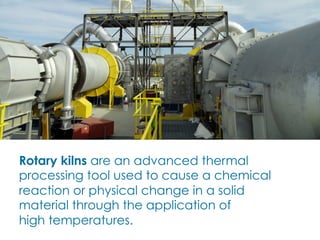
Rotary kilns are an advanced thermal
processing tool used to cause a chemical
reaction or physical change in a solid
material through the application of
high temperatures.
Rotary kilns are commonly used to carry out
processes such as:
Rotary kilns are commonly used to carry out
processes such as:
•  Calcination
Rotary kilns are commonly used to carry out
processes such as:
•  Calcination
•  Thermal Desorption
Rotary kilns are commonly used to carry out
processes such as:
•  Calcination
•  Thermal Desorption
•  Organic Combustion
Rotary kilns are commonly used to carry out
processes such as:
•  Calcination
•  Thermal Desorption
•  Organic Combustion
•  Heat Setting
Rotary kilns are commonly used to carry out
processes such as:
•  Calcination
•  Thermal Desorption
•  Organic Combustion
•  Heat Setting
•  Sintering/Induration
Rotary kilns are commonly used to carry out
processes such as:
•  Calcination
•  Thermal Desorption
•  Organic Combustion
•  Heat Setting
•  Sintering/Induration
•  And more…
Rotary kilns were originally developed for use
in the cement industry. However, their flexibility
in processing quickly pushed them into a
variety of industries, both for processing
commodities, as well as for highly specialized
processing applications.
Rotary kilns have become the backbone of
many of the industrial processes that make our
world a more efficient and sustainable place.
Rotary kilns have become the backbone of
many of the industrial processes that make our
world a more efficient and sustainable place.
As new applications continue to be
developed, much research and development
is being done around these versatile thermal
processing machines.
Today, they are used for a multitude of
applications, including:
Today, they are used for a multitude of
applications, including:
•  Mineral Roasting
Today, they are used for a multitude of
applications, including:
•  Mineral Roasting
•  Proppant Sintering
Today, they are used for a multitude of
applications, including:
•  Mineral Roasting
•  Proppant Sintering
•  Gypsum and Bauxite Calcining
Today, they are used for a multitude of
applications, including:
•  Mineral Roasting
•  Proppant Sintering
•  Gypsum and Bauxite Calcining
•  Activated Carbon Production & Re-Activation
Today, they are used for a multitude of
applications, including:
•  Mineral Roasting
•  Proppant Sintering
•  Gypsum and Bauxite Calcining
•  Activated Carbon Production & Re-Activation
•  Waste Incineration
Today, they are used for a multitude of
applications, including:
•  Mineral Roasting
•  Proppant Sintering
•  Gypsum and Bauxite Calcining
•  Activated Carbon Production & Re-Activation
•  Waste Incineration
•  Desorption of Soil Contaminants
Today, they are used for a multitude of
applications, including:
•  Mineral Roasting
•  Proppant Sintering
•  Gypsum and Bauxite Calcining
•  Activated Carbon Production & Re-Activation
•  Waste Incineration
•  Desorption of Soil Contaminants
•  Upgrading of Phosphate Ores
Today, they are used for a multitude of
applications, including:
•  Mineral Roasting
•  Proppant Sintering
•  Gypsum and Bauxite Calcining
•  Activated Carbon Production & Re-Activation
•  Waste Incineration
•  Desorption of Soil Contaminants
•  Upgrading of Phosphate Ores
•  Catalyst Activation
Today, they are used for a multitude of
applications, including:
•  Mineral Roasting
•  Proppant Sintering
•  Gypsum and Bauxite Calcining
•  Activated Carbon Production & Re-Activation
•  Waste Incineration
•  Desorption of Soil Contaminants
•  Upgrading of Phosphate Ores
•  Catalyst Activation
•  Ceramics Processing
Today, they are used for a multitude of
applications, including:
•  Mineral Roasting
•  Proppant Sintering
•  Gypsum and Bauxite Calcining
•  Activated Carbon Production & Re-Activation
•  Waste Incineration
•  Desorption of Soil Contaminants
•  Upgrading of Phosphate Ores
•  Catalyst Activation
•  Ceramics Processing
•  Plastics Processing
Today, they are used for a multitude of
applications, including:
•  Mineral Roasting
•  Proppant Sintering
•  Gypsum and Bauxite Calcining
•  Activated Carbon Production & Re-Activation
•  Waste Incineration
•  Desorption of Soil Contaminants
•  Upgrading of Phosphate Ores
•  Catalyst Activation
•  Ceramics Processing
•  Plastics Processing
•  And more…
How
Rotary Kilns Work
Rotary kilns work by holding the material
to be processed at a specific temperature
for a set amount of time.
Rotary kilns work by holding the material
to be processed at a specific temperature
for a set amount of time.
The temperature profile and retention time
are determined through thorough
chemical and thermal analyses of the
material, which allow process experts to
know at what temperatures reactions will
occur and for how long material will need
to be held at a certain temperature.
A rotary kiln is comprised of a rotating
cylinder (referred to as the drum), which is
sized in relation to the time and
temperature requirements of the material
to be processed.
A rotary kiln is comprised of a rotating
cylinder (referred to as the drum), which is
sized in relation to the time and
temperature requirements of the material
to be processed.
The drum is set at a slight angle, in order to
allow gravity to help move material
through the drum.
Rotary kilns can be either of the direct-fired
type, or the indirect-fired type.
Rotary kilns can be either of the direct-fired
type, or the indirect-fired type.
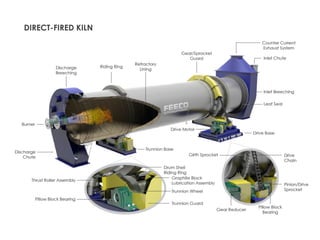
Direct-fired kilns rely on direct contact
between the material and the process gas in
order to process the material.
DIRECT-FIRED KILN
Conversely, indirect-fired kilns process material
in an inert environment, avoiding direct
contact between the material and processing
medium.
Conversely, indirect-fired kilns process material
in an inert environment, avoiding direct
contact between the material and processing
medium.
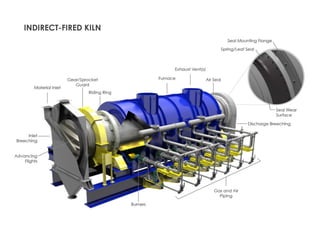
This is carried out by enclosing the drum in a
heat shroud, which is externally heated. The
material is heated through contact with the
shell of the drum.
INDIRECT-FIRED KILN
Rotary kilns can also be designed in a
co-current or counter current configuration,
which refers to the direction of the air flow in
relation to the material.
A variety of material characteristics will
influence how the material will behave in the
rotary kiln. These characteristics must be
prepared for and designed around in order to
reach the desired end product results.
A variety of material characteristics will
influence how the material will behave in the
rotary kiln. These characteristics must be
prepared for and designed around in order to
reach the desired end product results.
For this reason, testing is recommended to
work out process variables and provide data
for a commercial size unit.
Conclusion
Rotary kilns are a critical component in many
industrial processes, with new applications
being developed all the time. They are
available in the direct-fired and indirect-fired
type, with many customizations available.
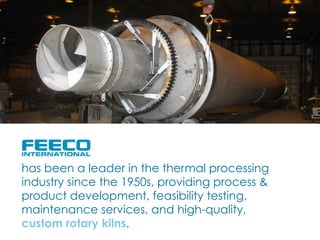
has been a leader in the thermal processing
industry since the 1950s, providing process &
product development, feasibility testing,
maintenance services, and high-quality,
custom rotary kilns.
Want to learn more?
Download our
Rotary Kiln Handbook
The Rotary Kiln Handbook
Rotary Kiln Sizing & Design
Processing Challenges
Service & Maintenance
And more…
Download Now

An Introduction to Rotary Kilns

  • 1.
    Rotary Kilns Experts inprocess design and material processing for over 65 years. An Introduction to
  • 2.
    Rotary kilns arean advanced thermal processing tool used to cause a chemical reaction or physical change in a solid material through the application of high temperatures.
  • 3.
    Rotary kilns arecommonly used to carry out processes such as:
  • 4.
    Rotary kilns arecommonly used to carry out processes such as: •  Calcination
  • 5.
    Rotary kilns arecommonly used to carry out processes such as: •  Calcination •  Thermal Desorption
  • 6.
    Rotary kilns arecommonly used to carry out processes such as: •  Calcination •  Thermal Desorption •  Organic Combustion
  • 7.
    Rotary kilns arecommonly used to carry out processes such as: •  Calcination •  Thermal Desorption •  Organic Combustion •  Heat Setting
  • 8.
    Rotary kilns arecommonly used to carry out processes such as: •  Calcination •  Thermal Desorption •  Organic Combustion •  Heat Setting •  Sintering/Induration
  • 9.
    Rotary kilns arecommonly used to carry out processes such as: •  Calcination •  Thermal Desorption •  Organic Combustion •  Heat Setting •  Sintering/Induration •  And more…
  • 10.
    Rotary kilns wereoriginally developed for use in the cement industry. However, their flexibility in processing quickly pushed them into a variety of industries, both for processing commodities, as well as for highly specialized processing applications.
  • 11.
    Rotary kilns havebecome the backbone of many of the industrial processes that make our world a more efficient and sustainable place.
  • 12.
    Rotary kilns havebecome the backbone of many of the industrial processes that make our world a more efficient and sustainable place. As new applications continue to be developed, much research and development is being done around these versatile thermal processing machines.
  • 13.
    Today, they areused for a multitude of applications, including:
  • 14.
    Today, they areused for a multitude of applications, including: •  Mineral Roasting
  • 15.
    Today, they areused for a multitude of applications, including: •  Mineral Roasting •  Proppant Sintering
  • 16.
    Today, they areused for a multitude of applications, including: •  Mineral Roasting •  Proppant Sintering •  Gypsum and Bauxite Calcining
  • 17.
    Today, they areused for a multitude of applications, including: •  Mineral Roasting •  Proppant Sintering •  Gypsum and Bauxite Calcining •  Activated Carbon Production & Re-Activation
  • 18.
    Today, they areused for a multitude of applications, including: •  Mineral Roasting •  Proppant Sintering •  Gypsum and Bauxite Calcining •  Activated Carbon Production & Re-Activation •  Waste Incineration
  • 19.
    Today, they areused for a multitude of applications, including: •  Mineral Roasting •  Proppant Sintering •  Gypsum and Bauxite Calcining •  Activated Carbon Production & Re-Activation •  Waste Incineration •  Desorption of Soil Contaminants
  • 20.
    Today, they areused for a multitude of applications, including: •  Mineral Roasting •  Proppant Sintering •  Gypsum and Bauxite Calcining •  Activated Carbon Production & Re-Activation •  Waste Incineration •  Desorption of Soil Contaminants •  Upgrading of Phosphate Ores
  • 21.
    Today, they areused for a multitude of applications, including: •  Mineral Roasting •  Proppant Sintering •  Gypsum and Bauxite Calcining •  Activated Carbon Production & Re-Activation •  Waste Incineration •  Desorption of Soil Contaminants •  Upgrading of Phosphate Ores •  Catalyst Activation
  • 22.
    Today, they areused for a multitude of applications, including: •  Mineral Roasting •  Proppant Sintering •  Gypsum and Bauxite Calcining •  Activated Carbon Production & Re-Activation •  Waste Incineration •  Desorption of Soil Contaminants •  Upgrading of Phosphate Ores •  Catalyst Activation •  Ceramics Processing
  • 23.
    Today, they areused for a multitude of applications, including: •  Mineral Roasting •  Proppant Sintering •  Gypsum and Bauxite Calcining •  Activated Carbon Production & Re-Activation •  Waste Incineration •  Desorption of Soil Contaminants •  Upgrading of Phosphate Ores •  Catalyst Activation •  Ceramics Processing •  Plastics Processing
  • 24.
    Today, they areused for a multitude of applications, including: •  Mineral Roasting •  Proppant Sintering •  Gypsum and Bauxite Calcining •  Activated Carbon Production & Re-Activation •  Waste Incineration •  Desorption of Soil Contaminants •  Upgrading of Phosphate Ores •  Catalyst Activation •  Ceramics Processing •  Plastics Processing •  And more…
  • 25.
  • 26.
    Rotary kilns workby holding the material to be processed at a specific temperature for a set amount of time.
  • 27.
    Rotary kilns workby holding the material to be processed at a specific temperature for a set amount of time. The temperature profile and retention time are determined through thorough chemical and thermal analyses of the material, which allow process experts to know at what temperatures reactions will occur and for how long material will need to be held at a certain temperature.
  • 28.
    A rotary kilnis comprised of a rotating cylinder (referred to as the drum), which is sized in relation to the time and temperature requirements of the material to be processed.
  • 29.
    A rotary kilnis comprised of a rotating cylinder (referred to as the drum), which is sized in relation to the time and temperature requirements of the material to be processed. The drum is set at a slight angle, in order to allow gravity to help move material through the drum.
  • 30.
    Rotary kilns canbe either of the direct-fired type, or the indirect-fired type.
  • 31.
    Rotary kilns canbe either of the direct-fired type, or the indirect-fired type. Direct-fired kilns rely on direct contact between the material and the process gas in order to process the material.
  • 32.
  • 33.
    Conversely, indirect-fired kilnsprocess material in an inert environment, avoiding direct contact between the material and processing medium.
  • 34.
    Conversely, indirect-fired kilnsprocess material in an inert environment, avoiding direct contact between the material and processing medium. This is carried out by enclosing the drum in a heat shroud, which is externally heated. The material is heated through contact with the shell of the drum.
  • 35.
  • 36.
    Rotary kilns canalso be designed in a co-current or counter current configuration, which refers to the direction of the air flow in relation to the material.
  • 37.
    A variety ofmaterial characteristics will influence how the material will behave in the rotary kiln. These characteristics must be prepared for and designed around in order to reach the desired end product results.
  • 38.
    A variety ofmaterial characteristics will influence how the material will behave in the rotary kiln. These characteristics must be prepared for and designed around in order to reach the desired end product results. For this reason, testing is recommended to work out process variables and provide data for a commercial size unit.
  • 39.
    Conclusion Rotary kilns area critical component in many industrial processes, with new applications being developed all the time. They are available in the direct-fired and indirect-fired type, with many customizations available.
  • 40.
    has been aleader in the thermal processing industry since the 1950s, providing process & product development, feasibility testing, maintenance services, and high-quality, custom rotary kilns.
  • 41.
    Want to learnmore? Download our Rotary Kiln Handbook The Rotary Kiln Handbook Rotary Kiln Sizing & Design Processing Challenges Service & Maintenance And more… Download Now