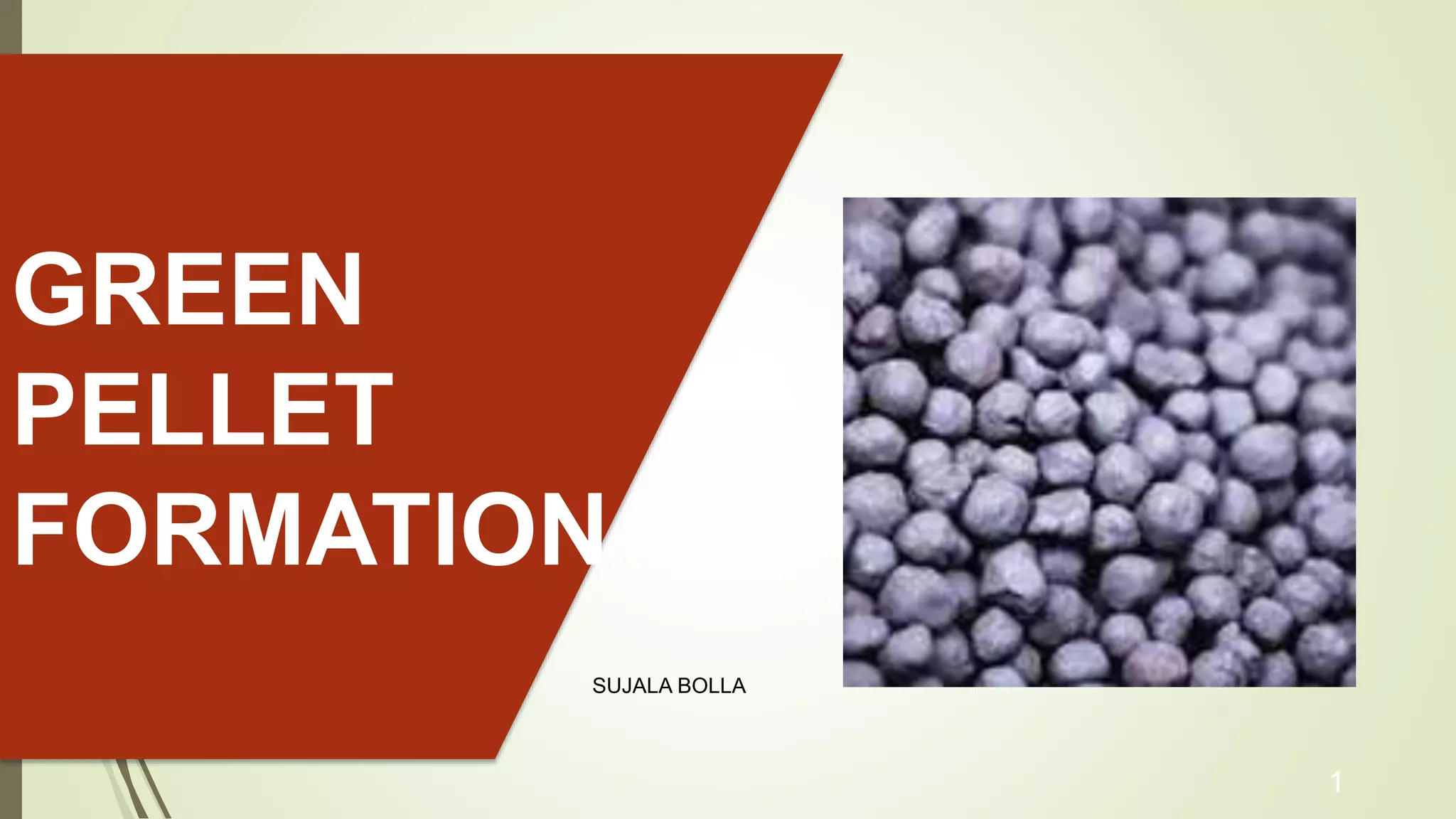
GREEN
PELLET
FORMATION
1
SUJALA BOLLA
Introduction To Pelletisation Process
 Pellets are spherical balls formed by the agglomeration of natural or
ground iron ore fines in the presence of moisture and binder
 These green balls of 5 – 20mm size are then dried, preheated and fired
at 1250 – 13500 C
 Bonding is developed between the fine ore particles at such high
temperatures
 Additives like Bentonite, lime or dolomite up to 0.5 -1.0% may be
added for improved bonding
2/18
Necessity of Pelletisation
 Utilization of iron ore fines of size even 0.5-0.15mm
 Extending the life of iron ore reserves of nation.
 To improve blast furnace performance
 Increase in blast furnace productivity.
 Decrease in uses of blast furnace fuel / coke fuel. Improve in quality of hot
metal.
3/18
4/18
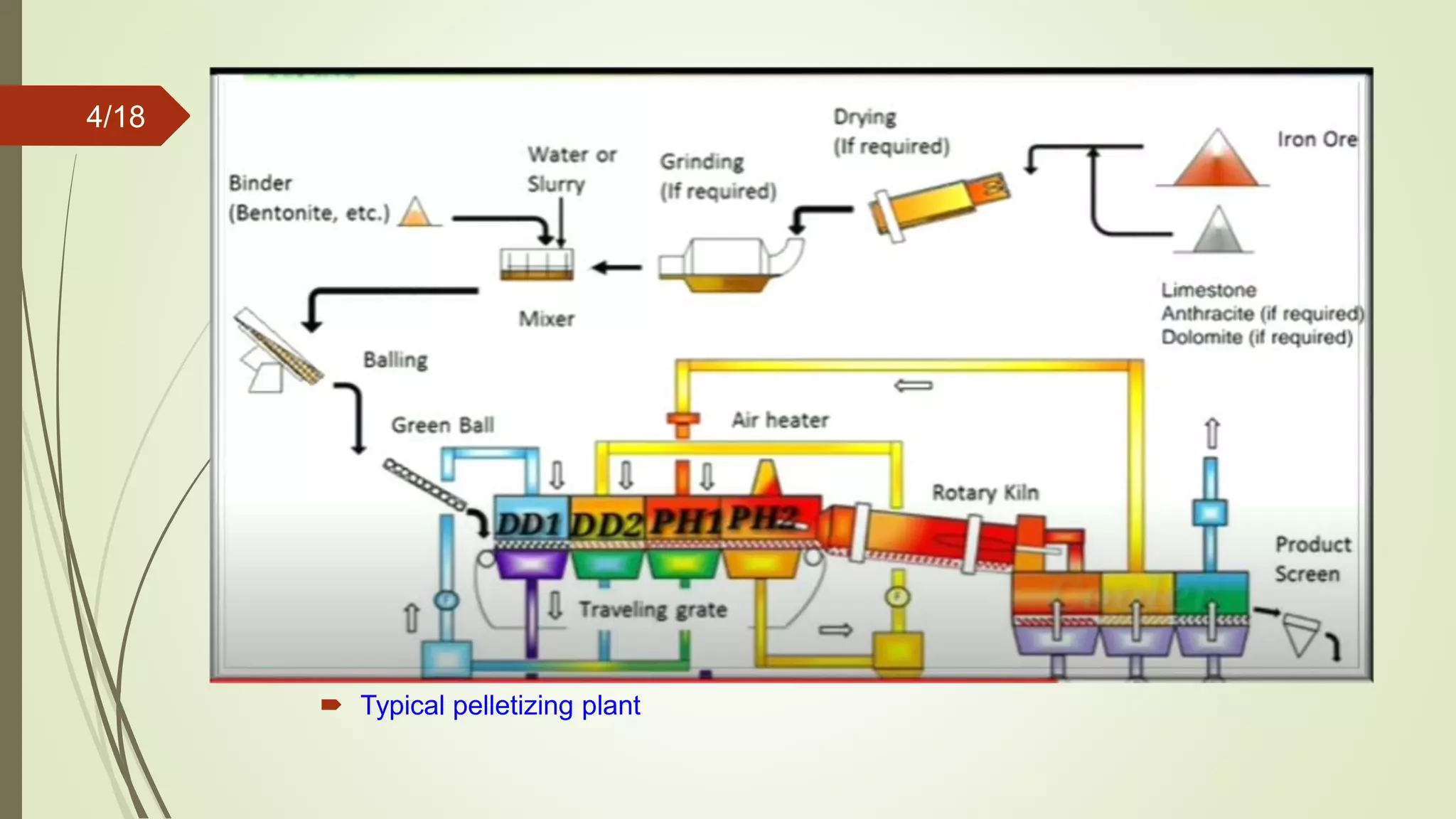
 Typical pelletizing plant
Pelletisation process consists of the following steps:
 Feed preparation
 Green ball production and sizing
 Green ball induration
Drying
Preheating
Firing
 Cooling of hardened pellets
5/18
Feed preparation
 Pelletizing feed preparation and mixing: the raw material (iron ore
concentrate, additives —Limestone or dolomite—and binders—Bentonite are
prepared in terms of particle size and chemical specifications, dosed, and
mixed together to feed the pelletizing process
 The feed size should be -100 mesh, with more than 60% as -350mesh
6/18
 The size and shape of feed particles leads to maximum mechanical
interlocking and surface tension to obtain strong green pellets
 To produce required quality green pellets, iron ore must be available in fine
ground form with around 60-80% , -45 microns sized particles.
7/18 Feed preparation(cont..)
Green ball production
 Green pellet formation process involves:
(a) mixing of ground iron ore mixture with process water, binder and fluxes
(b) formation of green pellets in disc or drum pelletizer followed by screening
process by roller screens.
 Two important methods of green ball production:
 Disc Pelletisation
 Drum Pelletisation
8/18
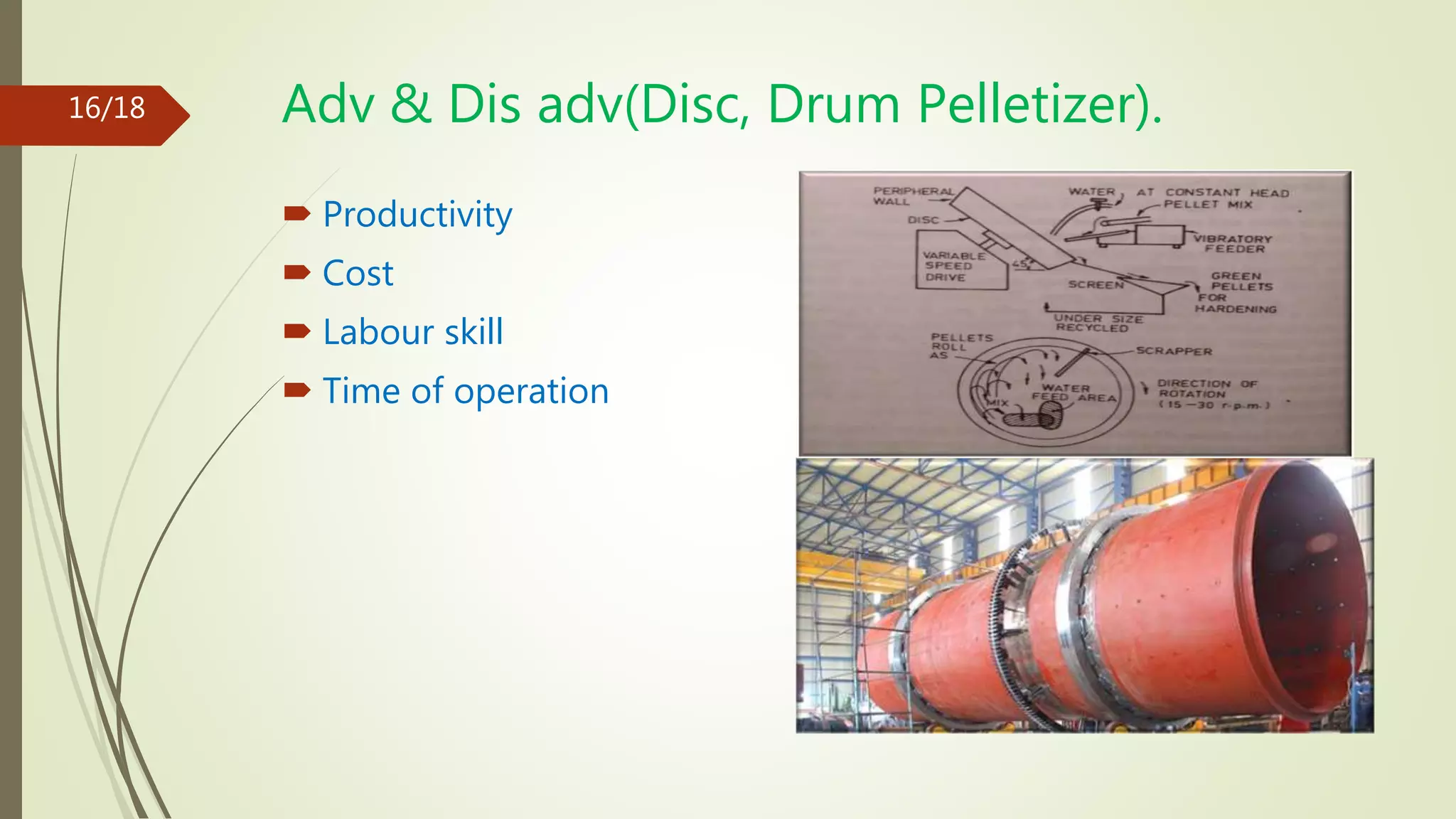
Disc pelletizer
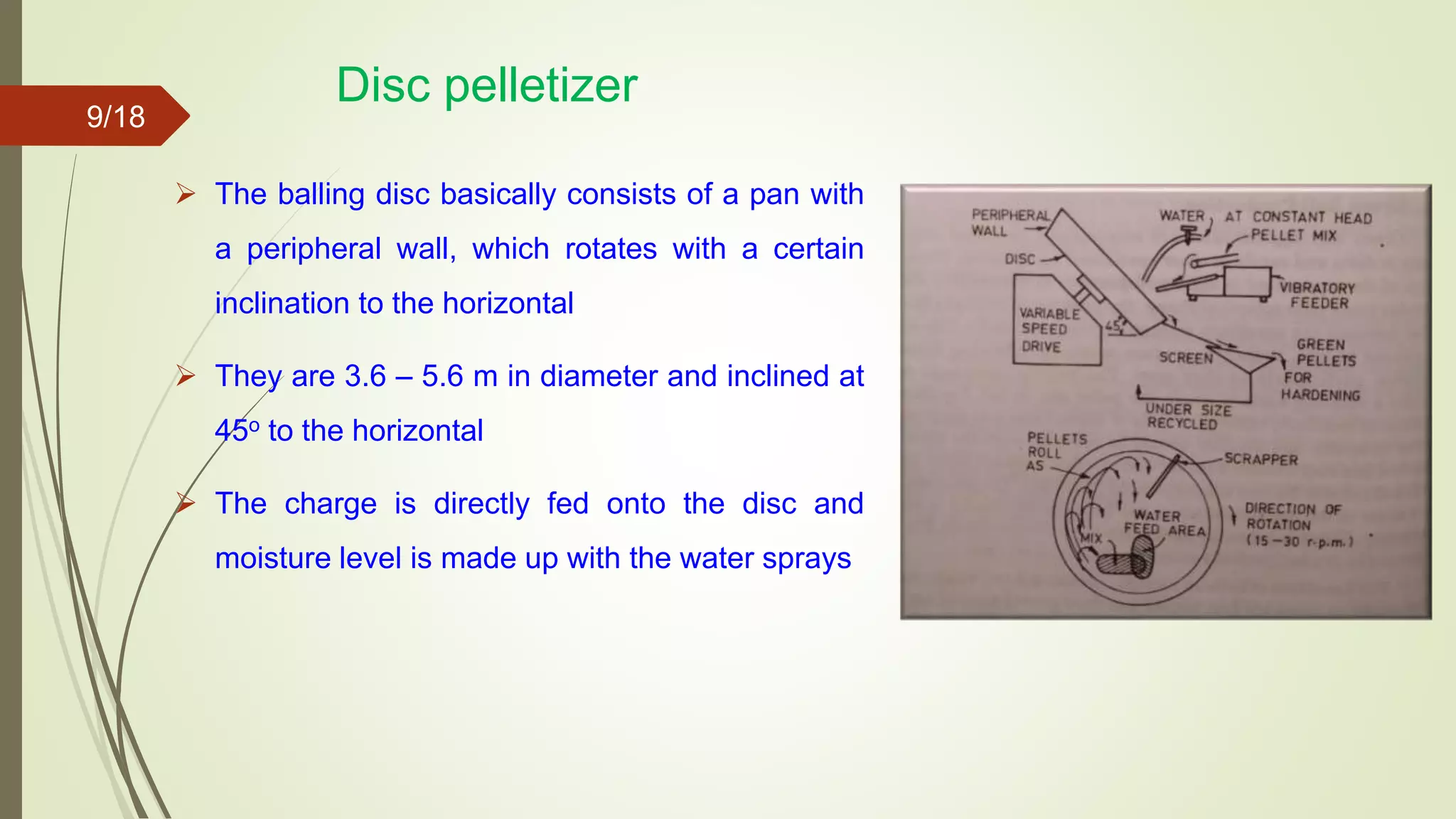
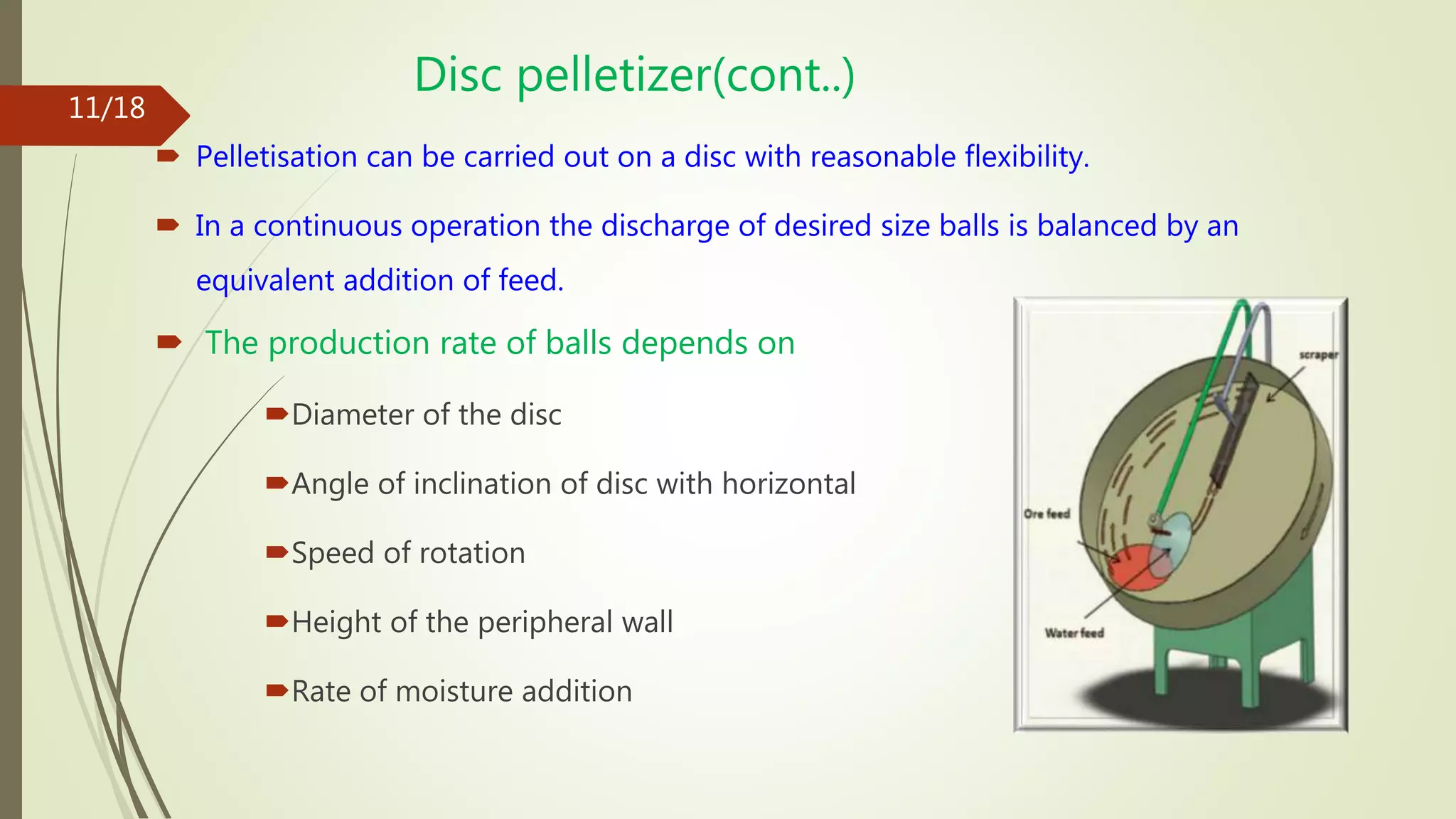
 The balling disc basically consists of a pan with
a peripheral wall, which rotates with a certain
inclination to the horizontal
 They are 3.6 – 5.6 m in diameter and inclined at
45o to the horizontal
 The charge is directly fed onto the disc and
moisture level is made up with the water sprays
9/18
Disc pelletizer(cont..)
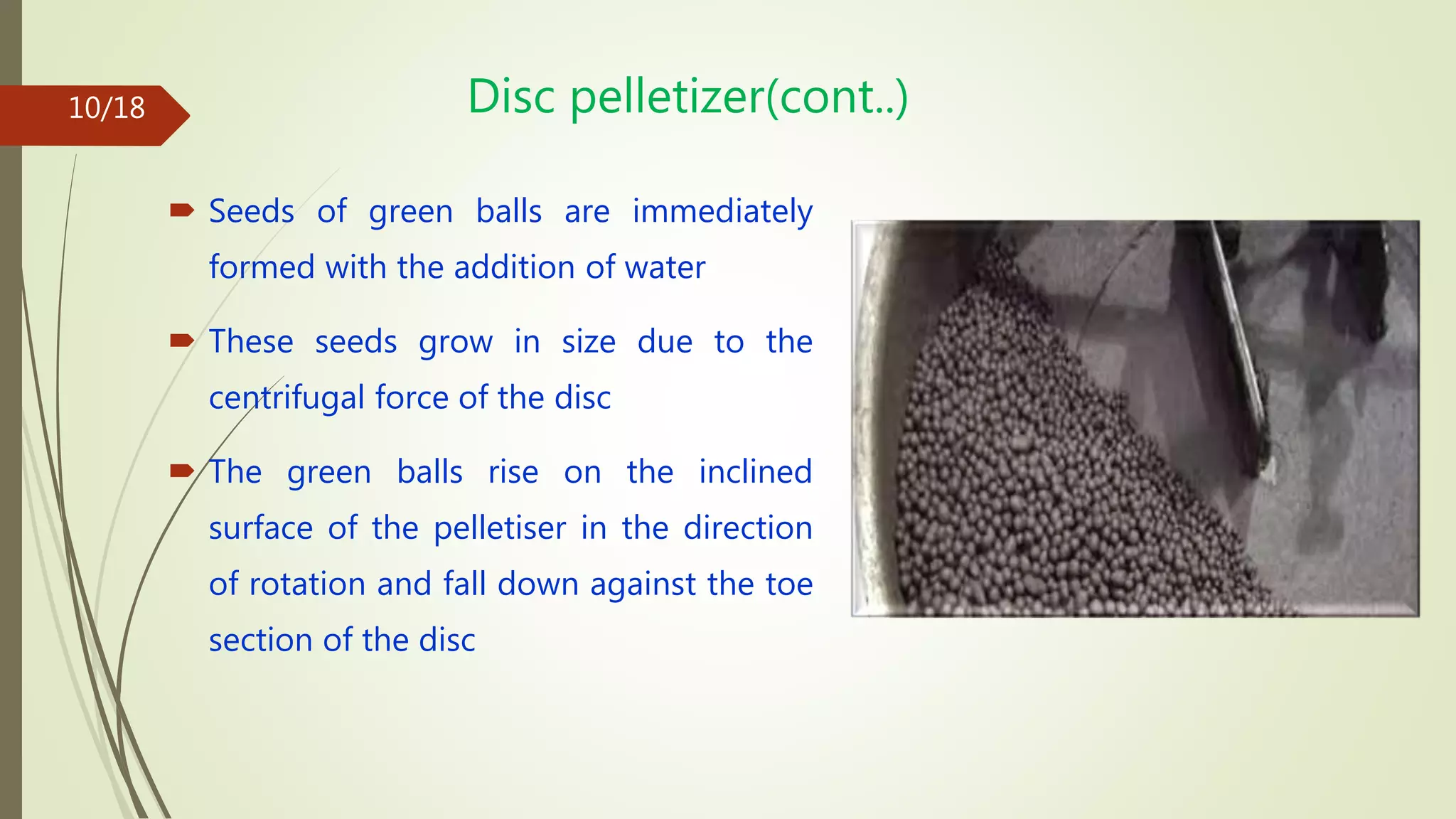
 Seeds of green balls are immediately
formed with the addition of water
 These seeds grow in size due to the
centrifugal force of the disc
 The green balls rise on the inclined
surface of the pelletiser in the direction
of rotation and fall down against the toe
section of the disc
10/18
 Pelletisation can be carried out on a disc with reasonable flexibility.
 In a continuous operation the discharge of desired size balls is balanced by an
equivalent addition of feed.
 The production rate of balls depends on
Diameter of the disc
Angle of inclination of disc with horizontal
Speed of rotation
Height of the peripheral wall
Rate of moisture addition
11/18
Disc pelletizer(cont..)
Mechanism of ball formation
 The formation of balls on a pellet depends primarily on the moisture
content.
 If moisture is less than the critical amount its distribution tends to be non -
uniform, major amount being present in the granulated material leaving
the non - granulated material relatively dry.
 If the moisture level is more than the critical value, growth rate is more but
the balls produced are liable to deformation because of their plasticity.
 Seeds are formed only if critical moisture level is maintained and without
which the process cannot proceed properly.
12/1812
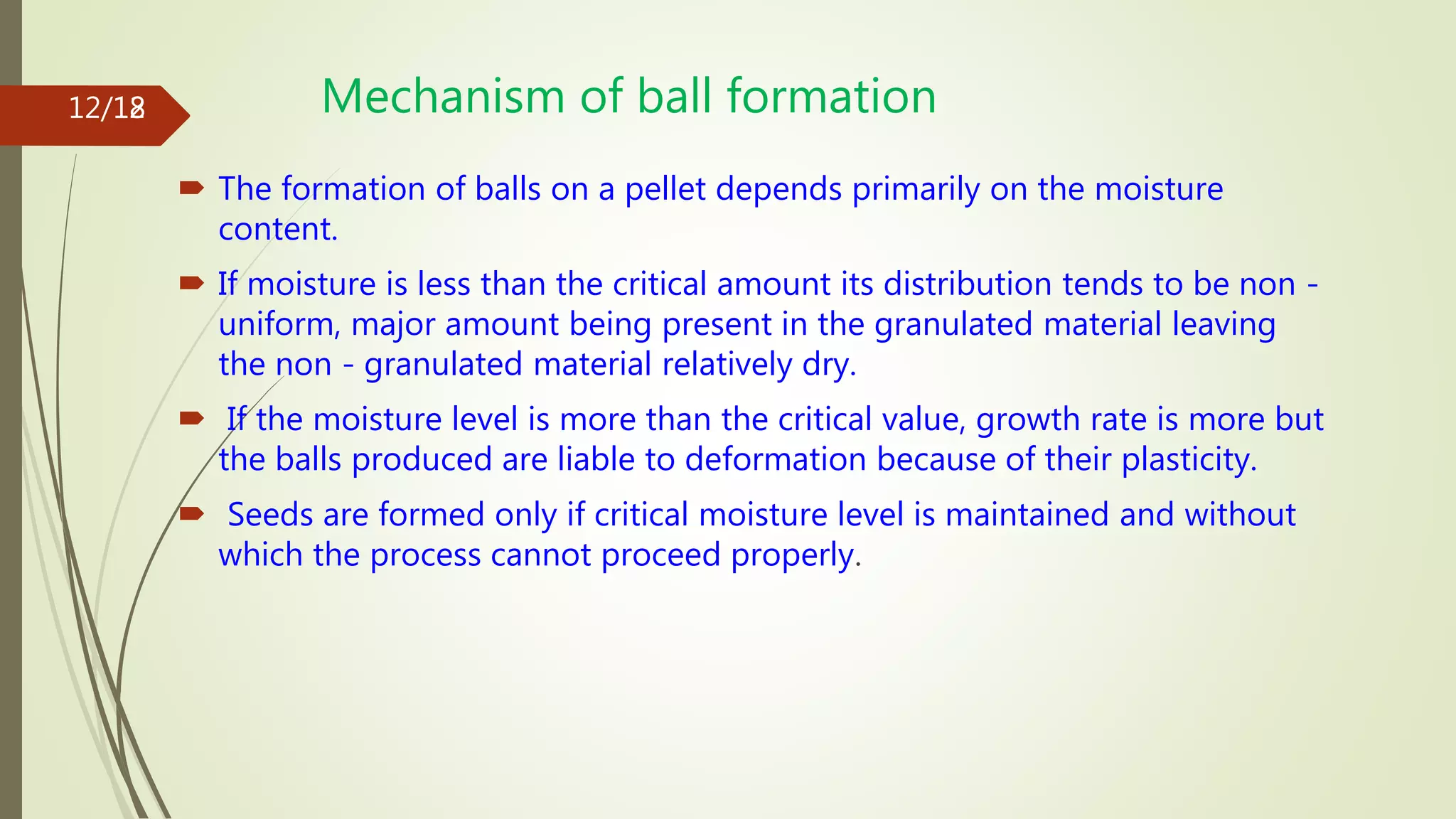
Ball formation is three regions
 Nucleii formation region
 Transition region
 Ball growth region
13/18
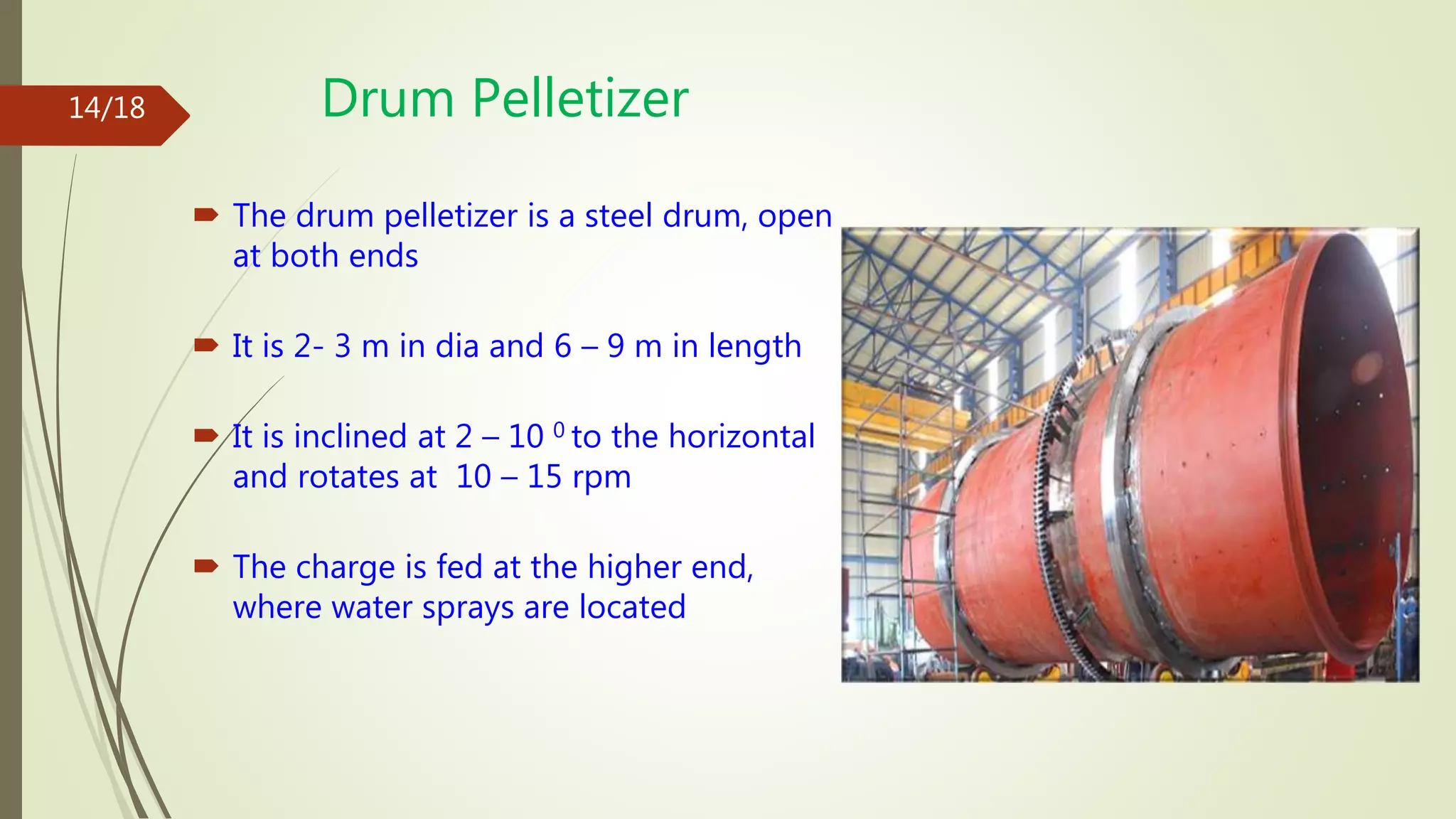
Drum Pelletizer
 The drum pelletizer is a steel drum, open
at both ends
 It is 2- 3 m in dia and 6 – 9 m in length
 It is inclined at 2 – 10 0 to the horizontal
and rotates at 10 – 15 rpm
 The charge is fed at the higher end,
where water sprays are located
14/18
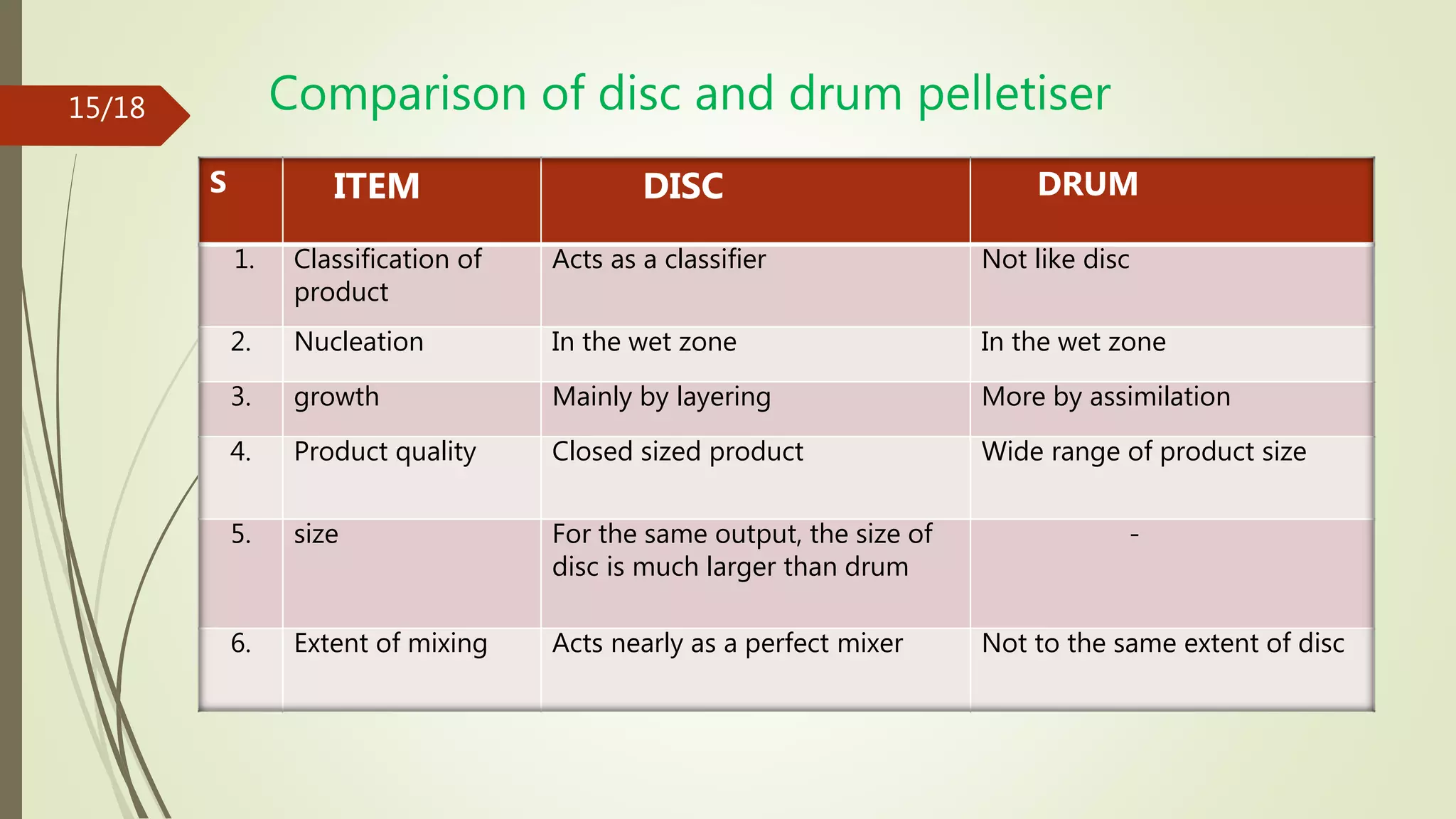
Comparison of disc and drum pelletiser
S ITEM DISC DRUM
1. Classification of
product
Acts as a classifier Not like disc
2. Nucleation In the wet zone In the wet zone
3. growth Mainly by layering More by assimilation
4. Product quality Closed sized product Wide range of product size
5. size For the same output, the size of
disc is much larger than drum
-
6. Extent of mixing Acts nearly as a perfect mixer Not to the same extent of disc
15/18
 Productivity
 Cost
 Labour skill
 Time of operation
Adv & Dis adv(Disc, Drum Pelletizer).16/18
Theory of bond
 Production of hardened pellets starts with the production of green balls in
the first place
 It is necessary that the green balls possess adequate strength to stand
bumps, overlying load and abrasion during screening and handling until
finally these are hardened by induration.
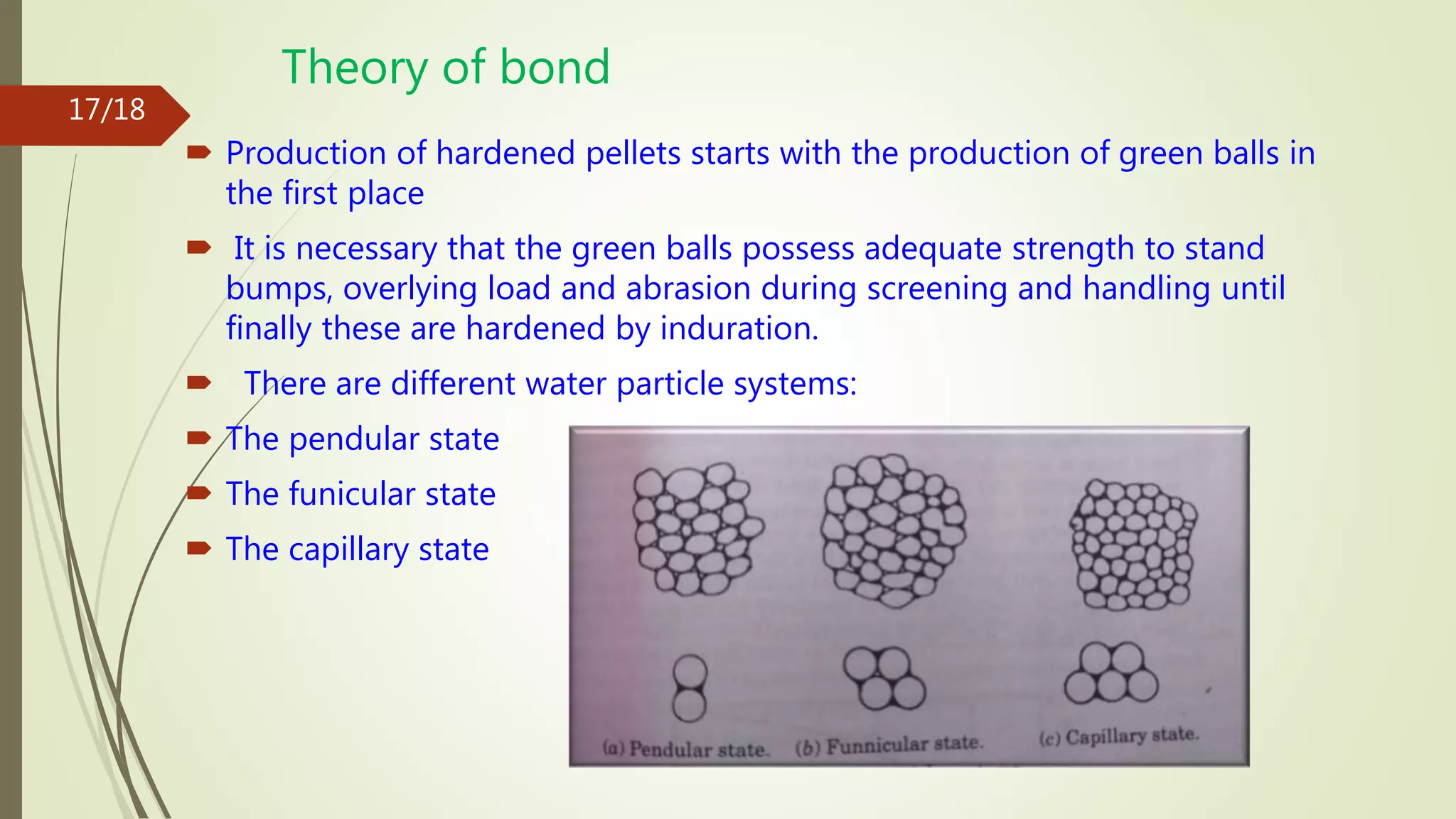
 There are different water particle systems:
 The pendular state
 The funicular state
 The capillary state
17/18
 Energy consumption
 Easy handling and transportation
 Good Bed Permeability
 Good Reducibility
 Uniform chemical composition
18/18 Advantages of pellets
19

Pelletisation process

  • 1.
  • 2.
    Introduction To PelletisationProcess  Pellets are spherical balls formed by the agglomeration of natural or ground iron ore fines in the presence of moisture and binder  These green balls of 5 – 20mm size are then dried, preheated and fired at 1250 – 13500 C  Bonding is developed between the fine ore particles at such high temperatures  Additives like Bentonite, lime or dolomite up to 0.5 -1.0% may be added for improved bonding 2/18
  • 3.
    Necessity of Pelletisation Utilization of iron ore fines of size even 0.5-0.15mm  Extending the life of iron ore reserves of nation.  To improve blast furnace performance  Increase in blast furnace productivity.  Decrease in uses of blast furnace fuel / coke fuel. Improve in quality of hot metal. 3/18
  • 4.
  • 5.
    Pelletisation process consistsof the following steps:  Feed preparation  Green ball production and sizing  Green ball induration Drying Preheating Firing  Cooling of hardened pellets 5/18
  • 6.
    Feed preparation  Pelletizingfeed preparation and mixing: the raw material (iron ore concentrate, additives —Limestone or dolomite—and binders—Bentonite are prepared in terms of particle size and chemical specifications, dosed, and mixed together to feed the pelletizing process  The feed size should be -100 mesh, with more than 60% as -350mesh 6/18
  • 7.
     The sizeand shape of feed particles leads to maximum mechanical interlocking and surface tension to obtain strong green pellets  To produce required quality green pellets, iron ore must be available in fine ground form with around 60-80% , -45 microns sized particles. 7/18 Feed preparation(cont..)
  • 8.
    Green ball production Green pellet formation process involves: (a) mixing of ground iron ore mixture with process water, binder and fluxes (b) formation of green pellets in disc or drum pelletizer followed by screening process by roller screens.  Two important methods of green ball production:  Disc Pelletisation  Drum Pelletisation 8/18
  • 9.
    Disc pelletizer  Theballing disc basically consists of a pan with a peripheral wall, which rotates with a certain inclination to the horizontal  They are 3.6 – 5.6 m in diameter and inclined at 45o to the horizontal  The charge is directly fed onto the disc and moisture level is made up with the water sprays 9/18
  • 10.
    Disc pelletizer(cont..)  Seedsof green balls are immediately formed with the addition of water  These seeds grow in size due to the centrifugal force of the disc  The green balls rise on the inclined surface of the pelletiser in the direction of rotation and fall down against the toe section of the disc 10/18
  • 11.
     Pelletisation canbe carried out on a disc with reasonable flexibility.  In a continuous operation the discharge of desired size balls is balanced by an equivalent addition of feed.  The production rate of balls depends on Diameter of the disc Angle of inclination of disc with horizontal Speed of rotation Height of the peripheral wall Rate of moisture addition 11/18 Disc pelletizer(cont..)
  • 12.
    Mechanism of ballformation  The formation of balls on a pellet depends primarily on the moisture content.  If moisture is less than the critical amount its distribution tends to be non - uniform, major amount being present in the granulated material leaving the non - granulated material relatively dry.  If the moisture level is more than the critical value, growth rate is more but the balls produced are liable to deformation because of their plasticity.  Seeds are formed only if critical moisture level is maintained and without which the process cannot proceed properly. 12/1812
  • 13.
    Ball formation isthree regions  Nucleii formation region  Transition region  Ball growth region 13/18
  • 14.
    Drum Pelletizer  Thedrum pelletizer is a steel drum, open at both ends  It is 2- 3 m in dia and 6 – 9 m in length  It is inclined at 2 – 10 0 to the horizontal and rotates at 10 – 15 rpm  The charge is fed at the higher end, where water sprays are located 14/18
  • 15.
    Comparison of discand drum pelletiser S ITEM DISC DRUM 1. Classification of product Acts as a classifier Not like disc 2. Nucleation In the wet zone In the wet zone 3. growth Mainly by layering More by assimilation 4. Product quality Closed sized product Wide range of product size 5. size For the same output, the size of disc is much larger than drum - 6. Extent of mixing Acts nearly as a perfect mixer Not to the same extent of disc 15/18
  • 16.
     Productivity  Cost Labour skill  Time of operation Adv & Dis adv(Disc, Drum Pelletizer).16/18
  • 17.
    Theory of bond Production of hardened pellets starts with the production of green balls in the first place  It is necessary that the green balls possess adequate strength to stand bumps, overlying load and abrasion during screening and handling until finally these are hardened by induration.  There are different water particle systems:  The pendular state  The funicular state  The capillary state 17/18
  • 18.
     Energy consumption Easy handling and transportation  Good Bed Permeability  Good Reducibility  Uniform chemical composition 18/18 Advantages of pellets
  • 19.