NEHRU INSTITUTE OF ENGINEERING
AND TECHNOLOGY
BE8254 - Basics of Electrical and Instrumentation
Engineering
OBJECTIVE
To analyze the operation of Three phase electrical circuits
and power measurement.
Todeal with the working principles ofElectrical machines.
To understand the principle of various measuring
instruments.
OUTCOMES
Concept of three phasepower circuits andmeasurement.
Comprehend the concepts in electrical generators, motors
and transformers.
Choose appropriate measuring instruments for given
application.
• 1.1 Threephasepower supply
• 1.2 Inter Connectionof windings
• 1.3 BalancedandUnbalanced loads
• 1.4 PowerEquation
• 1.5 StarDelta Conversion
• 1.6 Threephasepower measurement
• 1.7 TransmissionandDistribution of electrical energy
• 1.8 OverheadVsUndergroundsystem
• 1.9 Protection of power system
• 1.10 Typesof Tariff
• 1.11 Powerfactor improvement
Unit-I AC Circuits and Power Systems
1.1 Threephasepower supply
IMPORTANCEOFTHREEPHASESYSTEM
• Uniform power transmission and lessvibrationof
three phasemachines.
– Theinstantaneous power in a3 system canbe
constant (not pulsating).
– High power motors prefer asteady torque especially
one created by arotating magneticfield.
IMPORTANCEOFTHREEPHASESYSTEM
• Three phasesystem is more economical than the
single phase.
– Theamount of wire required for athreephase system
is lessthan required for an equivalent single phase
system.
– Conductor: Copper,Aluminum, etc
Differences
Single Phase Power Supply
230 V,50 Hz
Not sufficient for producinglarge amount
of power.
With single-phase current, the voltage
rises to a peak in one direction of flow,
subsides to zero, reverses, rises to a peak
in the opposite direction, subsides to zero,
and soon.
Single-phasecurrent requires the useof
one transformer.
Three Phase Power
Supply
440 V,50 Hz
Sufficient for producing large amountof
power.
There are three separate and distinct
single-phase currents, which are combined
so they can be transmitted over three or
four wires and these rise to a peak in one
direction, subside, reverse, and so on;
however they do not peak at the same
time.
Three-phase current requires two or three
transformers.
9
Three Phase CirCuiTs
10
1.1.1 Introduction:
• The generator , motor , transformer
called a single phase system
or rectifier have only one winding is
•
•
• If the current or voltage follows a phase difference 900 in a two windings,
called two phase systems
If the phase difference is 1200between voltages or currents in a three winding,
called as Three phase systems
In poly-phase systems , there are more than three windings
Advantages of three phase system:
•
•
•
More efficient than single phase system
Cost is less
Size is small . Compared to single phase system
MZCET 11
Advantages of Three Phase Circuits
•
•
•
• The amount of conductor material is required less for transmitting same power,
over the same distance , under same power loss
Three phase motors produce uniform torque , where as torque produced by
single motor is pulsating
Three phase generators not produce the harmonics when they are connected in
parallel
Three phase motors are self starting whereas single phase motors are not self
starting
THREEPHASEGENERATION
FARADAYSLAW
• Three things must be present in orderto
produce electrical current:
a) Magnetic field
b) Conductor
c) Relative motion
Conductor cuts lines of magnetic flux, avoltageis
induced in theconductor
Direction and Speedare important
•
•
GENERATING A SINGLE PHASE
Motion is parallel to the flux.
No voltage is induced.
N
S
N
S
Motion is 45 to flux.
Induced voltage is 0.707 of maximum.
GENERATING A SINGLE PHASE
x
N
S
Motion is perpendicular to flux.
Induced voltage is maximum.
GENERATING A SINGLE PHASE
N
S
Motion is 45 to flux.
Induced voltage is 0.707 of maximum.
GENERATING A SINGLE PHASE
N
S
Motion is parallel to flux.
No voltage is induced.
GENERATING A SINGLE PHASE
N
S
Notice current in the
conductor has reversed.
Motion is 45 to flux.
Induced voltage is
0.707 of maximum.
GENERATING A SINGLE PHASE
N
S
Motion is perpendicular to flux.
Induced voltage is maximum.
GENERATING A SINGLE PHASE
N
S
Motion is 45 to flux.
Induced voltage is 0.707 of maximum.
GENERATING A SINGLE PHASE
Motion is parallel to flux.
No voltage is induced.
Ready to produce another cycle.
N
S
THREEPHASEGENERATOR
GENERATORWORK
• Thegenerator consists of arotating magnet
(rotor) surrounded by astationary winding
(stator).
• Three separate windings or coils with terminalsa-
a’, b-b’, and c-c’ are physically placed 120 apart
around the stator.
• Asthe rotor rotates, its magnetic field cuts the
flux from the threecoils and induces voltages in
the coils.
• Theinduced voltage have equal magnitude but
out of phase by120.
GENERATION OF THREE-PHASE AC
N
x x
S
Phase 2 lags phase 1 by 120
Phase 3 lags phase 1 by 240
Phase 2 leads phase 3 by 120
Phase 1 leads phase 3 by 240
THREE-PHASE WAVEFORM
Phase 1 Phase 2 Phase 3
GENERATION OF 3 VOLTAGES
Phase 1 is ready to go positive.
Phase 2 is going more negative.
Phase 3 is going less positive.
N
x x
S
1.1.2 Generation of Three Phase Voltages
29
BALANCED3VOLTAGES
• Balanced three phasevoltages:
– samemagnitude (VM)
– 120 phase shift
cos t120
van (t)  VM cost
vbn (t)  VM cos t120
vcn (t)  VM cost  240  VM
• Vectorially r.m.s values of voltages
induced in three windings are represented
in the diagram
• ER= E ∟0ov,
• EY= E ∟-120ov
• EB= E ∟+120o v 31
Three voltages are not in phase, since there is aphase difference
of
Theorder of voltage waveform sequencesin apolyphase system
is called phase rotation or phase sequence.
This sequence of phase shifts has a definite order. For clockwise
rotation, the order is 1-2-3 (i.e) RYB(winding 1 peaks first, them
winding 2, then winding 3), which is known as a positive phase
sequence.
1.1.3 PHASE SEQUENCE
1 2 0
PHASESEQUENCE
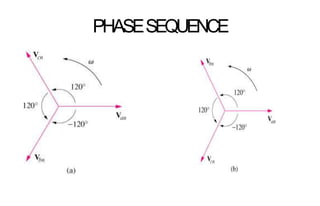
For anti-clockwise rotation, the
order is 3-2-1 (i.e) RBY (winding 3
peaks first, them winding 2, then
winding 1), which is known as a
negative phasesequence.
If we’re using a polyphase voltage
source to power resistive loads,
phase rotation will make no
difference at all.
Whether 1-2-3 or
voltage and current
will all be thesame.
3-2-1, the
magnitudes
PHASESEQUENCE
van (t) VM cost
vbn (t) VM cost 120
vcn (t) VM cost 120
Van VM 0
Vbn VM 120
Vcn VM 120
POSITIVE
SEQUENCE
NEGATIVE
SEQUENCE
Vcn VM 120
VM 120
Vbn
Van VM 0
1.2 INTERCONNECTIONOF
WINDINGS
36
THREEPHASEQUANTITIES
QUANTITY
S YMBO
L
Phase current
Line current
Phase voltage
Line voltage
I
IL
V

1.2.1 PHASEVOLTAGESand LINE
VOLTAGES
• Phasevoltage is measured between the neutral
and any line: line to neutralvoltage
• Line voltage is measured between any two ofthe
three lines: line to linevoltage.
1.2.2 PHASECURRENTSand LINE
CURRENTS
• Line current (IL)is the current in each line ofthe
source or load.
• Phasecurrent (I) is the current in eachphase
of the source orload.
Interconnection of windings
Three phase connections:
•
•
•
There are two types of three phase connections
Star connection (Y)
Delta connection (Δ)
1.2.3 Starconnection (Y):
• In this method of inter-connection, the similar ends, say, “start”
ends of three coils (it could be “finishing” ends also) are joined
together at point ‘N’
40
• The point ‘N’is known as star point or
neutral point
If this three-phase voltage is applied across
a balanced symmetrical load, the neutral wire
willbe carrying three currents which are exactly
equal in magnitude but are 120oout of phase
with each other. Hence, their vector sum is zero
IR+ IY+ IB= 0
•
Voltages and Currents in Y-Connection:
• The voltage induced in each winding is called the
‘phase’voltage and current in each winding is
known as ‘phase’ current.
41
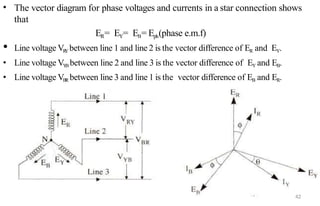
• The vector diagram for phase voltages and currents in a star connection shows
that
ER= EY= EB= Eph(phase e.m.f)
• Line voltage VR
Y between line 1 and line 2 is the vector difference of ER and EY.
• Line voltage VY
B between line 2 and line 3 is the vector difference of EY and EB.
• Line voltage VB
R between line 3 and line 1 is the vector difference of EB and ER.
42
• The p.d. between lines 1 and 2 is
VR
Y
= ER- EY(Vector difference)
•
•
•
C
O
VR
Y
is found by compounding ERand EY
reversed and its value is given by the
diagonal of the paral1elogram in figure.
The angle between ERand EYreversed is 60°.
If ER= EY= EB= EphthePhase e.m.f then,
VRY
Eph
cos30o
2
o
 2 Eph  cos30
VRY
ph
MZCET 43
ph 3E
 2 E 
2
3

•
It willbe noted from figure that
•
•
•
(a) Line voltages are 120° apart.
(b) Line voltages are 30° ahead of their respective phase voltages.
(c) The angle between the line currents and the corresponding line voltages is (30 + ɸ)
with current lagging.
44
similarly
VYB  EY  EB (Vector Difference)
VBR
 3Eph
 VYB  VBR
 line voltage, VL
 EB  ER
 3Eph
(Vector Difference)
and
VRY
Hence, in star connection
VL  3Eph
Line Currents and Phase Currents:
• Current in line 1 = IR
• Current in line 2 = IY
•Current in line 3 = IB
Since IR= IY= IB= say,
Iph- the phase current
Line current IL= Iph
Power:
•
•
The total power in the circuit is the sum of the three phase powers. Hence
Total Power =3 x phase power=
•
45
1.2.4 Delta (Δ) or Mesh Connection:
• Phase sequence is R,Y, B
• R leads Yby 120° and Yleads Bby 120°.
• The voltage between lines 1 and 2 as VR
Y
• The voltage between lines 2 and 3 as VY
B
VR
Y
leads VY
B
by 120
VY
B
leads VB
R
by 120°.
• VR
Y
=VYB= VB
R
= line voltageVL
• Then, it VL
= Vph
46
47
Line Currents and Phase Currents:
•
•
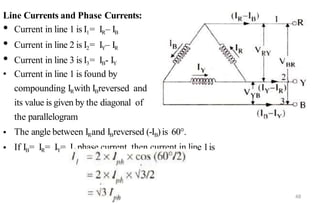
• Current in line 1 is I1= IR– IB
• Current in line 2 is I2= IY– IR
• Current in line 3 is I3= IB- IY
• Current in line 1 is found by
compounding IRwith IBreversed and
its value is given by the diagonal of
the parallelogram
The angle between IRand IBreversed (-IB)is 60°.
If IB= IR= IY= Iphphase current, then current in line 1is
48
Contd..
Since all line currents are equal in magnitude i.e., I1= I2 = I3= IL
From Vector diagram, it should be noted that
•
•
•
(a) Line currents are 120oapart.
(b) Line currents are 30obehind the respective phase currents.
(c) The angle between the line current and the corresponding line voltage is 49
Power:
50
cos
P  3 Eph I ph
VL
Eph
but
 IL
3
 IL
ph
I
 cos
3
L
P  3V
IL cos
P  3 VL
1.3 Balanced and unbalanced loads
51
1.3.1 Balanced three phase supply:
• A three phase supply is said to be balanced, when all the
three voltages have the same magnitude but differ in
phase by 120° with respect to one another.
• The three phase supply is said to be unbalanced, even if
one of the above conditions is not satisfied.
Balanced Supply
52
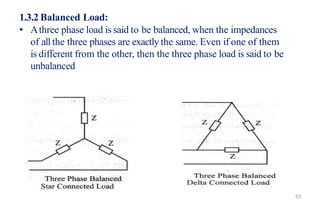
1.3.2 Balanced Load:
• Athree phase load is said to be balanced, when the impedances
of all the three phases are exactly the same. Even if one of them
is different from the other, then the three phase load is said to be
unbalanced
53
• In a three phase balanced load, whether star connected or delta connected, the
magnitudes of the phase currents are the same but differ in phase by 120owith
respected to one another
1.3.3 Unbalanced Load
• But in an unbalanced load, when a three phase balanced supply is given, the
magnitudes and phases of all the three phase currents willbe different.
54
55
1.4 Power Equation
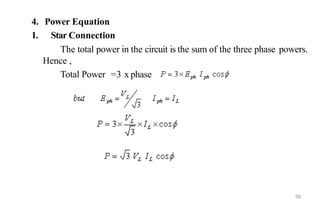
4. Power Equation
1. Star Connection
The total power in the circuit is the sum of the three phase powers.
Hence ,
Total Power =3 x phase power=
56
1.4.2 Power for delta connection
cos
P  3 Eph I ph
VL
Eph
but
 IL
3
 IL
ph
I
 cos
3
L
P  3V
IL cos
57
P  3 VL
58
1.5 Star Delta Conversion
Resistive Circuits (Basics)
Resistors in parallel:
R1
Resistors in series:
R2
R3
Current Division in ParallelCircuits
R
1
R
2
V
I I2
I1
Voltage Division in SeriesCircuits
R 1
R 2
+ V1 -
V
- V2 +
I
1.5.1 Star -> Delta Conversion
A
B
C
Rab
Rbc
Rca
B
C
Ra
Rb
Rc
A
Star Connection Delta Connection
63
Star-Delta conversion
Advantages
1. Theprimarysideisstar connected.Hencefewer number of
turnsare required. Thismakesthe connection economical
2. Theneutral available onthe primarycanbeearthed to avoid
distortion.
3. Largeunbalancedloadscanbehandled satisfactory.
64
Star-Delta conversion
• Disadvantages
• Thesecondaryvoltage isnot in phasewith the primary. (30⁰
phasedifference )
• Henceit isnot possibleto operate thisconnectionin parallel
with star-star or delta-delta connectedtransformer.
Wye(star) to Delta Transformation:
Consider the following:


a
 b
c 
a
 b
c 
R a
R b
R c
R 1 R 2
R 3
( a ) w y e configuration ( b ) delta configuration
a
 R c R a
 R b R c
R c
 R c R a
 R b R c

R a R b
b
 R c R a
a b
R
R a R b
R 3 
R
R
R R  R b R c
R 
2
1
1
R 1 R 3
1
R 2 R 3
1
R 1 R 2
c
R  R 2  R 3
R 
b
R  R 2  R 3
R 
a
R  R 2  R 3
R 
Using the following circuit. Find Req.
9 
10  5 
8  4 
V
+
_
Req 10 
I
a
b
c
Convert the delta around a – b – c to a wye.
Continued….
2 
2 
4 
4 
8 
9 
Req
It is easy to see that Req = 15 
1.5.2 Delta-star Transformation
B
C
Ra
Rb
Rc
A
B
Delta to StarTransformation:
A
Rca Rab
C
Rbc
Delta - StarTransformation
Features
secondaryPhasevoltage is1/√3 times of line voltage
neutral in secondarycanbegroundedfor 3 phase4 wire system
Neutral shiftingand3rdharmonicsare there
Phaseshift of 30⁰ between secondaryandprimary currentsand
voltages
69
1.6 THREE PHASE POWER MEASUREMENT
WHAT IS THREE-PHASE power?
Three-phase power is a common method
current electric
of alternating-
power generation, transmission, and distribution.
It is a type of polyphase system and is the most common
method used by electric grids worldwide to transfer power.
A polyphase system is a means
of distributing alternating-current electrical power.
An electrical grid is an interconnected network for
delivering electricity from suppliers to consumers.
1.6.1 Measure of power in Three Phase Circuits:
•
•
•
•
•
•
• Wattmeter is the instrument which
is used to measure power in an electrical circuit.
It consists of (i) a current coil ML’
through which the line current flows
(ii) a potential coil PV, which is connected
across the circuit.
The full voltage is applied across the potential coil and it carries a very small
current proportional to the applied voltage.
Three single phase watt-meters may be connected in each phase
The algebraic sum of their readings gives the total power consumed by the three
phase circuit.
It can be proved that only two watt-meters are sufficient to measure power in a
three phase circuit.
Various methods are used measurement of three
phase power in three phase circuits on the basis of
number of wattmeter used.
We have three methods:-
1) Three wattmeter method
2) Two wattmeter method
3) Single wattmeter method
1.6.2 MEASUREMENTOFTHREE
PHASE POWERBYTHREE
WATTMETER METHOD
Three Wattmeter method is used to
power in a 3 phase, 4 wire system.
measure
However, this method can also be used in a 3
phase, 3 wire delta connected load, where
power consumed by each load is required to
be determined separately.
The Three-wattmeter method can be used for
star and delta connected unbalnced loads.
• The connections for S
tar/Delta
connected loads for measuring
power by Three wattmeter
method is shown below:-
Thepressure coil of all
• the Three wattmeter namely W1,
W2and W3are connected to a
• common terminal known asthe
neutral point. The product of the
phase current and line voltage
represents as phase power and is
recorded by individual
wattmeter.
77
The total power in a Three wattmeter method of
power measurement is given by the algebraic sum
of the readings of Three wattmeter. i.e.
Where, W1 = V1I1 W2 = V2I2 W3 = V3I3
Except for 3 phase, 4 wire unbalanced load, 3
phase power can be measured by using only Two
Wattmeter Method.
1.6.3 MEASUREMENTOFTHREE
PHASE POWERBYTWO
WATTMETER METHOD
Two Wattmeter Method can be used to measure
the power in a 3 phase, 3 wire star or delta
connected balanced or unbalanced load.
In Two wattmeter method the current coils of the
wattmeter are connected with any two lines, say R
and Y and the potential coil of each wattmeter is
joined across the same line, the third line i.e. B.
The two wattmeter method is used for the power
measurement in the 3-phase system, irrespective of
whether the load is balanced or unbalanced.
MEASUREMENTOFPOWER
BY TWOWATTMETER
METHODIN ST
AR
CONNECTION
Let W1 and W2 Be the two
wattmeter.
Let andthe
phase voltages across the
three loads
be the phase currents
respectively.
The instantaneous current through the current coil
of Wattmeter, W1 is given by the equation shown
below.
Instantaneous potential difference across the
potential coil of Wattmeter, W1 is given as
Instantaneous power measured by the Wattmeter,
W1 is
The instantaneous current through the current coil
of Wattmeter, W2 is given by the equation
Instantaneous potential difference across the
potential coil of Wattmeter, W2 is given as
Instantaneous power measured by the Wattmeter,
W2 is
Therefore, the Total Power Measured by the Two
Wattmeter W1 and W2 will be obtained by adding the
equation (1) and (2).
Here P is the total power absorbed in the three loads at
any instant.
MEASUREMENT OF POWER BY
TWO WATTMETER METHOD IN
DELTA CONNECTION
There are similar notations for delta also.
The instantaneous current through the coil of the
Wattmeter, W1 is given by the equation
Instantaneous Power measured by the Wattmeter,
W1 will be
Therefore, the instantaneous power measured by
the Wattmeter, W1 will be given as
The instantaneous current through the current coil
of the Wattmeter, W2 is given as
The instantaneous potential difference across the
potential coil of Wattmeter, W2 is
Therefore, the instantaneous power measured by
Wattmeter, W2 will be
Hence, to obtain the total power measured by the Two
Wattmeter the two equations, i.e. equation (3) and (4)
has to be added.
Here P is the total power absorbed in the three loads at
any instant.
The power measured by the Two Wattmeter at any
instant is the instantaneous power absorbed by the
three loads connected in three phases.
In fact, this power is the average power drawn by the
load since the Wattmeter reads the average power
because of the inertia of their moving system.
1.6.4 MEASUREMENTOFPOWERBY
S
INGLE PHASE
WATTMETER METHOD
Power is measured in the electric
circuit using a wattmeter.
A single phase wattmeter
consists of two coils; namely the
current coil and the pressure coil.
The Current coil is connected in
series with the line and thus
carries the line current.
The Pressure coil is connected in
parallel with the line.
The Wattmeter gives the power
per phase.
• The wattmeter gives the value of power per phase.
• Therefore, Total power = 3 X Power per phase
= 3 X wattmeter reading
•The one wattmeter method is used for power
measurement in the 3-phase star connected balanced
load.
1.7 Transmission and Distribution of
Electrical Energy
95
9/20/2015
1
B Y 01,02,03,04,05,06,12604
2 9/20/2015
1.7.1 Introduction
01,02,03,04,05,06,12604
3
9/20/2015
4
1.7.2 Structure of Electrical Power System
9/20/2015
1.7.3 Distribution System
“The part of power system which distributes
electrical power for local use is known as
DISTRIBUTION SYSTEM.”
This system is the electrical system between the
substation fed by the transmission system and
consumer meter.
Distribution line generally consistof
Feeders
Distributers
Service mains
9/20/2015
FEEDERS DISTRIBUTORS SERVICE MAINS
Distribution
Feeder
A Feeder is conductor whichconnects the substation to the
area where power isto be distributed
Feeder are used to feed the electrical power
generating station to thesubstation
No tapings are taken from the feeder
So the current in it remainsthe same throughout
Main consideration in the design of feeder is
the Current carryingcapacity.
from the
8 9/20/2015
Distributer
A distributer is a conductor from which tapings
are taken from pole mounted transformer to the
consumer
The current through a distributer is not constant
because tapings aretaken at various places along
its length
Voltage drop ismainconsideration
Limit of variation is6%of rated at
consumer
9/20/2015
9
Service mains
A service mains isa generally a small cable which
connects the distributer to the consumer ‘smeter.
The connecting links between the distributor and
the consumer terminals.
10 9/20/2015
11
9/20/2015
12
9/20/2015
13
distributio
n
1.7.4 classification
16
of dc
Distribution system is a part of power system,
existing between distribution substations and
consumers.
Itisfurther classified on the basis ofvoltage
Primary distribution system- 11 KV or 6.6 KV or 3.3 KV
Secondary distribution system- 415 V or 230V
9/20/2015
Classification Of
Distribution System:
It can be classified under different considerations as;
1. Type Of Current:
a)AC Distribution
System
b)DC Distribution
System
2. Type Of Construction:
a)Overhead System
b)Underground System
9/20/2015
17
3. Type Of Service:
a)General Lighting & Power
b)Industrial Power
c)Railway
d)Streetlight etc
4. Number Of Wires:
a)Two Wire
b)Three Wire
c) Four Wire
5. Scheme Of Connection:
a)Radial DistributionSystem
b)Ring or Loop DistributionSystem
c) Interconnected Distribution System
9/20/2015
18
Ac distribution
A.c. distribution system is the electrical system
between the step-down substation fed by the
transmission system and the consumers’ meters.The
a.c. distribution
system isclassified into
( i) primary distribution system and
( ii)secondary distribution system.
9/20/2015
19
1.7.5 Primary distribution
system
voltages somewhat higher than general utilisation and
handles large blocks of electrical energy than the average
low-voltage consumer uses.
Commonly used primary distribution voltage 11KV, 6.6
KV,3.3 KV.
Electric power from the generating station is transmitted at
high voltage to the substation located in or near the city.
At this substation, voltage is stepped down to 11 kV with the
help of step-downtransformer.
Power is supplied tovarious substations for distribution or
to big consumers at this voltage.
This forms the high voltage distribution or primary
distribution.
20 9/20/2015
9/20/201
21
1.7.6 Secondary distribution system
Itisthat part of a.c. distribution system which includes
the range ofvoltages at which the ultimateconsumer
utilizes the electrical energy delivered to him.
The secondary distribution employs 400/230 V, 3-
phase, 4-wiresystem.
22
23
D.C. Distribution
D.c. supply is required for the operation of variable speed
machinery ( i.e., d.c. motors), for electro-chemical work and
for congested areas where storage battery reserves are
necessary.
For this purpose, a.c. power is convertedinto
d.c. power at the substation by using converting machinery
e.g., mercury arc rectifiers, and motor-generatorsets.
24
Type of DC distributor
The dc supply from the substation may be
obtained in formof
( i) 2-wire or
( ii) 3-wire for distribution.
25
2 wire 3 wire
9/20/2015
26
Two outer and a middle o2
r7
neutral wire is
the s/s.
earthed at
Voltage between the outer is twice the voltage
between either outer and neutral wire.
Advantage – available two voltage at the consumer
terminal.
Loads requiring high voltage connected across the
outers.
Lamps and heating circuits requiring less voltage are
connected between either outer and neutral.
Method of obtaining 3 wire D.c
system
Two generator method.
3-wire D.c. generator.
Balancer set
9/20/2015
28
Two generator method
29
Two generator method
D.c generator G1 and G2 are connected in series and
the neutral is obtained from the common point btwn
generator
G1 supplies a I1, G2 supplies a I2
Difference of load current on both side
through the neutralwire.
Disad.:two separate generator are required.
(I1-I2) flow
9/20/2015
30
3-wire D.c. generator.
9/20/2015
31
3-wire D.c. generator.
Consist of a standard 2 wire machine with one
or two coils of high reactance and low
resistance that connected to opposite points of
the armature winding.
Neutral wire isobtained fromcommon
point.
9/20/2015
32
Connection schemesof
distribution system
Radial system
Ring main system
Interconnected system
9/20/2015
33
Radial Distribution
System:
9/20/2015
separate feeders radiate from a single substation and feed the
distributors at one end only.
Only one path is connected between each customer and
substation.
Electrical power flows along a single path.
If interrupted, results in complete loss of power to the customer.
.
34
• Advantages:
Low cost .
Simple planning.
• Disadvantages :
The radial system isemployed only when power isgenerated
voltage and the substation is located at the centre of the load.
Distributor nearer to feeding end is heavily loaded.
Consumers at far end of feeder would be subjected to serious
• voltage fluctuations
at low
128
9/20/215
35
9/20/2015
36
Ring or Loop Distribution
System:
It consists of two or more paths between
• power sources and the customer.
Theloop circuit starts from the substation bus-bars, makesaloop
through the area to be served, and returnsto the substation
• Advantages:
Lessconductor material is required.
Lessvoltage fluctuations.
More reliable.
• Disadvantages:
It is difficult to design ascompared to the
design of radialsystem.
37 9/20/2015
38
Interconnected Distribution System:
It is supplied by a number of feeders.
Radial primary feeders can be tapped off from the
interconnecting tie feeders.
They can also serve directly from the substation.
Advantages:
Increases the reliability ofsupply
Losses are less
Quality of service isimproved.
Disadvantages:
Itsinitial cost ismore.
Difficult in planning, design and operation.
9/20/2015
39
9/20/2015
40
1.7.7 D.C. Distribution
D.c. supply is required for the operation of variable
speed machinery ( i.e., d.c.motors),
for electro-chemical work and for congested areas
where storage battery reserves are necessary.
For this purpose, a.c. power is converted into d.c.
power at the substation by using converting machinery
e.g., mercury arc rectifiers, rotaryconverters and motor-
generator sets. The d.c. supply from the substation may
be obtained in the form of
43 9/20/2015
DC
Distribution:
Voltage drop along distributor is considered as a
main factorwhile designing a distributor.
It depends upon the nature of load and also on
feeding, whether it is fed at one or both ends.
According to loading, a distributor can be classified
as:
i. Fed at oneend.
ii. Fed at both ends. a). With equal voltages.
b). With unequal voltages.
iii. Fed at centre.
Ring mains.
9/20/2015
DC Distribution Feed at one end
9/20/2015
a) The current in the various sections of the
distributor away from feeding point goes on
decreasing. Thus current in section AC ismore than
the current in section CD and current in section CD
is more than the current in section DE.
(b) The voltage across the loads away from the
feeding point goes on decreasing. Thus in Fig. 13.1,
the minimum voltage occurs at the load point E.
(c) Incase a fault occurs on any section of the
distributor, the whole distributor will have to be
disconnected from the supply mains. Therefore,
continuity of supply isinterrupted
Distributorfed at center
47
In this type of feeding the distributor is connected to the supply mains at
both ends and loads are tapped off at different points along the length of the
distributor.
Thevoltage at the feeding points may or may not be equal. distributor A B
fed at the ends A and B and loads of I1, I2 and I3 tapped off at points C
respectively.
Here, the load voltage goes on decreasing as we move away from one
feeding point say A , reaches minimum value and then again starts rising
and reaches maximum value when we reach the other feeding point B.
The minimum voltage occurs at some load point and is never fixed. It is
shifted with the variation of load on different sections of the distributor.
48 9/20/2015
Advantages
(a) If a fault occurs on any feeding point of the
distributor, the continuity of supply is main-tained from
the other feeding point.
(b) In case of fault on any section of the distributor,
the continuity of supply is maintained from the other
feeding point.
(C)The area of X-section required for a doubly fed
distributor is much less than that of a singly fed
distributor.
9/20/2015
49
RingDistributor
9/20/2015
50
9/20/2015
51
In thistype of feeding, the centre of the distributor
isconnected to thesupply mains as shown in Fig.
Itisequivalent to two singly fed distributors,
each distributorhaving a common feeding point
and length equal to half of the total length
1.8 Overhead VsUnderground
System
144
Transmission and
Distribution
Transmission lines
connect power
generation plants to
substations,
other
generating
power
plants,
and other utilities
at high voltages.
Distributes electricity
toeach customer's
residence, business,
or industrial plant at
lower voltages.
Transmission System Distribution System
Transmission and
Distribution
Transmission Distribution
Underground andOverhead
Undergrounding
transmission lines is
less common
Underground cables
have different
technical
requirements than
overhead and have
different impacts
Undergrounding
distributions lines
is more common
Transmission Distribution
Underground vs.Overhead
Transmission
Design Issues
Specialized engineering skills required
Extensive study required to determine site-
specific subsurface obstructions or obstacles
Longer timeframe for design
Need to provide larger budget contingency Flood
plain and wetland issues require special
consideration
Environmental impacts
Underground vs.Overhead
Transmission
Construction Concerns
Space for large vaults (8’ x 10’ X 20’)
Longer construction time frame
Dewatering in wet areas during construction
Significantly more impacts tosurrounding
properties
Open trenches
min. 5’ wide x 5’ deep
Specialized backfill
Underground vs.Overhead
Transmission
Operational Concerns
Difficult to identify outage location
Requires specialized work force
Long lead time fordelivery of materials
Need towarehouse specialized spare materials
Increased maintenance
Shorter life span
Dewatering and cleaning of equipment in
vaults
Underground vs.Overhead
Transmission
Cost
Typical underground costs are 8 to10 times the cost of
overhead construction
Typical life of underground is approximately one-half the
life of overhead construction
Depending on route may have significantly more
unanticipated problems with associated costs
4-Cable system required toincrease reliability which
adds cost
Specialized workforce increases cost
Wetland mitigation may be substantially more
depending on route
Warehousing of spare materials and equipment
Undergroun
d
Transmission
Generally used:
in densely populated and urban settings where
sufficient right-of-way is notavailable to reduce
visual impacts
riser poles at each end of the underground cable are large and
support additional equipment that create visual impacts
Reliability
May have fewer outages than overhead
When outages occur they will be more difficult to locate
and may take significantly more time to repair
comparison
comparison
1.9 Protection of PowerSystem
157
Power-system protection
Power-system protection is a branch of electrical power engineering that deals with the
protection of electrical power systems from faults through the isolation of faulted parts from
the rest of the electrical network.
The objective of a protection scheme is to keep the power system stable by isolating only
the components that are under fault, whilst leaving as much of the network as possible still in
operation.
Thus, protection schemes must apply a very pragmatic and pessimistic approach to
clearing system faults. For this reason, the technology and philosophies utilized in protection
schemes can often be old and well-established because they must be very reliable.
Components
Protection systems usually comprise five components:
•Current and voltage transformers to step down the high voltages and currents of the
electrical power system to convenient levels for the relays to deal with
•Protective relays to sense the fault and initiate a trip, or disconnection, order;
•Circuit breakers to open/close the system based on relay and autorecloser commands;
•Batteries to provide power in case of power disconnection in the system.
•Communication channels to allow analysis of current and voltage at remote terminals of a
line and to allow remote tripping of equipment.
For parts of a distribution system, fuses are capable of both sensing and disconnecting
faults.
Failures may occur in each part, such as insulation failure, fallen or broken transmission
lines, incorrect operation of circuit breakers, short circuits and open circuits. Protection
devices are installed with the aims of protection of assets, and ensure continued supply of
energy.
Switchgear is a combination of electrical disconnect switches, fuses or circuit breakers
used to control, protect and isolate electrical equipment. Switches are safe to open under
normal load current, while protective devices are safe to open under fault current.
Protective devices
Protective relays control the tripping of the circuit breakers surrounding the faulted part of
the network
Automatic operation, such as auto-re-closing or system restart
Monitoring equipment which collects data on the system for post event analysis
While the operating quality of these devices, and especially of protective relays, is always
critical, different strategies are considered for protecting the different parts of the system.
Very important equipment may have completely redundant and independent protective
systems, while a minor branch distribution line may have very simple low-cost protection.
There are three parts of protective devices:
•Instrument transformer: current or potential (CT or VT)
•Relay
•Circuit breaker
Advantages of protected
economy, and accuracy.
Safety:
devices with these three basic components include safety,
Instrument transformers create electrical isolation from the power system, and thus
establishing a safer environment for personnel working with the relays.
Economy:
Relays are able to be simpler, smaller, and cheaper given lower-level relay inputs.
Accuracy:
Power system voltages and currents are accurately reproduced by instrument transformers
over large operating ranges.
Performance and design criteria for system-protection devices include reliability, selectivity,
speed, cost, and simplicity.
Reliability: Devices must function consistently when fault conditions occur, regardless of
possibly being idle for months or years. Without this reliability, systems may result in high
costly damages.
Selectivity: Devices must avoid unwarranted, false trips.
Speed: Devices must function quickly to reduce equipment damage and fault duration, with
only very precise intentional time delays.
Economy: Devices must provide maximum protection at minimum cost.
Simplicity: Devices must minimize protection circuitry and equipment.
Protective relays
These are compact analog or digital networks, connected to various points of an
electrical system, to detect abnormal conditions occurring within their assigned
areas.
They initiate disconnection of the trouble area by circuit breakers. These relays
range from the simple overload unit on house circuit breakers to complex systems
used to protect extra high voltage power transmission lines.
They operate on voltage, current, current direction, power factor, power,
impedance, temperature.
In all cases there must be a measurable difference between the normal or
tolerable operation and the intolerable or unwanted condition.
165
System faults for which the relays respond are generally short circuits
between the phase conductors, or between the phases and grounds.
Some relays operate on unbalances between the phases, such as an open or
reversed phase.
A fault in one part of the system affects all other parts. Therefore relay sand
fuses throughout the power system must be coordinated to ensure the best
quality of service to the loads and to avoid operation in the non-faulted
areas unless the trouble is not adequately cleared in a specified time.
166
1.10 Typesof Tariff
The tariff is the rate at which the
electrical energy is sold. There are various types of
tariffs followed in the market. This post will give the
brief idea about different tarifftypes.
VARIOUSTYPESOF TARIFFS
1 Simple Tariff
2 Flat rate Tariff
3 - Block Rate Tariff
4- Two Part Tariff/Maximum Demand Tariff
5 - Power Factor Tariff
6 – Three Part Tariff
SIMPLETARIFF
Thetariff which hasafixed rate, per unitenergy consumed.
ADVANTAGES
:- This is simplest tariff.
:- Even a simple consumer can understand it.
DISADVANTAGES
:- There is no differentiation between small and big
consumers.
:- The cost is per unit is very high.
FLATRATETARIFF
It is a type in which different consumers have different rates. A
discrimination exists between small and large consumers.
ADVANTAGES
:- Large consumers are encouraged in this type.
:- This tariff is simple and easy to calculate.
DISADVANTAGES
:- Different energy meters are required to be installed at
consumer’s premises.
:- The supplier doesn’t get any return for the connection given
to the consumer If he doesn’t consume any energy in a
particular period.
BLOCKRATETARIFF
When the total energy consumed is divided into
blocks for the purpose of tariff.
ADVANTAGES
:- The consumers are encouraged to consume more
energy. This increase load factor of
the system and the cost of generation is reduced.
DISADVANTAGES
:- This doesn’t take into account the maximum
demand of the consumer.
TWOPARTTARIFF
This is the system in which the tariff is related to the consumer’s
maximum demand, and then, to his consumption of energy.
ADVANTAGES
:-This tariff is very suitable for industrial consumers who have higher
maximum demand.
:-It takes into considerations the maximum demand of the consumer.
DISADVANTAGES
:-A maximum demand indicator is to be installed at the premises for
assessing the maximum demand of the consumer.
:-The consumer has to pay some fixed amount per kw whether he
consumes energy or not in a particular period.
POWERFACTOR TARIFF
The tariff in which the power factor of the consumer is
taken into consideration.
In this there are following types:- (i)KVA
maximum demand tariff
(ii)Sliding scale tariff/Average P.F Tariff
(iii)KWh and KVAR Tariff
THREEPARTTARIFF
The tariff which charges a consumer in 3 parts.
First Part
This represents fixed charge
and depreciation.
which includes interest
Second Part
This is a semi-fixed charge which is calculated on
per kw of the maximum demand.
Third Part
This is a running charge which is calculated per kwh
of power consumed by the consumer
1.11 Power FactorImprovement
175
Active power actually performs the work and is measured in kW. This is also
what is read on awattmeter.
Reactive power sustains the electromagnetic field and is measured in kvar.
Power Factor is the measurement of how effectively your business uses the
electricity supplied toyour site
Ideal Power Factor is unity or1, anything less than 1 means that extra power is
required toachieve the necessary tasks.
The higher the power factor, the more effectively electrical power is being
used and vice versa.
Low Power Factor is expensive and inefficient, withmany utility companies
charging extra, (reactive power charge), forsites witha poorpowerfactor
Low Power Factor can also reduce the capacity of your electrical distribution
system by increasing current flow and causing voltage drops.
Power Factor is the ratio of true power to apparent power
Power Factor = KW
KVA
Power Factor Correction is the termgiven toa technology torestore Power
Factor toas close tounity as economically viable
This can be achieved by adding Power Factor Correction capacitors tothe
distribution system which provide orcompensate forthe Reactive Power
demand of the inductive load, and thus reduce the burdenonthe supply
Capacitors work as reactive current generators “providing” needed reactive
power (KVAr) intothe power supply
By supplying their own source of reactive power, the industrial user frees the utility
fromhaving tosupply it, and therefore the total amountof apparent power supplied
by the utility will be less.
Power Factor Correction Capacitors reduce the total current drawn from the distribution
system and subsequently increase the system’s capacity by raising the Power
Factor level.
A reduction in electricity charges
Elimination of utility power factor penalties, which can increase electrical bills by up
to 20%
Reduction in I²R losses of transformers and distribution equipment
Prolonging the life of equipment fromreduced heat in cables, switchgear,
transformers and alternators
Reduced voltage dropin cables, allowing the same cable tosupply a larger
motorand improving the starting of motorsat the end of the long cable runs
Thank You
184

unit-1-Three phase circuits and power systems.pptx

  • 1.
    NEHRU INSTITUTE OFENGINEERING AND TECHNOLOGY BE8254 - Basics of Electrical and Instrumentation Engineering
  • 2.
    OBJECTIVE To analyze theoperation of Three phase electrical circuits and power measurement. Todeal with the working principles ofElectrical machines. To understand the principle of various measuring instruments.
  • 3.
    OUTCOMES Concept of threephasepower circuits andmeasurement. Comprehend the concepts in electrical generators, motors and transformers. Choose appropriate measuring instruments for given application.
  • 4.
    • 1.1 Threephasepowersupply • 1.2 Inter Connectionof windings • 1.3 BalancedandUnbalanced loads • 1.4 PowerEquation • 1.5 StarDelta Conversion • 1.6 Threephasepower measurement • 1.7 TransmissionandDistribution of electrical energy • 1.8 OverheadVsUndergroundsystem • 1.9 Protection of power system • 1.10 Typesof Tariff • 1.11 Powerfactor improvement Unit-I AC Circuits and Power Systems
  • 5.
  • 6.
    IMPORTANCEOFTHREEPHASESYSTEM • Uniform powertransmission and lessvibrationof three phasemachines. – Theinstantaneous power in a3 system canbe constant (not pulsating). – High power motors prefer asteady torque especially one created by arotating magneticfield.
  • 7.
    IMPORTANCEOFTHREEPHASESYSTEM • Three phasesystemis more economical than the single phase. – Theamount of wire required for athreephase system is lessthan required for an equivalent single phase system. – Conductor: Copper,Aluminum, etc
  • 8.
    Differences Single Phase PowerSupply 230 V,50 Hz Not sufficient for producinglarge amount of power. With single-phase current, the voltage rises to a peak in one direction of flow, subsides to zero, reverses, rises to a peak in the opposite direction, subsides to zero, and soon. Single-phasecurrent requires the useof one transformer. Three Phase Power Supply 440 V,50 Hz Sufficient for producing large amountof power. There are three separate and distinct single-phase currents, which are combined so they can be transmitted over three or four wires and these rise to a peak in one direction, subside, reverse, and so on; however they do not peak at the same time. Three-phase current requires two or three transformers.
  • 9.
  • 10.
    10 1.1.1 Introduction: • Thegenerator , motor , transformer called a single phase system or rectifier have only one winding is • • • If the current or voltage follows a phase difference 900 in a two windings, called two phase systems If the phase difference is 1200between voltages or currents in a three winding, called as Three phase systems In poly-phase systems , there are more than three windings Advantages of three phase system: • • • More efficient than single phase system Cost is less Size is small . Compared to single phase system
  • 11.
    MZCET 11 Advantages ofThree Phase Circuits • • • • The amount of conductor material is required less for transmitting same power, over the same distance , under same power loss Three phase motors produce uniform torque , where as torque produced by single motor is pulsating Three phase generators not produce the harmonics when they are connected in parallel Three phase motors are self starting whereas single phase motors are not self starting
  • 12.
  • 13.
    FARADAYSLAW • Three thingsmust be present in orderto produce electrical current: a) Magnetic field b) Conductor c) Relative motion Conductor cuts lines of magnetic flux, avoltageis induced in theconductor Direction and Speedare important • •
  • 14.
    GENERATING A SINGLEPHASE Motion is parallel to the flux. No voltage is induced. N S
  • 15.
    N S Motion is 45to flux. Induced voltage is 0.707 of maximum. GENERATING A SINGLE PHASE
  • 16.
    GENERATING A SINGLEPHASE x N S Motion is perpendicular to flux. Induced voltage is maximum.
  • 17.
    GENERATING A SINGLEPHASE N S Motion is 45 to flux. Induced voltage is 0.707 of maximum.
  • 18.
    GENERATING A SINGLEPHASE N S Motion is parallel to flux. No voltage is induced.
  • 19.
    GENERATING A SINGLEPHASE N S Notice current in the conductor has reversed. Motion is 45 to flux. Induced voltage is 0.707 of maximum.
  • 20.
    GENERATING A SINGLEPHASE N S Motion is perpendicular to flux. Induced voltage is maximum.
  • 21.
    GENERATING A SINGLEPHASE N S Motion is 45 to flux. Induced voltage is 0.707 of maximum.
  • 22.
    GENERATING A SINGLEPHASE Motion is parallel to flux. No voltage is induced. Ready to produce another cycle. N S
  • 23.
  • 24.
    GENERATORWORK • Thegenerator consistsof arotating magnet (rotor) surrounded by astationary winding (stator). • Three separate windings or coils with terminalsa- a’, b-b’, and c-c’ are physically placed 120 apart around the stator.
  • 25.
    • Asthe rotorrotates, its magnetic field cuts the flux from the threecoils and induces voltages in the coils. • Theinduced voltage have equal magnitude but out of phase by120.
  • 26.
  • 27.
    Phase 2 lagsphase 1 by 120 Phase 3 lags phase 1 by 240 Phase 2 leads phase 3 by 120 Phase 1 leads phase 3 by 240 THREE-PHASE WAVEFORM Phase 1 Phase 2 Phase 3
  • 28.
    Phase 1 Phase2 Phase 3 GENERATION OF 3 VOLTAGES Phase 1 is ready to go positive. Phase 2 is going more negative. Phase 3 is going less positive. N x x S
  • 29.
    1.1.2 Generation ofThree Phase Voltages 29
  • 30.
    BALANCED3VOLTAGES • Balanced threephasevoltages: – samemagnitude (VM) – 120 phase shift cos t120 van (t)  VM cost vbn (t)  VM cos t120 vcn (t)  VM cost  240  VM
  • 31.
    • Vectorially r.m.svalues of voltages induced in three windings are represented in the diagram • ER= E ∟0ov, • EY= E ∟-120ov • EB= E ∟+120o v 31
  • 32.
    Three voltages arenot in phase, since there is aphase difference of Theorder of voltage waveform sequencesin apolyphase system is called phase rotation or phase sequence. This sequence of phase shifts has a definite order. For clockwise rotation, the order is 1-2-3 (i.e) RYB(winding 1 peaks first, them winding 2, then winding 3), which is known as a positive phase sequence. 1.1.3 PHASE SEQUENCE 1 2 0
  • 33.
  • 34.
    For anti-clockwise rotation,the order is 3-2-1 (i.e) RBY (winding 3 peaks first, them winding 2, then winding 1), which is known as a negative phasesequence. If we’re using a polyphase voltage source to power resistive loads, phase rotation will make no difference at all. Whether 1-2-3 or voltage and current will all be thesame. 3-2-1, the magnitudes
  • 35.
    PHASESEQUENCE van (t) VMcost vbn (t) VM cost 120 vcn (t) VM cost 120 Van VM 0 Vbn VM 120 Vcn VM 120 POSITIVE SEQUENCE NEGATIVE SEQUENCE Vcn VM 120 VM 120 Vbn Van VM 0
  • 36.
  • 37.
    THREEPHASEQUANTITIES QUANTITY S YMBO L Phase current Linecurrent Phase voltage Line voltage I IL V 
  • 38.
    1.2.1 PHASEVOLTAGESand LINE VOLTAGES •Phasevoltage is measured between the neutral and any line: line to neutralvoltage • Line voltage is measured between any two ofthe three lines: line to linevoltage.
  • 39.
    1.2.2 PHASECURRENTSand LINE CURRENTS •Line current (IL)is the current in each line ofthe source or load. • Phasecurrent (I) is the current in eachphase of the source orload.
  • 40.
    Interconnection of windings Threephase connections: • • • There are two types of three phase connections Star connection (Y) Delta connection (Δ) 1.2.3 Starconnection (Y): • In this method of inter-connection, the similar ends, say, “start” ends of three coils (it could be “finishing” ends also) are joined together at point ‘N’ 40
  • 41.
    • The point‘N’is known as star point or neutral point If this three-phase voltage is applied across a balanced symmetrical load, the neutral wire willbe carrying three currents which are exactly equal in magnitude but are 120oout of phase with each other. Hence, their vector sum is zero IR+ IY+ IB= 0 • Voltages and Currents in Y-Connection: • The voltage induced in each winding is called the ‘phase’voltage and current in each winding is known as ‘phase’ current. 41
  • 42.
    • The vectordiagram for phase voltages and currents in a star connection shows that ER= EY= EB= Eph(phase e.m.f) • Line voltage VR Y between line 1 and line 2 is the vector difference of ER and EY. • Line voltage VY B between line 2 and line 3 is the vector difference of EY and EB. • Line voltage VB R between line 3 and line 1 is the vector difference of EB and ER. 42
  • 43.
    • The p.d.between lines 1 and 2 is VR Y = ER- EY(Vector difference) • • • C O VR Y is found by compounding ERand EY reversed and its value is given by the diagonal of the paral1elogram in figure. The angle between ERand EYreversed is 60°. If ER= EY= EB= EphthePhase e.m.f then, VRY Eph cos30o 2 o  2 Eph  cos30 VRY ph MZCET 43 ph 3E  2 E  2 3 
  • 44.
    • It willbe notedfrom figure that • • • (a) Line voltages are 120° apart. (b) Line voltages are 30° ahead of their respective phase voltages. (c) The angle between the line currents and the corresponding line voltages is (30 + ɸ) with current lagging. 44 similarly VYB  EY  EB (Vector Difference) VBR  3Eph  VYB  VBR  line voltage, VL  EB  ER  3Eph (Vector Difference) and VRY Hence, in star connection VL  3Eph
  • 45.
    Line Currents andPhase Currents: • Current in line 1 = IR • Current in line 2 = IY •Current in line 3 = IB Since IR= IY= IB= say, Iph- the phase current Line current IL= Iph Power: • • The total power in the circuit is the sum of the three phase powers. Hence Total Power =3 x phase power= • 45
  • 46.
    1.2.4 Delta (Δ)or Mesh Connection: • Phase sequence is R,Y, B • R leads Yby 120° and Yleads Bby 120°. • The voltage between lines 1 and 2 as VR Y • The voltage between lines 2 and 3 as VY B VR Y leads VY B by 120 VY B leads VB R by 120°. • VR Y =VYB= VB R = line voltageVL • Then, it VL = Vph 46
  • 47.
  • 48.
    Line Currents andPhase Currents: • • • Current in line 1 is I1= IR– IB • Current in line 2 is I2= IY– IR • Current in line 3 is I3= IB- IY • Current in line 1 is found by compounding IRwith IBreversed and its value is given by the diagonal of the parallelogram The angle between IRand IBreversed (-IB)is 60°. If IB= IR= IY= Iphphase current, then current in line 1is 48
  • 49.
    Contd.. Since all linecurrents are equal in magnitude i.e., I1= I2 = I3= IL From Vector diagram, it should be noted that • • • (a) Line currents are 120oapart. (b) Line currents are 30obehind the respective phase currents. (c) The angle between the line current and the corresponding line voltage is 49
  • 50.
    Power: 50 cos P  3Eph I ph VL Eph but  IL 3  IL ph I  cos 3 L P  3V IL cos P  3 VL
  • 51.
    1.3 Balanced andunbalanced loads 51
  • 52.
    1.3.1 Balanced threephase supply: • A three phase supply is said to be balanced, when all the three voltages have the same magnitude but differ in phase by 120° with respect to one another. • The three phase supply is said to be unbalanced, even if one of the above conditions is not satisfied. Balanced Supply 52
  • 53.
    1.3.2 Balanced Load: •Athree phase load is said to be balanced, when the impedances of all the three phases are exactly the same. Even if one of them is different from the other, then the three phase load is said to be unbalanced 53
  • 54.
    • In athree phase balanced load, whether star connected or delta connected, the magnitudes of the phase currents are the same but differ in phase by 120owith respected to one another 1.3.3 Unbalanced Load • But in an unbalanced load, when a three phase balanced supply is given, the magnitudes and phases of all the three phase currents willbe different. 54
  • 55.
  • 56.
    4. Power Equation 1.Star Connection The total power in the circuit is the sum of the three phase powers. Hence , Total Power =3 x phase power= 56
  • 57.
    1.4.2 Power fordelta connection cos P  3 Eph I ph VL Eph but  IL 3  IL ph I  cos 3 L P  3V IL cos 57 P  3 VL
  • 58.
  • 59.
    Resistive Circuits (Basics) Resistorsin parallel: R1 Resistors in series: R2 R3
  • 60.
    Current Division inParallelCircuits R 1 R 2 V I I2 I1
  • 61.
    Voltage Division inSeriesCircuits R 1 R 2 + V1 - V - V2 + I
  • 62.
    1.5.1 Star ->Delta Conversion A B C Rab Rbc Rca B C Ra Rb Rc A Star Connection Delta Connection
  • 63.
    63 Star-Delta conversion Advantages 1. Theprimarysideisstarconnected.Hencefewer number of turnsare required. Thismakesthe connection economical 2. Theneutral available onthe primarycanbeearthed to avoid distortion. 3. Largeunbalancedloadscanbehandled satisfactory.
  • 64.
    64 Star-Delta conversion • Disadvantages •Thesecondaryvoltage isnot in phasewith the primary. (30⁰ phasedifference ) • Henceit isnot possibleto operate thisconnectionin parallel with star-star or delta-delta connectedtransformer.
  • 65.
    Wye(star) to DeltaTransformation: Consider the following:   a  b c  a  b c  R a R b R c R 1 R 2 R 3 ( a ) w y e configuration ( b ) delta configuration a  R c R a  R b R c R c  R c R a  R b R c  R a R b b  R c R a a b R R a R b R 3  R R R R  R b R c R  2 1 1 R 1 R 3 1 R 2 R 3 1 R 1 R 2 c R  R 2  R 3 R  b R  R 2  R 3 R  a R  R 2  R 3 R 
  • 66.
    Using the followingcircuit. Find Req. 9  10  5  8  4  V + _ Req 10  I a b c Convert the delta around a – b – c to a wye.
  • 67.
    Continued…. 2  2  4 4  8  9  Req It is easy to see that Req = 15 
  • 68.
    1.5.2 Delta-star Transformation B C Ra Rb Rc A B Deltato StarTransformation: A Rca Rab C Rbc
  • 69.
    Delta - StarTransformation Features secondaryPhasevoltageis1/√3 times of line voltage neutral in secondarycanbegroundedfor 3 phase4 wire system Neutral shiftingand3rdharmonicsare there Phaseshift of 30⁰ between secondaryandprimary currentsand voltages 69
  • 70.
    1.6 THREE PHASEPOWER MEASUREMENT
  • 71.
  • 72.
    Three-phase power isa common method current electric of alternating- power generation, transmission, and distribution. It is a type of polyphase system and is the most common method used by electric grids worldwide to transfer power. A polyphase system is a means of distributing alternating-current electrical power. An electrical grid is an interconnected network for delivering electricity from suppliers to consumers.
  • 73.
    1.6.1 Measure ofpower in Three Phase Circuits: • • • • • • • Wattmeter is the instrument which is used to measure power in an electrical circuit. It consists of (i) a current coil ML’ through which the line current flows (ii) a potential coil PV, which is connected across the circuit. The full voltage is applied across the potential coil and it carries a very small current proportional to the applied voltage. Three single phase watt-meters may be connected in each phase The algebraic sum of their readings gives the total power consumed by the three phase circuit. It can be proved that only two watt-meters are sufficient to measure power in a three phase circuit.
  • 74.
    Various methods areused measurement of three phase power in three phase circuits on the basis of number of wattmeter used. We have three methods:- 1) Three wattmeter method 2) Two wattmeter method 3) Single wattmeter method
  • 75.
  • 76.
    Three Wattmeter methodis used to power in a 3 phase, 4 wire system. measure However, this method can also be used in a 3 phase, 3 wire delta connected load, where power consumed by each load is required to be determined separately. The Three-wattmeter method can be used for star and delta connected unbalnced loads.
  • 77.
    • The connectionsfor S tar/Delta connected loads for measuring power by Three wattmeter method is shown below:- Thepressure coil of all • the Three wattmeter namely W1, W2and W3are connected to a • common terminal known asthe neutral point. The product of the phase current and line voltage represents as phase power and is recorded by individual wattmeter. 77
  • 78.
    The total powerin a Three wattmeter method of power measurement is given by the algebraic sum of the readings of Three wattmeter. i.e. Where, W1 = V1I1 W2 = V2I2 W3 = V3I3 Except for 3 phase, 4 wire unbalanced load, 3 phase power can be measured by using only Two Wattmeter Method.
  • 79.
  • 80.
    Two Wattmeter Methodcan be used to measure the power in a 3 phase, 3 wire star or delta connected balanced or unbalanced load. In Two wattmeter method the current coils of the wattmeter are connected with any two lines, say R and Y and the potential coil of each wattmeter is joined across the same line, the third line i.e. B. The two wattmeter method is used for the power measurement in the 3-phase system, irrespective of whether the load is balanced or unbalanced.
  • 81.
  • 82.
    Let W1 andW2 Be the two wattmeter. Let andthe phase voltages across the three loads be the phase currents respectively.
  • 83.
    The instantaneous currentthrough the current coil of Wattmeter, W1 is given by the equation shown below. Instantaneous potential difference across the potential coil of Wattmeter, W1 is given as Instantaneous power measured by the Wattmeter, W1 is
  • 84.
    The instantaneous currentthrough the current coil of Wattmeter, W2 is given by the equation Instantaneous potential difference across the potential coil of Wattmeter, W2 is given as Instantaneous power measured by the Wattmeter, W2 is
  • 85.
    Therefore, the TotalPower Measured by the Two Wattmeter W1 and W2 will be obtained by adding the equation (1) and (2). Here P is the total power absorbed in the three loads at any instant.
  • 86.
    MEASUREMENT OF POWERBY TWO WATTMETER METHOD IN DELTA CONNECTION
  • 87.
    There are similarnotations for delta also.
  • 88.
    The instantaneous currentthrough the coil of the Wattmeter, W1 is given by the equation Instantaneous Power measured by the Wattmeter, W1 will be Therefore, the instantaneous power measured by the Wattmeter, W1 will be given as
  • 89.
    The instantaneous currentthrough the current coil of the Wattmeter, W2 is given as The instantaneous potential difference across the potential coil of Wattmeter, W2 is Therefore, the instantaneous power measured by Wattmeter, W2 will be
  • 90.
    Hence, to obtainthe total power measured by the Two Wattmeter the two equations, i.e. equation (3) and (4) has to be added. Here P is the total power absorbed in the three loads at any instant.
  • 91.
    The power measuredby the Two Wattmeter at any instant is the instantaneous power absorbed by the three loads connected in three phases. In fact, this power is the average power drawn by the load since the Wattmeter reads the average power because of the inertia of their moving system.
  • 92.
  • 93.
    Power is measuredin the electric circuit using a wattmeter. A single phase wattmeter consists of two coils; namely the current coil and the pressure coil. The Current coil is connected in series with the line and thus carries the line current. The Pressure coil is connected in parallel with the line. The Wattmeter gives the power per phase.
  • 94.
    • The wattmetergives the value of power per phase. • Therefore, Total power = 3 X Power per phase = 3 X wattmeter reading •The one wattmeter method is used for power measurement in the 3-phase star connected balanced load.
  • 95.
    1.7 Transmission andDistribution of Electrical Energy 95
  • 96.
  • 97.
  • 98.
  • 99.
    9/20/2015 4 1.7.2 Structure ofElectrical Power System
  • 100.
  • 101.
    1.7.3 Distribution System “Thepart of power system which distributes electrical power for local use is known as DISTRIBUTION SYSTEM.” This system is the electrical system between the substation fed by the transmission system and consumer meter. Distribution line generally consistof Feeders Distributers Service mains 9/20/2015
  • 102.
    FEEDERS DISTRIBUTORS SERVICEMAINS Distribution
  • 103.
    Feeder A Feeder isconductor whichconnects the substation to the area where power isto be distributed Feeder are used to feed the electrical power generating station to thesubstation No tapings are taken from the feeder So the current in it remainsthe same throughout Main consideration in the design of feeder is the Current carryingcapacity. from the 8 9/20/2015
  • 104.
    Distributer A distributer isa conductor from which tapings are taken from pole mounted transformer to the consumer The current through a distributer is not constant because tapings aretaken at various places along its length Voltage drop ismainconsideration Limit of variation is6%of rated at consumer 9/20/2015 9
  • 105.
    Service mains A servicemains isa generally a small cable which connects the distributer to the consumer ‘smeter. The connecting links between the distributor and the consumer terminals. 10 9/20/2015
  • 106.
  • 107.
  • 108.
  • 109.
    distributio n 1.7.4 classification 16 of dc Distributionsystem is a part of power system, existing between distribution substations and consumers. Itisfurther classified on the basis ofvoltage Primary distribution system- 11 KV or 6.6 KV or 3.3 KV Secondary distribution system- 415 V or 230V 9/20/2015
  • 110.
    Classification Of Distribution System: Itcan be classified under different considerations as; 1. Type Of Current: a)AC Distribution System b)DC Distribution System 2. Type Of Construction: a)Overhead System b)Underground System 9/20/2015 17
  • 111.
    3. Type OfService: a)General Lighting & Power b)Industrial Power c)Railway d)Streetlight etc 4. Number Of Wires: a)Two Wire b)Three Wire c) Four Wire 5. Scheme Of Connection: a)Radial DistributionSystem b)Ring or Loop DistributionSystem c) Interconnected Distribution System 9/20/2015 18
  • 112.
    Ac distribution A.c. distributionsystem is the electrical system between the step-down substation fed by the transmission system and the consumers’ meters.The a.c. distribution system isclassified into ( i) primary distribution system and ( ii)secondary distribution system. 9/20/2015 19
  • 113.
    1.7.5 Primary distribution system voltagessomewhat higher than general utilisation and handles large blocks of electrical energy than the average low-voltage consumer uses. Commonly used primary distribution voltage 11KV, 6.6 KV,3.3 KV. Electric power from the generating station is transmitted at high voltage to the substation located in or near the city. At this substation, voltage is stepped down to 11 kV with the help of step-downtransformer. Power is supplied tovarious substations for distribution or to big consumers at this voltage. This forms the high voltage distribution or primary distribution. 20 9/20/2015
  • 114.
  • 115.
    1.7.6 Secondary distributionsystem Itisthat part of a.c. distribution system which includes the range ofvoltages at which the ultimateconsumer utilizes the electrical energy delivered to him. The secondary distribution employs 400/230 V, 3- phase, 4-wiresystem. 22
  • 116.
  • 117.
    D.C. Distribution D.c. supplyis required for the operation of variable speed machinery ( i.e., d.c. motors), for electro-chemical work and for congested areas where storage battery reserves are necessary. For this purpose, a.c. power is convertedinto d.c. power at the substation by using converting machinery e.g., mercury arc rectifiers, and motor-generatorsets. 24
  • 118.
    Type of DCdistributor The dc supply from the substation may be obtained in formof ( i) 2-wire or ( ii) 3-wire for distribution. 25
  • 119.
    2 wire 3wire 9/20/2015 26
  • 120.
    Two outer anda middle o2 r7 neutral wire is the s/s. earthed at Voltage between the outer is twice the voltage between either outer and neutral wire. Advantage – available two voltage at the consumer terminal. Loads requiring high voltage connected across the outers. Lamps and heating circuits requiring less voltage are connected between either outer and neutral.
  • 121.
    Method of obtaining3 wire D.c system Two generator method. 3-wire D.c. generator. Balancer set 9/20/2015 28
  • 122.
  • 123.
    Two generator method D.cgenerator G1 and G2 are connected in series and the neutral is obtained from the common point btwn generator G1 supplies a I1, G2 supplies a I2 Difference of load current on both side through the neutralwire. Disad.:two separate generator are required. (I1-I2) flow 9/20/2015 30
  • 124.
  • 125.
    3-wire D.c. generator. Consistof a standard 2 wire machine with one or two coils of high reactance and low resistance that connected to opposite points of the armature winding. Neutral wire isobtained fromcommon point. 9/20/2015 32
  • 126.
    Connection schemesof distribution system Radialsystem Ring main system Interconnected system 9/20/2015 33
  • 127.
    Radial Distribution System: 9/20/2015 separate feedersradiate from a single substation and feed the distributors at one end only. Only one path is connected between each customer and substation. Electrical power flows along a single path. If interrupted, results in complete loss of power to the customer. . 34
  • 128.
    • Advantages: Low cost. Simple planning. • Disadvantages : The radial system isemployed only when power isgenerated voltage and the substation is located at the centre of the load. Distributor nearer to feeding end is heavily loaded. Consumers at far end of feeder would be subjected to serious • voltage fluctuations at low 128
  • 129.
  • 130.
  • 131.
    Ring or LoopDistribution System: It consists of two or more paths between • power sources and the customer. Theloop circuit starts from the substation bus-bars, makesaloop through the area to be served, and returnsto the substation • Advantages: Lessconductor material is required. Lessvoltage fluctuations. More reliable. • Disadvantages: It is difficult to design ascompared to the design of radialsystem. 37 9/20/2015
  • 132.
  • 133.
    Interconnected Distribution System: Itis supplied by a number of feeders. Radial primary feeders can be tapped off from the interconnecting tie feeders. They can also serve directly from the substation. Advantages: Increases the reliability ofsupply Losses are less Quality of service isimproved. Disadvantages: Itsinitial cost ismore. Difficult in planning, design and operation. 9/20/2015 39
  • 134.
  • 135.
    1.7.7 D.C. Distribution D.c.supply is required for the operation of variable speed machinery ( i.e., d.c.motors), for electro-chemical work and for congested areas where storage battery reserves are necessary. For this purpose, a.c. power is converted into d.c. power at the substation by using converting machinery e.g., mercury arc rectifiers, rotaryconverters and motor- generator sets. The d.c. supply from the substation may be obtained in the form of 43 9/20/2015
  • 136.
    DC Distribution: Voltage drop alongdistributor is considered as a main factorwhile designing a distributor. It depends upon the nature of load and also on feeding, whether it is fed at one or both ends. According to loading, a distributor can be classified as: i. Fed at oneend. ii. Fed at both ends. a). With equal voltages. b). With unequal voltages. iii. Fed at centre. Ring mains. 9/20/2015
  • 137.
    DC Distribution Feedat one end 9/20/2015
  • 138.
    a) The currentin the various sections of the distributor away from feeding point goes on decreasing. Thus current in section AC ismore than the current in section CD and current in section CD is more than the current in section DE. (b) The voltage across the loads away from the feeding point goes on decreasing. Thus in Fig. 13.1, the minimum voltage occurs at the load point E. (c) Incase a fault occurs on any section of the distributor, the whole distributor will have to be disconnected from the supply mains. Therefore, continuity of supply isinterrupted
  • 139.
  • 140.
    In this typeof feeding the distributor is connected to the supply mains at both ends and loads are tapped off at different points along the length of the distributor. Thevoltage at the feeding points may or may not be equal. distributor A B fed at the ends A and B and loads of I1, I2 and I3 tapped off at points C respectively. Here, the load voltage goes on decreasing as we move away from one feeding point say A , reaches minimum value and then again starts rising and reaches maximum value when we reach the other feeding point B. The minimum voltage occurs at some load point and is never fixed. It is shifted with the variation of load on different sections of the distributor. 48 9/20/2015
  • 141.
    Advantages (a) If afault occurs on any feeding point of the distributor, the continuity of supply is main-tained from the other feeding point. (b) In case of fault on any section of the distributor, the continuity of supply is maintained from the other feeding point. (C)The area of X-section required for a doubly fed distributor is much less than that of a singly fed distributor. 9/20/2015 49
  • 142.
  • 143.
    9/20/2015 51 In thistype offeeding, the centre of the distributor isconnected to thesupply mains as shown in Fig. Itisequivalent to two singly fed distributors, each distributorhaving a common feeding point and length equal to half of the total length
  • 144.
  • 145.
    Transmission and Distribution Transmission lines connectpower generation plants to substations, other generating power plants, and other utilities at high voltages. Distributes electricity toeach customer's residence, business, or industrial plant at lower voltages. Transmission System Distribution System
  • 146.
  • 147.
    Underground andOverhead Undergrounding transmission linesis less common Underground cables have different technical requirements than overhead and have different impacts Undergrounding distributions lines is more common Transmission Distribution
  • 148.
    Underground vs.Overhead Transmission Design Issues Specializedengineering skills required Extensive study required to determine site- specific subsurface obstructions or obstacles Longer timeframe for design Need to provide larger budget contingency Flood plain and wetland issues require special consideration Environmental impacts
  • 150.
    Underground vs.Overhead Transmission Construction Concerns Spacefor large vaults (8’ x 10’ X 20’) Longer construction time frame Dewatering in wet areas during construction Significantly more impacts tosurrounding properties Open trenches min. 5’ wide x 5’ deep Specialized backfill
  • 152.
    Underground vs.Overhead Transmission Operational Concerns Difficultto identify outage location Requires specialized work force Long lead time fordelivery of materials Need towarehouse specialized spare materials Increased maintenance Shorter life span Dewatering and cleaning of equipment in vaults
  • 153.
    Underground vs.Overhead Transmission Cost Typical undergroundcosts are 8 to10 times the cost of overhead construction Typical life of underground is approximately one-half the life of overhead construction Depending on route may have significantly more unanticipated problems with associated costs 4-Cable system required toincrease reliability which adds cost Specialized workforce increases cost Wetland mitigation may be substantially more depending on route Warehousing of spare materials and equipment
  • 154.
    Undergroun d Transmission Generally used: in denselypopulated and urban settings where sufficient right-of-way is notavailable to reduce visual impacts riser poles at each end of the underground cable are large and support additional equipment that create visual impacts Reliability May have fewer outages than overhead When outages occur they will be more difficult to locate and may take significantly more time to repair
  • 155.
  • 156.
  • 157.
    1.9 Protection ofPowerSystem 157
  • 158.
    Power-system protection Power-system protectionis a branch of electrical power engineering that deals with the protection of electrical power systems from faults through the isolation of faulted parts from the rest of the electrical network. The objective of a protection scheme is to keep the power system stable by isolating only the components that are under fault, whilst leaving as much of the network as possible still in operation. Thus, protection schemes must apply a very pragmatic and pessimistic approach to clearing system faults. For this reason, the technology and philosophies utilized in protection schemes can often be old and well-established because they must be very reliable.
  • 159.
    Components Protection systems usuallycomprise five components: •Current and voltage transformers to step down the high voltages and currents of the electrical power system to convenient levels for the relays to deal with •Protective relays to sense the fault and initiate a trip, or disconnection, order; •Circuit breakers to open/close the system based on relay and autorecloser commands; •Batteries to provide power in case of power disconnection in the system. •Communication channels to allow analysis of current and voltage at remote terminals of a line and to allow remote tripping of equipment.
  • 160.
    For parts ofa distribution system, fuses are capable of both sensing and disconnecting faults. Failures may occur in each part, such as insulation failure, fallen or broken transmission lines, incorrect operation of circuit breakers, short circuits and open circuits. Protection devices are installed with the aims of protection of assets, and ensure continued supply of energy. Switchgear is a combination of electrical disconnect switches, fuses or circuit breakers used to control, protect and isolate electrical equipment. Switches are safe to open under normal load current, while protective devices are safe to open under fault current.
  • 161.
    Protective devices Protective relayscontrol the tripping of the circuit breakers surrounding the faulted part of the network Automatic operation, such as auto-re-closing or system restart Monitoring equipment which collects data on the system for post event analysis While the operating quality of these devices, and especially of protective relays, is always critical, different strategies are considered for protecting the different parts of the system. Very important equipment may have completely redundant and independent protective systems, while a minor branch distribution line may have very simple low-cost protection.
  • 162.
    There are threeparts of protective devices: •Instrument transformer: current or potential (CT or VT) •Relay •Circuit breaker Advantages of protected economy, and accuracy. Safety: devices with these three basic components include safety, Instrument transformers create electrical isolation from the power system, and thus establishing a safer environment for personnel working with the relays. Economy: Relays are able to be simpler, smaller, and cheaper given lower-level relay inputs. Accuracy: Power system voltages and currents are accurately reproduced by instrument transformers over large operating ranges.
  • 163.
    Performance and designcriteria for system-protection devices include reliability, selectivity, speed, cost, and simplicity. Reliability: Devices must function consistently when fault conditions occur, regardless of possibly being idle for months or years. Without this reliability, systems may result in high costly damages. Selectivity: Devices must avoid unwarranted, false trips. Speed: Devices must function quickly to reduce equipment damage and fault duration, with only very precise intentional time delays. Economy: Devices must provide maximum protection at minimum cost. Simplicity: Devices must minimize protection circuitry and equipment.
  • 164.
    Protective relays These arecompact analog or digital networks, connected to various points of an electrical system, to detect abnormal conditions occurring within their assigned areas. They initiate disconnection of the trouble area by circuit breakers. These relays range from the simple overload unit on house circuit breakers to complex systems used to protect extra high voltage power transmission lines. They operate on voltage, current, current direction, power factor, power, impedance, temperature. In all cases there must be a measurable difference between the normal or tolerable operation and the intolerable or unwanted condition.
  • 165.
    165 System faults forwhich the relays respond are generally short circuits between the phase conductors, or between the phases and grounds. Some relays operate on unbalances between the phases, such as an open or reversed phase. A fault in one part of the system affects all other parts. Therefore relay sand fuses throughout the power system must be coordinated to ensure the best quality of service to the loads and to avoid operation in the non-faulted areas unless the trouble is not adequately cleared in a specified time.
  • 166.
  • 167.
    The tariff isthe rate at which the electrical energy is sold. There are various types of tariffs followed in the market. This post will give the brief idea about different tarifftypes.
  • 168.
    VARIOUSTYPESOF TARIFFS 1 SimpleTariff 2 Flat rate Tariff 3 - Block Rate Tariff 4- Two Part Tariff/Maximum Demand Tariff 5 - Power Factor Tariff 6 – Three Part Tariff
  • 169.
    SIMPLETARIFF Thetariff which hasafixedrate, per unitenergy consumed. ADVANTAGES :- This is simplest tariff. :- Even a simple consumer can understand it. DISADVANTAGES :- There is no differentiation between small and big consumers. :- The cost is per unit is very high.
  • 170.
    FLATRATETARIFF It is atype in which different consumers have different rates. A discrimination exists between small and large consumers. ADVANTAGES :- Large consumers are encouraged in this type. :- This tariff is simple and easy to calculate. DISADVANTAGES :- Different energy meters are required to be installed at consumer’s premises. :- The supplier doesn’t get any return for the connection given to the consumer If he doesn’t consume any energy in a particular period.
  • 171.
    BLOCKRATETARIFF When the totalenergy consumed is divided into blocks for the purpose of tariff. ADVANTAGES :- The consumers are encouraged to consume more energy. This increase load factor of the system and the cost of generation is reduced. DISADVANTAGES :- This doesn’t take into account the maximum demand of the consumer.
  • 172.
    TWOPARTTARIFF This is thesystem in which the tariff is related to the consumer’s maximum demand, and then, to his consumption of energy. ADVANTAGES :-This tariff is very suitable for industrial consumers who have higher maximum demand. :-It takes into considerations the maximum demand of the consumer. DISADVANTAGES :-A maximum demand indicator is to be installed at the premises for assessing the maximum demand of the consumer. :-The consumer has to pay some fixed amount per kw whether he consumes energy or not in a particular period.
  • 173.
    POWERFACTOR TARIFF The tariffin which the power factor of the consumer is taken into consideration. In this there are following types:- (i)KVA maximum demand tariff (ii)Sliding scale tariff/Average P.F Tariff (iii)KWh and KVAR Tariff
  • 174.
    THREEPARTTARIFF The tariff whichcharges a consumer in 3 parts. First Part This represents fixed charge and depreciation. which includes interest Second Part This is a semi-fixed charge which is calculated on per kw of the maximum demand. Third Part This is a running charge which is calculated per kwh of power consumed by the consumer
  • 175.
  • 176.
    Active power actuallyperforms the work and is measured in kW. This is also what is read on awattmeter. Reactive power sustains the electromagnetic field and is measured in kvar.
  • 177.
    Power Factor isthe measurement of how effectively your business uses the electricity supplied toyour site Ideal Power Factor is unity or1, anything less than 1 means that extra power is required toachieve the necessary tasks. The higher the power factor, the more effectively electrical power is being used and vice versa. Low Power Factor is expensive and inefficient, withmany utility companies charging extra, (reactive power charge), forsites witha poorpowerfactor Low Power Factor can also reduce the capacity of your electrical distribution system by increasing current flow and causing voltage drops.
  • 178.
    Power Factor isthe ratio of true power to apparent power Power Factor = KW KVA
  • 179.
    Power Factor Correctionis the termgiven toa technology torestore Power Factor toas close tounity as economically viable This can be achieved by adding Power Factor Correction capacitors tothe distribution system which provide orcompensate forthe Reactive Power demand of the inductive load, and thus reduce the burdenonthe supply Capacitors work as reactive current generators “providing” needed reactive power (KVAr) intothe power supply By supplying their own source of reactive power, the industrial user frees the utility fromhaving tosupply it, and therefore the total amountof apparent power supplied by the utility will be less. Power Factor Correction Capacitors reduce the total current drawn from the distribution system and subsequently increase the system’s capacity by raising the Power Factor level.
  • 181.
    A reduction inelectricity charges Elimination of utility power factor penalties, which can increase electrical bills by up to 20% Reduction in I²R losses of transformers and distribution equipment Prolonging the life of equipment fromreduced heat in cables, switchgear, transformers and alternators Reduced voltage dropin cables, allowing the same cable tosupply a larger motorand improving the starting of motorsat the end of the long cable runs
  • 184.