SHOT TYPES
ESTABLISHING SHOT
• As much as a quarter of a
mile away, scene
establishing, tells us when
and where we are.
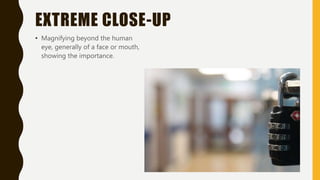
EXTREME CLOSE-UP
• Magnifying beyond the human
eye, generally of a face or mouth,
showing the importance.
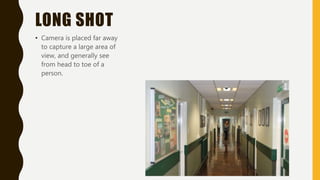
LONG SHOT
• Camera is placed far away
to capture a large area of
view, and generally see
from head to toe of a
person.
POINT OF VIEW
• See what the actor sees through their
eyes. Can cause sympathy or
discomfort.
MEDIUM SHOT
• Most common shot in movies, middle
upwards, should be matched with a
flow of long shot.
OVER THE SHOULDER
• This is a shot where we see what
the actors see but not through
their own eyes.
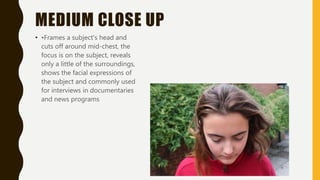
MEDIUM CLOSE UP
• •Frames a subject's head and
cuts off around mid-chest, the
focus is on the subject, reveals
only a little of the surroundings,
shows the facial expressions of
the subject and commonly used
for interviews in documentaries
and news programs
TWO SHOT
• A view of two people (the
subjects), the subjects do not
have to be next to each other,
and there are many common
two-shots which have one subject
in the foreground and the other
subject in the background. It is
very useful if the film is about two
people
CLOSE UP
• Very little background,
concentrates on face or mise
en scène. Shows emotion,
takes us into the mind of a
character and may be used to
feel uncomfortable about a
character.
TILTED
• A type of camera shot
where the camera is set so
that the horizon line of the
shot is not parallel with the
bottom of the camera
frame. This produces a
viewpoint akin to tilting
one's head to the side
HIGH ANGLE SHOT
• Looks down on the action
from a superior angle. The
observer dominates – power,
higher status
LOW ANGLE SHOT
• Looks up at the action from
below, an inferior position – the
observer is vulnerable, weak and
lower status.
ZOOM
• When the camera moves
closer to the action or away
in a very quick way. Zoom
lens means the camera does
not need to be moved. Can
suggest surveillance,
voyeurism or intense
observation.
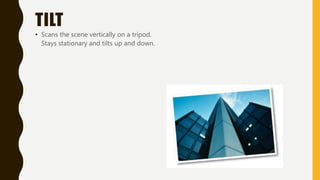
TILT
• Scans the scene vertically on a tripod.
Stays stationary and tilts up and down.
PAN
• Scans the scene horizontally.
Placed on a tripod and stays
still. Pans left to right.
TRACKING
• Similar to a pan the shot
moves left to right but not on
a tripod, the camera is moving
like a ‘crab’
HAND HELD SHOTS
• Handheld gives a ragged, jerky
effect, totally at odds with the
organised smoothness of the
dolly. Favoured for gritty
realism.
SHOT REVERSE SHOT
• When one character is shown
looking (often off screen) at
another character, and then the
other character is shown
‘looking back’ at the first
character.
WIDE SHOT
• Broad shot to emphasise
size/scale, parts of set or
externals
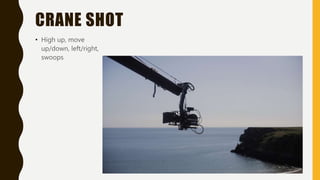
CRANE SHOT
• High up, move
up/down, left/right,
swoops
AERIAL SHOT
• Usually taken from a
helicopter, establish setting
and movement, very flexible
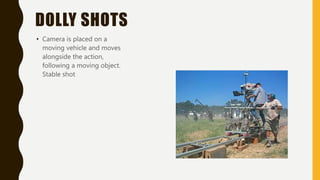
DOLLY SHOTS
• Camera is placed on a
moving vehicle and moves
alongside the action,
following a moving object.
Stable shot

Cinematography notes

  • 1.
  • 2.
    ESTABLISHING SHOT • Asmuch as a quarter of a mile away, scene establishing, tells us when and where we are.
  • 3.
    EXTREME CLOSE-UP • Magnifyingbeyond the human eye, generally of a face or mouth, showing the importance.
  • 4.
    LONG SHOT • Camerais placed far away to capture a large area of view, and generally see from head to toe of a person.
  • 5.
    POINT OF VIEW •See what the actor sees through their eyes. Can cause sympathy or discomfort.
  • 6.
    MEDIUM SHOT • Mostcommon shot in movies, middle upwards, should be matched with a flow of long shot.
  • 7.
    OVER THE SHOULDER •This is a shot where we see what the actors see but not through their own eyes.
  • 8.
    MEDIUM CLOSE UP ••Frames a subject's head and cuts off around mid-chest, the focus is on the subject, reveals only a little of the surroundings, shows the facial expressions of the subject and commonly used for interviews in documentaries and news programs
  • 9.
    TWO SHOT • Aview of two people (the subjects), the subjects do not have to be next to each other, and there are many common two-shots which have one subject in the foreground and the other subject in the background. It is very useful if the film is about two people
  • 10.
    CLOSE UP • Verylittle background, concentrates on face or mise en scène. Shows emotion, takes us into the mind of a character and may be used to feel uncomfortable about a character.
  • 11.
    TILTED • A typeof camera shot where the camera is set so that the horizon line of the shot is not parallel with the bottom of the camera frame. This produces a viewpoint akin to tilting one's head to the side
  • 12.
    HIGH ANGLE SHOT •Looks down on the action from a superior angle. The observer dominates – power, higher status
  • 13.
    LOW ANGLE SHOT •Looks up at the action from below, an inferior position – the observer is vulnerable, weak and lower status.
  • 14.
    ZOOM • When thecamera moves closer to the action or away in a very quick way. Zoom lens means the camera does not need to be moved. Can suggest surveillance, voyeurism or intense observation.
  • 15.
    TILT • Scans thescene vertically on a tripod. Stays stationary and tilts up and down.
  • 16.
    PAN • Scans thescene horizontally. Placed on a tripod and stays still. Pans left to right.
  • 17.
    TRACKING • Similar toa pan the shot moves left to right but not on a tripod, the camera is moving like a ‘crab’
  • 18.
    HAND HELD SHOTS •Handheld gives a ragged, jerky effect, totally at odds with the organised smoothness of the dolly. Favoured for gritty realism.
  • 19.
    SHOT REVERSE SHOT •When one character is shown looking (often off screen) at another character, and then the other character is shown ‘looking back’ at the first character.
  • 20.
    WIDE SHOT • Broadshot to emphasise size/scale, parts of set or externals
  • 21.
    CRANE SHOT • Highup, move up/down, left/right, swoops
  • 22.
    AERIAL SHOT • Usuallytaken from a helicopter, establish setting and movement, very flexible
  • 23.
    DOLLY SHOTS • Camerais placed on a moving vehicle and moves alongside the action, following a moving object. Stable shot