Establishing shot
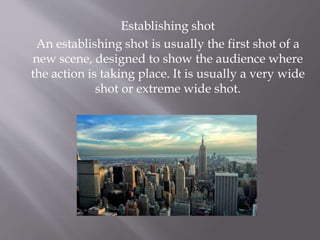
An establishing shot is usually the first shot of a
new scene, designed to show the audience where
the action is taking place. It is usually a very wide
shot or extreme wide shot.
Master shot
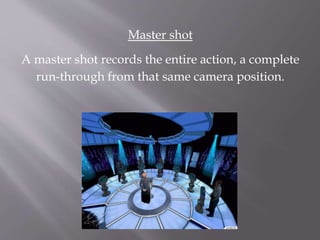
A master shot records the entire action, a complete
run-through from that same camera position.
Close-up
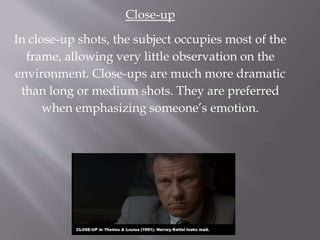
In close-up shots, the subject occupies most of the
frame, allowing very little observation on the
environment. Close-ups are much more dramatic
than long or medium shots. They are preferred
when emphasizing someone’s emotion.
Mid Shot
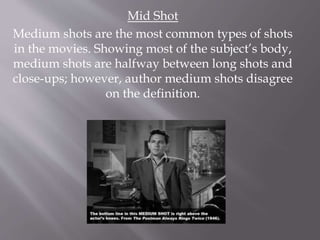
Medium shots are the most common types of shots
in the movies. Showing most of the subject’s body,
medium shots are halfway between long shots and
close-ups; however, author medium shots disagree
on the definition.
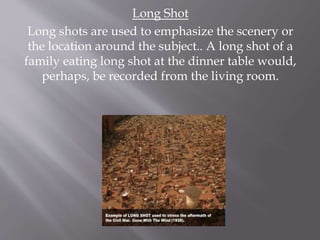
Long Shot
Long shots are used to emphasize the scenery or
the location around the subject.. A long shot of a
family eating long shot at the dinner table would,
perhaps, be recorded from the living room.
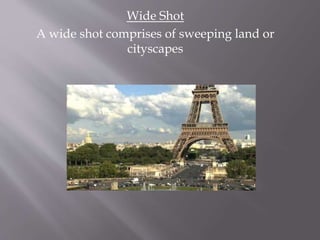
Wide Shot
A wide shot comprises of sweeping land or
cityscapes
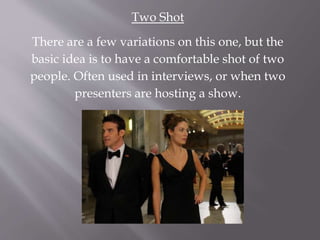
Two Shot
There are a few variations on this one, but the
basic idea is to have a comfortable shot of two
people. Often used in interviews, or when two
presenters are hosting a show.
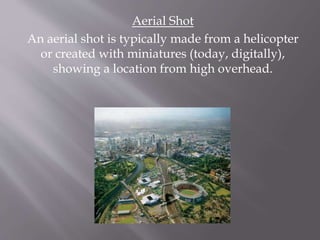
Aerial Shot
An aerial shot is typically made from a helicopter
or created with miniatures (today, digitally),
showing a location from high overhead.
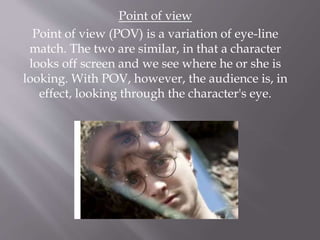
Point of view
Point of view (POV) is a variation of eye-line
match. The two are similar, in that a character
looks off screen and we see where he or she is
looking. With POV, however, the audience is, in
effect, looking through the character's eye.
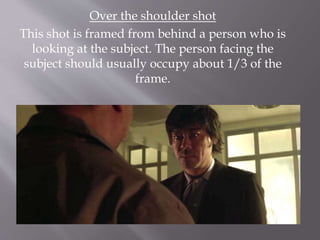
Over the shoulder shot
This shot is framed from behind a person who is
looking at the subject. The person facing the
subject should usually occupy about 1/3 of the
frame.
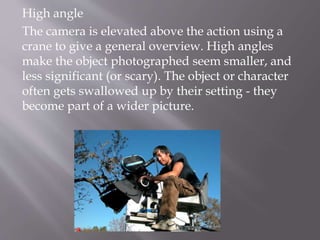
High angle
The camera is elevated above the action using a
crane to give a general overview. High angles
make the object photographed seem smaller, and
less significant (or scary). The object or character
often gets swallowed up by their setting - they
become part of a wider picture.
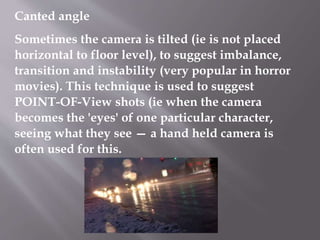
Canted angle
Sometimes the camera is tilted (ie is not placed
horizontal to floor level), to suggest imbalance,
transition and instability (very popular in horror
movies). This technique is used to suggest
POINT-OF-View shots (ie when the camera
becomes the 'eyes' of one particular character,
seeing what they see — a hand held camera is
often used for this.
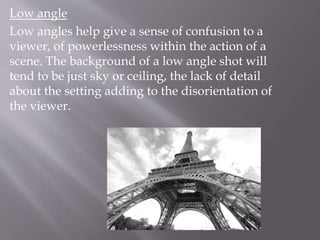
Low angle
Low angles help give a sense of confusion to a
viewer, of powerlessness within the action of a
scene. The background of a low angle shot will
tend to be just sky or ceiling, the lack of detail
about the setting adding to the disorientation of
the viewer.
Pan
A movement which scans a scene horizontally. The
camera is placed on a tripod, which operates as a
stationary axis point as the camera is turned, often
to follow a moving object which is kept in the
middle of the frame.
Tilt
A movement which scans a scene vertically,
otherwise similar to a pan.
Track
The term tracking shot is widely considered to be
synonymous with dolly shot; that is, a shot in which
the camera is mounted on a cart which travels along
tracks
Dolly
The camera is placed on a moving vehicle and moves alongside
the action, generally following a moving figure or object.
Crane
A crane (or jib), is a large, heavy piece of equipment, but is a
useful way of moving a camera - it can move up, down, left,
right, swooping in on action or moving diagonally out of it.
Steadicam
Has the freedom of a handheld shot but its stabilisation device
smooth's out the bumpiness of the handheld shot.
Handheld
The camera is literally held by the camera operator.
So often the shots are bumpy/jerky.
Zoom
A single shot which moves towards a particular
subject
Reverse zoom
A single shot which moves away from a particular
subject.
https://www.youtube.com/wat
ch?v=45e1XuA-oLY

Media terminology

  • 2.
    Establishing shot An establishingshot is usually the first shot of a new scene, designed to show the audience where the action is taking place. It is usually a very wide shot or extreme wide shot.
  • 3.
    Master shot A mastershot records the entire action, a complete run-through from that same camera position.
  • 4.
    Close-up In close-up shots,the subject occupies most of the frame, allowing very little observation on the environment. Close-ups are much more dramatic than long or medium shots. They are preferred when emphasizing someone’s emotion.
  • 5.
    Mid Shot Medium shotsare the most common types of shots in the movies. Showing most of the subject’s body, medium shots are halfway between long shots and close-ups; however, author medium shots disagree on the definition.
  • 6.
    Long Shot Long shotsare used to emphasize the scenery or the location around the subject.. A long shot of a family eating long shot at the dinner table would, perhaps, be recorded from the living room.
  • 7.
    Wide Shot A wideshot comprises of sweeping land or cityscapes
  • 8.
    Two Shot There area few variations on this one, but the basic idea is to have a comfortable shot of two people. Often used in interviews, or when two presenters are hosting a show.
  • 9.
    Aerial Shot An aerialshot is typically made from a helicopter or created with miniatures (today, digitally), showing a location from high overhead.
  • 10.
    Point of view Pointof view (POV) is a variation of eye-line match. The two are similar, in that a character looks off screen and we see where he or she is looking. With POV, however, the audience is, in effect, looking through the character's eye.
  • 11.
    Over the shouldershot This shot is framed from behind a person who is looking at the subject. The person facing the subject should usually occupy about 1/3 of the frame.
  • 12.
    High angle The camerais elevated above the action using a crane to give a general overview. High angles make the object photographed seem smaller, and less significant (or scary). The object or character often gets swallowed up by their setting - they become part of a wider picture.
  • 13.
    Canted angle Sometimes thecamera is tilted (ie is not placed horizontal to floor level), to suggest imbalance, transition and instability (very popular in horror movies). This technique is used to suggest POINT-OF-View shots (ie when the camera becomes the 'eyes' of one particular character, seeing what they see — a hand held camera is often used for this.
  • 14.
    Low angle Low angleshelp give a sense of confusion to a viewer, of powerlessness within the action of a scene. The background of a low angle shot will tend to be just sky or ceiling, the lack of detail about the setting adding to the disorientation of the viewer.
  • 15.
    Pan A movement whichscans a scene horizontally. The camera is placed on a tripod, which operates as a stationary axis point as the camera is turned, often to follow a moving object which is kept in the middle of the frame. Tilt A movement which scans a scene vertically, otherwise similar to a pan. Track The term tracking shot is widely considered to be synonymous with dolly shot; that is, a shot in which the camera is mounted on a cart which travels along tracks
  • 16.
    Dolly The camera isplaced on a moving vehicle and moves alongside the action, generally following a moving figure or object. Crane A crane (or jib), is a large, heavy piece of equipment, but is a useful way of moving a camera - it can move up, down, left, right, swooping in on action or moving diagonally out of it. Steadicam Has the freedom of a handheld shot but its stabilisation device smooth's out the bumpiness of the handheld shot.
  • 17.
    Handheld The camera isliterally held by the camera operator. So often the shots are bumpy/jerky. Zoom A single shot which moves towards a particular subject Reverse zoom A single shot which moves away from a particular subject.
  • 18.