Critical Thinking
A 21ST CENTURY SKILL

ANDREA PERROW
BRITTANY SELLERS

BRITTANY TAFT

BRAINS ARE BIOLOGICAL. MINDS ARE CREATED.
Today, almost anyone can open up a web
browser and tap into a seemingly infinite stream
of information—the only limiting factor being
one’s own curiosity and imagination
What Is Critical Thinking?
Use Systems Thinking
Analyze how parts of a
whole interact with each
other to produce overall
outcomes in complex
systems



Reason Effectively


Use various types of reasoning
(inductive, deductive, etc.) as
appropriate to the situation
What Is Critical Thinking?
Make Judgments and
Decisions
Effectively analyze and evaluate
evidence, arguments, claims
and beliefs
 Analyze and evaluate major
alternative points of view
 Synthesize and make
connections between
information and arguments
 Interpret information and draw
conclusions based on the best
analysis
 Reflect critically on learning
experiences and processes



Solve Problems


Solve different kinds of non-familiar
problems in both conventional
and innovative ways
Identify and ask significant
questions that clarify various points
of view and lead to better
solutions

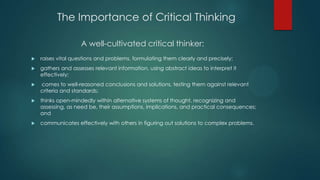
The Importance of Critical Thinking
A well-cultivated critical thinker:


raises vital questions and problems, formulating them clearly and precisely;



gathers and assesses relevant information, using abstract ideas to interpret it
effectively;



comes to well-reasoned conclusions and solutions, testing them against relevant
criteria and standards;



thinks open-mindedly within alternative systems of thought, recognizing and
assessing, as need be, their assumptions, implications, and practical consequences;
and



communicates effectively with others in figuring out solutions to complex problems.
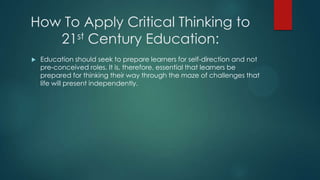
How To Apply Critical Thinking to
21st Century Education:


Education should seek to prepare learners for self-direction and not
pre-conceived roles. It is, therefore, essential that learners be
prepared for thinking their way through the maze of challenges that
life will present independently.
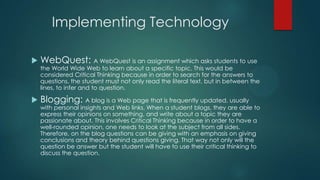
Implementing Technology


WebQuest: A WebQuest is an assignment which asks students to use



Blogging: A blog is a Web page that is frequently updated, usually

the World Wide Web to learn about a specific topic. This would be
considered Critical Thinking because in order to search for the answers to
questions, the student must not only read the literal text, but in between the
lines, to infer and to question.
with personal insights and Web links. When a student blogs, they are able to
express their opinions on something, and write about a topic they are
passionate about. This involves Critical Thinking because in order to have a
well-rounded opinion, one needs to look at the subject from all sides.
Therefore, on the blog questions can be giving with an emphasis on giving
conclusions and theory behind questions giving. That way not only will the
question be answer but the student will have to use their critical thinking to
discuss the question.
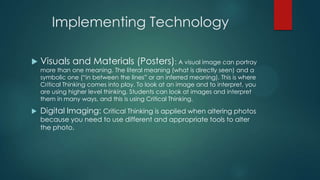
Implementing Technology


Visuals and Materials (Posters): A visual image can portray
more than one meaning. The literal meaning (what is directly seen) and a
symbolic one (―in between the lines‖ or an inferred meaning). This is where
Critical Thinking comes into play. To look at an image and to interpret, you
are using higher level thinking. Students can look at images and interpret
them in many ways, and this is using Critical Thinking.



Digital Imaging: Critical Thinking is applied when altering photos
because you need to use different and appropriate tools to alter
the photo.
Implementing Technology


Secondlife: Secondlife is a three-dimensional virtual community

created entirely by its membership. Members assume an identity
and take up residence in Second Life, creating a customized avatar
or personage to represent themselves. You can apply Critical
Thinking here by using higher level thinking to create a world and
the many parts. You can also interact, and apply it to education.
Example



Lumosity.com is a way to enhance brain activity by just playing games. You choose the skills you wish to enhance, and the games
are tailored to those skills.



Games include:

Speed Match- which focuses on information processing. Abilities trained includes faster reaction time, thinking faster, speeding up
cognitive processing.
Eagle Eye- focuses on attention ( things will flash for a minute and then you have to relocate in on the screen)
Monster Garden – focuses on memory (just like memory card game , you have to match items together.)
Brain Shift- focuses on flexibly ( you have the answer questions, but it keeps shifting from top to bottom, so you have to keep attention)

Raindrops- focuses on problem solving. ( just like candy crush, but in this game their math problem on the drops and the answers
match another drop)



It tracks your performance, this can be used as a tactic to get the students to finish assignments, classroom management, or just an
everyday activity.



In order to win the games, you need to utilize the traits of Critical Thinking

1. Making Judgments and Decisions

2. Use Systems Thinking
3. Reasoning Effectively
4. Solving Problems
Conclusion



Without thinking critically, you're only looking at the surface of things



Critical thinking is the process of examining, analyzing, questioning,
and challenging situations, issues, and information of all kinds



Critical thinking is an important tool in solving community problems
and in developing interventions or initiatives in health, human
services, and community development
Works Cited


http://www.p21.org/component/content/article/260-critical-thinking-and-problem-solving



http://eduscapes.com/tap/topic69.htm



http://www.accessexcellence.org/LC/TL/buchanan/



http://www.wannalearn.com/Academic_Subjects/Critical_Thinking/



http://www.lib.berkeley.edu/TeachingLib/Guides/Internet/Strategies.html



http://www.solution-tree.com/products.html



http://www.doane.edu/facstaff/resources/cetl-home/31812



http://www.lumosity.com

Ci350 critical thinking pp

  • 1.
    Critical Thinking A 21STCENTURY SKILL ANDREA PERROW BRITTANY SELLERS BRITTANY TAFT BRAINS ARE BIOLOGICAL. MINDS ARE CREATED.
  • 2.
    Today, almost anyonecan open up a web browser and tap into a seemingly infinite stream of information—the only limiting factor being one’s own curiosity and imagination
  • 3.
    What Is CriticalThinking? Use Systems Thinking Analyze how parts of a whole interact with each other to produce overall outcomes in complex systems  Reason Effectively  Use various types of reasoning (inductive, deductive, etc.) as appropriate to the situation
  • 4.
    What Is CriticalThinking? Make Judgments and Decisions Effectively analyze and evaluate evidence, arguments, claims and beliefs  Analyze and evaluate major alternative points of view  Synthesize and make connections between information and arguments  Interpret information and draw conclusions based on the best analysis  Reflect critically on learning experiences and processes  Solve Problems  Solve different kinds of non-familiar problems in both conventional and innovative ways Identify and ask significant questions that clarify various points of view and lead to better solutions 
  • 5.
    The Importance ofCritical Thinking A well-cultivated critical thinker:  raises vital questions and problems, formulating them clearly and precisely;  gathers and assesses relevant information, using abstract ideas to interpret it effectively;  comes to well-reasoned conclusions and solutions, testing them against relevant criteria and standards;  thinks open-mindedly within alternative systems of thought, recognizing and assessing, as need be, their assumptions, implications, and practical consequences; and  communicates effectively with others in figuring out solutions to complex problems.
  • 6.
    How To ApplyCritical Thinking to 21st Century Education:  Education should seek to prepare learners for self-direction and not pre-conceived roles. It is, therefore, essential that learners be prepared for thinking their way through the maze of challenges that life will present independently.
  • 7.
    Implementing Technology  WebQuest: AWebQuest is an assignment which asks students to use  Blogging: A blog is a Web page that is frequently updated, usually the World Wide Web to learn about a specific topic. This would be considered Critical Thinking because in order to search for the answers to questions, the student must not only read the literal text, but in between the lines, to infer and to question. with personal insights and Web links. When a student blogs, they are able to express their opinions on something, and write about a topic they are passionate about. This involves Critical Thinking because in order to have a well-rounded opinion, one needs to look at the subject from all sides. Therefore, on the blog questions can be giving with an emphasis on giving conclusions and theory behind questions giving. That way not only will the question be answer but the student will have to use their critical thinking to discuss the question.
  • 8.
    Implementing Technology  Visuals andMaterials (Posters): A visual image can portray more than one meaning. The literal meaning (what is directly seen) and a symbolic one (―in between the lines‖ or an inferred meaning). This is where Critical Thinking comes into play. To look at an image and to interpret, you are using higher level thinking. Students can look at images and interpret them in many ways, and this is using Critical Thinking.  Digital Imaging: Critical Thinking is applied when altering photos because you need to use different and appropriate tools to alter the photo.
  • 9.
    Implementing Technology  Secondlife: Secondlifeis a three-dimensional virtual community created entirely by its membership. Members assume an identity and take up residence in Second Life, creating a customized avatar or personage to represent themselves. You can apply Critical Thinking here by using higher level thinking to create a world and the many parts. You can also interact, and apply it to education.
  • 10.
    Example  Lumosity.com is away to enhance brain activity by just playing games. You choose the skills you wish to enhance, and the games are tailored to those skills.  Games include: Speed Match- which focuses on information processing. Abilities trained includes faster reaction time, thinking faster, speeding up cognitive processing. Eagle Eye- focuses on attention ( things will flash for a minute and then you have to relocate in on the screen) Monster Garden – focuses on memory (just like memory card game , you have to match items together.) Brain Shift- focuses on flexibly ( you have the answer questions, but it keeps shifting from top to bottom, so you have to keep attention) Raindrops- focuses on problem solving. ( just like candy crush, but in this game their math problem on the drops and the answers match another drop)  It tracks your performance, this can be used as a tactic to get the students to finish assignments, classroom management, or just an everyday activity.  In order to win the games, you need to utilize the traits of Critical Thinking 1. Making Judgments and Decisions 2. Use Systems Thinking 3. Reasoning Effectively 4. Solving Problems
  • 11.
    Conclusion  Without thinking critically,you're only looking at the surface of things  Critical thinking is the process of examining, analyzing, questioning, and challenging situations, issues, and information of all kinds  Critical thinking is an important tool in solving community problems and in developing interventions or initiatives in health, human services, and community development
  • 12.