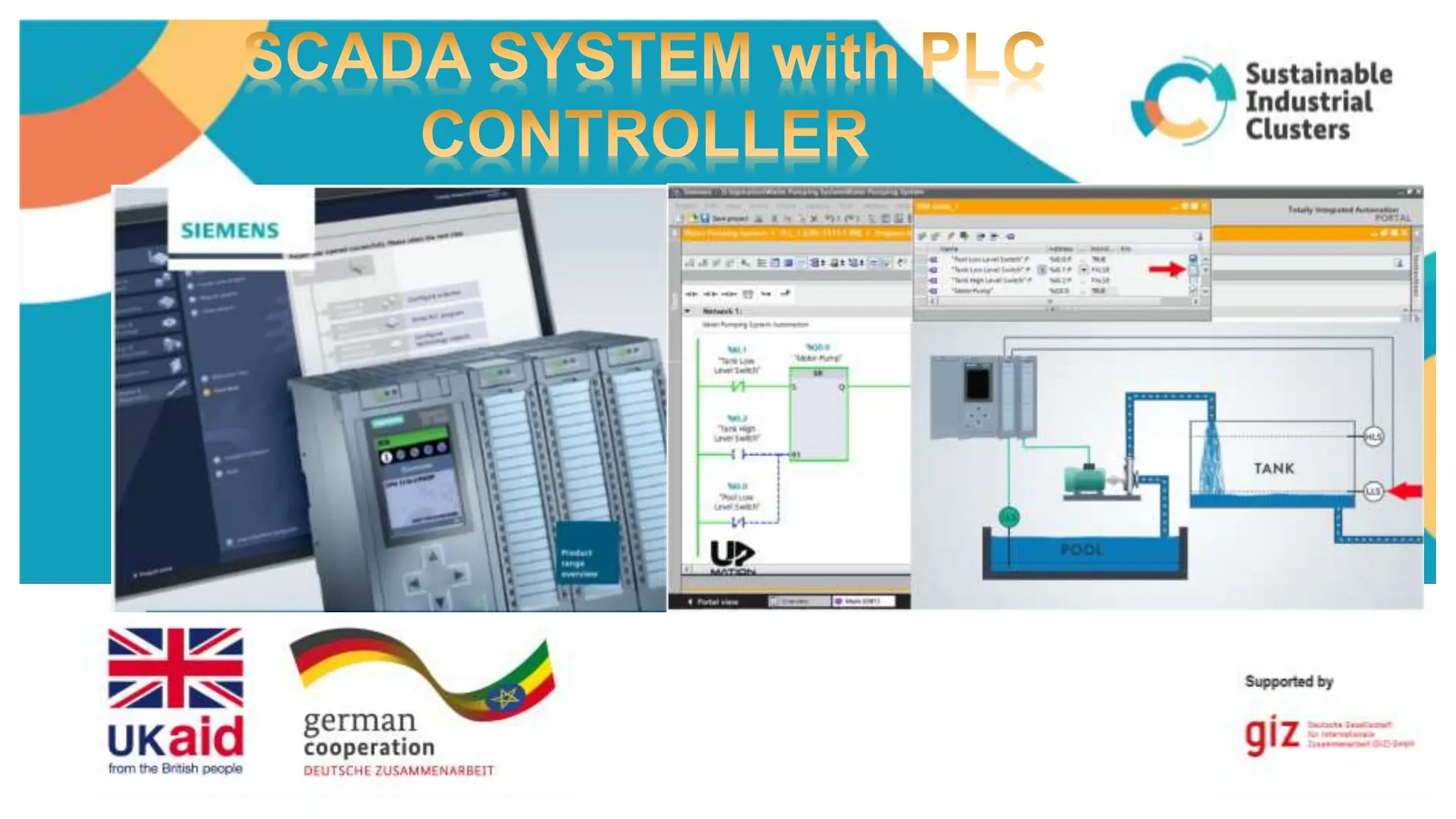
SCADA SYSTEM TRAINING COVERAGE
Titel der Präsentation
25. .05.2024
Seite 2
Process Control System
PROCESS
Process refers to the methods of changing or refining raw materials to create end
products. The raw materials during process are transferred, measured, mixed
heated or cooled, filtered, stored, or handled in some other way to produce the
end product
PROCESS CONTROL
is the method which is used to control process variables when manufacturing
products.
process Industries control the production process for three reasons:
 Reduce variability:-Process control can reduce variability in the end
product, which ensures a consistently high-quality product
 Increase efficiency:-Some processes need to be maintained at a
specific point to maximize efficiency
 Ensure safety:-A run-away process may result if manufacturers do
not maintain precise control of all of the process variables. The
consequences of a run-away process can be disastrous
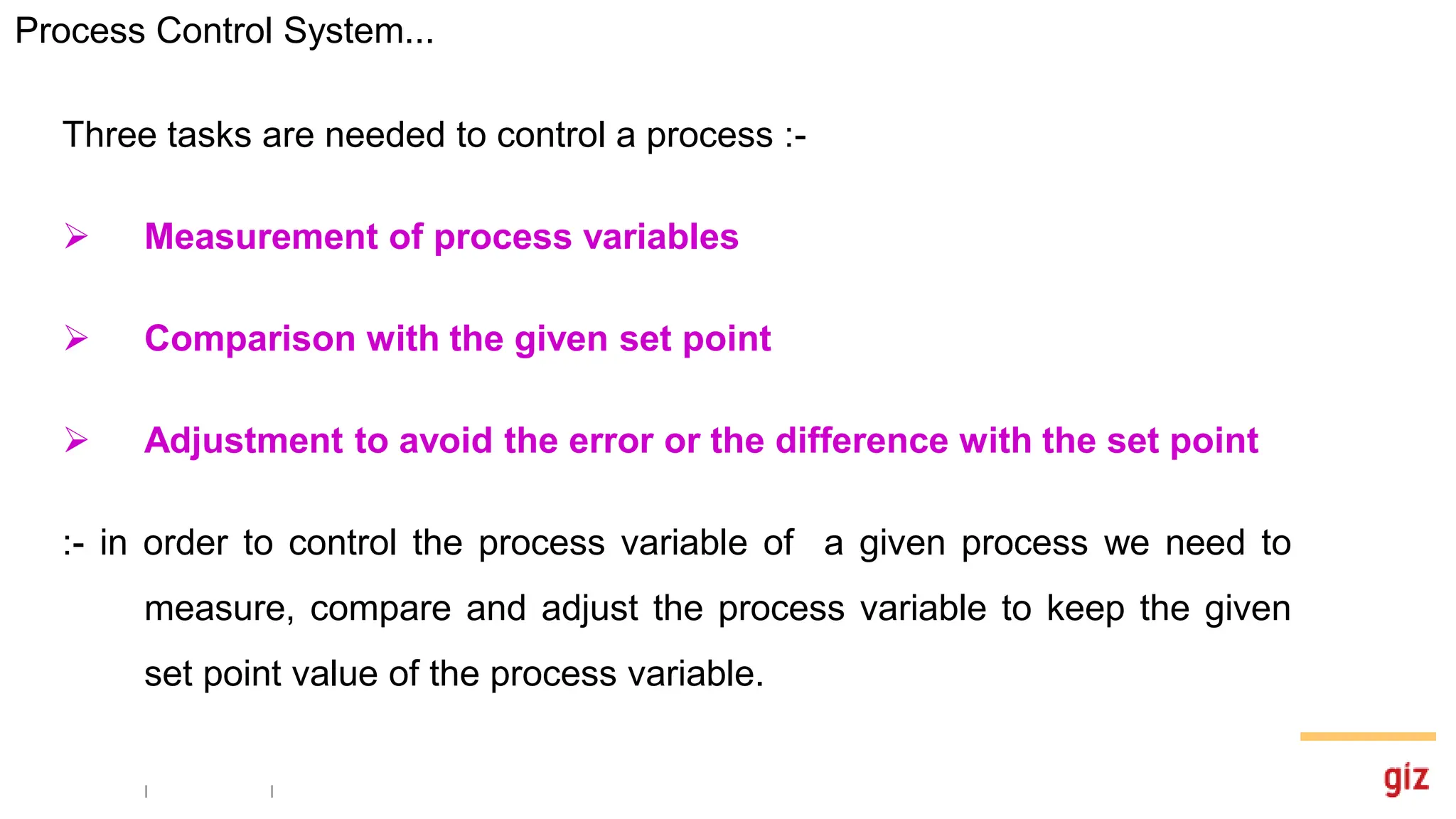
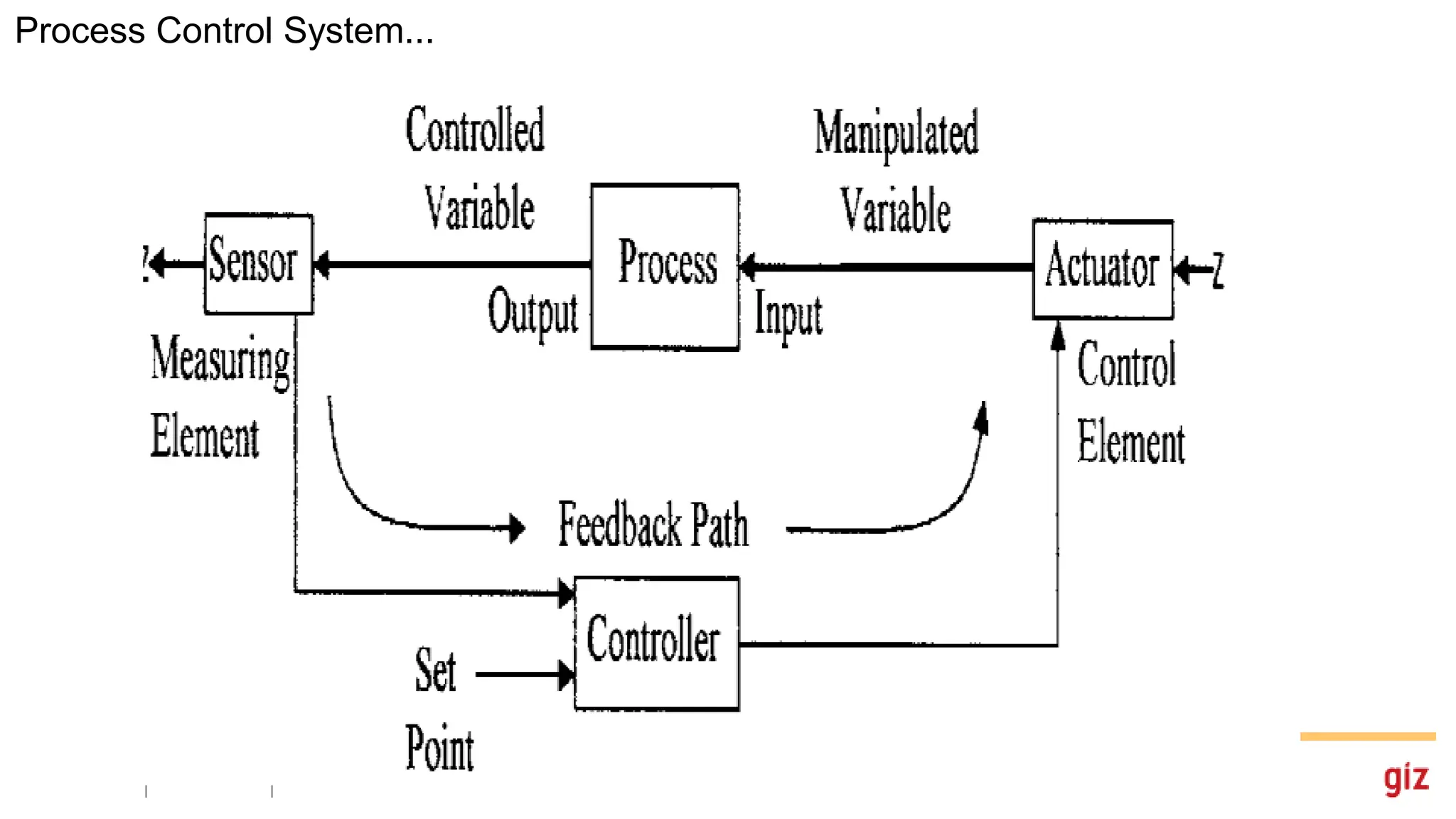
Three tasks are needed to control a process :-
 Measurement of process variables
 Comparison with the given set point
 Adjustment to avoid the error or the difference with the set point
:- in order to control the process variable of a given process we need to
measure, compare and adjust the process variable to keep the given
set point value of the process variable.
Process Control System...
Titel der Präsentation
22.01.2019
Seite 7
So we can conclude from the above that we need three type of instruments to
control a process:-
I. MEASURING ELEMENTS(SENSORS)
II. CONTROLLERS
III. CONTROL ELEMENTS (ACTUATORS)
Process Control System...
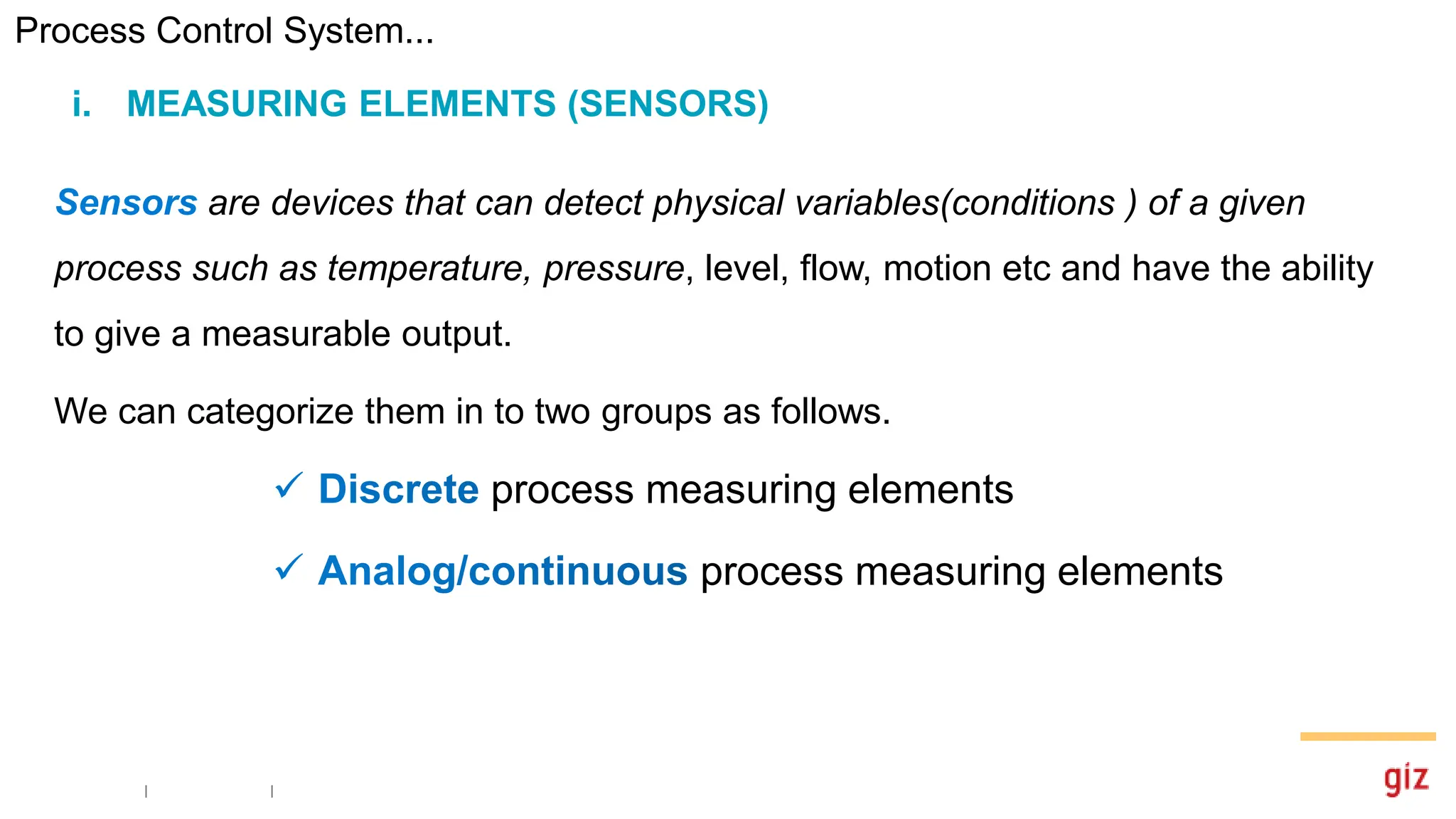
are devices that can detect physical variables(conditions ) of a given
process such as temperature, pressure, level, flow, motion etc and have the ability
to give a measurable output.
We can categorize them in to two groups as follows.
process measuring elements
i. MEASURING ELEMENTS (SENSORS)
Process Control System...
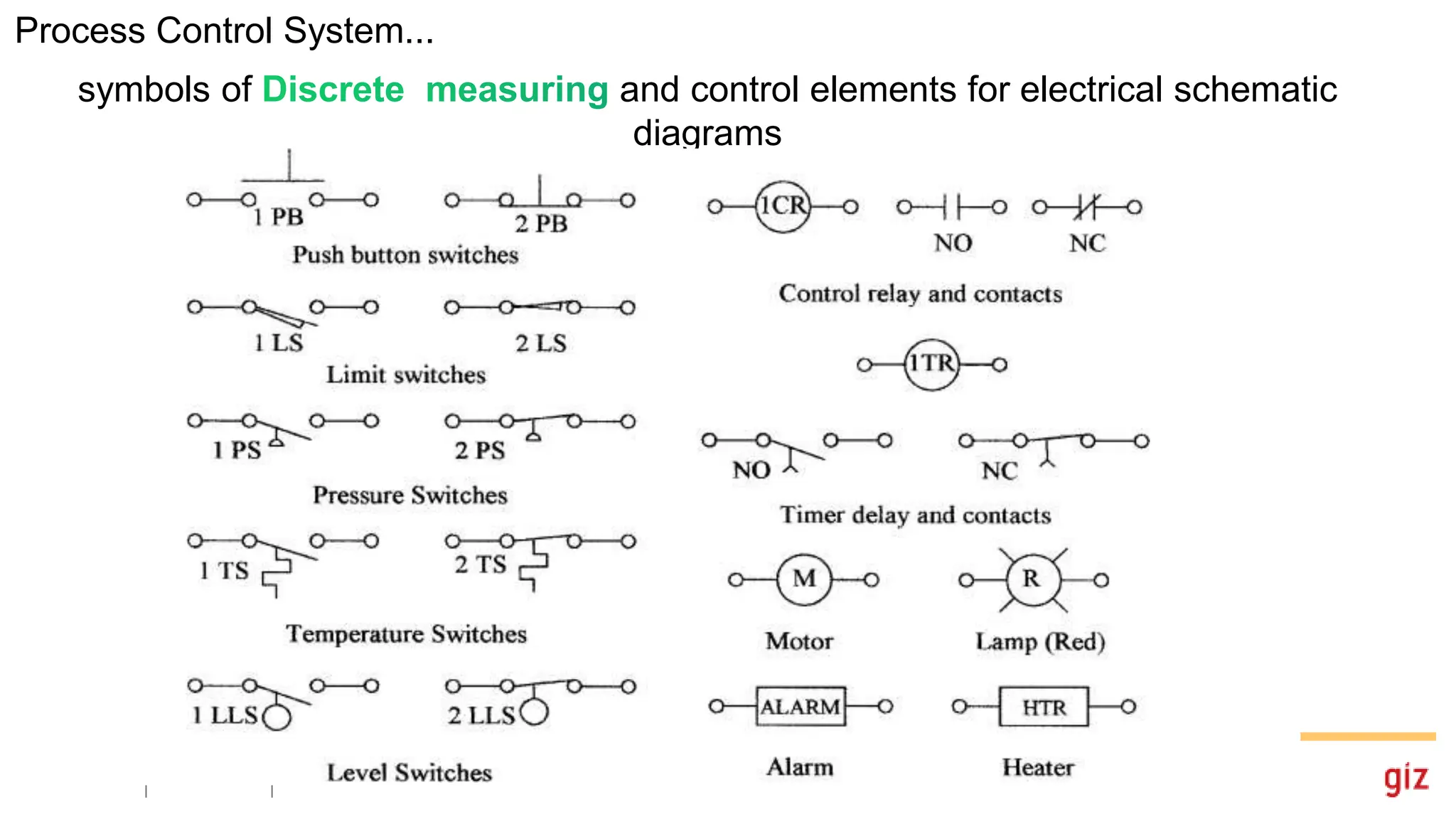
symbols of and control elements for electrical schematic
diagrams
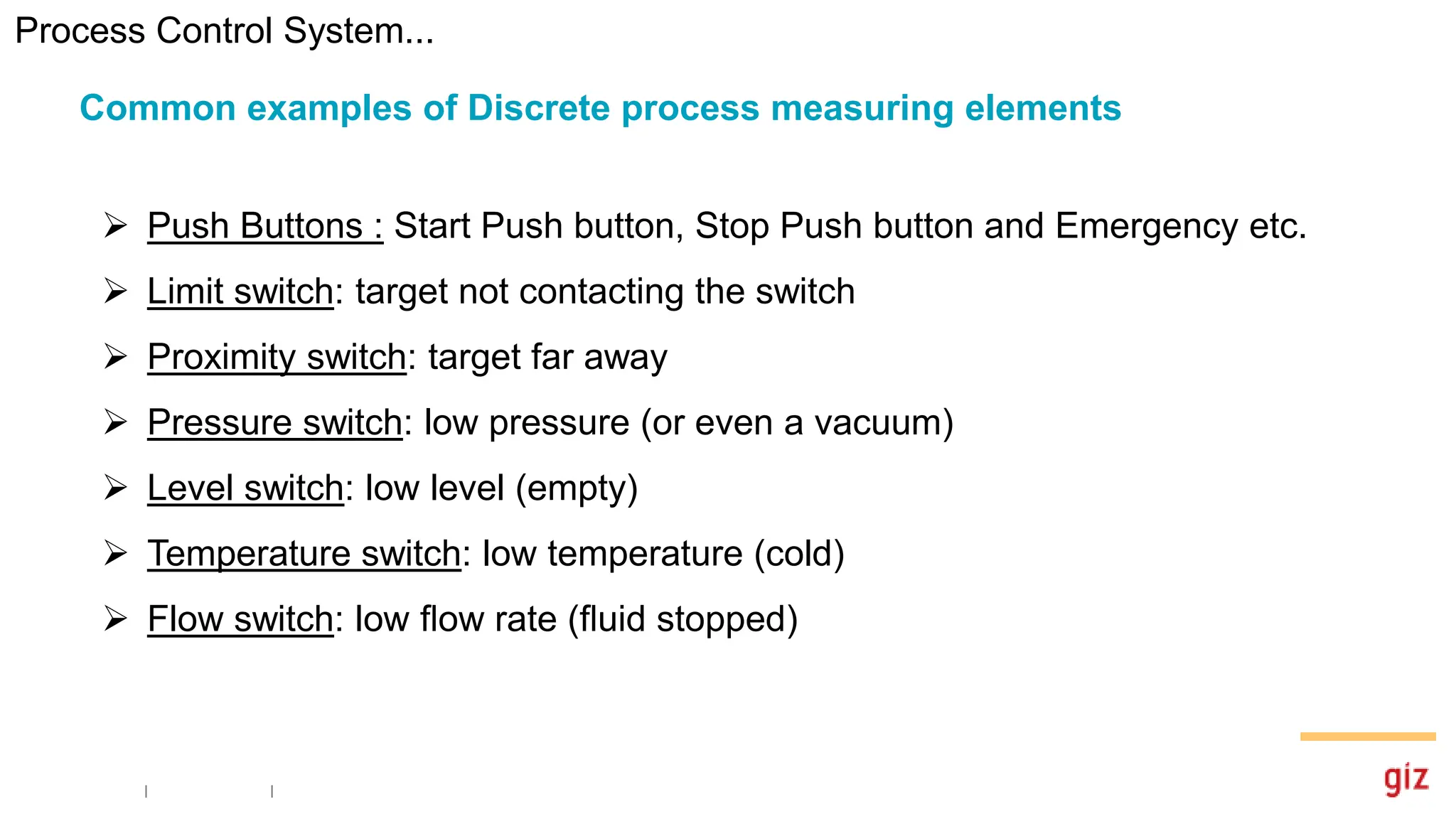
Common examples of Discrete process measuring elements
Process Control System...
 Push Buttons : Start Push button, Stop Push button and Emergency etc.
 Limit switch: target not contacting the switch
 Proximity switch: target far away
 Pressure switch: low pressure (or even a vacuum)
 Level switch: low level (empty)
 Temperature switch: low temperature (cold)
 Flow switch: low flow rate (fluid stopped)
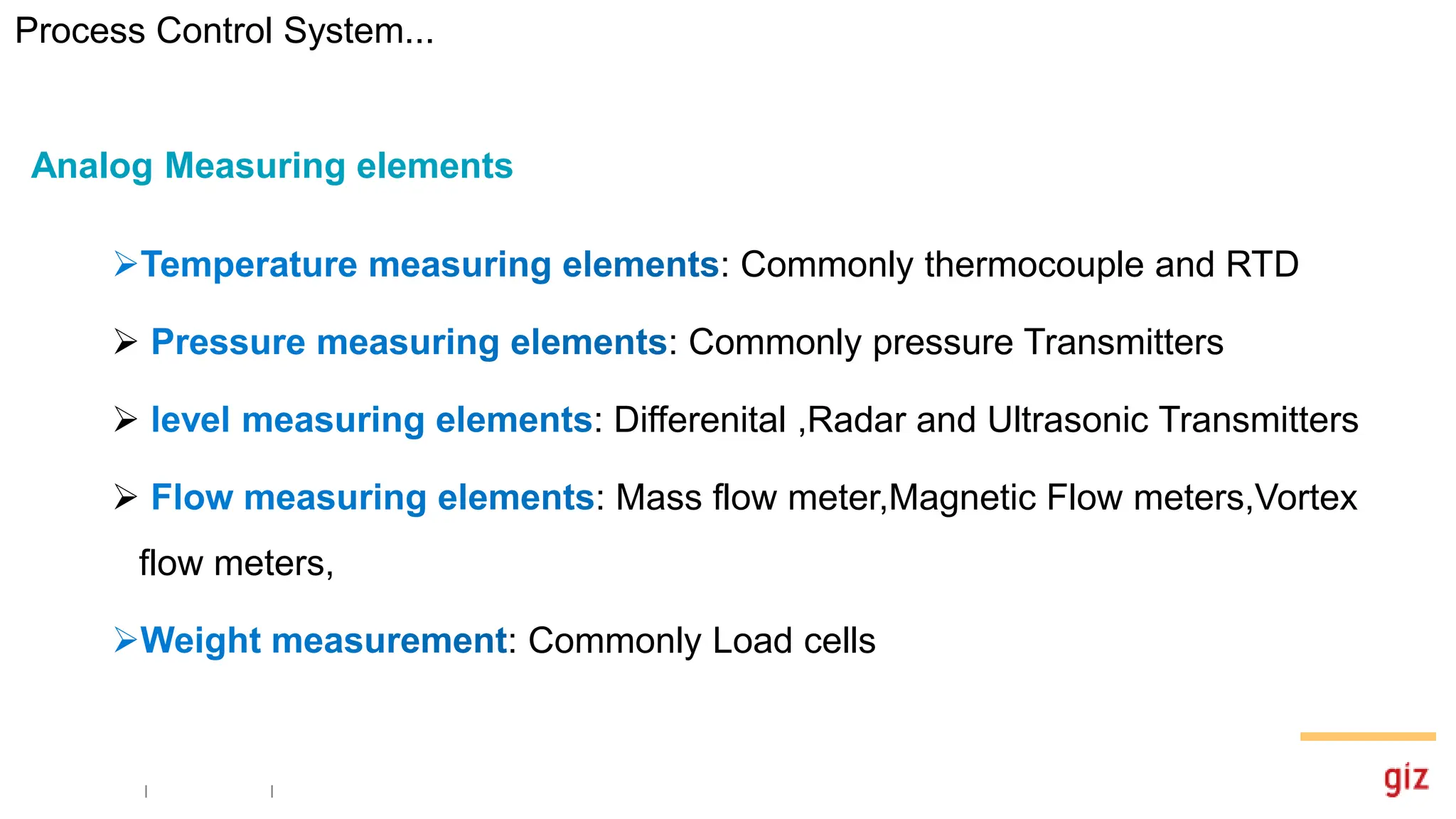
: Commonly thermocouple and RTD
 : Commonly pressure Transmitters
 : Differenital ,Radar and Ultrasonic Transmitters
 : Mass flow meter,Magnetic Flow meters,Vortex
flow meters,
: Commonly Load cells
Analog Measuring elements
Process Control System...
ii. FINAL CONTROL ELEMENTS (ACTUATORS)
Final control element is a device that receives out put signal from controller
and takes an action at the process according to the given instruction from
controller to avoid the error b/n PV and SV of the given process.
common control devices are:-
 solenoid valves
 control valves
 Contactors,Drives or variable speed drives (pumps, etc.)
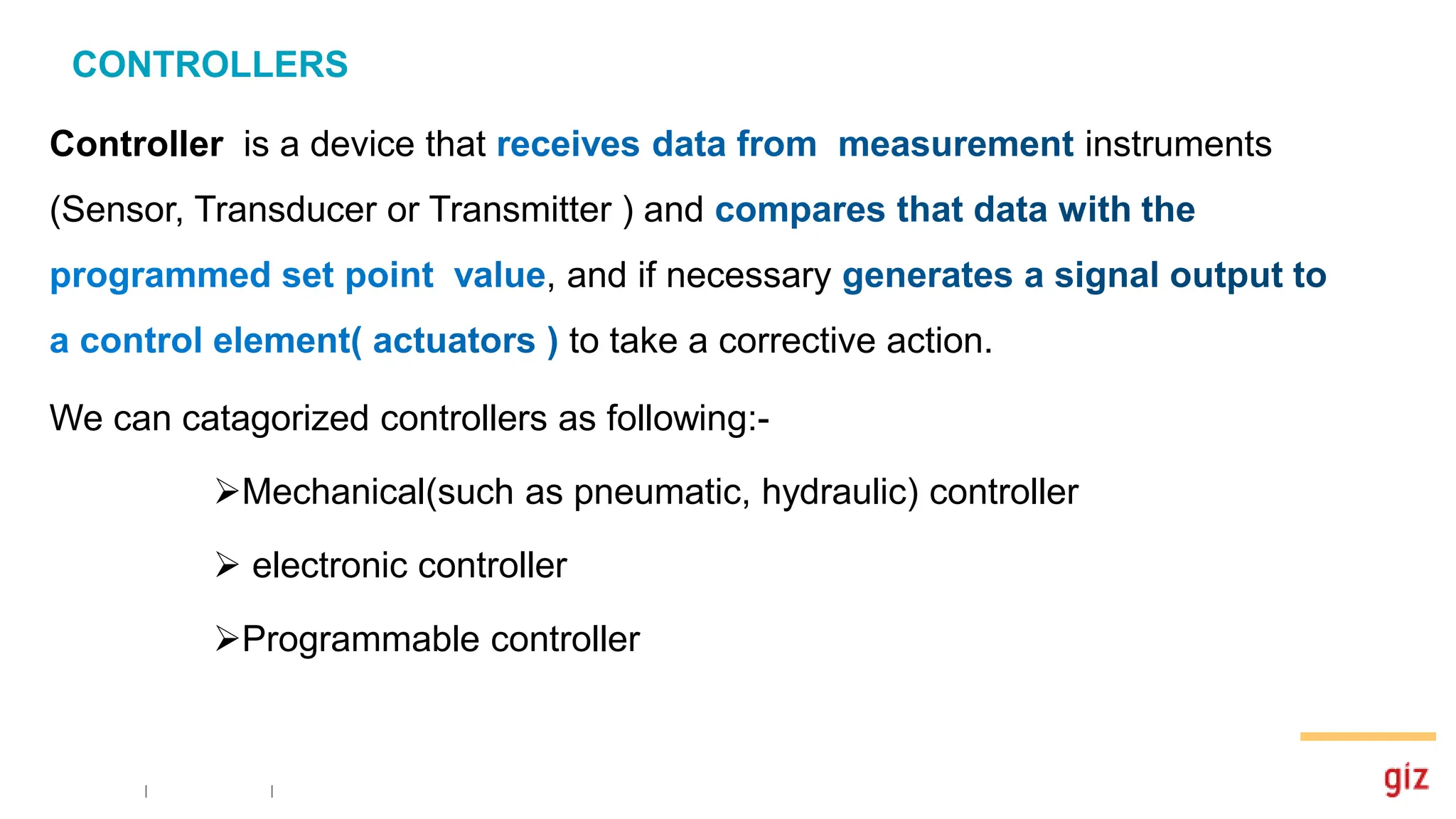
CONTROLLERS
Controller is a device that instruments
(Sensor, Transducer or Transmitter ) and
, and if necessary
to take a corrective action.
We can catagorized controllers as following:-
Mechanical(such as pneumatic, hydraulic) controller
 electronic controller
Programmable controller
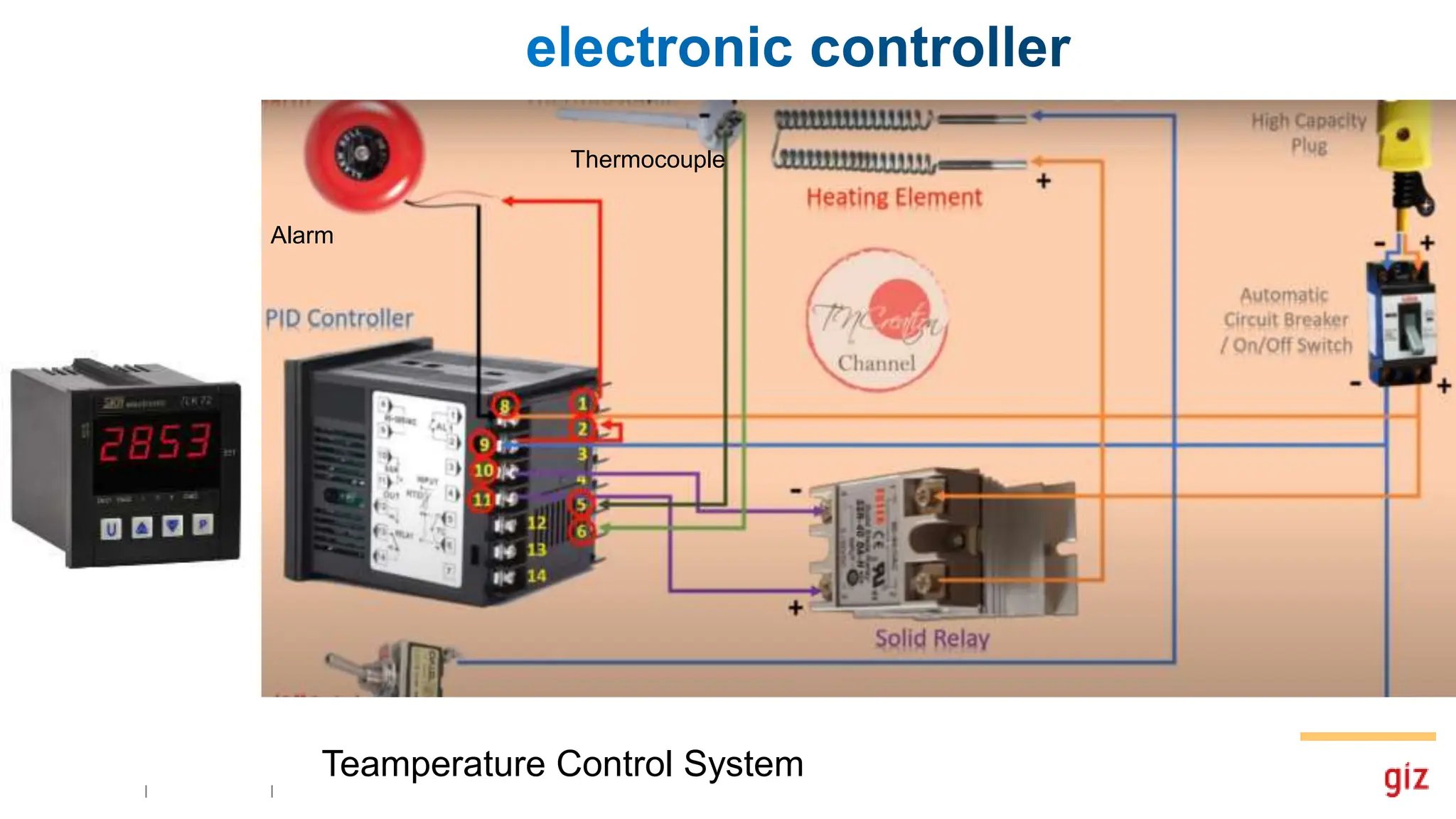
Thermocouple
Alarm
Teamperature Control System
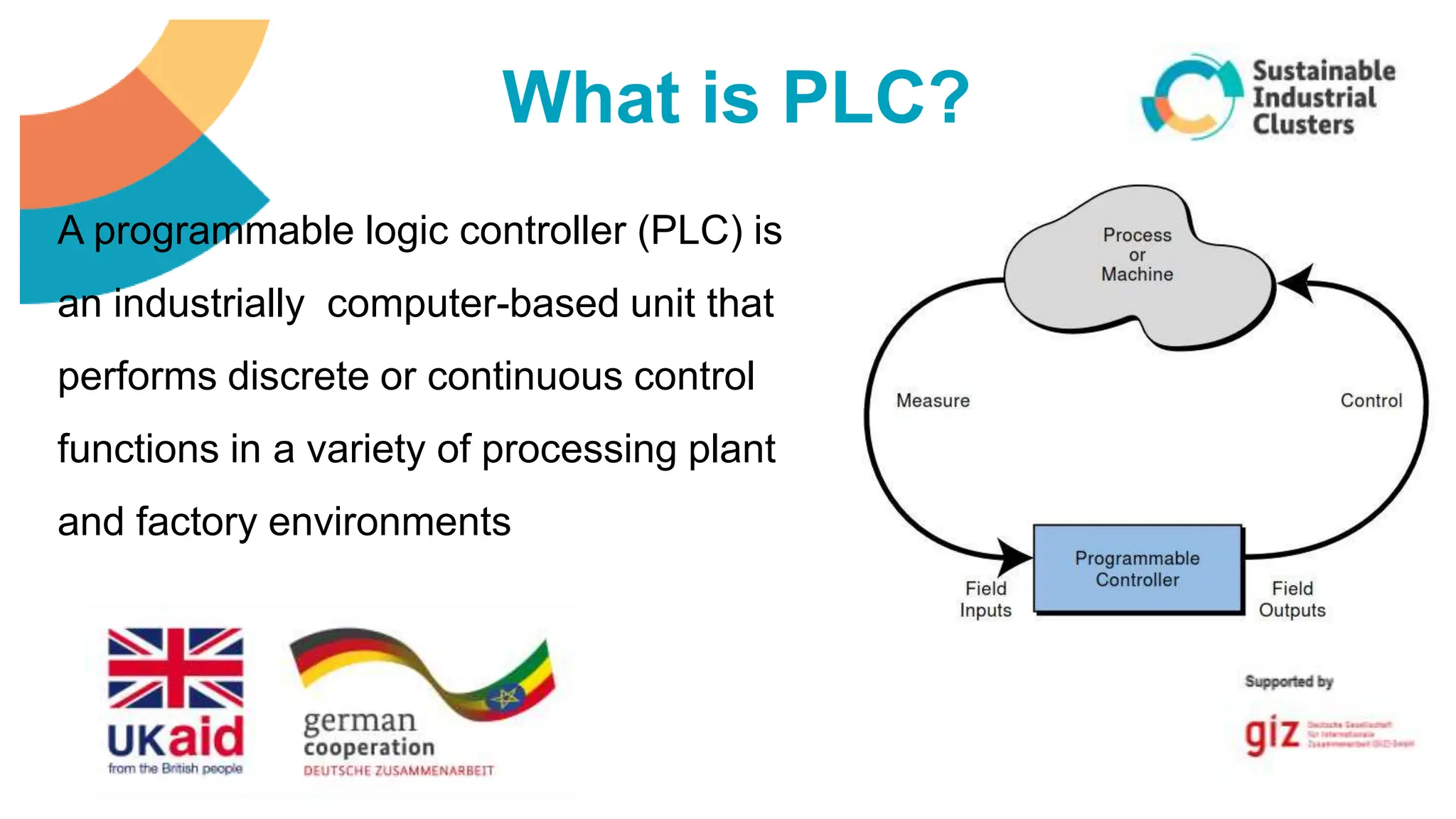
What is PLC?
A programmable logic controller (PLC) is
an industrially computer-based unit that
performs discrete or continuous control
functions in a variety of processing plant
and factory environments
The 6 basic hardware components that make up a PLC are:
 Processor (CPU)
 Mounting System
 Power Supply
 Input & Output Interface
 Communication Interface
 Programming Device
These main PLC hardware components are found in all PLC systems regardless of
.
They are the essential hardware elements that make up every PLC system.
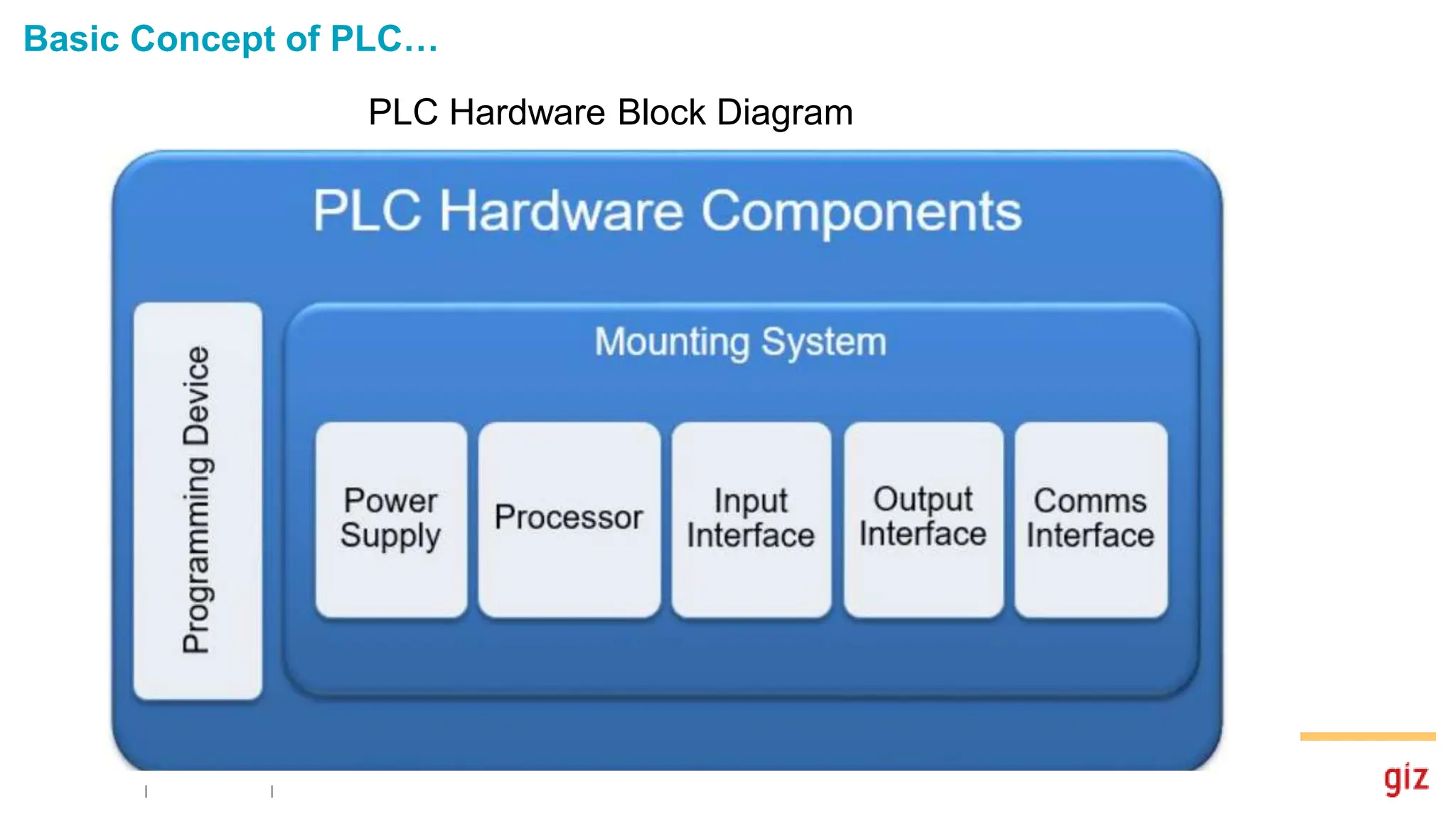
Basic Concept of PLC…
PLC Hardware Block Diagram
Basic Concept of PLC…
PLC Processor (CPU)
 The most crucial PLC hardware component
 Sometimes the PLC processor is also referred as the PLC controller or PLC
CPU (Central Processing Unit
 The PLC processor contains 3 fundamental components:
 PLC CPU (Central Processing Unit)
 PLC Memory
 PLC Programming port
PLC CPU (Central Processing Unit)
Basic Concept of PLC…
the CPU is responsible for
(such as ladder logic)
executes a program that is stored as a sequence of machine
language instructions in main memory
-by executing instructions that have been read from memory, in
which,tell the CPU what operations need to be performed on particular data items
stored in memory or registers.
-When an instruction is fetched from memory it is sent through the
control unit where it is decoded
Basic Concept of PLC…
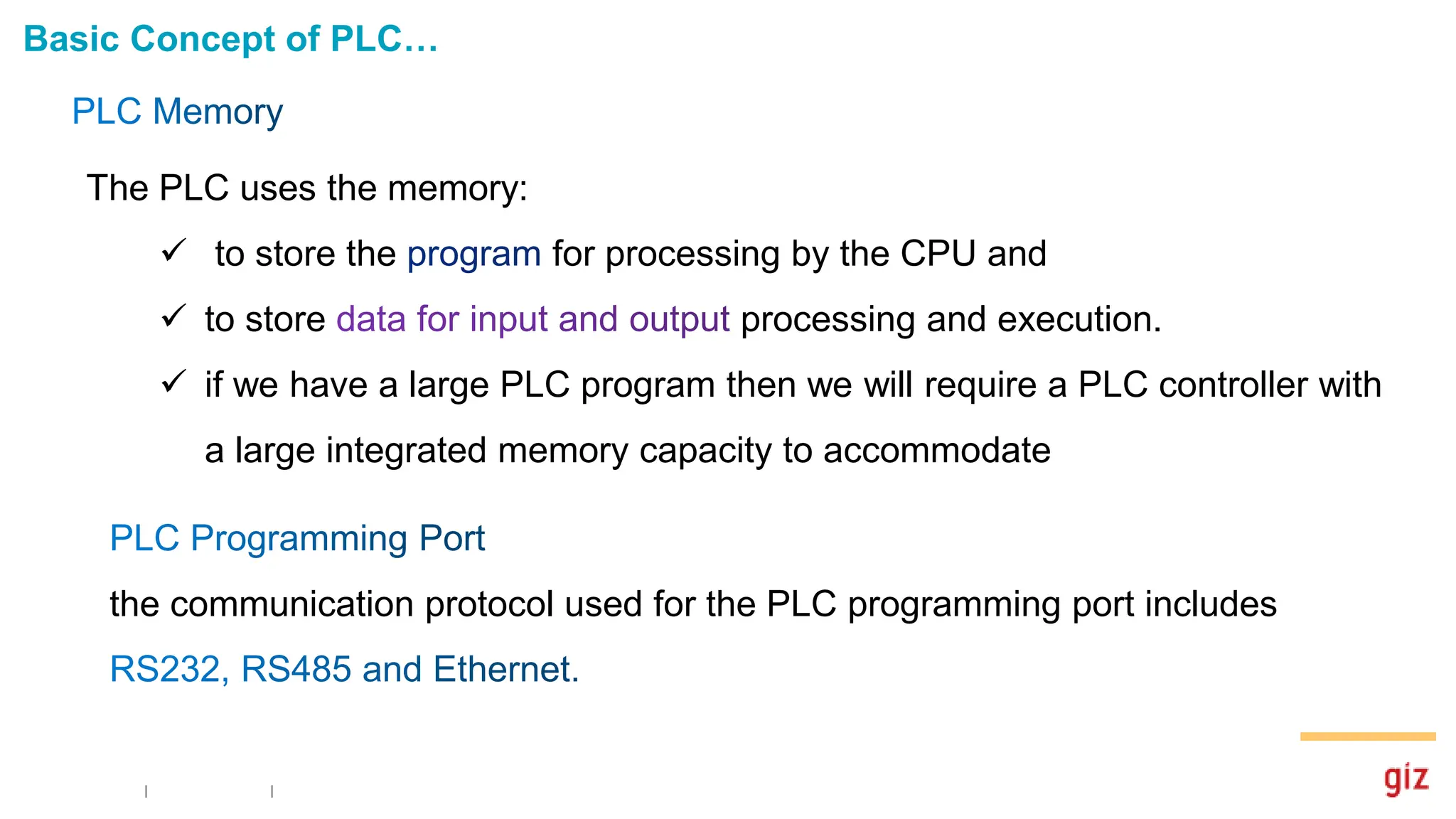
The PLC uses the memory:
 to store the for processing by the CPU and
 to store processing and execution.
 if we have a large PLC program then we will require a PLC controller with
a large integrated memory capacity to accommodate
the communication protocol used for the PLC programming port includes
Basic Concept of PLC…
Titel der Präsentation
25. .05.2024
Seite 22
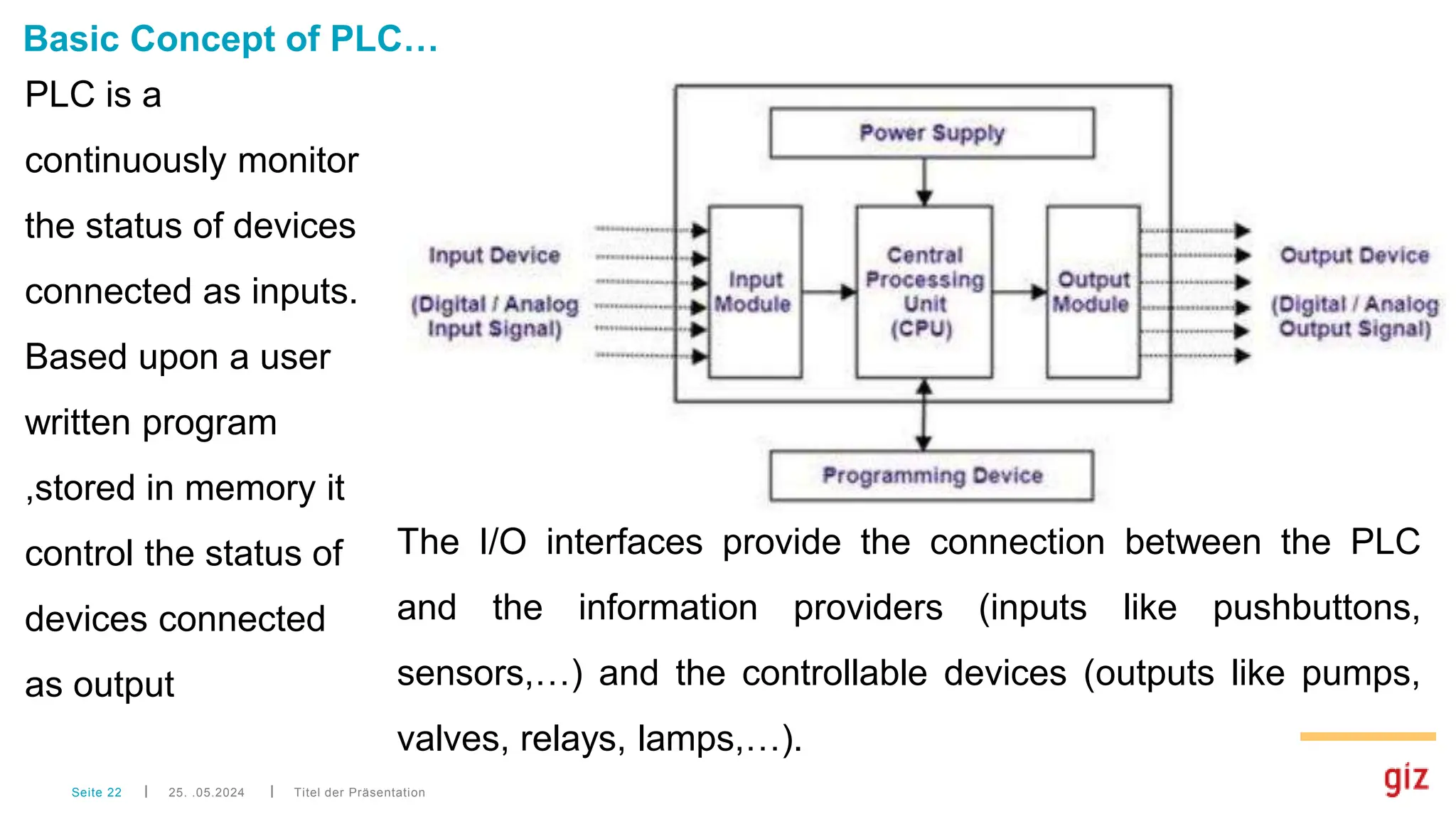
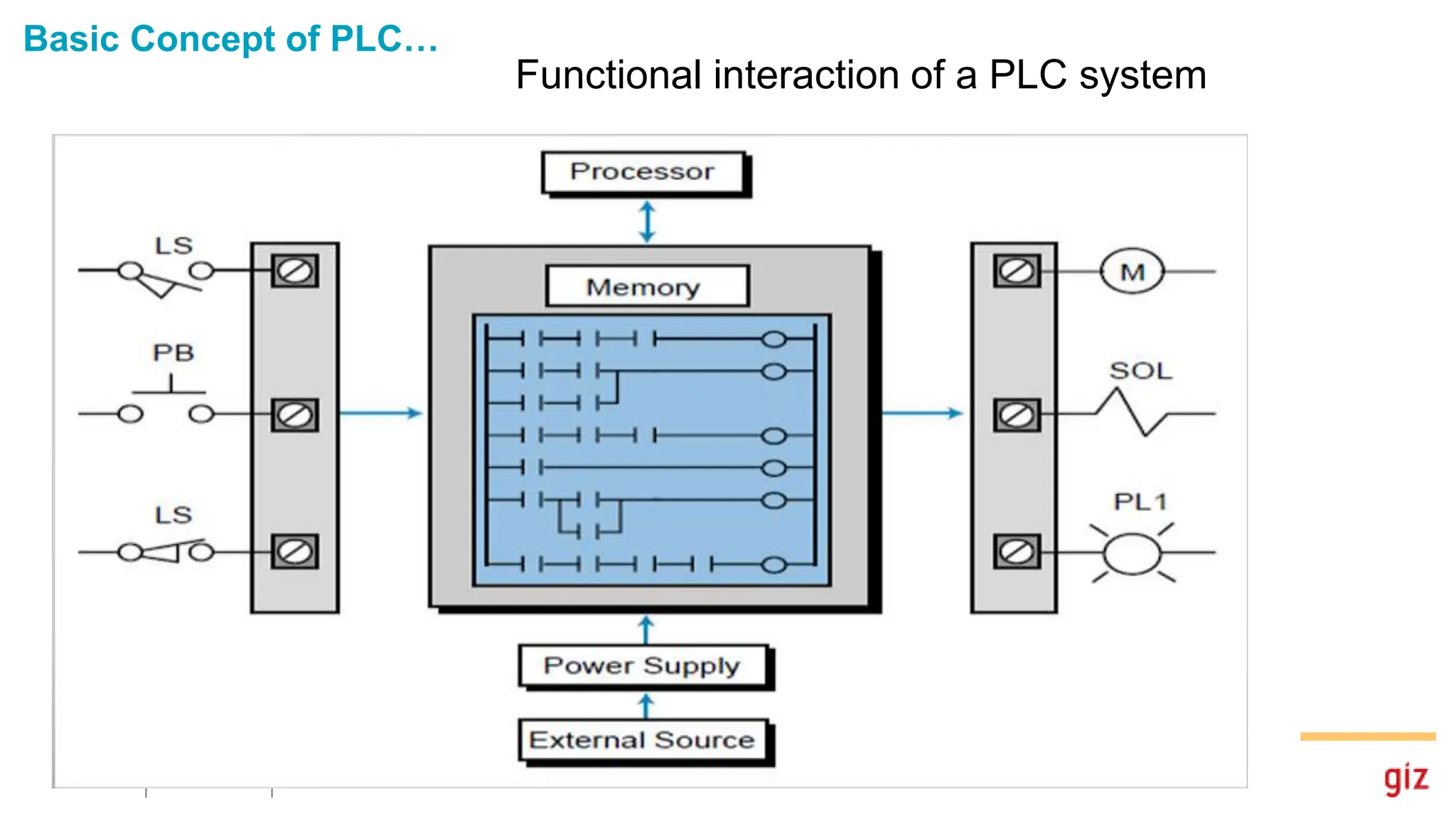
PLC is a
continuously monitor
the status of devices
connected as inputs.
Based upon a user
written program
,stored in memory it
control the status of
devices connected
as output
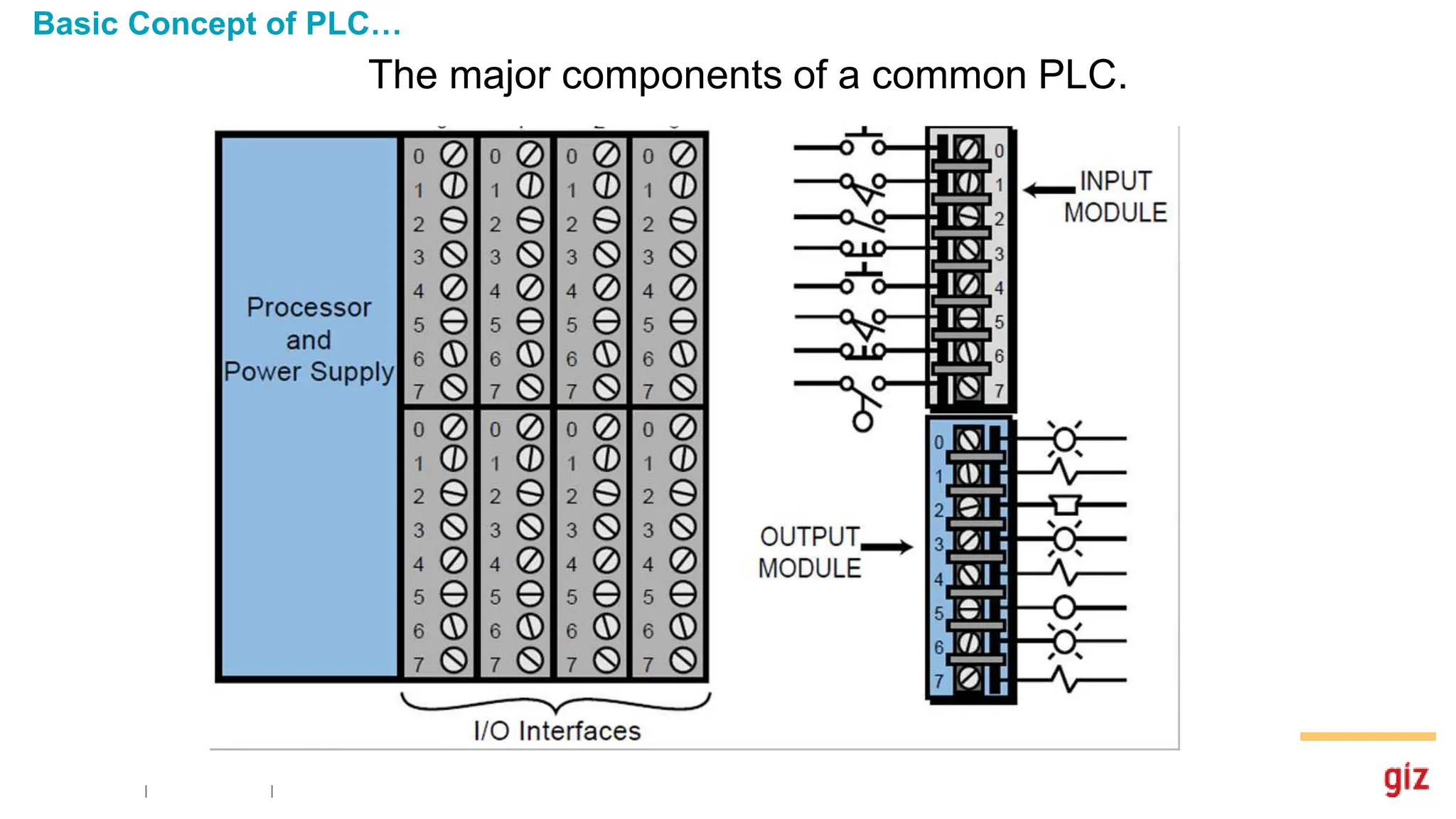
The I/O interfaces provide the connection between the PLC
and the information providers (inputs like pushbuttons,
sensors,…) and the controllable devices (outputs like pumps,
valves, relays, lamps,…).
22 Jan. 2019 Titel of the presentation
Page 23
Basic Concept of PLC…
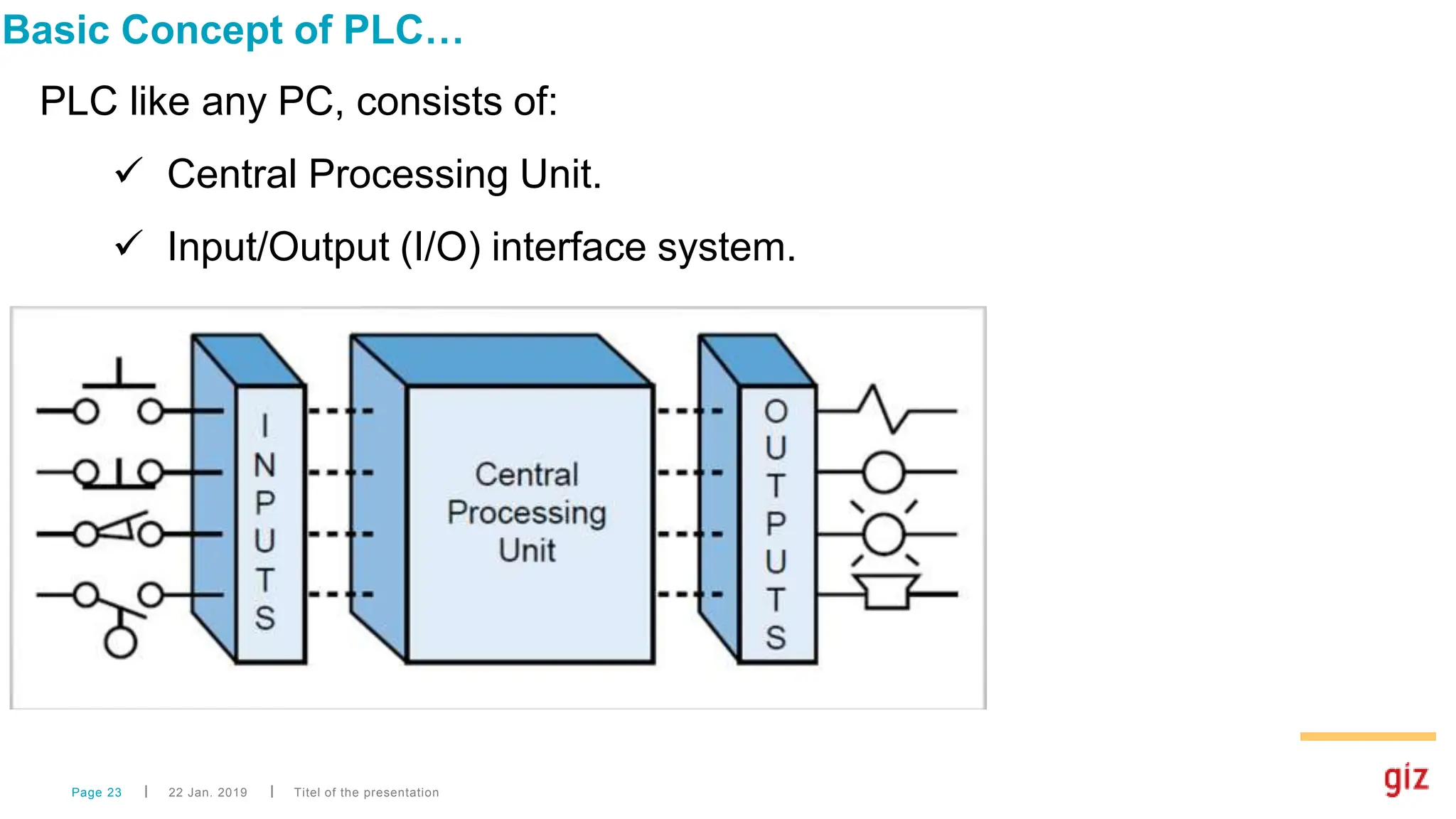
PLC like any PC, consists of:
 Central Processing Unit.
 Input/Output (I/O) interface system.
Basic Concept of PLC…
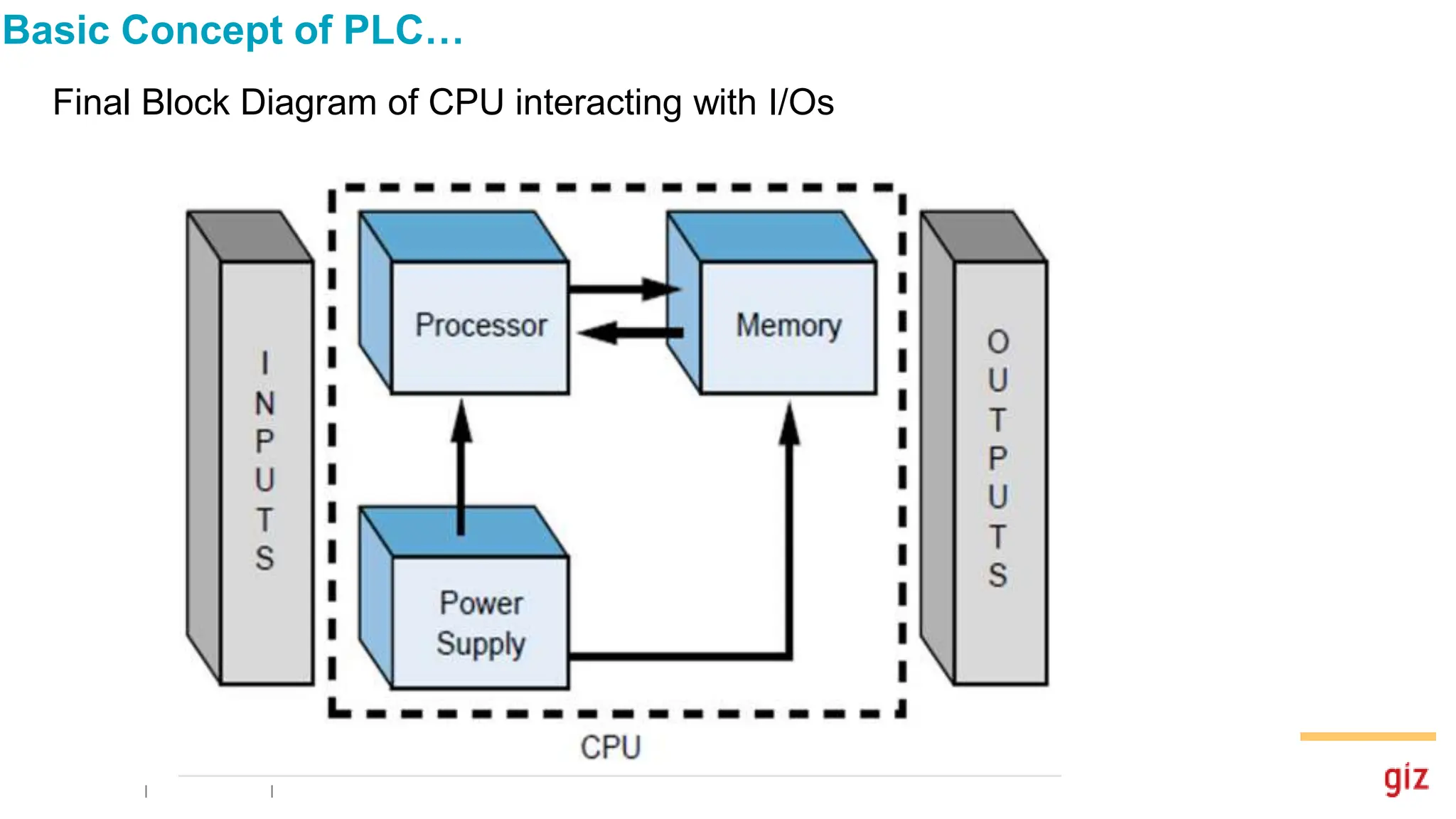
Final Block Diagram of CPU interacting with I/Os
Functional interaction of a PLC system
Basic Concept of PLC…
The major components of a common PLC.
Basic Concept of PLC…
PLC Hardware Mounting Systems
Basic Concept of PLC…
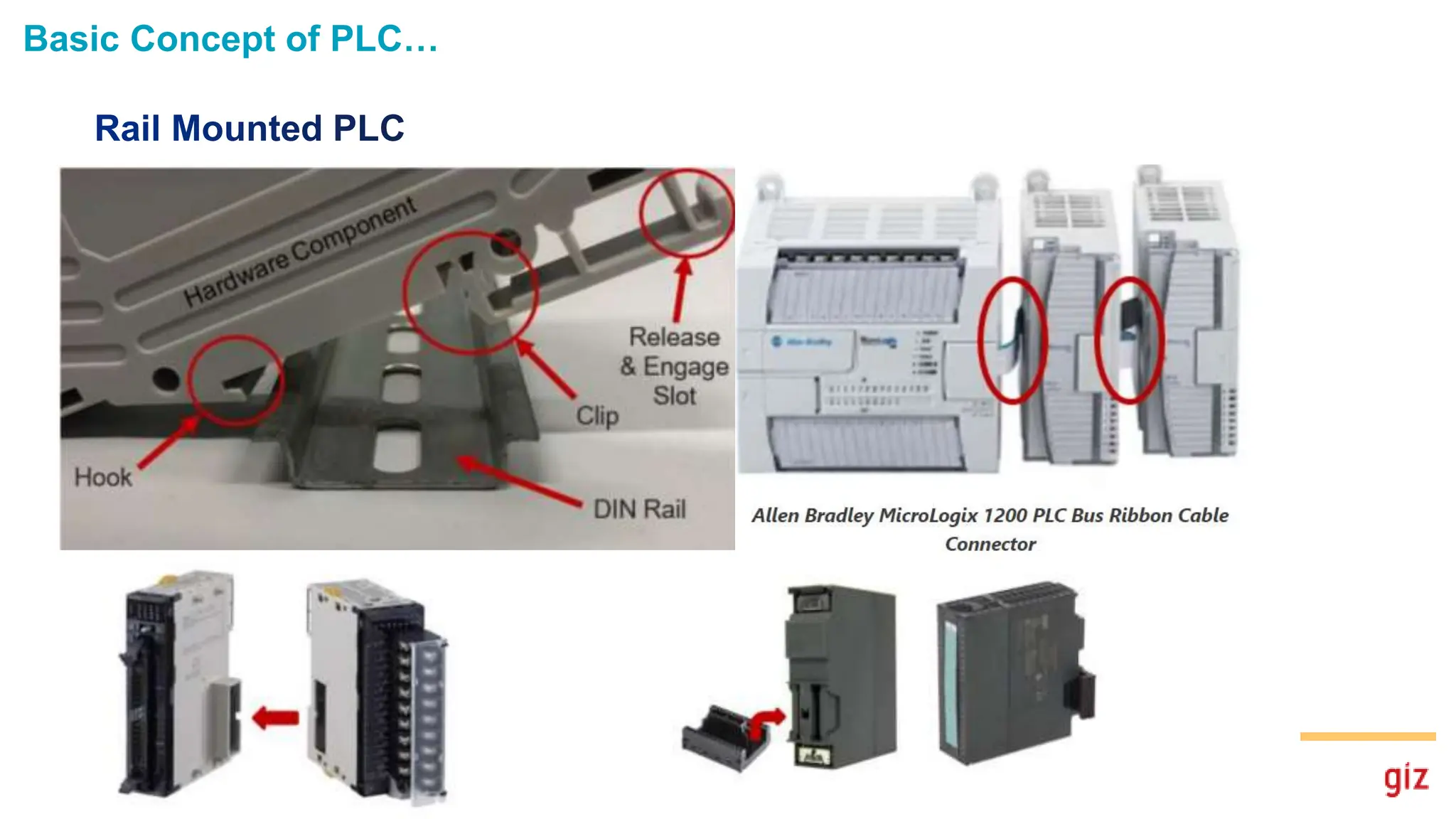
The hardware mounting system of a PLC provides the means to physically
connect the various hardware components of the PLC system.
PLC hardware mounting systems can vary from one PLC manufacturer to another
and can also vary depending on the type of PLC used
The 3 main PLC mounting systems used in industrial automation projects are:
• Rack mounted PLC
• Rail mounted PLC
• Panel mounted PLC
Basic Concept of PLC…
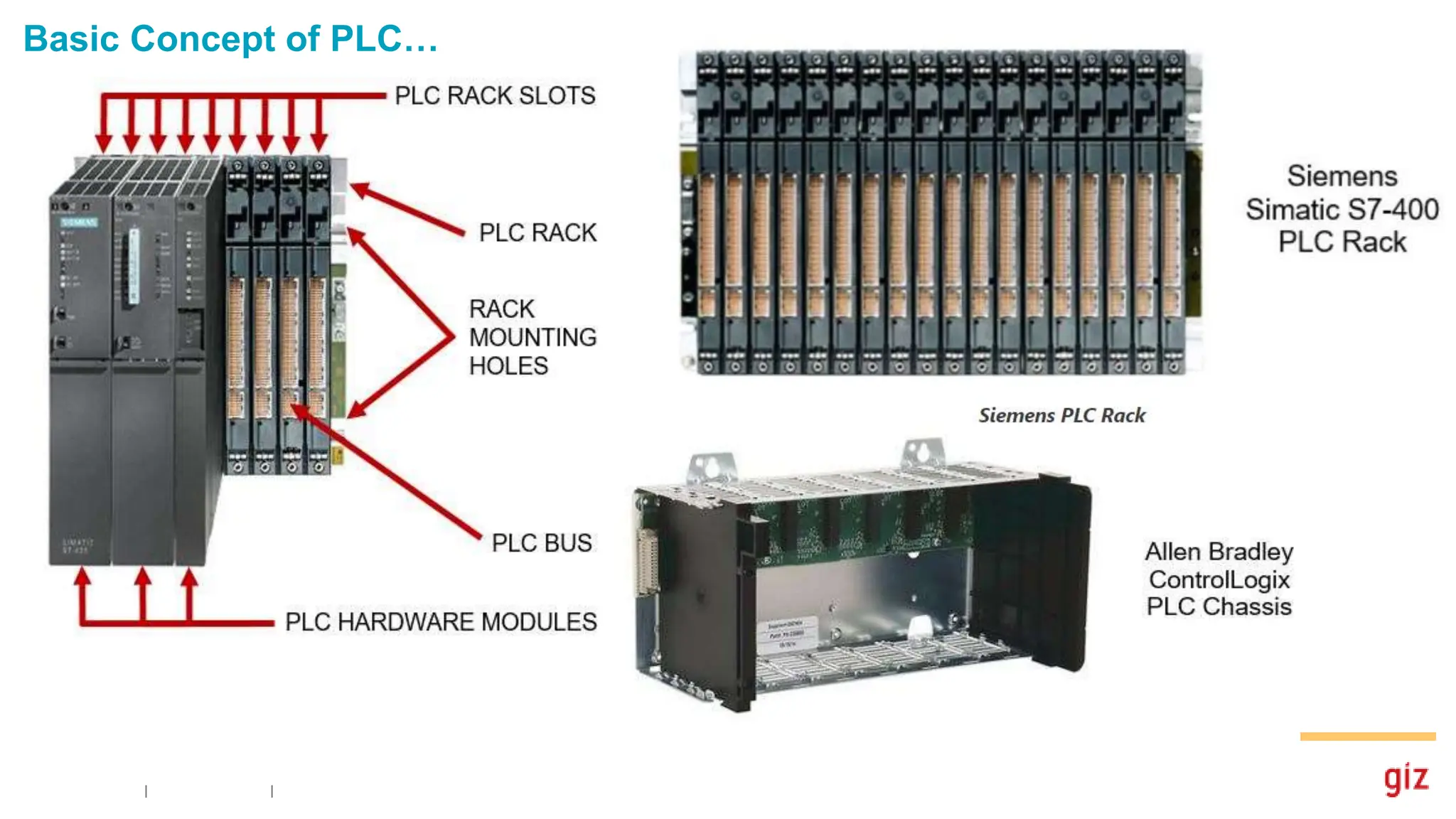
uses a mechanical mounting system in order to physically connect the PLC
processor and other PLC hardware components together
commonly used in modular and distributed type PLC systems
They are well suited to service higher end and plant wide applications where
multiple PLC racks and large numbers of inputs and outputs are required.
They have a fixed number of hardware module slots and generally have an
orderd hardware module layout.
such as power supply module, PLC processor module, communication modules
then input and output modules.
Basic Concept of PLC…
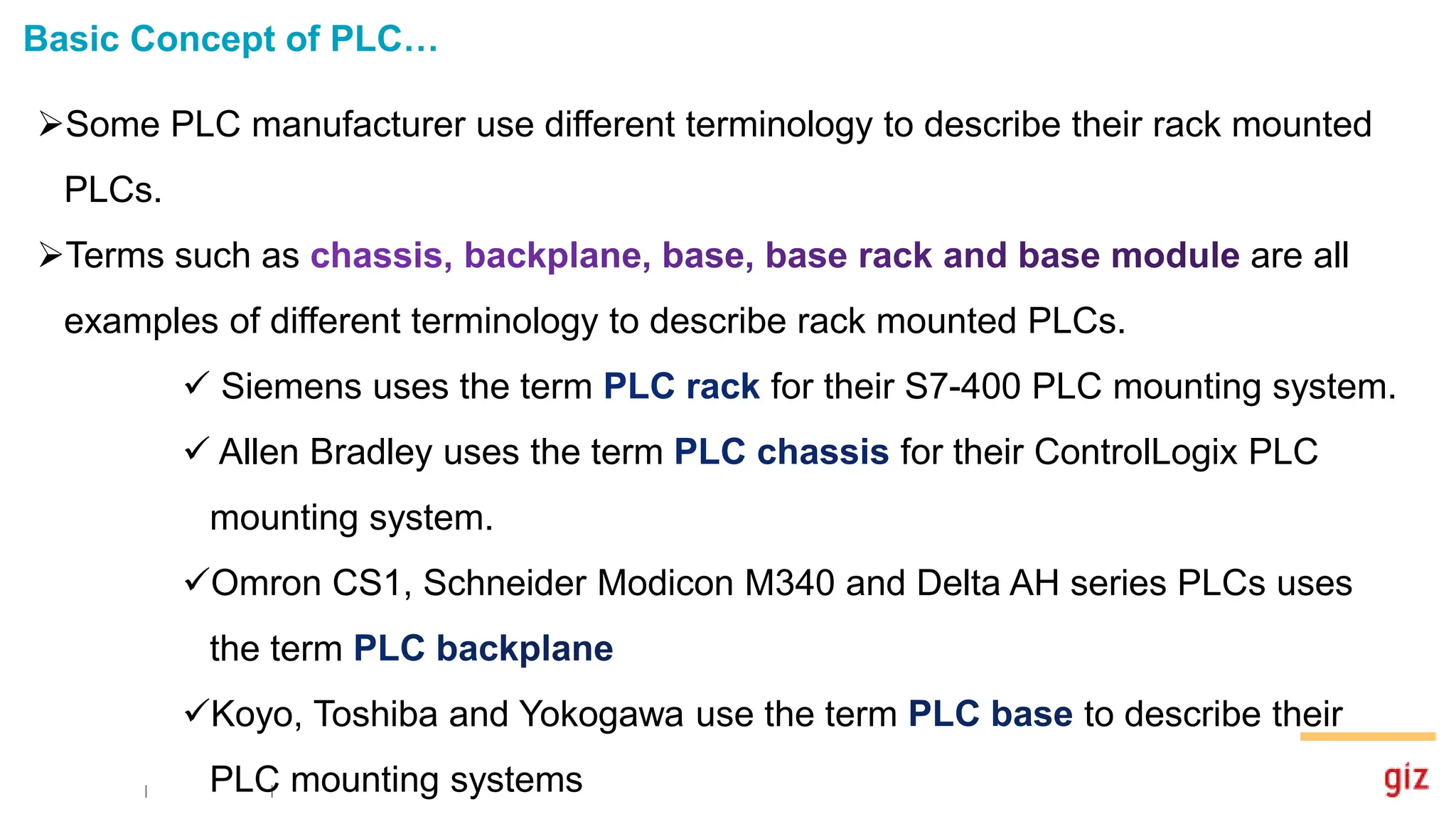
Some PLC manufacturer use different terminology to describe their rack mounted
PLCs.
Terms such as are all
examples of different terminology to describe rack mounted PLCs.
 Siemens uses the term for their S7-400 PLC mounting system.
 Allen Bradley uses the term for their ControlLogix PLC
mounting system.
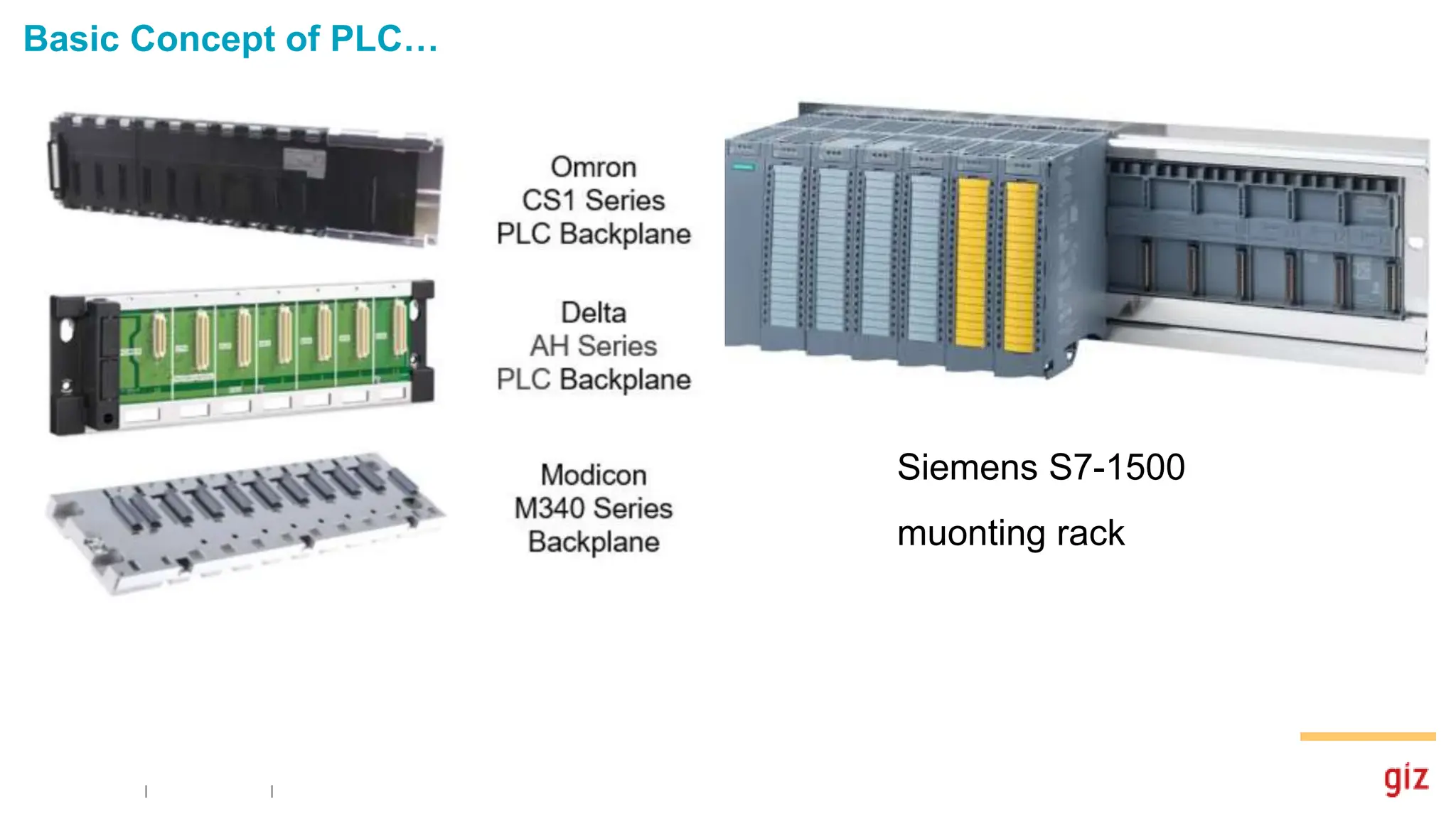
Omron CS1, Schneider Modicon M340 and Delta AH series PLCs uses
the term
Koyo, Toshiba and Yokogawa use the term to describe their
PLC mounting systems
Basic Concept of PLC…
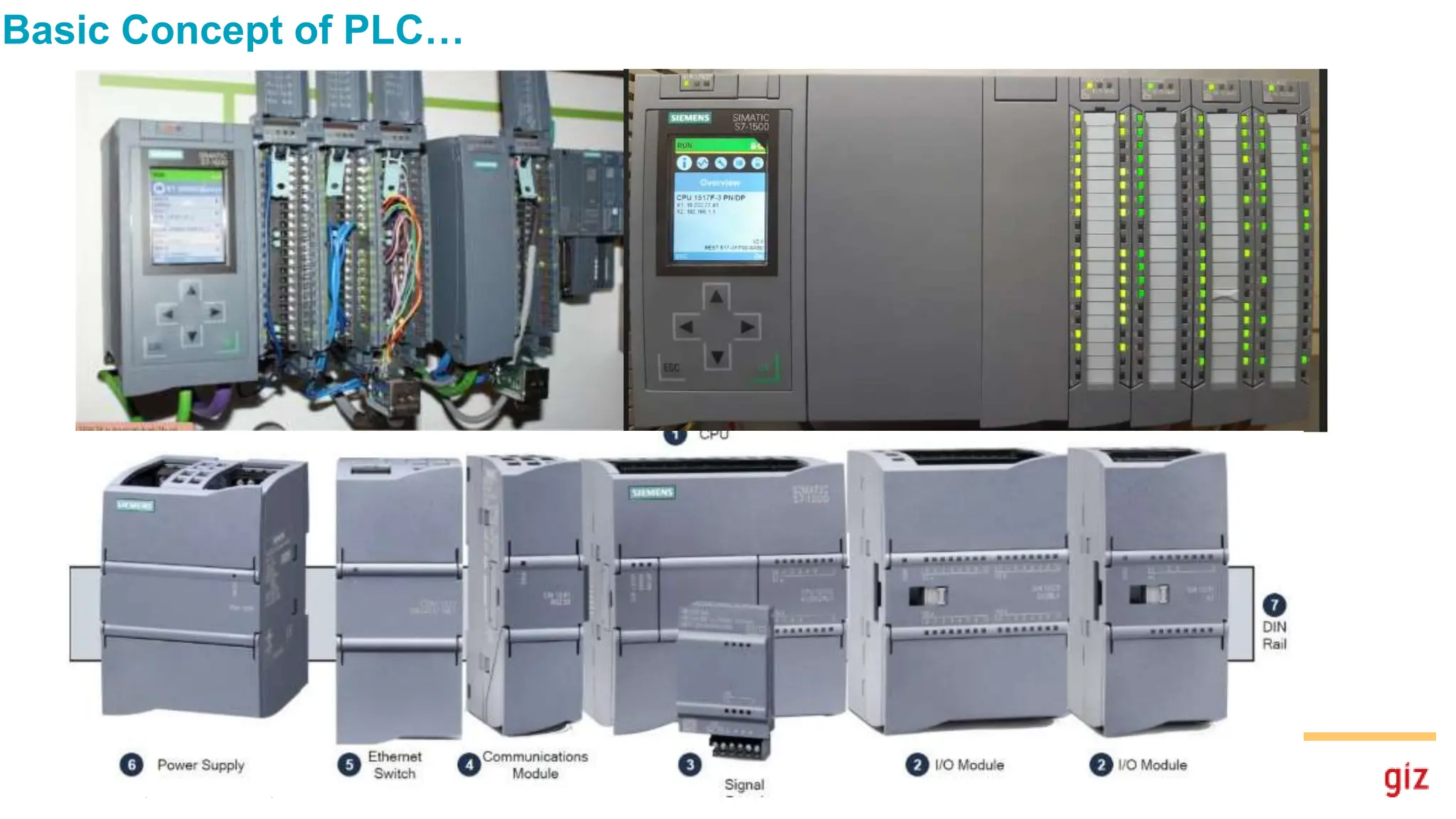
Siemens S7-1500
muonting rack
Basic Concept of PLC…
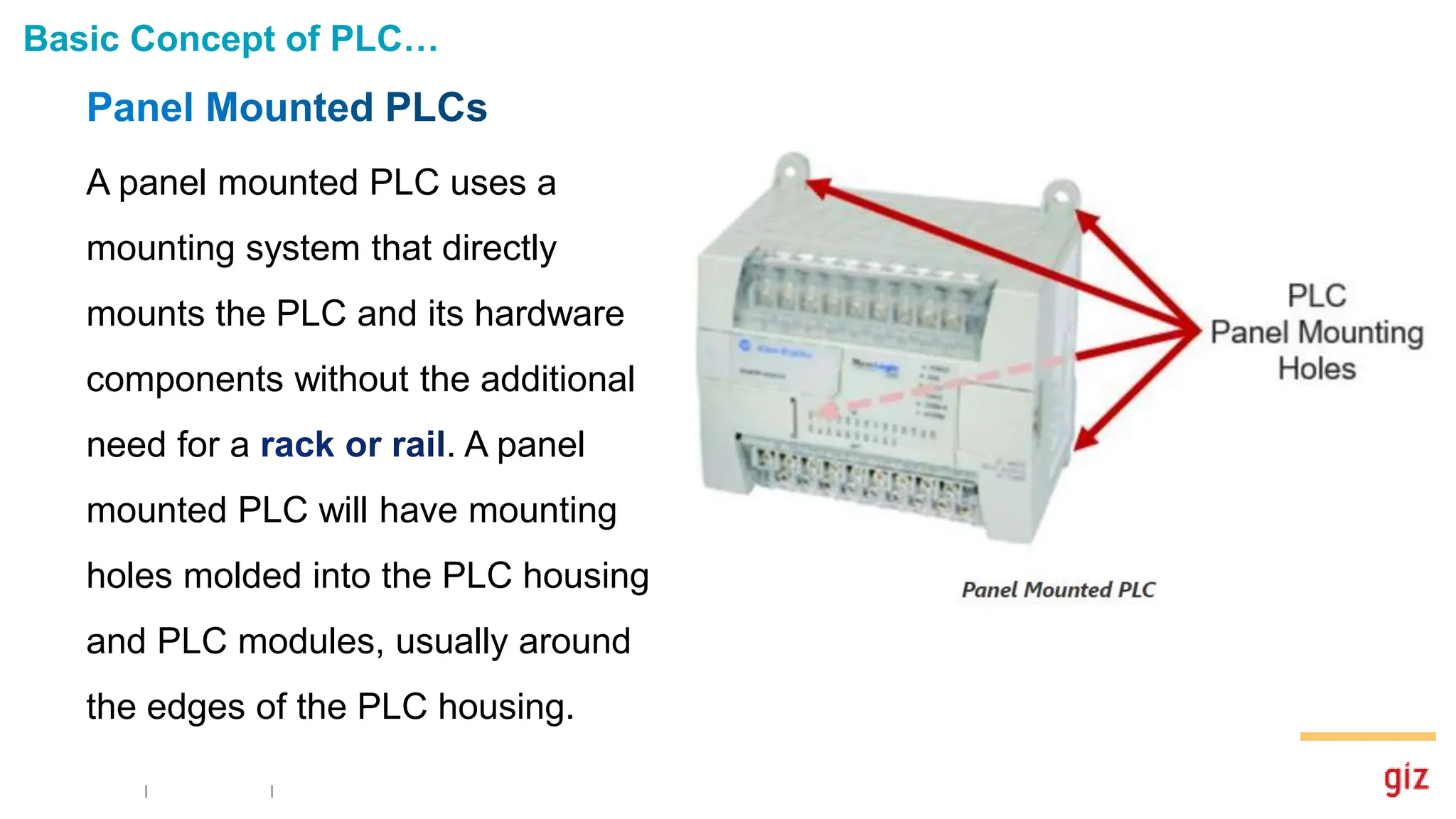
A panel mounted PLC uses a
mounting system that directly
mounts the PLC and its hardware
components without the additional
need for a . A panel
mounted PLC will have mounting
holes molded into the PLC housing
and PLC modules, usually around
the edges of the PLC housing.
Historical Background
Titel der Präsentation
Seite 35
Basic Concept of PLC…
 First commercial & successful Programmable Logic Controllers was
designed and developed by Modicon as a relay replacer for General
Motors automobile manufacturing industry to provide flexible, rugged
and easily programmable controllers to replace hard-wired relay logic
systems
 Later ,in late 1970’s,the micro processor became reality & greatly
enhanced the role of PLC permitting it to evolve from
simply relay to the sophisticated system.
25. .05.2024
Titel der Präsentation
Seite 36
Basic Concept of PLC…
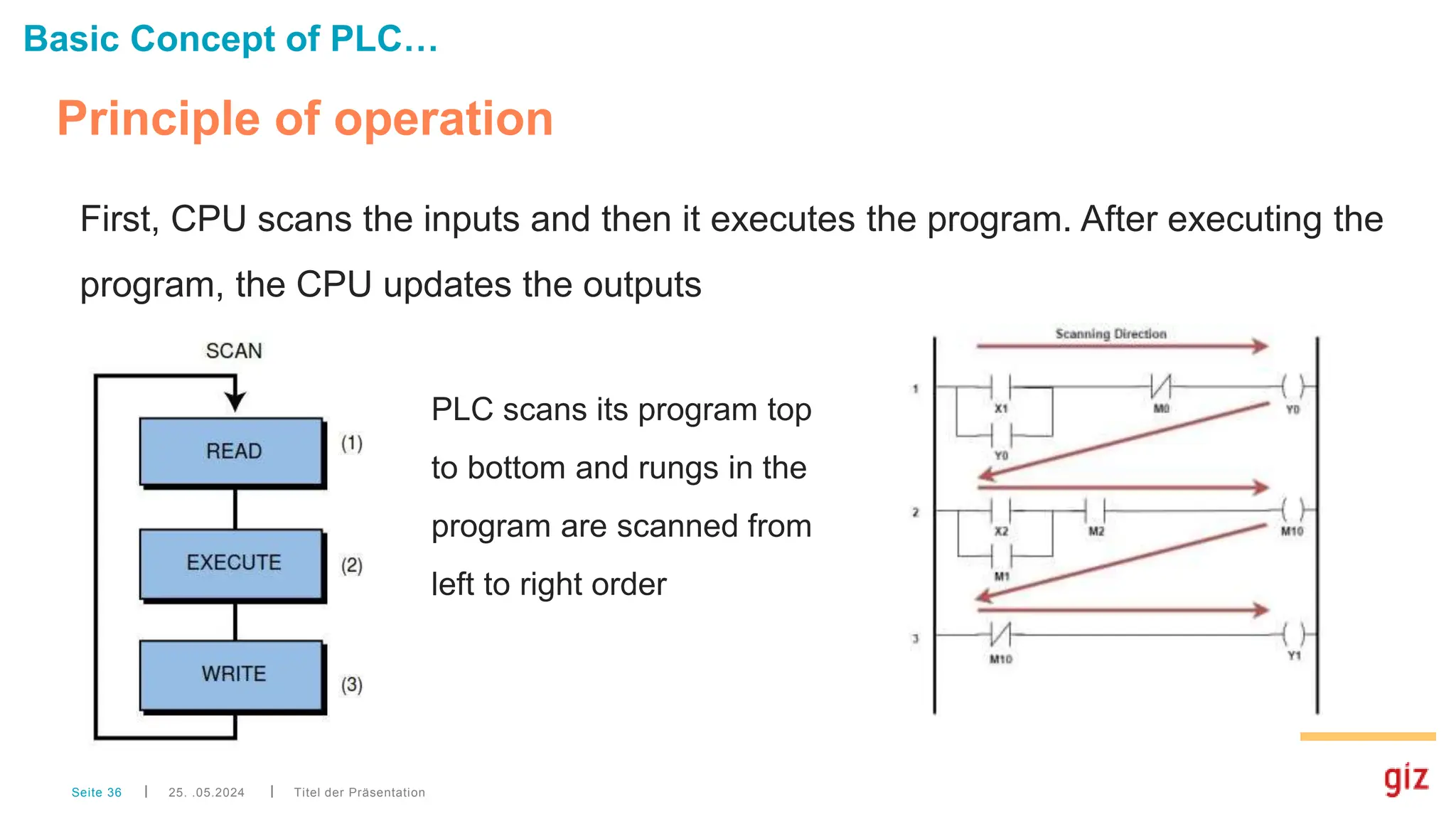
Principle of operation
First, CPU scans the inputs and then it executes the program. After executing the
program, the CPU updates the outputs
PLC scans its program top
to bottom and rungs in the
program are scanned from
left to right order
25. .05.2024
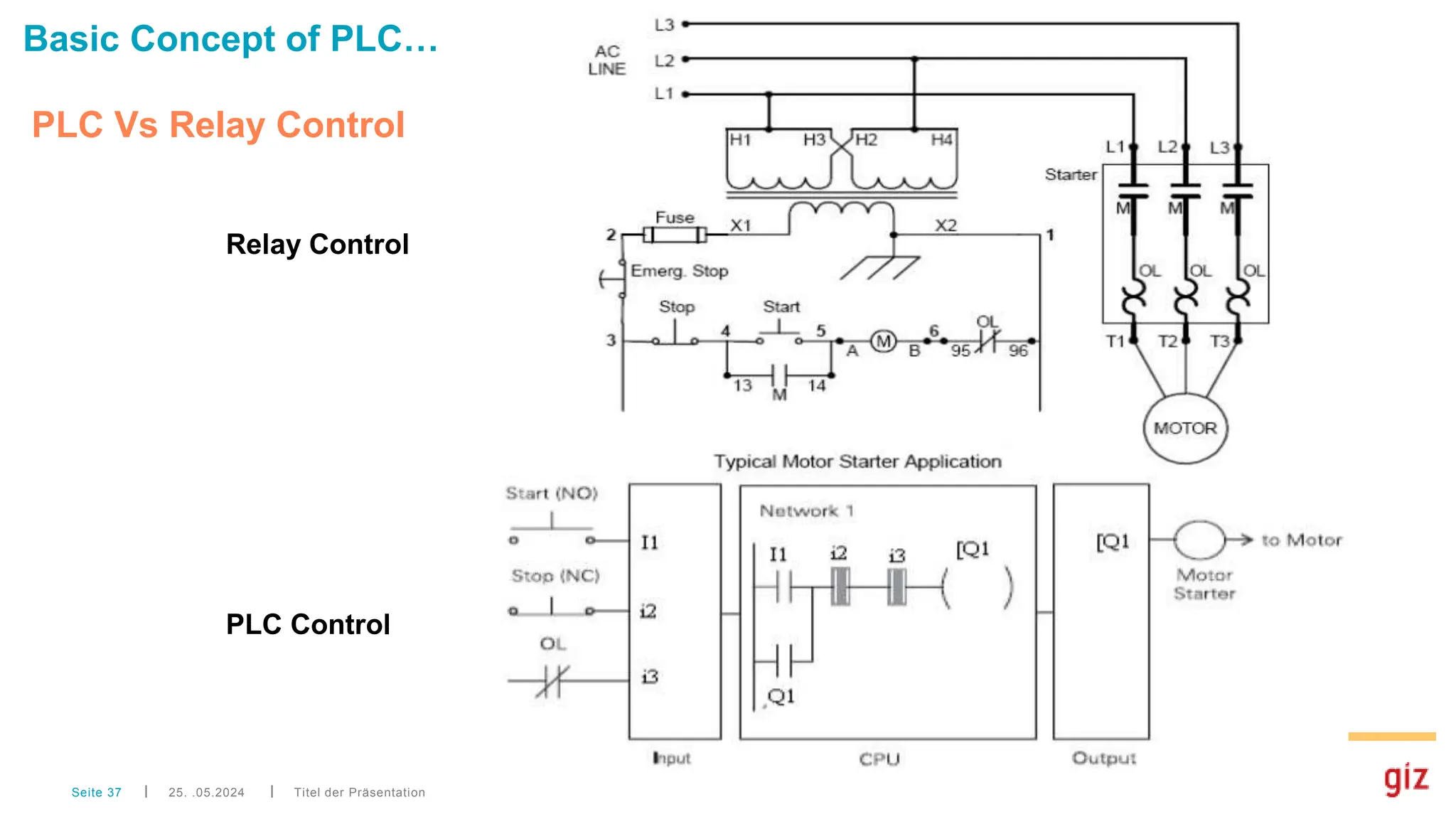
PLC Vs Relay Control
Titel der Präsentation
Seite 37
Basic Concept of PLC…
Relay Control
PLC Control
25. .05.2024
Titel der Präsentation
Seite 38
Basic Concept of PLC…
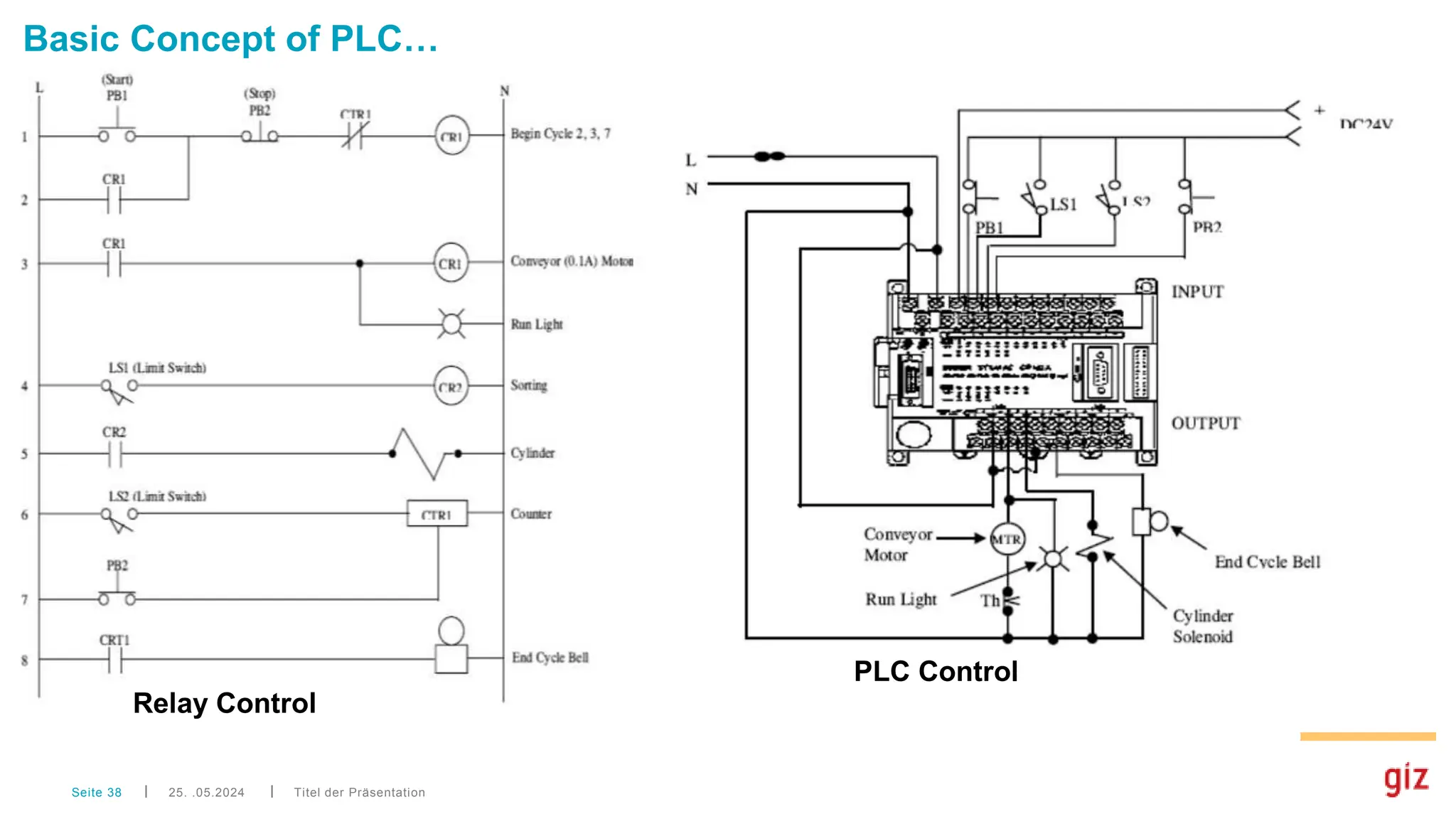
Relay Control
PLC Control
25. .05.2024
Titel der Präsentation
Seite 39
Basic Concept of PLC…
25. .05.2024
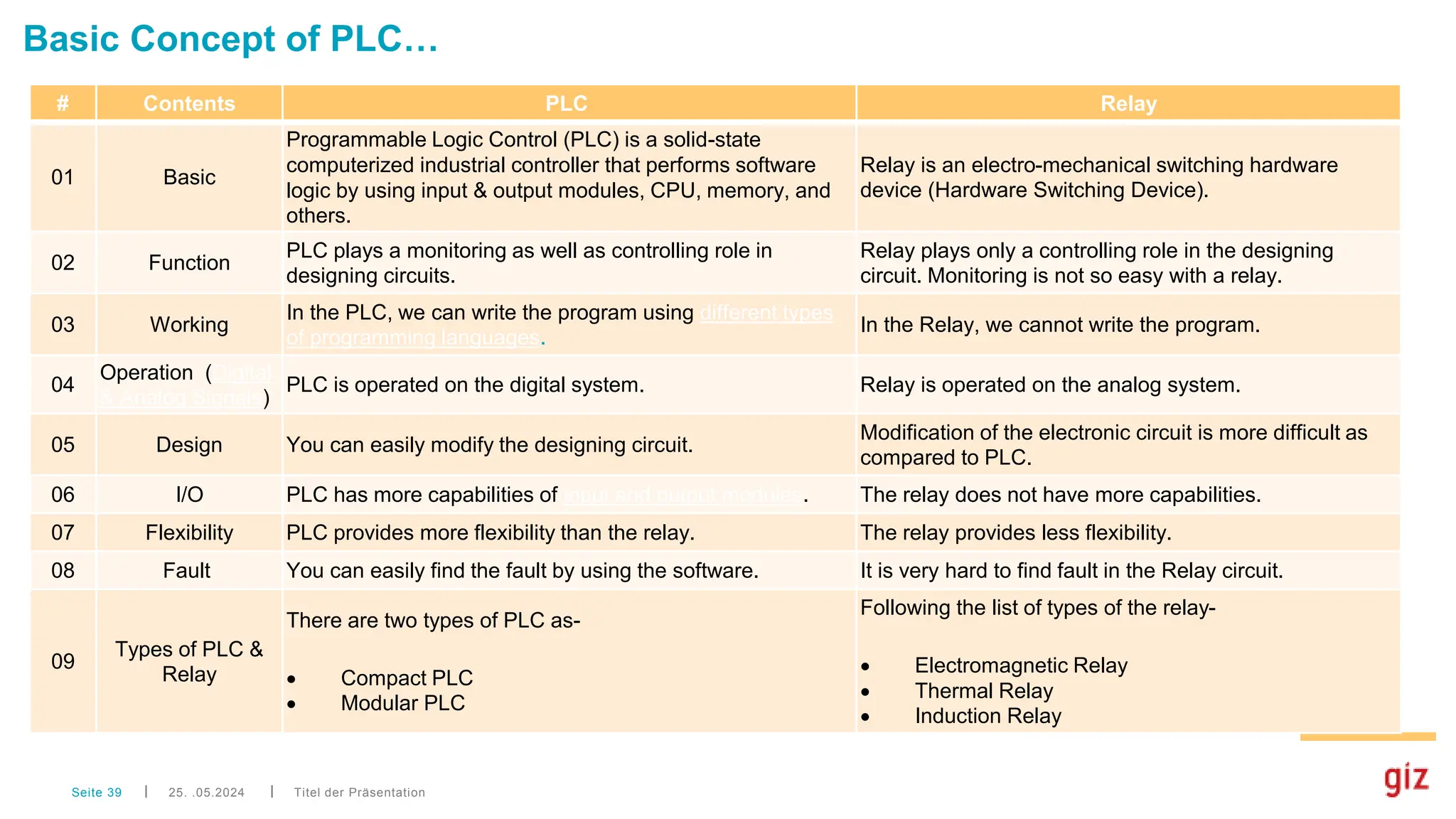
# Contents PLC Relay
01 Basic
Programmable Logic Control (PLC) is a solid-state
computerized industrial controller that performs software
logic by using input & output modules, CPU, memory, and
others.
Relay is an electro-mechanical switching hardware
device (Hardware Switching Device).
02 Function
PLC plays a monitoring as well as controlling role in
designing circuits.
Relay plays only a controlling role in the designing
circuit. Monitoring is not so easy with a relay.
03 Working
In the PLC, we can write the program using different types
of programming languages.
In the Relay, we cannot write the program.
04
Operation (Digital
& Analog Signals)
PLC is operated on the digital system. Relay is operated on the analog system.
05 Design You can easily modify the designing circuit.
Modification of the electronic circuit is more difficult as
compared to PLC.
06 I/O PLC has more capabilities of input and output modules. The relay does not have more capabilities.
07 Flexibility PLC provides more flexibility than the relay. The relay provides less flexibility.
08 Fault You can easily find the fault by using the software. It is very hard to find fault in the Relay circuit.
09
Types of PLC &
Relay
There are two types of PLC as-
 Compact PLC
 Modular PLC
Following the list of types of the relay-
 Electromagnetic Relay
 Thermal Relay
 Induction Relay
Thank you
22 Jan. 2019 Titel of the presentation
Page 40
In cooperation with:
Placeholder for
logo of cooperation partner
(please delete if not appropriate)
Implemented by

Basic concept of PLC which controls the process.pptx

  • 2.
    SCADA SYSTEM TRAININGCOVERAGE Titel der Präsentation 25. .05.2024 Seite 2
  • 3.
    Process Control System PROCESS Processrefers to the methods of changing or refining raw materials to create end products. The raw materials during process are transferred, measured, mixed heated or cooled, filtered, stored, or handled in some other way to produce the end product PROCESS CONTROL is the method which is used to control process variables when manufacturing products.
  • 4.
    process Industries controlthe production process for three reasons:  Reduce variability:-Process control can reduce variability in the end product, which ensures a consistently high-quality product  Increase efficiency:-Some processes need to be maintained at a specific point to maximize efficiency  Ensure safety:-A run-away process may result if manufacturers do not maintain precise control of all of the process variables. The consequences of a run-away process can be disastrous
  • 5.
    Three tasks areneeded to control a process :-  Measurement of process variables  Comparison with the given set point  Adjustment to avoid the error or the difference with the set point :- in order to control the process variable of a given process we need to measure, compare and adjust the process variable to keep the given set point value of the process variable. Process Control System...
  • 6.
  • 7.
    Titel der Präsentation 22.01.2019 Seite7 So we can conclude from the above that we need three type of instruments to control a process:- I. MEASURING ELEMENTS(SENSORS) II. CONTROLLERS III. CONTROL ELEMENTS (ACTUATORS) Process Control System...
  • 8.
    are devices thatcan detect physical variables(conditions ) of a given process such as temperature, pressure, level, flow, motion etc and have the ability to give a measurable output. We can categorize them in to two groups as follows. process measuring elements process measuring elements i. MEASURING ELEMENTS (SENSORS) Process Control System...
  • 9.
    Process Control System... symbolsof and control elements for electrical schematic diagrams
  • 10.
    Common examples ofDiscrete process measuring elements Process Control System...  Push Buttons : Start Push button, Stop Push button and Emergency etc.  Limit switch: target not contacting the switch  Proximity switch: target far away  Pressure switch: low pressure (or even a vacuum)  Level switch: low level (empty)  Temperature switch: low temperature (cold)  Flow switch: low flow rate (fluid stopped)
  • 11.
    : Commonly thermocoupleand RTD  : Commonly pressure Transmitters  : Differenital ,Radar and Ultrasonic Transmitters  : Mass flow meter,Magnetic Flow meters,Vortex flow meters, : Commonly Load cells Analog Measuring elements Process Control System...
  • 12.
    ii. FINAL CONTROLELEMENTS (ACTUATORS) Final control element is a device that receives out put signal from controller and takes an action at the process according to the given instruction from controller to avoid the error b/n PV and SV of the given process. common control devices are:-  solenoid valves  control valves  Contactors,Drives or variable speed drives (pumps, etc.)
  • 13.
    CONTROLLERS Controller is adevice that instruments (Sensor, Transducer or Transmitter ) and , and if necessary to take a corrective action. We can catagorized controllers as following:- Mechanical(such as pneumatic, hydraulic) controller  electronic controller Programmable controller
  • 14.
  • 16.
    What is PLC? Aprogrammable logic controller (PLC) is an industrially computer-based unit that performs discrete or continuous control functions in a variety of processing plant and factory environments
  • 17.
    The 6 basichardware components that make up a PLC are:  Processor (CPU)  Mounting System  Power Supply  Input & Output Interface  Communication Interface  Programming Device These main PLC hardware components are found in all PLC systems regardless of . They are the essential hardware elements that make up every PLC system.
  • 18.
    Basic Concept ofPLC… PLC Hardware Block Diagram
  • 19.
    Basic Concept ofPLC… PLC Processor (CPU)  The most crucial PLC hardware component  Sometimes the PLC processor is also referred as the PLC controller or PLC CPU (Central Processing Unit  The PLC processor contains 3 fundamental components:  PLC CPU (Central Processing Unit)  PLC Memory  PLC Programming port
  • 20.
    PLC CPU (CentralProcessing Unit) Basic Concept of PLC… the CPU is responsible for (such as ladder logic) executes a program that is stored as a sequence of machine language instructions in main memory -by executing instructions that have been read from memory, in which,tell the CPU what operations need to be performed on particular data items stored in memory or registers. -When an instruction is fetched from memory it is sent through the control unit where it is decoded
  • 21.
    Basic Concept ofPLC… The PLC uses the memory:  to store the for processing by the CPU and  to store processing and execution.  if we have a large PLC program then we will require a PLC controller with a large integrated memory capacity to accommodate the communication protocol used for the PLC programming port includes
  • 22.
    Basic Concept ofPLC… Titel der Präsentation 25. .05.2024 Seite 22 PLC is a continuously monitor the status of devices connected as inputs. Based upon a user written program ,stored in memory it control the status of devices connected as output The I/O interfaces provide the connection between the PLC and the information providers (inputs like pushbuttons, sensors,…) and the controllable devices (outputs like pumps, valves, relays, lamps,…).
  • 23.
    22 Jan. 2019Titel of the presentation Page 23 Basic Concept of PLC… PLC like any PC, consists of:  Central Processing Unit.  Input/Output (I/O) interface system.
  • 24.
    Basic Concept ofPLC… Final Block Diagram of CPU interacting with I/Os
  • 25.
    Functional interaction ofa PLC system Basic Concept of PLC…
  • 26.
    Basic Concept ofPLC… The major components of a common PLC.
  • 27.
  • 28.
    PLC Hardware MountingSystems Basic Concept of PLC… The hardware mounting system of a PLC provides the means to physically connect the various hardware components of the PLC system. PLC hardware mounting systems can vary from one PLC manufacturer to another and can also vary depending on the type of PLC used The 3 main PLC mounting systems used in industrial automation projects are: • Rack mounted PLC • Rail mounted PLC • Panel mounted PLC
  • 29.
    Basic Concept ofPLC… uses a mechanical mounting system in order to physically connect the PLC processor and other PLC hardware components together commonly used in modular and distributed type PLC systems They are well suited to service higher end and plant wide applications where multiple PLC racks and large numbers of inputs and outputs are required. They have a fixed number of hardware module slots and generally have an orderd hardware module layout. such as power supply module, PLC processor module, communication modules then input and output modules.
  • 30.
  • 31.
    Basic Concept ofPLC… Some PLC manufacturer use different terminology to describe their rack mounted PLCs. Terms such as are all examples of different terminology to describe rack mounted PLCs.  Siemens uses the term for their S7-400 PLC mounting system.  Allen Bradley uses the term for their ControlLogix PLC mounting system. Omron CS1, Schneider Modicon M340 and Delta AH series PLCs uses the term Koyo, Toshiba and Yokogawa use the term to describe their PLC mounting systems
  • 32.
    Basic Concept ofPLC… Siemens S7-1500 muonting rack
  • 33.
  • 34.
    Basic Concept ofPLC… A panel mounted PLC uses a mounting system that directly mounts the PLC and its hardware components without the additional need for a . A panel mounted PLC will have mounting holes molded into the PLC housing and PLC modules, usually around the edges of the PLC housing.
  • 35.
    Historical Background Titel derPräsentation Seite 35 Basic Concept of PLC…  First commercial & successful Programmable Logic Controllers was designed and developed by Modicon as a relay replacer for General Motors automobile manufacturing industry to provide flexible, rugged and easily programmable controllers to replace hard-wired relay logic systems  Later ,in late 1970’s,the micro processor became reality & greatly enhanced the role of PLC permitting it to evolve from simply relay to the sophisticated system. 25. .05.2024
  • 36.
    Titel der Präsentation Seite36 Basic Concept of PLC… Principle of operation First, CPU scans the inputs and then it executes the program. After executing the program, the CPU updates the outputs PLC scans its program top to bottom and rungs in the program are scanned from left to right order 25. .05.2024
  • 37.
    PLC Vs RelayControl Titel der Präsentation Seite 37 Basic Concept of PLC… Relay Control PLC Control 25. .05.2024
  • 38.
    Titel der Präsentation Seite38 Basic Concept of PLC… Relay Control PLC Control 25. .05.2024
  • 39.
    Titel der Präsentation Seite39 Basic Concept of PLC… 25. .05.2024 # Contents PLC Relay 01 Basic Programmable Logic Control (PLC) is a solid-state computerized industrial controller that performs software logic by using input & output modules, CPU, memory, and others. Relay is an electro-mechanical switching hardware device (Hardware Switching Device). 02 Function PLC plays a monitoring as well as controlling role in designing circuits. Relay plays only a controlling role in the designing circuit. Monitoring is not so easy with a relay. 03 Working In the PLC, we can write the program using different types of programming languages. In the Relay, we cannot write the program. 04 Operation (Digital & Analog Signals) PLC is operated on the digital system. Relay is operated on the analog system. 05 Design You can easily modify the designing circuit. Modification of the electronic circuit is more difficult as compared to PLC. 06 I/O PLC has more capabilities of input and output modules. The relay does not have more capabilities. 07 Flexibility PLC provides more flexibility than the relay. The relay provides less flexibility. 08 Fault You can easily find the fault by using the software. It is very hard to find fault in the Relay circuit. 09 Types of PLC & Relay There are two types of PLC as-  Compact PLC  Modular PLC Following the list of types of the relay-  Electromagnetic Relay  Thermal Relay  Induction Relay
  • 40.
    Thank you 22 Jan.2019 Titel of the presentation Page 40 In cooperation with: Placeholder for logo of cooperation partner (please delete if not appropriate) Implemented by