Government Polytechnic Nagpur
Name : Vivek Atalkar
Enroll : 1822006
Prog. : ME-II shift
Guided by : Prof. Y. Gaiky
Content
01 Introduction to Industrial Automation
02 SCADA (Supervisory Control And Data Acquisition )
03 Programmable Logic Controller (PLC)
04 Sensors and Transducer
Electric Drives
05
1.
Introduction
to
Automation
What is Industrial Automation?
Industrial automation is the use of
control systems, such as computers or
robots, and information technologies for
handling different processes and
machineries in an industry to replace a
human being. It is the second step beyond
mechanization in the scope of
industrialization.
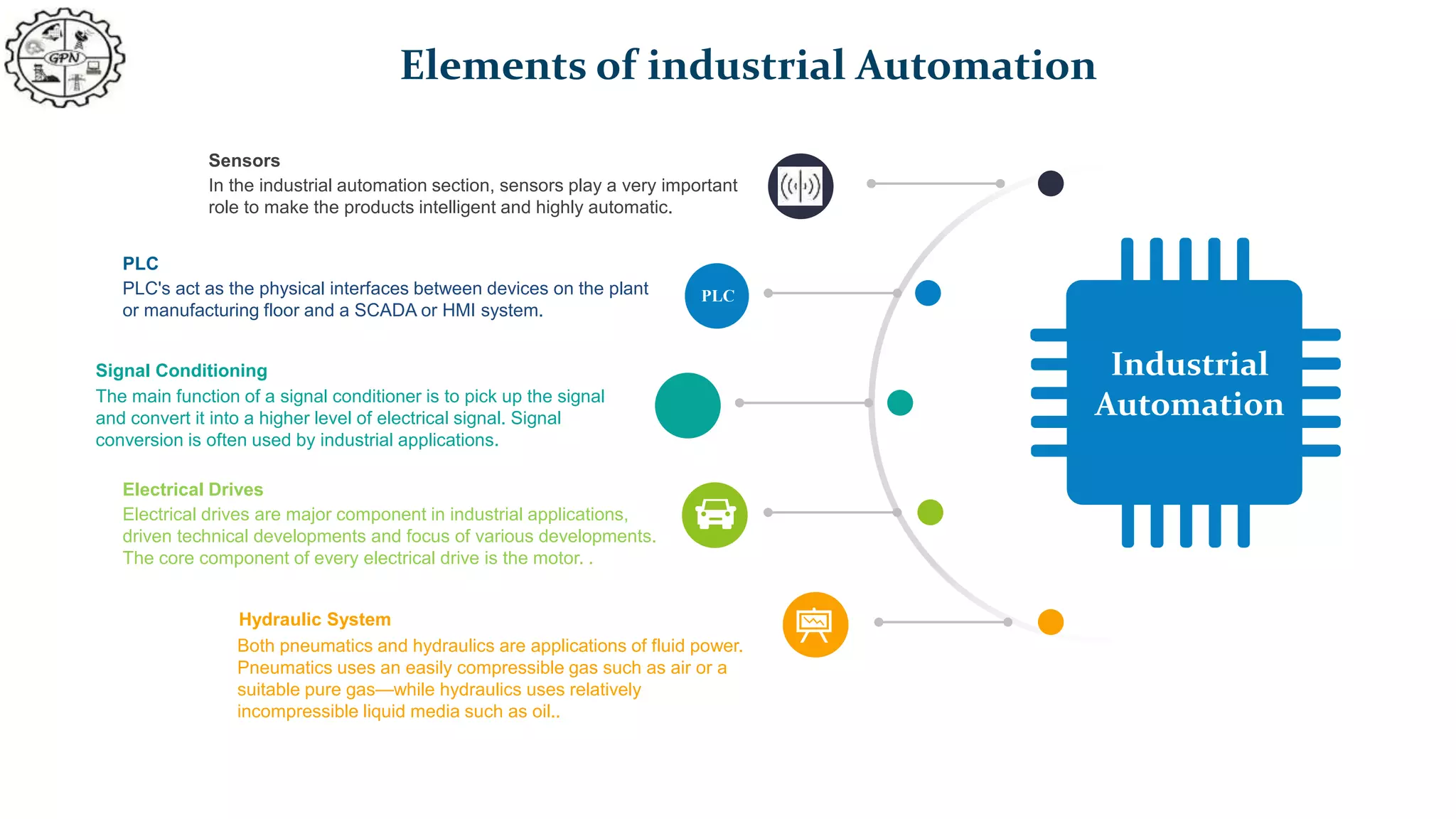
In the industrial automation section, sensors play a very important
role to make the products intelligent and highly automatic.
Sensors
The main function of a signal conditioner is to pick up the signal
and convert it into a higher level of electrical signal. Signal
conversion is often used by industrial applications.
Signal Conditioning
Both pneumatics and hydraulics are applications of fluid power.
Pneumatics uses an easily compressible gas such as air or a
suitable pure gas—while hydraulics uses relatively
incompressible liquid media such as oil..
Hydraulic System
PLC's act as the physical interfaces between devices on the plant
or manufacturing floor and a SCADA or HMI system.
PLC
Electrical drives are major component in industrial applications,
driven technical developments and focus of various developments.
The core component of every electrical drive is the motor. .
Electrical Drives
Industrial
Automation
PLC
Elements of industrial Automation
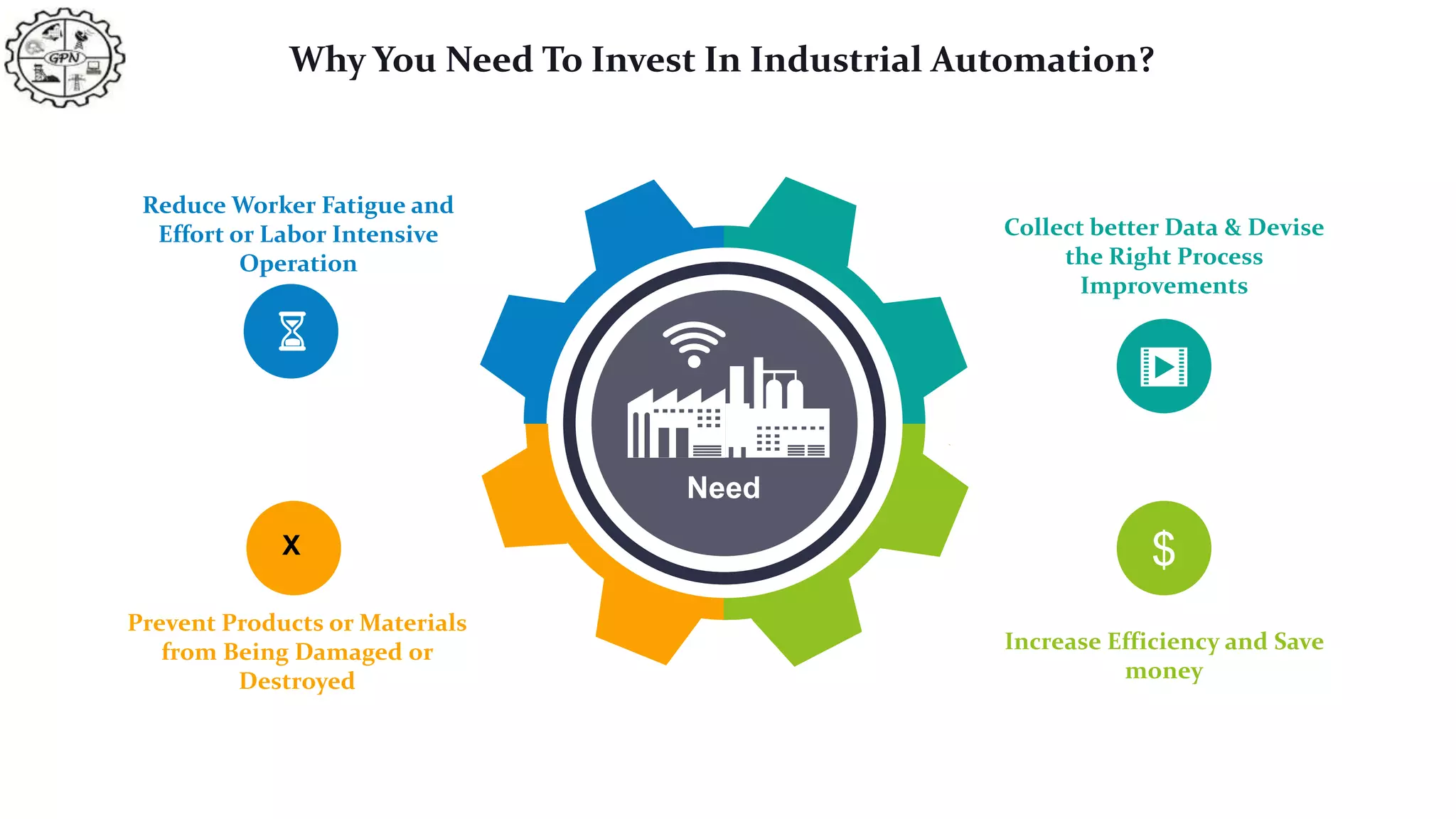
$
Need
Prevent Products or Materials
from Being Damaged or
Destroyed
Increase Efficiency and Save
money
Collect better Data & Devise
the Right Process
Improvements
Reduce Worker Fatigue and
Effort or Labor Intensive
Operation
Why You Need To Invest In Industrial Automation?
X
2. SCADA
What is SCADA?
• A SCADA system is a collection of both software and hardware components that
allow supervision and control of plants, both locally and remotely.
• Basically consists of data accessing featuring and controlling remotely.
• Conversion of data is possible i.e. Analog to Digital and vice-versa.
• Can communicate to any of the protocols available in market.
• Completely rely on windows based system.
• SCADA is not dedicated to any one type of application or industry.
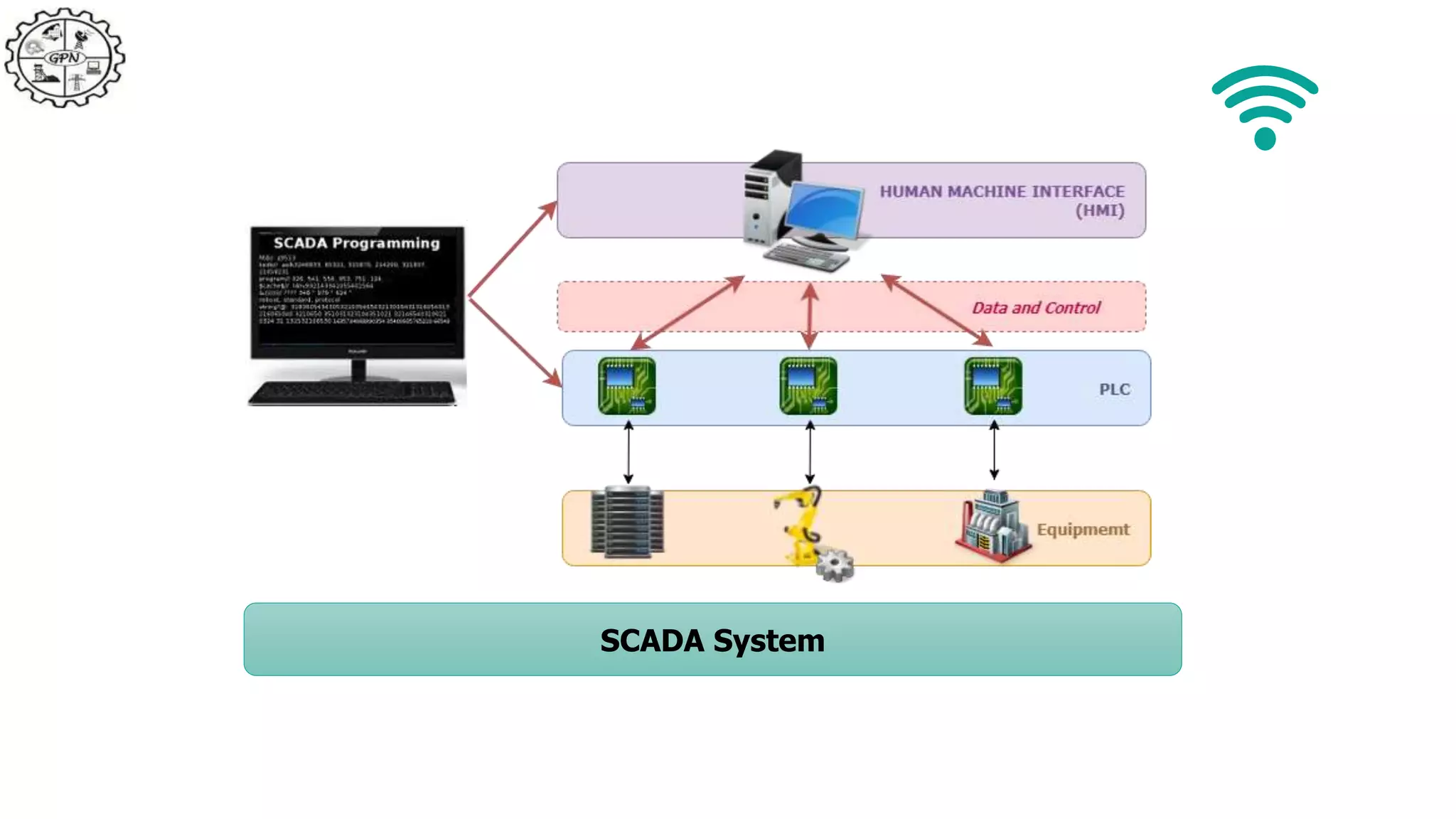
SCADA System
While these systems simplify a given infrastructure, their components are quite
complex. There are five essential composing parts of a SCADA system:
•Human Machine Interface (HMI)
•supervisory system
•Remote Terminal Units (RTUs)
•Programmable Logic Controllers (PLCs)
•communication infrastructures
Components of SCADA System
Supervisory computers
This is the core of the SCADA system, gathering data on the process and sending
control commands to the field connected devices. It refers to the computer and
software responsible for communicating with the field connection controllers.
Remote terminal units (RTUS)
Remote terminal units, also known as (RTJS), connect to sensors and actuators in
the process, and are networked to the supervisory computer system.
Programmable logic controllers(PLCS)
These are connected to sensors and actuators in the process, and are networked
to the supervisory system and are programmed in one or more IEC 61131-3
programming languages.
Function of SCADA
A SCADA system performs four functions:
• Data acquisition
• Networked data communication
• Data presentation
• Control
Function of SCADA
1. Sensors (either digital or analog) and control relays that directly interface with the
managed system.
2. Remote telemetry units (RTUs). These are small computerized units deployed in
the field at specific sites and locations. RTUs serve as local collection points for
gathering reports from sensors and delivering commands to control relays.
3. SCADA master units. These are larger computer consoles that serve as the central
processor for the SCADA system. Master units provide a human interface to the system
and automatically regulate the managed system in response to sensor inputs.
4. The communications network that connects the SCADA master unit to the RTUs in
the field.
3. PLC
What is PLC?
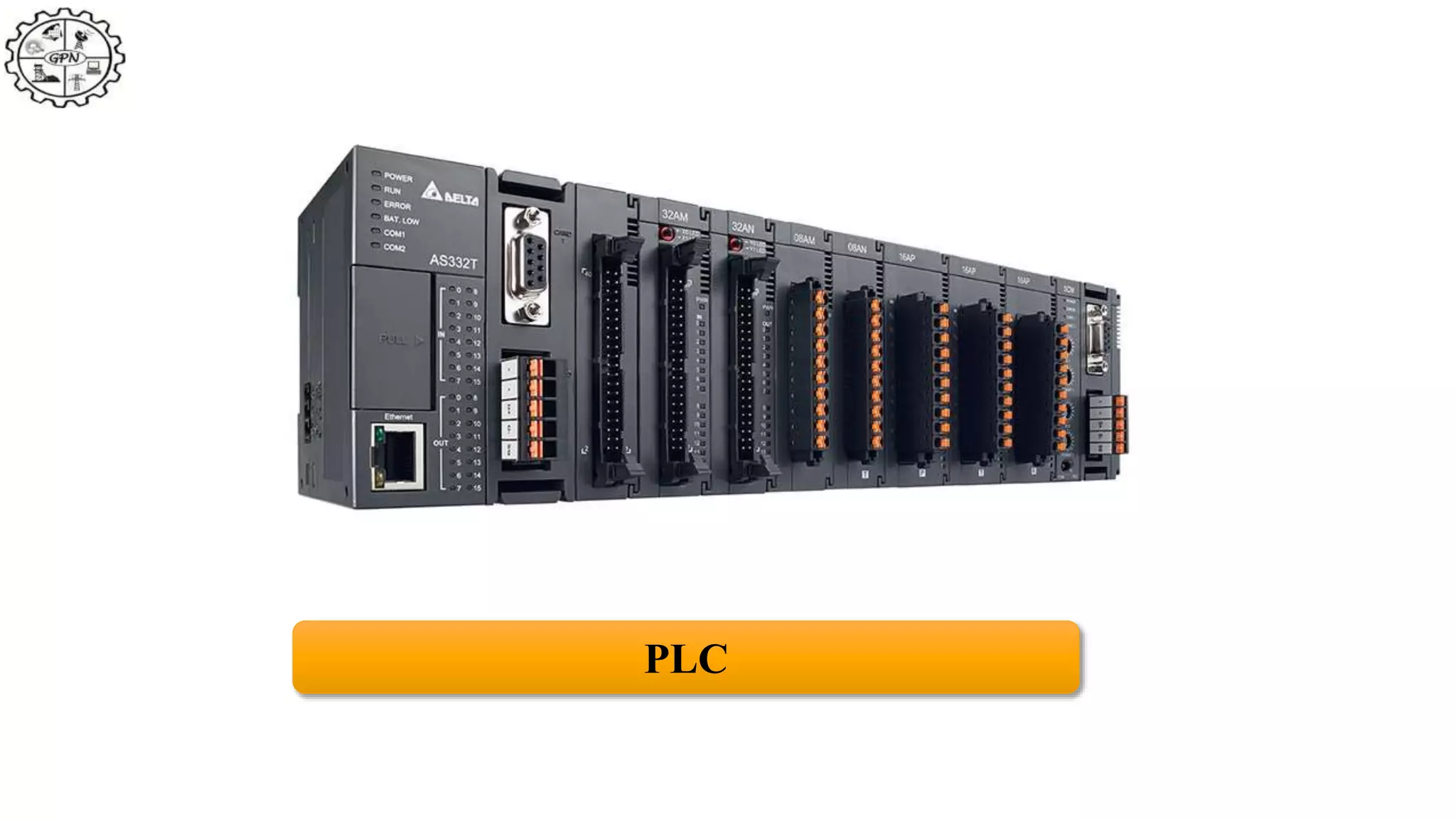
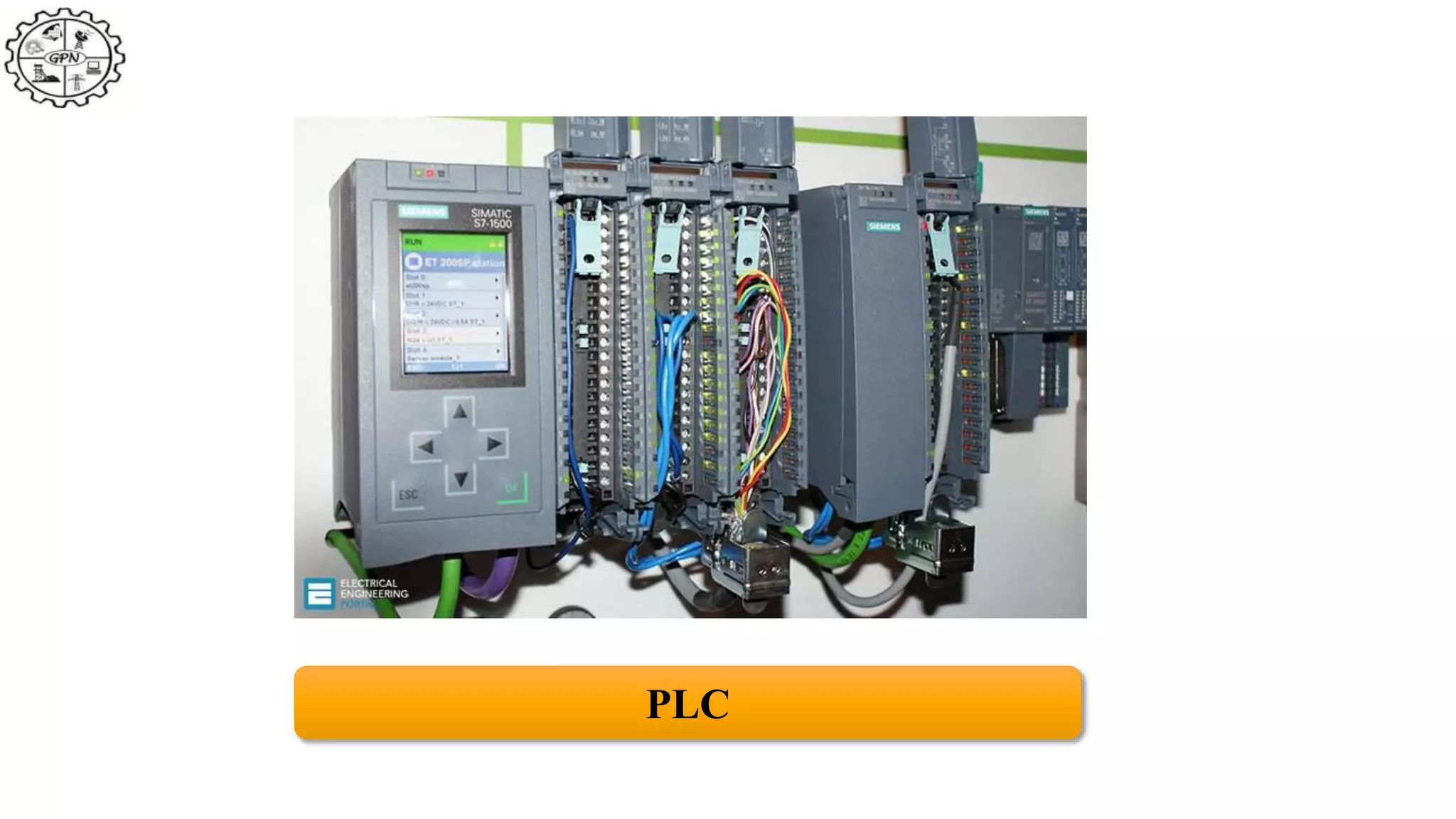
• A Programmable Logic Controller (PLC), also referred to as programmable
controller, is the name given to a type of computer commonly used in commercial
and industrial control applications.
• The PLC receives information from connected sensors or input devices, processes
the data, and triggers outputs based on pre-programmed parameters.
• Depending on the inputs and outputs, a PLC can monitor and record run-time data
such as machine productivity or operating temperature, automatically start and stop
processes, generate alarms if a machine malfunctions, and more. Programmable
Logic Controllers are a flexible and robust control solution, adaptable to almost any
application.
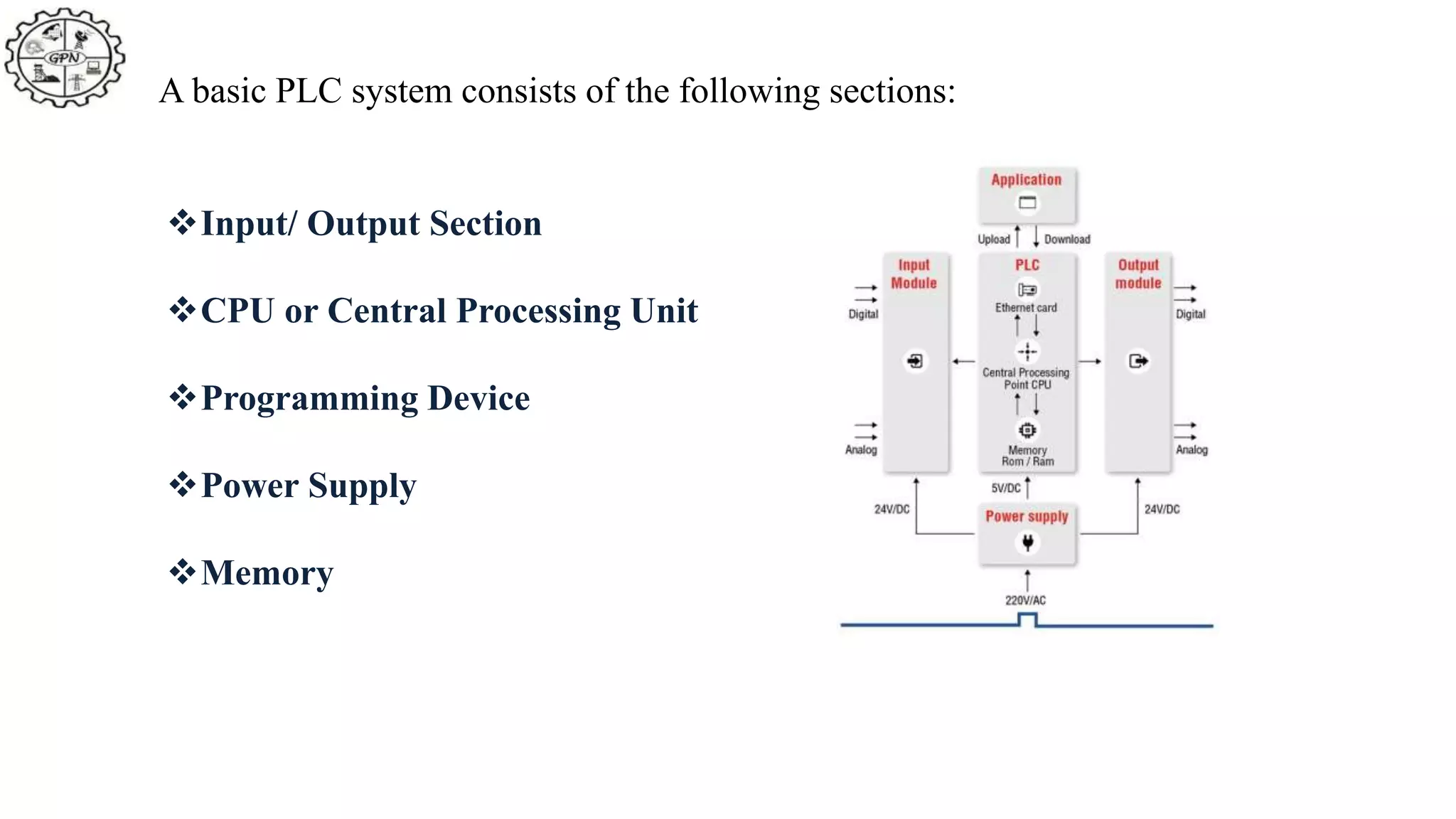
A basic PLC system consists of the following sections:
Input/ Output Section
CPU or Central Processing Unit
Programming Device
Power Supply
Memory
Programming Languages
A program loaded into PLC systems in machine code, a sequence of binary code
numbers to represent the program instructions.
Assembly language based on the use of mnemonics can be used, and a computer
program called an assembler is used to translate the mnemonics into machine code.
High level Languages (C, BASIC, etc.) can be used.
Programming Devices
PLC can be reprogrammed through an appropriate programming device:
1. Programming Console
2.PC
3.Hand Programmer
Introduction to Ladder Logic
Ladder logic uses graphic symbols similar to relay schematic circuit diagrams.
Ladder diagram consists of two vertical lines representing the power rails. Circuits
are connected as horizontal lines between these two vertical
PLC
PLC
4. Sensors
What is sensors?
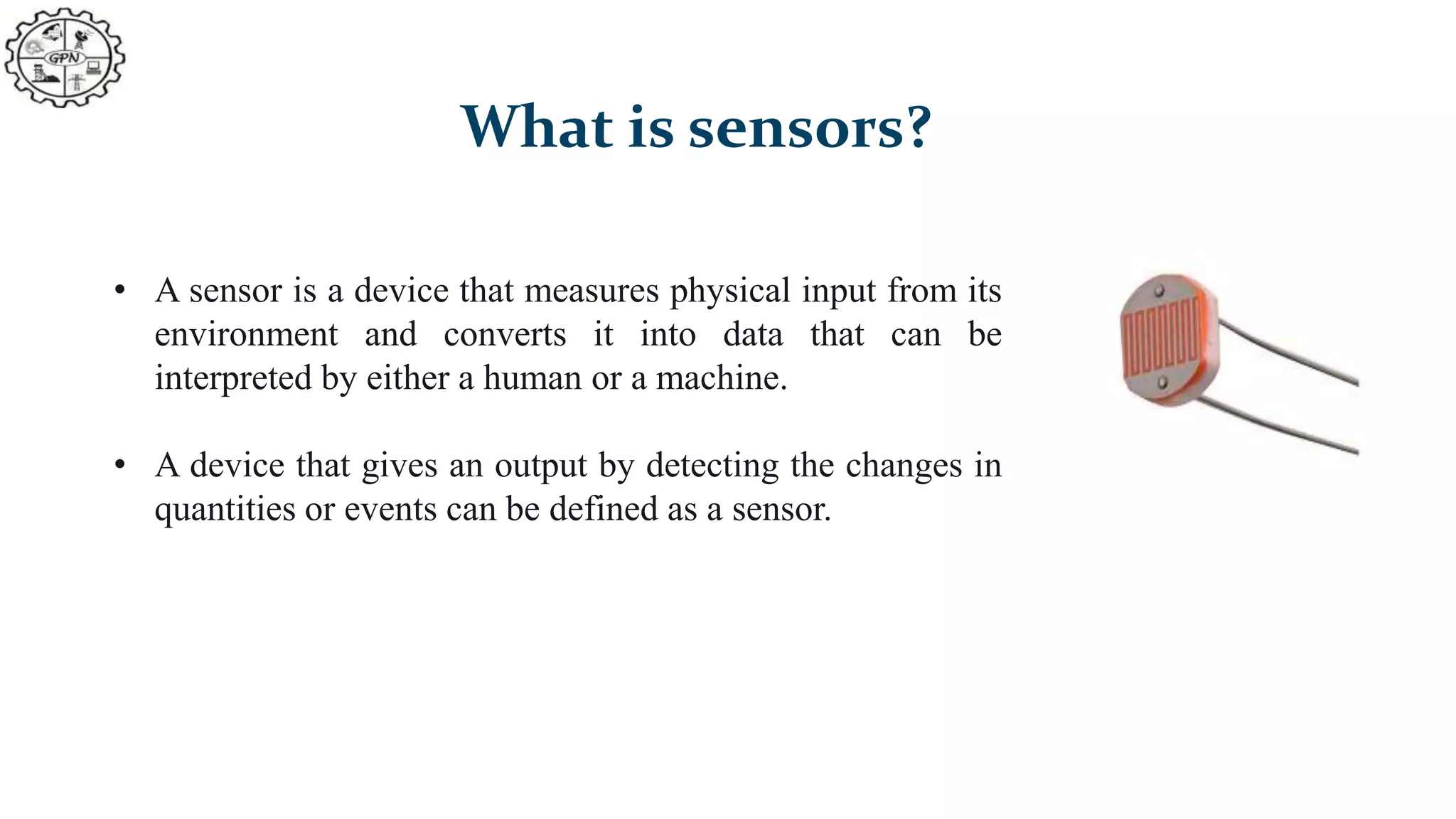
• A sensor is a device that measures physical input from its
environment and converts it into data that can be
interpreted by either a human or a machine.
• A device that gives an output by detecting the changes in
quantities or events can be defined as a sensor.
Types of sensors used in Automation
• Temperature Sensors
• Pressure sensors
• MEMS Sensors
• Torque Sensors
• Light Sensors
• Ultrasonic Sensors
• A temperature sensor is an electronic device that measures the temperature
of its environment and converts the input data into electronic data to record,
monitor, or signal temperature changes.
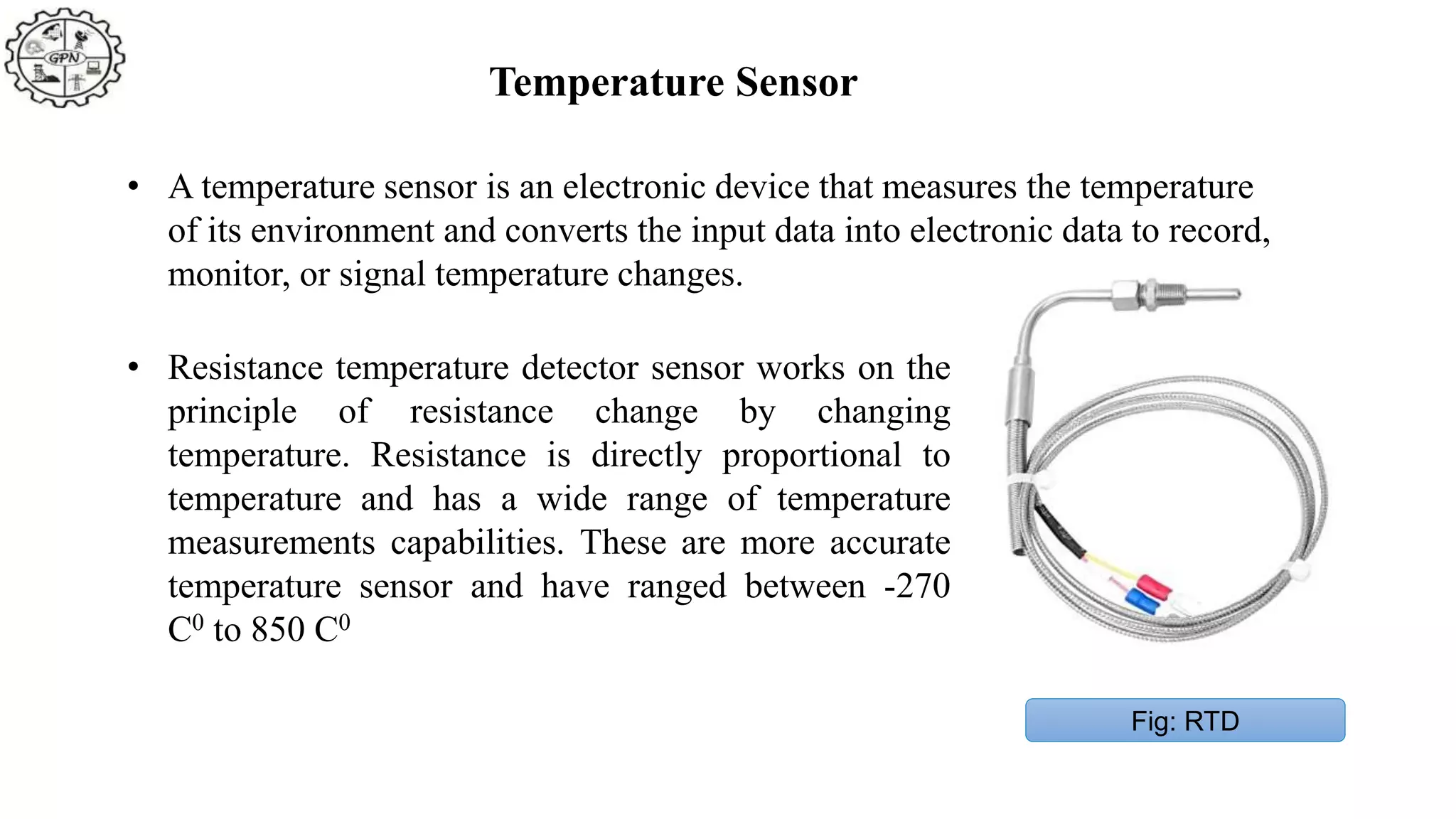
Fig: RTD
• Resistance temperature detector sensor works on the
principle of resistance change by changing
temperature. Resistance is directly proportional to
temperature and has a wide range of temperature
measurements capabilities. These are more accurate
temperature sensor and have ranged between -270
C0 to 850 C0
Temperature Sensor
Application of Temperature sensor:
1. Manufacturing Industries
2. Automobile
3. Medical
4. Aerospace & Automotive
5. Household appliances
6. HVAC
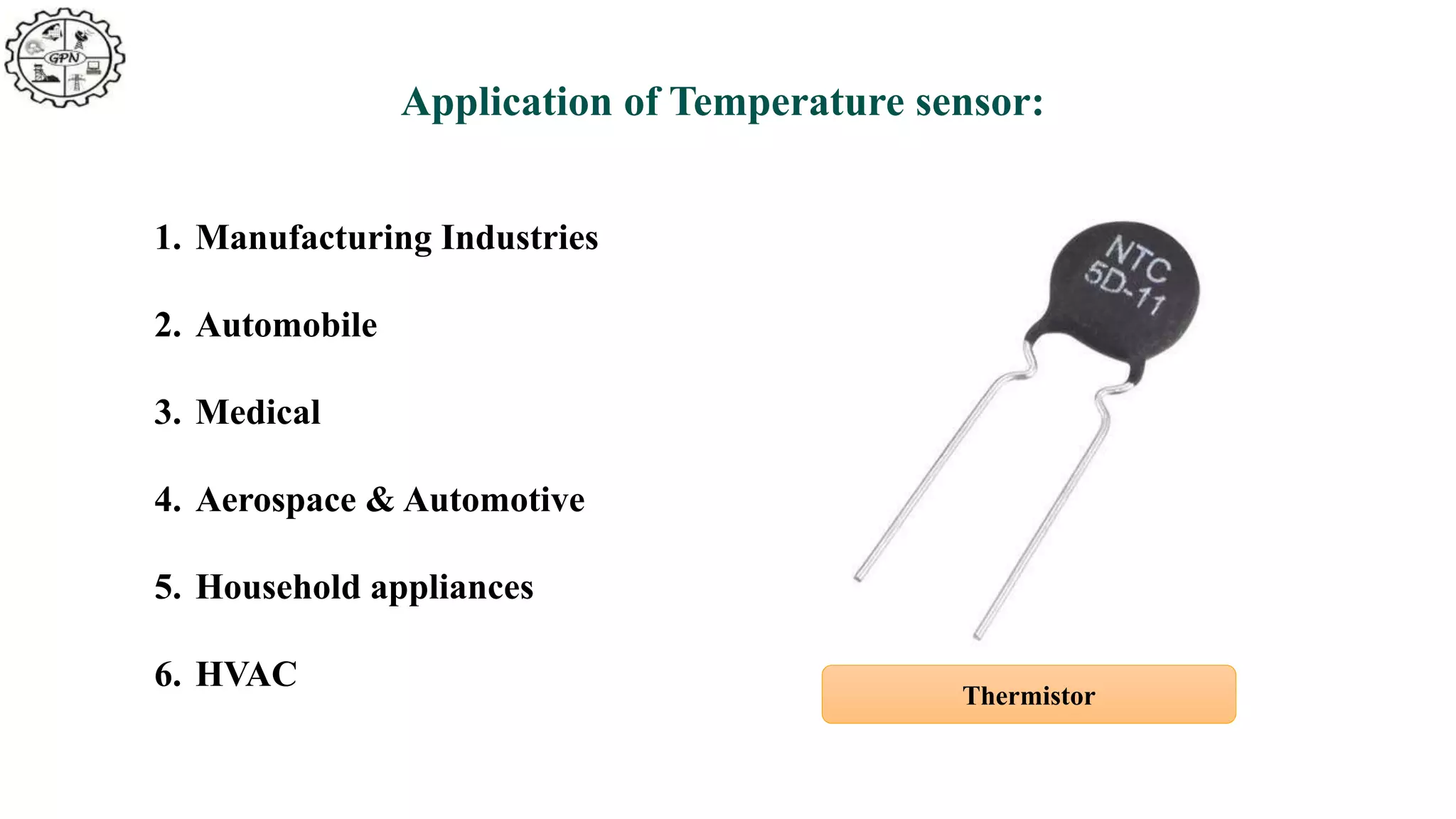
Thermistor
Pressure Sensors
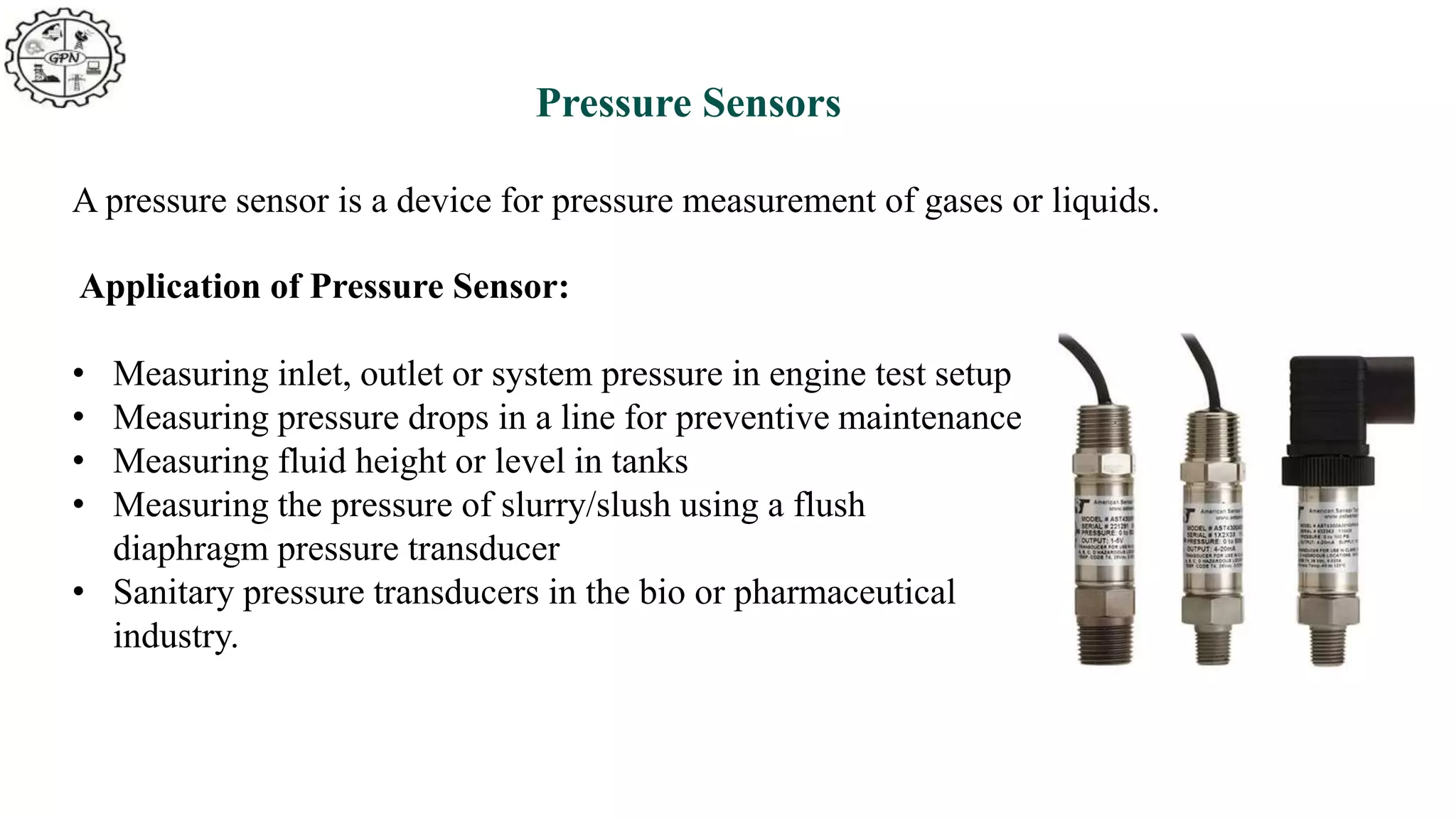
A pressure sensor is a device for pressure measurement of gases or liquids.
Application of Pressure Sensor:
• Measuring inlet, outlet or system pressure in engine test setup
• Measuring pressure drops in a line for preventive maintenance
• Measuring fluid height or level in tanks
• Measuring the pressure of slurry/slush using a flush
diaphragm pressure transducer
• Sanitary pressure transducers in the bio or pharmaceutical
industry.
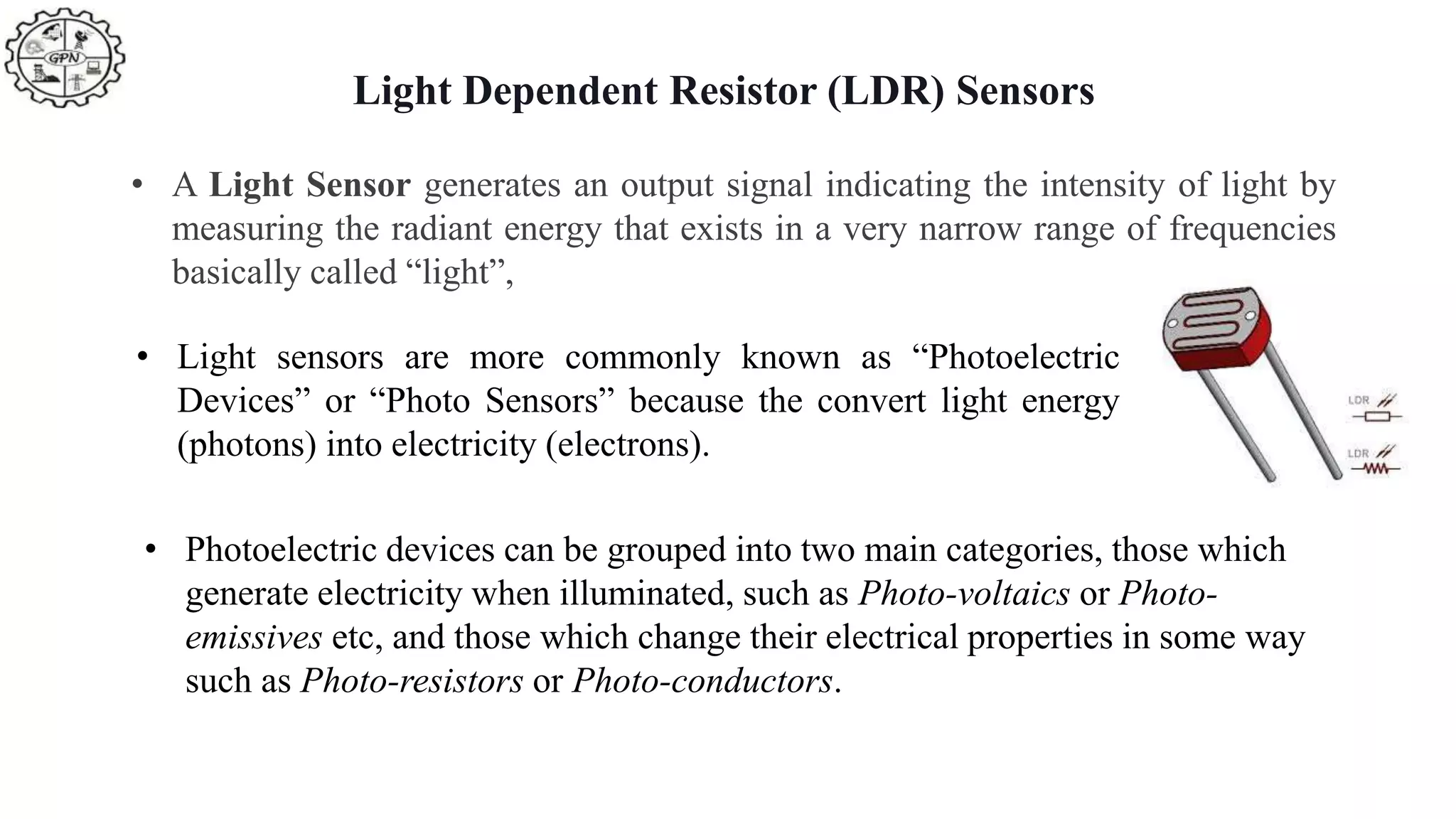
Light Dependent Resistor (LDR) Sensors
• A Light Sensor generates an output signal indicating the intensity of light by
measuring the radiant energy that exists in a very narrow range of frequencies
basically called “light”,
• Light sensors are more commonly known as “Photoelectric
Devices” or “Photo Sensors” because the convert light energy
(photons) into electricity (electrons).
• Photoelectric devices can be grouped into two main categories, those which
generate electricity when illuminated, such as Photo-voltaics or Photo-
emissives etc, and those which change their electrical properties in some way
such as Photo-resistors or Photo-conductors.
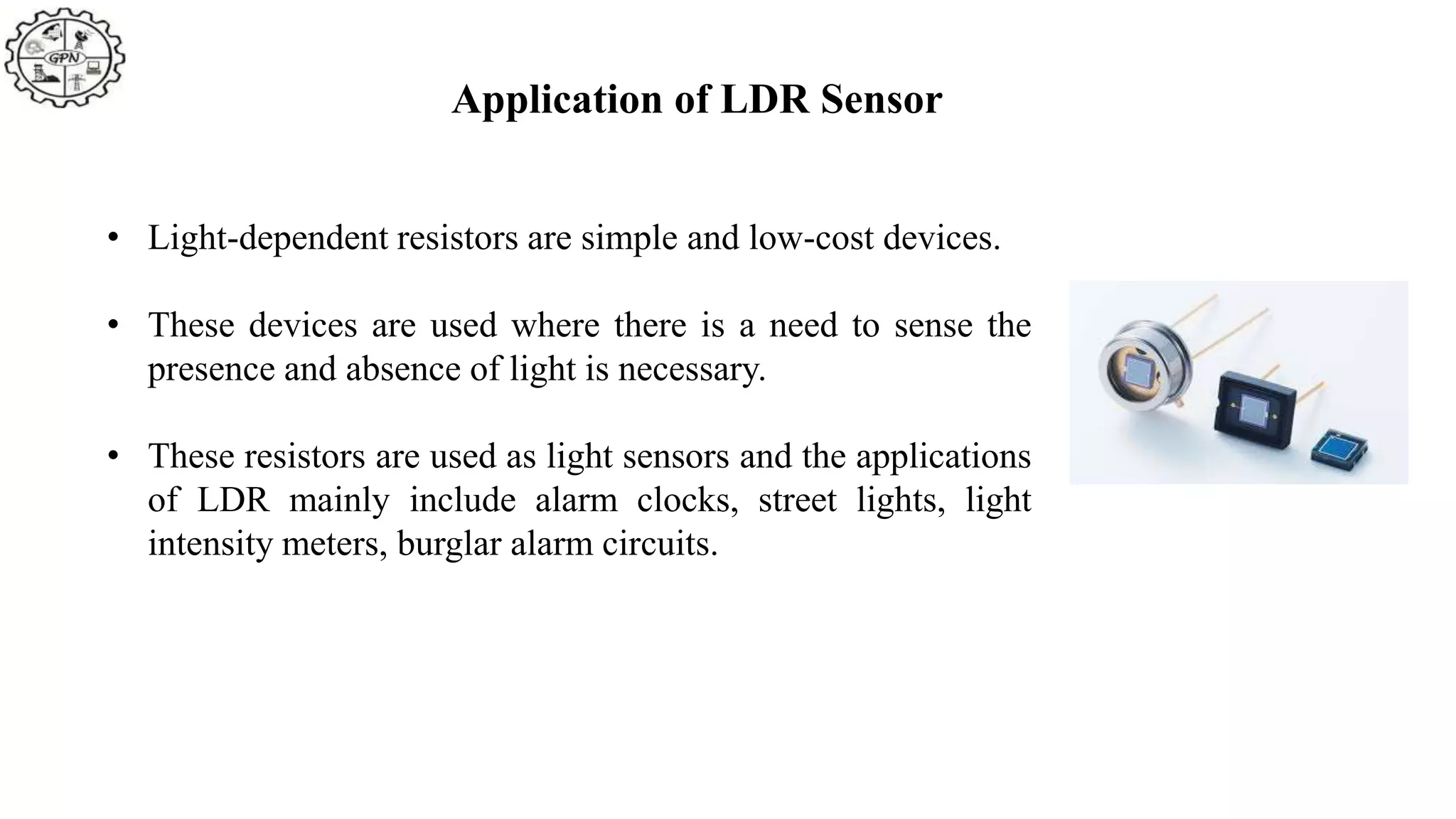
Application of LDR Sensor
• Light-dependent resistors are simple and low-cost devices.
• These devices are used where there is a need to sense the
presence and absence of light is necessary.
• These resistors are used as light sensors and the applications
of LDR mainly include alarm clocks, street lights, light
intensity meters, burglar alarm circuits.
Role of sensor in Automation
1. Robot designs able to withstand the challenging conditions that exist
in many industrial applications.
2. High accuracy that provides the correct data and information to the
factory systems and analytics.
3. High-resolution capability that can detect the slightest changes in
any parameter being measured.
4. Long term stability where the sensors performance remains the same
over years of service. This eliminates the need for costly recalibration
cycles and periodic maintenance.
5. Electric
drives
• An Electric Drive can be defined as, a system which is used to control the
movement of an electrical machine.
• An electric drive can be built with an electric drive motor as well as a
complicated control system to control the motor’s rotation shaft.
• At present, the controlling of this can be done simply using the software.
• Thus, the controlling turns into more accurate & this drive concept also
offers the ease of utilizing.
Electric Drives
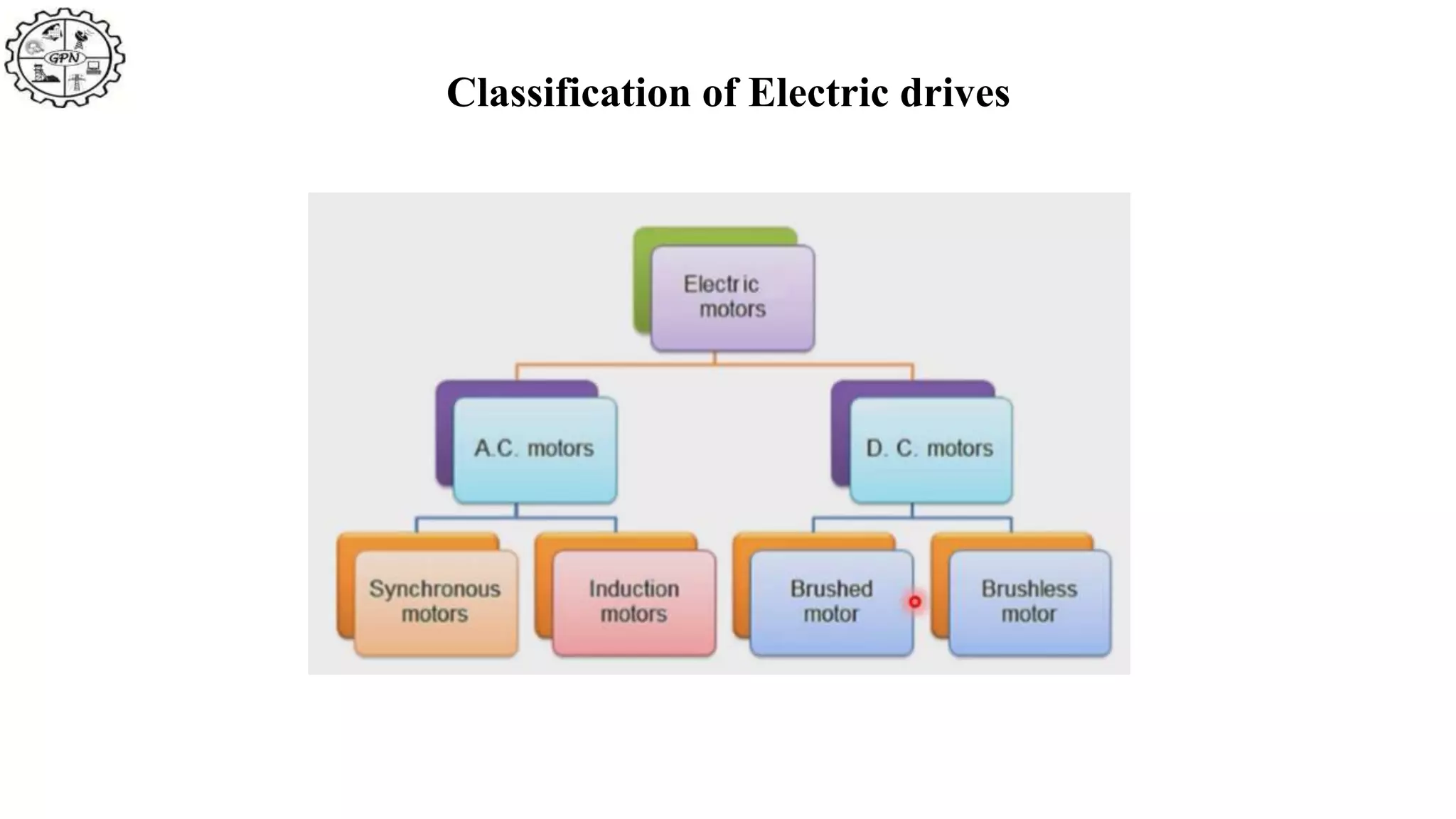
Classification of Electric drives
AC Motors:
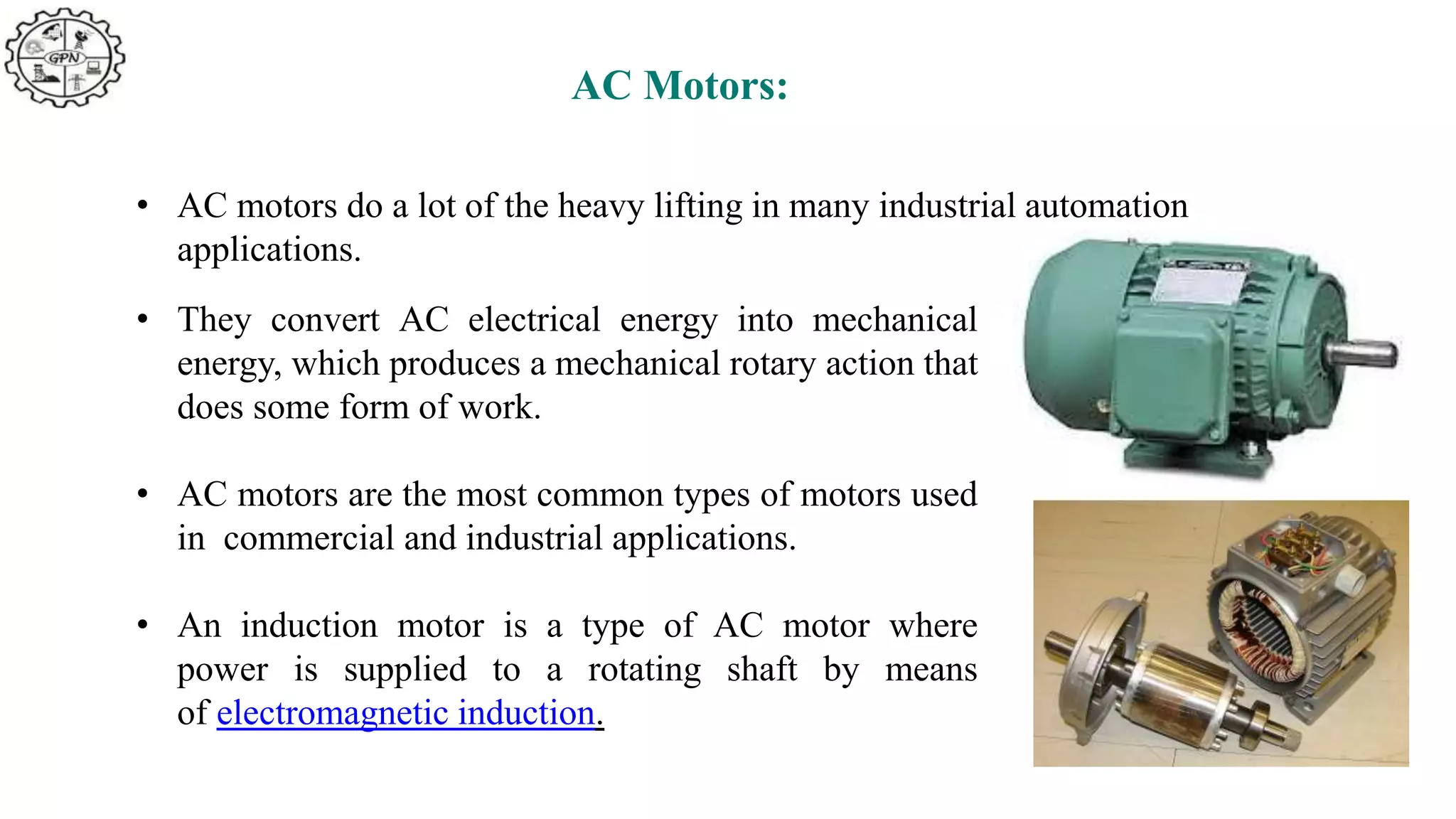
• AC motors do a lot of the heavy lifting in many industrial automation
applications.
• They convert AC electrical energy into mechanical
energy, which produces a mechanical rotary action that
does some form of work.
• AC motors are the most common types of motors used
in commercial and industrial applications.
• An induction motor is a type of AC motor where
power is supplied to a rotating shaft by means
of electromagnetic induction.
DC Motors:
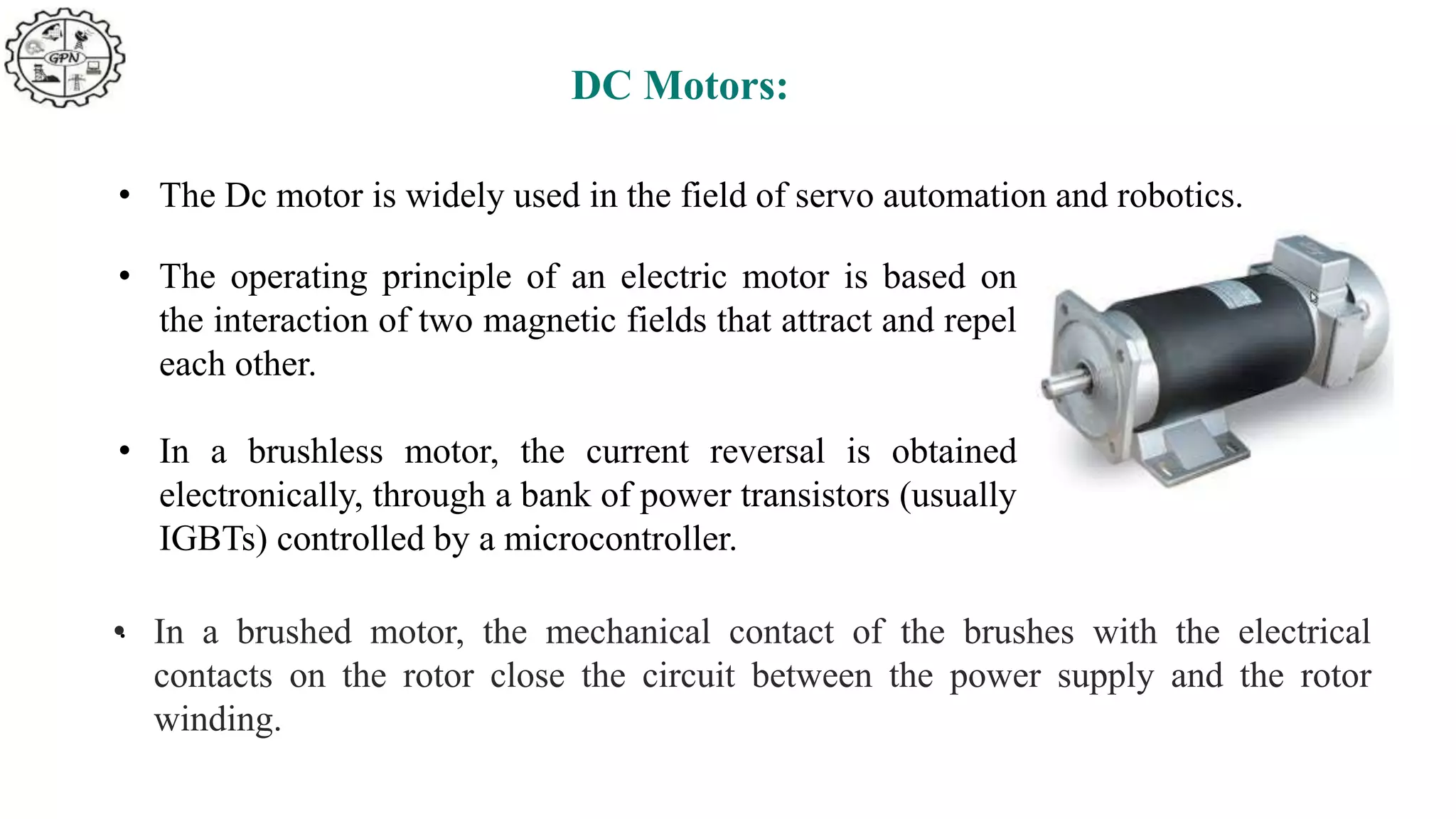
• The Dc motor is widely used in the field of servo automation and robotics.
• The operating principle of an electric motor is based on
the interaction of two magnetic fields that attract and repel
each other.
• In a brushless motor, the current reversal is obtained
electronically, through a bank of power transistors (usually
IGBTs) controlled by a microcontroller.
.
• In a brushed motor, the mechanical contact of the brushes with the electrical
contacts on the rotor close the circuit between the power supply and the rotor
winding.
Stepper Motors:
A stepper motor, also known as step motor or stepping motor, is a brushless DC
electric motor that divides a full rotation into a number of equal steps.
Application of Stepper Motor in automation:
• Used in positioning systems.
• They are used in numeric control of machine tools.
• The Stepper Motor are in spacecrafts launched for
• scientific explorations of the planets etc.
• The stepper motor also use in X-Y plotter and robotics.
Servo Motors:
• A servo motor is a type of motor that can rotate with great precision. Normally
this type of motor consists of a control circuit that provides feedback on the
current position of the motor shaft, this feedback allows the servo motors to
rotate with great precision
• If you want to rotate an object at
some specific angles or distance,
then you use a servo motor.
Application of Servo Motors:
• The servo motor is used in robotics to activate movements, giving the arm to its
precise angle.
• The Servo motor is used to start, move and stop conveyor belts carrying the
product along with many stages. For instance, product labeling, bottling and
packaging.
.
• The Servo motor is used in Textiles to control spinning and weaving machines,
knitting machines and looms
• The Servo motor is used in automatic door openers to control the door in public
places like supermarkets, hospitals and theatres.
CONCLUSION
 Automation is the use of machines, control systems and information technologies to optimize
productivity in the production of goods and delivery services.
 The correct incentive for applying automation is to increase productivity, and/or quality
beyond that possible, with current human labor level so as to realize economies of scale,
and/or realia predictable quality even.
 The incorrect application of automation, which occurs most often, is an effort to eliminate or
replace human labor.
 As we all know that the branch instrumentation plays a very important role in the
management of automation in any industry or process plan. Each and every process requires
the need of certain specific instruments for their controlling.
 When the word automation comes into play, instrumentation automatically involves in it.
Without the help of instrumentation it is not possible to apply automation in any industry.
REFERENCE
https://www.google.com/search?q=idustrial/automation
https://swayam.gov.in/NPTEL
https://www.youtube.com/results?search_query=industrial+automation
1. HMT Ltd. Mechatronics, Tata McGraw‐Hill, New Delhi, 1988
2. Bolton, W., Mechatronics: electronic control systems in mechanical
and electrical engineering, Longman, Singapore,1999.
Thank You

Presentation on Industrial Automation by Vivek Atalkar

  • 2.
    Government Polytechnic Nagpur Name: Vivek Atalkar Enroll : 1822006 Prog. : ME-II shift Guided by : Prof. Y. Gaiky
  • 3.
    Content 01 Introduction toIndustrial Automation 02 SCADA (Supervisory Control And Data Acquisition ) 03 Programmable Logic Controller (PLC) 04 Sensors and Transducer Electric Drives 05
  • 4.
  • 5.
    What is IndustrialAutomation? Industrial automation is the use of control systems, such as computers or robots, and information technologies for handling different processes and machineries in an industry to replace a human being. It is the second step beyond mechanization in the scope of industrialization.
  • 8.
    In the industrialautomation section, sensors play a very important role to make the products intelligent and highly automatic. Sensors The main function of a signal conditioner is to pick up the signal and convert it into a higher level of electrical signal. Signal conversion is often used by industrial applications. Signal Conditioning Both pneumatics and hydraulics are applications of fluid power. Pneumatics uses an easily compressible gas such as air or a suitable pure gas—while hydraulics uses relatively incompressible liquid media such as oil.. Hydraulic System PLC's act as the physical interfaces between devices on the plant or manufacturing floor and a SCADA or HMI system. PLC Electrical drives are major component in industrial applications, driven technical developments and focus of various developments. The core component of every electrical drive is the motor. . Electrical Drives Industrial Automation PLC Elements of industrial Automation
  • 9.
    $ Need Prevent Products orMaterials from Being Damaged or Destroyed Increase Efficiency and Save money Collect better Data & Devise the Right Process Improvements Reduce Worker Fatigue and Effort or Labor Intensive Operation Why You Need To Invest In Industrial Automation? X
  • 10.
  • 11.
    What is SCADA? •A SCADA system is a collection of both software and hardware components that allow supervision and control of plants, both locally and remotely. • Basically consists of data accessing featuring and controlling remotely. • Conversion of data is possible i.e. Analog to Digital and vice-versa. • Can communicate to any of the protocols available in market. • Completely rely on windows based system. • SCADA is not dedicated to any one type of application or industry.
  • 12.
  • 13.
    While these systemssimplify a given infrastructure, their components are quite complex. There are five essential composing parts of a SCADA system: •Human Machine Interface (HMI) •supervisory system •Remote Terminal Units (RTUs) •Programmable Logic Controllers (PLCs) •communication infrastructures
  • 14.
    Components of SCADASystem Supervisory computers This is the core of the SCADA system, gathering data on the process and sending control commands to the field connected devices. It refers to the computer and software responsible for communicating with the field connection controllers. Remote terminal units (RTUS) Remote terminal units, also known as (RTJS), connect to sensors and actuators in the process, and are networked to the supervisory computer system. Programmable logic controllers(PLCS) These are connected to sensors and actuators in the process, and are networked to the supervisory system and are programmed in one or more IEC 61131-3 programming languages.
  • 15.
    Function of SCADA ASCADA system performs four functions: • Data acquisition • Networked data communication • Data presentation • Control
  • 16.
    Function of SCADA 1.Sensors (either digital or analog) and control relays that directly interface with the managed system. 2. Remote telemetry units (RTUs). These are small computerized units deployed in the field at specific sites and locations. RTUs serve as local collection points for gathering reports from sensors and delivering commands to control relays. 3. SCADA master units. These are larger computer consoles that serve as the central processor for the SCADA system. Master units provide a human interface to the system and automatically regulate the managed system in response to sensor inputs. 4. The communications network that connects the SCADA master unit to the RTUs in the field.
  • 17.
  • 18.
    What is PLC? •A Programmable Logic Controller (PLC), also referred to as programmable controller, is the name given to a type of computer commonly used in commercial and industrial control applications. • The PLC receives information from connected sensors or input devices, processes the data, and triggers outputs based on pre-programmed parameters. • Depending on the inputs and outputs, a PLC can monitor and record run-time data such as machine productivity or operating temperature, automatically start and stop processes, generate alarms if a machine malfunctions, and more. Programmable Logic Controllers are a flexible and robust control solution, adaptable to almost any application.
  • 19.
    A basic PLCsystem consists of the following sections: Input/ Output Section CPU or Central Processing Unit Programming Device Power Supply Memory
  • 20.
    Programming Languages A programloaded into PLC systems in machine code, a sequence of binary code numbers to represent the program instructions. Assembly language based on the use of mnemonics can be used, and a computer program called an assembler is used to translate the mnemonics into machine code. High level Languages (C, BASIC, etc.) can be used. Programming Devices PLC can be reprogrammed through an appropriate programming device: 1. Programming Console 2.PC 3.Hand Programmer Introduction to Ladder Logic Ladder logic uses graphic symbols similar to relay schematic circuit diagrams. Ladder diagram consists of two vertical lines representing the power rails. Circuits are connected as horizontal lines between these two vertical
  • 21.
  • 22.
  • 23.
  • 24.
    What is sensors? •A sensor is a device that measures physical input from its environment and converts it into data that can be interpreted by either a human or a machine. • A device that gives an output by detecting the changes in quantities or events can be defined as a sensor.
  • 25.
    Types of sensorsused in Automation • Temperature Sensors • Pressure sensors • MEMS Sensors • Torque Sensors • Light Sensors • Ultrasonic Sensors
  • 26.
    • A temperaturesensor is an electronic device that measures the temperature of its environment and converts the input data into electronic data to record, monitor, or signal temperature changes. Fig: RTD • Resistance temperature detector sensor works on the principle of resistance change by changing temperature. Resistance is directly proportional to temperature and has a wide range of temperature measurements capabilities. These are more accurate temperature sensor and have ranged between -270 C0 to 850 C0 Temperature Sensor
  • 27.
    Application of Temperaturesensor: 1. Manufacturing Industries 2. Automobile 3. Medical 4. Aerospace & Automotive 5. Household appliances 6. HVAC Thermistor
  • 28.
    Pressure Sensors A pressuresensor is a device for pressure measurement of gases or liquids. Application of Pressure Sensor: • Measuring inlet, outlet or system pressure in engine test setup • Measuring pressure drops in a line for preventive maintenance • Measuring fluid height or level in tanks • Measuring the pressure of slurry/slush using a flush diaphragm pressure transducer • Sanitary pressure transducers in the bio or pharmaceutical industry.
  • 29.
    Light Dependent Resistor(LDR) Sensors • A Light Sensor generates an output signal indicating the intensity of light by measuring the radiant energy that exists in a very narrow range of frequencies basically called “light”, • Light sensors are more commonly known as “Photoelectric Devices” or “Photo Sensors” because the convert light energy (photons) into electricity (electrons). • Photoelectric devices can be grouped into two main categories, those which generate electricity when illuminated, such as Photo-voltaics or Photo- emissives etc, and those which change their electrical properties in some way such as Photo-resistors or Photo-conductors.
  • 30.
    Application of LDRSensor • Light-dependent resistors are simple and low-cost devices. • These devices are used where there is a need to sense the presence and absence of light is necessary. • These resistors are used as light sensors and the applications of LDR mainly include alarm clocks, street lights, light intensity meters, burglar alarm circuits.
  • 31.
    Role of sensorin Automation 1. Robot designs able to withstand the challenging conditions that exist in many industrial applications. 2. High accuracy that provides the correct data and information to the factory systems and analytics. 3. High-resolution capability that can detect the slightest changes in any parameter being measured. 4. Long term stability where the sensors performance remains the same over years of service. This eliminates the need for costly recalibration cycles and periodic maintenance.
  • 32.
  • 33.
    • An ElectricDrive can be defined as, a system which is used to control the movement of an electrical machine. • An electric drive can be built with an electric drive motor as well as a complicated control system to control the motor’s rotation shaft. • At present, the controlling of this can be done simply using the software. • Thus, the controlling turns into more accurate & this drive concept also offers the ease of utilizing. Electric Drives
  • 34.
  • 35.
    AC Motors: • ACmotors do a lot of the heavy lifting in many industrial automation applications. • They convert AC electrical energy into mechanical energy, which produces a mechanical rotary action that does some form of work. • AC motors are the most common types of motors used in commercial and industrial applications. • An induction motor is a type of AC motor where power is supplied to a rotating shaft by means of electromagnetic induction.
  • 36.
    DC Motors: • TheDc motor is widely used in the field of servo automation and robotics. • The operating principle of an electric motor is based on the interaction of two magnetic fields that attract and repel each other. • In a brushless motor, the current reversal is obtained electronically, through a bank of power transistors (usually IGBTs) controlled by a microcontroller. . • In a brushed motor, the mechanical contact of the brushes with the electrical contacts on the rotor close the circuit between the power supply and the rotor winding.
  • 37.
    Stepper Motors: A steppermotor, also known as step motor or stepping motor, is a brushless DC electric motor that divides a full rotation into a number of equal steps. Application of Stepper Motor in automation: • Used in positioning systems. • They are used in numeric control of machine tools. • The Stepper Motor are in spacecrafts launched for • scientific explorations of the planets etc. • The stepper motor also use in X-Y plotter and robotics.
  • 38.
    Servo Motors: • Aservo motor is a type of motor that can rotate with great precision. Normally this type of motor consists of a control circuit that provides feedback on the current position of the motor shaft, this feedback allows the servo motors to rotate with great precision • If you want to rotate an object at some specific angles or distance, then you use a servo motor.
  • 39.
    Application of ServoMotors: • The servo motor is used in robotics to activate movements, giving the arm to its precise angle. • The Servo motor is used to start, move and stop conveyor belts carrying the product along with many stages. For instance, product labeling, bottling and packaging. . • The Servo motor is used in Textiles to control spinning and weaving machines, knitting machines and looms • The Servo motor is used in automatic door openers to control the door in public places like supermarkets, hospitals and theatres.
  • 40.
    CONCLUSION  Automation isthe use of machines, control systems and information technologies to optimize productivity in the production of goods and delivery services.  The correct incentive for applying automation is to increase productivity, and/or quality beyond that possible, with current human labor level so as to realize economies of scale, and/or realia predictable quality even.  The incorrect application of automation, which occurs most often, is an effort to eliminate or replace human labor.  As we all know that the branch instrumentation plays a very important role in the management of automation in any industry or process plan. Each and every process requires the need of certain specific instruments for their controlling.  When the word automation comes into play, instrumentation automatically involves in it. Without the help of instrumentation it is not possible to apply automation in any industry.
  • 41.
    REFERENCE https://www.google.com/search?q=idustrial/automation https://swayam.gov.in/NPTEL https://www.youtube.com/results?search_query=industrial+automation 1. HMT Ltd.Mechatronics, Tata McGraw‐Hill, New Delhi, 1988 2. Bolton, W., Mechatronics: electronic control systems in mechanical and electrical engineering, Longman, Singapore,1999.
  • 42.