Introduction to
Programmable Controllers
D R . TAREK TUTUNJI
P H I L A D E L P H I A U N I V E R S I T Y , J O R D A N
Definition
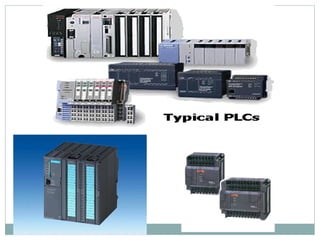
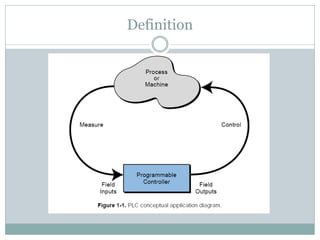
 Programmable logic controllers, also called
programmable controllers or PLCs, are solid-state
members of the computer family, using integrated
circuits instead of electromechanical devices to
implement control functions.
 They are capable of storing instructions, such as
sequencing, timing, counting, arithmetic, data
manipulation, and communication, to control
industrial machines and processes.
Definition
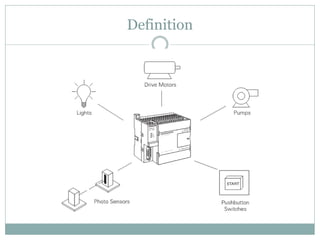
 PLCs are industrial computers with specially
designed architecture in both their central units (the
PLC itself) and their interfacing circuitry to field
devices (input/output connections to the real world).
Definition
Definition
Historical Background
 General Motors specified the design criteria for the first programmable
controller in 1968.
 Their primary goal was to eliminate the high costs associated with
inflexible, relay controlled systems.
 Initial Specification included the following:
 The new control system had to be price competitive with relay systems.
 The system had to be capable of sustaining an industrial environment.
 The input and output interfaces had to be easily replaceable.
 The control system needed to pass data collection to a central system.
 The system had to be reusable.
 The method used to program the controller had to be simple
Historical Background
 The first PLCs offered relay functionality, thus replacing the
original hardwired relay logic, which used electrically
operated devices to mechanically switch electrical circuits.
 They met the requirements of:
 Modularity.
 Expandability.
 Programmability.
 Ease of use in an industrial environment.
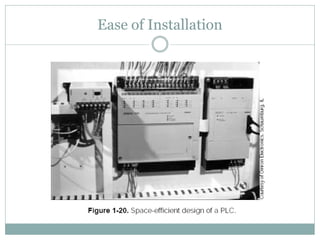
 Ease of installation.
 Used less space.
 Were reusable.
 The controller programming, although a little tedious, had a
recognizable plant standard: the ladder diagram format.
Historical Background
 By 1971, PLCs were being used to provide relay
replacement as the first steps toward control
automation in other industries, such as food and
beverage, metals, manufacturing, and pulp and
paper.
 Many technological advances in the programmable
controller industry continue today. Changes
include both hardware (physical components) and
software (control program) upgrades.
Historical Background:
PLC hardware enhancements
 Faster scan times.
 Small, low-cost PLCs with more power.
 High-density input/output (I/O) systems.
 Intelligent, microprocessor-based I/O interfaces such as
PID, network, and host computer.
 Mechanical design improvements have included: rugged
input/output enclosures and input/output systems that have
made the terminal an integral unit.
 Special interfaces have allowed certain devices to be
connected directly to the controller, such as thermocouples
and strain gauges.
 Peripheral equipment has improved operator interface
techniques
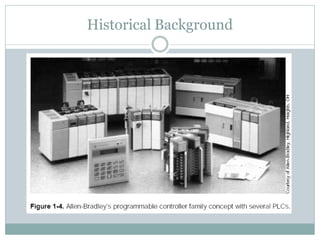
Historical Background
Historical Background:
PLC software enhancements
 Object-oriented programming tools have been
incorporated.
 Powerful instructions have been provided.
 High-level languages, such as BASIC and C, have been
implemented.
 Advanced functional block instructions have been
implemented for ladder diagram instruction.
 Diagnostics and fault detection have been expanded.
 Floating-point math has made it possible to perform
complex calculations.
 Data handling and manipulation instructions have been
improved and simplified.
Historical Background
 PLCs are being incorporated into computer-integrated manufacturing
(CIM) systems, robots, and CAD/CAM systems.
 Advances in PLC technology include features such as better operator
interfaces, graphic user interfaces (GUIs), and more human-oriented
man/machine interfaces (such as voice modules).
 Advances include development of interfaces that allow communication
with equipment, hardware, and software that supports artificial
intelligence, such as fuzzy logic I/O systems.
 New PLC instructions are developed out of the need to add intelligence
to a controller.
 The future will almost certainly continue to cast programmable
controllers as an important player in the factory.
Principles of Operation
Principles of Operations
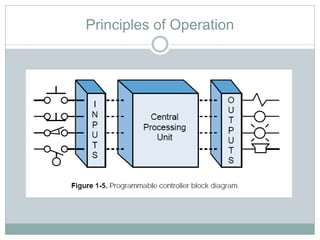
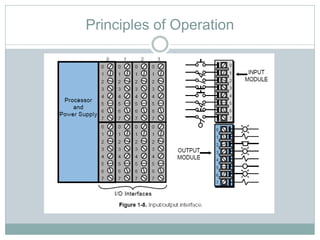
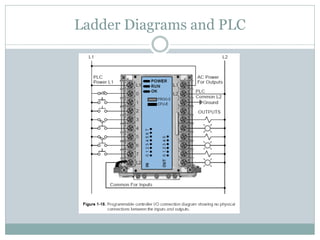
 The input/output system forms the interface by which field devices are
connected to the controller.
 The main purpose of the interface is to condition the various signals
received from or sent to external field devices.
 Incoming signals from sensors (e.g., push buttons, limit switches,
analog sensors, selector switches, and thumbwheel switches) are wired
to terminals on the input interfaces.
 Devices that will be controlled, like motor starters, solenoid valves, pilot
lights, and position valves, are connected to the terminals of the output
interfaces.
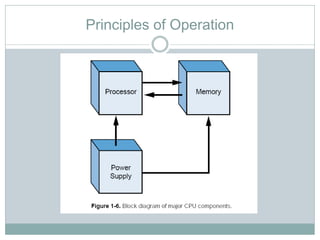
 The system power supply provides all the voltages required for the
proper operation of the various central processing unit sections.
Principles of Operation
Principles of Operation:
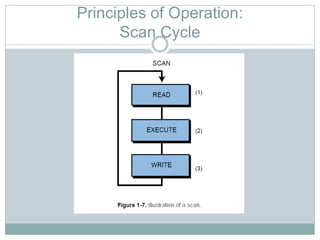
Scan Cycle
PLCs versus other controllers
 Is there a need for flexibility in control logic changes?
 Is there a need for high reliability?
 Are space requirements important?
 Are increased capability and output required?
 Are there data collection requirements?
 Will there be frequent control logic changes?
 Will there be a need for rapid modification?
 Must similar control logic be used on different machines?
 Is there a need for future growth?
 What are the overall costs?
PLC Applications
 Automotive.
 Chemical and Petrochemical.
 Glass Processing.
 Manufacturing and Machining.
 Materials Handling.
 Metals.
 Power.
 Pulp and Paper.
 Rubber and Plastic.
PLC Applications: Automotive
 Internal Combustion Engine Monitoring.
 Carburetor Production Testing.
 Monitoring Automotive Production
Machines.
 Power Steering Valve Assembly and
Testing.
PLC Applications:
Chemical and Petrochemical
 Dyes.
 Chemical Batching.
 Fan Control.
 Gas Transmission and Distribution.
 Pipeline Pump Station Control.
 Oil Fields.
PLC Applications:
Manufacturing / Machining
 Production Machines.
 Transfer Line Machines.
 Wire Machine.
 Tool Changing.
 Paint Spraying.
PLC Applications: Power
 Plant Power System.
 Energy Management.
 Coal Fluidization Processing.
 Compressor Efficiency Control.
Ladder Diagrams and PLC
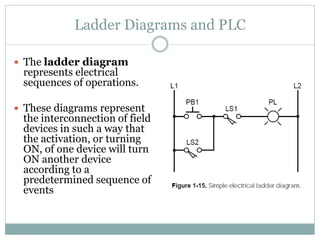
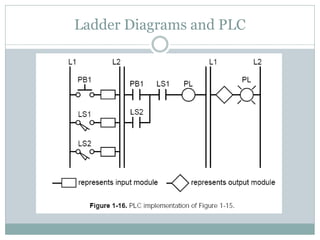
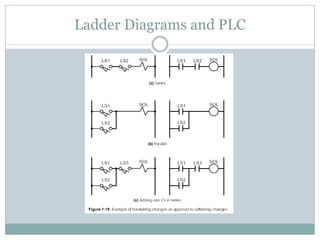
 The ladder diagram
represents electrical
sequences of operations.
 These diagrams represent
the interconnection of field
devices in such a way that
the activation, or turning
ON, of one device will turn
ON another device
according to a
predetermined sequence of
events
Ladder Diagrams and PLC
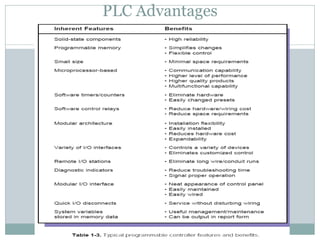
PLC Advantages
Ease of Installation
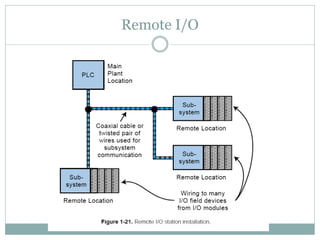
Remote I/O
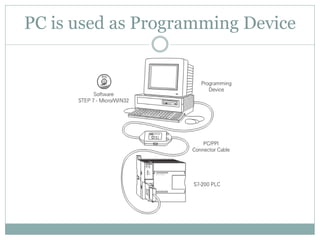
PC is used as Programming Device
R E F E R E N C E : P R O G R A M M A B L E C O N T R O L L E R S :
T H E O R Y A N D I M P L E M E N T A T I O N B Y B R Y A N A N D
B R Y A N

Introduction to Programmable Controllers

  • 1.
    Introduction to Programmable Controllers DR . TAREK TUTUNJI P H I L A D E L P H I A U N I V E R S I T Y , J O R D A N
  • 3.
    Definition  Programmable logiccontrollers, also called programmable controllers or PLCs, are solid-state members of the computer family, using integrated circuits instead of electromechanical devices to implement control functions.  They are capable of storing instructions, such as sequencing, timing, counting, arithmetic, data manipulation, and communication, to control industrial machines and processes.
  • 4.
    Definition  PLCs areindustrial computers with specially designed architecture in both their central units (the PLC itself) and their interfacing circuitry to field devices (input/output connections to the real world).
  • 5.
  • 6.
  • 7.
    Historical Background  GeneralMotors specified the design criteria for the first programmable controller in 1968.  Their primary goal was to eliminate the high costs associated with inflexible, relay controlled systems.  Initial Specification included the following:  The new control system had to be price competitive with relay systems.  The system had to be capable of sustaining an industrial environment.  The input and output interfaces had to be easily replaceable.  The control system needed to pass data collection to a central system.  The system had to be reusable.  The method used to program the controller had to be simple
  • 8.
    Historical Background  Thefirst PLCs offered relay functionality, thus replacing the original hardwired relay logic, which used electrically operated devices to mechanically switch electrical circuits.  They met the requirements of:  Modularity.  Expandability.  Programmability.  Ease of use in an industrial environment.  Ease of installation.  Used less space.  Were reusable.  The controller programming, although a little tedious, had a recognizable plant standard: the ladder diagram format.
  • 9.
    Historical Background  By1971, PLCs were being used to provide relay replacement as the first steps toward control automation in other industries, such as food and beverage, metals, manufacturing, and pulp and paper.  Many technological advances in the programmable controller industry continue today. Changes include both hardware (physical components) and software (control program) upgrades.
  • 10.
    Historical Background: PLC hardwareenhancements  Faster scan times.  Small, low-cost PLCs with more power.  High-density input/output (I/O) systems.  Intelligent, microprocessor-based I/O interfaces such as PID, network, and host computer.  Mechanical design improvements have included: rugged input/output enclosures and input/output systems that have made the terminal an integral unit.  Special interfaces have allowed certain devices to be connected directly to the controller, such as thermocouples and strain gauges.  Peripheral equipment has improved operator interface techniques
  • 11.
  • 12.
    Historical Background: PLC softwareenhancements  Object-oriented programming tools have been incorporated.  Powerful instructions have been provided.  High-level languages, such as BASIC and C, have been implemented.  Advanced functional block instructions have been implemented for ladder diagram instruction.  Diagnostics and fault detection have been expanded.  Floating-point math has made it possible to perform complex calculations.  Data handling and manipulation instructions have been improved and simplified.
  • 13.
    Historical Background  PLCsare being incorporated into computer-integrated manufacturing (CIM) systems, robots, and CAD/CAM systems.  Advances in PLC technology include features such as better operator interfaces, graphic user interfaces (GUIs), and more human-oriented man/machine interfaces (such as voice modules).  Advances include development of interfaces that allow communication with equipment, hardware, and software that supports artificial intelligence, such as fuzzy logic I/O systems.  New PLC instructions are developed out of the need to add intelligence to a controller.  The future will almost certainly continue to cast programmable controllers as an important player in the factory.
  • 14.
  • 15.
  • 16.
    Principles of Operations The input/output system forms the interface by which field devices are connected to the controller.  The main purpose of the interface is to condition the various signals received from or sent to external field devices.  Incoming signals from sensors (e.g., push buttons, limit switches, analog sensors, selector switches, and thumbwheel switches) are wired to terminals on the input interfaces.  Devices that will be controlled, like motor starters, solenoid valves, pilot lights, and position valves, are connected to the terminals of the output interfaces.  The system power supply provides all the voltages required for the proper operation of the various central processing unit sections.
  • 17.
  • 18.
  • 19.
    PLCs versus othercontrollers  Is there a need for flexibility in control logic changes?  Is there a need for high reliability?  Are space requirements important?  Are increased capability and output required?  Are there data collection requirements?  Will there be frequent control logic changes?  Will there be a need for rapid modification?  Must similar control logic be used on different machines?  Is there a need for future growth?  What are the overall costs?
  • 20.
    PLC Applications  Automotive. Chemical and Petrochemical.  Glass Processing.  Manufacturing and Machining.  Materials Handling.  Metals.  Power.  Pulp and Paper.  Rubber and Plastic.
  • 21.
    PLC Applications: Automotive Internal Combustion Engine Monitoring.  Carburetor Production Testing.  Monitoring Automotive Production Machines.  Power Steering Valve Assembly and Testing.
  • 22.
    PLC Applications: Chemical andPetrochemical  Dyes.  Chemical Batching.  Fan Control.  Gas Transmission and Distribution.  Pipeline Pump Station Control.  Oil Fields.
  • 23.
    PLC Applications: Manufacturing /Machining  Production Machines.  Transfer Line Machines.  Wire Machine.  Tool Changing.  Paint Spraying.
  • 24.
    PLC Applications: Power Plant Power System.  Energy Management.  Coal Fluidization Processing.  Compressor Efficiency Control.
  • 25.
    Ladder Diagrams andPLC  The ladder diagram represents electrical sequences of operations.  These diagrams represent the interconnection of field devices in such a way that the activation, or turning ON, of one device will turn ON another device according to a predetermined sequence of events
  • 26.
  • 27.
  • 28.
  • 29.
  • 30.
  • 31.
  • 32.
    PC is usedas Programming Device
  • 33.
    R E FE R E N C E : P R O G R A M M A B L E C O N T R O L L E R S : T H E O R Y A N D I M P L E M E N T A T I O N B Y B R Y A N A N D B R Y A N