Review and new Insights
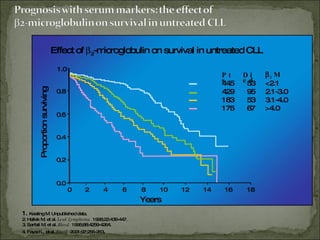
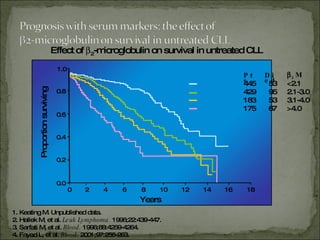
Effect of   2 -microglobulin on survival in untreated CLL Years Proportion surviving 16 0 2 4 6 8 10 12 14 1.0 18 0.8 0.6 0.4 0.0 0.2 1.  Keating M. Unpublished data. 2. Hallek M, et al.  Leuk Lymphoma.  1996;22:439-447. 3. Sarfati M, et al.  Blood.  1996;88:4259-4264. 4. Fayad L, et al.  Blood.  2001;97:256-263 .  Pts Died  2 M 445 53 <2.1 429 95 2.1-3.0 183 53 3.1-4.0 175 67 >4.0
Effect of   2 -microglobulin on survival in untreated CLL Years Proportion surviving 16 0 2 4 6 8 10 12 14 1.0 18 0.8 0.6 0.4 0.0 0.2 1. Keating M. Unpublished data. 2. Hallek M, et al.  Leuk Lymphoma.  1996;22:439-447. 3. Sarfati M, et al.  Blood.  1996;88:4259-4264. 4. Fayad L, et al.  Blood.  2001;97:256-263.  Pts Died  2 M 445 53 <2.1 429 95 2.1-3.0 183 53 3.1-4.0 175 67 >4.0
Clonal disorder of B and T lymphocytes Elderly patients usually 10% are < 50 yrs 50% are asymptomatic at diagnosis Lymph nodes Splenomegaly Fatigue Infections
Symptomatic patients Lymphadenopathy Splenomegaly Anemia Acquired Inhibitors  to VIII/VWF Bruising and bleeding Hypogammaglobulinemia Recurrent infections
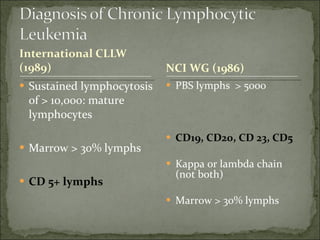
Sustained lymphocytosis of > 10,000: mature lymphocytes Marrow > 30% lymphs CD 5+ lymphs PBS lymphs  > 5000 CD19, CD20, CD 23, CD5 Kappa or lambda chain (not both) Marrow > 30% lymphs NCI WG (1986)
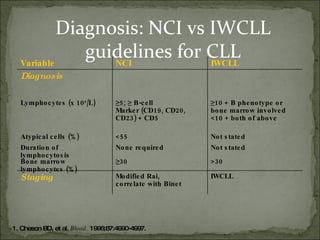
Diagnosis: NCI vs IWCLL guidelines for CLL 1. Cheson BD, et al.  Blood.  1996;87:4990-4997.   Variable NCI IWCLL Diagnosis Lymphocytes (x 10 9 /L) ≥ 5; ≥ B-cell Marker (CD19, CD20, CD23) + CD5 ≥ 10 + B phenotype or bone marrow involved <10 + both of above Atypical cells (%) <55 Not stated Duration of lymphocytosis None required Not stated Bone marrow lymphocytes (%) ≥ 30 >30 Staging Modified Rai, correlate with Binet IWCLL
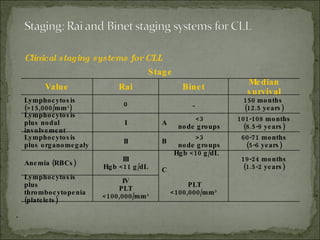
.  Clinical staging systems for CLL Stage Value Rai Binet Median survival Lymphocytosis (>15,000/mm 3 ) 0 - 150 months  (12.5 years) Lymphocytosis plus nodal involvement I A <3 node groups 101-108 months (8.5-9 years) Lymphocytosis plus organomegaly II B >3 node groups 60-71 months (5-6 years) Anemia (RBCs) III Hgb <11 g/dL C Hgb <10 g/dL  19-24 months (1.5-2 years) Lymphocytosis plus thrombocytopenia (platelets) IV PLT <100,000/mm 3 PLT <100,000/mm 3
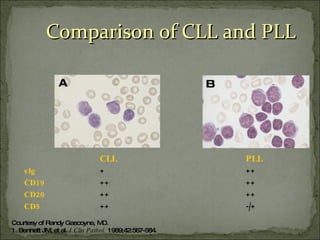
Comparison of CLL and PLL Courtesy of Randy Gascoyne, MD. 1. Bennett JM, et al.  J Clin Pathol.  1989;42:567-584.   CLL PLL slg + ++ CD19 ++ ++ CD20 ++ ++ CD5 ++ -/+
 
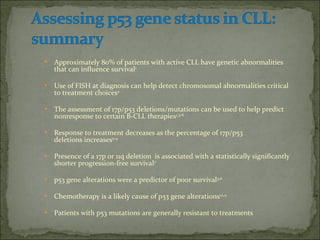
Approximately 80% of patients with active CLL have genetic abnormalities  that can influence survival 1 Use of FISH at diagnosis can help detect chromosomal abnormalities critical  to treatment choices 2 The assessment of 17p/p53 deletions/mutations can be used to help predict nonresponse to certain B-CLL therapies 1,3-6 Response to treatment decreases as the percentage of 17p/p53  deletions increases 5-9 Presence of a 17p or 11q deletion  is associated with a statistically significantly shorter progression-free survival 7 p53 gene alterations were a predictor of poor survival 5,6 Chemotherapy is a likely cause of p53 gene alterations 10,11 Patients with p53 mutations are generally resistant to treatments
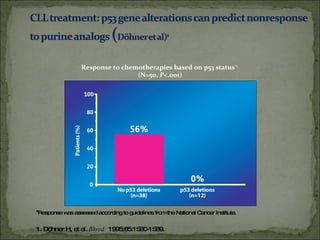
Response to chemotherapies based on p53 status *1  (N=50,  P <.001) 1. Döhner H, et al.  Blood.  1995;85:1580-1589. * Response was assessed according to guidelines from the National Cancer Institute.
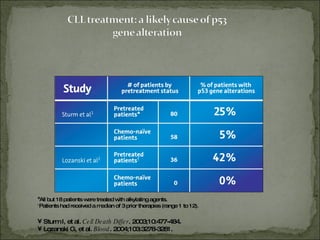
Sturm I, et al.  Cell Death Differ . 2003;10:477-484.  Lozanski G, et al.  Blood . 2004;103:3278-3281.   * All but 18 patients were treated with alkylating agents. † Patients had received a median of 3 prior therapies (range 1 to 12).
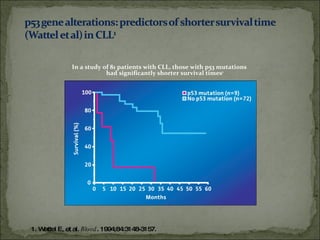
In a study of 81 patients with CLL, those with p53 mutations  had significantly shorter survival times 1 1. Wattel E, et al.  Blood . 1994;84:3148-3157.
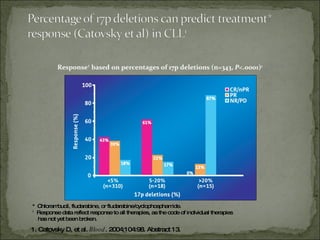
Response †  based on percentages of 17p deletions (n=343,  P <.0001) 1 1. Catovsky D, et al.  Blood . 2004;104:98. Abstract 13. *  Chlorambucil, fludarabine, or fludarabine/cyclophosphamide. †  Response data reflect response to all therapies, as the code of individual therapies   has not yet been broken.
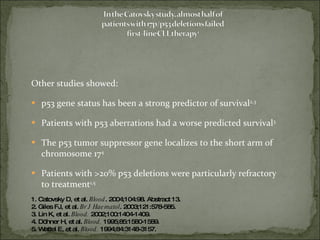
Other studies showed: p53 gene status has been a strong predictor of survival 2,3 Patients with p53 aberrations had a worse predicted survival 3   The p53 tumor suppressor gene localizes to the short arm of chromosome 17 4 Patients with >20% p53 deletions were particularly refractory  to treatment 1,5 1. Catovsky D, et al.  Blood . 2004;104:98. Abstract 13. 2. Giles FJ, et al.  Br J Haematol . 2003;121:578-585. 3. Lin K, et al.  Blood.  2002;100:1404-1409.  4. Döhner H, et al.  Blood.  1995;85:1580-1589. 5. Wattel E, et al.  Blood.  1994;84:3148-3157.
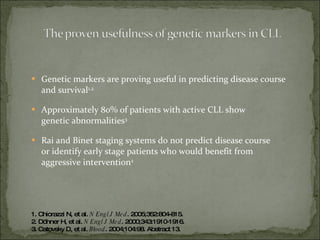
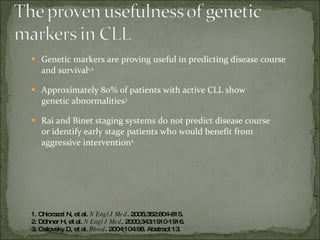
Genetic markers are proving useful in predicting disease course  and survival 1,2 Approximately 80% of patients with active CLL show  genetic abnormalities 3 Rai and Binet staging systems do not predict disease course  or identify early stage patients who would benefit from  aggressive intervention 2 1. Chiorazzi N, et al.  N Engl J Med . 2005;352:804-815.  2. Döhner H, et al.  N Engl J Med . 2000;343:1910-1916. 3. Catovsky D, et al.  Blood . 2004;104:98. Abstract 13.
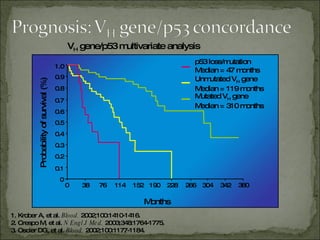
Months V H  gene/p53 multivariate analysis 1. Krober A, et al.  Blood.  2002;100:1410-1416. 2. Crespo M, et al.  N Engl J Med.  2003;348:1764-1775. 3. Oscier DG, et al.  Blood.  2002;100:1177-1184.  1.0 0.9 0.8 0.7 0.6 0.5 0.4 0.3 0.2 0.1 0 380 0 38 76 114 152 228 190 304 266 342 p53 loss/mutation Median = 47 months Probability of survival (%) Unmutated V H  gene Median = 119 months Mutated V H  gene Median = 310 months
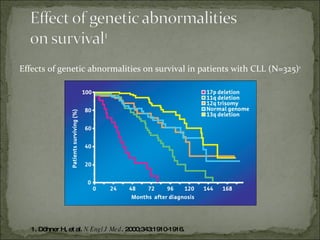
Effects of genetic abnormalities on survival in patients with CLL (N=325) 1 1. Döhner H, et al.  N Engl J Med . 2000;343:1910-1916.
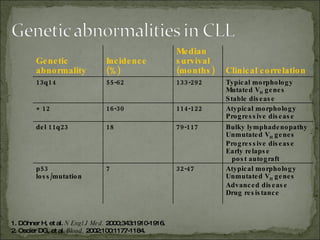
1. D Ö hner H , et al.  N Engl J Med.  2000;343:1910-1916. 2. Oscier DG, et al.  Blood.  2002;100:1177-1184. Genetic abnormality Incidence  (%) Median survival (months) Clinical correlation 13q14 55-62 133-292 Typical morphology  Mutated V H  genes  Stable disease + 12 16-30 114-122 Atypical morphology  Progressive disease del 11q23 18 79-117 Bulky lymphadenopathy Unmutated V H  genes  Progressive disease  Early relapse    post autograft p53 loss/mutation 7 32-47 Atypical morphology  Unmutated V H  genes  Advanced disease  Drug resistance
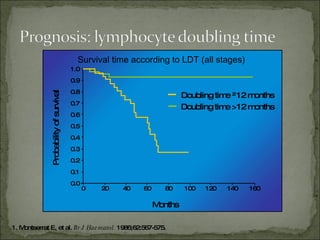
Survival time according to LDT (all stages) Months Probability of survival 160 0 20 40 60 80 100 120 140 1.0 0.9 0.8 0.7 0.6 0.5 0.4 0.3 0.2 0.1 0.0 Doubling time ≤12 months Doubling time >12 months 1. Montserrat E, et al.  Br J Haematol.  1986;62:567-575.
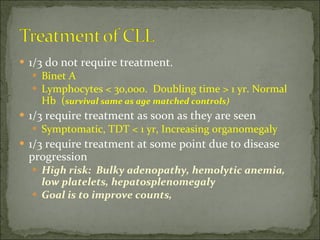
1/3 do not require treatment. Binet A Lymphocytes < 30,000.  Doubling time > 1 yr. Normal Hb  ( survival same as age matched controls) 1/3 require treatment as soon as they are seen Symptomatic, TDT < 1 yr, Increasing organomegaly 1/3 require treatment at some point due to disease progression High risk:  Bulky adenopathy, hemolytic anemia, low platelets, hepatosplenomegaly Goal is to improve counts,
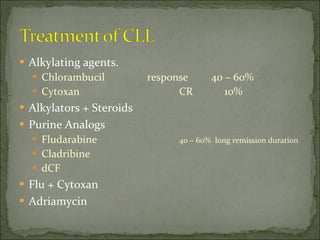
Alkylating agents. Chlorambucil response 40 – 60% Cytoxan CR   10% Alkylators + Steroids Purine Analogs Fludarabine 40 – 60%  long remission duration  Cladribine dCF Flu + Cytoxan Adriamycin
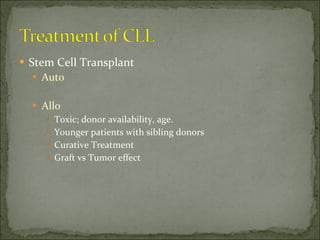
Stem Cell Transplant Auto Allo Toxic; donor availability, age. Younger patients with sibling donors  Curative Treatment Graft vs Tumor effect
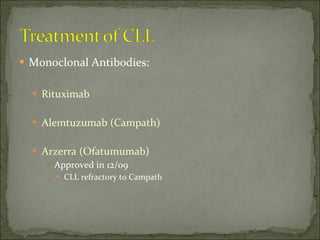
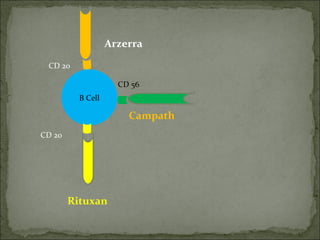
Monoclonal Antibodies: Rituximab Alemtuzumab (Campath) Arzerra (Ofatumumab) Approved in 12/09  CLL refractory to Campath
B Cell CD 20 Rituxan CD 56 CD 20 Arzerra Campath

Chronic lymphocytic leukemia

  • 1.
  • 2.
    Effect of  2 -microglobulin on survival in untreated CLL Years Proportion surviving 16 0 2 4 6 8 10 12 14 1.0 18 0.8 0.6 0.4 0.0 0.2 1. Keating M. Unpublished data. 2. Hallek M, et al. Leuk Lymphoma. 1996;22:439-447. 3. Sarfati M, et al. Blood. 1996;88:4259-4264. 4. Fayad L, et al. Blood. 2001;97:256-263 . Pts Died  2 M 445 53 <2.1 429 95 2.1-3.0 183 53 3.1-4.0 175 67 >4.0
  • 3.
    Effect of  2 -microglobulin on survival in untreated CLL Years Proportion surviving 16 0 2 4 6 8 10 12 14 1.0 18 0.8 0.6 0.4 0.0 0.2 1. Keating M. Unpublished data. 2. Hallek M, et al. Leuk Lymphoma. 1996;22:439-447. 3. Sarfati M, et al. Blood. 1996;88:4259-4264. 4. Fayad L, et al. Blood. 2001;97:256-263. Pts Died  2 M 445 53 <2.1 429 95 2.1-3.0 183 53 3.1-4.0 175 67 >4.0
  • 4.
    Clonal disorder ofB and T lymphocytes Elderly patients usually 10% are < 50 yrs 50% are asymptomatic at diagnosis Lymph nodes Splenomegaly Fatigue Infections
  • 5.
    Symptomatic patients LymphadenopathySplenomegaly Anemia Acquired Inhibitors to VIII/VWF Bruising and bleeding Hypogammaglobulinemia Recurrent infections
  • 6.
    Sustained lymphocytosis of> 10,000: mature lymphocytes Marrow > 30% lymphs CD 5+ lymphs PBS lymphs > 5000 CD19, CD20, CD 23, CD5 Kappa or lambda chain (not both) Marrow > 30% lymphs NCI WG (1986)
  • 7.
    Diagnosis: NCI vsIWCLL guidelines for CLL 1. Cheson BD, et al. Blood. 1996;87:4990-4997. Variable NCI IWCLL Diagnosis Lymphocytes (x 10 9 /L) ≥ 5; ≥ B-cell Marker (CD19, CD20, CD23) + CD5 ≥ 10 + B phenotype or bone marrow involved <10 + both of above Atypical cells (%) <55 Not stated Duration of lymphocytosis None required Not stated Bone marrow lymphocytes (%) ≥ 30 >30 Staging Modified Rai, correlate with Binet IWCLL
  • 8.
    . Clinicalstaging systems for CLL Stage Value Rai Binet Median survival Lymphocytosis (>15,000/mm 3 ) 0 - 150 months (12.5 years) Lymphocytosis plus nodal involvement I A <3 node groups 101-108 months (8.5-9 years) Lymphocytosis plus organomegaly II B >3 node groups 60-71 months (5-6 years) Anemia (RBCs) III Hgb <11 g/dL C Hgb <10 g/dL 19-24 months (1.5-2 years) Lymphocytosis plus thrombocytopenia (platelets) IV PLT <100,000/mm 3 PLT <100,000/mm 3
  • 9.
    Comparison of CLLand PLL Courtesy of Randy Gascoyne, MD. 1. Bennett JM, et al. J Clin Pathol. 1989;42:567-584. CLL PLL slg + ++ CD19 ++ ++ CD20 ++ ++ CD5 ++ -/+
  • 10.
  • 11.
    Approximately 80% ofpatients with active CLL have genetic abnormalities that can influence survival 1 Use of FISH at diagnosis can help detect chromosomal abnormalities critical to treatment choices 2 The assessment of 17p/p53 deletions/mutations can be used to help predict nonresponse to certain B-CLL therapies 1,3-6 Response to treatment decreases as the percentage of 17p/p53 deletions increases 5-9 Presence of a 17p or 11q deletion is associated with a statistically significantly shorter progression-free survival 7 p53 gene alterations were a predictor of poor survival 5,6 Chemotherapy is a likely cause of p53 gene alterations 10,11 Patients with p53 mutations are generally resistant to treatments
  • 12.
    Response to chemotherapiesbased on p53 status *1 (N=50, P <.001) 1. Döhner H, et al. Blood. 1995;85:1580-1589. * Response was assessed according to guidelines from the National Cancer Institute.
  • 13.
    Sturm I, etal. Cell Death Differ . 2003;10:477-484. Lozanski G, et al. Blood . 2004;103:3278-3281. * All but 18 patients were treated with alkylating agents. † Patients had received a median of 3 prior therapies (range 1 to 12).
  • 14.
    In a studyof 81 patients with CLL, those with p53 mutations had significantly shorter survival times 1 1. Wattel E, et al. Blood . 1994;84:3148-3157.
  • 15.
    Response † based on percentages of 17p deletions (n=343, P <.0001) 1 1. Catovsky D, et al. Blood . 2004;104:98. Abstract 13. * Chlorambucil, fludarabine, or fludarabine/cyclophosphamide. † Response data reflect response to all therapies, as the code of individual therapies has not yet been broken.
  • 16.
    Other studies showed:p53 gene status has been a strong predictor of survival 2,3 Patients with p53 aberrations had a worse predicted survival 3 The p53 tumor suppressor gene localizes to the short arm of chromosome 17 4 Patients with >20% p53 deletions were particularly refractory to treatment 1,5 1. Catovsky D, et al. Blood . 2004;104:98. Abstract 13. 2. Giles FJ, et al. Br J Haematol . 2003;121:578-585. 3. Lin K, et al. Blood. 2002;100:1404-1409. 4. Döhner H, et al. Blood. 1995;85:1580-1589. 5. Wattel E, et al. Blood. 1994;84:3148-3157.
  • 17.
    Genetic markers areproving useful in predicting disease course and survival 1,2 Approximately 80% of patients with active CLL show genetic abnormalities 3 Rai and Binet staging systems do not predict disease course or identify early stage patients who would benefit from aggressive intervention 2 1. Chiorazzi N, et al. N Engl J Med . 2005;352:804-815. 2. Döhner H, et al. N Engl J Med . 2000;343:1910-1916. 3. Catovsky D, et al. Blood . 2004;104:98. Abstract 13.
  • 18.
    Genetic markers areproving useful in predicting disease course and survival 1,2 Approximately 80% of patients with active CLL show genetic abnormalities 3 Rai and Binet staging systems do not predict disease course or identify early stage patients who would benefit from aggressive intervention 2 1. Chiorazzi N, et al. N Engl J Med . 2005;352:804-815. 2. Döhner H, et al. N Engl J Med . 2000;343:1910-1916. 3. Catovsky D, et al. Blood . 2004;104:98. Abstract 13.
  • 19.
    Months V H gene/p53 multivariate analysis 1. Krober A, et al. Blood. 2002;100:1410-1416. 2. Crespo M, et al. N Engl J Med. 2003;348:1764-1775. 3. Oscier DG, et al. Blood. 2002;100:1177-1184. 1.0 0.9 0.8 0.7 0.6 0.5 0.4 0.3 0.2 0.1 0 380 0 38 76 114 152 228 190 304 266 342 p53 loss/mutation Median = 47 months Probability of survival (%) Unmutated V H gene Median = 119 months Mutated V H gene Median = 310 months
  • 20.
    Effects of geneticabnormalities on survival in patients with CLL (N=325) 1 1. Döhner H, et al. N Engl J Med . 2000;343:1910-1916.
  • 21.
    1. D Öhner H , et al. N Engl J Med. 2000;343:1910-1916. 2. Oscier DG, et al. Blood. 2002;100:1177-1184. Genetic abnormality Incidence (%) Median survival (months) Clinical correlation 13q14 55-62 133-292 Typical morphology Mutated V H genes Stable disease + 12 16-30 114-122 Atypical morphology Progressive disease del 11q23 18 79-117 Bulky lymphadenopathy Unmutated V H genes Progressive disease Early relapse post autograft p53 loss/mutation 7 32-47 Atypical morphology Unmutated V H genes Advanced disease Drug resistance
  • 22.
    Survival time accordingto LDT (all stages) Months Probability of survival 160 0 20 40 60 80 100 120 140 1.0 0.9 0.8 0.7 0.6 0.5 0.4 0.3 0.2 0.1 0.0 Doubling time ≤12 months Doubling time >12 months 1. Montserrat E, et al. Br J Haematol. 1986;62:567-575.
  • 23.
    1/3 do notrequire treatment. Binet A Lymphocytes < 30,000. Doubling time > 1 yr. Normal Hb ( survival same as age matched controls) 1/3 require treatment as soon as they are seen Symptomatic, TDT < 1 yr, Increasing organomegaly 1/3 require treatment at some point due to disease progression High risk: Bulky adenopathy, hemolytic anemia, low platelets, hepatosplenomegaly Goal is to improve counts,
  • 24.
    Alkylating agents. Chlorambucilresponse 40 – 60% Cytoxan CR 10% Alkylators + Steroids Purine Analogs Fludarabine 40 – 60% long remission duration Cladribine dCF Flu + Cytoxan Adriamycin
  • 25.
    Stem Cell TransplantAuto Allo Toxic; donor availability, age. Younger patients with sibling donors Curative Treatment Graft vs Tumor effect
  • 26.
    Monoclonal Antibodies: RituximabAlemtuzumab (Campath) Arzerra (Ofatumumab) Approved in 12/09 CLL refractory to Campath
  • 27.
    B Cell CD20 Rituxan CD 56 CD 20 Arzerra Campath

Editor's Notes

  • #3 1. Keating M. Unpublished data. 2. Hallek M, et al. Leuk Lymphoma . 1996;22:439-447. 3. Sarfati M, et al. Blood . 1996;88:4259-4264. 4. Fayad L, et al. Blood. 2001;97:256-263. Serum  2 -microglobulin, soluble CD23, and serum thymidine kinase are independent predictors of progression-free survival in CLL. In a large set of patients treated independently over a 17-year period, follow-up according to  2 -microglobulin status showed that survival is improved with lower levels of  2 -microglobulin, whereas those with high  2 -microglobulin levels have the poorest survival outcome.
  • #4 1. Keating M. Unpublished data. 2. Hallek M, et al. Leuk Lymphoma . 1996;22:439-447. 3. Sarfati M, et al. Blood . 1996;88:4259-4264. 4. Fayad L, et al. Blood. 2001;97:256-263. Serum  2 -microglobulin, soluble CD23, and serum thymidine kinase are independent predictors of progression-free survival in CLL. In a large set of patients treated independently over a 17-year period, follow-up according to  2 -microglobulin status showed that survival is improved with lower levels of  2 -microglobulin, whereas those with high  2 -microglobulin levels have the poorest survival outcome.
  • #12 In conclusion, genetic abnormalities can be shown in approximately 80% of patients with active CLL, and the presence or absence of genetic abnormalities can influence a patient’s chances of survival. 1 The use of FISH at diagnosis can detect chromosomal abnormalities that can impact the effect of treatment choices. 2 Data have shown that response to treatment decreases as the percentage of 17p/p53 deletions increases. 1-6 Several important studies have shown that 17p/p53 deletions or mutations can be efficient predictors of treatment outcomes with certain alkylating agents, purine analogs, rituximab, and the combination of fludarabine and cyclophosphamide. 5-9 We have seen that p53 gene alterations are proven predictors of poor survival for patients with CLL. 5,6 Evidence also shows that chemotherapy is a likely cause of p53 alterations. 10,11 Thus, CLL patients who have received treatment with chemotherapy may have genetic alterations that were not present at diagnosis. In summary, p53 gene status assessment can provide valuable prognostic information regarding treatment response and survival in patients with B-CLL. Catovsky D, et al. Blood . 2004;104:98. Abstract 13. Stilgenbauer S, et al. Leukemia . 2002;16:993-1007. Giles FJ, et al. Br J Haematol . 2003;121:578-585. Lin K, et al. Blood. 2002;100:1404-1409. Döhner H, et al. Blood. 1995;85:1580-1589. Wattel E, et al. Blood. 1994;84:3148-3157. Grever MR, et al. J Clin Oncol. 2007;25:799-804. El Rouby S, et al. Blood. 1993;82:3452-3459. Byrd JC, et al. Cancer Res. 2003;63:36-38. Sturm I, et al. Cell Death Differ . 2003;10:477-484. Lozanski G, et al. Blood . 2004;103:3278-3281.
  • #13 p53 gene status is proving to be a useful tool in predicting patient response to various treatments for CLL. For example, Döhner and colleagues, in the retrospective study cited previously, found that p53 gene deletion can predict nonresponse to therapy with purine analogs. 1 As this slide illustrates, of the 50 patients who received treatment with purine analogs, none of the 12 patients with a p53 gene deletion responded to therapy with fludarabine (7 patients) or pentostatin (5 patients) compared to 56% of patients with no p53 gene deletions. 1 1. Döhner H, et al. Blood. 1995;85:1580-1589.
  • #14 DNA-damaging chemotherapy may be a cause of p53 inactivation and the resulting resistance to therapy. 1,2 In a multicenter study, Sturm and colleagues investigated the p53 mutational status of 138 B-CLL samples and compared their findings with drug and γ -irradiation sensitivity profiles. Their results showed that treatment with alkylating agents correlated with the occurrence of p53 mutations: 25% of patients who had been pretreated with chemotherapy (all but 18 with alkylating agents) showed p53 gene alterations as compared with only 5% of patients who had not received previous chemotherapy. 1 In another study of 36 patients with refractory CLL who had received a median of 3 prior therapies (range from 1 to 12) including fludarabine, 15 patients, or 42%, had p53 mutations or chromosome 17p13.1 deletions. 2 Sturm I, et al. Cell Death Differ . 2003;10:477-484. Lozanski G, et al. Blood . 2004;103:3278-3281.
  • #15 In their study of 81 patients with CLL, Wattel and colleagues also showed that survival time was significantly shorter in patients with p53 gene mutations compared with patients without these mutations ( P &lt;.00001). Median survival time for all patients with p53 gene mutations was 7 months; in nonmutated cases median survival was not reached. The difference was also significant when the analysis was restricted to patients treated with chemotherapy ( P &lt;.0001). 1 1. Wattell E, et al. Blood . 1994;84:3148-3157.
  • #16 It has been demonstrated that the presence of 17p/p53 alterations can be used to help predict treatment response. This slide presents evidence that clinicians can also use the percentage of 17p deletions to predict a response to CLL treatment. In the Catovsky study of 730 patients with CLL, 17p deletions predicted patient response to chlorambucil, fludarabine, or fludarabine and cyclophosphamide. The bar graph here illustrates the correlation between 17p deletions and patient response to treatment. Clearly, the higher the proportion of 17p deletions, the lower the response was to treatment. 1 1. Catovsky D, et al. Blood . 2004;104:98. Abstract 13.
  • #17 Since the p53 tumor suppressor gene localizes to the short arm of chromosomes, 17p deletions result in p53 aberrations that have a decisive impact on patient response to treatment and overall survival. 1 Catovsky and colleagues, in a preliminary analysis from the Leukaemia Research Fund CLL trial 4 (LRF CLL4), looked at 440 patients with CLL who had been treated with either chlorambucil, fludarabine, or fludarabine plus cyclophosphamide. They found that almost half of patients with 17p deletions at the p53 locus did not respond to or show progressive disease after first-line therapy. 2 Giles et al, in a multivariate analysis of 90 patients, and Lin and colleagues, in a study of CLL cells in 71 patients, confirmed that p53 is a strong predictor of survival. 3,4 The percentage of p53 mutations is also a strong predictor of response to treatment. Catovsky et al found that patients with &gt;20% p53 deletions were particularly refractory to treatment. Of 15 such cases, 87% were nonresponders or showed progressive disease. These results were confirmed by Wattel et al in a study that looked at 81 patients with CLL, 11% of whom showed p53 mutations. In this trial, 8 of the 9 mutated cases required treatment with chlorambucil and/or CHOP (cyclophosphamide, hydroxydaunomycin/doxorubicin [Adriamycin], Oncovin [vincristine], prednisone) and/or fludarabine. Only 1 patient responded to treatment (with chlorambucil), and in a multivariate analysis, p53 mutations emerged as the most significant prognostic factor of survival in all CLL cases. 1,5 Catovsky and colleagues also demonstrated that patients with p53 deletions had a worse predicted survival rate. 2 1. Döhner H, et al. Blood. 1995;85:1580-1589. 2. Catovsky D, et al. Blood . 2004;104:98. Abstract 13. 3. Giles FJ, et al. Br J Haematol . 2003;121:578-585. 4. Lin K, et al. Blood. 2002;100:1404-1409. 5. Wattel E, et al. Blood. 1994;84:3148-3157.
  • #18 Chromosomal aberrations are proving to be useful prognostic indicators, 1,2 especially in CLL where approximately 80% of patients with active disease show genetic abnormalities. 3 While the Rai and Binet staging systems offer guidelines for initiating therapy, they cannot be used to predict (nor were they intended to predict) a patient’s individual risk of disease progression or identify early stage patients who could benefit from aggressive treatment. 2 1. Chiorazzi N, et al. N Engl J Med . 2005;352:804-815. 2. Döhner H, et al. N Engl J Med . 2000;343:1910-1916. 3. Catovsky D, et al. Blood . 2004;104:98. Abstract 13.
  • #19 Chromosomal aberrations are proving to be useful prognostic indicators, 1,2 especially in CLL where approximately 80% of patients with active disease show genetic abnormalities. 3 While the Rai and Binet staging systems offer guidelines for initiating therapy, they cannot be used to predict (nor were they intended to predict) a patient’s individual risk of disease progression or identify early stage patients who could benefit from aggressive treatment. 2 1. Chiorazzi N, et al. N Engl J Med . 2005;352:804-815. 2. Döhner H, et al. N Engl J Med . 2000;343:1910-1916. 3. Catovsky D, et al. Blood . 2004;104:98. Abstract 13.
  • #20 1. Krober A, et al. Blood . 2002;100:1410-1416. 2. Crespo M, et al. N Engl J Med. 2003;348:1764-1775. 3. Oscier DG, et al. Blood . 2002;100:1177-1184. Two multivariate analyses comprising over 500 patients with B-CLL demonstrated that V H gene mutation status and p53 loss or mutation are independent prognostic factors. In the group of patients with mutated V H genes, median survival was 310 months compared with 119 months for the patients with unmutated V H genes. In patients with p53 loss or mutation, median survival was only 47 months. In most cases, the average clinical laboratory is not equipped to determine V H gene status; in addition, the technique required to make this determination is prohibitively expensive to be part of the standard workup for CLL patients. For this reason, finding a surrogate for IgV H mutational status has become an important goal.
  • #21 Döhner et al evaluated 325 cases of CLL to assess the frequency and clinical relevance of genomic aberrations. 1 Of the 325 patients, 248 had received no prior treatment, 39 had received 1 chemotherapeutic agent, and 38 had received 2 or more chemotherapeutic regimens before the cytogenetic analysis was conducted. 1 Of the 325 patients, 268, or 82%, exhibited abnormalities. The primary endpoint for this study was survival from time of diagnosis. All cases were evaluated by interphase cytogenetics. On the basis of regression analysis, the investigators constructed a hierarchical model of 5 genetic categories for evaluation as prognostic factors: 17p deletion; 11q deletion but not a 17p deletion; 12q trisomy but not a 17p or 11q deletion; normal genome; and 13q deletion as the sole aberration. Of the 325 patients, 300 could be assigned to one of these 5 subgroups; 25 with various chromosomal abnormalities could not. This slide illustrates the percentage of surviving patients by genetic aberration over 168 months. Median survival times for the groups were: 17p deletion, 32 months; 11q deletion, 79 months; 12q trisomy, 114 months; normal genome, 111 months; and 13q deletion as the only abnormality, 133 months. As the slide shows, patients with 17p deletions had by far the worst prognosis. 1 1. Döhner H, et al. N Engl J Med. 2000;343:1910-1916.
  • #22 1. Döhner H, et al. N Engl J Med. 2000;343:1910-1916. 2. Oscier DG, et al. Blood. 2002;100:1177-1184. Because of the limitations of the Rai and Binet systems in predicting the progression of CLL, other prognostic criteria are being considered; for instance, advanced disease stage, male gender, CD38 expression &gt;30%, and atypical morphology predict relatively poor outcomes in CLL. Additionally, karyotyping and molecular biology techniques reveal that the behavior of certain genetic markers in CLL may offer insights into the molecular mechanism of the disease and predict treatment outcome. In a study of 205 patients with CLL, 69% were found to have an abnormal karyotype. Genetic abnormalities included: structural abnormality of chromosome 13q14 trisomy 12 11q23 deletion 17p13 abnormalities; loss or mutation of the p53 gene 13q14 deletion carries a better prognosis than deletion of 11q13 or 17p13. Deletion of 11q23 is associated with bulky lymphadenopathy and a high incidence of residual disease following autologous transplantation. 17p13 abnormalities that result in mutation or loss of the p53 gene correlate with resistance to purine analogs.
  • #23 1. Montserrat E, et al. Br J Haematol . 1986;62:567-575. Lymphocyte doubling time (LDT) is clearly related to prognosis in patients with CLL. In a study of 100 untreated patients, LDT correlated partially with clinical stage and with bone marrow patterns, but it also had a clear prognostic significance by itself. Patients with an LDT  12 months were likely to have a poor prognosis, whereas those with an LDT &gt;12 months had a good prognosis, with a long treatment-free period and survival.