Presented By: Dr ORAKWELU ARINZE
Physiotherapy Department AKTH
As the End OF Neurology
and Mental Health Posting
20/09/2019
 Introduction
 Stages
 Epidemiology
 Etiology
 Pathophysiology
 Clinical presentations
 Risks Factors
 Complications
 Diagnosis
 Differential diagnosis
 Management
 Prognosis
 Case Study
 Conclusion
 Recommendation
 References
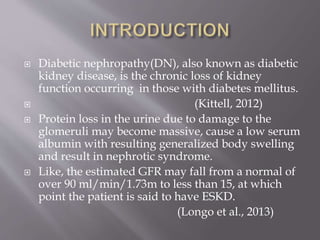
 Diabetic nephropathy(DN), also known as diabetic
kidney disease, is the chronic loss of kidney
function occurring in those with diabetes mellitus.
 (Kittell, 2012)
 Protein loss in the urine due to damage to the
glomeruli may become massive, cause a low serum
albumin with resulting generalized body swelling
and result in nephrotic syndrome.
 Like, the estimated GFR may fall from a normal of
over 90 ml/min/1.73m to less than 15, at which
point the patient is said to have ESKD.
(Longo et al., 2013)
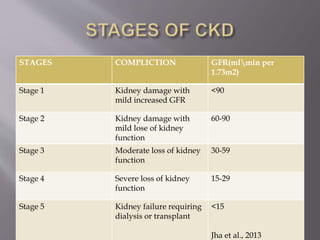
STAGES COMPLICTION GFR(mlmin per
1.73m2)
Stage 1 Kidney damage with
mild increased GFR
<90
Stage 2 Kidney damage with
mild lose of kidney
function
60-90
Stage 3 Moderate loss of kidney
function
30-59
Stage 4 Severe loss of kidney
function
15-29
Stage 5 Kidney failure requiring
dialysis or transplant
<15
Jha et al., 2013
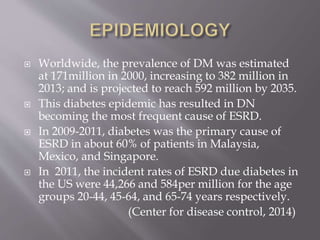
 Worldwide, the prevalence of DM was estimated
at 171million in 2000, increasing to 382 million in
2013; and is projected to reach 592 million by 2035.
 This diabetes epidemic has resulted in DN
becoming the most frequent cause of ESRD.
 In 2009-2011, diabetes was the primary cause of
ESRD in about 60% of patients in Malaysia,
Mexico, and Singapore.
 In 2011, the incident rates of ESRD due diabetes in
the US were 44,266 and 584per million for the age
groups 20-44, 45-64, and 65-74 years respectively.
(Center for disease control, 2014)
 In some European countries, particularly
Germany, the proportion of patients admitted
for renal replacement therapy exceeds the
figures reported from the United states.
 In south west Germany, 59% of patients
admitted for renal replacement therapy in 1995
had diabetes and 90% of those had type 2 DM.
(Vecihi et al., 2019)
 There is paucity of data on CKD from west Africa subregion.
 However a study carried out in southern Nigeria showed that the
incidence of nephropathy among diabetiess is 72.63%.
(Onovughakpo et al 2019)
 The incidence of CKD have increased in the recent years in developed
and developing nations and are consuming a huge proportion of health
care finances in developed countries while contributing significantly to
morbidity, mortality and decreased life expectancy, particularly in
developing countries.
(Alebiosu et al., 2005)
 SEX DISTRIBUTION
 Diabetic nephropathy
affects males and
female equally.
 RACE
DISTRIBUTION
 The race distribution
is incongruent which
could suggest that
socioeconomic factors
play the key role.
 AGE DISTRIBUTION
 DN rarely develops
before 10yrs duration
of DM
 The peak incidence is
usually found in
persons who have had
DM for 10-20yrs.
(Vecihi et al., 2019)
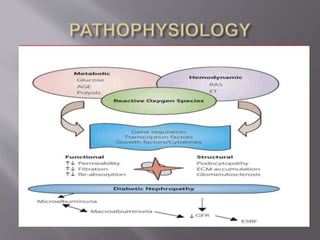
 The exact cause of diabetic nephropathy is
unknown, but various postulated mechanisms
are hyperglycemia (causing hyperfiltration and
renal injury), advanced glycation products, and
activation of cytokines.
 Many investigators now agree that diabetes is
an autoimmune disorder, with overlapping
pathophysiologies contributing to both type 1
and 2 diabetes.
(Odegaard et al., 2012)
 Nocturia
 Tiredness
 Headache
 Generalized feeling of illness
 Nausea
 Vomiting
 Frequent daytime urination
 Lack of appetite
 Itchy skin
 Leg swelling (Medline plus, 2015)
 Poor control of blood glucose
 Uncontrolled high blood pressure
 Type 1 diabetes mellitus, with onset before age
20
 Past or current cigarette use
 A family history of diabetic nephropathy
(Medline Plus, 2015)
 Edema
 Hyperkalemia
 Heart and blood vessel disease
 Diabetic retinopathy
 Anemia
 Foot sores
 Erectile dysfunction
 Diarrhea (Mayo clinic, 2016)
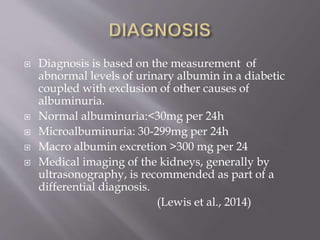
 Diagnosis is based on the measurement of
abnormal levels of urinary albumin in a diabetic
coupled with exclusion of other causes of
albuminuria.
 Normal albuminuria:<30mg per 24h
 Microalbuminuria: 30-299mg per 24h
 Macro albumin excretion >300 mg per 24
 Medical imaging of the kidneys, generally by
ultrasonography, is recommended as part of a
differential diagnosis.
(Lewis et al., 2014)
 Multiple myeloma
 Nephrosclerosis
 Nephrotic Syndrome
 Renal Artery Stenosis
 Renovascular Hypertention
 Tubulointerstitial Nephritis
(Vecihi et al., 2019)
 Medical management
 Drugs like angiotensin converting
enzyme(ACE) or angiotensin receptor
blockers(ARBs).
 Control of high blood pressure and blood
sugar
 Reduction of salt intake
(Vecihi et al., 2019)
 Surgical management(ESRD):
 Kidney transplant
(Vecihi et al., 2019)
 Aims
 Reduce pain
 Reduce/prevent swelling
 Enhance/maintain joint Rom
 Enhance cardiopulmonary function
 To improve strength
 To improve balance and coordination
 To maintain muscle tone
 Means
 STM with analgesic cream
 Coordination exercise
 Balance training
 Therapeutic positioning
 Range of motion exercises
 Breathing exercise
 Strengthening exercise
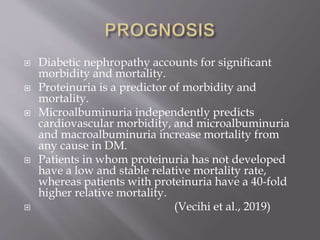
 Diabetic nephropathy accounts for significant
morbidity and mortality.
 Proteinuria is a predictor of morbidity and
mortality.
 Microalbuminuria independently predicts
cardiovascular morbidity, and microalbuminuria
and macroalbuminuria increase mortality from
any cause in DM.
 Patients in whom proteinuria has not developed
have a low and stable relative mortality rate,
whereas patients with proteinuria have a 40-fold
higher relative mortality.
 (Vecihi et al., 2019)
 Thiamine and it derivatives benfotiamine
 ALT-711 Which metabolizes AGEs
 PKC-BETA inhibitor
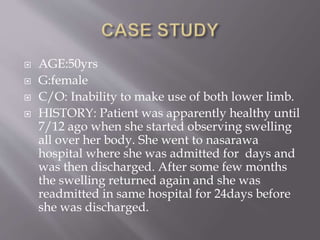
 AGE:50yrs
 G:female
 C/O: Inability to make use of both lower limb.
 HISTORY: Patient was apparently healthy until
7/12 ago when she started observing swelling
all over her body. She went to nasarawa
hospital where she was admitted for days and
was then discharged. After some few months
the swelling returned again and she was
readmitted in same hospital for 24days before
she was discharged.
 When she returned home her children noticed
that the swelling has not subsided and she was
taken to prime clinic. At prime clinic she was
on admission for 17days during which she was
said to have vomited severally and also had
constant abdominal pain. There at prime clinic
she was referred to AKTH for expert
management.
 PMHX:PUD+, DM+(20yrs), HTN+(10yrs), fall+
 FSHX: A widow with 4children(3 males and 1
female)
 DHX:Heparin, iv frusemide, Losarton,
Amlodiphine
 O/E: An ill looking elderly woman met in slouch
sitting position. Pale, acynosed, anicteric, afebrile
and in no obvious respiratory distress. Well
oriented in TPP.
 BP=170/100mmhg, PR=76bpm, RR=22cpm
 H&N: Patient cannot see
 T&A: NAD
 UL: NAD
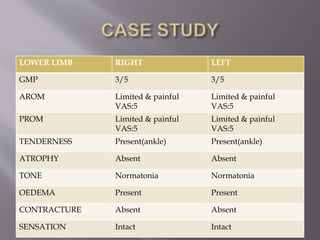
LOWER LIMB RIGHT LEFT
GMP 3/5 3/5
AROM Limited & painful
VAS:5
Limited & painful
VAS:5
PROM Limited & painful
VAS:5
Limited & painful
VAS:5
TENDERNESS Present(ankle) Present(ankle)
ATROPHY Absent Absent
TONE Normatonia Normatonia
OEDEMA Present Present
CONTRACTURE Absent Absent
SENSATION Intact Intact
 FUNCTIONAL ABILITIES/INABILITIES
 Patient cannot carry out ADL
 Patient can sit unsupported
 Patient can stand with support
 Patient cannot walk
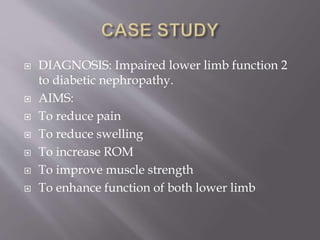
 DIAGNOSIS: Impaired lower limb function 2
to diabetic nephropathy.
 AIMS:
 To reduce pain
 To reduce swelling
 To increase ROM
 To improve muscle strength
 To enhance function of both lower limb
 TREATMENT PLAN:
 STM with neurogesic cream
 Effleurage massage + elevation to both lower
limb
 Assisted active exs to both lower limb
 RA exs to lower limb
 Standing/walking re-education
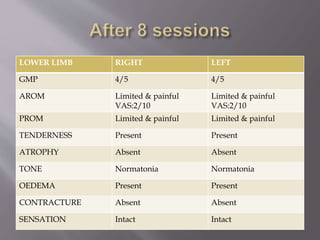
 w/p
LOWER LIMB RIGHT LEFT
GMP 4/5 4/5
AROM Limited & painful
VAS:2/10
Limited & painful
VAS:2/10
PROM Limited & painful Limited & painful
TENDERNESS Present Present
ATROPHY Absent Absent
TONE Normatonia Normatonia
OEDEMA Present Present
CONTRACTURE Absent Absent
SENSATION Intact Intact
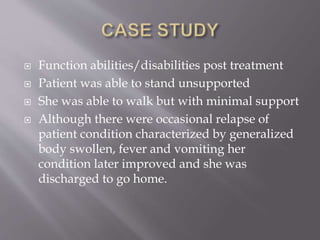
 Function abilities/disabilities post treatment
 Patient was able to stand unsupported
 She was able to walk but with minimal support
 Although there were occasional relapse of
patient condition characterized by generalized
body swollen, fever and vomiting her
condition later improved and she was
discharged to go home.
 Physiotherapy intervention has shown to play
a vital role in the management of patient with
diabetic nephropathy.
 There is need to intensify screening strategies
for CKD to detect early stages of the disease for
more effective intervention.
 There is also need for reinforced population-
wide health education and screening
programme for early detection of these
modifiable risk factors to prevent and reduce
the prevalence and burden of CKD and it
sequelae in Nigeria.
 Mogensen CE, Christensen CK, Vittinghus E (1983) The stages in Diabetic
kidney disease. With emphasis on the stage of incipient diabetic
nephropathy. Diabetes 1983; 32 suppl 2;64-78.
 Kittell F (2012). Diabetes Management. In Thomas LK, othersen JB(eds).
Nutrition Therapy for Chronic kidney disease. CRC Press p 198.
 Longo D, Fauci A, Kasper D, Hauser S, Jameson J, Loscalzo J (2013).
Harrisons manual of medicine (18th ed.). New York: MCGraw-Hill
Medical. P.2982. ISBN 978-0-07-174519-2
 Diabetes and kidney disease; Medline Medical Encyclopedia. www.nlm.
Gov.Retrieved 2015-06-27
 Shlipak M Diabetic nephropathy. BMJ Clinical Evidence 2009: 01:606
 Vecihi Batuman, Romesh Khardori. Diabetic Nephropathy. Jun 19 2019.
MEDSCAPE
^ a b c Lewis G, Maxwell AP (February 2014). "Risk factor control is
key in diabetic nephropathy". The Practitioner .
258 (1768): 13–7, 2.
PMID 24689163 .
 Onovughakpo-sakpa o. Ejuoghanran, Onyeneke E.
Chukwu and Olumese E Fidelis, 2009. Incidence of
Diabetic Nephropathy in Southern Nigeria. Journal of
Medical Sciences, 9; 264-269.
 Alebiosu CO, Ayodele OE. The global burden of
chronic kidney disease and the way forward. Ethn Dis
2005;15;418-23
 Center for disease control and prevention. National
diabetes fact sheet; National estimates and general
information on diabetes and prediabetes in the united
states. Atlanta, Ga; US department of Health and
human services; 2011. Accessed september 2, 2014
 Odegaard JI, Chawla A. Connecting type 1 and 2
diabetes through innate immunity. Cold spring Harb
perspect Med. 2012 Mar. 2(3):a007724.
Diabetic Nephropathy;Physiotherapy approach, a case report

Diabetic Nephropathy;Physiotherapy approach, a case report

  • 1.
    Presented By: DrORAKWELU ARINZE Physiotherapy Department AKTH As the End OF Neurology and Mental Health Posting 20/09/2019
  • 2.
     Introduction  Stages Epidemiology  Etiology  Pathophysiology  Clinical presentations  Risks Factors  Complications  Diagnosis  Differential diagnosis  Management  Prognosis  Case Study  Conclusion  Recommendation  References
  • 3.
     Diabetic nephropathy(DN),also known as diabetic kidney disease, is the chronic loss of kidney function occurring in those with diabetes mellitus.  (Kittell, 2012)  Protein loss in the urine due to damage to the glomeruli may become massive, cause a low serum albumin with resulting generalized body swelling and result in nephrotic syndrome.  Like, the estimated GFR may fall from a normal of over 90 ml/min/1.73m to less than 15, at which point the patient is said to have ESKD. (Longo et al., 2013)
  • 4.
    STAGES COMPLICTION GFR(mlminper 1.73m2) Stage 1 Kidney damage with mild increased GFR <90 Stage 2 Kidney damage with mild lose of kidney function 60-90 Stage 3 Moderate loss of kidney function 30-59 Stage 4 Severe loss of kidney function 15-29 Stage 5 Kidney failure requiring dialysis or transplant <15 Jha et al., 2013
  • 5.
     Worldwide, theprevalence of DM was estimated at 171million in 2000, increasing to 382 million in 2013; and is projected to reach 592 million by 2035.  This diabetes epidemic has resulted in DN becoming the most frequent cause of ESRD.  In 2009-2011, diabetes was the primary cause of ESRD in about 60% of patients in Malaysia, Mexico, and Singapore.  In 2011, the incident rates of ESRD due diabetes in the US were 44,266 and 584per million for the age groups 20-44, 45-64, and 65-74 years respectively. (Center for disease control, 2014)
  • 6.
     In someEuropean countries, particularly Germany, the proportion of patients admitted for renal replacement therapy exceeds the figures reported from the United states.  In south west Germany, 59% of patients admitted for renal replacement therapy in 1995 had diabetes and 90% of those had type 2 DM. (Vecihi et al., 2019)
  • 7.
     There ispaucity of data on CKD from west Africa subregion.  However a study carried out in southern Nigeria showed that the incidence of nephropathy among diabetiess is 72.63%. (Onovughakpo et al 2019)  The incidence of CKD have increased in the recent years in developed and developing nations and are consuming a huge proportion of health care finances in developed countries while contributing significantly to morbidity, mortality and decreased life expectancy, particularly in developing countries. (Alebiosu et al., 2005)
  • 8.
     SEX DISTRIBUTION Diabetic nephropathy affects males and female equally.  RACE DISTRIBUTION  The race distribution is incongruent which could suggest that socioeconomic factors play the key role.  AGE DISTRIBUTION  DN rarely develops before 10yrs duration of DM  The peak incidence is usually found in persons who have had DM for 10-20yrs. (Vecihi et al., 2019)
  • 9.
     The exactcause of diabetic nephropathy is unknown, but various postulated mechanisms are hyperglycemia (causing hyperfiltration and renal injury), advanced glycation products, and activation of cytokines.  Many investigators now agree that diabetes is an autoimmune disorder, with overlapping pathophysiologies contributing to both type 1 and 2 diabetes. (Odegaard et al., 2012)
  • 11.
     Nocturia  Tiredness Headache  Generalized feeling of illness  Nausea  Vomiting  Frequent daytime urination  Lack of appetite  Itchy skin  Leg swelling (Medline plus, 2015)
  • 12.
     Poor controlof blood glucose  Uncontrolled high blood pressure  Type 1 diabetes mellitus, with onset before age 20  Past or current cigarette use  A family history of diabetic nephropathy (Medline Plus, 2015)
  • 13.
     Edema  Hyperkalemia Heart and blood vessel disease  Diabetic retinopathy  Anemia  Foot sores  Erectile dysfunction  Diarrhea (Mayo clinic, 2016)
  • 14.
     Diagnosis isbased on the measurement of abnormal levels of urinary albumin in a diabetic coupled with exclusion of other causes of albuminuria.  Normal albuminuria:<30mg per 24h  Microalbuminuria: 30-299mg per 24h  Macro albumin excretion >300 mg per 24  Medical imaging of the kidneys, generally by ultrasonography, is recommended as part of a differential diagnosis. (Lewis et al., 2014)
  • 15.
     Multiple myeloma Nephrosclerosis  Nephrotic Syndrome  Renal Artery Stenosis  Renovascular Hypertention  Tubulointerstitial Nephritis (Vecihi et al., 2019)
  • 16.
     Medical management Drugs like angiotensin converting enzyme(ACE) or angiotensin receptor blockers(ARBs).  Control of high blood pressure and blood sugar  Reduction of salt intake (Vecihi et al., 2019)
  • 17.
     Surgical management(ESRD): Kidney transplant (Vecihi et al., 2019)
  • 18.
     Aims  Reducepain  Reduce/prevent swelling  Enhance/maintain joint Rom  Enhance cardiopulmonary function  To improve strength  To improve balance and coordination  To maintain muscle tone
  • 19.
     Means  STMwith analgesic cream  Coordination exercise  Balance training  Therapeutic positioning  Range of motion exercises  Breathing exercise  Strengthening exercise
  • 20.
     Diabetic nephropathyaccounts for significant morbidity and mortality.  Proteinuria is a predictor of morbidity and mortality.  Microalbuminuria independently predicts cardiovascular morbidity, and microalbuminuria and macroalbuminuria increase mortality from any cause in DM.  Patients in whom proteinuria has not developed have a low and stable relative mortality rate, whereas patients with proteinuria have a 40-fold higher relative mortality.  (Vecihi et al., 2019)
  • 21.
     Thiamine andit derivatives benfotiamine  ALT-711 Which metabolizes AGEs  PKC-BETA inhibitor
  • 22.
     AGE:50yrs  G:female C/O: Inability to make use of both lower limb.  HISTORY: Patient was apparently healthy until 7/12 ago when she started observing swelling all over her body. She went to nasarawa hospital where she was admitted for days and was then discharged. After some few months the swelling returned again and she was readmitted in same hospital for 24days before she was discharged.
  • 23.
     When shereturned home her children noticed that the swelling has not subsided and she was taken to prime clinic. At prime clinic she was on admission for 17days during which she was said to have vomited severally and also had constant abdominal pain. There at prime clinic she was referred to AKTH for expert management.  PMHX:PUD+, DM+(20yrs), HTN+(10yrs), fall+
  • 24.
     FSHX: Awidow with 4children(3 males and 1 female)  DHX:Heparin, iv frusemide, Losarton, Amlodiphine  O/E: An ill looking elderly woman met in slouch sitting position. Pale, acynosed, anicteric, afebrile and in no obvious respiratory distress. Well oriented in TPP.  BP=170/100mmhg, PR=76bpm, RR=22cpm  H&N: Patient cannot see  T&A: NAD  UL: NAD
  • 25.
    LOWER LIMB RIGHTLEFT GMP 3/5 3/5 AROM Limited & painful VAS:5 Limited & painful VAS:5 PROM Limited & painful VAS:5 Limited & painful VAS:5 TENDERNESS Present(ankle) Present(ankle) ATROPHY Absent Absent TONE Normatonia Normatonia OEDEMA Present Present CONTRACTURE Absent Absent SENSATION Intact Intact
  • 26.
     FUNCTIONAL ABILITIES/INABILITIES Patient cannot carry out ADL  Patient can sit unsupported  Patient can stand with support  Patient cannot walk
  • 30.
     DIAGNOSIS: Impairedlower limb function 2 to diabetic nephropathy.  AIMS:  To reduce pain  To reduce swelling  To increase ROM  To improve muscle strength  To enhance function of both lower limb
  • 31.
     TREATMENT PLAN: STM with neurogesic cream  Effleurage massage + elevation to both lower limb  Assisted active exs to both lower limb  RA exs to lower limb  Standing/walking re-education  w/p
  • 32.
    LOWER LIMB RIGHTLEFT GMP 4/5 4/5 AROM Limited & painful VAS:2/10 Limited & painful VAS:2/10 PROM Limited & painful Limited & painful TENDERNESS Present Present ATROPHY Absent Absent TONE Normatonia Normatonia OEDEMA Present Present CONTRACTURE Absent Absent SENSATION Intact Intact
  • 33.
     Function abilities/disabilitiespost treatment  Patient was able to stand unsupported  She was able to walk but with minimal support  Although there were occasional relapse of patient condition characterized by generalized body swollen, fever and vomiting her condition later improved and she was discharged to go home.
  • 34.
     Physiotherapy interventionhas shown to play a vital role in the management of patient with diabetic nephropathy.
  • 35.
     There isneed to intensify screening strategies for CKD to detect early stages of the disease for more effective intervention.  There is also need for reinforced population- wide health education and screening programme for early detection of these modifiable risk factors to prevent and reduce the prevalence and burden of CKD and it sequelae in Nigeria.
  • 36.
     Mogensen CE,Christensen CK, Vittinghus E (1983) The stages in Diabetic kidney disease. With emphasis on the stage of incipient diabetic nephropathy. Diabetes 1983; 32 suppl 2;64-78.  Kittell F (2012). Diabetes Management. In Thomas LK, othersen JB(eds). Nutrition Therapy for Chronic kidney disease. CRC Press p 198.  Longo D, Fauci A, Kasper D, Hauser S, Jameson J, Loscalzo J (2013). Harrisons manual of medicine (18th ed.). New York: MCGraw-Hill Medical. P.2982. ISBN 978-0-07-174519-2  Diabetes and kidney disease; Medline Medical Encyclopedia. www.nlm. Gov.Retrieved 2015-06-27  Shlipak M Diabetic nephropathy. BMJ Clinical Evidence 2009: 01:606  Vecihi Batuman, Romesh Khardori. Diabetic Nephropathy. Jun 19 2019. MEDSCAPE ^ a b c Lewis G, Maxwell AP (February 2014). "Risk factor control is key in diabetic nephropathy". The Practitioner . 258 (1768): 13–7, 2. PMID 24689163 .


  • 37.
     Onovughakpo-sakpa o.Ejuoghanran, Onyeneke E. Chukwu and Olumese E Fidelis, 2009. Incidence of Diabetic Nephropathy in Southern Nigeria. Journal of Medical Sciences, 9; 264-269.  Alebiosu CO, Ayodele OE. The global burden of chronic kidney disease and the way forward. Ethn Dis 2005;15;418-23  Center for disease control and prevention. National diabetes fact sheet; National estimates and general information on diabetes and prediabetes in the united states. Atlanta, Ga; US department of Health and human services; 2011. Accessed september 2, 2014  Odegaard JI, Chawla A. Connecting type 1 and 2 diabetes through innate immunity. Cold spring Harb perspect Med. 2012 Mar. 2(3):a007724.