Chronic Kidney Disease

              Internal Medicine
                   August 2011
Definition
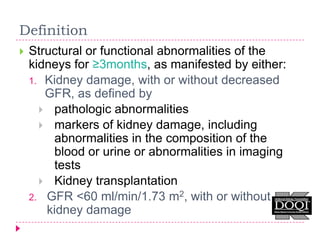
   Structural or functional abnormalities of the
    kidneys for ≥3months, as manifested by either:
    1. Kidney damage, with or without decreased
       GFR, as defined by
       pathologic abnormalities
       markers of kidney damage, including
        abnormalities in the composition of the
        blood or urine or abnormalities in imaging
        tests
       Kidney transplantation
    2. GFR <60 ml/min/1.73 m2, with or without
       kidney damage
Definition
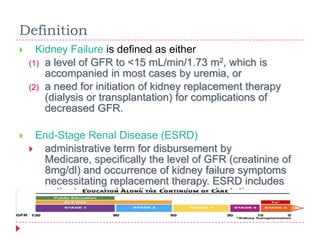
     Kidney Failure is defined as either
    (1) a level of GFR to <15 mL/min/1.73 m2, which is
        accompanied in most cases by uremia, or
    (2) a need for initiation of kidney replacement therapy
        (dialysis or transplantation) for complications of
        decreased GFR.

    End-Stage Renal Disease (ESRD)
     administrative term for disbursement by
      Medicare, specifically the level of GFR (creatinine of
      8mg/dl) and occurrence of kidney failure symptoms
      necessitating replacement therapy. ESRD includes
      patients treated by dialysis or transplantation.
Causes and Incidence
    Chronic renal failure occurs in approximately 1
     out of 1,000 people.
    Causative diseases include any type:
    1. Diabetes mellitus - most common cause
    2. Hypertension
    3. Glomerulonephritis
    4. Others
       chronic pyelonephritis, PKD /polycystic kidney
         disease, obstructive uropathy
         (stones, BPH, cancer, etc), Alport syndrome, and
         drug-induced nephropathy
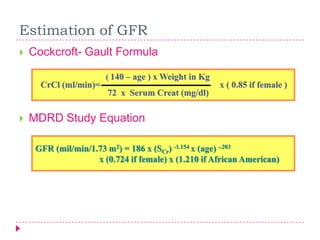
Estimation of GFR
   Cockcroft- Gault Formula

                       ( 140 – age ) x Weight in Kg
      CrCl (ml/min)=                                  x ( 0.85 if female )
                       72 x Serum Creat (mg/dl)

   MDRD Study Equation

     GFR (mil/min/1.73 m2) = 186 x (SCr) -1.154 x (age) -.203
                    x (0.724 if female) x (1.210 if African American)
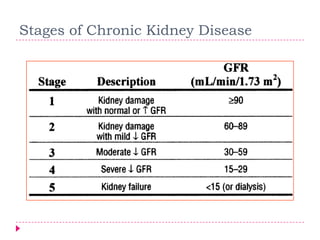
Stages of Chronic Kidney Disease
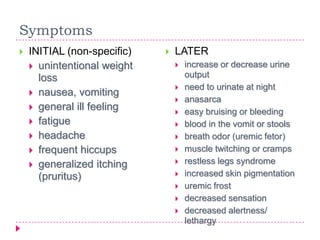
Symptoms
   INITIAL (non-specific)      LATER
     unintentional weight          increase or decrease urine
      loss                           output
                                    need to urinate at night
     nausea, vomiting
                                    anasarca
     general ill feeling
                                    easy bruising or bleeding
     fatigue                       blood in the vomit or stools
     headache                      breath odor (uremic fetor)
     frequent hiccups              muscle twitching or cramps
     generalized itching           restless legs syndrome
      (pruritus)                    increased skin pigmentation
                                    uremic frost
                                    decreased sensation
                                    decreased alertness/
                                     lethargy
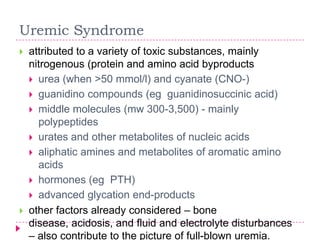
Uremic Syndrome
   attributed to a variety of toxic substances, mainly
    nitrogenous (protein and amino acid byproducts
     urea (when >50 mmol/l) and cyanate (CNO-)
     guanidino compounds (eg guanidinosuccinic acid)
     middle molecules (mw 300-3,500) - mainly
      polypeptides
     urates and other metabolites of nucleic acids
     aliphatic amines and metabolites of aromatic amino
      acids
     hormones (eg PTH)
     advanced glycation end-products
   other factors already considered – bone
    disease, acidosis, and fluid and electrolyte disturbances
    – also contribute to the picture of full-blown uremia.
Signs and Tests
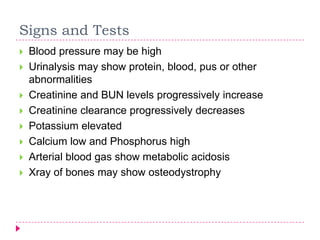
   Blood pressure may be high
   Urinalysis may show protein, blood, pus or other
    abnormalities
   Creatinine and BUN levels progressively increase
   Creatinine clearance progressively decreases
   Potassium elevated
   Calcium low and Phosphorus high
   Arterial blood gas show metabolic acidosis
   Xray of bones may show osteodystrophy
Signs and Tests
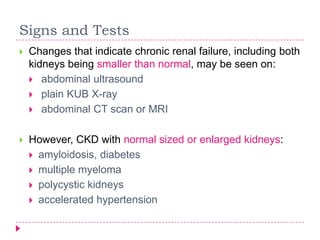
   Changes that indicate chronic renal failure, including both
    kidneys being smaller than normal, may be seen on:
     abdominal ultrasound
     plain KUB X-ray
     abdominal CT scan or MRI


   However, CKD with normal sized or enlarged kidneys:
     amyloidosis, diabetes
     multiple myeloma
     polycystic kidneys
     accelerated hypertension
Determinants of Rate of Progression
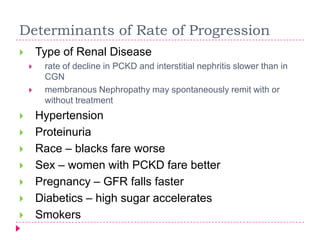
       Type of Renal Disease
        rate of decline in PCKD and interstitial nephritis slower than in
         CGN
        membranous Nephropathy may spontaneously remit with or
         without treatment
       Hypertension
       Proteinuria
       Race – blacks fare worse
       Sex – women with PCKD fare better
       Pregnancy – GFR falls faster
       Diabetics – high sugar accelerates
       Smokers
Importance of Proteinuria
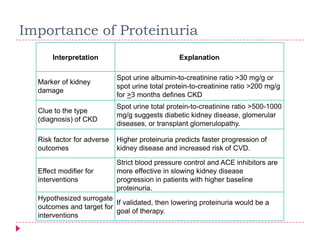
       Interpretation                           Explanation

                            Spot urine albumin-to-creatinine ratio >30 mg/g or
  Marker of kidney
                            spot urine total protein-to-creatinine ratio >200 mg/g
  damage
                            for >3 months defines CKD
                            Spot urine total protein-to-creatinine ratio >500-1000
  Clue to the type
                            mg/g suggests diabetic kidney disease, glomerular
  (diagnosis) of CKD
                            diseases, or transplant glomerulopathy.

  Risk factor for adverse   Higher proteinuria predicts faster progression of
  outcomes                  kidney disease and increased risk of CVD.

                            Strict blood pressure control and ACE inhibitors are
  Effect modifier for       more effective in slowing kidney disease
  interventions             progression in patients with higher baseline
                            proteinuria.
  Hypothesized surrogate
                          If validated, then lowering proteinuria would be a
  outcomes and target for
                          goal of therapy.
  interventions
Dietary Requirements
1.       Protein
          0.6-0.8 gm/k/day
          supplements of essential amino acids at 0.3 gm/k/day
          may allow lower protein intake to 0.4 gm/k/day
          intake for uremic patient not yet dialysed: 0.4 -
           0.6gm/k/day
          for dialysed patients: increase to 1.0 - 1.2 gm/k/day
2.       Energy
          35 kcal/k/day for sedentary, stable, non-obese HD
           patients
          higher with strenuous labor, underweight or
           hypercatabolic
Dietary Requirements
3.  Fat
     limit cholesterol <300 mg/day
     more proportion of mono- or polyunsaturated than
      saturated
4. Na+
     7-10 gm/day (table salt) if with adequate urine
     <6 gm/day or <100 mmol/day if with fluid
      retention/edema
5. K+
   HD: restrict to 2-3 gm/day (50-75 meq/day)
   PD: 3-4 gm/day or 75-100 meq/day
Dietary Requirements
6.       Ca++
         restrict milk products so supplemental Ca++ is needed
          (1-1.5 gm/day) + Vitamin D to keep serum Ca++ >2.5 mg/dl
7.       Phosphorus
         restrict to 0.6 - 1.2 gm/day to maintain s.Phos <4.5 to 5.5 mg/dl
         phosphate binders as needed such as calcium carbonate and
          calcium acetate
8.       Vitamins/ Minerals
         ascorbic acid < 150-200 mg maximum to avoid oxalosis
         folic acid 1000 mcg; vit.B1 30 or > mg/day; B6 20 or more
          mg/day; Other water soluble vitamins based on RDA
         provide selenium and zinc
         vitamin A preparations must be avoided
Management with
Progressive Renal Disease
1.   early recognition
2.   monitoring the progression
3.   detection and correction of reversible causes
4.   institution of interventions to delay progression,
                eg diet, ACEinhibitors, BP, and sugar
     control
5.   avoidance of additional renal injury,
                eg
     smoking, NSAIDs, radiocontrast, aminoglycosides
6.   treatment of complications, eg acid-
     base, mineral, and fluid-electrolyte abnormalities
7.   planning ahead for renal replacement therapy
        (dialysis or transplantation)
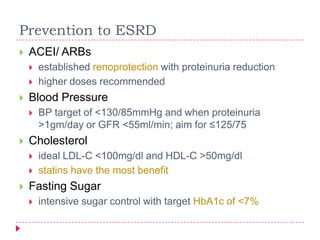
Prevention to ESRD
   ACEI/ ARBs
       established renoprotection with proteinuria reduction
       higher doses recommended
   Blood Pressure
       BP target of <130/85mmHg and when proteinuria
        >1gm/day or GFR <55ml/min; aim for ≤125/75
   Cholesterol
       ideal LDL-C <100mg/dl and HDL-C >50mg/dl
       statins have the most benefit
   Fasting Sugar
       intensive sugar control with target HbA1c of <7%
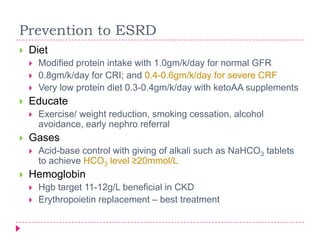
Prevention to ESRD
   Diet
       Modified protein intake with 1.0gm/k/day for normal GFR
       0.8gm/k/day for CRI; and 0.4-0.6gm/k/day for severe CRF
       Very low protein diet 0.3-0.4gm/k/day with ketoAA supplements
   Educate
       Exercise/ weight reduction, smoking cessation, alcohol
        avoidance, early nephro referral
   Gases
       Acid-base control with giving of alkali such as NaHCO3 tablets
        to achieve HCO3 level ≥20mmol/L
   Hemoglobin
       Hgb target 11-12g/L beneficial in CKD
       Erythropoietin replacement – best treatment
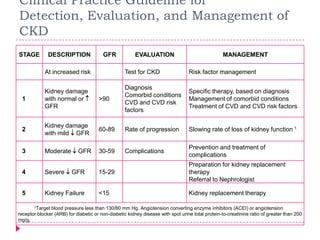
Clinical Practice Guideline for
Detection, Evaluation, and Management of
CKD
STAGE         DESCRIPTION               GFR             EVALUATION                                MANAGEMENT

            At increased risk                      Test for CKD                  Risk factor management

                                                   Diagnosis
            Kidney damage                                                        Specific therapy, based on diagnosis
                                                   Comorbid conditions
 1          with normal or           >90                                        Management of comorbid conditions
                                                   CVD and CVD risk
            GFR                                                                  Treatment of CVD and CVD risk factors
                                                   factors

            Kidney damage
 2                                    60-89        Rate of progression           Slowing rate of loss of kidney function 1
            with mild  GFR

                                                                                 Prevention and treatment of
 3          Moderate  GFR            30-59        Complications
                                                                                 complications
                                                                                 Preparation for kidney replacement
 4          Severe  GFR              15-29                                      therapy
                                                                                 Referral to Nephrologist

 5          Kidney Failure            <15                                        Kidney replacement therapy

       1Target blood pressure less than 130/80 mm Hg. Angiotension converting enzyme inhibitors (ACEI) or angiotension
receptor blocker (ARB) for diabetic or non-diabetic kidney disease with spot urine total protein-to-creatinine ratio of greater than 200
mg/g.
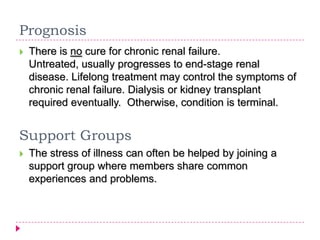
Prognosis
   There is no cure for chronic renal failure.
    Untreated, usually progresses to end-stage renal
    disease. Lifelong treatment may control the symptoms of
    chronic renal failure. Dialysis or kidney transplant
    required eventually. Otherwise, condition is terminal.


Support Groups
   The stress of illness can often be helped by joining a
    support group where members share common
    experiences and problems.
Thank You!

Chronic Kidney Disease

  • 1.
    Chronic Kidney Disease Internal Medicine August 2011
  • 2.
    Definition  Structural or functional abnormalities of the kidneys for ≥3months, as manifested by either: 1. Kidney damage, with or without decreased GFR, as defined by  pathologic abnormalities  markers of kidney damage, including abnormalities in the composition of the blood or urine or abnormalities in imaging tests  Kidney transplantation 2. GFR <60 ml/min/1.73 m2, with or without kidney damage
  • 3.
    Definition  Kidney Failure is defined as either (1) a level of GFR to <15 mL/min/1.73 m2, which is accompanied in most cases by uremia, or (2) a need for initiation of kidney replacement therapy (dialysis or transplantation) for complications of decreased GFR.  End-Stage Renal Disease (ESRD)  administrative term for disbursement by Medicare, specifically the level of GFR (creatinine of 8mg/dl) and occurrence of kidney failure symptoms necessitating replacement therapy. ESRD includes patients treated by dialysis or transplantation.
  • 4.
    Causes and Incidence  Chronic renal failure occurs in approximately 1 out of 1,000 people.  Causative diseases include any type: 1. Diabetes mellitus - most common cause 2. Hypertension 3. Glomerulonephritis 4. Others  chronic pyelonephritis, PKD /polycystic kidney disease, obstructive uropathy (stones, BPH, cancer, etc), Alport syndrome, and drug-induced nephropathy
  • 5.
    Estimation of GFR  Cockcroft- Gault Formula ( 140 – age ) x Weight in Kg CrCl (ml/min)= x ( 0.85 if female ) 72 x Serum Creat (mg/dl)  MDRD Study Equation GFR (mil/min/1.73 m2) = 186 x (SCr) -1.154 x (age) -.203 x (0.724 if female) x (1.210 if African American)
  • 6.
    Stages of ChronicKidney Disease
  • 7.
    Symptoms  INITIAL (non-specific)  LATER  unintentional weight  increase or decrease urine loss output  need to urinate at night  nausea, vomiting  anasarca  general ill feeling  easy bruising or bleeding  fatigue  blood in the vomit or stools  headache  breath odor (uremic fetor)  frequent hiccups  muscle twitching or cramps  generalized itching  restless legs syndrome (pruritus)  increased skin pigmentation  uremic frost  decreased sensation  decreased alertness/ lethargy
  • 8.
    Uremic Syndrome  attributed to a variety of toxic substances, mainly nitrogenous (protein and amino acid byproducts  urea (when >50 mmol/l) and cyanate (CNO-)  guanidino compounds (eg guanidinosuccinic acid)  middle molecules (mw 300-3,500) - mainly polypeptides  urates and other metabolites of nucleic acids  aliphatic amines and metabolites of aromatic amino acids  hormones (eg PTH)  advanced glycation end-products  other factors already considered – bone disease, acidosis, and fluid and electrolyte disturbances – also contribute to the picture of full-blown uremia.
  • 9.
    Signs and Tests  Blood pressure may be high  Urinalysis may show protein, blood, pus or other abnormalities  Creatinine and BUN levels progressively increase  Creatinine clearance progressively decreases  Potassium elevated  Calcium low and Phosphorus high  Arterial blood gas show metabolic acidosis  Xray of bones may show osteodystrophy
  • 10.
    Signs and Tests  Changes that indicate chronic renal failure, including both kidneys being smaller than normal, may be seen on:  abdominal ultrasound  plain KUB X-ray  abdominal CT scan or MRI  However, CKD with normal sized or enlarged kidneys:  amyloidosis, diabetes  multiple myeloma  polycystic kidneys  accelerated hypertension
  • 11.
    Determinants of Rateof Progression  Type of Renal Disease  rate of decline in PCKD and interstitial nephritis slower than in CGN  membranous Nephropathy may spontaneously remit with or without treatment  Hypertension  Proteinuria  Race – blacks fare worse  Sex – women with PCKD fare better  Pregnancy – GFR falls faster  Diabetics – high sugar accelerates  Smokers
  • 12.
    Importance of Proteinuria Interpretation Explanation Spot urine albumin-to-creatinine ratio >30 mg/g or Marker of kidney spot urine total protein-to-creatinine ratio >200 mg/g damage for >3 months defines CKD Spot urine total protein-to-creatinine ratio >500-1000 Clue to the type mg/g suggests diabetic kidney disease, glomerular (diagnosis) of CKD diseases, or transplant glomerulopathy. Risk factor for adverse Higher proteinuria predicts faster progression of outcomes kidney disease and increased risk of CVD. Strict blood pressure control and ACE inhibitors are Effect modifier for more effective in slowing kidney disease interventions progression in patients with higher baseline proteinuria. Hypothesized surrogate If validated, then lowering proteinuria would be a outcomes and target for goal of therapy. interventions
  • 13.
    Dietary Requirements 1. Protein  0.6-0.8 gm/k/day  supplements of essential amino acids at 0.3 gm/k/day  may allow lower protein intake to 0.4 gm/k/day  intake for uremic patient not yet dialysed: 0.4 - 0.6gm/k/day  for dialysed patients: increase to 1.0 - 1.2 gm/k/day 2. Energy  35 kcal/k/day for sedentary, stable, non-obese HD patients  higher with strenuous labor, underweight or hypercatabolic
  • 14.
    Dietary Requirements 3. Fat  limit cholesterol <300 mg/day  more proportion of mono- or polyunsaturated than saturated 4. Na+  7-10 gm/day (table salt) if with adequate urine  <6 gm/day or <100 mmol/day if with fluid retention/edema 5. K+  HD: restrict to 2-3 gm/day (50-75 meq/day)  PD: 3-4 gm/day or 75-100 meq/day
  • 15.
    Dietary Requirements 6. Ca++  restrict milk products so supplemental Ca++ is needed (1-1.5 gm/day) + Vitamin D to keep serum Ca++ >2.5 mg/dl 7. Phosphorus  restrict to 0.6 - 1.2 gm/day to maintain s.Phos <4.5 to 5.5 mg/dl  phosphate binders as needed such as calcium carbonate and calcium acetate 8. Vitamins/ Minerals  ascorbic acid < 150-200 mg maximum to avoid oxalosis  folic acid 1000 mcg; vit.B1 30 or > mg/day; B6 20 or more mg/day; Other water soluble vitamins based on RDA  provide selenium and zinc  vitamin A preparations must be avoided
  • 16.
    Management with Progressive RenalDisease 1. early recognition 2. monitoring the progression 3. detection and correction of reversible causes 4. institution of interventions to delay progression, eg diet, ACEinhibitors, BP, and sugar control 5. avoidance of additional renal injury, eg smoking, NSAIDs, radiocontrast, aminoglycosides 6. treatment of complications, eg acid- base, mineral, and fluid-electrolyte abnormalities 7. planning ahead for renal replacement therapy (dialysis or transplantation)
  • 17.
    Prevention to ESRD  ACEI/ ARBs  established renoprotection with proteinuria reduction  higher doses recommended  Blood Pressure  BP target of <130/85mmHg and when proteinuria >1gm/day or GFR <55ml/min; aim for ≤125/75  Cholesterol  ideal LDL-C <100mg/dl and HDL-C >50mg/dl  statins have the most benefit  Fasting Sugar  intensive sugar control with target HbA1c of <7%
  • 18.
    Prevention to ESRD  Diet  Modified protein intake with 1.0gm/k/day for normal GFR  0.8gm/k/day for CRI; and 0.4-0.6gm/k/day for severe CRF  Very low protein diet 0.3-0.4gm/k/day with ketoAA supplements  Educate  Exercise/ weight reduction, smoking cessation, alcohol avoidance, early nephro referral  Gases  Acid-base control with giving of alkali such as NaHCO3 tablets to achieve HCO3 level ≥20mmol/L  Hemoglobin  Hgb target 11-12g/L beneficial in CKD  Erythropoietin replacement – best treatment
  • 19.
    Clinical Practice Guidelinefor Detection, Evaluation, and Management of CKD STAGE DESCRIPTION GFR EVALUATION MANAGEMENT At increased risk Test for CKD Risk factor management Diagnosis Kidney damage Specific therapy, based on diagnosis Comorbid conditions 1 with normal or  >90 Management of comorbid conditions CVD and CVD risk GFR Treatment of CVD and CVD risk factors factors Kidney damage 2 60-89 Rate of progression Slowing rate of loss of kidney function 1 with mild  GFR Prevention and treatment of 3 Moderate  GFR 30-59 Complications complications Preparation for kidney replacement 4 Severe  GFR 15-29 therapy Referral to Nephrologist 5 Kidney Failure <15 Kidney replacement therapy 1Target blood pressure less than 130/80 mm Hg. Angiotension converting enzyme inhibitors (ACEI) or angiotension receptor blocker (ARB) for diabetic or non-diabetic kidney disease with spot urine total protein-to-creatinine ratio of greater than 200 mg/g.
  • 20.
    Prognosis  There is no cure for chronic renal failure. Untreated, usually progresses to end-stage renal disease. Lifelong treatment may control the symptoms of chronic renal failure. Dialysis or kidney transplant required eventually. Otherwise, condition is terminal. Support Groups  The stress of illness can often be helped by joining a support group where members share common experiences and problems.
  • 21.