CHRONIC KIDNEY DISEASE UNDERSTANDING PROGRESSION AND CLINICAL CONSEQUENCES.
PRE TEST Is serum creatinine a good marker of renal function in all people and at all ages? What is the most common cause of death in those with chronic renal failure? Why is oral calcium therapy in those with chronic renal failure both good and bad? What is the target haemoglobin level when using erythropoietin? What is the target BP in those with chronic renal failure?
WHAT IS CHRONIC KIDNEY DISEASE? Damage to the renal parenchyma that persists for more than 3 months.  Some types of CKD are visible on imaging:  hydronephrosis, renal calculi, renal cysts. CKD due to glomerular damage is recognised by persistent proteinuria.
WHAT ABOUT A FUNCTIONAL DEFINITION? Chronic kidney disease can also be defined as a GFR less than 60ml per minute for 3 months or more.  The difference between CKD and renal failure is that renal failure is a GFR below 15ml per minute.
THE GLOMERULAR FILTRATION RATE IS A PARAMETER THAT TELLS US ABOUT THE FUNCTION OF THE KIDNEY.   The GFR to the kidney is what the Ejection Fraction is to the heart.
HOW DOES THE GFR HELP TO CLASSIFY C.K.D.? Stage 1 – GFR more than 90ml per min.  Stage 2 – GFR between 60 and 90 Stage 3 – GFR between 30 and 60 Stage 4 – GFR between 15 and 30 Stage 5 – GFR below 15ml per minute.  Stage 5 CKD is renal failure
BLOOD UREA & SERUM CREATININE Is this statement always true?  “ A normal blood urea or serum creatinine means normal renal function.” Blood urea and serum creatinine levels reflect the balance between production and excretion.
SERUM CREATININE Increased production + normal excretion ( in African Americans ) Decreased production + normal excretion ( in elderly people ) Decreased production + decreased excretion ( elderly with early renal disease ) Normal production + Decreased excretion  (blood level reflects renal function)
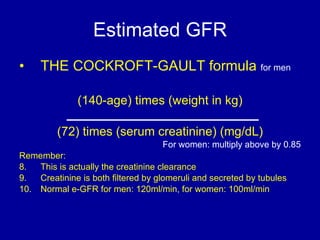
Estimated GFR THE COCKROFT-GAULT formula  for men (140-age) times (weight in kg) (72) times (serum creatinine) (mg/dL) For women: multiply above by 0.85 Remember:  This is actually the creatinine clearance Creatinine is both filtered by glomeruli and secreted by tubules Normal e-GFR for men: 120ml/min, for women: 100ml/min
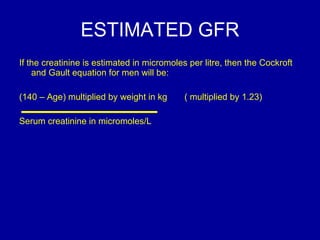
ESTIMATED GFR If the creatinine is estimated in micromoles per litre, then the Cockroft and Gault equation for men will be: (140 – Age) multiplied by weight in kg  ( multiplied by 1.23) Serum creatinine in micromoles/L
Courtesy: MEDSCAPE
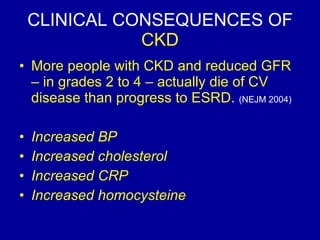
CLINICAL CONSEQUENCES OF  CKD More people with CKD and reduced GFR – in grades 2 to 4 – actually die of CV disease than progress to ESRD.  (NEJM 2004) Increased BP Increased cholesterol Increased CRP Increased homocysteine
WE MAY NOT BE ABLE TO DO MUCH FOR THE KIDNEY DISEASE BUT WE CAN REDUCE THE CARDIOVASCULAR RISK THAT COMES WITH IT
REDUCING THE C.V. RISK IN THOSE WITH CKD Reduce BP Reduce proteinuria Which antihypertensive in CKD? ACEI / ARB if they have diabetes or proteinuria. Then add diuretic, BB / CCB.   How to reduce proteinuria? ARB, ACEI or Combination
REDUCING THE C.V. RISK IN THOSE WITH CKD Increased serum phosphate predisposes to vascular calcification and is now being recognised as a cardiovascular risk factor.  Drugs used to reduce serum phosphate are Calcium carbonate Sevelamer Lanthanum carbonate
IS CALCIUM GOOD OR BAD IN CKD? Calcium is good because – It will reduce the increased PTH levels that cause bone disease Serum calcium is low in patients with CKD Calcium is bad because – Increased calcium predisposes to vascular calcification (increase in the calcium - phosphorous product)
IS VITAMIN D GOOD FOR THOSE WITH CKD? The active form of vitamin D is needed to absorb calcium from the intestines There are vitamin D receptors in the nucleus of the cells of the parathyroid gland. Stimulation of these receptors results in lower PTH secretion Vitamin D is given as: Calcitriol Alphacalcidol Paricalcitol  (NEW)
DO THOSE WITH CKD BENEFIT FROM STATINS? The CARDS study ( Lancet, 2004 ) showed that treating diabetics with an additional risk factor like hypertension or proteinuria with atorvastatin reduced CV risk.  A Dutch study called the 4 D study ( NEJM, 2005 ) showed that treating patients on hemodialysis with atorvastatin did not reduce CV risk.
A PRESCRIPTION FOR CKD Control BP to 125/75 with ACEI or ARB, but keep a watch on the serum potassium.  Try to increase ACEI or ARB so that BP is well controlled as well as proteinuria is reduced. Use a statin to keep the LDL cholesterol at 2.6mmol (100mg) or less Use a diuretic if there is edema. But remember, better to have a little edema than to be too dry.  Calcium Carbonate 1.5 to 2 grams per day plus Calcitriol 0.25 micrograms daily (can increase to max of 1microgram daily). Watch serum calcium and serum phosphorus.  Restrict fluids according to urine output. Rule of thumb is urine output plus 500ml per day
A PRESCRIPTION …. Iron needed if serum iron / Ferritin is low. Erythropoietin needed if serum iron normal but patient is anemic (E. alpha given as 50 units per kg IV slowly twice or thrice a week) Vitamin B supplements including folic acid.  Hepatitis B immunisation (double dose needed) Protein content of diet to be around 0.8gm per kg per day (not necessary in ESRD patients on dialysis) Check serum PTH levels once a year
WHAT IS NEW? In 2006, researchers are working on the hypothesis that reduced levels of vitamin D receptors are associated with increased renin, increased angiotensin and increased CV risk.  The increased CV risk in CKD may be partly explained by the lower levels of active  vitamin D in these patients.
TARGET HEMOGLOBIN IN CKD The Normal Hematocrit Study looked at the use of Erythropoietin alpha to maintain a hematocrit of 30 percent against that of 42 percent for patients with ESRD and CVD. The study was stopped early because of increased mortality in the higher hematocrit group.  NEJM 1998 The CREATE trial looked at patients with CKD treated with Erythropoietin beta to a target Hb level of 11.5 to 13.5 versus 10.5 to 11.5.  The study found more cardiovascular events in the higher hemoglobin group. NEJM 2006 The CHOIR trial looked at anemia correction in patients with CKD and found that those whose hemoglobin was corrected to 11.3gm/dL had less CV events than those whose hemoglobin was corrected to 13.5gm/dL.  NEJM 2006
HEMODIALYSIS Maintenance Hemodialysis helps to prolong life in chronic kidney disease. However it cannot replace all the functions of the kidney.  Data from the USA tell us that only about 35 percent of people on thrice weekly hemodialysis survive five years.
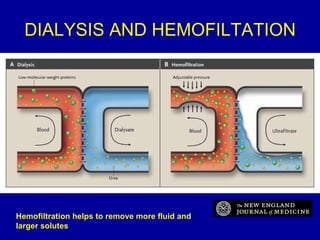
DIALYSIS AND HEMOFILTATION Hemofiltration helps to remove more fluid and  larger solutes
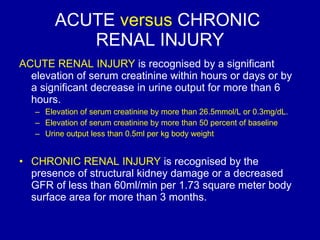
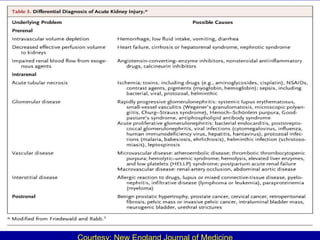
ACUTE  versus  CHRONIC  RENAL INJURY ACUTE RENAL INJURY  is recognised by a significant elevation of serum creatinine within hours or days or by a significant decrease in urine output for more than 6 hours.  Elevation of serum creatinine by more than 26.5mmol/L or 0.3mg/dL.  Elevation of serum creatinine by more than 50 percent of baseline Urine output less than 0.5ml per kg body weight CHRONIC RENAL INJURY  is recognised by the presence of structural kidney damage or a decreased GFR of less than 60ml/min per 1.73 square meter body surface area for more than 3 months.
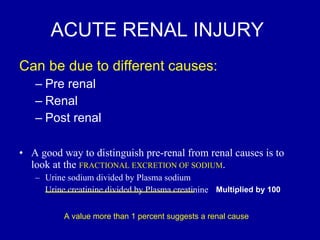
ACUTE RENAL INJURY  Can be due to different causes:  Pre renal Renal Post renal A good way to distinguish pre-renal from renal causes is to look at the  FRACTIONAL EXCRETION OF SODIUM . Urine sodium divided by Plasma sodium Urine creatinine divided by Plasma creatinine A value more than 1 percent suggests a renal cause Multiplied by 100
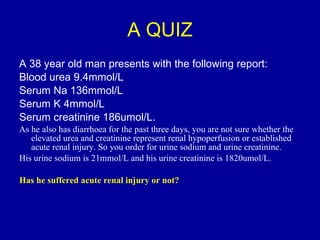
A QUIZ A 38 year old man presents with the following report: Blood urea 9.4mmol/L Serum Na 136mmol/L Serum K 4mmol/L Serum creatinine 186umol/L.  As he also has diarrhoea for the past three days, you are not sure whether the elevated urea and creatinine represent renal hypoperfusion or established acute renal injury. So you order for urine sodium and urine creatinine.  His urine sodium is 21mmol/L and his urine creatinine is 1820umol/L.  Has he suffered acute renal injury or not?
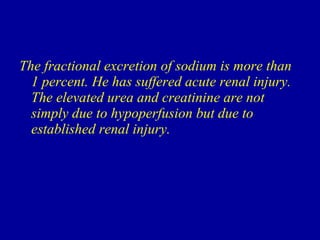
The fractional excretion of sodium is more than 1 percent. He has suffered acute renal injury. The elevated urea and creatinine are not simply due to hypoperfusion but due to established renal injury.
Courtesy: New England Journal of Medicine
THANK YOU

Chronic Kidney Disease

  • 1.
    CHRONIC KIDNEY DISEASEUNDERSTANDING PROGRESSION AND CLINICAL CONSEQUENCES.
  • 2.
    PRE TEST Isserum creatinine a good marker of renal function in all people and at all ages? What is the most common cause of death in those with chronic renal failure? Why is oral calcium therapy in those with chronic renal failure both good and bad? What is the target haemoglobin level when using erythropoietin? What is the target BP in those with chronic renal failure?
  • 3.
    WHAT IS CHRONICKIDNEY DISEASE? Damage to the renal parenchyma that persists for more than 3 months. Some types of CKD are visible on imaging: hydronephrosis, renal calculi, renal cysts. CKD due to glomerular damage is recognised by persistent proteinuria.
  • 4.
    WHAT ABOUT AFUNCTIONAL DEFINITION? Chronic kidney disease can also be defined as a GFR less than 60ml per minute for 3 months or more. The difference between CKD and renal failure is that renal failure is a GFR below 15ml per minute.
  • 5.
    THE GLOMERULAR FILTRATIONRATE IS A PARAMETER THAT TELLS US ABOUT THE FUNCTION OF THE KIDNEY. The GFR to the kidney is what the Ejection Fraction is to the heart.
  • 6.
    HOW DOES THEGFR HELP TO CLASSIFY C.K.D.? Stage 1 – GFR more than 90ml per min. Stage 2 – GFR between 60 and 90 Stage 3 – GFR between 30 and 60 Stage 4 – GFR between 15 and 30 Stage 5 – GFR below 15ml per minute. Stage 5 CKD is renal failure
  • 7.
    BLOOD UREA &SERUM CREATININE Is this statement always true? “ A normal blood urea or serum creatinine means normal renal function.” Blood urea and serum creatinine levels reflect the balance between production and excretion.
  • 8.
    SERUM CREATININE Increasedproduction + normal excretion ( in African Americans ) Decreased production + normal excretion ( in elderly people ) Decreased production + decreased excretion ( elderly with early renal disease ) Normal production + Decreased excretion (blood level reflects renal function)
  • 9.
    Estimated GFR THECOCKROFT-GAULT formula for men (140-age) times (weight in kg) (72) times (serum creatinine) (mg/dL) For women: multiply above by 0.85 Remember: This is actually the creatinine clearance Creatinine is both filtered by glomeruli and secreted by tubules Normal e-GFR for men: 120ml/min, for women: 100ml/min
  • 10.
    ESTIMATED GFR Ifthe creatinine is estimated in micromoles per litre, then the Cockroft and Gault equation for men will be: (140 – Age) multiplied by weight in kg ( multiplied by 1.23) Serum creatinine in micromoles/L
  • 11.
  • 12.
    CLINICAL CONSEQUENCES OF CKD More people with CKD and reduced GFR – in grades 2 to 4 – actually die of CV disease than progress to ESRD. (NEJM 2004) Increased BP Increased cholesterol Increased CRP Increased homocysteine
  • 13.
    WE MAY NOTBE ABLE TO DO MUCH FOR THE KIDNEY DISEASE BUT WE CAN REDUCE THE CARDIOVASCULAR RISK THAT COMES WITH IT
  • 14.
    REDUCING THE C.V.RISK IN THOSE WITH CKD Reduce BP Reduce proteinuria Which antihypertensive in CKD? ACEI / ARB if they have diabetes or proteinuria. Then add diuretic, BB / CCB. How to reduce proteinuria? ARB, ACEI or Combination
  • 15.
    REDUCING THE C.V.RISK IN THOSE WITH CKD Increased serum phosphate predisposes to vascular calcification and is now being recognised as a cardiovascular risk factor. Drugs used to reduce serum phosphate are Calcium carbonate Sevelamer Lanthanum carbonate
  • 16.
    IS CALCIUM GOODOR BAD IN CKD? Calcium is good because – It will reduce the increased PTH levels that cause bone disease Serum calcium is low in patients with CKD Calcium is bad because – Increased calcium predisposes to vascular calcification (increase in the calcium - phosphorous product)
  • 17.
    IS VITAMIN DGOOD FOR THOSE WITH CKD? The active form of vitamin D is needed to absorb calcium from the intestines There are vitamin D receptors in the nucleus of the cells of the parathyroid gland. Stimulation of these receptors results in lower PTH secretion Vitamin D is given as: Calcitriol Alphacalcidol Paricalcitol (NEW)
  • 18.
    DO THOSE WITHCKD BENEFIT FROM STATINS? The CARDS study ( Lancet, 2004 ) showed that treating diabetics with an additional risk factor like hypertension or proteinuria with atorvastatin reduced CV risk. A Dutch study called the 4 D study ( NEJM, 2005 ) showed that treating patients on hemodialysis with atorvastatin did not reduce CV risk.
  • 19.
    A PRESCRIPTION FORCKD Control BP to 125/75 with ACEI or ARB, but keep a watch on the serum potassium. Try to increase ACEI or ARB so that BP is well controlled as well as proteinuria is reduced. Use a statin to keep the LDL cholesterol at 2.6mmol (100mg) or less Use a diuretic if there is edema. But remember, better to have a little edema than to be too dry. Calcium Carbonate 1.5 to 2 grams per day plus Calcitriol 0.25 micrograms daily (can increase to max of 1microgram daily). Watch serum calcium and serum phosphorus. Restrict fluids according to urine output. Rule of thumb is urine output plus 500ml per day
  • 20.
    A PRESCRIPTION ….Iron needed if serum iron / Ferritin is low. Erythropoietin needed if serum iron normal but patient is anemic (E. alpha given as 50 units per kg IV slowly twice or thrice a week) Vitamin B supplements including folic acid. Hepatitis B immunisation (double dose needed) Protein content of diet to be around 0.8gm per kg per day (not necessary in ESRD patients on dialysis) Check serum PTH levels once a year
  • 21.
    WHAT IS NEW?In 2006, researchers are working on the hypothesis that reduced levels of vitamin D receptors are associated with increased renin, increased angiotensin and increased CV risk. The increased CV risk in CKD may be partly explained by the lower levels of active vitamin D in these patients.
  • 22.
    TARGET HEMOGLOBIN INCKD The Normal Hematocrit Study looked at the use of Erythropoietin alpha to maintain a hematocrit of 30 percent against that of 42 percent for patients with ESRD and CVD. The study was stopped early because of increased mortality in the higher hematocrit group. NEJM 1998 The CREATE trial looked at patients with CKD treated with Erythropoietin beta to a target Hb level of 11.5 to 13.5 versus 10.5 to 11.5. The study found more cardiovascular events in the higher hemoglobin group. NEJM 2006 The CHOIR trial looked at anemia correction in patients with CKD and found that those whose hemoglobin was corrected to 11.3gm/dL had less CV events than those whose hemoglobin was corrected to 13.5gm/dL. NEJM 2006
  • 23.
    HEMODIALYSIS Maintenance Hemodialysishelps to prolong life in chronic kidney disease. However it cannot replace all the functions of the kidney. Data from the USA tell us that only about 35 percent of people on thrice weekly hemodialysis survive five years.
  • 24.
    DIALYSIS AND HEMOFILTATIONHemofiltration helps to remove more fluid and larger solutes
  • 25.
    ACUTE versus CHRONIC RENAL INJURY ACUTE RENAL INJURY is recognised by a significant elevation of serum creatinine within hours or days or by a significant decrease in urine output for more than 6 hours. Elevation of serum creatinine by more than 26.5mmol/L or 0.3mg/dL. Elevation of serum creatinine by more than 50 percent of baseline Urine output less than 0.5ml per kg body weight CHRONIC RENAL INJURY is recognised by the presence of structural kidney damage or a decreased GFR of less than 60ml/min per 1.73 square meter body surface area for more than 3 months.
  • 26.
    ACUTE RENAL INJURY Can be due to different causes: Pre renal Renal Post renal A good way to distinguish pre-renal from renal causes is to look at the FRACTIONAL EXCRETION OF SODIUM . Urine sodium divided by Plasma sodium Urine creatinine divided by Plasma creatinine A value more than 1 percent suggests a renal cause Multiplied by 100
  • 27.
    A QUIZ A38 year old man presents with the following report: Blood urea 9.4mmol/L Serum Na 136mmol/L Serum K 4mmol/L Serum creatinine 186umol/L. As he also has diarrhoea for the past three days, you are not sure whether the elevated urea and creatinine represent renal hypoperfusion or established acute renal injury. So you order for urine sodium and urine creatinine. His urine sodium is 21mmol/L and his urine creatinine is 1820umol/L. Has he suffered acute renal injury or not?
  • 28.
    The fractional excretionof sodium is more than 1 percent. He has suffered acute renal injury. The elevated urea and creatinine are not simply due to hypoperfusion but due to established renal injury.
  • 29.
    Courtesy: New EnglandJournal of Medicine
  • 30.