PERFORMANCE
EXCELLENCE
AND
ORGANIZATIONAL
CHANGE
CHAPTER11
CADORNA SAWIT
CALAWOD BELA-ONG
Organizations contemplating change
must answer some tough questions, such
as:
•Why is the change necessary?
•What will it do to my organization
(department, job)?
•What problems will I encounter in making the
change? and perhaps the most important
one — What’s in it for me?
CHANGE
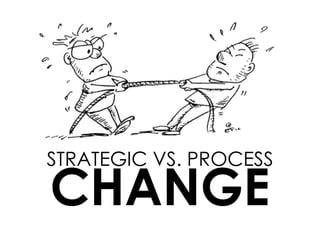
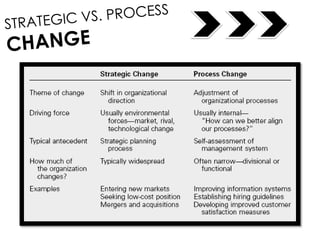
STRATEGIC VS. PROCESS
is broad in scope and stems from
strategic objectives, which are
generally externally focused and relate
to significant customer, market,
product/service, or technological
opportunities and challenges.
STRATEGIC CHANGE
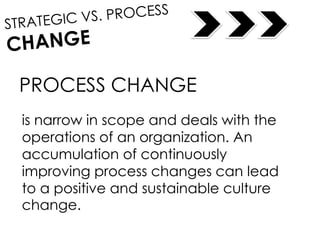
PROCESS CHANGE
is narrow in scope and deals with the
operations of an organization. An
accumulation of continuously
improving process changes can lead
to a positive and sustainable culture
change.
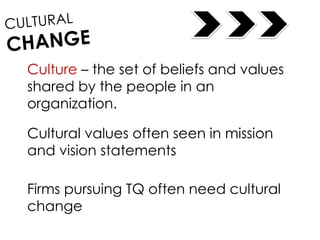
Culture – the set of beliefs and values
shared by the people in an
organization.
Cultural values often seen in mission
and vision statements
Firms pursuing TQ often need cultural
change
EXCELLENCE CULTURE
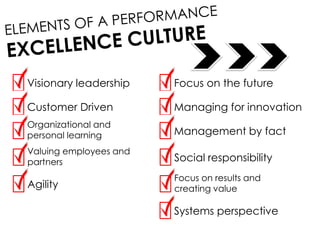
ELEMENTS OF A PERFORMANCE
Visionary leadership
Customer Driven
Organizational and
personal learning
Valuing employees and
partners
Agility
Focus on the future
Managing for innovation
Management by fact
Social responsibility
Focus on results and
creating value
Systems perspective
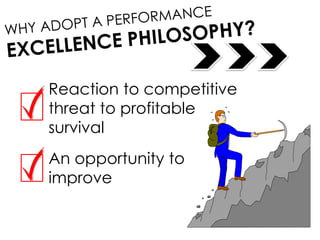
Reaction to competitive
threat to profitable
survival
An opportunity to
improve
Readiness for change
Sound practices and
implementation strategies
Effective organization
Change can be
accomplished, but it is difficult
Imposed change will be resisted
Full cooperation, commitment,
and participation by all levels of
management is essential
Change takes time
You might not get positive
results at first
Change might go in
unintended directions
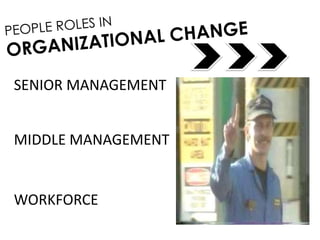
SENIOR MANAGEMENT
MIDDLE MANAGEMENT
WORKFORCE
Empower
Create a common vision of
excellence
Create new organizational rules
Implement continuous improvement
Develop and retain peak performers
Change is regarded as a short-term “program”
Compelling results are not obtained quickly
Process not driven by focus on customer, connection
to strategic business issues, and support from senior
management
Structural elements block change
Goals set too low
“Command and control” organizational culture
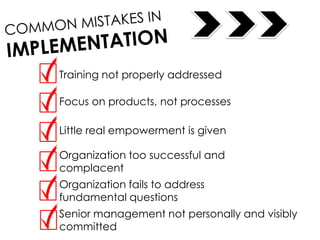
Training not properly addressed
Focus on products, not processes
Little real empowerment is given
Organization too successful and
complacent
Organization fails to address
fundamental questions
Senior management not personally and visibly
committed
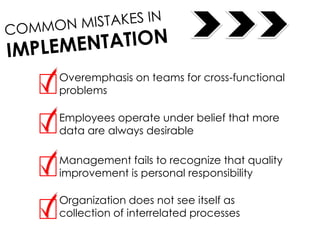
Overemphasis on teams for cross-functional
problems
Employees operate under belief that more
data are always desirable
Management fails to recognize that quality
improvement is personal responsibility
Organization does not see itself as
collection of interrelated processes
BEST PRACTICE
BUILDING ON
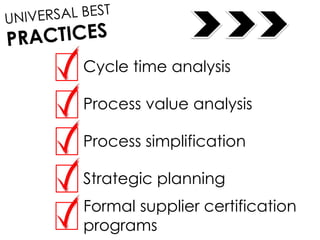
Cycle time analysis
Process value analysis
Process simplification
Strategic planning
Formal supplier certification
programs
BEST PRACTICES:
INFRASTRUCTURE DESIGN
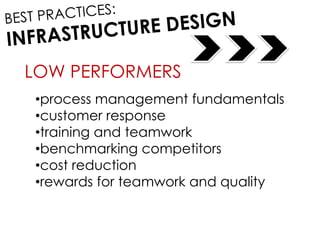
LOW PERFORMERS
•process management fundamentals
•customer response
•training and teamwork
•benchmarking competitors
•cost reduction
•rewards for teamwork and quality
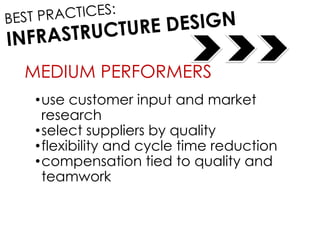
MEDIUM PERFORMERS
•use customer input and market
research
•select suppliers by quality
•flexibility and cycle time reduction
•compensation tied to quality and
teamwork
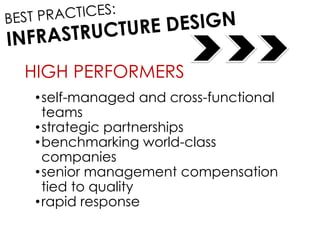
HIGH PERFORMERS
•self-managed and cross-functional
teams
•strategic partnerships
•benchmarking world-class
companies
•senior management compensation
tied to quality
•rapid response
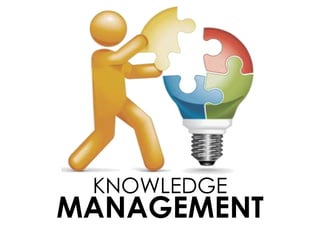
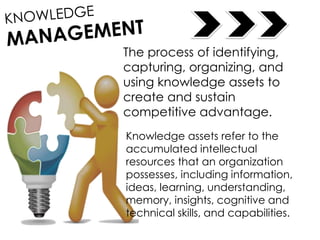
KNOWLEDGE
MANAGEMENT
The process of identifying,
capturing, organizing, and
using knowledge assets to
create and sustain
competitive advantage.
Knowledge assets refer to the
accumulated intellectual
resources that an organization
possesses, including information,
ideas, learning, understanding,
memory, insights, cognitive and
technical skills, and capabilities.
Explicit knowledge includes information
stored in documents or other forms of
media.
Tacit knowledge is information that is
formed around intangible factors resulting
from an individual’s experience, and is
personal and content-specific.
Create a “learning organization”
•Planning
•Execution of plans
•Assessment of progress
•Revision of plans based on
assessment findings
Systematic problem solving
Experimentation with new
approaches
Learning from their own
experiences and history
Learning from the experiences and
best practices of others
Transferring knowledge quickly and
efficiently throughout the organization
The ability to identify and transfer
best practices within the
organization
Process:
•Identify and collect internal knowledge
and best practices
•Share and understand those practices
•Adapt and apply them to new situations
and bringing them up to best-practice
performance levels.
Committed leadership
Integration with existing initiatives,
business strategy, and
performance measurement
Process thinking
Disciplined customer and
market intelligence gathering
A bottom line orientation
Leadership in the trenches
Training
Continuous reinforcement and
rewards
ORGANIZATIONAL CHANGE, LEARNING &
ORGANIZATIONAL THEORY
REASON FOR CHANGE
•Traditional: productivity or
job satisfaction
•TQ: customer satisfaction
SOURCE OF CHANGE
•BOTH: Top Management
TYPE OF CHANGE
•Traditional: limited in scope
and duration
•TQ: continuous improvement
over a long period of time
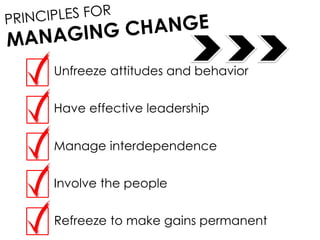
Unfreeze attitudes and behavior
Have effective leadership
Manage interdependence
Involve the people
Refreeze to make gains permanent
Chp11 performance excellence

Chp11 performance excellence

  • 1.
  • 2.
    Organizations contemplating change mustanswer some tough questions, such as: •Why is the change necessary? •What will it do to my organization (department, job)? •What problems will I encounter in making the change? and perhaps the most important one — What’s in it for me?
  • 3.
  • 4.
    is broad inscope and stems from strategic objectives, which are generally externally focused and relate to significant customer, market, product/service, or technological opportunities and challenges. STRATEGIC CHANGE
  • 5.
    PROCESS CHANGE is narrowin scope and deals with the operations of an organization. An accumulation of continuously improving process changes can lead to a positive and sustainable culture change.
  • 7.
    Culture – theset of beliefs and values shared by the people in an organization. Cultural values often seen in mission and vision statements Firms pursuing TQ often need cultural change
  • 8.
  • 9.
    Visionary leadership Customer Driven Organizationaland personal learning Valuing employees and partners Agility Focus on the future Managing for innovation Management by fact Social responsibility Focus on results and creating value Systems perspective
  • 10.
    Reaction to competitive threatto profitable survival An opportunity to improve
  • 11.
    Readiness for change Soundpractices and implementation strategies Effective organization
  • 12.
    Change can be accomplished,but it is difficult Imposed change will be resisted Full cooperation, commitment, and participation by all levels of management is essential
  • 13.
    Change takes time Youmight not get positive results at first Change might go in unintended directions
  • 14.
  • 15.
    Empower Create a commonvision of excellence Create new organizational rules Implement continuous improvement Develop and retain peak performers
  • 16.
    Change is regardedas a short-term “program” Compelling results are not obtained quickly Process not driven by focus on customer, connection to strategic business issues, and support from senior management Structural elements block change Goals set too low “Command and control” organizational culture
  • 17.
    Training not properlyaddressed Focus on products, not processes Little real empowerment is given Organization too successful and complacent Organization fails to address fundamental questions Senior management not personally and visibly committed
  • 18.
    Overemphasis on teamsfor cross-functional problems Employees operate under belief that more data are always desirable Management fails to recognize that quality improvement is personal responsibility Organization does not see itself as collection of interrelated processes
  • 19.
  • 20.
    Cycle time analysis Processvalue analysis Process simplification Strategic planning Formal supplier certification programs
  • 21.
  • 22.
    LOW PERFORMERS •process managementfundamentals •customer response •training and teamwork •benchmarking competitors •cost reduction •rewards for teamwork and quality
  • 23.
    MEDIUM PERFORMERS •use customerinput and market research •select suppliers by quality •flexibility and cycle time reduction •compensation tied to quality and teamwork
  • 24.
    HIGH PERFORMERS •self-managed andcross-functional teams •strategic partnerships •benchmarking world-class companies •senior management compensation tied to quality •rapid response
  • 25.
  • 26.
    The process ofidentifying, capturing, organizing, and using knowledge assets to create and sustain competitive advantage. Knowledge assets refer to the accumulated intellectual resources that an organization possesses, including information, ideas, learning, understanding, memory, insights, cognitive and technical skills, and capabilities.
  • 27.
    Explicit knowledge includesinformation stored in documents or other forms of media. Tacit knowledge is information that is formed around intangible factors resulting from an individual’s experience, and is personal and content-specific.
  • 28.
    Create a “learningorganization” •Planning •Execution of plans •Assessment of progress •Revision of plans based on assessment findings
  • 29.
    Systematic problem solving Experimentationwith new approaches Learning from their own experiences and history Learning from the experiences and best practices of others Transferring knowledge quickly and efficiently throughout the organization
  • 30.
    The ability toidentify and transfer best practices within the organization Process: •Identify and collect internal knowledge and best practices •Share and understand those practices •Adapt and apply them to new situations and bringing them up to best-practice performance levels.
  • 31.
    Committed leadership Integration withexisting initiatives, business strategy, and performance measurement Process thinking Disciplined customer and market intelligence gathering
  • 32.
    A bottom lineorientation Leadership in the trenches Training Continuous reinforcement and rewards
  • 33.
    ORGANIZATIONAL CHANGE, LEARNING& ORGANIZATIONAL THEORY
  • 34.
    REASON FOR CHANGE •Traditional:productivity or job satisfaction •TQ: customer satisfaction
  • 35.
  • 36.
    TYPE OF CHANGE •Traditional:limited in scope and duration •TQ: continuous improvement over a long period of time
  • 37.
    Unfreeze attitudes andbehavior Have effective leadership Manage interdependence Involve the people Refreeze to make gains permanent