12-112-1McGraw-Hill/Irwin Copyright © 2009 by The McGraw-Hill Companies, Inc. All rights reserved.
Welcome Your Prospect’s
Objections
Chapter
12
12-3
Welcome Objections!
 Accept objections as a challenge
 People do not want to be taken advantage of
 Learn to overcome objections
12-4
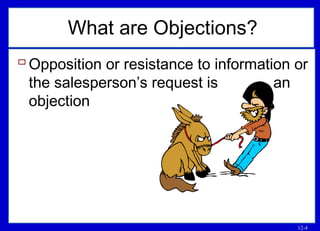
What are Objections?
Opposition or resistance to information or
the salesperson’s request is an
objection
12-5
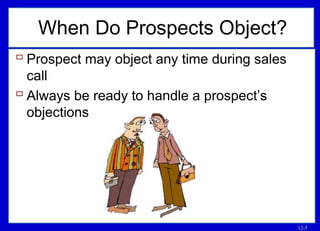
 Prospect may object any time during sales
call
 Always be ready to handle a prospect’s
objections
When Do Prospects Object?
12-6
Objections and the Sales Process
 Objections can occur at any time
 When objections occur, quickly determine
what to do
12-7
Basic Points to Consider in Meeting
Objections
 Plan for objections
 Anticipate objection before it arises
 Handle objections as they arise –
postponement may cause a negative mental
picture or reaction
 Be positive
 Listen – hear them out
12-8
Basic Points to Consider in Meeting
Objections, cont…
 Understand objections
Request for information
A condition (negotiation can overcome a
condition)
Major or minor objection
Practical or psychological objection
12-9
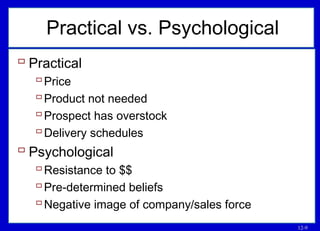
Practical vs. Psychological
 Practical
Price
Product not needed
Prospect has overstock
Delivery schedules
 Psychological
Resistance to $$
Pre-determined beliefs
Negative image of company/sales force
12-10
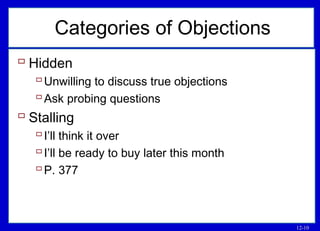
Categories of Objections
 Hidden
Unwilling to discuss true objections
Ask probing questions
 Stalling
I’ll think it over
I’ll be ready to buy later this month
P. 377
12-11
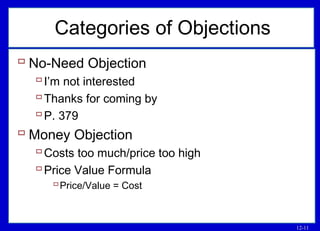
Categories of Objections
 No-Need Objection
I’m not interested
Thanks for coming by
P. 379
 Money Objection
Costs too much/price too high
Price Value Formula
Price/Value = Cost
12-12
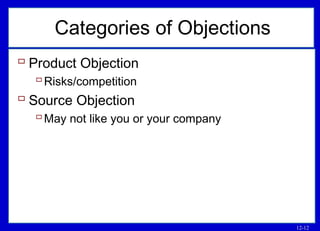
Categories of Objections
 Product Objection
Risks/competition
 Source Objection
May not like you or your company
12-13
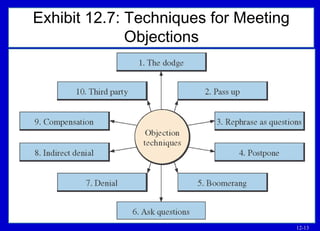
Exhibit 12.7: Techniques for Meeting
Objections
12-14
Techniques for Meeting Objections
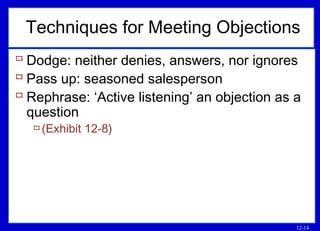
 Dodge: neither denies, answers, nor ignores
 Pass up: seasoned salesperson
 Rephrase: ‘Active listening’ an objection as a
question
(Exhibit 12-8)
12-15
Techniques for Meeting Objections
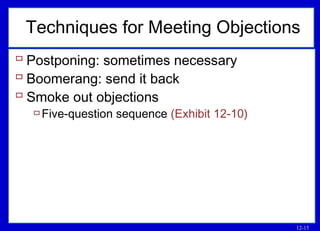
 Postponing: sometimes necessary
 Boomerang: send it back
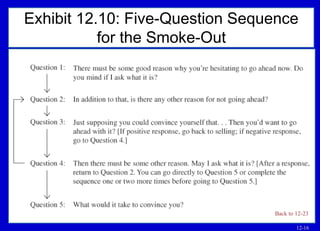
 Smoke out objections
Five-question sequence (Exhibit 12-10)
12-16
Exhibit 12.10: Five-Question Sequence
for the Smoke-Out
Back to 12-23
12-17
Techniques for Meeting Objections,
when they are incorrect….
 Use direct denial tactfully
 The indirect denial works
‘I agree’
‘Yes’
 Compensation/counterbalance method
Show the benefits/value in profits
 Third party answer
Proof of testimony
12-18
Let’s Review! When Is It Time to Use a
Trial Close?
 After making a strong selling point in the
presentation
 After the presentation but before the close
 After answering an objection
 Immediately before you move to close the
sale
12-19
Let’s Review! What Does the Trial
Close Allow You to Determine?
 Whether the prospect likes your product’s
FAB – the strong selling point
 Whether you have successfully answered the
objection
 Whether any objections remain
 Whether the prospect is ready for you to
close the sale
12-20
What is an Example of a Trial Close
Used to Respond to an Objection?
 “Does that answer your question?”
 “With that question out of the way, we can go
ahead – don’t you think?”
12-21
Once You Have Satisfactorily Responded to
the Objection, What Should You Do Next?*
 Make a smooth transition back into your
presentation
“As we were discussing…”
 Move to close the sale if you have completed
your presentation
 Move to close again if objection was after a
close
12-22
If you Cannot Overcome the Objection, What
Are Three Alternatives to Consider? (#1)
 Return to presentation concentrating on new
or previously discussed FABs of your project.
12-23
If you Cannot Overcome the Objection, What
Are Three Alternatives to Consider? (#2)
 Admit it
 Compensate for it by showing how your
product’s benefit(s) outweigh the
disadvantage(s)
12-24
If You Cannot Overcome the Objection, What
Are Three Alternatives to Consider (#3)
 If 100% sure the customer will not buy
Go ahead and close
Always ask for the order
Allow the buyer to say “no” – don’t say it yourself
Your competitor(s) may not be able to overcome
the objection(s) either
 A competitor may make the sale because he/she asked
for it
 Be professional, not pushy
 Leave the door open for a return visit
12-25
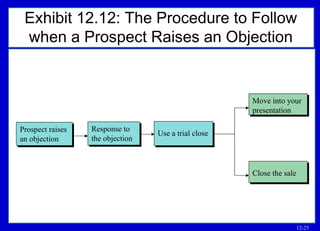
Exhibit 12.12: The Procedure to Follow
when a Prospect Raises an Objection
Prospect raises
an objection
Prospect raises
an objection
Response to
the objection
Response to
the objection Use a trial closeUse a trial close
Move into your
presentation
Move into your
presentation
Close the saleClose the sale
12-26
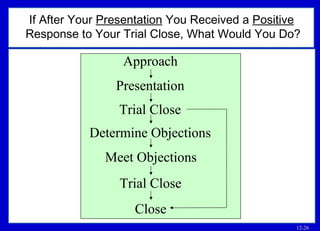
If After Your Presentation You Received a Positive
Response to Your Trial Close, What Would You Do?
Approach
Presentation
Trial Close
Determine Objections
Meet Objections
Trial Close
Close
12-27
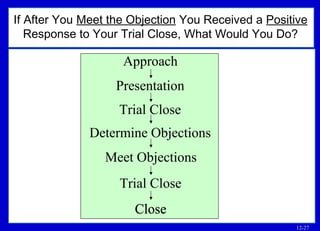
If After You Meet the Objection You Received a Positive
Response to Your Trial Close, What Would You Do?
Approach
Presentation
Trial Close
Determine Objections
Meet Objections
Trial Close
CloseCloseCloseCloseCloseCloseCloseCloseCloseCloseCloseCloseCloseCloseCloseClose
12-28
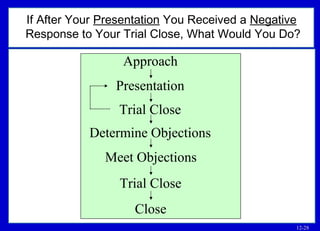
If After Your Presentation You Received a Negative
Response to Your Trial Close, What Would You Do?
Approach
Presentation
Trial Close
Determine Objections
Meet Objections
Trial Close
Close
12-29
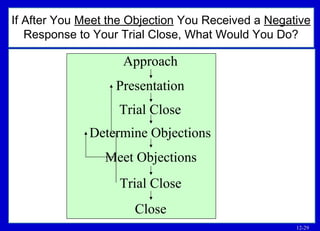
Approach
Presentation
Trial Close
Determine Objections
Meet Objections
Trial Close
Close
If After You Meet the Objection You Received a Negative
Response to Your Trial Close, What Would You Do?

Chp 12 Prospects Objections ppt

  • 1.
    12-112-1McGraw-Hill/Irwin Copyright ©2009 by The McGraw-Hill Companies, Inc. All rights reserved.
  • 2.
  • 3.
    12-3 Welcome Objections!  Acceptobjections as a challenge  People do not want to be taken advantage of  Learn to overcome objections
  • 4.
    12-4 What are Objections? Oppositionor resistance to information or the salesperson’s request is an objection
  • 5.
    12-5  Prospect mayobject any time during sales call  Always be ready to handle a prospect’s objections When Do Prospects Object?
  • 6.
    12-6 Objections and theSales Process  Objections can occur at any time  When objections occur, quickly determine what to do
  • 7.
    12-7 Basic Points toConsider in Meeting Objections  Plan for objections  Anticipate objection before it arises  Handle objections as they arise – postponement may cause a negative mental picture or reaction  Be positive  Listen – hear them out
  • 8.
    12-8 Basic Points toConsider in Meeting Objections, cont…  Understand objections Request for information A condition (negotiation can overcome a condition) Major or minor objection Practical or psychological objection
  • 9.
    12-9 Practical vs. Psychological Practical Price Product not needed Prospect has overstock Delivery schedules  Psychological Resistance to $$ Pre-determined beliefs Negative image of company/sales force
  • 10.
    12-10 Categories of Objections Hidden Unwilling to discuss true objections Ask probing questions  Stalling I’ll think it over I’ll be ready to buy later this month P. 377
  • 11.
    12-11 Categories of Objections No-Need Objection I’m not interested Thanks for coming by P. 379  Money Objection Costs too much/price too high Price Value Formula Price/Value = Cost
  • 12.
    12-12 Categories of Objections Product Objection Risks/competition  Source Objection May not like you or your company
  • 13.
    12-13 Exhibit 12.7: Techniquesfor Meeting Objections
  • 14.
    12-14 Techniques for MeetingObjections  Dodge: neither denies, answers, nor ignores  Pass up: seasoned salesperson  Rephrase: ‘Active listening’ an objection as a question (Exhibit 12-8)
  • 15.
    12-15 Techniques for MeetingObjections  Postponing: sometimes necessary  Boomerang: send it back  Smoke out objections Five-question sequence (Exhibit 12-10)
  • 16.
    12-16 Exhibit 12.10: Five-QuestionSequence for the Smoke-Out Back to 12-23
  • 17.
    12-17 Techniques for MeetingObjections, when they are incorrect….  Use direct denial tactfully  The indirect denial works ‘I agree’ ‘Yes’  Compensation/counterbalance method Show the benefits/value in profits  Third party answer Proof of testimony
  • 18.
    12-18 Let’s Review! WhenIs It Time to Use a Trial Close?  After making a strong selling point in the presentation  After the presentation but before the close  After answering an objection  Immediately before you move to close the sale
  • 19.
    12-19 Let’s Review! WhatDoes the Trial Close Allow You to Determine?  Whether the prospect likes your product’s FAB – the strong selling point  Whether you have successfully answered the objection  Whether any objections remain  Whether the prospect is ready for you to close the sale
  • 20.
    12-20 What is anExample of a Trial Close Used to Respond to an Objection?  “Does that answer your question?”  “With that question out of the way, we can go ahead – don’t you think?”
  • 21.
    12-21 Once You HaveSatisfactorily Responded to the Objection, What Should You Do Next?*  Make a smooth transition back into your presentation “As we were discussing…”  Move to close the sale if you have completed your presentation  Move to close again if objection was after a close
  • 22.
    12-22 If you CannotOvercome the Objection, What Are Three Alternatives to Consider? (#1)  Return to presentation concentrating on new or previously discussed FABs of your project.
  • 23.
    12-23 If you CannotOvercome the Objection, What Are Three Alternatives to Consider? (#2)  Admit it  Compensate for it by showing how your product’s benefit(s) outweigh the disadvantage(s)
  • 24.
    12-24 If You CannotOvercome the Objection, What Are Three Alternatives to Consider (#3)  If 100% sure the customer will not buy Go ahead and close Always ask for the order Allow the buyer to say “no” – don’t say it yourself Your competitor(s) may not be able to overcome the objection(s) either  A competitor may make the sale because he/she asked for it  Be professional, not pushy  Leave the door open for a return visit
  • 25.
    12-25 Exhibit 12.12: TheProcedure to Follow when a Prospect Raises an Objection Prospect raises an objection Prospect raises an objection Response to the objection Response to the objection Use a trial closeUse a trial close Move into your presentation Move into your presentation Close the saleClose the sale
  • 26.
    12-26 If After YourPresentation You Received a Positive Response to Your Trial Close, What Would You Do? Approach Presentation Trial Close Determine Objections Meet Objections Trial Close Close
  • 27.
    12-27 If After YouMeet the Objection You Received a Positive Response to Your Trial Close, What Would You Do? Approach Presentation Trial Close Determine Objections Meet Objections Trial Close CloseCloseCloseCloseCloseCloseCloseCloseCloseCloseCloseCloseCloseCloseCloseClose
  • 28.
    12-28 If After YourPresentation You Received a Negative Response to Your Trial Close, What Would You Do? Approach Presentation Trial Close Determine Objections Meet Objections Trial Close Close
  • 29.
    12-29 Approach Presentation Trial Close Determine Objections MeetObjections Trial Close Close If After You Meet the Objection You Received a Negative Response to Your Trial Close, What Would You Do?