Time, Territory, and Self-
Management: Keys to Success
Chapter
15
15-2
Customers Form Sales Territories
 A sales territory comprises
a group of customers or a geographical area
assigned to a salesperson
15-3
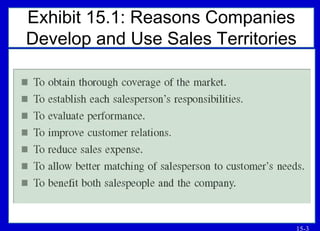
Exhibit 15.1: Reasons Companies
Develop and Use Sales Territories
15-4
Elements of Time and Territory
Management
 Salesperson’s sales quota (goals) may
involve:
Sales volume quotas
Profit quotas
Expense quotas
Activity quotas
Customer satisfaction scores
15-5
Elements of Time and Territory
Management, cont…
 Account analysis:
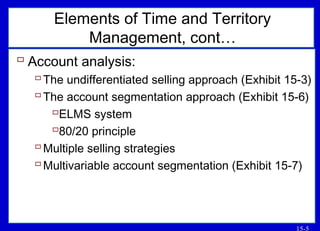
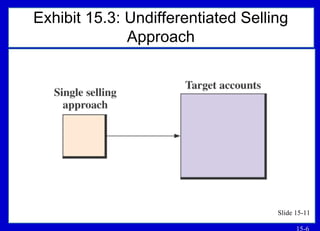
The undifferentiated selling approach (Exhibit 15-3)
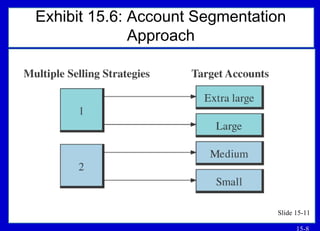
The account segmentation approach (Exhibit 15-6)
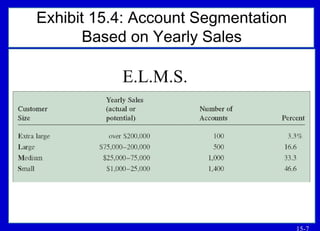
ELMS system
80/20 principle
Multiple selling strategies
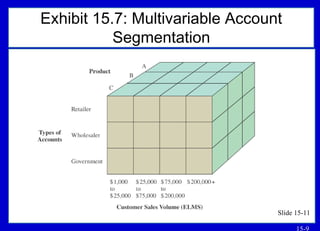
Multivariable account segmentation (Exhibit 15-7)
15-6
Exhibit 15.3: Undifferentiated Selling
Approach
Slide 15-11
15-7
Exhibit 15.4: Account Segmentation
Based on Yearly Sales
E.L.M.S.
15-8
Exhibit 15.6: Account Segmentation
Approach
Slide 15-11
15-9
Exhibit 15.7: Multivariable Account
Segmentation
Slide 15-11
15-10
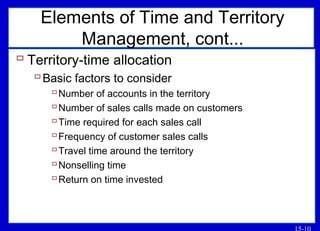
Elements of Time and Territory
Management, cont...
 Territory-time allocation
Basic factors to consider
Number of accounts in the territory
Number of sales calls made on customers
Time required for each sales call
Frequency of customer sales calls
Travel time around the territory
Nonselling time
Return on time invested
15-11
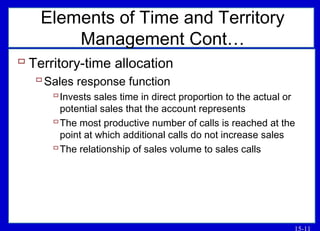
Elements of Time and Territory
Management Cont…
 Territory-time allocation
Sales response function
Invests sales time in direct proportion to the actual or
potential sales that the account represents
The most productive number of calls is reached at the
point at which additional calls do not increase sales
The relationship of sales volume to sales calls
15-12
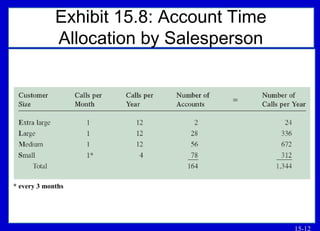
Exhibit 15.8: Account Time
Allocation by Salesperson
* every 3 months
15-13
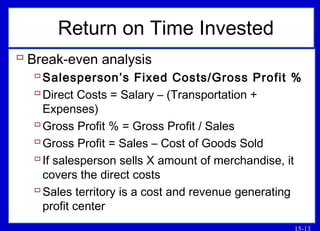
Return on Time Invested
 Break-even analysis
Salesperson’s Fixed Costs/Gross Profit %
Direct Costs = Salary – (Transportation +
Expenses)
Gross Profit % = Gross Profit / Sales
Gross Profit = Sales – Cost of Goods Sold
If salesperson sells X amount of merchandise, it
covers the direct costs
Sales territory is a cost and revenue generating
profit center
15-14
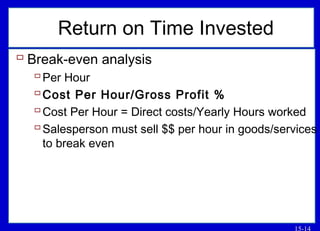
Return on Time Invested
 Break-even analysis
Per Hour
Cost Per Hour/Gross Profit %
Cost Per Hour = Direct costs/Yearly Hours worked
Salesperson must sell $$ per hour in goods/services
to break even

Chp 15 Time and Territory

  • 1.
    Time, Territory, andSelf- Management: Keys to Success Chapter 15
  • 2.
    15-2 Customers Form SalesTerritories  A sales territory comprises a group of customers or a geographical area assigned to a salesperson
  • 3.
    15-3 Exhibit 15.1: ReasonsCompanies Develop and Use Sales Territories
  • 4.
    15-4 Elements of Timeand Territory Management  Salesperson’s sales quota (goals) may involve: Sales volume quotas Profit quotas Expense quotas Activity quotas Customer satisfaction scores
  • 5.
    15-5 Elements of Timeand Territory Management, cont…  Account analysis: The undifferentiated selling approach (Exhibit 15-3) The account segmentation approach (Exhibit 15-6) ELMS system 80/20 principle Multiple selling strategies Multivariable account segmentation (Exhibit 15-7)
  • 6.
    15-6 Exhibit 15.3: UndifferentiatedSelling Approach Slide 15-11
  • 7.
    15-7 Exhibit 15.4: AccountSegmentation Based on Yearly Sales E.L.M.S.
  • 8.
    15-8 Exhibit 15.6: AccountSegmentation Approach Slide 15-11
  • 9.
    15-9 Exhibit 15.7: MultivariableAccount Segmentation Slide 15-11
  • 10.
    15-10 Elements of Timeand Territory Management, cont...  Territory-time allocation Basic factors to consider Number of accounts in the territory Number of sales calls made on customers Time required for each sales call Frequency of customer sales calls Travel time around the territory Nonselling time Return on time invested
  • 11.
    15-11 Elements of Timeand Territory Management Cont…  Territory-time allocation Sales response function Invests sales time in direct proportion to the actual or potential sales that the account represents The most productive number of calls is reached at the point at which additional calls do not increase sales The relationship of sales volume to sales calls
  • 12.
    15-12 Exhibit 15.8: AccountTime Allocation by Salesperson * every 3 months
  • 13.
    15-13 Return on TimeInvested  Break-even analysis Salesperson’s Fixed Costs/Gross Profit % Direct Costs = Salary – (Transportation + Expenses) Gross Profit % = Gross Profit / Sales Gross Profit = Sales – Cost of Goods Sold If salesperson sells X amount of merchandise, it covers the direct costs Sales territory is a cost and revenue generating profit center
  • 14.
    15-14 Return on TimeInvested  Break-even analysis Per Hour Cost Per Hour/Gross Profit % Cost Per Hour = Direct costs/Yearly Hours worked Salesperson must sell $$ per hour in goods/services to break even